2017 2nd International Conference on Computational Modeling, Simulation and Applied Mathematics (CMSAM 2017) ISBN: 978-1-60595-499-8
Storage and Processing System of Meter Data Based on Hadoop
Sai LIU, Jian GUO and Yuan FENG
*Ocean University of China, Qingdao city, 266100 China
*Corresponding author
Keywords: Hadoop, HBase, HDFS, MapReduce, Meter data.
Abstract. The traditional meter data storage and processing system generally uses the expensive large
server and relational database to ensure the normal operation of the system. When dealing with a large amount of meter data, this kind of system is difficult to expand, data processing is not in time and the efficiency of data retrieval is low, which led to the fault response cycle is prolonged, even cause a fatal impact on the enterprise. This thesis designed and implemented a storage and processing system for electric meter data based on Hadoop Technology which can realize the distributed storage and processing of the electric meter data. After analyzed the result of System benchmark I/O test, and compared data storage and processing capabilities with the traditional solution, it is proved that the new system has the advantages of efficient storage and processing under the condition of mass data, and is suitable for storage of mass meter data. The new system can significantly improve the efficiency and accuracy of data analysis, reduce labor management costs, has extensive practical value for improving the efficiency and the competitive power of the electric meter.
Introduction
As a distributed technology platform, Hadoop distributed platform has become the hot research object of enterprise, government and University, and has become the pronoun of distributed technology [1]. The two cores of Hadoop are HDFS and MapReduce, and the full name of HDFS is the Hadoop distributed file system, which provides storage for mass data, while MapReduce provides computing for massive data [2] [3]. Hadoop can be used in the deployment of inexpensive hardware, suitable for solving mass meter data storage and process of high cost, poor scalability, the problem of slow response speed [4].
In China, the meter data storage and processing systems basically use the traditional solutions, which rely on the high configuration server provides powerful computing capabilities, disk arrays and the use of traditional relational database support for data storage. With the growth of data, the relational database reaches a certain size, will cause bad performance, limited storage capacity, low scalability and availability of concurrent I/O.
In the situation of traditional meter data monitoring platform cannot meet the current requirement, the Hadoop platform is used as the basis for the distributed storage and processing of the meter data in the form of cluster. After we get lots of real meter data from the meter manufacturers, MapReduce model is used for processing these data. Then compare the performance test with the traditional relational database, and analyze the advantages of this system compared to the traditional platform.
The Design of the Meter Data Storage and Processing System Based on Hadoop
the project code. The function of the system is divided into four modules: data acquisition, data storage, data processing and data report. The modules are independent of function, but call each other and serve each other inside the system.
System Overall Analysis
The meter data comes from the electric meter data acquisition center of provinces and cities in China. The data files are stored in the form of Excel. Each Excel file stores all the meter data for a city in a day time. Each data file including the power supply unit (i.e., the city), the data acquisition terminal date, address code, terminal address, the manufacturer, whether out of count, the number of successful meter reading, the terminal states. The electric meter data acquisition center can get about 500 thousand meter data per day. The amount of data in one year will reach hundreds of millions.
It is very difficult to query and obtain the required information with such a large amount of data. How to satisfy the massive meter data storage and improve the efficiency of query data is the key point of this system. At the same time, the system should have high reliability, scalability and low cost. As the most popular large data processing framework, Hadoop can support the system very well. The flow chart of the system is shown in Figure 1:
[image:2.595.154.449.304.403.2]User Upload File Interface HDFS HBase Database Data Report Page User Request Data Report Interface HBase Database Upload File MapReduce Processing and Storage Data Request MapReduce Data Query and Processing
Figure 1. Flow chart of the system.
The system consists of four modules: data upload modular, data storage modular, data processing modular and data report display modular. Considering the magnanimity of the meter data, the data files are uploaded to the HDFS file system first, and then distributed and stored by the MapReduce. The data storage module consists of two parts: HDFS and HBase. The HDFS stores the original data files and the HBase stores the meter data.
The data processing module will first change HDFS Excel format data files into Txt format using MapReduce, and then save the data to the raw data table; the data of the raw data table is processed and transferred to other regional level data tables. When the users send the data request, the data processing module receives the users’ request, carries on the act of meter data querying and processing, and then returns the data to the users.
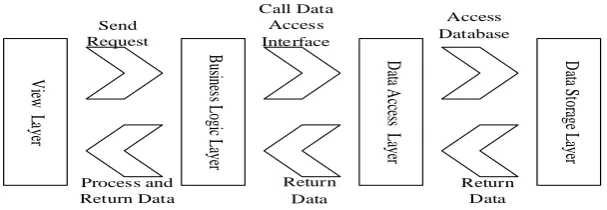
The Overall Architecture of the System
V iew L aye r B us ine ss L ogi c L aye r D ata A cce ss La ye r D ata S tor age L ayer Send Request Access Database Call Data Access Interface Process and Return Data Return Data Return Data
Figure 2. Flow chart of the system data.
[image:2.595.148.452.591.696.2]System Function Module Design
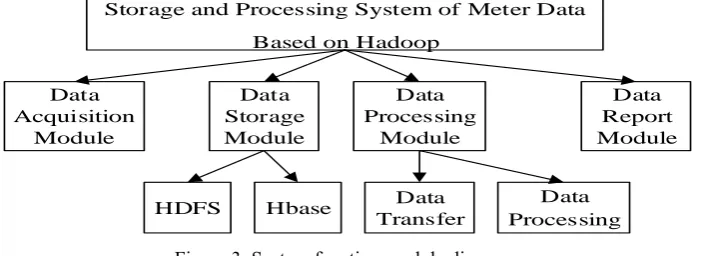
The system is divided into four modules from the functional point of view: data acquisition modular, data storage modular, data processing modular, data report modular. The system module partition is shown in Fig.3:
Data Acquisition
Module
Data Report Module Storage and Processing System of Meter Data
Based on Hadoop
HDFS Hbase Data
Transfer
Data Processing Data
Storage Module
Data Processing
[image:3.595.124.476.137.265.2]Module
Figure 3. System function module diagram.
(1) Data acquisition module: This module is responsible for storing the Excel files with the meter data in the HDFS.
(2) Data storage modular: This module consists of two parts: HDFS distributed file system and HBase database.HDFS distributed file system is used to store the Excel files of original meter data. The data in the file is taken out and stored in the HBase data table after processing, which is convenient for users to query.According to the characteristics of the meter data and the data items concerned by the users, the HBase data tables are set up: the original data table, the national level data table, the provincial level data table and the city level data table.
(3) Data processing modular: It is used for processing the meter data. The main functions of this module include: Data format conversion module: Since MapReduce does not support direct read and write operations on Excel files, it is necessary to convert Excel data files into Txt format data files via MapReduce. Data dump module: The Txt data files are distributed by MapReduce, and the meter data is saved into the original data table of HBase. Data update module. Data inquiry module.
(4) Data report modular: The data report module is divided into two parts: single day data report module and interval data report module.Through the single day data report module, users can choose a vendor, a regional level, a date to query data in a single day.This part of the data report is selected as pie chart.Select the start date and the expiration date, the data within the date range is queried, so the users can get the data movements for a period of time through the interval data report module.The data report of this module is chosen as the form of line chart. These charts can help users analyze whether the data is stable, the equipment work is normal, the failure of equipment maintenance is in time.
Comparison of Performance with Traditional Data Storage and Processing System
In this chapter, the benchmark I/O test of HDFS distributed file system is first carried out, the influence of the number of files and the size of files on the speed of reading and writing of HDFS is tested respectively. Secondly, the storage performance and data processing performance of the HBase database and the traditional relational database are tested and compared. It verifies that the new system has advantages over the traditional meter data platform in the storage and processing of mass meter data.
HDFS Benchmark I/O Test
Figure 4. Run time diagram of HDFS read and write.
(1) Keep the number of files constant always be the 10, changing the size of each file from 100M to 500M, and performing Read and Write tests.
The left table in figure 4 shows that the total running time is increasing because the total amount of data files is increasing. However, the average length of data files per unit size is decreasing.When the number of files is the same as the size of the file, the rate of reading files is always faster than the rate of writing files.
(2) Keep the file size of 100M and change the number of files from 10 to 50.
The middle table in figure 4 shows that as the total amount of data files is increasing from 1000MB to 5000MB, the total running time is increasing. But the average rate of data files per unit size is also decreasing. It can be concluded that HDFS is suitable for reading and writing large scale data.
(3) Keep the total size of the file to 5000M, and change the number of files from 10 to 50.
Do the read and write file operations on the HDFS distributed file system.The right table in figure 4 shows that when the total amount of the file is kept unchanged by 5000MB and the number of files increases from 10 to 50, the running time increases gradually.This is because that with the increase in the number of files, the system requires a lot of overhead to assign tasks to handle small files. The more files there are, the longer the average read and write time, indicating that HDFS is not suitable for dealing with fragmented files,this may be partly because the file system allocates more tasks and requires a lot of overhead; on the other hand, it is due to the way the traditional disk is addressed.
Comparison of Data Storage Performance and Data Processing Performance between HBase Database and Traditional Relational Database
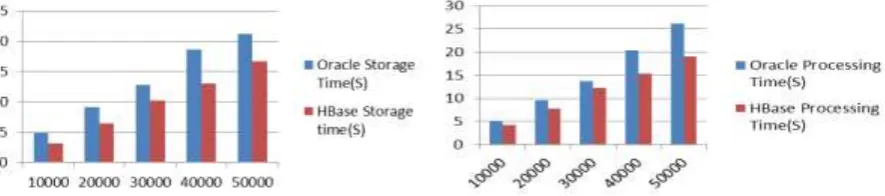
This system is compared with the traditional meter data platform for storage performance test.The traditional meter data platform uses Oracle 11g as its database.In addition to the data storage and data access interface, the rest of the code and the implementation is exactly the same. Insert the same data every time, the amount of data from 10000 to 50000, each set of data is averaged by three times of the experiments.
The data storage performance contrast diagram is shown in the left of figure 5. It can be found that the writing speed of HBase database is stable, and it has some advantages compared to the traditional relational database when the number of nodes is small and the configuration is not high. Among the five data, HBase spent only about 70% time of the Oracle database for data storage, the efficiency increased by about 30%.
[image:4.595.87.530.657.755.2]The data processing mainly refers to the processing time needed to process the mass meter data in the original data table and transfer it to the three regional level data tables of the national, provincial and municipal levels. The experimental environment is the same as comparison of storage performance between HBase database and traditional relational database.
The data processing performance contrast diagram is shown in the right of figure 5. It can be found that the HBase database processing efficiency is faster than the traditional relational database. Among the five data, HBase spent only about 80% time of the Oracle database for data processing, the efficiency increased by about 20%.
Summary
The characteristics of the meter data files are analyzed, according to the characteristics of the meter data, combined with the demands of the users, the meter data storage and processing system is designed respectively from the overall architecture and function module. Then, through HDFS benchmark I/O test for this system, comparisons with traditional relational database on data storage and data processing performance, it is proved that the new system is more efficient in data storage and processing.
The meter data storage and processing system based on Hadoop has greatly improved the storage and processing efficiency of data. At the same time, this system provides double data storage in HDFS and HBase, improves the safety of meter data greatly. The system is easy to extend. Users can extend the storage and processing capacity by simply increasing the number of cluster nodes. The system can also reduce the load capacity of the entire cluster by reducing the number of nodes, which will make computer resources more efficient. This system has extensive practical value for mass meter data storage and processing.
Acknowledgement
This work was supported by the National Natural Science Foundation of China Grant 61379127, 61379128, 61572448.
References
[1] Ling Shen, Qing Xi Peng. Near Duplicated Text Detection Based on MapReduce[J]. Applied Mechanics and Materials, 2013, 2748(427) 2618~2621.
[2] Rodek L, Poulsen H F, Knudsen E, et al. A Storage Model of Equipment Data Based on HBase[J]. Applied Mechanics & Materials, 2015, 713-715(2)2418-2422.
[3] Bende S, Shedge R. Dealing with Small Files Problem in Hadoop Distributed File System[J]. Procedia Computer Science, 2016, 79:1001-1012.