2017 3rd International Conference on Computer Science and Mechanical Automation (CSMA 2017) ISBN: 978-1-60595-506-3
A Communication Network Robustness Estimation Method
Based on an Improved ELM
Guo-Yi WEN
1,2, Ning HUANG
1,*and Wei-Qiang WU
31School of Reliability and Systems Engineering, Beihang University, Xue Yuan Road No. 37,
HaiDian District, Beijing, China, 100083
2
Department of Aeronautic Electronics, The First Aeronautic Institute of Air Force, Shihe District, Xinyang, China, 464000
3
China Huarong Asset Management Co., Ltd. Postdoctoral Research Station, No. 8 Financial Street, Xicheng District, Beijing, China, 100033
Email: [email protected], [email protected], [email protected].
Keywords: Estimation, Robustness, Fault-tolerant strategy, ELM, Communication network.
Abstract. The communication network robustness is becoming increasingly important because of its wider applications on higher reliability requirement systems, such as UAV, CBTC, etc. But communication network robustness estimation is becoming more difficult due to related various factors such as attacks, EMI, errors, mobility, fault-tolerant strategies, etc. With the purpose of estimating the robustness of communication network, most existing network robustness estimation researches mainly focus on failures in network physical layer and take complex network methods to estimate network robustness; recently, others have used Monte Carlo method to consider nodes mobility and several researches have summed up whole factors with weights to estimate the network robustness by AHP methods. Though these methods have largely been exploited to estimate the robustness of networks approximately, there is still no proper method to estimate the robustness of real communication network with consideration of nonlinear relationships among multiple factors. In this study, firstly, a double-layer network robustness model has been constructed; secondly, in order to take more robustness related factors into consideration, we have constructed a simulation platform based on NS-3; finally, wehave proposed a novel robustness estimation method based on improved ELM (extreme learning machine), which is powerful to estimate the nonlinear relationships. The novel robustness estimation method has been formed by four steps: simulation and data collection, improved EML, model training, and estimation. In the end, contrast analyzes have been made to illustrate three facts: (1) fault-tolerant strategies can improve the robustness obviously;(2) our double-layer network robustness model is better than the previous model; (3) the improved ELM has a better cross-validation accuracy which is above 95%.
Introduction
The robustness of network is of great importance especially when it is under targeted attacks or stochastic failures and has attracted increasing attention in various fields, such as communication network[1, 2], biology[3, 4] and other common network[5, 6]. In order to improve the robustness of network, fault-tolerant strategies are employed to struggle against the attacks in both the physical and logical layers of the communication network[7, 8].The analysis and estimation of robustness can avoid suffering, lower the risk, and help to improve the reliability[9, 10].
random graph theory and percolation theory were taken to estimate the robustness of network[17, 18]. Zhao et al.[17] derived a sharp zero-one law for k-robustness in a random graph model. Scuola et al.[18]used a percolation dynamics analytical method to estimate the robustness on a modular network and the percolation criticality value is proposed.
Further researcheshave taken some new methods to estimate the robustness of the network with considerations of dynamics networks over time, such as under different attacking strategies. Salvatoret al.[19]used temporal robustness metric to estimate the robustness of temporal random network. Morohosiet al.[20]used Monte Carlo method to estimate the robustness of network. Motter et al.[21]used Load-Capacity Model and studied the robustness of network under targeted attacks or random failures.
Based on the AHP (Analytic Hierarchy Process) method, researches estimated the robustness of a networkand consider multiple layers[22, 23]. Ren[23]assumed that the robustness of the IoT(Internet of Things) should include three layers, which were the perception layer, transport layer, and application layer. Li[22] conducted a robustness index system, which included several layers and plenty of related factors, and estimated the robustness of service-oriented manufacturing information system.
According to the related researches, robustness estimation is increasingly coming towards the real system. Now more and more networks begin to apply fault-tolerant strategies to improve the robustness of network. The estimation of a network robustness, which employed fault-tolerant strategies, is more realistic and badly needed, especially when networks have high reliability demands. To the best of our knowledge, we find little relative robustness estimation study which considers multi-factors on both the physical layers and logical layers and estimates the robustness from the double layers, especially for communication network.
The aim of our study is to propose a robustness estimation method, which is suitable for networks with multiple nonlinear impacting factors. First of all, a network robustness model, which can cover the physical layers and logical layers with multiple nonlinear impacting factors, has been constructed; secondly, run and simulate the network robustness model and calculate the robust parameters of physical layers, logical layers and the whole system; finally, because the nonlinear relationships among the factors relative to the network robustness are various, the ELM is adopted to estimate the network robustness by the machine learning on the big data derived from the simulation. And In order to improve generalization characters, we give the improved ELM method.
Network Robustness Model
To estimate the network robustness, a network robustness model, considered the network structure and fault-tolerant strategies, should be constructed. The communication network can be divided into several different layers, such as, the seven layers, the five layers and others. Here the two layers division, which includes the physical layer and logical layer, is adopted. Because of attacks, error, and mobility, the physical structure of a network varies with time. To achieve a successful communication, the routing table produced by the routing protocol on the logical layer which is based on the physical layer, also varies with time[24]. So a network model, which is spatio-temporal dynamics, should be constructed firstly.
Spatio-temporal Dynamics Network Model
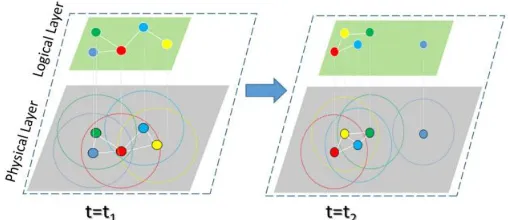
In order to describe the temporal and spatial dynamic characteristics and apply fault-tolerant strategies on both of the logical layer and the physical layer, a model is proposed as shown in figure 1.
The spatio-temporal dynamic network model is composed of two parts: a physical layer constructed by physical connections, and a logical layer constructed by protocols such as routing. The physical layer changes with the mobility, radiation range of nodes, targeted attacks, random errors, and et al. Correspondingly, the routing table, transition path, time delay and others parameters on the logical layer, varies with the physical layer to keep a successful communication.
The spatio-temporal dynamic network model can be described in the following two layers.
Figure 1. Physical and logical layers in different times.
1. Physical layer description.In the graph theory, network G, having N vertices and M edges, can
be described as
(
)
( , )
,
d u v
L
P u v βe α −
= . So as to describe the communication network, the paths are
directed. Ifu∈V v, ∈V , β α, ∈(0,1
]
means the directed path from nodeu to nodevand the ensemble{
}
= e , ,
E u v u∈V v∈V . The number of nodes and edges in the network can be described
respectively as V and E . The function W ( e u v, ) is the weight of the edge eu v, , which is
positive real arithmetic value and if this value is 0, there is no edge between nodeuand node v.
2. Logical layer description. In the logical layer, it is important to find the best directed path to
deliver data packages. Let’s definep a t h u v, as a certain path from the node u to node v, which
successively pass through nodeu , nodev1,nodev2,…,nodevn, to nodev.The ensemblePath u v,
concludes all the paths from the nodeu to nodev. The function (f path u v, )can evaluate the
,
path u v , And the best directed path from the node u to node v can be expressed bypath u v∗ , ,
which can be found by (f p a th u v, ) and satisfy the equation (f path u v∗ , ) (≤ f path u v, ).
Robustness Model with Fault-tolerant Strategies
Be similar to the spatio-temporal dynamic network model, it is also needed to describe the robustness of double layers and fault-tolerant strategies.
1.Physical layer robustness with fault-tolerant strategies. Plenty of research studied the network robustness of the physical layer and many parameters can reflect fault-tolerant strategies. The flow robustness, which is defined as the fraction of node pairs that remain connected after a number of
deletions [25], is chosen as the network robustness of the physical layer. Here we use Rpsto represent
the network robustness of the physical layer, and then
1| | (| | 1)
=
| | (| | 1)
k
i i i
p s
n n
R
N N
= −
−
∑
(1)Whereniis the number of nodes in the giant componenti.AndNis the number of nodes in the
whole network.
2.Logical layer robustness with Fault-tolerant strategies. The robustness of the logical layer is to
maintain an effective logical path with fault-tolerant strategies especial when the network is under
attacks or errors and the previous path has destroyed. And a parameter, which reflects the diversity of
the paths between a given node-pair, is the EPD(effective paths diversity)[26], and here we use the
EPD as our model.
1
kp dE P D
=
−
e
−λ (2)Whereλis an experimentally determined constant, and thekpd is a value of the added diversity of
1
= k
p d m i n i i =
k
∑
D ( P ) (3)WhereDmin( )Pi is the minimum diversity of the path I when evaluated against each member of the
set of previously selected paths.
Robustness Estimation Method
The related factors, which influence the network robustness, are complex and have the nonlinear relationships. In order to take the related factors into consideration, we constructed a simulation platform based on NS-3 to finish the simulation and data collection. The traditional methods based on the models are impossible to analyze the nonlinear relationship. To estimate the network robustness, the extreme learning machine, abbreviated to ELM, is adapted. Because the ELM has the lower generalization character, we improved the ELM by adding a different function to the function of hidden node and the generalization character is raised obviously. And then a robustness estimation method, based on the improved ELM, is finished by following four steps. As can be shown in Fig. 2.
Simulation and data collection
Model training
Estimation Improved
ELM
Run and calculate the Rps,,,,EPDand PDR
(CRCRCRCR’’’,’,PDR,,PDRPDR’PDR’’’)
Figure 2. Steps of robustness estimation method.
1. Simulation and Data Collection. The above network robustness models, give us the parameters,
such as Rps, EPD, that represent the robustness of the physical and logical layer. In order to obtain
these values in different situation, we should simulate the packages delivering process of network
and choose the package delivering ratio, abbreviated toPDR, which is a reliability parameter, to the
whole communication network robustness. And we choose the Waxman model [27] to construct a network graph to simulate the communication network. In order to add different routing protocols, the NS3 is adapted because of its extensibility and openness.
2. Improved ELM. Here the ELM, is adapted to analyze the nonlinear relationship between the
inputsRps, EPD and the output PDR. The nonlinear relationship, which has multi-parameter inputs,
other environmental influence factors and all these inputs and factors are coupling with each other, can be described as the following dynamic equation [28].
( )
(
)
1
,
N i
i ij i j
j dx
F x A G x x
dt =
= +
∑
(4)Where the xiis an element in the vector x
. The F x( )i andG x x
(
i, j)
represent the dynamical lowsthat govern the system’s components.Aijis the weighed connectivity matrix. In the ELM, the equation
to estimate the robustness can be written as follows.
( ) ( )
1
L
i i i
i
x β f a b
=
+
∑
F = Hβ =β =β =β = x (5)
Where
( )
( ) ( )
( ) ( )
1 1 1 1
1 2 1 2 1 2
1 1
, , , , , , , , , , ,
L L
L L L
L L L L
f a x b f a x b
a a a b b b x x x
f a x b f a x b
+ + = + + … … …
H (6)
Usually the ββββ is an unknown vector, which can be obtained by the training samples. But there
always exists an error O between the target T and the estimation result Hββββ as follows.
−
O = Hββββ T (7)
In order to get a minimum errorO, we add ( )
i i i
g a x + b to the hidden layers to solve the generation
problem. Here thef a( ix+bi)and the g a x + b( i i i) is replace by.
(a bi, , xi i) f a b( i, , xi i) (1 ) (g a bi, , xi i)
ϕ =α⋅ + −α (8)
Where α is the proportion of f x( )and g x( ). And these two functions must be continuously
differentiable function. And two typical continuously differentiable functions chosen are the sigmoid
functionf x( ) and radial basis functiong x( ). So
( ) 1
1 x f x e− = + (9) ( ) i i x
g x e
− = µ µ µ µ σ σ σ σ (10)
And the structure diagram of improved ELM model is shown in the Fig.3.
1 n 1 2 i i+1 L 1 m β1 β1 β2 β2 βi βi βL βL . . . . . . . . . . . . F(x) f(a2,b2,x)
g(aL,bL,x)
Weight vector Hidden
layer
Figure 3. Structure diagram of improved ELM model.
2. ELM Model Training. The model training is the process of machine learning to obtain the
weighed vectorββββ. Let us suppose the error equal to 0. So
Hββββ= T (11)
Then
1
−
= H T
β ββ
But generally, His not invertible matrix because the number of hidden layers is less than the
sample number. In that case, the Moore-Penrose generalized inverse matrix +
H is adapted to replace
1
−
H .
3. Network Robustness Estimation. If the upper tasks are finished completely, we can use the
Eq.5 to realize the network robustness estimation just by inputting the vectorx
. You can give different kinds of input data, which vary with different rules to get certain laws in different situations. And in order to test the estimation accuracy, the data can be divided into training set and testing set randomly.
Case Analysis and Method Verification
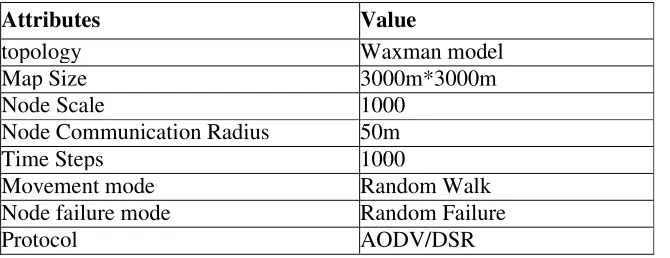
[image:6.612.142.477.257.386.2]Here we construct a tactical internet, belonging to the communication network, with the following settings in the Table 1.
Table 1. Communication network simulation settings.
Attributes Value
topology Waxman model
Map Size 3000m*3000m
Node Scale 1000
Node Communication Radius 50m
Time Steps 1000
Movement mode Random Walk
Node failure mode Random Failure
Protocol AODV/DSR
Waxman model can be realized by INET module in NS3.If β α, ∈(0,1
]
are given, the networktopology will be generated and probability of the edge between node u and node v is given by based
on the following equation.
(
)
( , )
,
d u v
L P u v β e α
−
= (13)
Whereβ α, ∈(0,1
]
, and (d u v, )is the distance from nodeuto v,Lis the maximum distance betweentwo nodes.
Table 2. The robustness of physical layer.
Failed nodes α=0.5, β=0.8 α=0.8, β=0.5
1 0.784 0.535
40 0.524 0.346
80 0.284 0.214
… .. …
[image:6.612.167.441.681.748.2]The table 2 gives theRpsunder certain parameters and failed nodes with same logical layer settings.
Table 3. The robustness under different failed nodes.
Failed nodes Rps EPD PDR
1 0.783784 0.591592 0.546547
2 0.793587 0.601202 0.55511
3 0.807422 0.605817 0.561685
Failed nodes Rps EPD PDR
4 0.791165 0.581325 0.558233
5 0.78794 0.59598 0.552764
6 0.795775 0.586519 0.54829
7 0.791541 0.599194 0.562941
… … … …
1000 0 0 0
And the Table 3 gives theRps, EPD, and PDR, which vary with the number of failed nodes, with
[image:7.612.96.524.213.375.2]AODV and β α= =0.5.
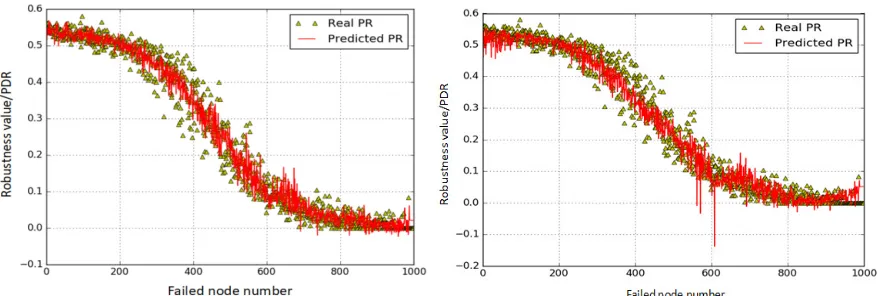
Figure 4. Robustness of AODV and DSR under different failure nodes. Figure 5. Contrast among the estimation effect based on different ways.
As shown in Fig.4, there is much difference of robustness when AODV protocol and DSR protocol are used respectively, and the robustness of communication network with AODV protocolis better because tolerant strategies are employed in AODV protocol. It is obvious that fault-tolerant strategies can improve the robustness of communication network.
[image:7.612.88.527.539.687.2]To verify the effectiveness of this model, we give the contrast figure, Fig.5. It is obvious the proposed model can predict the robust value with higher estimation accuracy than others because the proposed spatio-temporal dynamic network model is better than the previous. And the improved ELM method is also better, which can be seen by contrasting the Fig.6 and Fig.7.
As shown in Fig.6, the red real robustness value and the yellow estimation value are very close; the average accuracy is 95.32%.In Fig.7, there are some big errors between the red real robustness value and the yellow estimation value at the node number of around 600 if the EML is not improved, and the average accuracy is 92.41%, which is lower than results from the improved EML. So the improved ELM method, which is powerful to estimate the nonlinear relationship, can be proved.
Conclusions
Both simulations and analytical results reveal that there are plenty of related factors, which have obvious influence on the network robustness. For example, with different network protocols, the robustness is different, and here the AODV is a better choice. It is obvious our proposed double-layer robustness model is better than others, which can be seen in the Fig.5; the platform gives a flexible way to estimate the robustness of a complex communication network with different factors, such as fault-tolerant strategies; the proposed improved EML method is successful to estimate the network robustness and also powerful to estimate other nonlinear relationships. We improve the ELM by adding a different function to the functions of hidden nodes and the generalization character is raised obviously.
References
[1] N. T. Phuong and H. Saito, "Enhancing Physical Network Robustness Against Earthquake
Disasters With Additional Links,"Journal of Lightwave Technology, 34, 5226-5238, 2016.
[2] S. Scellato, I. Leontiadis, C. Mascolo, P. Basu, and M. Zafer, "Evaluating Temporal Robustness
of Mobile Networks,"IEEE Transactions on Mobile Computing, 12, 105-117, 2013.
[3] N. Li, K. Daie, K. Svoboda, and S. Druckmann, "Robust neuronal dynamics in premotor cortex
during motor planning,"Nature, 532, p. 459, 2016.
[4] G. Strona and K. D. Lafferty, "Environmental change makes robust ecological networks
fragile,"Nature Communications, 7, p. 12462, 2016.
[5] G. S. Peng, S. Y. Tan, J. Wu, and P. Holme, "Trade-offs between robustness and small-world
effect in complex networks,"Scientific Reports, 6, p. 37317, 2016.
[6] Y. N. Bai, N. Huang, L. Wang, and Z. X. Wu, "Robustness and Vulnerability of Networks with
Dynamical Dependency Groups,"Scientific Reports, 6, p. 37749, 2016.
[7] M. Radetzki, C. Feng, X. Zhao, and A. Jantsch, "Methods for Fault Tolerance in
Networks-on-Chip,"ACM Computing Surveys, 46, 2013.
[8] C. H. Alfi, Y. K. Hilal, G. H. Aziz, H. H. Halawa, T. K. Refaat, R. M. Daoud, H. H. Amer, and H. M. ElSayed, "Network Fabric Fault-Tolerance for Ethernet-based Networked Control Systems," in IEEE International Conference on Industrial Informatics INDIN, 2013, 636-641.
[9] S. Streif, K. K. K. Kim, P. Rumschinski, M. Kishida, D. E. Shen, R. Findeisen, and R. D. Braatz, "Robustness analysis, prediction, and estimation for uncertain biochemical networks: An
overview,"Journal of Process Control, 42, 14-34, 2016.
[10] J. Gao, S. V. Buldyrev, S. Havlin, and H. E. Stanley, "Robustness of a network of
networks,"Physical Review Letters, 107, p. 195701, 2010.
[11] R. Albert, H. Jeong and A. L. Barabasi, "Error and attack tolerance of complex
networks,"Nature, 406, p. 378, 2001.
[12] L. K. Gallos, R. Cohen, P. Argyrakis, A. Bunde, and S. Havlin, "Stability and topology of
scale-free networks under attack and defense strategies.,"Physical Review Letters, 94, p. 188701,
2005.
[13] L. Gao, M. Li, J. Wu, and Z. Di, "Betweenness-based attacks on nodes and edges of food
webs,"Dynamics of Continuous Discrete & Impulsive Systems, 13, 421-428, 2006.
[14] A. G. Smart, L. A. N. Amaral and J. M. Ottino, "Cascading failure and robustness in metabolic
networks," Proceedings of the National Academy of Sciences of the United States of America, 105,
13223-13228, 2008.
[15] G. Dong, J. Gao, R. Du, L. Tian, H. E. Stanley, and S. Havlin, "Robustness of network of
networks under targeted attack,"Physical Review E Statistical Nonlinear & Soft Matter Physics, 87,
p. 052804, 2013.
[16] E. Szathmáry, "A robust approach,"Nature, 439, 19-20, 2006.
[17] J. Zhao, "Robustness of complex networks with applications to random graphs," in IEEE
Global Conference on Signal and Information Processing, 2015, 1062-1065.
[18] S. Toyonaga, D. Kominami and M. Murata, "Percolation analysis for constructing a robust
modular topology based on a binary-dynamics model,"International Journal of Distributed Sensor
Networks, 13, 2017.
[19] S. Scellato, I. Leontiadis, C. Mascolo, P. Basu, and M. Zafer, "Evaluating Temporal
Robustness of Mobile Networks,"IEEE Transactions on Mobile Computing, 12, 105-117, 2013.
[20] H. Morohosi, "Measuring the network robustness by Monte Carlo estimation of shortest path
length distribution,"Mathematics and Computers In Simulation, 81, 551-559, 2010.
[21]A. E. Motter, "Cascade control and defense in complex networks.,"Physical Review Letters, 93,
p. 098701, 2004.
[22] L. Weican, "Construction and application of robustness index system of service-oriented manufacturing information system,": South China University of Technology, 2016.
[23] R. Min, "Robustness evaluation method based on cloud model in internet of things,": Taiyuan University of Technology, 2015.
[24] Y. Chen and H. Yang, "Sparse Modeling and Recursive Prediction of Space-Time Dynamics in
Stochastic Sensor Networks,"IEEE Transactions on Automation Science and Engineering, 13,
215-226, 2016.
[25] E. K. Çetinkaya, A. M. Peck and J. P. G. Sterbenz, "Flow robustness of multilevel networks," in Design of Reliable Communication Networks, 2013, 274-281.
[26] W. H. Ip and D. Wang, "Resilience Evaluation Approach of Transportation Networks," in
International Joint Conference on Computational Sciences and Optimization, 2009, 618-622.
[27] B. M. Waxman, "Thesis Proposal: Routing of Multipoint Connections," 1987.
[28] J. Gao, B. Barzel and A. L. Barabási, "Universal resilience patterns in complex