University of Huddersfield Repository
Johnson, Mark, Lager, Peter, Pollard, Bill, Hall, Graham, Edwards, Miranda, Whitfield, Pete and
Ward, Rupert
Between analysis and transformation: technology, methodology and evaluation on the SPLICE
project
Original Citation
Johnson, Mark, Lager, Peter, Pollard, Bill, Hall, Graham, Edwards, Miranda, Whitfield, Pete and
Ward, Rupert (2009) Between analysis and transformation: technology, methodology and
evaluation on the SPLICE project. In: "In dreams begins responsibility" choice, evidence, and
change. Conference Proceedings, 16th International Conference, 810 September, Manchester, UK.
Association for Learning Technology, pp. 4050. ISBN 978 0 95 458 709 3
This version is available at http://eprints.hud.ac.uk/id/eprint/7649/
The University Repository is a digital collection of the research output of the
University, available on Open Access. Copyright and Moral Rights for the items
on this site are retained by the individual author and/or other copyright owners.
Users may access full items free of charge; copies of full text items generally
can be reproduced, displayed or performed and given to third parties in any
format or medium for personal research or study, educational or notforprofit
purposes without prior permission or charge, provided:
•
The authors, title and full bibliographic details is credited in any copy;
•
A hyperlink and/or URL is included for the original metadata page; and
•
The content is not changed in any way.
For more information, including our policy and submission procedure, please
contact the Repository Team at: [email protected].
www.alt.ac.uk
Acknowledgements
Production editing by Lucy Saxton, ALT. Produced with the assistance of Melanie Fox (ALT), Oxford Abstracts, and Bob Pomfret
Design by [email protected] Cover Design by Bob Pomfret Printed by Nuffield Press
ALT gives permission for authors to reproduce and distribute their own work on the understanding that the origins of the publication are fully acknowledged. Please use the following format for referencing:
Your name (2009). Your paper title. In Damis, H. and Creanor, L. (Eds). “In dreams begins responsibility” — choice, evidence and change. The 16th Association for Learning Technology Conference (ALT-C 2009). Held 8–10 September 2009, University of Manchester, England, UK Copyright of individual papers remains vested with individual authors and / or their institution. Other material is copyright 2009 the Association for Learning Technology, and is Creative Commons licensed (Attribution-Non-Commercial 2.0 UK: England and Wales).
ALT is a registered charity, no. 1063519 ISBN 978 0 95 458 709 3
This document is available online at: repository.alt.ac.uk/466
Editorial
Section 1: Research Papers
0114 Taking the lead: learners’ experiences across the disciplines 1
0299 Is there a Net generation coming to university? 10
0178 All hands on deck: CREWED for technology-enabled learning 21
0055 ‘Unfettered expression of thought’? Experiences of anonymous online role play 31
0084 Between analysis and transformation: technology, methodology and evaluation on the SPLICE project 40
0031 Technology enhanced learning in 21st century mass higher education. Aspects of design, practice and strategy for a necessary step change 51
0207 Audio and screen visual feedback to support student learning 61
0288 Students and mobile devices: choosing which dream 70
Section 2: Other Papers
0291 Next Generation User Skills 82
0164 The learning technologies of the future: technologies that learn? 97
0123 When the shoe doesn’t fit: supporting students who are
challenged by online educational technologies 104
0081 PortisHEad: portfolios in successful Higher Education admissions 111
0213 In the eye of the storm: preliminary evidence on the use of online learning diaries 116
0315 To what extent could Business Process Management Suite (BPMS) contribute positively to e-learning? 124
0161 A taxonomy of podcasts and its application to higher education 132
0102 Can acquisition of expertise be supported by technology? 141
Index
Index of Authors 156
ALT-C 2009
“In dreams begins responsibility”
—
choice, evidence, and change
ito
ria
l
Editorial
In keeping with the broad nature of this year’s conference theme, the eight research papers in these proceedings range from a focus on pedagogical and curriculum re-design to the development of a research culture and the spread of evidence-informed innovation. The gradual ‘coming of age’ of the learning technology domain and the responsibility which that entails is apparent here in the shift from small scale implementation to a more considered adoption of innovation, and in the critical reflection on both past experience and future potential.
This is apparent in the paper by Dickinson where he describes a strategic, longitudinal approach to the implementation and evaluation of blended learning in a large business school core module through a focus on pedagogical alignment. It is also voiced most eloquently by Traxler in his carefully considered ‘thought piece’ on mobile learning in which he reflects on the ubiquitous nature of mobile devices and highlights the emerging paradox for institutions with regard to central control of learning technology and the increasing drive towards learner independence.
Issues of agency, control and empowerment are challenging for researchers, practitioners and senior managers alike. They are reflected here in different ways, for example by Cornelius, Gordon and Harris as they analyse the experiences of tutors and learners in an anonymous role play activity; by Hardy et al as they describe the findings of their investigation into the personal use of technology by first year students from different disciplines; and by Jones and Cross whose large scale study of students from five universities suggests that the rhetoric surrounding the so-called net generation should be viewed with a considerable degree of caution. All of these papers confirm not only the growing complexity of the learning environment, but also the central role of the learner in informing the design and future implementation of technology enhanced learning.
The move towards embedding innovation is confirmed by Russell in her account of the transformation of two undergraduate engineering courses, one as blended learning and the other fully online, as part of a curriculum renewal initiative. The findings here again point to the need for appropriate pedagogical models along with a review of resources to underpin such changes. Complementing this, Rodway-Dyer and Dunne focus on feedback as a key aspect of student achievement as they describe the outcomes of an innovative study on the impact of audio and video feedback. Their conclusions highlight a range of pedagogical and practical issues to be considered if this approach is to be widely adopted.
Finally, based on a Realistic Evaluation approach, Johnson et al illustrate an innovative use of technology to encourage collaboration and engagement amongst a range of project stakeholders. By using techniques such as mind-mapping, micro-blogging and animated modelling, the researchers encouraged collaborative analysis and joint ownership of the project outcomes, thus suggesting new options for a technology-supported research methodology.
Ed
ito
ria
reviewers with backgrounds in multiple disciplines — always a difficult task. Consequently the number of research papers submitted and accepted has never grown sufficiently to develop into a fully independent research track as had been envisaged. As a result, an issue which will be the subject of debate at the conference and for the next conference committee will be the future of the research track in the years to come.
Hugh Davis, University of Southampton Linda Creanor, Glasgow Caledonian University
Other papers
Some other papers are also significant; however they are not full research papers for one or several of the following reasons
They are thought pieces: they suggest connections or provide a set of
■
views without being fully evidenced. They are reports of work in progress.
■
They are policy rather than research focussed.
■
They report on small projects where the scale of responses is insufficient
■
as yet for full deductions.
They are directed at practitioners who wish to use a technology or the
■
results of a project.
Se cti on 1 : R es ea rch P ap ers 01 14 T ak in g t he l ea d: l ea rn ers ’ e xp eri en ce s a cro ss t he d isc ip lin es 1
Section 1: Research Papers
0114 Taking the lead: learners’
experiences across the disciplines
Introduction
Recent reports into the current generation of students’ expectations of, and experiences with, the use of information and communication technology (ICT) to support their learning have highlighted a number of common themes. It is clear that university students expect to use ICT routinely as part of their academic studies (ECAR, 2008; JISC / Ipsos MORI, 2007, 2008); indeed, very many UK university students now arrive with their own laptop, both for personal and academic pursuits. The use of the internet as a communication tool is increasing, within both academic and social contexts. There is widespread use of social networking sites for communication, especially between peers, and perhaps in preference to what is now seen as the more ‘traditional’ email (Salaway et. al., 2008, Oblinger, 2008). Yet despite their widespread social use, the potential of Web 2.0 technologies for learning appears to be less well-appreciated or understood by students. Furthermore, despite having a high degree of proficiency with common software and web search engines, there is evidence that students may arrive at university lacking some of the vital information literacy skills needed to fully support their studies (CIBER, 2008, Oblinger, 2008). There is also evidence of a small, but significant, minority of students who do not actively engage with ICT (JISC / Ipsos MORI, 2008). The majority of published reports have centred on young (typically aged 17–22) adult learners; the ‘Net’ or ‘Google Generation’. However, it is important not to over-generalise these findings and stereotypes to make inappropriate assumptions which do not apply beyond this particular demographic group, especially with the increasing emphasis on lifelong learning and adult returnees in higher education.
It is widely accepted that good course and curriculum design should align learning and teaching activities with the intended learning outcomes, and that assessment tasks should measure the extent to which these have been met. This is the foundation of ‘constructive alignment’ (Biggs, 1996, 2003), which is based on the (constructivist) premise that students construct their own learning from the activities with which they engage. More recently, the ideas of constructive alignment have been extended to incorporate a wider range of course ‘settings’ that may influence student learning, including curriculum aims and design; learning and teaching activities; learning support; assessment and feedback; course management; and students’ background, knowledge and aspirations (McCune and Hounsell, Hounsell, 2005; Hounsell and Hounsell, 2007). The term ‘congruence’ has been proposed to describe the interactions between these factors and the quality of student learning. This model is particularly relevant to early-years undergraduate courses, where large class sizes, a relatively low staff-student contact and diverse student cohort — and hence a wide range of student perspectives and experiences — are generally the norm. The interplay between these factors, set within the context of students’ use of both institutional and non-institutional ICT and learning technologies to support their learning, forms the backdrop for the present study.
Authors
Judy Hardy, Simon Bates
The School of Physics and Astronomy, James Clerk Maxwell Building, Mayfield Road, The University of Edinburgh, Edinburgh EH9 3JZ
[email protected], [email protected] Jeff Haywood, Denise Haywood, Hamish Macleod
Higher and Community Education, Pater-son’s Land, Holyrood Road, The Univer-sity of Edinburgh, Edinburgh EH8 8AQ [email protected], denise.haywood@ ed.ac.uk, [email protected] Jessie Paterson
The School of Divinity, New College, Mound Place, The University of Edinburgh, Edinburgh EH1 2LX [email protected] Susan Rhind
The Royal (Dick) School of Veterinary Studies, Easter Bush Veterinary Centre, Roslin, The University of Edinburgh, Edinburgh EH25 9RG
Abstract
ct
io
n 1
: R
es
ea
rc
h P
ap
er
s
01
14 T
ak
in
g t
he l
ea
d: l
ea
rn
er
s’ e
xp
er
ie
nc
es a
cr
os
s t
he d
is
ci
pl
in
es
as a whole. To capture the breadth and complexity of their experiences we used a mixed-mode approach, including a series of reflective diaries recorded by learners (in video, audio or text format) together with surveys and focus groups. Students do not form a homogenous group, and findings in this area are inevitably complex. They have high expectations and are generally confident with technology; however, they may not always recognise technology’s potential to support and enhance learning. The term e-learning does not mean much to them; there is simply learning with strands of technology running through. This is reflected in a strong desire for face-to-face contact, with technology used to supplement and enhance this. Students are social, with informal group learning often facilitated by technology. They find their comfort zones and ways of working that are personal to them, and use technology to suit their own way of learning.
In this paper we present outcomes from a study of a heterogeneous group of first-year undergraduate students from a variety of disciplines and different entry routes at the University of Edinburgh in 2007/08. The focus was on ‘critical moments’; specifically, the involvement and impact of ICT and learning technologies on students’ transition into university, and the changes in their use of these tools as they progressed through their first year. The overall shape of our research was based on two underlying principles, advocated by Sharpe (2005) and Mayes (2006). Firstly, that it is important to take a learner-centred approach, whereby the students’ own views and opinions are central to the study. Secondly, that the research should adopt a holistic approach in which students’ use of technology is set within the context of their learning experiences as a whole. Within this framework, the key questions that we wished to address were:
What are students’ expectations regarding the availability and use of
■
e-learning at university?
How do students adapt and change their approaches to e-learning during
■
their first year?
What are the factors that influence students’ choices of e-learning
■
strategies and their utilisation?
To what extent do students use non-institutional technologies to support
■
their learning?
The paper is organised as follows. To set the scene, a short description of the selected disciplines is given, including general characteristics of their students, courses and methods of teaching. This is followed by an overview of the methodological approach taken in the study. Our findings are then presented, and we conclude with some reflections and implications for the future.
The context: the disciplines, their students, courses and
use of technology
The three subject areas chosen for this study were Divinity, Physics and Veterinary Medicine, representing a cross-section of the wide range of disciplines available at the University. Academic staff in all three disciplines have substantial experience in the innovative use of learning technologies to encourage and support greater self-responsibility for learning amongst students. First year courses in these disciplines have a well-established online presence, marrying online and real environments in a blended approach to learning and teaching. While to some extent, the courses in this study may be slightly atypical of the majority of degree programmes at the University of Edinburgh, it is because of their strengths in e-learning that this was an ideal time to study the student perspective.
Divinity
The first year cohort in Divinity includes a wide age profile from school leavers to mature returnees, providing a population with highly variable ICT literacy levels and engagement with modern technology. E-learning uptake by the academic staff ranges from no engagement to those using a rich blended approach where e-learning, including the use of Web 2.0 technologies (weblogs and podcasts), is an integral part of the teaching programme.
Physics
Se
cti
on 1
: R
es
ea
rch P
ap
ers
01
14 T
ak
in
g t
he l
ea
d: l
ea
rn
ers
’ e
xp
eri
en
ce
s a
cro
ss t
he d
isc
ip
lin
es
1
Veterinary
Medicine
Veterinary Medicine students are typically high achieving, highly motivated individuals. All students have access to the school Virtual Learning Environment (VLE), embedded within which are a number of resources under the umbrella of the ‘Virtual Veterinary Practice’. These include RSS feeds, webcams and wikis, with podcasts under development. E-assessment and e-portfolios are being piloted in selected courses. Individual teachers and courses vary in the extent to which they take advantage of these resources.
Methodology
The methodology used in this study has been reported previously (Hardy et al, 2008) therefore only a brief summary is given here. A mixed-methods approach was used to collect a range of quantitative and qualitative data, including:
An institution-wide survey, conducted at the start of the year;
■
A series of reflective diaries throughout the first year recorded by all
■
24 participating students, 7–9 students from each of the three target disciplines;
An end-of-year survey of all 24 participating students;
■
A number of focus groups with the participating students and others.
■
Surveys were conducted either online or using paper and analysed using MS Excel and SPSS. Diaries were recorded in either video or audio (using webcams), or in text format. Information from the diaries and focus groups was organised and analysed using NVivo8.
Reflective diaries were recorded by the students themselves, without anyone from the research team present. Diaries were recorded at key points over the course of the academic year. They were relatively freeform but were based around a number of themes and questions, chosen to reflect significant study-related events, see Table 1.
Table 1: Diary Key Points and Themes
Semester 1 Semester 2
Early First impressions and transition Return after first vacation
Mid First assessed assignment Nearing the end of first year teaching
Late Exam revision Return from vacation, exam revision
Findings: the student year
Students cannot be considered as a homogenous group, and our findings are inevitably complex and wide-ranging. However, the main findings and messages are summarised under a number of themes, which broadly follow the trajectory of our students’ journey over the course of their first year at university.
Learning new university technologies
ct
io
n 1
: R
es
ea
rc
h P
ap
er
s
01
14 T
ak
in
g t
he l
ea
d: l
ea
rn
er
s’ e
xp
er
ie
nc
es a
cr
os
s t
he d
is
ci
pl
in
es
1
are very different organisations from school and work, and offered some pleasant surprises.
“I knew the university have a lot of resources...which were going to give me a lot of facilities. But I couldn’t believe when I saw how much computers and internet are used in each course.”
“The resources I have used so far to do my studying are what the lecturers have recommended us to buy and the WebCT...It’s a bit different to what we did at school as we never got recommended books. We just used to Google everything and use search engines to find out as much information as we could.”
The extensive use of technology from the outset for both studying and administrative tasks was seen by some as a challenge. This was a common view, even among students with good ICT skills, suggesting that the recent movement across all universities to high dependence on ICT has not yet been perceived and internalised by intending students.
“There was an over-reliance on computers in the first two weeks!”
The non-optional nature of the use of technology may be part of this challenge, as personal and social use is to a large extent self-regulated. In addition, the expectations of most new students may be set particularly by use of ICT in schools, which is still generally much less pervasive than in universities.
Over the course of the year, technology was seen as providing a valuable contribution to effective study — one obvious benefit being making materials easier to access — but alongside the advantages were some significant disadvantages. These were often due to limitations in the way technology was used by teaching staff, the inability of students to navigate to important information (either due to poor guidance or failure to take note of it when offered) or access restrictions.
“Lecturers did eventually put everything on WebCT following encouragement (by the students). One was very good and put a good selection of different things — podcasts, internet sources, further reading, as well as her own power points and lecture notes. But it was very lecturer dependent.”
“I’m disappointed that [specific e-learning material] is only available in the university computers, it would be better to be available on [online] as I do not like to study in the computer labs.”
“I’m just starting to doubt the efficacy of... any online university portal. They are just a maze to navigate through and I am not always able to find what I should.”
Using social / personal technologies
Many students used a combination of personal and institutional technologies for fast access to sources of information. Some also had preferences for particular technologies that assisted their studying.
“I can’t revise if I’m not in front of my computer. I use WebCT a lot, or msn for asking someone who knows about what I need to know...Also, there are many blogs where you can find many interesting things that you can’t find in course books...”
“I found in my own revision, that the use of my own personal computer and ‘Inspiration’, the Mind Mapping software, was helpful. I did a lot of mind mapping and also going over podcasts, audio files, MP3 files as a revision aid and also for constructing my revision.”
For some students, paper was the ‘real’ place to be working, while others clearly favoured electronic media. However, many felt the key was to obtain a balance between different activities.
Se
cti
on 1
: R
es
ea
rch P
ap
ers
01
14 T
ak
in
g t
he l
ea
d: l
ea
rn
ers
’ e
xp
eri
en
ce
s a
cro
ss t
he d
isc
ip
lin
es
1 while you think about them and compare to other sections rather than searching
through and copy pasting, combine bits and pieces, write bullet points by hand.”
“Although I feel equally reliant on both, if it came to a definitive choice, I just could not cope without electronic sources and materials!”
“Electronic resources should aid and not replace paper but all the time the two should work in harmony and it’s brilliant that the WebCT service has been very useful.”
There is an instrumental component in this choice because some current academic activities preclude the use of technology, and so working (and practising) in the traditional medium of paper and pens may be most pragmatic.
“If you are going to be asked to write a [exam] response using a pen and a piece of paper then that colours how you will be using the online resources on the lead up (to the assessment) and you are more likely to ‘have a go’ at what you would be doing in the exam. If the nature of the exam was different and there was an online aspect to the exam or you could use a laptop, then all of the dynamic might be entirely different..”
Technology undoubtedly made it easier for students to communicate with others for group work, both formal and informal. It is difficult to be certain to what extent this is common practice across all students, or whether we observed a particularly committed, studious or ‘tech-savvy’ cohort. The Vets appeared to make most use of online group activities, perhaps because the opportunity had been established for them before they arrived (via a Facebook community set up by the previous year’s students), by the evident encouragement and support of staff, or simply because they regard themselves as a budding professional cohort. However, the use of online groups was not limited to the Vets, and these tools are likely to rise in popularity with time.
“I find it really helpful to go over material with other students, whether I’m
organising that through IT discussion boards or just emailing a person I know on the course and asking their opinion on something.”
“I use a lot of MSN and forums to communicate with fellow students and teacher, where I can ask questions and discuss with my colleague.”
Assessment and feedback
The diaries showed clear signs of strong personal feelings regarding both the actual and potential roles of technology for assessment and feedback; students were perhaps more polarised about this than on any other topic. The majority of comments on the overall composition of assessment related to the balance (or lack of balance) between what was being learned and the assessment tasks. Written exams are the most common form of assessment at Edinburgh and quite strong views were expressed about the role that is, or might be, played by technology. For some students, ‘handwriting is still king’ and is expected be around into the indefinite future due to its flexibility, speed, ease of annotation etc. For others it was already a handicap to clarity of expression, with technology helping to avoid illegible handwriting and to align with the rest of their study and life. Some could clearly see both sides of the question.
“I don’t mind handwriting exams, I think that way it’s fair on everyone, whereas if an exam was to be typed it would be unfair on people who couldn’t type as fast as others.”
ct
io
n 1
: R
es
ea
rc
h P
ap
er
s
01
14 T
ak
in
g t
he l
ea
d: l
ea
rn
er
s’ e
xp
er
ie
nc
es a
cr
os
s t
he d
is
ci
pl
in
es
1
“Obviously, certain subjects, such as Informatics, are examined via computers by definition, but enforcing ICT on all subjects is progress for progress’s sake and will surely have the opposite of the intended effect. Handwritten work is far more natural and personal, and does not require any translation from the brain into which keys must be pressed, which often makes the student lose their train of thought.”
We had expected to elicit suggestions for innovative uses of technology (either actual or potential) for assessment. In fact, this was rather sparsely addressed. The few students who responded did so only in terms of the sorts of technology-based assessments they had experienced, with quizzes the most commonly mentioned. Although students were unsure about using computers for long text-based answers, many felt that technology has value for short answer and MCQ tests, especially where it could maintain a high quality test environment.
“I like the online quizzes, it is not long and I can access it all the time at home, so that I can do it when I am ready and gave the best result, well, there is nothing to blame if I get a bad result.”
Despite the fact that almost all students have laptops, used extensively for preparing essays and other coursework, no-one suggested a future in which they would take exams on their own machines, and there was almost no prediction of greater ease of use of IT applications, e.g. for drawing or writing equations, or that physical exams involving objects or evidencing skills might move into virtual spaces. This tends to suggest that their limited prior experience of online assessment was restricting their view of what was possible.
There was also no consistent view about how technology might be used to create or deliver feedback, although in general durable over ephemeral formats were preferred, and perhaps textual over aural.
“I think that verbal feedback from a tutor is the most suitable form. It also gives students the chance to ask any questions or address issues regarding the exams that concern them. A recording/ pod cast of this feedback would also be extremely helpful for future reference.”
“I would rather have text comments than verbally-recorded ones since I’m a more visual person. I don’t retain information well if I just listen to it, so I’d probably have to play recorded comments over and over. I wouldn’t want verbal comments from a tutor because I have a bad memory and I’d probably forget what the tutor said as soon as I left the room.”
Literacies
Two important transitions focused around students’ changing ICT skills and competences — new skills acquired through their studies, and pre-existing skills that were not used and hence may have degraded through lack of practice. Two-thirds of our students reported some new skills development, largely related to the specific technologies used within their courses. Divinity and Vet Medicine students showed the most new skill acquisition, mainly associated with the academic use of blogs (Divinity) or discussion forums / wikis (Vet Medicine). Physics students did not offer much evidence of skill extension except for their use of personal response systems, which are used extensively in their first year courses.
al-Se
cti
on 1
: R
es
ea
rch P
ap
ers
01
14 T
ak
in
g t
he l
ea
d: l
ea
rn
ers
’ e
xp
eri
en
ce
s a
cro
ss t
he d
isc
ip
lin
es
1
ternatives mentioned to them included bookmarking applications and online social tagging services, but neither these nor other options were suggested.
One very important skill is the assessment of the quality of online materials. Student’s rating of their confidence in this area is shown in Table 2. As a group, albeit small in number, graduate entry Vets were the most confident, with none reporting low confidence. There was no clear difference in confidence by subject studied among the other students.
Table 2: Student confidence in assessing the quality of self-discovered online materials
Very confident Confident Somewhat
unconfident Not at all confident
4/23 13/23 5/23 1/23
Given the extent of the use of Google to find information, this ought to be a frequently practised skill, however students reported little evidence of direct advice from lecturers other than to take care in doing so, to avoid citing Wikipedia etc.
Reflections
As the end of the academic year approached, students were asked what advice about ICT they would offer both to the university and to students following on after them. Advice to students included:
Purchase a computer before you arrive and make sure you know how to
■
use and maintain it.
Check the compatibility with university networks and course requirements.
■
Practice your keyboard skills, as this will save you time later.
■
Log onto systems and check your email daily, as much important
■
communication takes place online.
University is about self-reliance, so make sure you have acquired skills to
■
support yourself.
Advice to the university related to the quality of facilities and services, which most students rated quite highly at present, rather than about innovation, and overall the advice was pragmatic and perhaps not overly challenging, consisting of desirable actions that would not come as any surprise to teaching staff or support services:
IT provision is generally good, but do more, and do it better.
■
Not everyone has a computer, or uses it on-campus, so availability of
■
access is important (computer labs, student residences and wireless network coverage).
Promote the university laptop loan service and laptop check-up
■
workshops.
Consider offering preferential laptop purchase schemes.
■
Good training and support is available; make sure students know how to
■
access it.
Be more consistent in the use of the VLE across courses.
■
ct
io
n 1
: R
es
ea
rc
h P
ap
er
s
01
14 T
ak
in
g t
he l
ea
d: l
ea
rn
er
s’ e
xp
er
ie
nc
es a
cr
os
s t
he d
is
ci
pl
in
es
1
However, to all of them this just appeared to be how they see learning, and to some degree teaching, in the first decade of the 21st century. We did not present this as ‘e-learning’ to them in our interactions with them, and they did not use the term spontaneously. Most adopted into their daily study lives institutional e-learning technologies on offer; VLEs, online quizzes and assessments, Web 2.0 tools such as the wiki, web-based submission of assignments, email etc without overtly querying their value, appropriateness or effectiveness (as tools). They progressively became regular users of the university’s extensive digital library; most of these resources were new to them, e-journals, bibliographic databases and e-books being little available to schools or the general public. Alongside, and interwoven with, these institutional technologies, they used their own technologies — mobile phones, laptops, Facebook, blogs etc — to communicate with each other, with staff and with family / friends, and to study and learn.
No classes required our students to own laptops, but all of their courses required them to carry out a substantial proportion of their studying using the internet and ICT. Students ‘moved’ their studying from machine to machine as was most convenient to them, making heavy use of both the university computer labs and their own laptops as suited them. What they did not appear to do, was use their handheld devices (almost entirely mobile phones) as tools for learning, e.g. to access the digital library or the VLE, with the exception of podcasts on MP3 players.
Several courses required students to work in groups, but this was often not scheduled or offered in specific time-allocated spaces. Some students adopted IM as a mechanism to support this activity, using this as an
alternative to email and sms, either on their own or on university equipment. In this sense, they adopted the institutional technologies that were necessary for them to use to gain access to learning materials and tasks (e.g. the VLE), and adapted their own technologies (e.g. mobile phones, Google) to support their learning activities. They were generally fairly tolerant of system deficiencies (this may change in subsequent years when the pressure is greater), although older students from well-resourced workplaces perhaps viewed university systems as less professionally polished than the commercial systems they had experienced.
These reflections reinforce the commentary offered in US studies of technology in higher education published by ECAR in which they observed that students value convenience and control (Kvavik et al, 2004).
Few of our students offered reflections that pushed the boundaries of what we offer at present in terms of innovation in e-learning. This may be partly due to ‘self-selection’; the university does not emphasise substantial use of technology in most of its degree programmes, but presents a traditional university education in its public-facing information. It may also arise from an intrinsic cautiousness; high-achieving students may not generally see risk-taking by the university as a ‘good thing’. Similar concerns have been voiced in other research studies, which have presented scenarios for the future use of technology in university education to student focus groups, and with student reactions to e-portfolio pilots (Tosh et al, 2005). This suggests that universities that wish to expand their use of technology into more innovative and non-elective activities need to do so with suitable advance preparation of student attitudes, despite the rhetoric of a few Net Gen proponents.
Conclusions
Se
cti
on 1
: R
es
ea
rch P
ap
ers
01
14 T
ak
in
g t
he l
ea
d: l
ea
rn
ers
’ e
xp
eri
en
ce
s a
cro
ss t
he d
isc
ip
lin
es
1
of novel or innovative uses of technology, but do expect reliability,
predictability, and high quality use across their courses. There is a continuing need to understand the student perspective as we move into an even more technology-rich world. The diversity of the student population, coupled with the changing nature of teaching and learning, offers both challenges and opportunities. Keeping students’ voices central to research in this area will be key to the success in meeting students’ needs and aspirations.
Acknowledgements
We are grateful to the JISC for partial funding for this work under the e-Learning pedagogy programme. Thanks are due to the Support and Synthesis team for their advice and encouragement. We would like to thank staff from EUSA (Edinburgh University Student Association), the SFC (Scottish Funding Council) and the University of Edinburgh for valuable advice and support. Finally, we are hugely grateful to all of the students from the University of Edinburgh who participated in the project, and thank them for all of their contributions during the project and beyond.
References
Biggs, J. B. (1996) Enhancing teaching through constructive alignment. Higher Education, 32: 347–364
Biggs, J. B. (2003) Teaching for Quality Learning at University. 2nd edition. Buckingham: SRHE & Open University Press
CIBER group. (2008) Information behaviour of the researcher of the future www.jisc.ac.uk/ whatwedo/programmes/resourcediscovery/googlegen.aspx [accessed Nov 3rd 2008]
Hardy, J., Haywood, D., Bates S., Paterson J., Rhind S., Macleod H. and Haywood
J. (2008) Expectations and Reality: Exploring the use of learning technologies across the
disciplines. In Learners’ Experience of e-Learning: Research from the UK. Sixth International Conference Networked Learning www.networkedlearningconference.org.uk/abstracts/ PDFs/Hardy_475-483.pdf [accessed Nov 4th 2008]
Hounsell, D. and Hounsell, J. (2007) Teaching-learning environments in contemporary mass higher education in Entwistle, N.J., et al. (eds) Student Learning and University Teaching, Psychological Aspects of Education — Current Trends. British Journal of Educational Psychology Monograph Series II, British Psychological Society, Leicester: 91–111
JISC/Ipsos MORI. (2007) Student Expectations Study, www.jisc.ac.uk/publications/ publications/studentexpectations [accessed Nov 4th 2008].
JISC/Ipsos MORI. (2008) Great expectations of ICT: How Higher Education institutions are measuring up, www.jisc.ac.uk/publications/publications/greatexpectations [accessed Nov 4th 2008]
Kvavik, R.B., Caruso, J.B. & Morgan, G., (2004) ECAR Study of Students and Information Technology 2004: Convenience, Connection and Control, (Research Study Volume 5) Boulder Colorado: ECUCAUSE Center for Applied Research, net.educause.edu/ir/library/pdf/ ers0405/rs/ers0405w.pdf [accessed Nov 28th 2008]
McCune, V. and Hounsell, D. (2005) The development of students’ ways of thinking and practising in three final-year biology courses. Higher Education, 49: 255–289
Mayes, T. (2006) LEX The Learner Experience of e-Learning Methodology Report, www.jisc.ac.uk/elp_learneroutcomes.html [accessed Dec 4th 2007]
Oblinger, D. G. (2008) Growing up with Google: What it means to education, in Emerging technologies Volume 3, connect.educause.edu/Library/Abstract/ GrowingupwithGooglewhatit/46571 [accessed Nov 12th 2008]
Salaway, G., Caruso, J. B., Nelson, M. R. (2008) The ECAR Study of undergraduate students and information technology 2008 connect.educause.edu/Library/ECAR/ TheECARStudyofUndergradua/47485 [accessed Nov 3rd 2008]
Sharpe R., Benfield G., Lessner E. and DeCicco E. (2005) Scoping Study for the Pedagogy Strand of the JISC e-Learning Programme, www.jisc.ac.uk/elp_learneroutcomes.html [accessed Nov 27th 2007]
ct
io
n 1
: R
es
ea
rc
h P
ap
er
s
02
99 I
s t
he
re a N
et g
en
er
at
io
n c
om
in
g t
o u
ni
ve
rs
it
y?
1
0299 Is there a Net generation
coming to university?
Authors
Chris Jones, Simon Cross
The Institute for Educational Technology, The Open University, Milton Keynes MK7 6AA
[email protected], [email protected]
Abstract
This paper reports the first phase of an ESRC funded research project to investigate first year students’ use of technology in relation to the idea of young people born after 1983 forming a distinct age cohort described variously as the Net generation or Digital Natives. The research took place in five English universities in the spring of 2008. The research found a far more complex picture than that suggested by the rhetoric with student use of new technologies varying between different universities and courses. Some of the more discussed new technologies such as blogs, wikis and virtual worlds were shown to be less used by students than might have been expected. The Net generation appears if anything to be a collection of minorities with a small number of technophobic students and larger numbers of others making use of new technologies but in ways that did not fully correspond with many of the expectations built into the Net generation and Digital Natives theses.
Introduction
The Net Generation is one of several terms used to identify a distinct generational group in ways that have relevance for teaching and learning. This new generation is identified with young people born after 1983. At the time of writing this makes the oldest Net generation members 26. Some recent reports suggest that there is a further generational shift following the Net generation beginning in the year 1993 (JISC-Ciber 2008). For our purposes we accept this ten year period between 1983 and 1993 as the boundaries of our research. It is claimed that the Net generation prefer active to passive learning, have distinct information searching patterns and a low tolerance for delays. From these characteristics there are derived particular issues that might affect teaching and learning, for example the kinds of attention spans that are exhibited by students such as working in ‘bursts’. This new generation has been entering UK higher education since 2001 and on their arrival they encounter an increasingly extensive use of e-learning. Currently it is still not clear what the characteristics of this emerging student body are. Nor is it clear what the most important influences might be on student engagement with networked and digital technologies during their studies.
The term Net generation is most commonly associated with the work of Tapscott (1998 and 2008) and he argues that these young people are different to previous cohorts because of their experience of networked and digital technologies. He writes, for example, that:
Today’s youth are different from any generation before them. They are exposed to digital technology in virtually all facets of their day-to-day existence, and it is not difficult to see that this is having a profound impact on their personalities, including their attitudes and approach to learning. Tapscott (1998 a)
We are interested in how these changes might affect learning and Tapscott suggests that the changes in technology have some ‘inevitable’ consequences for learning. Tapscott argues that that the ultimate interactive environment is the internet itself and that education will need to move from a teacher-centered approach to learning to learner centered approaches. “But as we make this inevitable transition we may best turn to the generation raised on and immersed in new technologies.” (Tapscott 1999 p11).
Another key source for arguments about the Net generation comes from articles written by Prensky using the term Digital Natives (Prensky 2001 and 2001a). In a similar way to Tapscott he argues that digital natives are part of a step change in attitudes and styles:
.. not just changed incrementally from those of the past, nor simply changed their slang, clothes, body adornments, or styles, as has happened between generations previously. A really big discontinuity has taken place. One might even call it a “singularity” — an event which changes things so fundamentally that there is absolutely no going back. (Prensky 2001 p 1)
Se
cti
on 1
: R
es
ea
rch P
ap
ers
02
99 I
s t
he
re a N
et g
en
era
tio
n c
om
in
g t
o u
niv
ers
ity
1
substantiation, by Baroness Greenfield the Director of the Royal Institution in the United Kingdom. She told the House of Lords that children’s experiences on social networking sites:
“are devoid of cohesive narrative and long-term significance. As a consequence, the mid-21st century mind might almost be infantilised, characterised by short attention spans, sensationalism, inability to empathise and a shaky sense of identity”.
24th of February 2009 (www.guardian.co.uk/uk/2009/feb/24/ social-networking-site-changing-childrens-brains )
Lady Greenfield echoed Prensky in suggesting that exposure to new technologies and web services was likely to fundamentally change children’s and young adult’s brains. Prensky argued that in education there is a disconnect between the ‘digital native’ students and the ‘digital immigrant’ staff who retain the ‘accent’ of the pre-digital era even when they become socialized into a digital environment. This suggests that being a digital native or a digital immigrant is not a learned skill and in Prensky’s view it is a fixed product of early development. In a recent article Prensky has suggested that the distinction between digital natives and immigrants will become less important and developed a new set of distinctions around the term digital wisdom (Prensky 2009). However it is clear that both Prensky and Tapscott still suggest that the changes in technology lead to determinate outcomes. Indeed Tapscott advances the technologically determinist argument that changes to pedagogy flow in an ‘inevitable’ way from changes in technology.
Diana Oblinger of EduCause uses the term Millenials for the generation born after 1982 and her work is supported by large scale annual surveys of students in the USA. However her argument continues to describe a whole generation and she claims to have identified a trend towards an internet age mindset. Oblinger also identifies what she describes as a disconnection be-tween the new Millenial students and the institutions that they are enrolled in. Unlike Prensky, Oblinger and Oblinger (2005) suggest exposure to tech-nology might be more important than age group, allowing older students to develop different approaches. “Although these trends are described in gener-ational terms, age may be less important than exposure to technology.” (2.9).
ct
io
n 1
: R
es
ea
rc
h P
ap
er
s
02
99 I
s t
he
re a N
et g
en
er
at
io
n c
om
in
g t
o u
ni
ve
rs
it
y?
1
The survey
This research is the first phase of a two year study funded by the Economic and Social Science Research Council. The overall aim of the research is to provide an empirically based understanding of the Net generation as they first engage with e-learning in UK tertiary education. The research uses a mixed method approach including interviews and the Day Experience Method, a form of cultural probe, to supplement the survey work (Riddle and Arnold 2007). Five universities were selected to represent the main ‘types’ of university in England. Fourteen courses were surveyed representing a range of subject and disciplinary areas in both pure and applied branches of learning (see Table 1 for a more detailed description). A survey was chosen as the main intervention in the first phase of the research to provide a single snap-shot of student use of technology and to provide a background for further research including a range of methods in the second phase of research which has taken place during the 2008/9 academic year.
A questionnaire exploring first-year experiences of e-learning was developed by the research team and tested with a small number of students for timing and comprehension. Survey instruments developed by researchers in the USA and Australia were considered and informed the design of some questions but they were not considered to be directly transferable to a UK context. The instrument sought to collect baseline information about some of the key aspects of the students’ use of technology in their studies. It was mainly composed of closed questions but included a number of open text responses. The instrument contained four sections: demographic characteristics of the respondents, access to technology, use of technology in university studies in general and finally course-specific uses of technology.
Table 1: University types (Jones and Ramanau 2009a)
University A University B University C University D University E
Founded
Founded 19th Century
Founded 1970s (Polytechnic) university status in 1992
Founded 1970s Founded 1970s Founded 21st Century from university college
Location Large urban
metropolitan Large urban metropolitan Large scale distance Mid size campus outside small city
Mid size with multi-site campuses in small towns Course units English Sociology Science Modern Languages Journalism
Bio-science Information and Communication Health and Social Care Computing Psychology
Veterinary science The Arts Accounting and Finance Social Work
A maximum of 1809 students nearing the end of their first year study at university were available to participate in the survey. A total of 596 first-year students completed the survey yielding a response rate of approximately 33%. A further 62 responses had to be excluded because students had either failed to finish the survey form or had not signed the consent sheet. This purposive sample provides a robust basis for presenting a descriptive account of first year students use of technology.
Se
cti
on 1
: R
es
ea
rch P
ap
ers
02
99 I
s t
he
re a N
et g
en
era
tio
n c
om
in
g t
o u
niv
ers
ity
1
paper version for distribution and collection within a teaching session; and, for distance learners, a paper version that could be mailed to their home and returned in a prepaid envelope. Of the fifteen courses surveyed: nine courses used only online surveys; five offered a combination of online and paper; and one used paper only.
Findings
The demographic profile of our sample is shown in Table 2. Two features are worth noting in our sample. The gender distribution is skewed towards female students and the sample from University C (the distance university), is disproportionately over 25. Both these proportions are beyond what might have been expected as the course recruitments were not as skewed as our respondents. The Net generation age group in the distance university shows a skew that exaggerates the current recruitment patterns at this university as under 25s could be expected to be approximately 20% of the intake for first level courses.
Table 2: Key demographic characteristics (% of the total) (Jones and Ramanau 2009b)
University A University B University C University D University E Overall
Male 22.3 27.3 36.1 43.2 16.3 27.8
Female 77.7 72.7 63.9 56.8 83.7 72.2
UK Students 96.6 95.3 93.3 80.8 98.0 93.9
International Students 3.4 4.6 6.7 19.2 2.0 6.1
18–25 years of age 96.0 89.1 12.6 95.9 84.4 75.8
Older than 25 4.0 10.9 87.4 4.1 15.6 24.2
Full-time student 99.4 96.9 5.1 100.00 99.0 80.3
Part-time student 0.6 3.1 94.9 0 1.0 19.7
Total number 176 128 119 74 99 596
Computer and network access
Just over three quarters (77.4%) of the respondents had access to a laptop and over a third (38.1% where n=554) owned a desktop computer. Only two (0.4%) had no access to a desktop computer and eight (1.4%) no access to a laptop. Over half (55.4%) used a desktop computer in a public place but this suggests that a large minority of students only make use of private access to computing which could have implications for university provision. Around two thirds (70.1%) of those asked felt that their access to computers was sufficient to meet their computing needs whilst a further 26.4% said that it mostly met their needs. Only 3.3% of students said it ‘partially’ meet their needs and only one student said that their access did not meet their needs at all. A supplementary question (Q2.3) asked this minority to explain why their needs were only partially met or not met at all and 14 gave as their reason ‘cannot afford the necessary software / hardware’, 11 that ‘the computer is too old’ and 11 that ‘the place of access is inconvenient. Other open text comments included one student citing ‘excessive port blocking’ by university systems and another complaining about limited access in halls of residence.
ct
io
n 1
: R
es
ea
rc
h P
ap
er
s
02
99 I
s t
he
re a N
et g
en
er
at
io
n c
om
in
g t
o u
ni
ve
rs
it
y?
1
[image:19.624.243.540.562.786.2]content’ and another student said ‘mobile computing is becoming a priority’. In another question we asked students where they accessed the internet and included the option of ‘anywhere, mobile internet’. Whilst this isn’t directly comparable with a question specifically identifying mobile broadband access, it gives further confirmation of the rough size of the minority of students because 11.1% of respondents reported using mobile internet. This latter figure is similar to the proportion of students claiming to have a wireless mobile connection (13.4%) but cross-tabulation reveals that 9% of students responded positively to both question and this would suggest that caution needs to be exercised in interpreting these results.
Student access to other devices was in some ways predictable. Almost all students owned a mobile phone (97.8%) and these phones generally came with a camera (91.9%); music player (77.25); and internet access (75.7%). Less common were wifi (14.2%) and plain phones with none of these features (6.4%). This still meant that 35 of the students only had a basic phone and 6 of our respondents reported that they did not have any access at all to a mobile phone. Memory sticks were the second most commonly reported device (87.9%) but once again there were a small minority who did not own or have access to one (7.9%). An MP3 device or other digital music player was also a commonly owned device with 82.4% reporting ownership. Other devices were less common such as a games console 38.4%, although this was one case that showed a significant amount of shared use (21.5%), and a large minority who reported no access at all (39.5%). A further question about the kinds of games players that were owned, included hand held as well as console players. Around half of students (50.2%) reported that they owned a games player of one kind or another and most who owned a handheld games player also owned a console. Personal Digital Assistants (PDA) were used by very few with PDAs with wifi owned by 5.7% and PDAs without wifi by 4.6%. Fifteen individuals reported both owning a PDA with and without wifi and we cannot be sure if this implied two separate devices or was a double reporting of the same device. When we asked which of these devices they would miss the most if they did not have access to it 83.2% chose their mobile phone. In open text answers it appears that this was because the phones had several functions (i.e. the phone function was not the only, or indeed the primary, benefit).
Student use of technology
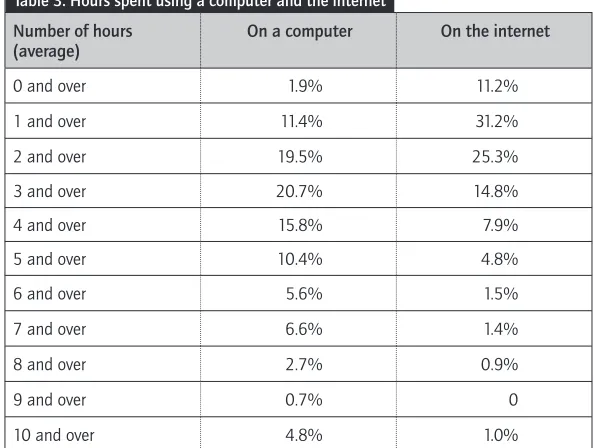
Students reported spending a considerable amount of time working on computers and using the internet.
The majority of students use their computers for up to four hours a day and the internet for up to three hours. However there are a small number of outliers that use the computer for over 10 hours a day and a handful of extreme users who access the internet for over 10 hours a day.
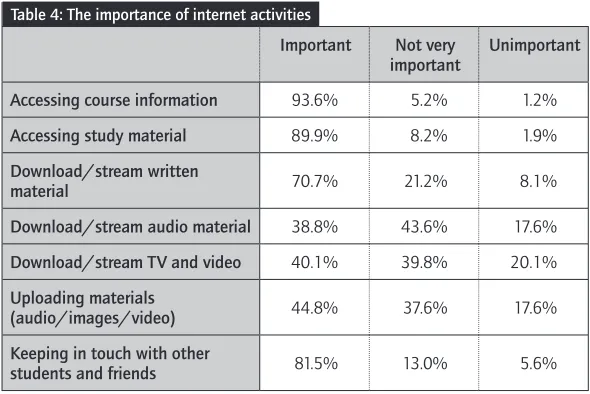
Respondents were asked how important internet access was for a variety of activities. The activities rated most important were accessing materials and communicating rather than downloading and uploading materials. This suggests that the idea that the Net generation are more likely to be inclined to
Table 3: Hours spent using a computer and the internet Number of hours
(average) On a computer On the internet
0 and over 1.9% 11.2%
1 and over 11.4% 31.2%
2 and over 19.5% 25.3%
3 and over 20.7% 14.8%
4 and over 15.8% 7.9%
5 and over 10.4% 4.8%
6 and over 5.6% 1.5%
7 and over 6.6% 1.4%
8 and over 2.7% 0.9%
9 and over 0.7% 0
Se
cti
on 1
: R
es
ea
rch P
ap
ers
02
99 I
s t
he
re a N
et g
en
era
tio
n c
om
in
g t
o u
niv
ers
ity
1
participation might be somewhat exaggerated. However there appeared at first sight to be a minority who reported that uploading and downloading audio and video was important. On inspecting the data it is not clear whether this apparent minority really does cohere and further analysis is required to establish whether downloading and uploading audio and video materials are an indicator of a coherent minority of students.
We also asked respondents about the frequency of use of twelve types of technology. The horizontal bar charts below show the cumulative percentage of student responses:
[image:20.624.85.380.85.282.2]Students were asked specifically about their use of particular technologies that have received significant attention in recent educational technology literature, blogs, wikis and virtual worlds. Perhaps surprisingly there is no evidence of a significant uptake of any of these technologies amongst the first year students and of virtual worlds in particular. These figures are consistent with those shown in Figure 1 when students were asked if they used a blog and a majority of students report never having used one. The percentages for wiki use are not directly comparable as those reported in Figure 1 show the use of Wikis including Wikipedia and those in Table 5 ask if the students had contributed to a wiki. In this case the contrast is sharp with only a small minority of students having contributed to a wiki whilst a majority of students use wikis including Wikipedia at least weekly.
We asked students to report on how confident they felt (defined in relation to skills) using a set of common tools and technologies. Over 80% of students reported slight confidence and basic skills or better in using presentation software (87.5%), online library resources (86.5%) spreadsheets (84.9%), and in computer maintenance (82.3%). However, over a third reported no confidence or minimal skills (not known or not confident) using Virtual Learning Environments (VLEs) (37.7%), writing and commenting on blogs and wikis (40.6%), and graphics software (36.4%); with almost two thirds (60.3%) reporting no confidence or minimal confidence in video / audio editing software (Figure 2).
Kennedy et al (2008) have made a distinction between what they called technologies for life and technologies for learning. We explored this distinction and asked two sets of Likert scale questions about the importance students placed on a variety of technologies firstly for study purposes and secondly for their social life and leisure (Figure 3). There are some interesting features to the responses. Firstly there is a small minority of students who never use email for study purposes and a similar small minority who never use email for social purposes. When cross-tabulated only 3 individuals never use email for either study purposes or social life and leisure but a further 42 cases then report low use of either email for study purposes (21 at 0–1 hour a day) or for social and leisure purposes (21 at 0–1 hour a day). It suggests that there are a minority of students for whom email is not heavily used and this might have important implications for routine methods of communication by universities with first year students.
In terms of the frequency of use of technologies in relation to their courses, around two thirds of students use computers, the internet and web and Table 4: The importance of internet activities
Important Not very
important Unimportant
Accessing course information 93.6% 5.2% 1.2%
Accessing study material 89.9% 8.2% 1.9%
Download / stream written
material 70.7% 21.2% 8.1%
Download / stream audio material 38.8% 43.6% 17.6% Download / stream TV and video 40.1% 39.8% 20.1%
Uploading materials
(audio / images / video) 44.8% 37.6% 17.6%
Keeping in touch with other
students and friends 81.5% 13.0% 5.6%
Table 5: The use of new technology forms (Blogs, wikis and virtual worlds)
Yes No
21.5% 78.2% Contributed to a blog
12.1% 87.9% Contributed to a wiki
ct
io
n 1
: R
es
ea
rc
h P
ap
er
s
02
99 I
s t
he
re a N
et g
en
er
at
io
n c
om
in
g t
o u
ni
ve
rs
it
y?
1
the university intranet / portal at least once a day. Around two fifths use the University VLE as least once a day, whilst over half never use a networked device as a course requirement. A fifth of students use the network to access library resources at least once a day and a majority of students access online library resources at least weekly. There are some interesting aspects of the use of technologies connected to course requirements. We asked, for example about course requirements to access online library resources and over 60% reported that there was such a requirement (61.7%). The results reveal that even, within specific courses, opinions do vary. On one course
0% 20% 40% 60% 80% 100%
Never (left most bar)
Monthly
Weekly
Daily
More than once a day (right most bar) a. Read and/or send email
b. Use mobile phone messaging (SMS/MMS)
c. Chat using instant messaging (MSM, etc)
d. Participate in online social networks (*)
e. Use blogs
f. Use wikis (including Wikipedia)
g. Shop online
h. Download/stream music
i. Download/stream TV/video (iplayer, YouTube, 4OD, etc)
j. Upload audio/images/video (*)
k. Play games on a PC, console or handheld device
l. Gamble online
Se
cti
on 1
: R
es
ea
rch P
ap
ers
02
99 I
s t
he
re a N
et g
en
era
tio
n c
om
in
g t
o u
niv
ers
ity
1
73.7% (14 students) reported that access to online library resources was not a requirement whilst 26.3% reported that it was; and on another course, 65.6% reported that it was (21) whilst another 34.4% reported that it was not. Even on those courses with greatest agreement, not all student responses agree and these findings illustrate the variation within a single age cohort and the way course requirements and instructions only have an indirect effect on student understandings of them.
We also asked about thirteen technological tools in relation to what the stu-dents had used for study, and in relation to what the student thought they were required to use. Table 6 shows that in all cases the use of tools exceed-ed the perceivexceed-ed requirement to use them. However, for some technologies the difference is greater than others. For example, instant messaging, online quizzes, wikis and social networking sites are all used to a much greater ex-tent than they are required to be. Email and the course website are almost universally used, although only three quarters of students believed that use was a course requirement. Wikis (including Wikipedia) were used almost as much as journals / books and the VLE. Only one in ten students used e-portfolios and simulations while lower numbers used blogs and only a hand-ful used virtual worlds.
0% 20% 40% 60% 80% 100%
Not known or not confident/no or minimal skills (left most bar)
Slightly confident/basic skills
Reasonably confident/ competent skills
Pretty confident/good skills
Very confident/
excellent skills (right most bar) Spreadsheet software
Presentation software
Graphics software
Video/audio software
Online library resource
Computer maintenance
Computer security
Writing and commenting on blogs and wikis
Virtual Learning Environments (VLEs)
0% 20% 40% 60% 80% 100%
Not known or not confident/no or minimal skills (left most bar)
Slightly confident/basic skills
Reasonably confident/ competent skills
Pretty confident/good skills
Very confident/
excellent skills (right most bar) Spreadsheet software
Presentation software
Graphics software
Video/audio software
Online library resource
Computer maintenance
Computer security
Writing and commenting on blogs and wikis
Virtual Learning Environments (VLEs)
ct
io
n 1
: R
es
ea
rc
h P
ap
er
s
02
99 I
s t
he
re a N
et g
en
er
at
io
n c
om
in
g t
o u
ni
ve
rs
it
y?
1
0% 20% 40% 60% 80% 100%
Never (left most bar)
0-1 hours
1-3 hours
3-5 hours
More than 5 hours (right most bar)
0% 20% 40% 60% 80% 100%
a. Email
b. Text messaging
c. Instant messaging
d. Social networking sites
e. Chat rooms
f. Virtual worlds (Second Life, etc.)
g. Internet telephony and conferencing (*)
* e.g. Skype, Vonage, Tesco, etc. a. Email
b. Text messaging
c. Instant messaging
d. Social networking sites
e. Chat rooms
f. Virtual worlds (Second Life, etc.)
g. Internet telephony and conferencing (*)
* e.g. Skype, Vonage, Tesco, etc. Figure 3: Study purposes (left) social life and leisure (right)
0% 20% 40% 60% 80% 100%
Never (left most bar)
0-1 hours
1-3 hours
3-5 hours
More than 5 hours (right most bar)
0% 20% 40% 60% 80% 100%
a. Email
b. Text messaging
c. Instant messaging
d. Social networking sites
e. Chat rooms
f. Virtual worlds (Second Life, etc.)
g. Internet telephony and conferencing (*)
* e.g. Skype, Vonage, Tesco, etc. a. Email
b. Text messaging
c. Instant messaging
d. Social networking sites
e. Chat rooms
f. Virtual worlds (Second Life, etc.)
g. Internet telephony and conferencing (*)
* e.g. Skype, Vonage, Tesco, etc.
Table 6: Use and requirement to use on course
Use Required to use
Email 96.1% 75.7%
Course Web site 91.2% 76.1%
VLE 63.4% 58%
E-journal / e-books 65.6% 48.4%
Instant messaging 30.7% 3.1%
Online quizzes or tests 48.4% 23.5%
E-portfolio 13.8% 10.1%
Simulations / computer models 10.3% 4.9%
Blogs 8.2% 5.6%
Wikis (including Wikipedia) 46.7% 12.3%
Social networking sites 34.8% 4.5%
Virtual worlds 1.4% 0.2%
Discipline specific technology / software 16.7% 14.4%
Se
cti
on 1
: R
es
ea
rch P
ap
ers
02
99 I
s t
he
re a N
et g
en
era
tio
n c
om
in
g t
o u
niv
ers
ity
1
The figures in Table 6 support the data displayed in Figure 3 and the distinction suggested by Kennedy et al. between technologies for life (used for social life and leisure) and technologies for learning (technologies used for study purposes).
Finally we report a set of questions that explored the use of written materials online. Over two thirds (68.3%) reported that they save / download materials when accessing them online. The majority (56%) report mostly or always reading on screen, although around a third of students still report mostly or always printing out downloaded written materials. Asked about their practices when printing out materials students reported the results shown in table 7.
When asked about their writing activity, around a quarter of students report writing course notes on a computer but this proportion rose to around three quarters when drafting essays or coursework. Almost all students reported writing their final essays or coursework on a computer.