2013. Vol.4, No.9, 41-50
Published Online September 2013 in SciRes (http://www.scirp.org/journal/ce)
Language Development: The Effect of Aquatic and
On-Land Motor Interventions
Ronit Ram-Tsur
1, Michal Nissim
1, Michal Zion
1, Tal Dotan Ben-Soussan
2,3, Zemira Mevarech
1 1School of Education, Bar-Ilan University, Ramat-Gan, Israel
2The Gonda (Goldschmied) Multidisiplinary Brain Research Center, Bar-Ilan University, Ramat-Gan, Israel 3Research Institute for Neuroscience, Education and Didactics, Patrizio Paoletti Foundation
for Development and Communication, Assisi (PG), Italy Email: [email protected]
Received July 2013
The aim of the current preliminary research was to examine the relationship between aquatic motor activ-ities and language abilactiv-ities. Our hypothesis suggests that changing the environment to water may improve motor and linguistic abilities. The study included 94 children between the ages of four and six. Thirty-one children who participated in aquatic motor activities were compared to 41 children who participated in on-land motor activities and to 21 children who participated in non-motor activities. Developmen-tal-functionality tests, including gross and fine motor, time estimation and language tests, were used to diagnose participants’ abilities before and after six months of intervention. We found significant im-provement in gross motor, fine motor and time estimation abilities for the aquatic motor activities group. Moreover, improvement in gross motor and time estimation abilities moderated the association between aquatic motor activities and children’s naming ability, suggesting the positive effect of aquatic motor ac-tivities on language abilities. Based on these novel findings, child-development professionals can have a better understanding of relation between language abilities and motor abilities, possibly leading to an im-provement of intervention methods with early-childhood patients. Early childhood intervention could aid in reducing primary differences between children in motor abilities, and especially in motor-development disorders, which in turn are thought to lead to additional learning disabilities.
Keywords: Early Childhood Intervention; Physical Activity; Aquatic Environment; Language; Time Estimation
Introduction
Over the years, many studies have shown that physical activ- ity has mental, cognitive and physical benefits (Cragg & Ca- meron, 2006; Ben-Soussan, Glicksohn, Goldstein, Berkovich- Ohana, & Donchin, 2013; Warburton, Nicol, & Bredin, 2006). Since there is high neuroplasticity in early childhood (Hanna- ford, 2005) and the early years are the most cost-effective time to intervene (Heckman, Stixrud, & Urzua, 2006), we wanted to examine the effects of physical activity in children.Appropriate motor performance at the ages 4-6 is a prerequisite for learning; deficient motor performance is thought to be a sign of possible academic problems in the future (Losse et al., 1991). Although every child has a unique developmental pattern, development is influenced by the interaction between life experiences and the environment in which these occur. For example, according to the dynamic-system theory, the interaction between the indi- viduals, the purpose of the task and the environmental conditions contribute to the child’s development (Smith & Thelen, 2003). It is thus theoretically possible that changing the training envi-ronment from non-aquatic to aquatic, may enhance the child’s capabilities, improve existing skills and/or introduce new ones. In fact, throughout history, water has been used for many pur-poses, including physical therapy, sport, and physical hygiene. These activities have been made possible by the advantages of water’s special qualities (Becker & Cole, 1997; Becker, 2009;
Campion, 1997). Consequently, we chose to examine the changes in language abilities following Aquatic Motor Activi- ties (AMA) in comparison with On Land Motor Activities (OLMA) and Non Motor Activities (NMA) in children. Be- cause of the unique qualities of water, a child can be exposed to new skills such as diving and floating, which cannot be per- formed on land. In addition, AMA provides multisensory sti- mulation combining three sensory systems: vestibular, proprio- ception and tactile. This multisensory stimulation may improve balance and coordination (Ahrendt, 1999; Devereux, Robertson, & Briffa, 2005). Immersion improves balancing abilities by in- creasing the proprioceptive input to the immersed body and provides greater body alignment and stability. Sensory feed- back is increased by promoting a sense of body awareness, as resistance to movement through water is greater than resistance through air (Roth et al., 2006). AMA also exposes the child to sensorimotor stimuli, including floating boards and sinking ob- jects, which can be used only in an aquatic environment.
The experience of these spatial concepts depends on the partic- ular kind of individuals’ body, and how that body learns to interacts with its surroundings (Lakoff & Johnson, 1999).
A recent study investigating the influence of water immer- sion on cortical activation, using functional near-infrared spec- troscopy, has found that water immersion induced cortical acti- vation in both somatosensory and motor areas. These results suggest that water immersion may enhance motor learning dur- ing the period of acquisition of motor skills (Sato et al., 2012). The results of the Zelazo & Weiss experiment (2006) for initial five-test trials for infants aged four-, eight-, twelve- and six- teen-months were similar for kicking, arm flexion, the righting response, turning 180 degrees, and grasping the pool wall. In- fants at all four ages initially displayed disorganized behaviors. The study showed that training improved all behaviors during the initial five test trials for all four age groups. The data from Zelazo’& Weiss’s experiment implies that early neuro-motor development is a bi-directional process, in which the infant’s movement results in feedback from the environment, which then influences both central and peripheral nervous system de- velopment.
The integration of the sensorimotor information learned in controlling the aquatic environment is made possible by the plasticity of the nervous system, which enables it to develop a network of neural connections as a response to experiences in life. These neural groups create communication patterns which develop into neural paths, particularly after repetition. It has been observed that brain structure undergoes changing through- out life. These changes are influenced by the environment, by the individual’s exposure to different stimulus, and by genetics (Blakemore & Frith, 2005).
One of the investigated areas in the brain is the neuroplastic- ity of the cerebellum (Grossman et al., 2002). It has long been known that it is involved in the coordination of movements, balance and posture, visually-guided movements, and motor- learning (Stoodley & Stein, 2011). In the last decades, evidence has indicated its importance in timing processes (Harrington & Haaland, 1999). Studies have shown that patients with cerebel- lar lesions displayed poor performance in time-estimation task (Ivry, Keele, & Diener, 1988; Ivry & Keele, 1989; Ivry & Di- ener, 1991). Several studies have shed light on additional func- tions of the cerebellum (Stoodley & Stein, 2011). One study, which explored a population with reading disabilities (dyslexia), suggested that cerebellar deficits can lead to phonological and processing-speed problems. The cerebellar deficits are thought to affect articulation and working memory, due to deficits in the timing functioning which interfere with the automatization of function development. These findings have constituted the “ce- rebellar deficit hypothesis of dyslexia” (Nicolson, Fawcett, & Dean, 2001). In support of this hypothesis, Specific Language Impairment (SLI) in children was found to be related to low motor performance (Hill, 2001), and impaired motor function is further evident in Developmental Language Impairment (DLI) (Webster, Majnemer, Platt, & Shevell, 2005). Despite the above findings, the connection between motor experience, language development and cerebellum functionality is still debated. This is also probably due to the fact that there is a dearth of evidence for the comparative effects of differing environments on lan- guage development. More specifically, in addition to the scar- city of studies aimed at understanding of the possible motor aspects important for the cognitive enhancement, there have
been very few researches in the field related to AMA’s contri- bution to physiological or motor-related functioning. Conse- quently, the current study combined motor- and language-re- lated research, in order to provide practical understanding of the importance of AMA. We posited a neurobiological hypothesis for the relationship between AMA and language processes. To this end, we aimed at examining three main questions:
1) Do the changes in the fine motor and time estimation abil- ities mediate the effect study group on the gross motor abilities?
2) Do the changes in the fine motor and time estimation abil- ities mediate the effect study group on the language abilities?
3) Do the changes in the gross motor abilities mediate the effect of study group on the linguistic abilities?
Method
Participates and Procedure
Study participants were recruited from a regional kindergar- ten-complex serving 350 children between the ages of four and six. Participants were recruited from September 1 through Oc- tober 31, 2011. The research was approved by the Ministry of Education’s Chief Scientist in Israel and by the Bar-Ilan Uni- versity ethics committee. In order to ascertain if the child was appropriate for the current study, and which grouping best re- presents the child, parents of potential research participants were requested to complete a developmental and background questionnaire. Criteria for the child’s eligibility included: (a) participation in only one additional extracurricular activity pro- vided by the local community center after October 31, 2011; (b) in order to control the motivation and willingness of each sub- ject to participate in each activity, the choice of the activity was the child’s and not the parent’s according to the questionnaire given to the parents; (c) there was no absence longer than one week from the kindergarten before October 31, 2011. The study further excluded children who were receiving additional thera- pies such as occupational, speech, or physical therapies. One- hundred and twenty-nine parents returned the questionnaire and a total of 111(86%) children were found appropriate for the cur- rent study. Testing of motor abilities, cognitive abilities and time estimation ability were conducted during personal meet- ings with the children prior to the activities and after six months of participation. The activity took the form of a weekly training session of 45 minutes’ duration.
Training Groups
Aquatic Motor Activities (AMA)
The AMA occurred in a hydrotherapy pool (14 meters long and 5 meters wide and kept at 33˚C. The pool depth ranged from 80 centimeters to 140 centimeters). One swimming in- structor accompanied five children in the water. The children learned how to control the aquatic environment in activities including standing and walking in water up to the chest, float- ing on the back/stomach, rolling over from stomach to back (and vice versa) while kicking with legs and moving the hands, and diving. Thirty-three children were in this group at the be- ginning; two left the activity during the experiment. Therefore, the group included 31 children.
On-Land Motor Activities (OLMA)
ticipated in OLMA (basketball, football, judo, general gymnas- tic or ballet). Four left the activity during the experiment. There- fore, the OLMA group included 41 children.
Non-Motor Activities (NMA)
The third intervention group consisted of 33 children partic- ipating in NMA (chess, drama or art). Four left the activity and six added another motor activity during the study and so were left out of the sample. Another child had medical problems and was also not included in the sample. Therefore, the NMA group included 22 children.
Tasks
The cognitive protocol included the following test:
TheRaven’scolouredprogressivematrices were used to es- timate differences between study groups at baseline. This is a well-known assessment battery of nonverbal intelligence using the ability of matching appropriate colors and patterns. The outcome is the number of correct answers and the total time taken (Raven, 1965).
The language protocol included the following tests (for a de- tailed explanation about punctuation in Hebrew, see (Ram-Tsur, Faust, & Zivotofsky, 2008):
SemanticFluency test (Kave, 2006) which measures ability to retrieve information from semantic memory. The child has to name as many words in a category as he/she could within one minute. Semantic fluency was measured in the categories of “animals” and “food”. These are categories used in most studies on semantic fluency (Hurks et al., 2006; Riva, Nichelli, & De- voti, 2000). The outcome is the number of correct answers for both categories combined.
The AutomaticPicture-Naming test and the AutomaticCol- or-Naming test ofthe Assessment BatterySahtil (Sahtil, 2002) were used to measure ability inautomatic naming. The auto- matic picture-naming test consists of 21 pictures that the child is requested to identify as quickly as possible. The outcome is the number of correct answers and the time needed for execu- tion. The automatic color-naming consists of 21 colors with the child requested to name all the colors as quickly as possible. The outcome is the time needed for execution.
The Automatic Digit Naming of the Assessment Battery
“Aleph-Taph” (Shany et al., 2005) was used to measure the ability of automatic digit naming. The child had to name 50 digits as fast as possible. The outcome is the executive time. The PhonologicalAwareness test of the AssessmentBattery Sahtil (Sahtil, 2002) was used to measure phonological aware- ness. The child had to repeat the first phonemic sound of a non- word. The stimuli were 16 non-words. The outcome is the num- ber of correct answers.
The motor protocol included the following tests:
The Test of Gross Motor Development (TGMD) (Ulrich, 1985) was developed to score objectively the quality and quan- tity of movement in children. It can be used to assess changes as a function of increasing age, experience, instruction or inter- vention. We used the Israeli version (Hotzler, 1995a, 1995b). The test includes locomotion and object-controlabilities. The locomotion part consists of four consecutive items: running, horizontal jumping, sliding and galloping. The object-control subtest consists of four consecutive items: catching, kicking, bouncing and overhand throwing. All data collection was con-
ducted in the kindergarten facility. Prior to testing, an accurate demonstration and verbal description of the skill were provided to the child by an experienced adult. The child was given one practice trial to insure that the child understood what to do. If the child did not appear to understand the task or had not per- formed correctly in the practice trial, additional demonstration and instructions were provided by the experienced adult. Each child then performed three trials for each gross motor skill; first, all the locomotion subtest abilities and then all the object-con- trol abilities. When the performance was correct, a score of 1 was marked; incorrect performances were scored 0. The sum of both performances represents the final score for each item. The outcome is the score for each part.
Tests of fine motor skills:
Bead-threading test (Fawcett & Nicolson, 1996): the child had to thread 15 beads as quickly as possible. The outcome was the total time taken, and was assessed twice.
Finger-to-thumb test (Dow & Moruzzi, 1958): the child plac- ed the index finger of one hand onto the thumb of the other hand and vice-versa. Then, keeping the top thumb and finger together, the child rotated one hand clockwise and the other anti-clockwise until the finger and thumb touched again, and so on. The task was demonstrated and subjects trained until they completed the movement fluently five times. They were then asked to perform ten such movements as quickly as possible. The outcome was the time taken for ten movements, and was assessed twice.
Repetitivefingertapping (Denckla et al., 1985) the children were asked to press repeatedly and as fast as possible a button on a response box with the index finger for 1 min. all presses were recorded and the outcome is the average duration between two presses, the number of presses and standard deviation.
Time estimation included the following test:
Thetimeestimation testwas inspired by the test of Nicolson et al. (1995), which was itself inspired by Ivry & Keele (1989). In each time-estimation trial, two tones were presented succes- sively, and the task was to say whether the second tone was longer or shorter than the first one. The standard stimulus, al- ways presented first, was a 1200 ms-long pure tone of frequen- cy 392 Hz. Fifteen comparison tones had respective durations of 400, 700, 800, 900, 950, 1000, 1050, 1200, 1350, 1450, 1500, 1600, 1700 and 2000 ms. The two tones were separated by a 1000-ms silence interval. Each trial was repeated twice, amoun- ting to 30 test trials presented in a random order. The test block was preceded by a practice block of eight trials (using only the eight extreme comparison tones), during which feedback was provided. No feedback was provided during the test block. The stimuli were presented by a computer through headphones at about 75 dB SPL. After each pair of sounds, subjects had to say whether the second one was longer or shorter than the first one. The outcome is the number of correct answers.
Data Analysis
Table 1.
Sample characteristics.
F(1, 91)
NMA (n = 22) M (SD)
OLMA (n = 41) M (SD)
AMA (n = 31) M (SD)
0.18 53.5 (7.5) 57.1 (8.5) 57.2 (7.8) Chronological age (months)
0.61 13 (2.89) 13.56 (3.12) 12.87 (3.24) Raven score at baseline
Results
Dothechangesinthefinemotorandtimeestimation abili-tiesmediatetheeffectstudygrouponthegrossmotorabilities?
In this section, we examined whether the change in the fine motor abilities and time estimation ability mediated the effect of study groups (AMA, OLMA, and NMA) on gross motor abilities (locomotion and object control). To this end, we em-ployed mediation analyses by Preacher and Hayes’s (2008) procedure. This procedure follows Baron and Kenny’s (1986) 4-step method. The progression from one step to the next is contingent on obtaining significant results in the preceding step. In the first step, we examined whether study group (X; the pre-dictor) predicts the change in the fine motor abilities and time estimation ability (M; the mediators). In the second step, we examined whether the change in the Fine motor abilities and time estimation ability predict the change in gross motor abili-ties (Y; the outcomes) while controlling for the effect of the study group. In the third step, we examined whether the media-tion paths from the study group via the change in the fine motor skills and time estimation ability to the change in gross motor abilities were significant. A significant bias-corrected bootstrap analysis would support mediation. Finally, in the fourth step, we examined whether the direct links from study group to the change in gross motor abilities remained significant while con-trolling for the change in the fine motor abilities and time esti-mation ability. A significant direct link would support partial mediation, whereas a non-significant link would support full mediation. In the present analyses, we forgo Baron and Ken-ny’s (1986) traditional first step in which one needs to establish a significant direct link from the predictor to the outcome vari-able as recommended by Preacher and colleagues (2010) and several other scholars (e.g., Shrout & Bolger, 2002; MacKin-non, Krull, & Lockwood, 2000). Step I. To examine whether study group predicts the change in the fine motor abilities and time estimation ability, we first effect-coded the study group variable. This coding enabled us to compare the effect of the AMA group (coded 1) with those of the OLMA group (coded
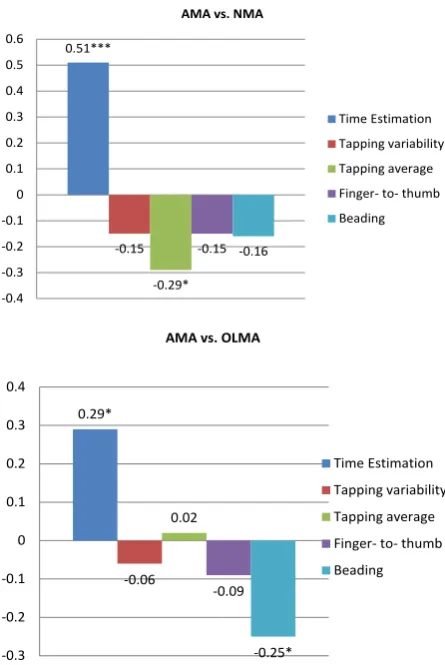
−1) and NMA (coded −1). Unstandardized regression coeffi-cients are presented in Figure 1. The analyses revealed that the AMA group was related with a shorter tapping average duration between two presses and with a better time estimation than the NMA group. AMA group was also related with a quicker com-pletion of the beading task and with a better time estimation than the OLMA group. Therefore, we continue to assess the mediation processes only via these Fine motor skills and time estimation ability. Step II. Unstandardized regression coeffi-cients are presented in Table 2. The analyses revealed that the quicker the completion of the beading task, the better the loco-motion, but not the object control ability. This effect was sig-nificant above and beyond the contribution of the study group to the prediction. Steps III to IV. The bias-corrected bootstrap
0.51***
-0.15
-0.29*
-0.15 -0.16
-0.4 -0.3 -0.2 -0.1 0 0.1 0.2 0.3 0.4 0.5 0.6
AMA vs. NMA
Time Estimation Tapping variability Tapping average Finger- to- thumb Beading
0.29*
-0.06 0.02
-0.09
-0.25* -0.3
-0.2 -0.1 0 0.1 0.2 0.3 0.4
AMA vs. OLMA
Time Estimation Tapping variability Tapping average Finger- to- thumb Beading
Figure 1.
Unstandardized regression coefficients for predicting the change in the fine motor abilities and time estimation ability by study group. Note: *p
[image:4.595.308.539.510.655.2]< .05, ***p < .001.
Table 2.
Unstandardized regression coefficients for predicting the change in the motoric-related abilities by the fine motor abilities and time estimation ability and study group.
Object control Locomotion
−.08 −.23* Beading task
−.04 −.04 Finger-to-thumb
−.11 −.07 Tapping average
.05 .01 Tapping variability
.15 .12 Time estimation
.25* .12 AMA vs. NMA
.45*** .54*** AMA vs. OLMA
Note: *p < .05, ***p < .001.
the inclusion of the fine motor abilities and time estimation ability. Thus, the mediation path was only partial. Figure 2
presents the diagram of the mediating model between AMA (verses the OLMA) via time to complete the beading task to participants’ locomotion abilities.
Dothechangesinthefinemotorandtimeestimation abili-tiesmediatetheeffectstudygrouponthelanguageabilities? In this section, we examined whether the change in the fine motor abilities and time estimation mediated the effect of study groups (AMA, OLMA, and NMA) on linguistic abilities (lan-guage fluency, object naming time, color naming time, digit naming time, phonological awareness). To this end, we em-ployed mediation analyses by Preacher and Hayes’s (2008) procedure, as in our first research question. Step I. To examine whether study group predicts the change in the fine motor abili-ties and time estimation ability, we used the effect-coding that compare the effect of the AMA group (coded 1) with those of the OLMA group (coded −1) and NMA (coded −1). Unstandar-dized regression coefficients are presented in Figure 1. The analyses revealed that the AMA group was related with a quicker tapping time and with a better time estimation than the NMA group. AMA group was also related with a quicker com-pletion of the beading task and with a better time estimation than the OLMA group. Therefore, we continue to assess the mediation processes only via these fine motor abilities and time estimation ability. Step II. Unstandardized regression coeffi-
Figure 2.
Conceptual diagram of the mediating models.
cients are presented in Table 3. The analyses revealed that an improvement in the time taken to complete the finger-to-toe task was linked with an improvement in the phonological aware- ness score. Nevertheless, because study group did not predict the performance in the finger-to-toe task, mediation processes could not have occurred. Conversely, an improvement in the time estimation ability was related with an improvement in the time taken to complete the object naming task. The other paths were not significant. Steps III to IV. Bias-corrected boot-strap analyses revealed that the mediation paths from the AMA group (verses the OLMA and NMA) via the ability to assess time to participants’ object naming time were significant: the 95% confidence intervals (CI) did not include the value zero, CI −.21 to −.03 for NMA, and CI −.32 to −.05 for OLMA. In addition, as can be seen in Table 3, the link between study group and participants’ object naming time was not significant after the inclusion of the Cerebellum related abilities. Thus, the time estimation ability fully mediated these paths. Figure 2 pre- sents the diagram of the mediating model between AMA (verses the OLMA training and/or NMA group) via time esti-mation ability to participants’ object naming ability.
Doesthechangeinthegrossmotorabilitiesmediatetheef- fectofstudygrouponthelinguisticabilities?
In this section, we examined whether the change in the gross motor abilities mediated the effect of study groups (AMA, OLMA, and NMA) on linguistic abilities (language fluency, object naming time, color naming time, digit naming time, pho- nological awareness). To this end, we employed mediation ana- lyses by Preacher and Hayes’s (2008) procedure, as in the first research question. Step I. To examine whether study group pre- dicts the change in the gross motor abilities, we first effect- coded the study group variable. This coding enabled us to com- pare the effect of the AMA (coded 1) with those of the OLMA (coded −1) and NMA (coded −1). Unstandardized regression coefficients are presented in Figure 3. The analyses revealed that the AMA was related with a better locomotion and object control abilities than both the NMA and OLMA conditions. Therefore, we continue to assess the mediation processes via all of the gross motor abilities. Step II. Unstandardized regression coefficients are presented in Table 4 for linguistic abilities. The analyses revealed that better object control abilities were linked with a quicker naming ability. This effect was significant above and beyond the contribution of the study group to the predic-tion.
Steps III to IV. The bias-corrected bootstrap analyses re-vealed that the mediation paths from the AMA (verses the OLMA training and/or NMA group) via object control abilities to participants’ overall naming score (95% CI .06, .45 for AMA vs. NMA, 95% CI .03, .22 for AMA vs. OLMA) were signifi-cant. In addition, as can be seen in Table 4, the path between study group and participants’ overall naming score remained significant after the inclusion of the gross motor abilities, the thus the motor-related abilities only partially mediated this path.
Figure 2 presents the diagram of the mediating model between AMA (verses the OLMA training and/or NMA group) via ob-ject control abilities to participants’ overall naming ability.
Discussion
The aim of this study was to investigate the effects of AMA on motor and language abilities, as well as to examine whether the change in the fine motor abilities and time estimation ability
Table 3.
Unstandardized regression coefficients for predicting the change in the linguistic abilities by the fine motor abilities and time estimation ability and study group.
Phonological Awareness Digit Naming Color Naming Object Naming Language Fluency
−.09 −.02 .15 .01 .05 Beading
−.23* .15 .36** .28** .02 Finger-to-toe
.02 .06 .02 −.13 .02 Tapping average
.07 −.04 .10 .13 −.08 Tapping variability
−.15 −.19 −.13 −.30** −.01 Time Estimation
−.08 −.13 −.06 .05 .02 AMA vs. NMA
.20 −.25 −.06 .04 .14 AMA vs. OLMA
Note: *p < .05, ***p < .001.
0.57***
0.66***
0.52 0.54 0.56 0.58 0.6 0.62 0.64 0.66 0.68
AMA vs. NMA
Object Control Locomotion
0.32**
0.22*
0 0.05 0.1 0.15 0.2 0.25 0.3 0.35
AMA vs. OLMA
[image:6.595.78.521.248.423.2]Object Control Locomotion
Figure 3.
Unstandardized regression coefficients for predicting the change in the motor-related abilities by study group. Note: *p < .05, **p
[image:6.595.56.541.490.577.2]< .01, ***p < .001.
Table 4.
Unstandardized regression coefficients for predicting the change in the linguistic-related abilities by the gross motor abilities and study group.
Phonological Awareness Naming Digit Naming Color Naming Object Naming Language Fluency
−.11 −.04 −.19 −.17 −.18 −.02 Locomotion
.13 .32* −.24 .08 −.06 −.05 Object Control
.16 −.12 −.16 −.16 −.03 .03 AMA vs. NMA
−.10 −.25* −.06 −.16 .03 .18 AMA vs. OLMA
Note: *p < .05, ***p < .001.
can explain change in language abilities in children. To this aim, we examined 94 four- to six-year-old children attending a nor-mal kindergarten. To our knowledge, this is study the first to examine the extent to which cerebellum-related abilities such as gross motor, fine motor abilities and time estimation ability may be mediator in the relationship between language aspects and AMA.
First, we found that the AMA group was related with better gross motor abilities than both the NMA and OLMA conditions. in contrast to Becker (2009: p. 865), who claimed that it is un- likely that aquatic training can substantially improve dryland performance in adults (Killgore, Wilcox, Caster, & Wood, 2006; Robinson, Devor, Merrick, & Buckworth, 2004), our results
AMA, which could account for the difference between the OLMA and AMA groups. The current results of enhancing gross motor-related abilities, are in line with previous studies which reported a similar enhancement, which was claimed to be mediated by increased cortical activation motor areas which was induced by water immersion (Sato et al., 2012).
Second, AMA was related with a shorter tapping average duration between two presses than the NMA group. AMA group was also related with a quicker completion of the beading task than the OLMA group. The development of the human bo- dy follows a proximo-distal and cephalo-caudal direction (Shar- ma, 2005). Thus, children who evidence greater improvement in the gross motor abilities, in the AMA group, may have grea- ter capacity for some fine motor abilities, as evidenced by the scores in bead-threading and the tapping task which are a fine motor task. A possible mediating mechanism for our finding regarding to the motor abilities and the time estimation ability might be increased cerebellar activity, as will be discussed be-low.
AMA provides multisensory stimulation combining these three sensory systems: the vestibular, the proprioception and the tactile. Immersion increases the proprioceptive input and sensory feedback to the immersed body (Roth et al., 2006). The vestibular system is in the inner ear and reacts to head move-ments relative to gravity, and is connected to the cerebrum via the brain stem and cerebellum. The system operates in integra-tion with the proprioceptive system and produces the sense of balance and stability. The vestibular system influences regula-tion of muscle tension, body-movement coordinaregula-tion, and con-trol of eye movements which ensure a stable field of vision while moving (Bundy & Murray, 2002). The proprioceptive system refers to the sensation provided by muscles, ligaments and joints, and is created as a result of body movement.
Proprioception allows ongoing awareness of posture and body movements in space, and the rhythm and timing of these movements (Williamson & Anzalone, 2001). Thus, it is a sys-tem providing external feedback to the cerebellum, allowing regulation of motor activity. The tactile system has receptors in the skin, serving as a mediator between self and environment (Williamson & Anzalone, 2001). Thus, the tactile system pro-vides the cerebellum with external feedback, allowing improv- ed reaction time and precision of movement via the cerebellum. Third, AMA was related with a better time estimation than both the NMA and OLMA conditions. Timing-processing is di- vided into two separate aspects: motor timing, which refers to the timing aspects of motor, speech and cognitive acts; and time perception, which refers to the discriminative aspects of cogni-tive time management, such as the ability to estimate temporal delays (Fuster, 1990). The intermediate cerebellum, through its direct connections with the motor system, mediates the motor aspects of timing, while the lateral cerebellar hemispheres and their output nuclei mediate the cognitive or perceptual aspects of timing through their connections with the fronto-parietal association cortex (Middleton & Strick, 1994). However, func-tional neuroimaging studies showed activation of both the medial and the lateral zones of the cerebellar cortex during tasks requiring the precise representation of temporal informa-tion (Kawashima et al., 2000; Ramnani & Passingham, 2001; Harrington et al., 2004). Thus, it is still unclear if the cerebellar system mediates time-perception independently from motor be- havior or other cognitive functions. Our findings suggest that time-estimation is associated with motor activities and motor
behavior. However, how these results relate to cerebellar acti-vation and neuroplasticity requires additional investigation.
Forth, we did not find differences between the study groups in language abilities. Interestingly, we confirmed association between motor activities in gross motor abilities aspects, but only partially in fine motor aspects. Previous studies found that by kindergarten, fine motor tasks are better predictors of read-ing achievement than gross motor tasks (Wolff, Gunnoe, & Cohen, 1985). In longitudinal study, children with composite gross and fine motor abilities in preschool attained higher levels of third-grade reading achievement (McPhillips & Jordan-Black, 2007). Moreover, Grissmer et al. (2010) found that gross motor abilities did not predict achievement, but fine motor abilities did predict later achievement in math and reading. It seems that fine motor, rather than gross motor abilities are more significant in predicting language abilities. Thus, it seems reasonable to hypothesize that our results about no differences between the three study groups in linguistics abilities could be due to the partially differences in fine motor aspects.
positive effect of AMA on language abilities. It is important to remember that motor abilities are also cerebellum-related abili- ties. These novel findings shed light on the normal develop-ment of the neural network controlling reading-related abilities, which emphasize the importance of the cerebellar activity. Moreover, intervention that enhances functions traditionally re- lated to cerebellum activity leads to improvements in automatic naming ability.
Study Limitations
Up to now, there has been very little research in the field of AMA, especially in regard to the contribution of aquatic activi-ties to areas of functioning that are not physiological or mo-tor-related. The current exploratory study provides a neurobio-logical hypothesis for the relationship between an aquatic envi-ronment and language processes. This is a new concept for research, and one having great importance for developing our understanding of the contribution of aquatic activities. Never-theless, the study has limitations that should be acknowledged. First, the small sample size limited the power of the study and prevents further sub analyses, such as examination of family history of learning disabilities. Second, we are aware of the po- tential differences between various types of motor and non- motor activities that are non-aquatic and that the allocation of the groups was not random. However, this is a preliminary re- search aimed to examine the relationship between AMA and language abilities in normal population during early childhood, as the research related to AMA in this population is scarce. Third, we used gross motor, fine motor and time estimation test as “cerebellum-related” abilities. The claim should be accom-panied by the examination of exercise on brain morphology and internal connectivity (MRI or TDI). Further research is needed to conduct a study that includes this possibility for validating our results. We are currently examining working in this direc-tion.
Conclusion
In conclusion, data from our study supported the “cerebellar deficit hypothesis of dyslexia” (Nicolson et al., 2001) suggest-ing that motor and non motor cerebellar-related abilities are associated with naming abilities. In addition, time-estimation ability moderated the association between AMA and children’s picture naming ability, while object control abilities moderated the association between aquatic motor activities and children’s overall naming score, suggesting the positive effect of AMA on language abilities. Together, the study may contribute to the understanding of the possibilities of different motor interven-tion in different environments. The combinainterven-tion of the advan-tages of an aquatic environment for children may provide use-ful knowledge for physical-education teachers and could be uti- lized in the development of motor interventions for preschool children.
According to our study, early aquatic motor intervention may help reduce early motor difficulties, thereby possibly preventing additional motor disorders which can lead to associated educa-tional problems. Thus, our findings might be the basis for new interventions for naming-related disabilities, such as dyslexia.
Acknowledgements
The results of this research are part of Michal Nissim’s thesis,
Bar-Ilan University in partial fulfillment of the requirements toward her Ph.D. degree.
Michal Nissim is grateful to the Azrieli Foundation for the award of an Azrieli Fellowship.
The authors also wish to thank The Ministry of Education’s Chief Scientist in Israel for the approval and support in con-ducting this research.
REFERENCES
Ahrendt, L. (1999). Influence of water programs on infants motor de- velopment during the first year of life under consideration of their mothers, physical concept. In the 5th International Aquaic Education Conference, Toulouse, 21-23 October 1999. CompteRendu FAAEL. Baron, R., & Kenny, D. A. (1986). The moderator-mediator variable
distinction in social psychological research: Conceptual, strategic, and statistical considerations. JournalofPersonalityandSocialPsy- chology,51, 1173-1182.
Becker, B. E., & Cole, A. J. (1997). Comprehensiveaquatictherapy. Boston: Butterworth-Heinemann.
Becker, B. E. (2009). Aquatic therapy: Scientific foundations and clin- ical rehabilitation applications. AmericanAcademyofPhysicalMed- icineandRehabilitation, 1, 859-872.
Ben-Soussan, T. D., Glicksohn, J., Goldstein, A., Berkovich-Ohana, A., & Donchin, O. (2013). Into the Square and out of the box: The ef-fects of quadrato motor training on creativity and alpha coherence.
PloSone,8, e5502
Breznitz, Z. (2006). Fluencyinreading: Synchronizationofprocesses. Hillsdale, NJ: Lawrence Erlbaum Associates.
Blakemore, S. J., & Frith, U. (2005). Thelearningbrain: Lessonsfor education. Oxford: Blackwell.
Bundy, A. C., & Murray, A. E. (2002). Sensory integration: A. Jean Ayres’ theory revisited. In A. C. Bundy, S. J. Lane, & E. A. Murray (Eds.), Sensoryintegration: Theoryandpractice (2nd ed., pp. 3-33). Philadelphia: F. A. Davis.
Campion, M. R. (1997). Hydrotherapy. Oxford: ButterWarth-Heine- mann.
Cragg, S., & Cameron, C. (2006). Physical activity of Canadian youth—An analysis of 2002 health behaviour in school-aged child-ren data. Canadian Fitness and Lifestyle Research Institute. Ottawa: Ontario.
Denckla, M. B., Rudel, R. G., Chapman, C., & Krieger, J. (1985). Mo- tor proficiency in dyslexic children with and without attentional dis- orders.ArchivesofNeurology, 42, 228-231.
Desmond, J. E., Gabrieli, J. D. E., Wagner, A. D., Ginier, B. L., & Glo- ver, G. H. (1997). Lobular patterns of cerebellar activation of verbal working-memory and finger-tapping tasks as revealed by functional MRI. JournalofNeuroscience, 17, 9675-9685.
Devereux, K., Robertson, D., & Briffa, N. K. (2005). Effects of a wa- ter-based program on women 65 years and over: A randomized con- trolled trial. AustralianJournalofPhysiotherapy, 51, 102-108.
Dow, R., & Moruzzi, G. (1958). Thephysiologyandpathologyofthe cerebellum. Minneapolis, MN: University of Minnesota Press. Fawcett, A., & Nicolson, R. (1996). The dyslexia screening test. Lon-
don: The Psychological Corporation.
Fuster, J. M. (1990). Prefrontal cortex and the bridging of temporal gaps in the perception-action cycle. AnnNYAcadSci,608, 318-329.
Georgiou, G. K., Parrila, R., & Liao, C. H. (2008). Rapid naming speed and reading across languages that vary in orthographic consistency.
Read.Writ,21, 885-903.
Grissmer, D., Grimm, K. J., Aiyer, S. M., Murrah, W. M., & Steele, J. S. (2010). Fine motor skills and early comprehension of the world: Two new school readiness indicators. Developmental Psychology, 46,
Grossman, A. W., Churchill, J. D., Bates, K. E., Kleim, J. A., & Gree- nough, W. T. (2002). A brain adaptation view of plasticity: Is synap- tic plasticity an overly limited concept? ProgBrainRes,138, 91-108.
Hannaford, C. (2005). Smartmoves: Why learningisnot allin your head (2nd ed.). Great River Books.
Harrington, D. L., & Haaland, K. Y. (1999). Neural underpinnings of temporal processing: A review of focal lesion, pharmacological, and functional imaging research. RevNeurosci,10, 91-116.
Harrington, D. L., Boyd, L. A., Mayer, A. R., Sheltraw, D. M., Lee, R. R., Huang, M., & Rao, S. M. (2004). Neural representation of inter- val encoding and decision making. BrainResCognBrainRes,21,
193-20
Heckman, J. J., Stixrud, J., & Urzua, S. (2006). The effects of cognitive and noncognitive abilities on labor market outcomes and social be-havior. JournalofLaborEconomics,24, 411-482.
Hill, E. L. (2001). Non-specific nature of specific language impairment: A review of the literature with regard to concomitant motor impair-ments. International Journal ofLanguage &Communication
Dis-orders,36, 149-17
Holzer, I. (1996). Assessment of motor abilities in school-age children: Theoretical aspects. Part 1. JournalofSports&PhysicalEducation, 1, 15-18. (Hebrew).
Holzer, I. (1996). Assessment of motor abilities in school-age children: Recommendations for Grades 1-4. Journal of Sports & Physical Education,2, 22-25. (Hebrew).
Hurks, P., Vles, J., Hendriksen, J., Kalff, A., Feron, F., Kroes, M. et al. (2006). Semantic category fluency versus initial letter fluency over 60 seconds as a measure of automatic and controlled processing in healthy school-aged children. Journal of Clinical & Experimental Neuropsychology,28, 684-695.
Ivry, R. B., Keele, S. W., & Diener, H. C. (1988). Dissociation of the lateral and medial cerebellum in movement timing and movement execution. ExpBrainRes,73, 167-180.
Ivry, R. B., & Keele, S. W. (1989). Timing functions of the cerebellum.
JournalofCognitiveNeuroscience,1, 136-152.
Ivry, R. B., & Diener, H. C. (1991). Impaired velocity perception in pa- tients with lesions of cerebellum. JCognNeurosci,3, 355-366.
Kave, G. (2006). The Development of naming and word fluency: Evi-dence from Hebrew-speaking children between Ages 8 and 17. De-velopmentalNeuropsychology, 29, 493-508.
Kawashima, R., Okuda, J., Umetsu, A., Sugiura, M., Inoue, K., Suzuki, K. et al. (2000). Human cerebellum plays an important role in memo- ry-timed finger movement: an fMRI study. JNeurophysiol,83, 1079- 1087.
Killgore, G. L., Wilcox, A. R., Caster, B. L., & Wood, T. M. (2006). A lower-extremities kinematic comparison of deep-water running styles and treadmill running. JStrengthCondRes,20, 919-927.
Lakoff, G., & Johnson, M. (1999). Philosophyintheflesh: The embo-diedmindanditschallengestowesternthought. New York: Basic Books.
Losse, A., Henderson, S. E., Elliman, D., Hall, D., Knight, E., & Jong-mans, M. (1991). Clumsiness in children: Do they grow out of it? A 10-year follow-up study.DevelopmentalMedicineandChild Neu-rology,33, 55-68.
MacKinnon, D. P., Krull, J. L., & Lockwood, C. M. (2000). Equiva- lence of the mediation, confounding and suppression effect. Preven-tionScience,1, 173-181.
McPhillips, M., & Jordan-Black, J. A. (2007). Primary reflex persis- tence in children with reading difficulties (dyslexia): A cross-sec- tional study. Neuropsychologia,45, 748-754.
Mechelli, A., Gorno-Tempini, M. L., & Price, C. J. (2003). Neuroimag- ing studies of word and pseudoword reading: Consistencies, incon- sistencies, and limitations. Journal ofCognitiveNeuroscience, 15,
260-27
Middleton, F. A., & Strick, P. L. (1994). Anatomical evidence for ce-rebellar and basal ganglia involvement in higher cognitive function.
Science,266, 458-
Murray, G. K., Jones, P. B., Kuh, D., & Richards, M. (2007). Infant developmental milestones and subsequent cognitive function. Ann
Neurol, 62, 128-136.
Nicolson, R. I., Fawcett, A. J., & Dean, P. (1995). Time estimation deficits in developmental dyslexia: Evidence of cerebellar involve- ment. Proc. R. Soc. LondBBiol. Sci.,259, 43-47.
Nicolson, R. I., Fawcett, A. J., & Dean, P. (2001). Dyslexia, develop-ment and the cerebellum. TrendsNeurosci,24, 515-516.
Norton, E. S., & Wolf, M. (2012). Rapid automatized naming (RAN) and reading fluency: Implications for understanding and treatment of reading disabilities. AnnualReviewofPsychology,63, 427-452.
Overy, K., Nicolson, R. I., Fawcett, A. J., & Clarke, E. F. (2003). Dys-lexia and music: Measuring musical timing skills. Dyslexia,9, 18-36.
Preacher, K. J., & Hayes, A. F. (2008). Asymptotic and resampling strategies for assessing and comparing indirect effects in multiple mediator models. BehaviorResearchMethods,40, 879-891.
Preacher, K. J., Zyphur, M. J., & Zhang, Z. (2010). A general multile-vel SEM framework for assessing multilemultile-vel mediation.
Psychologi-cal Methods, 15, 209-
Ramnani, N., & Passingham, R. E. (2001). Changes in the human brain during rhythm learning. JCognNeurosci,13, 952-966.
Ram-Tsur, R., Faust, M., Caspi, A., Gordon, C. R., & Zivotofsky, A. Z. (2006). Evidence for ocular-motor deficits in developmental dyslexia: Application of the double-step paradigm. InvestOphthalmology
Vis-ualScience,47, 4401-440
Ram-Tsur, R., Faust, M., & Zivotofsky, A. Z. (2008). Poor perfor-mance on serial visual tasks in persons with reading disabilities: Im-paired working memory? JLearnDisabil,41, 437-450.
Raven, J. C. (1965). Guidetousingthecolouredprogressivematrices setsA,Ab,B. (Revised Order, 1956). London: H.K. Lewis.
Riva, D., Nichelli, F., & Devoti, M. (2000). Developmental aspects of verbal fluency and confrontation naming in children. Brain and
Language,71, 267-
Robinson, L. E., Devor, S. T., Merrick, M. A., & Buckworth, J. (2004). The effects of land vs. aquatic plyometrics on power, torque, velocity, and muscle soreness in women.JStrengthCondRes,18, 84-91. Roth, A. E., Miller, M. G., Ricard, M., Ritenour, D., & Chapman, B. L.
(2006). Comparisons of static and dynamic balance following train-ing in aquatic and land environments. JournalofSportRehabilitation, 15, 299-311.
Sato, D., Yamashiro, K., Onishi, H., Shimoyama, Y., Yoshida, T., & Maruyama, A. (2012). The effect of water immersion on short-la- tency somatosensory evoked potentials in human. BMC
Neuros-cience, 13, 13-
Shany, M., Bahat, A., Lachman, D., Shalem, Z., & Zeiger, T. (2005).
“Aleph-Taph”: Anassessment systemforreadingandwriting dis-abilities [in Hebrew]. Tel Aviv, Israel: Yesod.
Sharma, V. K., Das, S., Mondal, S., Goswami, U., & Gandhi, A. (2005). Effect of sahaj yoga on depressive disorders. IndianJPhysiolPhar- macol,49, 462-468.
Shatil, E. (2002). TheShatiltestfortheearlydetectionofspecificdis- abilitiesandofgenerallanguageimpairmentsintheacquisitionof reading and spelling: Thecomprehensive evaluation [in Hebrew]. Kiryat Bialick, Israel: Ach Books.
experimental studies: New procedures and recommendations. Psy- chologicalMethods,7, 422-445.
Smith, L. B., & Thelen, E. (2003). Development as a dynamic system.
TrendsinCognitiveSciences,7, 343-348.
Stoodley, C. J., & Stein, J. F. (2011). The cerebellum and dyslexia.
Cortex,47, 101-116
Strong, W. B., Malina, R. M., Blimkie, C. J., Daniels, S. R., Dishman, R. K., Gutin, B., etal. (2005). Evidence based physical activity for school-age youth. JournalofPediatrics,146, 732-737.
Tan, L. H., Spinks, J. A., Eden, G. F., Perfetti, C. A., & Siok, W. T. (2005). Reading depends on writing, in Chinese. Proc.Natl.Acad.
Sci,102, 8781-8785
Ulrich, D. A. (1985). Testofgrossmotordevelopment. Texas: Pro-ED. Warburton, D. E., Nicol, C. W., & Bredin, S. S. (2006). Health benefits
of physical activity: The evidence. Canadian MedicalAssociation
Journal,174, 801-
Webster, R. I., Majnemer, A., Platt, R. W., & Shevell, M. I. (2005).
Motor function at school age in children with a preschool diagnosis of developmental language impairment. TheJournalof Pediatrics,
146, 80-
Wigfield, A. (1994). Expectancy-value theory of achievement motiva- tion: A developmental perspective. EducationalPsychologyReview,
6, 49-
Wigfield, A., & Eccles, J. S. (2000). Expectancy-value theory of moti-vation. ContemporaryEducationalPsychology,25, 68-81.
Williamson, G. G., & Anzalone, M. E. (2001). Sensoryintegrationand self-regulationininfantsandtoddlers: Helpingveryyoungchildren interactwiththeirenvironment. Washington DC: Zero to Three. Wolff, P. H., Gunnoe, G., & Cohen, C. (1985). Neuromotor maturation
and psychological performance: A developmental study. Develop-mentalMedicineandChildNeurology,27, 344-354.
Zelazo, R., & Weiss, M. J. (2006). Infant swimming behaviors: Cogni-tive control and the influence of experience. Journalof Cognition andDevelopment, 7, 1-25.