Munich Personal RePEc Archive
Analyzing the Impact of Macroeconomic
Shocks on Public Debt Dynamics: An
Application to the Czech Republic
Melecky, Ales and Melecky, Martin
Technical University of Ostrava
October 2011
1
Analyzing the Impact of Macroeconomic Shocks on Public Debt Dynamics:
An Application to the Czech Republic
#Ales Melecky
Martin Melecky
Technical University of Ostrava Department of Economics Sokolska trida 33
Ostrava 1, 701 21 Czech Republic
E-mail: [email protected], [email protected].
Abstract
The global financial crisis and its ramification into the fiscal area have demonstrated the importance of regular assessment and monitoring of fiscal vulnerabilities, including the sustainability of sovereign debt. This paper extends the analytical framework of Favero and Giavazzi (2007) to facilitate the analysis of the effects of macroeconomic shocks on public debt dynamics in an open economy. It then applies this framework using the data for the Czech Republic and derives some policy implications from such an analysis. The modeling framework nests a linear structural vector auto-regression (SVAR) model estimated with short-run identifying restrictions and a non-linear equation describing the public debt dynamics. The main variables of the system include GDP growth, inflation, the effective interest rate on government debt, government expenditures and revenues, the exchange rate and government debt. The utilized estimation method is the Bayesian approach.
Keywords: Macroeconomic Shocks, Non-linear Public Debt Dynamics, Open Economy, Czech Republic, Structural Vector Autoregression Model, Bayesian Estimation.
JEL codes: E62, H68, E37
1. Introduction
The global financial crisis and its ramification into the fiscal area have demonstrated the importance of regular assessment and monitoring of fiscal vulnerabilities, including the sustainability of sovereign debt. The analysis of public debt sensitivities to macroeconomic shocks is important for understanding risks to the future path of public debt and most likely causes of its possible adverse developments. This understanding then enables authorities to develop a set of contingency plans that can be effectively deployed should adverse scenarios realize and through such policy interventions ensure continued public debt sustainability. The existing methodologies for debt sustainability analysis are most commonly conducted within linear systems or often neglect the feedback effect of the public indebtedness on the macroeconomy.
This paper extends the analytical framework of Favero and Giavazzi (2007) to facilitate the analysis of the effects of macroeconomic shocks on public debt dynamics in an open economy context. It then applies this framework to data for the Czech Republic to understand the vulnerabilities of the fiscal stance in the Czech Republic to main macroeconomic shocks. Based on the identified main vulnerabilities, the paper attempts to derive some recommendations to ensure continues public debt sustainability. The modeling framework includes a linear structural vector auto-regression (SVAR) model estimated with short-run identifying restrictions and a non-linear specification of the public debt dynamics. The main variables of the system include GDP growth, inflation, the effective interest rate on government debt, government expenditures and revenues, the exchange rate and government debt. The utilized estimation method is the Bayesian system estimator which combines the advantages
#
2
of the full information likelihood approach and possibility to employ priors. The latter enable one to draw on the relevant economic theory and ensure that the optimizer used in the estimation of posterior modes of the model parameters is well behaved.
The remainder of the paper is organized as follows. Section two explains the modeling approach. Section three discusses the employed data. Section four describes the estimation methodology. Section five discusses the estimation results and the ensuing policy implications. And, section six concludes.
2. The Modeling Approach
Following Favero and Giavazzi (2007), we nest our modeling approach in a linear Vector Autoregression (VAR) structure, and add a non-linear specification for the public debt-to-GDP ratio. Namely, we start from designing a Structural VAR by means of which we identify the structural shocks of interest using short-run restrictions resulting from the ordering of the endogenous variables. The model takes the form:
1 1
k k
t i t i i t i t
i i
AY B Y−
δ
d−ε
= =
=
∑
+∑
+ (1)where
Y
t is a vector of endogenous variables with linear dynamics, including the log of government ofexpenditures (
g
t), the log of government revenues (t
t), the log of real GDP (y
t), the annualizedquarterly change in GDP deflator (
∆
p
t), the effective interest rate on government debt (i
t), and theannualized quarterly change in the real effective exchange rate (
s
t).d
t is public debt over GDP, andt
ε
is a vector of structural shocks. A is a lower triangular matrix of estimated coefficients for thecontemporaneous endogenous variables, Bis a matrix of estimated coefficient for the lagged
endogenous variables, and
δ
is a vector of estimated coefficients on the lagged government debt toGDP ratio. The reduced-form of the SVAR in (1) can be then written as:
1 1
k k
t i t i i t i t
i i
Y C Y−
γ
d− u= =
=
∑
+∑
+ (2)where C= A B−1 ,
A
−1γ
andu
t is the reduced-form shock with:11
21
31 32
41 42 43
51 52 53 54
61 62 63 64 65
1
0
0
0
0
1
0
1
1
1
1
1
1
0
1
0
1
0
0
1
g g t t t t t t y y t t p p t t r r t t s s t t
b
u
e
a
u
e
a
a
u
e
a
a
a
u
e
a
a
a
a
u
e
a
a
a
a
a
u
e
=
(3)where et ’s are the structural shocks. The main identification assumption imposes a diagonal structure
on the A matrix. This implies that output, inflation, interest rates and revenues respond
3
ordered as the last, and this makes it the most endogenous variable within the system. Such an assumption is typical for open economy models due the empirically evidenced high efficiency of foreign exchange markets and quick absorption and pricing of any news by foreign exchange markets.
The public debt evolution is described by the following equation:
(
)(
)
1( )
( )
( )
exp exp
1
1 1 exp
t t
t
t t
t t t
g t
i
d d
p y − y
− +
= +
+ ∆ + ∆ (4)
Given the non-linear form of equation (4), the debt dynamics, the first difference of the public debt itself follows a non-linear process. Differencing equation (4) one obtains:
(
)
(
)(
)
1( )
( )
( )
exp exp
1 1 exp
t t t t t t t
t t
t t t
i p y y p g t
d d
p y − y
− ∆ − ∆ − ∆ ∆ −
∆ = +
+ ∆ + ∆ (5)
The system of equations described in (2) and (4) will enable us to study, simulate and forecast the debt-to-GDP ratio dynamics and its responses to macroeconomic shocks. We will describe the data to which the system is fitted and the employed Bayesian estimation method next.
3. Data Description
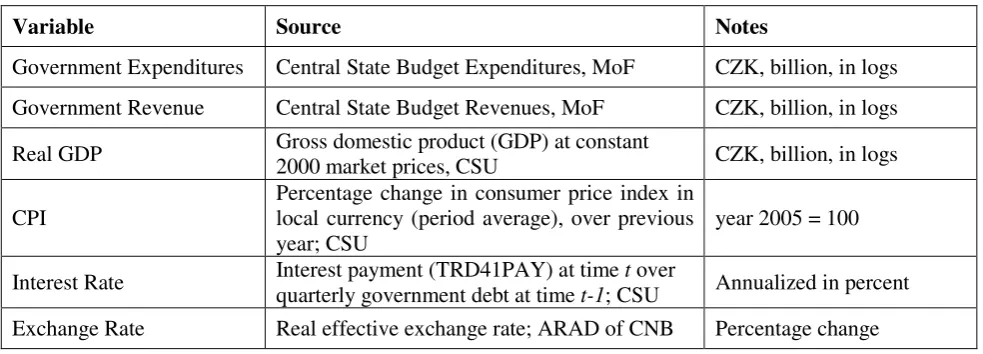
To estimate the model, we use data series for the Czech Republic over the period 2000-2010. The reason for starting as of 2000 is that the data on debt service charges on government debt, which are needed to construct the effective interest rate on government debt, are only available as of 2000. Despite the rather short data span, there is one advantage to starting as of 2000. Namely, the period covers only one monetary policy regime of inflation targeting introduced by the Czech National Bank as of 1998. The government expenditure and revenue series were obtained from the Economic Intelligence Unit (EIU) based on the primary data published by the Czech Ministry of Finance. The real GDP and CPI series was taken from the EIU and originally complied by the Czech Statistical Office (CSU). The effective interest rate on government debt was calculated as the ratio of interest payment on government debt over the quarterly government debt lagged one period and annualized. The exchange rate change is the quarterly percentage change in the real effective exchange rate obtained from the Czech National Bank (CNB). All series were seasonally adjusted using the Census X12 tool and de-meaned prior to the estimation.
[image:4.595.56.548.553.730.2]
Table 1: Employed Data Series and Their Sources
Variable Source Notes
Government Expenditures Central State Budget Expenditures, MoF CZK, billion, in logs
Government Revenue Central State Budget Revenues, MoF CZK, billion, in logs
Real GDP Gross domestic product (GDP) at constant
2000 market prices, CSU CZK, billion, in logs
CPI
Percentage change in consumer price index in local currency (period average), over previous year; CSU
year 2005 = 100
Interest Rate Interest payment (TRD41PAY) at time t over
quarterly government debt at time t-1; CSU Annualized in percent
Exchange Rate Real effective exchange rate; ARAD of CNB Percentage change
4
4. Estimation Method
Since the nonlinear equation describing debt-to-GDP dynamics does not contain any
parameters that need to be estimated, the VAR including its structural factorization can be
estimated separately from the debt dynamics. Therefore, one can use simple linear estimation
methods such as the OLS. However, one can improve on the OLS by applying some system
estimation method such as the Full Information Maximum Likelihood (FIML). One of the
drawbacks of using ML is that parameters can take on corner solutions or theoretically
implausible values. Additionally, it is often the case that the log-likelihood function is flat in
certain directions of the parameter space or extremely hilly overall, so that without careful
constraints on the parameters space it is difficult to numerically maximize the log-likelihood
function (see An and Schorfheide, 2005, for more details). Rather than imposing constraints
on the parameter space in ML estimation, it is more natural to add a probabilistic statement, or
a prior belief, on the parameter space of the estimated model. This can be done easily within a
Bayesian estimation approach which combines theoretical constraints and prior beliefs on the
parameter space with the information contained in the data (see, e.g., Adolfson
et al.
, 2005).
Due to these reasons, we use the Bayesian estimation method to obtain estimates of and draw
inference on the model parameters.
Our model has a VAR(1) structure for which the likelihood function can be easily
computed and combined with the prior densities on the parameters to arrive at the posterior
density. Namely, given the priors
, where is a vector containing the model parameters,
the posterior density
is proportional to the product of the likelihood function of the
solved model and the priors:
(6)
where
is the likelihood function conditional on data . Note that the priors that we use
are mutually independent, so that
is constructed as the product of the individual priors
on the structural parameters given in the second column of Table 1. The posterior in (6) is
generally a non-linear function of the structural parameters and is maximized using a
numerical optimization algorithm.
1The values of the parameters at the posterior mode,
together with the corresponding Hessian matrix are then used to start the random walk
Metropolis-Hastings sampling algorithm to obtain draws from the entire posterior distribution.
Proposals in the sampling algorithm are drawn from a multivariate Normal distribution, where
a scaling factor of 0.2 was used, resulting in an acceptance rate of 35.8%. We generated
20,000 draws, where the first 50% of each chain were discarded as a burn-in sample.
5. Discussion of Estimation Results
In this section, we start by discussing the Bayesian estimation results of the non-linear system described in subsection 1, then proceed to forecast simulation of the debt-to-GDP ratio in subsection 2, and finally to studying the impulse response functions of the debt-to-GDP ratio to the identified macroeconomic shocks of interest in subsection 3. Basically, the idea is to look into which are the likely most important drivers of the debt to GDP dynamics based on the estimated reduce form of the system. Then use the system to simulate a forecast of the debt-to-GDP including its growth dynamics while outlining the degree of uncertainty surrounding this forecast simulation. Given the forecast uncertainty, we ask ourselves the question of what are then the most important shocks that, if realized, can take the debt-to-GDP ratio off its mean forecast trajectory. And, we use the impulse response analysis for that.
1
5
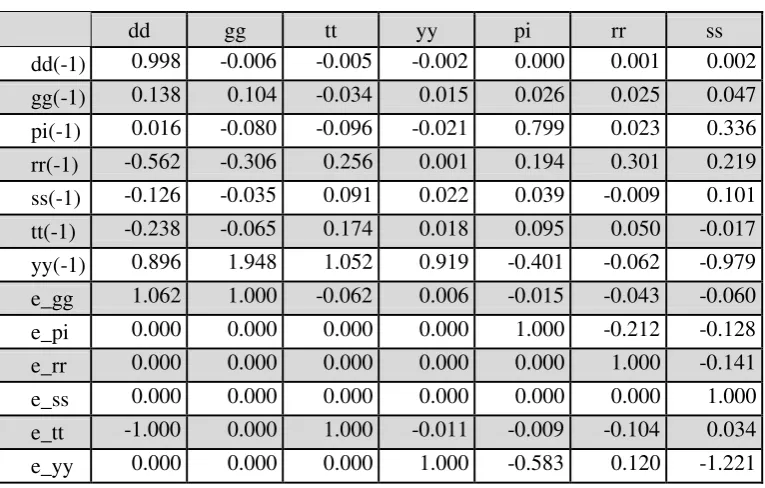
5.1. The Reduced-Form Estimation ResultsTable 2 shows the reduced-form solution based on the structural VAR estimation results using the Bayesian approach. The persistence of the endogenous variables conditional on the marginal effects of other endogenous variables is our first calibrated parameter of interest, as it predetermines how long the impact of macroeconomic shocks on a given variable is likely to last. The debt to GDP ratio shows high persistence of close to one so that all macroeconomic shocks are expected to have a long-lasting effect on the variable. Government expenditures and revenues show lower persistence of 0.10 and 0.17 respectively, and we can expect relatively faster adjustment of those variables after a macroeconomic shock to their steady state. Similarly as the debt to GDP ratio, the log of GDP shows high persistence of 0.92 with an expected, long-lasting effect of shocks on GDP. Inflation shows also a rather higher persistence of 0.8; however, it is noticeably lower than those of the debt to GDP ratio and GDP. The financial variables, the effective interest rate on government debt and the exchange rate, show respective persistence of 0.3 and 0.1 with an expectation of rather a stronger adjustment back to the steady state.
Since the debt to GDP ratio is our primary variable of interest, we will comment on the calibrated marginal effects of the other lagged endogenous variable on the debt to GDP ratio next. The lagged government expenditure (gg) has a positive effect on the debt to GDP ratio of 0.138, in contrast to government revenues, with a negative effect of -0.238. Both effects are in line with the economic theory and the overall relative effects of the two variables will also depend on the size and effect of their respective shocks. In this respect, the estimated direct effect of government revenue and government expenditure shocks on debt/GDP, shown in the first column of Table 2, seem to point out to a marginally higher impact of changes in government revenues on the debt to GDP ratio.
Lagged inflation has only a small positive effect on debt/GDP and this could be due to the fact that although rising prices broaden the tax base and increase collections of progressive taxes, they also represent a negative supply shock and thus lower performance of the production side of the economy. These two theoretical effects seem to cancel out and produce an empirical estimate close to zero. In contract, GDP is expected to have a strong positive effect on the debt to GDP ratio, as it drives the denominator of this ratio (recall that GDP shows also high persistence). Furthermore, GDP is also very closely correlated with revenues, with the causality expected to work from GDP to revenues. Given these strong theoretical links, the GDP effect is rather moderate in light of such considerations.
The effect of the lagged interest rate is strongly negative. This is a puzzling estimate as one would expect that an increased financing cost would result in higher debt service payments and further accumulation of debt. Nevertheless, the empirical result suggests that as the government financing cost increase, the Czech government resorts to debt consolidation through either reallocation, restructuring or running smaller deficits and manages to lower the debt to GDP ratio as a result. Note that this estimate is expected to also produce counterintuitive impulse responses when we study the effect of the interest rate shock on debt/GDP. Also the lagged real exchange rate appears to bear a counter-intuitive sign in the reduced form calibration. However, one needs to recognize that the exchange rate has both a positive income effect and a negative balance-sheet effect on the economy and public debt. Namely, as the exchange rate depreciates, the local currency value of the foreign currency debt increases as a result and so do the associated debt service charges. This should produce a negative effect on debt/GDP. At the same time though, the real exchange rate depreciation increases the price competitiveness of the domestic economy, and helps boost net exports, GDP and government revenues. This should lower the public debt, increase GDP and lower debt/GDP. Since in our model the balance-sheet effect is downplayed as we do not model explicitly the currency allocation of the total government debt, the empirical estimates imply dominance of the positive income effect of an exchange rate depreciation on debt/GDP.
6
Table 2: Reduced-Form Estimates of the Analyzed System
dd gg tt yy pi rr ss
dd(-1) 0.998 -0.006 -0.005 -0.002 0.000 0.001 0.002
gg(-1) 0.138 0.104 -0.034 0.015 0.026 0.025 0.047
pi(-1) 0.016 -0.080 -0.096 -0.021 0.799 0.023 0.336
rr(-1) -0.562 -0.306 0.256 0.001 0.194 0.301 0.219
ss(-1) -0.126 -0.035 0.091 0.022 0.039 -0.009 0.101
tt(-1) -0.238 -0.065 0.174 0.018 0.095 0.050 -0.017
yy(-1) 0.896 1.948 1.052 0.919 -0.401 -0.062 -0.979
e_gg 1.062 1.000 -0.062 0.006 -0.015 -0.043 -0.060
e_pi 0.000 0.000 0.000 0.000 1.000 -0.212 -0.128
e_rr 0.000 0.000 0.000 0.000 0.000 1.000 -0.141
e_ss 0.000 0.000 0.000 0.000 0.000 0.000 1.000
e_tt -1.000 0.000 1.000 -0.011 -0.009 -0.104 0.034
e_yy 0.000 0.000 0.000 1.000 -0.583 0.120 -1.221
Source: Bayesian Estimates (Posterior Means), Authors’ calculations.
5.2. The Debt Level to GDP Ratio Forecast
The left panel of Figure 1 shows the results of the simulated Bayesian dynamic forecast 20 periods ahead for the debt to GDP ratio, as of 2010Q4. Note that zero on the X-axis corresponds to
2009Q2 and the forecast starts in the 6th period as delineated by the forecast confidence intervals. The
right panel then shows the derived forecast of the debt to GDP growth rate for the same period.
Figure 1: Forecast of the Debt Level to GDP Ratio
Source: Authors’ Calculations
Notes: zero represent Q2 of 2009; forecast starts in Q4 2010; 90% confidence bands.
[image:7.595.70.528.460.721.2]7
i.e. by 2015Q4, the debt to GDP ratio could reach about 37 percent. This is an increase up from about 36.5 percent by end-2010. However, the risk is that negative macroeconomic environment represented by adverse macroeconomic shocks could make the debt to GDP grow as far as 39 percent based on the 90 percent confidence bands estimates. It is therefore crucial that efforts to consolidate public debt are undertaken.
One option is to implement a sequence of discretionary changes in government expenditure or better allocation or structuring of public debt. The second option could be to introduce more
permanent changes in government policies behind the revenues, expenditures and debt structure.2
However, this would amount to a systemic change of government policy and thus also a change in the government reaction functions, which we condition on in our model, in particular the estimated
equations for government expenditure and revenue.3 It seems that the second type of reform is needed
as the upside risk represented by the lower 90% confidence interval still shows positive trend so that even a sequence of discretionary changes in fiscal stance is not likely to reverse the forecasted trend, at the given confidence level.
The right panel of Figure 1 shows the forecasted growth in the debt to GDP ratio. The growth rate is expected to stay positive but decline over time and reach zero by 2015. However, the growth rate is forecasted to remain above three percentage points for the next two years (eight periods). In sum, although it seems that the macroeconomic shocks should not jeopardize the Czech Republic’s fiscal stance and debt sustainability in the context of the 60% Maastricht criterion on the debt to GDP, some fiscal rules along those introduced e.g. by Poland (see Melecky A. and Skutova, 2011), which would trigger early consolidation of government debt, could be desirable. This is especially important in light of the EU countries fiscal stance vulnerability to macroeconomic shocks identified in Dybczak and Melecky (2011).
4.3. The Debt Level to GDP Ratio Responses to Macroeconomic Shocks
Figure 2 shows the impulse responses of the debt to GDP ratio to the macroeconomic shocks of interest that were identified using the SVAR restrictions imposed on the data. The macroeconomic shocks of interest are (i) the fiscal shocks, i.e. discretionary changes in government revenues and expenditure, (ii) the real economy shocks, i.e. the shocks to real GDP and inflation which are also deemed to characterize the aggregate demand and aggregate supply shock, respectively, and (iii) financial shocks, i.e. the shocks to the effective interest rate on government debt and the exchange rate. We will discuss the individual responses in turn, next.
2
Melecky (2007a) provides an analysis and discussion of public debt management strategies across countries; Melecky (2007b) discusses the authorities’ approaches to choosing their government debt structure; and Melecky (2010) studies the synchronization indicators of exchange rate volatility for optimal allocation of foreign currency debt.
3
8
Figure 2: Debt Level to GDP Ratio Responses to Macroeconomic Shocks
Source: Authors’ Calculations
Although we do not report the impulse responses for the other endogenous variables in the system, due to the non-linear specification of the debt/GDP dynamics, the responses associated with the latter variable are much more pronounced (volatile) and longer-lasting. The reported IRFs are with respect to the one-standard deviation shocks, i.e. shocks of similar probability not a similar magnitude.
Consider first the debt/GDP responses to the fiscal shocks. A positive discretionary increase in government revenues is estimated to decrease the debt/GDP ratio at impact in line with the economic theory. This impact is rather short-lasting and its magnitude moderate compared to the other shock, implying that adjustments in fiscal stance might be more effectively implemented on the expenditure side. This is because a discretionary increase in government expenditures increases the debt/GDP ratio, also in line with the economic theory, but the effect of this shock at impact is almost two times greater than that of the revenue shock. As a result, also the duration of this response is longer lasting. It seems that based on the impulse responses discretionary government expenditures have the tendency to introduce more volatility into the debt/GDP dynamics compared to discretionary increase in the revenues. This could indicate that in order to achieve more stability of public finances and less of an disruptive effect of the debt/GDP changes on the real economy more discipline and consolidation efforts should be concentrated on the government expenditure side (note the negative sign on the effect of the debt/GDP on GDP in the first row of the forth column in Table 2).
Next, consider the responses of debt/GDP to the real economy shocks. The impact of inflation (negative supply) shock reaches its first extreme after around two periods by causing debt/GDP increase because the economy underperforms as a result of the negative supply shock and government revenues decline. Subsequently the response turns significantly negative showing a much greater decrease in debt/GDP at its peak after some 20 periods. This swing in the impact of the inflation shock could be explained by a broadening of a tax base and more tax payers entering higher brackets in progressive tax scheme that comes to play only gradually after an inflation increase.
9
increase in revenues. Although a positive GDP shock does cause an about one-for-one increase in government revenues, it also causes an increase in government expenditures. In fact our estimate is that the increase in government expenditures, most likely due to an expected revenue windfall, is about two times bigger than the actual increase in revenues. This divergence between the response of government revenues and expenditures after a positive GDP causes the debt/GDP to increase significantly with the response showing strong persistence. This finding indicates that pro-cyclicality of government fiscal stance could be a major problem for future debt dynamics in the Czech Republic.
Finally, consider the response of debt/GDP to the financial shocks. The response of debt/GDP to the real exchange rate shocks changes its direction over time. Namely, it starts consistently with the expectation that a positive change in exchange rate should increase a country’s competitiveness, net exports and government revenues and thus lower the debt/GDP ratio. However, this effect is reversed after some ten periods and the debt/GDP increases henceforth significantly. This could be explained by two possible effects that might be at play and are not directly apparent from our reduced-form estimation results. Namely, the exchange rate depreciation causes the local currency (CZK) value of the foreign currency portion of the total government debt to increase permanently and further increase the debt service payments on foreign currency debt. This could be problematic if the government itself does not possess significant foreign currency hedges, either natural or synthetic ones. This seems to be the case in the Czech Republic and therefore better allocation of the total debt across currencies could be considered. This is despite the fact that the portion of the foreign currency debt of the Czech government is relatively small by international standards.
The response of debt/GDP to an interest rate shock is another puzzling one. The theory
suggests that an increase in the financing cost should make it ceteris paribus more difficult for a
government to service their obligations and result in the accumulation of more debt. However, this expected outcome under the “everything else constant” constant scenario, is not supported by our estimates which indicate that after an unexpected increase in the financing cost, the Czech government undertakes significant consolidation efforts to lower the debt/GDP ratio. This conclusion is also supported by the estimated negative effect of the lagged effective interest rate on government expenditures and in parallel on the debt/GDP itself. The Czech government seemed to have been able to systematically lower the debt burden in the past during the challenging times when the effective interest rate on government debt had increased.
In sum, the non-linear specification of the debt/GDP dynamics seems to make the responses of this variable more persistence and volatile since the responses often change their direction over time. The fiscal stance in the Czech Republic seems to be most vulnerable to an unexpected exchange rate depreciation which initially generates more revenues through a positive income effect but later on the negative balance sheet effect takes over and produces an overall significant negative response. The second vulnerability that the Czech fiscal stance has been facing originates in discretionary increases in government spending that are strongly pro-cyclical and tend to increase the sovereign debt burden. However, severe deflationary shocks could be even more harmful to the Czech fiscal stance and take the debt/GDP ratio for a long time away from its steady state. This finding is concerning in relation to the most recent periods of the global financial and economic crisis which has produced below-the equilibrium inflation rates due to a significant wealth destruction effect.
6. Conclusion
10
percentage points between end-2010 and end-2015. Therefore in the second step, we analyzed the sensitivity of the debt-to-GDP ratio to main macroeconomic shocks identified by means of an SVAR model. We found that considering the non-linear specification for the debt-to-GDP dynamics could produce more persistence and volatile responses of the variable to macroeconomic shocks. Overall, the fiscal stance in the Czech Republic seems to be most vulnerable to an unexpected local currency depreciation which initially generates more revenues through a positive income effect, but later on the negative balance sheet effect takes over and produces a significant negative response. The second largest vulnerability that we identified originates in strongly pro-cyclical discretionary increases in government spending that tend to increase the sovereign debt burden. Nevertheless, severe deflationary shocks could be even more harmful to the Czech fiscal stance and derail the debt-to-GDP ratio for an extended period away from its steady state. Given our findings and the importance of exchange rate movements for a small open economy, future research should focus on explicit modeling of the exchange rate balance-sheet effect on government debt considering its detailed currency allocation.
References
Adolfson, M., Laseen, S., Linde, J., Villani, M. (2005). Empirical Properties of Closed and
Open Economy DSGE Models of the Euro Area.
Macroeconomic Dynamics
12(S1), 2-19.
An, S., Schorfheide, F. (2005). Bayesian Analysis of DSGE Models. Discussion Paper 5207,
Centre for Economic Policy Research.
BLANCHARD, O., PEROTTI, R. (2002). An Empirical Characterization of the Dynamic Effects of
Changes in Government Spending and Taxes on Output. The Quarterly Journal of Economics,
117(4):1329-1368.
CHRISTIANO, L.J., EICHENBAUM, M., EVANS, C.L. (1998). Monetary Policy Shocks: What
Have We Learned and to What End?, in J.B. Taylor and M. Woodford eds., Handbook of
Macroeconomics, volume 1A, 65-148. (also NBER WP 6400).
Dybczak, K., Melecky, M. (2011). Macroeconomic Shocks and the Fiscal Stance within the
EU: A Panel Regression Analysis. MPRA Paper 33684, University Library of Munich,
Germany.
Favero, C., Giavazzi, F. (2007). Debt and the Effects of Fiscal Policy. NBER Working Paper Series 12822.
ILZETZKI, E., MENDOZA, E., VEGH, C. (2010). How Big (Small?) are Fiscal Multipliers? Mimeo,
University of Maryland.