http://www.scirp.org/journal/ajor ISSN Online: 2160-8849
ISSN Print: 2160-8830
Adaptive Parallel Particle Swarm
Optimization Algorithm Based on Dynamic
Exchange of Control Parameters
Masaaki Suzuki
Department of Industrial Administration, Tokyo University of Science, Chiba, Japan
Abstract
Updating the velocity in particle swarm optimization (PSO) consists of three terms: the inertia term, the cognitive term and the social term. The balance of these terms determines the balance of the global and local search abilities, and therefore the per-formance of PSO. In this work, an adaptive parallel PSO algorithm, which is based on the dynamic exchange of control parameters between adjacent swarms, has been developed. The proposed PSO algorithm enables us to adaptively optimize inertia factors, learning factors and swarm activity. By performing simulations of a search for the global minimum of a benchmark multimodal function, we have found that the proposed PSO successfully provides appropriate control parameter values, and thus good global optimization performance.
Keywords
Swarm Intelligence, Particle Swarm Optimization, Global Optimization, Metaheuristics, Adaptive Parameter Tuning
1. Introduction
In the various aspects of optimization, there are cases where a globally optimal solution is not necessarily obtainable. In such cases, it is desirable to find instead a semi-optimal solution that can be computed within a practical timeframe. To achieve this goal, heu-ristic optimization techniques are popularly studied and used, typified by genetic
algo-rithms (GA), simulated annealing (SA) and particle swarm optimization [1] (PSO). In
addition, since multipoint search algorithms like GAs and PSO can determine a Pareto- optimal solution based on a one-time calculation, they are actively employed in applied research to handle multipurpose optimization problems.
How to cite this paper: Suzuki, M. (2016) Adaptive Parallel Particle Swarm Optimi-zation Algorithm Based on Dynamic
Ex-change of Control Parameters. American
Journal of Operations Research, 6, 401- 413.
http://dx.doi.org/10.4236/ajor.2016.65037
Received: July 29, 2016 Accepted: September 25, 2016 Published: September 28, 2016
Copyright © 2016 by author and Scientific Research Publishing Inc. This work is licensed under the Creative Commons Attribution International License (CC BY 4.0).
http://creativecommons.org/licenses/by/4.0/
If the objective function under consideration is multimodal, then heuristic optimiza-tion techniques are desired to have qualities including a global soluoptimiza-tion search ability, maintained by preservation of solution diversity; a local solution search ability, main-tained conversely by centralization of the solution search; and a balance between these two. Solution diversification and centralization strategies are factors universally shared by heuristic optimization techniques, and influence their performance. However, there are few precise and universal guidelines for configuring the values of the parameters that control these strategies: their configuration is problem-specific. Additionally, tun-ing of these parameters is not simple, and generally requires many preliminary calcula-tions. Furthermore, which parameter values are suitable may vary at every stage of the solution search; pertinent examples include the configuration of crossover rate and spontaneous mutation rate in GAs and the temperature cooling schedule in SA.
Focusing on PSO, a kind of multipoint search heuristic optimization technique, in this study we propose several parallel PSO algorithms in which control parameters are dynamically exchanged between a number of swarms and are adaptively adjusted dur-ing the solution search process. We also share our finddur-ings from an evaluation of algo-rithm performance on a minimum search problem for a multimodal objective function.
2. Particle Swarm Optimization
PSO is an evolutionary optimization calculation technique based on the concept of swarm intelligence. In PSO, the hypersurface of an objective function is searched as in-formation is exchanged between swarms of search points, which simulate animals or insects. The next state of each individual is generated based on the optimal solution in
its search history (“personal best”; pbest), the optimal solution in the combined search
history of all individuals in the swarm (“global best”; gbest), and the current velocity
vector. Briefly, assuming a population size Np and problem dimension Nd, the position
and velocity of an individual i (where i=1,,Np) at the t + 1th step of the search,
re-spectively ( )t 1 i
+
x and vi( )t+1 , are:
( )1
(
( )1 ( )1 ( )1)
,1 , , , , , , d
t t t t
i xi xi j xi N
+ = + + +
x (1)
( )1
(
( )1 ( )1 ( )1)
,1 , , , , , , d
t t t t
i vi vi j vi N
+ = + + +
v (2)
These two variables can be updated by means of the following equation, using the position and velocity at the tth step, ( )t
i
x and vi( )t :
( )1 ( )
(
( ) ( ))
(
( ) ( ))
, , 1 1, , , 2 2, ,
t t t t t t
i j i j i j i j i j i j j i j
v + = ⋅γ v + ⋅c rand ⋅ pbest −x + ⋅c rand ⋅ gbest −x (3)
( )1 ( ) ( )1
, , ,
t t t
i j i j i j
x + =x +v + (4)
Here, ( )t
i
pbest represents the optimal solution discovered during the search
through the tth step by individual i itself, while ( )t
gbest represents the optimal solution
discovered during the search through the tth step by the swarm to which individual i
belongs. The term γ represents inertia, and takes a value between [0, 1] (inertia
the social learning factor (learning factors); and rand1 and rand2 are uniform random numbers in [0, 1]. The PSO solution search procedure is described below:
1. Decide population size and maximum number of search steps. 2. Set initial position and velocity of each individual.
3. Calculate objective function value for each individual.
4. Determine the optimal individual solution pbest for each individual and the
op-timal swarm solution gbest, and update these values.
5. Update the position and velocity of each individual according to Equation (3) and (4).
6. End search if desired solution accuracy is obtained or if maximum number of steps is reached.
The algorithm behind PSO is simpler than a GA, another multipoint search heuristic optimization technique, making it easier to code and tending to lead to faster solution convergence. On the other hand, PSO sometimes loses solution diversity during the search, which readily invites excessive convergence. In response, improved PSO tech-niques have begun to be proposed around the world. Examples include distributed PSO and hierarchical PSO, which search the solution space with multiple different swarms
[2] [3]; a method that performs a global search for its initial calculations but intensively
searches the area of suboptimal solutions thereafter similar to SA [4]; a technique that
incorporates bounded rational randomness thereafter, like the “lazy ant” in ant colony optimization; and a method that avoids local solutions if the algorithm become caught in them for a while. As with many other heuristic optimization techniques, PSO in-cludes several option control parameters that analysts can set. Because these settings can greatly influence search performance, theoretical research on stability and
conver-gence due to parameter values [5] [6] and research and development on PSO with
adaptive parameter tuning functions (e.g., [7] [8]) are underway. The tuning of the
quantum PSO (QPSO) [9] is simpler compared to standard PSO since QPSO has only a
single control parameter.
3. Proposed Method
In this study, we focus on several parameters to control diversification and centrali-zation in solution search: the inertia factor γ , learning factors c1 and c2, and swarm activity (described in Section 3.3). Introducing concepts similar to those employed in
the replica-exchange method [10] and parallel SA method, we propose parallel PSO
algorithms in which parameter values are adaptively adjusted via dynamic exchange of the above control parameters between multiple swarms during the solution search process.
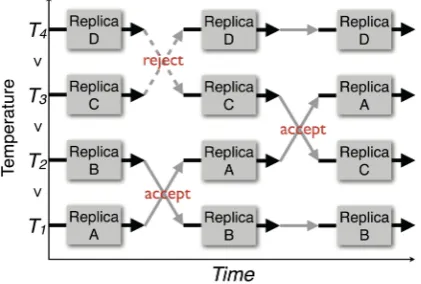
encourage readers to imagine “temperature” here as the temperature parameter in Me-tropolis Monte Carlo simulations, i.e., it indicates the degree to which deterioration is permitted when making the decision to transition to a candidate in the next state. Solu-tion searches in high-temperature systems exhibit behavior close to a random search, whereas solution searches in low-temperature systems exhibit behavior close to the steepest descent method. Solution search calculations are run independently and si-multaneously for each replica, each at its respective constant temperature. At the same time, temperature is exchanged periodically after a certain number of search steps
ac-cording to the exchange probability w in the following equations between a given
rep-lica pair (with respective states XT T=k and XT T′=k+1) having adjacent temperatures (Tk
and Tk+1).
{
} {
}
(
1 1)
( )
1 forΔ 0
, ,
exp Δ forΔ 0
k k k k
T T T T T T T T
w X = X′= + → X = + X′= = ≤
− >
(5)
(
) (
)
{
1}
1
1 1
k k
T T T T
k k
E X E X
T T+ = + =
′
∆ ≡ − −
(6)
Here, E(X) represents the energy of a replica at state X (i.e., the objective function
value). Figure 1 shows a schematic diagram of the replica-exchange method. In the
replica-exchange method, high-temperature calculations correspond to retention of solution diversity, while low-temperature calculations correspond to a local solution search. Moreover, we can argue that it has some qualities of heuristic optimization al-gorithms for multimodal objective functions, in that its calculations are repeated as temperatures are probabilistically exchanged. Unlike SA, in which temperature falls monotonically, in this technique the temperature meanders if we focus on a single giv-en replica. Thus, one can use this method to search a large solution space without be-coming caught in a semi-s state.
3.1. Inertia-Factor Parallel PSO
Here, we first propose a technique focusing on the inertia factor γ , a control parameter
[image:4.595.269.480.541.683.2]in Equation (3). The search trajectories of individuals with large γ are more curved,
whereas those of individuals with small γ converge to an intermediate point between
pbest and gbest (dependent on c1 and c2). Thus, efficient optimization should be achievable if, in the initial search, individuals are given large γ values and the solu-tion search space is wide, while in its final stages, individuals are instead given small γ
values and a solution is searched for intensively at pbest, gbest, and the area between them. For this reason, each individual’s γ is typically reduced linearly with increasing search step t, according to the following equation:
( ) max min
max max t t t γ γ
γ =γ − − ⋅ (7)
Here, γmax and γmin respectively represent the maximum and minimum inertia
factors, and tmax is the maximum number of search steps. Note that there is no single
optimal reduction schedule one can choose for inertia factor γ: in truth, multiple
techniques have been proposed besides the linear reduction described above [11],
in-cluding exponential reduction [12] and stepwise reduction methods [13].
We consider Ns swarms with various different γ values in the Inertia-factor Parallel PSO (IP-PSO) proposed in this section. We assign
γ
k(
k=1,,Ns)
in this paperus-ing the followus-ing equation:
(
)
max min min 1 1 k s k N γ γγ = − ⋅ − +γ
− (8)
In IP-PSO, each swarm has its own gbest, the optimal solution found across all
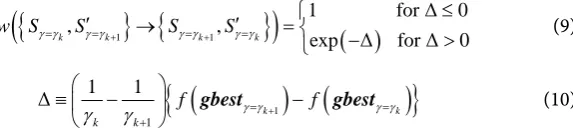
indi-viduals in the swarm. Periodically, after a certain number of search steps, the objective function f(gbest) values of two swarms (Sγ γ=k and Sγ γ′=k+1) having adjacent γk values
are compared. Each γk value is then probabilistically exchanged (or not) according to
the Metropolis decisions in Equations (9) and (10).
{
} {
}
(
1 1)
( )
1 forΔ 0
, ,
exp Δ for Δ 0
k k k k
w Sγ γ= Sγ γ= + Sγ γ= + Sγ γ=
≤
′ → ′ =
− >
(9)
(
) (
)
{
1}
1
1 1
Δ k k
k k
f γ γ f γ γ
γ γ = + =
+
≡ − −
[image:5.595.264.551.452.517.2] gbest gbest (10)
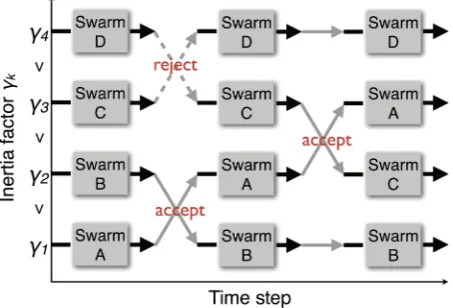
Figure 2 shows a schematic diagram of IP-PSO. The IP-PSO (and also the other proposed adaptive parallel PSOs described in Sections 3.2 - 3.4) employs the Metropolis criterion to determine the exchange acceptance of the control parameter rather than the
move acceptance of each solution. The Metropolis decision will assign smaller γk
val-ue to the swarm having the superior f(gbest) value with higher probability. (Note: “su-perior” here means “smaller”, since this paper is concerned with minimum search problems.) As a result, a more intensive search can be performed in the vicinity of
gbest. On the other hand, it is also possible to escape local optimum solutions by a
global search, because larger γk value is assigned to the swarm having the inferior
f(gbest) value with higher probability. In addition, unlike the related methods
men-tioned above in which γ decreases monotonically, this method can escape local
Figure 2. Schematic illustration of the Inertia-factor Parallel PSO (IP-PSO), with four swarms.
cause a larger γ value could be probabilistically assigned. The dynamic assignment of
appropriate inertia factor γ values to each swarm according to the search conditions
makes it unnecessary to configure a γ reduction schedule before carrying out
opti-mization. The IP-PSO solution search procedure is described below:
1. Decide total population size, number of swarms, and maximum number of search steps.
2. Assign initial inertia factor values to each swarm according to Equation (8). 3. Set initial position and velocity of each individual.
4. Calculate objective function value for each individual.
5. Determine the optimal individual solution pbest for each individual and the
op-timal swarm solution gbest, and update these values.
6. Update the position and velocity of each individual according to Equation (3) and (4).
7. Periodically, after a certain number of search steps, compare objective function values between two swarms having adjacent inertia factor values; make the decision to exchange inertia factors according to Equations (9) and (10).
8. End search if desired solution accuracy is obtained or if maximum number of search steps is reached.
Because each swarm can be simulated independently and simultaneously with only a slight communication cost, the IP-PSO (and also the other proposed adaptive parallel PSOs described in Sections 3.2 - 3.4) are well suited for and very efficiently runs on massively parallel computers.
3.2. Learning-Factor Parallel PSO
Here, we propose a technique focusing on learning factors c1 and c2, control parameters in Equation (3). For individuals with relatively large c1, PSO searches in the vicinity of
the optimal solution in that individual’s search history, pbest, whereas for individuals
with large c2, it searches in the vicinity of the optimal solution in the search history of
search, individuals are given large c1 and small c2 values to ensure solution diversity, while in its final stages, individuals are instead given small c1 and large c2 values in an
attempt to centralize the search in the vicinity of gbest. Some time-change schedules
have learning factors c1 and c2 decrease (or increase) linearly with increasing number of search steps [14].
For the Learning-factor Parallel PSO (LP-PSO) proposed in this section, we
intro-duce the allocation parameter
α
(
0≤ ≤α
1)
, which regulates the balance betweenlearning factors c1 and c2, and define the LP-PSO learning factors c1′ and c2′
accord-ing to the followaccord-ing equation:
(
)
1 0 2 0 2 2 1 c c c c α α ′ = ′ = − (11)
Here, c0 is a constant. This paper uses c0 = 1.4955, a learning factor determined to be stable in a PSO stability analysis run by Clerc et al.[5]. When α=1 in Equation (11),
2 0
c′ = and the search is run in the vicinity of pbest; when α=0, c1′ =0 and the
search is run in the vicinity of gbest. Similar to IP-PSO in Section 3.1, we consider Ns
swarms having various different α values. We determine
α
k(
k=1,,Ns)
in thispaper using the following equation:
(
)
max min min 1 1 k s k N α αα = − ⋅ − +α
− (12)
Thereafter, as in IP-PSO, each swarm has its own gbest, the optimal solution found
across all individuals in the swarm. Periodically, after a certain number of search steps, the objective function f(gbest) values of two swarms having adjacent αk values are
compared. Each αk value is then probabilistically exchanged (or not) according to the
Metropolis decisions in the same manner as Equations (9) and (10). The decision will assign smaller αk value to the swarm having the superior f(gbest) value (i.e., small
1
c′ and large c2′) with higher probability. As a result, a more-intensive search can be
performed in the vicinity of gbest. On the other hand, it is also possible to escape local
optimum solutions using a global search based on the pbest of each individual, because
larger αk value (i.e., large c1′ and small c2′) is assigned to the swarm having the
in-ferior f(gbest) value with higher probability. The assignment of appropriate learning
factor c1′ and c2′ values to each swarm according to the search conditions actually
makes it unnecessary to configure a time-change schedule before carrying out optimi-zation.
3.3. Activity Parallel PSO
Here, we propose a technique focusing on the control parameter for swarm activity.
Yasuda et al. [15] used molecular motion as an analogy for the movement of each
indi-vidual in PSO, and defined the activity of a swarm Act as an index of the
diversifica-tion/centralization of a solution search according to the following equation:
1 2 2
,
1 1
1 Np Nd
i j
i j
p d
Act v
N N = =
=
⋅
Swarms with high activity have many individuals with high velocities, and search over a wide solution space. Swarms with low activity, on the other hand, have many in-dividuals with low velocities, and so search intensively for local solutions. Activity is observed moment-to-moment, because searches in which activity decreases gradually and continually can yield favorable solutions. In the event that measured activity is lower than the preset baseline activity, increasing the inertia factor γ of each individ-ual promotes global searches; in the event that measured activity is higher than the preset baseline activity, decreasing the inertia factor promotes local searches. These be-haviors thus constitute adaptive parameter regulation (of the inertia factor). However, the baseline activity reduction schedule must be set appropriately in advance, such that it decreases gradually with increasing search steps.
For the Activity Parallel PSO (AP-PSO) proposed in this section, we directly control
swarm activity (i.e., what was measured in [15], the past study mentioned above) in a
manner similar to temperature control methods in molecular dynamics applications. Each individual’s velocity should be appropriately scaled at each search step in order to control the measured, actual activity Act (defined by Equation (13)) at the target activi-ty Act0. Briefly, the scaling factor s is calculated according to the following equation, where the velocity vi of each individual is converted to vi′ = ⋅s vi:
1 2
0 2
,
1 1
p d
p d
N N
i j
i j
N N
s Act
v
= =
⋅
= ⋅
∑ ∑
(14)We consider Ns swarms controlled by various different target activity Act0 values. We determine Act0,k (k=1,,Ns) in this paper using the following equation:
(
)
0,max 0,min
0, 1 0,min
1
k
s
Act Act
Act k Act
N
−
= ⋅ − +
− (15)
Thereafter, as in IP-PSO and LP-PSO, each swarm has its own gbest, the optimal
so-lution found across all individuals in the population. Periodically, after a certain
num-ber of search steps, the objective function f(gbest) values of two swarms having
adja-cent Act0,k values are compared. Each Act0,k value is then probabilistically exchanged (or not) according to the Metropolis decisions in the same manner as Equations (9) and
(10). The decision will assign smaller Act0,k value to the swarm having the superior
f(gbest) value with higher probability. As a result, a more-intensive search can be per-formed in the vicinity of gbest. On the other hand, it is also possible to escape local
op-timum solutions using a global search, because larger Act0,k value is assigned to the
swarm having the inferior f(gbest) value with higher-probability. Assigning an
appro-priate activity value to each swarm according to the search conditions makes it unne-cessary to configure an activity reduction schedule in advance.
3.4. PSO with Simultaneous Exchange of Multiple Control Parameters
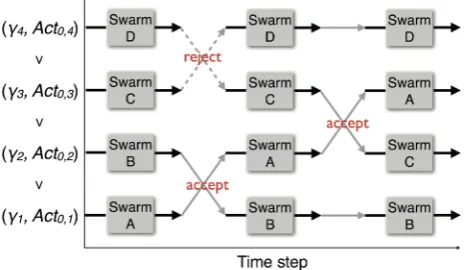
swarm. Nonetheless, adaptive control is possible if several control parameters are si-multaneously and dynamically exchanged between swarms. For example, we can con-sider Ns swarms each having a different inertia factor γ and target activity Act0: we call this technique the Inertia-factor and Activity Parallel PSO (IAP-PSO). For IP-PSO
in Section 3.1, a given γk value corresponds one-to-one with a given swarm; however,
with IAP-PSO, a given
(
γk,Act0,k)
pair corresponds one-to-one with a given swarm.These control parameter pairs are exchanged between swarms. Figure 3 shows a
sche-matic diagram of IAP-PSO. We can consider an Inertia-factor and Learning-factor Pa-rallel PSO (ILP-PSO) the same way: in it, the inertia factor and learning factors are si-multaneously exchanged.
4. Numerical Simulation and Discussion
We evaluate the performance of the proposed techniques using a minimum search problem for a Rastrigin function, a representative multimodal function. Our Rastrigin function is represented by the following equation:
( )
2(
)
1 10 cos 2π 10
d
N
j j
j
f x =
∑
= x − x + (14)The Rastrigin function is multimodal, its variables are completely independent of
each other, and it has a minimum value of
( )
*0
f x = for x* =
(
0, 0,, 0)
. In theperformance evaluation experiments, the number of dimensions was set at Nd = 100,
and the initial coordinates and initial velocity of each individual were set according to
uniform random numbers in the respective ranges ( )0
, 100 xi j 100
− ≤ ≤ and ( )0
,
0≤vi j ≤100.
We first evaluated the proposed PSO techniques, in which only a single control pa-rameter is exchanged in the search process. We observed the relationship between suc-cessful transitions in control parameter value and changes in objective function value, and compared its performance with other techniques. Specifically, we compared a Li-nearly decreasing Inertia factor PSO (LDI-PSO), in which the inertia factor liLi-nearly and
continually decreases according to Equation (7) with increasing search step t, with the
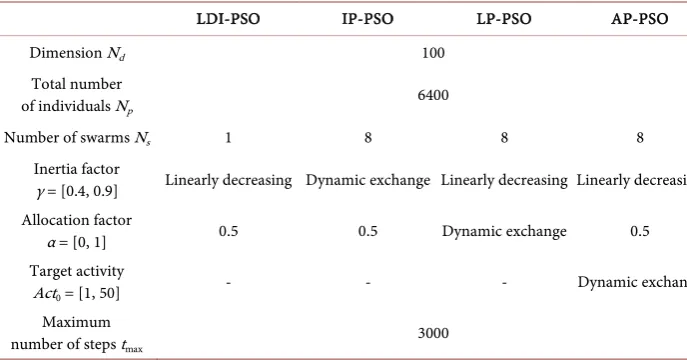
proposed techniques IP-PSO, LP-PSO, and AP-PSO. Table 1 shows the major
[image:9.595.258.492.539.674.2]simula-tion condisimula-tions for each technique.
Figure 3. Schematic illustration of the Inertia-factor and Activity Parallel PSO (IAP-PSO), with
Table 1. Summary of simulation conditions for performance evaluation of the proposed PSOs which exchange a single control parameter.
LDI-PSO IP-PSO LP-PSO AP-PSO
Dimension Nd 100
Total number
of individuals Np 6400
Number of swarms Ns 1 8 8 8
Inertia factor
γ = [0.4, 0.9] Linearly decreasing Dynamic exchange Linearly decreasing Linearly decreasing Allocation factor
α = [0, 1] 0.5 0.5 Dynamic exchange 0.5
Target activity
Act0 = [1, 50] - - - Dynamic exchange
Maximum
number of steps tmax 3000
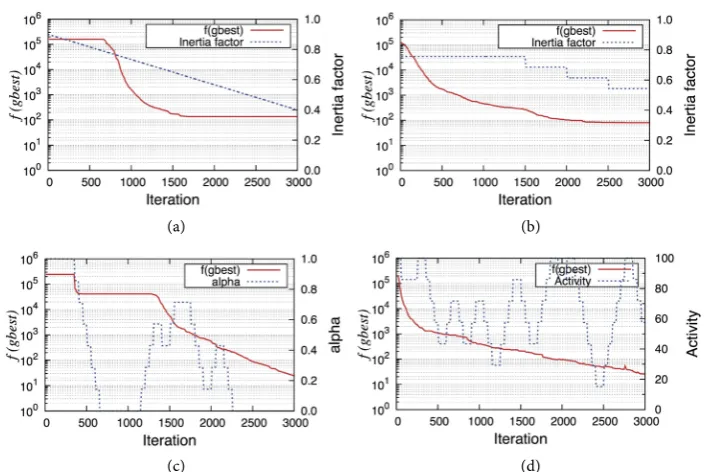
Figure 4 shows time series data for the objective function f(gbest) and the control parameter values obtained via each technique. The time series shown for LDI-PSO is data for the best of eight search attempts, assuming 6400 individuals × 1 swarm. The time series shown for IP-PSO, LP-PSO, and AP-PSO are respective data for the best swarm within a representative search attempt (eight search attempts in total), assuming 800 individuals × 8 swarms. In IP-PSO, adaptive control is realized through the dy-namic exchange of inertia factor values, which occurs spontaneously without the need to configure a stepwise reduction schedule for the inertia factor, a condition seen in the
aforementioned [13]. Compared with LDI-PSO, which also uses the inertia factor as a
control parameter and has a linear reduction schedule for the inertia factor, IP-PSO achieves lower objective function values. Looking at LP-PSO, on the other hand, small
k
α (i.e., small c1′ and large c2′) values are assigned from around the 350th search
step onward, in response to the relatively small objective function values obtained in the initial search around that step number. The solution ceases to improve for a while thereafter, but large αk (i.e., large c1′ and small c2′) values were assigned from step
1150 to around step 1700; as a result, the trajectory escapes the local optimum solution, and the solution continues to improve from around step 1400 onwards. After around
the 1700th search step, small αk values are assigned once more; as a result of this
search centralization, the objective function continues to drop until the maximum (i.e.,
final) search step. For AP-PSO, the solution continually improves as activity frequently fluctuates. The above results obtained with each proposed PSO technique show that the observed diverse shifts in control parameters depend on the search conditions. LP-PSO and AP-PSO achieved superior results to LDI-PSO and IP-PSO, with final objective function values of, respectively, 24.5 and 25.0 versus 135.3 and 80.6.
We next evaluated the proposed PSO techniques in which multiple parameters are exchanged simultaneously. The four techniques compared were (1) linearly decreasing
(a) (b)
[image:11.595.197.551.66.302.2](c) (d)
Figure 4. Performance evaluation of IP-PSO, LP-PSO, and AP-PSO: Time series of f(gbest) and
control parameter value
(
γ α, orAct0)
. (a) LDI-PSO; (b) IP-PSO; (c) LP-PSO; (d) AP-PSO.the allocation parameter for learning factors α both linearly decrease with increasing
step number t; (2) ILP-PSO, in which
(
γ α
k, k)
pairs are simultaneously anddynami-cally exchanged between swarms; (3) linearly decreasing inertia-factor and activity PSO
(LDIA-PSO), in which the inertia factor γ and target activity Act0 both linearly
de-crease with increasing step number t; and(4) IAP-PSO, in which
(
γk,Act0,k)
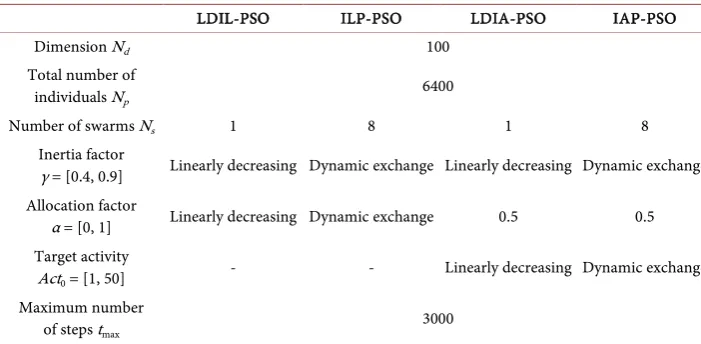
pairs aresimultaneously and dynamically exchanged between swarms. Table 2 shows the major
simulation conditions for each technique.
Figure 5 shows time series plots for the objective function f(gbest) obtained via each technique. The time series shown for LDIL-PSO and LDIA-PSO are the data for the best of eight search attempts, assuming 6400 individuals × 1 swarm. The time series shown for ILP-PSO and IAP-PSO are the data for the best swarm within a representa-tive search attempt (eight search attempts in total), assuming 800 individuals × 8 swarms. We can see that the simultaneous adjustment of multiple control parameters
improves search performance compared with Figure 4. This is true if we compare those
[image:12.595.205.546.71.188.2]
(a) (b)
Figure 5. Performance evaluation of ILP-PSO and IAP-PSO: Time series of f(gbest). (a)
LDIL-PSO vs. ILP-PSO; (b) LDIA-PSO vs. IAP-PSO.
Table 2. Summary of simulation conditions for performance evaluation of the proposed PSOs
which exchange multiple control parameters.
LDIL-PSO ILP-PSO LDIA-PSO IAP-PSO
Dimension Nd 100
Total number of
individuals Np 6400
Number of swarms Ns 1 8 1 8
Inertia factor
γ = [0.4, 0.9] Linearly decreasing Dynamic exchange Linearly decreasing Dynamic exchange Allocation factor
α = [0, 1] Linearly decreasing Dynamic exchange 0.5 0.5
Target activity
Act0 = [1, 50] - - Linearly decreasing Dynamic exchange
Maximum number
of steps tmax 3000
5. Conclusion
We proposed five types of adaptive parallel PSO algorithms that employed the dynamic exchange of control parameters between multiple swarms-IP-PSO, LP-PSO, AP-PSO, ILP-PSO and IAP-PSO while focusing on the PSO control parameters of inertia factor, learning factors and swarm activity. The proposed algorithms were adopted to adap-tively regulate control parameters at each step of the search in an experiment consisting of a minimum search problem for a multimodal function. The results show the systems transition appropriately between global and local solution search phases, meaning that efficient searches that do not stall at local optimum solutions are possible. Superior ob-jective function values were obtained by ILP-PSO in particular: this method achieves adaptive regulation through the simultaneous exchange of the inertia factor and learn-ing factors. Additional numerical experiments and assessments of the performance characteristics with a larger set of testing pool such as CEC benchmark are important topics for future research.
References
[image:12.595.196.547.264.436.2]International Conference on Neural Networks, 4, 1942-1948.
http://dx.doi.org/10.1109/ICNN.1995.488968
[2] Janson, S. and Middendorf, M. (2005) A Hierarchical Particle Swarm Optimizer and Its Adaptive Variant. IEEE Transactions on Systems, Man, and Cybernetics, Part B, 35, 1272- 1282. http://dx.doi.org/10.1109/TSMCB.2005.850530
[3] Yen, G.G. and Daneshyari, M. (2006) Diversity-Based Information Exchange among Mul-tiple Swarms in Particle Swarm Optimization. Proceeding of IEEE Congress on Evolutio-nary Computation (CEC 2006), Vancouver, 16-21 July 2006, 6150-6157.
http://dx.doi.org/10.1109/cec.2006.1688511
[4] Eberhart, R.C. and Shi, Y. (2000) Comparing Inertia Weights and Constrictions Factors in Particle Swarm Optimization. Proceeding of the Congress on Evolutionary Computation
(CEC 2000), San Diego, 16-19 July 2000, 84-88. http://dx.doi.org/10.1109/cec.2000.870279
[5] Clerc, M. and Kennedy, J. (2002) The Particle Swarm: Explosion, Stability, and Conver-gence in a Multi-Dimensional Complex Space. IEEE Transactions on Evolutionary Com-putation, 6, 58-73. http://dx.doi.org/10.1109/4235.985692
[6] Parsopoulos, K.E. and Vrahatis, M.N. (2002) Recent Approaches to Global Optimization Problems through Particle Swarm Optimization. Natural Computing, 1, 235-306.
http://dx.doi.org/10.1023/A:1016568309421
[7] Cooren, Y., Clerc, M. and Siarry, P. (2009) Performance Evaluation of TRIBES, an Adaptive Particle Swarm Optimization Algorithm. Swarm Intelligence, 3, 149-178.
http://dx.doi.org/10.1007/s11721-009-0026-8
[8] Jana, N.D. and Sil, J. (2014) Particle Swarm Optimization with Lévy Flight and Adaptive Polynomial Mutation in Gbest Particle. Recent Advances in Intelligent Informatics, 235, 275-282. http://dx.doi.org/10.1007/978-3-319-01778-5_28
[9] Mikki, S.M. and Kishk, A.A. (2006) Quantum Particle Swarm Optimization for Electro-magnetics. IEEE Transactions on Antennas and Propagation, 54, 2764-2775.
http://dx.doi.org/10.1109/TAP.2006.882165
[10] Hukushima, K. and Nemoto, K. (1996) Exchange Monte Carlo Method and Application to Spin Glass Simulations. Journal of the Physical Society of Japan, 65, 1604-1608.
http://dx.doi.org/10.1143/JPSJ.65.1604
[11] Shi, Y. and Eberhart, R.C. (1998) Parameter Selection in Particle Swarm Optimization, Evolutionary Programming VII. Lecture Notes in Computer Science, 1447, 591-600.
http://dx.doi.org/10.1007/BFb0040810
[12] Li, H.-R. and Gao, Y.-L. (2009) Particle Swarm Optimization Algorithm with Exponent Decreasing Inertia Weight and Stochastic Mutation. Proceeding of 2009 2nd International Conference on Information and Computing Science, 1, 66-69.
http://dx.doi.org/10.1109/ICIC.2009.24
[13] Xin, J., Chen, G. and Hai, Y. (2009) A Particle Swarm Optimizer with Multi-Stage Linearly- Decreasing Inertia Weight. Proceeding of the 2009 International Joint Conference on Computational Sciences, and Optimization, 1, 505-508.
http://dx.doi.org/10.1109/CSO.2009.420
[14] Ratnaweera, A., Halgamuge, S.K. and Watson, H.C. (2004) Self-Organizing Hierarchical Particle Swarm Optimizer with Time-Varying Acceleration Coefficients. IEEE Transactions on Evolutionary Computation, 8, 240-255. http://dx.doi.org/10.1109/TEVC.2004.826071
Submit or recommend next manuscript to SCIRP and we will provide best service for you:
Accepting pre-submission inquiries through Email, Facebook, LinkedIn, Twitter, etc. A wide selection of journals (inclusive of 9 subjects, more than 200 journals)
Providing 24-hour high-quality service User-friendly online submission system Fair and swift peer-review system
Efficient typesetting and proofreading procedure
Display of the result of downloads and visits, as well as the number of cited articles Maximum dissemination of your research work
Submit your manuscript at: http://papersubmission.scirp.org/