EUR 4479 e
i
SPECTRAL PARAMETI
■i$m\
WÊà
m
ΐίίΒ-1«
MWfj
léii**1
A.C.
Ü
BE
ii
tum
\>mm.
m
' ä-'ÜBit-f
, ,^.
1970
Blip
liill
Η ·■: Joint Nuclear Research Center Ispra Establishment - Italy
Reactor Physics Department Research Reactors
i t ,
wmSm
waëïi
any person acting on their behalf :make any warranty or representation, express or implied, with respect to the accuracy, completeness or usefulness of the information contained in this
fWJftJSû
document, or that the use of 'any information, apparatus, method or process disclosed in this document may not infringe privately owned rights; or
l l å f
, „ u
,
, , , 1 » Ü 1
assume any liability with respect to the use of, or for damages resulting from the use of any information, apparatus, method or process disclosed in this document.
fi Aie
ιΐϋΐ
•sír'5¿i'}ll!
This report is on sale at the addresses listed on cover page 4
fS'-iEuflfi'piîMLsfli'iiÎMiW'1 'J*' r'Urt^íSlTSfltislHiilMiMHjTÍ"^
.¡vit-ut the price of FF 9,45 FB 8 5 - D M 6,20 Lit 1.060 FI. 6,20
ïah When ordering, please quote the EUR number and the title, which are indicated on the cover of each report
1 WMpttIcU *v*r 1 BE
sfliilìl »l^ifie KS?
ί
MM
Printed by Smeets, Brussels Luxembour,
-h
Vlililí u # f e e I t ó
1ouTg, May 1970
K*l*LrV,;íld
»Av
ψ4
This document was reproduced on the basis of the best available copy
Joint N u c l e a r Research C e n t e r - Ispra Establishment (Italy) Reactor Physics Department - Research Reactors
Luxembourg, M a y 1970 - 58 Pages - 2 Figures - F B 85
T h e aim of this report is to examine the properties and statistical errors of the estimators of some spectral parameters of stationary, ergodic, linear processes (power and cross-power spectral density, Fourier transform, transfer functions).
In addition, procedures and computing programmes are supplied for the estimation of these parameters by means of the statistical dynamics analyzer S . D . A . - M o d . 040. T h e case of deterministic signals is also taken into consideration.
EUR 4 4 7 9 e
S P E C T R A L P A R A M E T E R E S T I M A T I O N F O R L I N E A R S Y S T E M I D E N T I F I C A T I O N , by C . L U C I A
Commission of t h e European Communities
Joint Nuclear Research Center - Ispra Establishment i(Italy) Reactor Physics Department - Research Reactors
Luxembourg, M a y 1970 - 58 Pages - 2 Figures - F B 8 5
T h e aim of this report is to examine t h e properties a n a statistical errors of the estimators of some spectral parameters of stationary, ergodic, linear processes (power and cross-power spectral density, Fourier transrorm, transfer functions).
In addition, procedures and computing programmes are supplied for the estimation of these parameters by means of the statistical dynamics analyzer S . D . A . - M o d . 040. T h e case of deterministic signals is also taken into consideration.
EUR 4 4 7 9 e
S P E C T R A L P A R A M E T E R E S T I M A T I O N F O R L I N E A R S Y S T E M I D E N T I F I C A T I O N , by C . L U C I A
Commission of the European Communities
Joint Nuclear Research Center - Ispra Establishment (Italy) Reactor Physics Department - Research Reactors
Luxembourg, M a y 1970 - 58 Pages - 2 Figures - F B 85
T h e aim of this report is to examine t h e properties and statistical errors of the estimators of some spectral parameters of stationary, ergodic, linear processes (power and cross-power spectral density, Fourier transrorm, transfer functions).
COMMISSION OF THE EUROPEAN COMMUNITIES
SPECTRAL PARAMETER ESTIMATION FOR LINEAR
SYSTEM IDENTIFICATION
by
AC. LUCIA
1970
Joint Nuclear Research Center Ispra Establishment - Italy
errors or the estimators of some spectral parameters of stationary, ergodic. linear processes (power and cross-power spectral density. Fourier transform, transfer functions).
In addition, procedures and computing programmes are supplied for the estimation of these parameters by means of the statistical dynamics analyzer S.D.A. - Mod. 040. The case of deterministic signals is also taken into consideration.
KEYWORDS
MATHEMATICS PARAMETERS
FOURIER TRANSFORMATIONS COMPUTERS
INTRODUCTION
1.) SPECTRAL ANALYSIS OF RANDOM SIGNALS
1.1.) Power spectral density estimation 7 1.2.) Cross-power spectral density estimation -\ A
1.3.) Power and cross-power spectral density estimation with
the statistical dynamics analyzer S.D.A 17
2.) SPECTRAL ANALYSIS OF APERIODIC SIGNALS 24 2.1.) Fourier transform estimation 25 2.2.) Fourier transform estimation with the statistical
dyna-mics analyzer S.D.A. 26 2.3.) Energy and cross-energy spectral density estimation .... 3O
2.4.) Energy and cross-energy spectral density estimation with
the statistical dynamics analyzer S.D.A 31
3.) SPECTRAL ANALYSIS OF PERIODIC SIGNALS 33 3.1.) Fourier transform estimation with the statistical
dyna-mics analyzer S.D.A 34 3.2.) Power and cross-power spectral density estimation with
the statistical dynamics analyzer S.D.A 37
APPENDIX 39
FIGURE CAPTIONS 56
LIST OF TABLES 56
INTRODUCTION *)
The techniques for determining the power and cross-power spectral density, the Fourier transforms and the transfer functions assume considerable importance in the identification of a system or
1 2 3
process ) ) ). From these functions it is in fact often pos-sible to arrive at some basic parameters of the system or process un-der examination. For this reason it is interesting to know the characteristics of the estimators we use and the accuracy obtainable with them.
This report studies the statistical properties of some continuous estimators in general use which allow direct determination of Fourier transforms, power and cross-power spectral densities and transfer functions. The determination of these functions is trea-ted categorically for the cases of random signals and of aperiodic and periodic signals.
The estimators we deal with in this work also constitute the algorithms by which are obtained the determinations made on the statistical dynamics analyzer S.D.A. (a general purpose analyzer, 4 designed and built at the Euratom Joint Research Center of Ispra) ) .
In the sections 1.3; 2.3 and 3.2 and in the Appendix, in which processing procedures and computing programmes are given,
re-ference is made exclusively to the S.D.A.
stationary and ergodic, even when this is not explicity stated.
We know that in the case of random signals, no Fourier transform (of the classic type) exists, and that for this reason the power spectra are defined in terms of Fourier transforms of the corre
lation functions ) 16 )
Φ
(ω) =
if
1 Τlim 2T / x(*) x(t+T)dt
_ T-* «e J _ φ eJWTdT (1)
Φ
(ω)
yy
co Τ
■ —
ƒ film ~ fy(t) y(t+r)at
e-Jft,TdT (2)# ^ ( »
1 2πΤ
lim
Jr
/ x(t) y(t-»r)dt
T-» ce J _τ-JWT,
β dr
(3)
Nevertheless the validity of the direct determination (by the Fourier transform of the signals under examination) of the power and cross-power spectral density, is demonstrated ) ).
The estimators by which the direct determinations can be carried out have the following expressions:
XX
1 j _
2ir Τ
.Τ
c(t) θ
-3<iì t d t(4)
* (ω)
yy
v1 j _
which are the estimators we are considering here; they are likewise 4 used in the S.D.A. for the spectral analysis of random signals ).
1.1.) Power spectral density estimation
Let expression (4):
Τ
Φ (ω) xx
1 ι
2π Τ
c(t) e"d<ütdt
(4)
be the estimator of the power spectral density of a stationary, ergo dic random signal x(t).
We will see what the properties of this estimator are, particularly as far as the bias and the variance of the estimation are concerned. The mathematical expectation of the estimator is:
Φ (ω)
rxx ■1 I F
2π Τ E
x(t) e"Jwtdt
(7)
Considering the square of the modulus of the integral at the right hand member of (7) as a double integral and remembering that:
E
c(t) x(e)
R (te)xx (8)
where R is the autocorrelation function of x(t), we can write ):
E Φ ( ω )
χ χν
±-lfjí
(t-e) e-
Jw(t
-
e)
dt dö
2π Τ / / χ χν '
which gives f i n a l l y
)
■[>»(·>]
^¡j^y^r)
eJwTdT (10)For an analysis time Τ tending to the infinite, wherever the auto
correlation function can be integrated absolutely, we obtain from (10)ι
lim E
Τ*«·
ƒ«(-)]
Η.
R (τ) e xx '-JUT
dr = Φrx x (ω) x ' ( H )
i.e. the estimator (4) is unbiased in the limit, but for a finite ana lysis time Τ , it is biased: that is, it contains a systematic error. Let us now see what the variance of the estimate is:
var
*„(-)]
EΦ' (u)
xxv - E ψrxx (ω) x (12)Q
where the mathematical expectation of the square of the estimate is ):
E
[>„<«:
Er
J__ 1
2π Τ
x(t) e-^at
2]
2
]
τ τ τ. τ
= -
L—ί
! [
ΓΕ Tx(t) χ(0) χ(τ,)
χ(ξ)β'
οω^
+θ-
η'
ξ)Ί dt dø dr, ae
1*1* T?b h h Jo L
J
(13)
E(xlxax3x4)= EtxiX,) Ε(χ3χ4)+ E(x1x3)E(xax4)+ Ε(χ1χ4)Ε(χ3χ3) 2 3^X3X3^ =
= RiaR34+ Ri3Ra4+ » 1 4 ^ 3 - 2 x ^ x , ^ (14)
where R.. is the correlation function of the ith and jth random va
riables, we obtain from expression (13):
Τ Τ Τ Τ
<Φ
^χχ^2(ω)) = — i ,
¡^ τβ ¡οo Jo J o
*«<**> Rx x(^} + Rx x( t ^ Rxx(0^)+
^ x x ^ ^ ^ x x ^ ^ 2^
eJ(t+e7íí)at ¿g d7) ^
(15)
Taking into consideration expression (9) , expansion of the righthand
member of (15) gives:
E[>y«))
2 (
E
»
M
( » » ) H ^
.τ .T
R (t*) e> ( t + ö )d t dø
xxx '
O J O
Τ Τ Τ Τ
1 f Γ Γ Ι Ι -juit+θ-η-ξ)
"
2
*V W
O JO JO JO e dt dø dr? άξ (16)As Τ tends to the infinite, equation (16) becomes;
lim Ε ( ^ ( ω ) ) =
Τ-»««
lim 2(ErJ
T->«° xx(«)))
(17)so t h a t by v i r t u e of (12) and (17) one can w r i t e :
lim varfj (ω)) = Τ-*00
l i m ( Έ{φ (ω)) )
Hence from (11)
lim var (ίχχ(ω))
Τ-*»
ø
2(ω)
XX
(19)
which means that the random variable constituted by the estimator Ψχγ^ω'
does not converge in the mean upon the value Φ (ω ) of the power spectral density, and the accuracy of the measurement does not improve with an increase of integration time Τ . The statistical error
thus remains, even with an infinite analysistime.
Let us however repeat this measurement on successive times, and use then the estimator:
7 ( \ 1 1 1 ^ χ χ( ω ) = k 2 7 ?
i=1
t . + T
ι c ( t ) e - j û J t
d t
i=1
( 2 0 )
which is unbiased in the limit, as estimator (4) was already; in fact:
k
Ε(Λ>)) = Ï^C*«,!
0
^
i=1
i xx (21)
and remembering ( i l ) :
l i m E ^ χ χ( ω ) ) =
T->°°
1_
k φ . ( ω ) = Φ ( ω ) ( 2 2 )
i=1
As far as the variance of the new estimator is concerned, we must bear in mind that if the initial instants t. of each integration are spa
ced sufficiently so that the k determinations can be considered inde
1 ?
pendent, one can write1^) 13 ) :
var (^χχΟ")) =
—k varC¿_»)
by which, for ( 1 9 ) , we have:
lim var ( ^ ^ ( ω ) ) =
T-+0O
¿e>)
X X ( 2 4 )which clearly means that:
lim var (^ (ω)) = lim £ «^U» ) = °
T> °° k» °°
k»°°
(25)
As for an infinite analysis time Τ , the estimator (20) is unbia sed (so that mean square arror and variance of the estimate have the same value), expression (25) means also that estimator (20) is
consistent for infinite values of both Τ and k.
It will be observed that the variance of the estimator tends to zero, when k tends to be infinite, even if Τ remains finite, while the mean square error tends to a nonzero value owing to the bias of the estimate.
Equation (25) has been deduced by considering k indepen dent measurements. Let us take, on the other hand, the general case of correlated measurements:
v a r
Ax<
w) = E
k£>>
- E Λk x x Φ ( ω )X i 7,ww)
2
] - [
E
[À>>
i=1
(26)
t h a t i s , d e v e l o p i n g t h e s q u a r e of t h e summation:
k_ k
var(
kí
xx(
W))= s ß r ¿ ^ ( « V
ΈτΣ+χχ,±(
ω)**χΛ
ω) i=1 i , j = 1i * j
{
E
[Âx^
J
If we consider the determinations φ .(u)
rxx,i
and remember that, for two random variables 9
write ):
as random variables
ζ and w wa can
E(z') = a" + ζ _ a ζ
E ( ζ w ) = α
rs (28)
a n = R (
1 1 zwv τ) = z.w + ρ (τ) \ C (0)C (θ) zw' ζζν wvr = i.w + ρ (τ) σ σ * yzwv y ζ w
where α is the moment of order r+s, equation (27) can be ex·
rs n
pressed as:
'
iJv
k xx V(o>))
= £
var Φ .(ω) + E k * x x ^2
Ì
J
> + ^ ί
,Ä (ω )+ - v a r
*~
Λ«>)
XX,χ
ρ . / τ ) . (E ,0 (ω)
k xxs(29)
from which we obtain the final result:
var k¿xx( w ) var
Φ
.(ω)
_
—
1 +
* / / ± ί
( τ )__ L— —J
i,j=1
i
4 J
(30)
where ρ. ·\τ) expresses the degree of correlation existing between
the ith and the jth measurement, and can assume values between zero and one.
If the function p. .(τ) is supposed to be constant for
var
Α χ
( ω } = varΦ~ Λω)
X X , 1(k-1 )pk(r ) + 1
(31)
If Ρ-Λ,Τ ) is zero, we come back to the theoretical case considered
in equation (23). It is however sufficient that ρ{τ) is less
than unity for the relation (25) to be valid, and the estimator to
be consistent.
It would be interesting here to examine more closely the
spectral estimator, and the physical significance of the error introdu
ced by the finite analysis time T.
To do this, it is not necessary to take the repetitions into account;
for simplicity of notation, we will therefore refer to estimator (4)
and resume equation (10):
Ε(^χχ(ω)) = _1_
2π
-Τ
1 - R (τ)
XX
e dr ( ■ C i
whose second member can be interpreted as the Fourier transform of the
product of the autocorrelation fu:
to be analyzed, and the function:
product of the autocorrelation function R (τ) of the signal x(t) xx
h(r)
1
ιTI
τ
(3Σ
defined for ¡r| $ Τ and zero elsewhere; that is, the estimated
power spectral density is the Fourier transform of the autocorrelation
function weighed by a data window h(T).
In the frequency domain, remembering the convolution theo
rem, the Fourier transform of the product is given by the convolution
of the factors:
where:
Τ / sen ω — \ 2
H(«) = Τ (
ç-S- )
(34)
\ ω — '
Expression (33) means that the power spectral density estimator has
an expected value which corresponds to the theoretical value φ (ω )
14 XX
sean through a spectral window Η(ω) ) .
As Τ tends to infinity, Η(ω) tends to a delta function centered at ω=ω' ; hence the spectrum estimator gives a correct, unbiased estimate.
In practice the spectral window is composed essentially of a slit with a width of the order of — (in Hz); hence, for suf
ficiently large values of T, it is reasonable to assume φ (ω) quite constant in the frequency range — , so that:
/· "" / sen U
Γ / s e n ~õ~ \ o
"£#«(-·» = # „ ( . ' )l τ
(—¡¡2- )
2t*
-
tjM')
J_ oo \ " S '
(35)
Once again, it becomes obvious that the error due to the finite analysis time is less serious than, and has nothing to do with, the statistical error, so that having a record of lenght Τ of the signal to analyze,
it is better to divide the time Τ into k intervals Τ. , sui tably spaced out, and to perform k measurements, rather than to per form one continuous analysis for the whole period Τ .
1.2.) Crosspower spectral density estimation
Let us consider the estimator (6):
Τ Τ
The same considerations that were taken for the analogous
estimator (4) of the power spectral density ψ (ω) are valid for
this estimator. In fact:
Εί^Οω))
Τ Τ 1 1
2ir
1 / / Ε [ Χ ( Ϊ Μ · ) . *
( Μ )o O
dt df? (36)
from which ) ;
E(¿ (ju)) = 1
2π Τ
- ^
κ
xy»
-JUT dT (37)which, in the case of the absolute integrality of R (τ), allows
us to write:
lim E O (jeu)) T*Μ
Ψ (ju)
xy (38)
which means the estimator is unbiased in the limit.
Let us consider now the variance of the estimate
v a r^ x y ^w^
E I ^xyO)
Φxy (ju) (39)x r a r C ^ U a O ) = [ > ( ί ^ ( * ) ) ] + ~
¿ Γ
ƒ ƒ V
^ ) e
j w ( t + 0 )d t de
Τ Τ
'o J o
■2 χ/
^^ílíí^^-^at
dø d, d,
τ
3
W í l
i'
(40)
which, for Τ tending to infinity, gives:
lim var (φ (ju)) l i m T> °°
Ε
*^(*0
= Φ" (ju)xy
(41)
To reduce the variance of the determination, i t i s b e t t e r
to use an estimator of the t y p e :
A y
( j w ) =k 2 * Τ
k_ tj+T t . + T
' x(t) e ^ d t . f
y(t) e'
j i j tdt =
t .
i=1 !
= — > $ . ( j(i> )
k / ^
rx y , i
wi=1
for which one h a s :
E
^ x y
(^
=
k - ^ x y , ! ^ »
i=1
from which, taking equation
(38)
i n t o account:
(42)
(43)
limEC^O))
* * y
( j w )
(44)
Proceeding in a manner similar to that employed for ^χ χ(ω ' w e fi-nd;
var(k^xy(jw)) = varf ^ . ( ju ))
(k-l)pv(r) + 1
(45)
because of which, if Ρν(τ) is less than unity:
lim var ( ^ (ju)) - 0
k-> °°
(46)
Expression (46) is valid whatever the value of the integration time T, while the mean square error (m.s.e.) tends to zero only if both Τ and k tends to infinity:
lim m.s.e. ί,(ί ( ju j J = 0
„ - k xy
T-* °° (47)
The considerations set out for the power spectral density concerning the physical significance of the error due to the finite analysis time are also valid for the cross-power spectral density.
1.3.) Power and cross-power spectral density estimation with the statistical
dynamics analyzer S.D.A.
The estimate of the power and cross-power spectral density of random signals is carried out in the S.D.A. statistical dynamics
4 15
analyzer ) ) , on the basis of estimators (20) and (42).
If x(t) and y(t) are the random signals being exami ned, the initial expressions are therefore:
Φ (u)
rx xv
1_ 1 1
2ir k Τi=1
t.+T
1 x(t) e_ > td t
t. ι
Sy
(,,)1_ 1 1
2ττ k Τt.+T
1
y ( t )
5- J
w td t
i=1 ι
(49)
V '
x y( > ) =
1_ 1 1 2ττ
k t . + T ti +T
1 l y j
1
x(t).>*at .ƒ y(t)e->
t
dt
i=1 ι 1
(50)
where, for s i m p l i c i t y of n o t a t i o n , we have omitted the s u b s c r i p t k A
at the left-hand side of φ .
The S.D.A. system calculates and supplies the following 4 15
data ) ) to the computer which constitutes its final element:
o. .
"1
t.+T
1G~3 / f (t)f (ΐ)τ, dt
s x ke
J
t.
ι
(51)
t.+T
Γ
3 jf
0(t)f
x(t) T
k edt
* t.
1
t.+T
à'. ,π-3 { f ( t ) f ; ( t )f (t f '{t Tτ. V Q d t
(' sv ' y ke
t. ι
i = 1,2, k
(52)
(53)
1θ"3
t.+T ι
/ f (t)f (t) τ, dt
ƒ c y ke
(54)
where f (t) and f (t) are the frequencies, variable with time,
S C 1 5 )
of the frequency modulated pulses which constitute the sine and cosine reference signals:
f ( t )
fe( t )
— K sen
4 τ
u t— Κ cos ω t
4 τ
in which K is the constant number of pulses per cycle of the two reference signals (the kernels, e ).
The frequencies f (t) and f (t) are proportional respectively -ι χ y to the analog input signals x(t) and y(t) according to the re lations:
x(t) h . f (t)
y(t) = h . f (t) y
(56)
h being the proportionality coefficient in the voltage to frequency conversion.
Finally, τ, is the length of the sine and cosine pulses. Thus κβ
substitution of (55) and (56) in (51), (52), (53) and (54) gives :
α. ι
ω Κ τ » ι
1 0Ο 1—κβ_ j χ ^ s e n ω t d t
4 h
t. ι
(57)
ω Κ τ, t.+T
-5 ω
τ
kef x10
-ΊΠΤ^Ι
*
t. (t) cos ω t dti
(58)
t.+T
, ω K τ Λ i
10-j) τ—Ke y(^t) s e n u t d t
4 h / t.
(5Í
δ.
1
t.+T ω K τ, r χ
10 ^ ]" / y(t) cos ω t dt
■'t. i
(60)
Expressions (57) (6θ) allow to write:
aU
β 10 6 τ ke 16 h2t.+T
χ jwt, x(t) e """dt t.
χ
¿τ^+δ2. = i o
¿ ω3 Κ3 τ»
- 6 τ ke 16 h3
t . + T ι
y ( t )
e'^åt
( 6 2 ). ω3ΐΡ τ3
α . Γ . + ά . δ . = 1 0 "b — — Re
1 1 1 1 16 h3
r- /· ι
t^+T t . + T
(t)e
Jwtdt .ƒ
XyCtJe-*»*«"
■'t.
χ
t .
χ
( 6 3 )
α . δ . - f l . i r .
χ χ " χ χ
¿ ω3Κ? τ?
. - 6 τ ke τ
10 Im
16 h3
t . + T
ι j o t .
t . + T
X
( t ) ej a M- d t . y ( t ) e "-jut. j a'l' d t (64)
I f we now remember t h e r e l a t i o n s ( 4 8 ) , ( 4 9 ) and ( 5 0 ) , we can see t h a t i t i s p o s s i b l e t o o b t a i n t h e power s p e c t r a l d e n s i t y from t h e q u a n t i t i e s a . , A. » i". and δ . :
Φ (u) =
xx
1_11
2ττ k Τ4 h3
l O ' V f ^ T ? K3
ke τ
}>Μ> ■
χ=1h L·
ίξ 2«i*i>
1=1
(65)
^ (ω) =
yy
ι__±± 4 "h3 r
-27 k τ ^ - 6 ^ ^ ^
¿_(^
+δ1) =
ke τ χ=1 1=1
(66)
R e t f ^ O ) )
1 1 1 4 h3 Έ~\ Ν 1 f 1 V ?= 27 k Τ , ο ^ ^ j .
¿
( ai W i
}= 27 ta J ^
1* *
1^
ke τ i = 1 Γ ϊ = ϊ
(67)
Imtø (ju))
= 27 k T
1 0
- 6 ^
τ^ ^ ^
αχ
δΓ
β/ χ ) = 2 7 ^
^ ¿ « i V ^
r i=1
where power and cross-power spectral densities are expressed in volts squared per unit of angular frequency and, in agreement with their theo retical definition, defined fot both positive and negative frequencies,
1 6> .
If we want to express the spectral densities in squared volts per hertz, we have to multiply expressions (65) (68) by a factor 2ττ.
In the right-hand members of (65), (66), (67) and (68) du<
gnal analysis:
we have introduced the normalization coefficient h for random si-r
π
f
τ,Κ
. _ 5 —
-h
ιο
_3 ke_r_
( 6 9 )r 2 h
and we have expressed the integration time Τ as:
τ = ? (7o:
since in the S.D.A. apparatus this time is defined, in the spectral analysis of random signals, as a multiple of the period 1/f of the frequency being examined ).
The normalisation coefficient h depends upon the frequency decade under examination, but does not vary with the frequency, which means that τ, is inversely proportional to the frequency itself ). Its value is however supplied directly from the analyzer to the final
computer, together with the quantities α. , β- y ^i ' δ. ,
the analysis frequency f , the n number of integration cycles, and the k number of repetitions ) ).
This can be obtained on the basis of the definition 16, )
Gr(ju)
Φ (ju)
xy
Φ (u)
XX
(71)
and by rearranging (65), (67) and (68); we have:
Re(G(j(j)) = Re
Γ- Φ (ju)—\
xy
-Φ
r(ω) J
x xΣ
(
ν±
+
β
±*±
:
1=1
~k
(72)
1=1
Im(a(ju)) - Im
Φ (ω) _ xx
) (α.δ. - fl.ir.)
/ v χ χ rx χ'
i=1
κ
^(«î*/^:
(73)
1=1
In fig. 1 is shown a brief sequential diagram of operation, in which the operations performed by the computer, and those performed by that part of the S.D.A. (indicated by the name "analyzer,,) which processes the signals before the computer does, are listed separately
for clarity.
Analysis
1 ι ' x' 1
1
C a l c u l a t e
Cale : u l a t e
Σ («\ +
1
Σ Λ * 1 +
"V
δ',)
A
Cale : u l a t e
xv 1 1 + fl. δ . )
A
Cai : u l a t e Σία.δ . Λ ι ι - fl.ir.)
r 1 ly
i < k i = k
F i g . 1
Read and s t o r e f, k, η, hr
1
Calculate Φ (m ιXX
A
CalculateKy
{u)1
Calculate *e(J (jv))
A
Calculate Imf> ( j ω) j
A
Calculate \^(ju)\A
2.) SPECTRAL ANALYSIS OF APERIODIC SIGNALS
Let x(t) and y(t) be two aperiodic signals; their
Fourier transforms are defined· ) as:
i ( d « )
2π
χ(t)
e
-jut
åt(74)
Y(j«)
hf
y ( t ) β- j « t
dt
(75)
while the power and crosspower spectral densities can be obtained from
the following relations:
Φ (ω)
x x 2ϊτ χ ( * > )
(76)
ífr ( ω )
yy
2ττ
Y(J«)
(77)
*
(Jw)
=
2ττ l ( j « ) . Y(joj)
(78)
The Fourier transforms (74) and (75) are complex conti
nuous spectra and can be divided into amplitude density spectra (|x(jw)| >
|Y(j")|) and phase density spectra; it is clear that the amplitude den
sity spectrum of a transient signal does not express the actual ampli
tudes of the sinusoids composing the signal under examination (as they
are infinitesimal), but gives relative magnitudes only ) ).
2.1.) Fourier transform estimation
For the spectral analysis of aperiodic signals, one can
employ formulae of the type:
t +T
ï(ju)
= ^ Γ
x(t) e"
J w tdt
(79)
* t
o
where the error due to the finite analysis time becomes irrelevant if the
time T is chosen in such a way as to cover the whole period during
which the signal under examination has an amplitude too great to be igno
red; such a time T is independent of the analysis frequencies, whe
reas the instant t at which the analysis starts should be chosen
o J
appartunely during the transient in examination.
The real and imaginary parts of the Fourier transform of
x(t) and y(t) can then be estimated from the relations:
T
Re(X(jüj)) = ^ j x(t) cos ω t dt (80)
ι
Im(X(jcu)) = ¿ j x(t) sen m t dt (81)
o
and from similar expressions for the signal y ( t ) , having assumed the
instant t as the origin of the axis of the times, o
In expressions (80) and (81) measurement repetitions
are not indicated. In effect, even in the case of deterministic si
gnals, such as the aperiodic signals, the averaging out of several mea
surements is useful, insofar as it serves to reduce the influence of
spurious noise which sumperimposes itself upon the signal to be ana
2.2.) Fourier transform estimation with the statistical dynamics analyzer
S.D.A.
The evaluation of the Fourier transforms of the aperiodic
signals x(t) and y(t) is performed, in the S.D.A. analyzer^
on the basis of relations:
Re(x(>)) =
ll.
ti
k 2ir
Γ
lì
x(t) cos ω t dti=1
1 1
k 2ττ
Im(x( ju)) - - — "τ- ) / x(t) sen ω t dt
i=1
Re(Y(>)) = l i
li
k 2π y(t) cos ω t dt
1*1
im(Y(>))
=ττ
y(t) sen ω t dt _J χi=1
(82)
(83)
(84)
(85)
The data which the S.D.A. preprocessing system supplies to the ge
neral purpose digital processor are α. , β ■ , X. and δ. v.'hich
χ ' rx ' χ ι
(see formulae (57)...(60) ) can be expressed as:
α.
χ
, u Κ τ
_ 10·Ο 2_jœ 2 π Im(x(j(U))i
4 h
"i
7
ω Κ τ.
10
-3 I__ke_
2 π R e^ (
j f t, ) ^
4 h
X(87)
ir.
X
10
-3 " **
Tke
2 π ΐΓη(γ(^))
4 h
(88), ω Κ τ.
10
-3 I_ke_
2 π R e(
Y ( j a J))_
4 h
x (89)where the subscript i indicates the ith of the k repetitions,
From the preceding formulae one obtains:
Re(x(jcu)) =
i_ io3 _ > βr
2f τ, K k /
Pi
ke τ
i=1
1 h k
a — i=
ß.
(90)Im(x(jo)))
10'π
f τ, K
ke τ
i = 1
1
h k / ι
a —
(91)
Re(Y(j
W)) = *
10'
2 f Tke
Kr
k
i=1
h.k ^
δ1
(92)
Im(Y(j«)) = %
10k
1 \—
2 ■ ^ ^ " h l ) yi
*
f τ, K
k/_
1ke τ
i = 1 i=1where h , called the normalization coefficient for aperiodic signals, a represents the expression:
π2 f τ, Κ
ke τ
h 10'
(94)
whose value is supplied directly to the final computer from the matrix of the normalization coefficients; it depends upon the frequency decade under examination, but not upon the frequency itself.
In the case where x(t) and y(t) are respectively the input and the output of a linear, time - invariant system, their Fourier transforms also allow the determination of the system transfer function defined by:
& ( > ) Y(ja)
X(jO)) (95)
Substitution of expressions (90) to (93) in (95) allows us to write: k
Re(&(jw)) = Re
j(ju)
L*(J«) J
i=1 (96)*i i=1
Im(G(jo)) = Im Y(j->) X(J«)
1=1 (97)
i <k
Analysis
i = k
F i g . 2
ai ' ^ i ' *i' 5i
i
C a l c u l a t e Σ α.
1
C a l c u l a t e Σ fl, i ^
i
C a l c u l a t e Σ ï .
i x
A
C a l c u l a t e Σ δ, i
Γ
L
Rea f,
d and s t o r e k, n, ha
1
Calcula
Calcula
te -Im(X(jw)j
1
te Re(x(joj)j
A
Calcula te -Im(Y(jw))
i
Calcula te Re(Y(jw);
A
In fig. 2 is given a brief sequential operating diagram for the Fourier analysis of aperiodic signals.
In Appendix A.3 the complete program for the Olivetti P102 computer is shown.
2.3.) Energy and cross-energy spectral density estimation
The energy spectral densities φ (ω) and φ (ω)
xx yy of the aperiodic signals x(t) and y(t) , and the cross-energy
spectral density ψ (ju) can be calculated from (76) (77) and
xy
(78), by using the estimated values of X(jw) and X(ju):
Φ (u)
rx xx 2π Χ(άω) 2π
t +T o
x ( t ) e-j w t dt (98)
Φ (u)
yy
2TT
Y ( > )
12π
t +T - o
y ( t ) e " Jw t dt (59)
Φ ( ¿ω)
xy 2π X(ju) . Y(ju)
t +T t +T
h i °^
eJwt dt
·
ƒ y(t)
e - ^
J t J t
dt
I t i s demonstrated ) t h a t :
(100)
lim Φ^ω) = V^u)
lim φ (u)
yy
T->°°
li-n '>, ; χ νϋω;
í/r ( ω )
yy
Φ V ju
xy
(^01)
where, as with random signals, the physical significance of an analy
sis time Τ tending to infinity is to restrict progressively the
width of the spectral line around the frequency whose spectral densi
ty is to be calculated.
For the repetitions, what has already been said for the
Fourier transform estimation is valid.
2.4.) Energy and crossenergy spectral density estimation with the statistical
dynamics analyzer S.D.A.
The energy and crossenergy spectral densities of the ape
riodic signals x(t) and y(t) are calculated, in the S.D.A.,
from the expressions:
Φ (ω)
xx
1_ 1
2π ki=1
x(t) e "j W t dt
— ι
(102)
Φ (u)
yy
1_ 1
2TT k i=1
y(t) eJwt dt (103)
k Τ
^xy
(J
w)=
h
k
x(t) e*"* dt/ s -jUt j ,
y(t) e cl t
i=1
where, as already in (82) (85), we have assumed the instant of the start of analysis as the origin of the axis of the times, and where
the subscript i indicates the ith repetition.
Rearranging equations (102), (103) and (104) on the basis of expressions (90) to (93), we obtain the relations by which the functions we are looking for, are related to the quantities α. , 0. , ¿T. and δ. :
rx ' ι χ
ft. K.
* „ ( « ) = 2 r £ V R I Ã J C O ) ) .
+I m A j a , ) ^ )
=
f
± £ (α%Α
2.)
(105)
i=1
ai=1
k
k
φ^(
ω)
= 2i
ryÍRe(Y(ju))
í+
ά(Υ(^
ω))Λ =
ψ ^ ) (*\
+SV
(106)
i=1 i=1
^ k
Μφ (ju)) =
2ττ V R e (
l(ju).Y(ju)).
= ^ r V(a.2r.+/3.8, ) (107)
^y /_, ι h k / . .
1 1 1 1i=1 a i
=i
Im( X(jo).Y(jw)). = - y - ) (α.δ,-fl.ar, ) (108)
h k Z ^
1 1 1 1i=1 i=1
In practice it is often more interesting to evaluate the transfer function &(ju) between the signals x(t) and y(t) , rather than the cross-power spectral density. For determining the real and imaginary parts
of the Gr(ju) , relations (71) (72) and (73) supplied for the
The sequence of operations in the S.D.A. system for the
energy spectral analysis of transient signals is in practise the same
as that for random signals, which can be seen in fig.l.
Appendix A4 presents in detail Lhe computation program
mes for the Olivetti P102.
3.) SPECTRAL ANALYSIS OF PERIODIC SIGNALS
When one is dealing with periodic signals, the Fourier tran
sforms of x(t) and y(t) are giver, by ).
Τ
X( jmw
m Τ
x(t; e o (109)
t m ü
o 2
Is
o 2
t + m ^
Y(jmuQ)
m T
/, \ ¿mu t
y(t) e ° o at (110)
V - T
where T represents the period of the signal under examination,
and m the order of the analyzed harmonic, while t is an arbi o
trary value of the time chosen to be the central instant of the measu
rement .
The functions X(jmOJ ) and Y(jmW ) are complex line
spectra. Their absolute values (i.e. the amplitude spectra") are
The power and cross-power spectral densities can be estimated from ):
φ (πιω ) XX o X(jmci» )
(111)
ti< (TOU )
yy o
Y(jw»
0)
(112)ψ (jmcJo) = X(jmwo) . Y(jmwo) (113)
where, as already in (109) and (110), is the fundamental
angular frequency of the periodic function to be analyzed.
The cross-power spectral density is a complex function; its absolute value and the power spectral densities are expressed in squared volts.
Expressions (109) (113) give, also for finite mea surement times, determinations which correspond to the theoretical va lues.
In practise it is better, as before in the case of aperio dic signals, to repeat the measurement several times and to average out the results in order to reduce the influence of spurious noise which may have been superimposed upon the signal to be analyzed.
3.1.) Fourier transform estimation with the statistical dynamics analyzer S.D.A.
As we have already said, the Fourier transforms of perio dic signals have line spectra; therefore the analysis is only carried out on the harmonics of the fundamental frequency
of the expressions:
Λ . t.+n m Τ
RefxUrn^)) = ^ \ j X °x(t) cos m % t dt
0
cJ h
(114)
ns;
k t.+n m T
ImfXUmw )) = \ / x(t) ser. i t ■
0 k η m Τ / J
o „ t ι=ι ri
and of the similar expressions for the signal y(t).
In equations (114) and (115) T and m repre
' o '
sent respectively the period of the signal x(t) and the order of
the harmonic under examination, while η represents the number of
periods of integration and k the number of repetitions.
Taking equations (57) t < l ( 6 0 ) i n t o a c c o u n t , a n d i n d i c a
t i n g b y ω ' t h e a n g u l a r f r e q u e n c y m u. a n d b y T ' t h e p e r i o d
m Τ o f t h e h a r m o n i c o f o r d e r m , t h e v a l u e s α Η ί
o i I_ 2
ar.d o. supplied by the S.D.A. analyzer can be expressed in the fo 1 lowing way :
a . ι
' i
, ω1 τ, Κ
]Q-) ice τ η T' Im(X(jaj')
4 h
ιΝ
( 1 I M
ω' τ Κ
ΙΟ*·5 — — — η Τ' Rel'XÍJt« )"; ( 1 1 7)
4 h
ω' τ, Κ
ï. = - 1 0 J > k e _ r _ η τ, I mr v (> t y
ι
4 h
, ω' τ. Κ
¡Ο"5 K e Τ η Τ' R e ( Y ( > ' ) '
(1 IS ')
(11 c> )
4 h
parts of the Fourier transforms of the periodic signals x(t) and
y(t) are given by:
3 k k
Re(x(ju')) = ¿ ? , 1 0 ,£ V f l . = Τ-^ττΥ ß ( 1 2 0 )
k π n rk e Kr /_fx k n h p ¿ P i
1=1 i=1
1 k
2 . 1 03. h
π n τ . K ke τ
k
1=1
k
f' v^
k n h / Ρ l—
1=1
i m ( x ( j " ' ) ) = - r Γ ^ Γ Τ — — > », = - r — — > ^ (121)
H.CÎO·» - è ^ # V V
k π n τ, K /8
, - r £ r V . <
i k n hke τ ƒ__ ρ /
i=1 1=1
k
,*, .N-, 1 2 Ί 0 » h \~^ fi
I m ( Y ( ^ · ) ) = - £ , n Tt o Kr ¿ , / i = - T h r ) * i ( 1 2 3 )
1=1 P fel
where h represents the normalization coefficient for the spectral Ρ
analysis of periodic signals, and is given by:
" Tke Kr 'f '
h = SLI (124)
P 2 105 h
where the product Τ · f' is independent of the frequency.
Κ. θ
As far as the determination is concerned, through the Fourier transforms, of the transfer function of the system in which x(t) and y(t) are respectively the input and the output signal, the relations
In Appendix A5 the programmes (for Olivetti Ρ 102) relative to the Fourier analysis of periodic signals are shown.
3.2.) Power and cross-power spectral density estimation with the statistical dynamics analyzer S.D.A.
The power spectral densities φ (ω j and ύ (ω) of
xx yy the periodic signals x(t) and y(t) , and their cross-power spec tral density φ ( jw ) are calculated, in the S.D.A. svstem, by
xy J
virtue of the relations:
xx o k 2 2ma
n m Τ
t.+η m Τ
ι o
*χχ(™ο> = Ï T T L T ") !/ x ( t ) e ^ oo dt i t (125)
o h, \J t.
1=1 i
t.+n m Τ χ o
φ (w ) = i
—
JV
/
y(t) e
_ >V dt
yy o k n m 2T2
(126)
o '—, 't.
x=1 χ
k t.+n m T t.+n m Τ η' πΤ Τ"
χ ο
1 1 \ / f,\ +jmit
* » < » =
Ϊ Τ Ζ ; / x(t)e-^Vdt
y(t) e"*»,,* dt
1 o0 Γ-1 t, t. 1=1 ι
1
(127)
where k , η , m , Τ and t. have the same meaning as in equations (114) and (115).
Φ (u>)
rxx
1
k
Ψ . ( ω ' )
1=1
k
•12
n 2 h3
(4^1)
1=1
(128)
Φ (ω')
yy k
Φ .(u')
vyy,i
i=1
k
fl2
n3 h2
Ρ 1=1
(*!**!) (129)
k
i=1 Ρ i=i
(130)
k
lm(¿
xy
(^»)) = ¿ yim(í
xy)i
(>·)) = 1-fj
7 ( - δ
Γ
^ ί )
(131)
1=1 n
2 h2
/-Ρ 1=1
For the determination of transfer functions from power spectra, relations (71) (72) and (73) , given for random si gnals, are valid.
A P P E N D I X
A.l.
Computing programmes for the computer composing the final element of the S.D.A. system all have a common structure, irrespec tive of the type of analysis to which they refer.
A typical programme can in fact be considered to be compo sed of four parts.
The first part (from AZ to AV , if an Olivetti Ρ 102 is
being used) corresponds to the introduction of data α χ
and δ. , into the machine, and, when the repetitions are finished, of the values f, n, k and h , where the generic normalization
n coefficient is indicated bv h
n
The second part of the programme (AV Z) processes the data in order to obtain the functions for which one is looking.
The third part, (AW Z) is designed to carrv out a nor malization of the quantities calculated in the second part, and to print
the results.
The final part of the programme performs the sequence of ope rations linked to an overload of the S.D.A. system. Any type of
overload (for exemple in the input amplifier, or in the α , β , Χ ,
δ , counters) in fact cancels out the number of the repetitions , which number, in normal operating conditions, is never zero. The cancella tion of k triggers off this part of the programme ( /V ), which interrupts the calculation sequence relative to the point under examina tion, cancels any results relative to it which have already been obtained, and takes the apparatus forward to the following point.
the data α. , β. , ¿% , δ. , f , η , k an¿¡ h
ι χ ι χ η
supplied by the analyzer to the final computer, it would be possible to
calculate all the interesting functions in one programme, if only the
capacity of the computer did not place limits upon the length of program
me that can be memorized.
We therefore list here, for each function of the S.D.A. ,
different programmes, each one of which calculates some of the functions
Α.2. Programmes for the power spectral analysis of random signals
Table A.2.1. describes the programme which calculates
the power spectral densities φ (ω) and φ (ω) of the random
xx yy
signals x(t) and y(t) being dealt with.
Results will be printed in the following order:
f
k
in Hz
φ (ω) in V^/HZ
(analysis frequency)
( r e p e t i t i o n number)
(number of integration ciclos
xx
φ (ω) in ν2 /Hz
yy
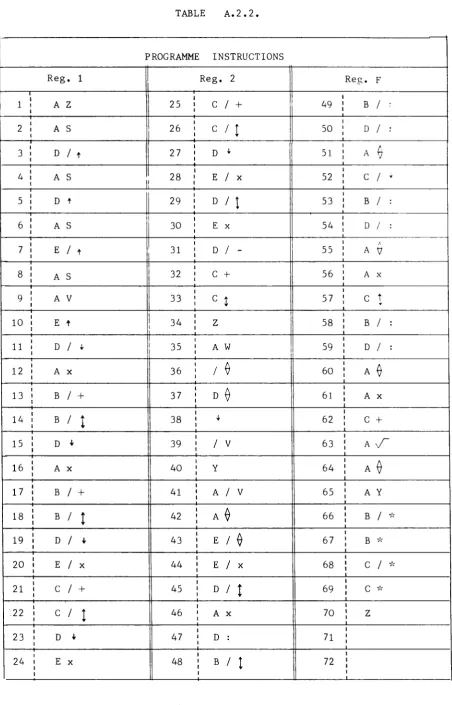
Table A.2.2. shows the programme for calculating the
power spectral density of the signal x(t) , and the real and
imaginary parts and the modulus of the crosspoxver spectral density
^
x y( ¿
w)
·
Results will be printed in the following order:
f in Hz
k
n
^χ χ( ω ) in ν2/Hz
Re(í (¿ω)) in ν2/Hz
Imí<Â (ju)) in ν2/Hz
" xv
\φ (ju)\ in ν2 Hz
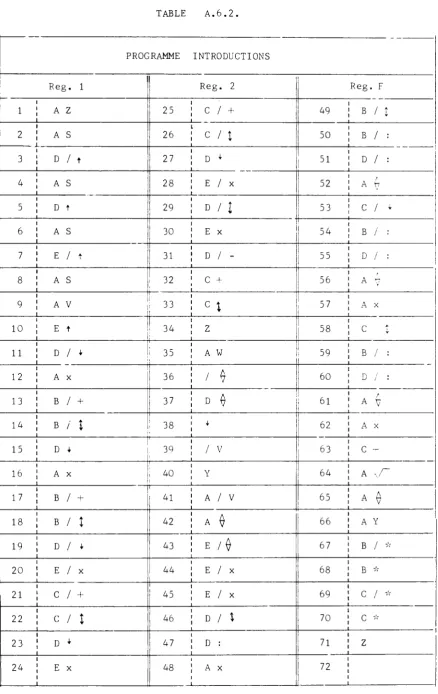
Table Α.2.3. shows the programme concerned with the calculation of the transfer function G(jtø) of the system of
which x(t) and y(t) represent respectively the input and the output signal.
Results will be printed in the following order:
f in Hz
k
n
Re(&(jw))
Im(G(jo)))
Im(&0))
tgp =
Re(&(jo)))
This last programme is the same also for periodic and aperiodic signals, since for the calculation· of the &(j(u) one uses power spectra ra tios in which there are no normalizations.
In effect, the values of the power and crosspower spec tral densities are half of the real values, because they are supplied as bilateral spectra (i.e. also for negative frequencies).
TABLE Α . 2 . 1 .
PROGRAMME INSTRUCTIONS
R e g . 1
1 ! Α Ζ
2 ! A S
3 ! D / t
4 ! A S
5 1 D t
6 ! A S
7 ! E / t
8 ! A S
9 ! A V
IO ! E t
1 1 1 D / +
12 ! Α χ
1 3 ! Β / +■
14 | Β /. \
15 ! D +
16 ! Α χ
17 ! Β / +
18 ! Β / χ
19 ! Ε / ;
20 ! Α χ
21 ! Β +
22 ! Β \
23 ! Ε Ι
24 ! Α χ
R e g . 2
25 ! Β +
26 | Β J
27 ! Ζ
28 ! A W
29 ! / $
30 ! D φ
31 ¡ 4·
32 ¡ / V
33 ,' Υ
34 1 Α / V
R e g . F
49
50
51
52
53
i
54
55
56
■
! 57
I
58
35 ! A Ô 59
1
36 Ε /Ο 60
37 ¡ Ε / χ 61
38 Ι Ε / \
39 ! D / 4.
40 ¡ D / χ
41 ! D :
42 D / I
43 ! Β / i
44 ! D / :
45 ! E / :
46 ! Α φ
47 ! Β +
ι
48 ! D / :
62 63 64 65 66 67 68 69 70 71 72 1
E / :
Λ
A y
A Y
Β / *
Β
-'■-c /
TABLE Α . 2 . 2 .
PROGRAMME INSTRUCTIONS
Reg. 1
ι !
2 ! 3 ! 4 ! 5 ! 6 ! 7 ! 8 9 10 11 12 13 14 15 16 17 18 19 20 21 .22 23 24A Ζ
A S
D / t
A S
D t
A S
E / t
A S
A V
E t
D / 1
A χ
B / +
B / J
D V
A χ
Β / +
Β / |
D / 1
! Ε / χ
! c /
+
!
c
' 1
D 4
Ι Ε χ
Reg. 2
25 j C / +
26 ; C / J
27 '¡ D i
28 ¡' E / χ
29 ¡ D / J
30 E x
31 j D /
32 C +
33
i
c
ι
34 j Ζ35 j A W
36 ; / ν
37 j D
φ
38 j *
39 j / V
40 j Y
41 A / V
42 j A 0
43 j E / φ
44 ! E / χ
45 j D / J
46 Α χ
47 ; D :
48 j Β / J
Reg. F
49 j
50 ';
51 j
52
53
54 j
55 |
56 57 58 59 60 61 62 63 64 65 66 67 68 69 70 71 72
Β / :
D / :
A v
C / *
B / :
D / :
A v
A χ
C t
B / :
D / :
AO
A χ
C +
Α
-r
AO
A Y
B / *
B *
C / *
¡ C *
[image:48.595.80.533.104.810.2]TABLE Α . 2 . 3 .
PROGRAMME INSTRUCTIONS
Reg. 1 1 2 3 4 5 b 7 8 9 10 1 1 12 13 14 15 16 17 18 19 20 21 22 23 24 A Ζ A S
D / t
A S
D ,
A S
E / .
A S
A V
E t
D / +
A χ
B / +
B / I
D *
A χ
Β / +
Β / 1
D / 4
Ε / χ
C / +
c /
ΧD 4.
Ε χ
Reg. 2 jj
25 ! C / +
26 !
C /
I27 ! D 4
I
!
28 . E / χ
29 ! D / I
; 30 ! E x
31 Ι D /
!
J
I 32 ι C +
! 33 ! C \
¡ 34 ! Ζ
35 I A W
36 i
/ O
!
37 ! D {? !
38 ! 4
39 ! / V
40 ! Y
41 ! A / V
42 ! A V
1
!
; 43 ι E / v
44 ! C / 4
45 i B / :
46 ¡
A 0
1
47 ι A x
48 ! E / %
49
i
5 0i 5 1
1
! 5 2
i 5 3
54
i 55
i 56
57 58 59 60 61 62
' 63
64 65 66 67 68 69 70 71 72 Reg. F
C
B / :
Av*
A χ
E /
A .Γ
A 0
C v C / : A " Λ Y
B / ■;·■
B ··'■
c / ■'■
c
A.3. Programme for computation of the Fourier transforms of aperiodic
signals
Table A.3.1. shows the programme which calculates
the real and imaginary parts of the Fourier transforms X(jw) and Y(ja) of the two aperiodic signals x(t) and y(t).
Results will be printed in the following order:
f in Hz
k
Τ in sec. ( analysis time )
Im(x(jaO)
Re(X(jû)))
Im(Y(>))
TABLE A . 3 . 1 .
PROGRAMME INSTRUCTIONS R e g . 1
1 | 2 ; 3 | 4 | 5 j
6 7 8 9 10 11 12 13 14 15 16 17 18 19 20 21 22 23 24
A Ζ A S D / t A S D t A S E / t A S A V
4
C +
c I
R e g . 2
1 li
25 ; D '0 i!
26 ! * ;
27 ; / V
í
28 ; Y
! t
29 ,' A / V
3 o ; A A !
31 ¡ D / χ
ii
3 2 ¡ D t
ti i1
' 3 3 ¡ A / t
¡i ' i
ii 1 i
!: 34 ¡ R *
i ι
; 35 ¡ R S ti '
i 36 ; D / s
Il ι D / 4
B / +
B / I
D 4 B +
B Î
! E / * C / +
i c /
X
! z
; A w
i
ή
3 7 ; 4 ;
38 ; E / χ
39 ', Α 0
40 | Β / 4
41 ; D :
42 ', Α χ
43 ; Β 4
44 j D :
45 ; A y
46 ; C / 4
47 ; D : 48 ; A 0
1 49 50 51 52 53 54 55 5b 5 7 58 59 60 61 62 b3 64 65 ι 66
! 6 7
68 ; b« 70 71 |! 72 1 II }eg. F
c
-D :
A ^
A Y
B / *
B --'■
-C / * C ,
Α.4. - Programmes for the energy spectral analysis of aperiodic signals
In Table A.4.1. we list the programme for calculating
the energy spectral densities φ (u) and ψ (u ) of the
tran-xx yy sient signals x(t) and y(t).
The results obtained by the programme are:
f in Hz
k
Τ in sec (analysis time)
φ (u) in volt squar-ed-second per hertz
Φ
(ω)yy
π n it η ii it
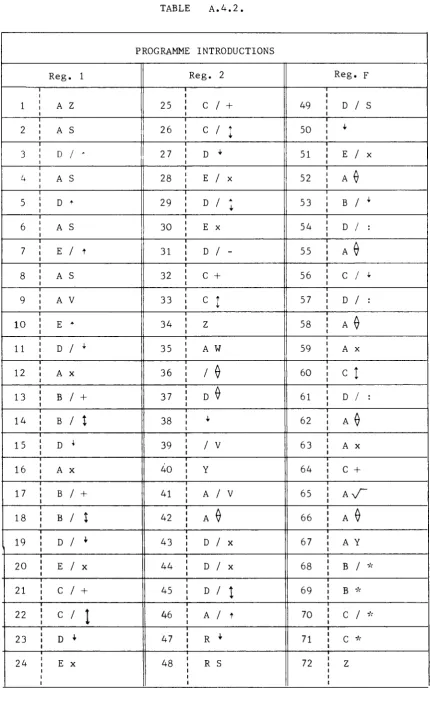
Table A.4.2. shows a programme which evaluates the energy
spectral density ψ (ω) and the real part, the imaginary part and
the modulus of the cross-energy spectral density φ (ju).
xy
The following quantities will be printed out as computing results:
f in Hz
k
Τ in sec.
φ (ω) in volt squared-second per hertz xxv
TABLE Α . 4 . 1 .
PROGRAMME INSTRUCTIONS
Reg. 1
1 ! Α Ζ
2 j A S
3 j D / t
4 ! A S
5 ; D t
6 ί A S
7 E / t
8 ! A S
9 i A V
IO ! E f
11 ¡ D / φ
12 1 Α χ
13 ! Β / +
14 | Β / Ι
15 i D 4
16 ! Α χ
17 j Β / +
18 j Β /
i
19 ! E / 4
20 ! A χ
21 j Β +
22 ί Β î
23 ί E 4
24 ! Α χ
Reg. 2
25 j Β +
26 j Β
î
27 j Z
28 ¡ A W
29 j / 0
30 j D Ø
31 j *
32 j / V
33 j Y
34 ! A / V
35 j A 0
36 ! D / χ
37 ! D / χ
38 ί Ό / Ι
39 | Α / t
40 ! R 4
41 j R S
42 j D / S
43 j 4
44 j E / χ
45 j A 0
46 j Β / ;
47 j D / :
48 i A 0
1 I
Reg. F
49 ! Β *
50 ί D / :
51 ! A V
52 ¡ A Y
53 | B / *
54 j B *
55 j C / '
56 j C '■
57 j Z
58 j
59 j
60 !
61 |
62 j
63 |
64 j
65 |
66 ¡
67 j
68 |
69 |
7 0 !
71 |
TABLE Α . 4 . 2 .
PROGRAMME INTRODUCTIONS
Reg. 1
1 ! Α Ζ
2 ! A S
3 ! D / *
4 ! A S
5 ! D t
6 ! A S
7 ! E / t
8 ! A S
9 ! A V
10 ! E *
11 ! D / ^
12 ! A x
13 ! B / +
14 ! B / t
15 ! D 4
16 ! A χ
17 ! B / +
18 ! B / l
19 ! D / +
20 ! E / χ
21 C / +
22 ! C / t
23 ! D 4
24 Ί E x
Reg. 2
25 ! C / +
26 ! C / t
27 ! D *
28 ! E / χ
29 D / ♦
30 ! E x
31 D /
-32 ! C +
33 C J
34 Ζ
35 ! AW
36 ! / $
37 D V
38 ! +
39 ! / V
40 ! Y
41 ! A / V
42 A 0
43 D / χ
44 D / χ
45 D / χ
46 A / t
47 R *
48 ! R S
R e g . F
49 ! D / S
50 j *
51 ! E / χ
52 j A 0
53 ! Β / +
54 D / :
55 ; A O
56 ! C / 4
57 D / :
58 A 0
59 ! Α χ
60 C J
61 ! D / :
62 ! A 0
63 A x
64 C +
65 Α χ Λ
66 A 0
67 ¡ A Y
68 Β / *
69 Β *
70 C / *
71 C *
[image:54.595.95.526.109.817.2]Α.5. - Programme for computation of the Fourier transforms of periodic signals
In Table A.5.1. we show the programme which calculates the real and imaginary parts of the Fourier transforms X(jw) and Y ( V J ) of two periodic signals x(t) and y(t) .
Results will be printed in the following order:
f in Hz k
TABLE Α . 5 . 1 .
PROGRAMME INSTRUCTIONS
Reg. 1
1 ! A Z
2 ! A S
3 ! D / t
4 ! A S
5 ¡ D t
6 ! A S
7 ! E / t
8 ! A S
9 ! A V
IO ! 4
ii ! c +
i2 c ;
13 ! D / »
14 ¡ B / +
15 j B / I
16 ', D 4
17 ! Β +
18 j Β ♦
19 I E / .
20 ! C / +
21 C / I
22 ¡ Ζ
23 ! A W
24 j / A
Reg. 2
25 : D ^
26 ¡ 4
27 ! / V
28 ¡ Y
29 ¡ A / V
30 A 0
31 ! E / 0
32 ! E / χ
33 i D / χ
34 ! D I
35 ! D :
36 ¡ D / I
37 ¡ D / ;
38 Β / χ
39. ! A 0
40 ¡ Β 4
41 ! D / χ
42 A 0
43 ! C / 4
44 ¡ D / χ
45 ! A 0
46 C 4
47 ! D / χ
48 ! A 0
Reg. F
49 ! A Y
5o ; Β / *
51 Β *
52 ! C / *
53 ! C *
54 ; Ζ
55 !
56 !
57 !
58 ¡
59 !
60 !
61 ;
62 ¡
63
64 !
65 !
66
67 !
68 !
69 I
70
71