System Support for Loosely Coupled Resources in Mobile Computing
by
Xiaozhu Lin
Modern mobile platforms are embracing not only heterogeneous but also loosely coupled computational resources. For instance, a smartphone usually incorporates multiple processor cores that have no hardware cache coherence. Loosely coupled re-sources allow a high degree of resource heterogeneity that can greatly improve system energy efficiency for a wide range of mobile workloads.
However, loosely coupled resources create application programming difficulty: both resources and program state are distributed, which call for explicit commu-nication for consistency. This difficulty is further exacerbated by the large numbers of mobile developers and mobile applications.
In order to ease application programming over loosely coupled resources, in this thesis work we explore system support – at both user level and OS level – that bridges desirable programming abstractions with the underlying hardware. We study three loosely coupled architectures widely seen in mobile computing: i) a smartphone ac-companied by wearable sensors, ii) a mobile device encompassing multiple processors that share no memory, and iii) a mobile System-on-Chip (SoC) with multiple cores sharing incoherent memory.
In order to address the three architectures, this thesis contributes three closely related research projects. In project Dandelion, we propose a Remote Method
Invo-ware Distributed Shared Memory (DSM) to automatically keep user state consistent; the DSM always employs a low-power processor to host shared memory objects in order to maximize sleep periods of high-power processors. In project K2, we identify and apply a shared-most OS model to construct a single OS image over loosely coupled processor cores. Following the shared-most model, high-level OS services (e.g., device drivers and file systems) are mostly unmodified with their state transparently kept consistent; low-level OS services (e.g., page allocator) are implemented as separate instances with independent state for the sake of minimum communication overhead. We report the research prototypes, our experiences in building them, and the experimental measurements. We discuss future directions, in particular how our principles in treating loosely coupled resources can be used for improving other key system aspects, such as scalability.
Acknowledgements
I would most like to thank my advisor Prof. Lin Zhong for his advice and guidance. He provided great vision, encouragement and resources for me to complete the PhD program. The experiences working with him will be a great fortune in my future career as a research professional.
I would like to thank the rest of my thesis committee, Prof. Alan L. Cox and Prof. Peter J. Varman, for their insightful comments and useful suggestions on interesting research directions to explore.
My gratitude extends to the fellow graduate students at RECG, including Zhen Wang, Ardalan Amiri Sani, Robert LiKamWa, Clayton Shepard, and Mian Dong for many hours of mutual support and insightful discussions.
Finally, I would like to especially thank my family for giving me continuous love, care, and support. I could not have done it without them.
Abstract ii
List of Illustrations x
List of Tables xiii
1 Introduction
1
1.1 Benefits of Loosely Coupled Resources . . . 1
1.2 Challenges to Software . . . 2
1.3 Thesis Overview . . . 3
2 Background
7
2.1 Light Tasks in Mobile Systems . . . 72.2 Trends in Mobile Hardware . . . 8
2.2.1 Central, Powerful Processor Is Inadequate . . . 8
2.2.2 Heterogeneous Mobile Architecture . . . 9
2.3 Major Programming Paradigms . . . 14
3 Related Work
17
3.1 User-level Support . . . 17 3.1.1 Direct Programming . . . 18 3.1.2 Library-based Approaches . . . 18 3.1.3 Virtual Machine . . . 18 3.1.4 Domain-specific Abstractions . . . 193.1.5 Software Distributed Shared Memory . . . 20
3.2.1 Single OS Image . . . 21
3.2.2 Sharing Reduction in OS . . . 23
3.2.3 Refactoring Mature OS . . . 24
4 Remote Method Invocation Across Mobile Devices
25
4.1 Motivation: Tension and Gap . . . 254.2 Overview of Dandelion . . . 27
4.3 Programming Support . . . 29
4.3.1 Template for Senselet . . . 29
4.3.2 Platform Services . . . 31
4.3.3 Remote Method Invocations . . . 33
4.3.4 Senselet Executable Generation . . . 36
4.4 Execution Support . . . 36
4.4.1 Dandelion Runtime System . . . 37
4.4.2 Senselet Resource Exception . . . 38
4.5 Prototype Realization . . . 39
4.5.1 Smartphone-side Software . . . 40
4.5.2 Sensor-side Software . . . 40
4.6 Evaluation . . . 41
4.6.1 Benchmark Health Applications . . . 42
4.6.2 Source Code Examination . . . 42
4.6.3 Overhead Measurements . . . 45
4.7 Summary . . . 48
5 Energy-efficient Distributed Shared Memory Over Mobile
Processors
49
5.1 Overview of Reflex . . . 495.1.2 How Reflex Works . . . 50
5.1.3 Hardware Requirements . . . 51
5.2 Distributed Runtime Design . . . 51
5.2.1 Module Execution Model . . . 52
5.2.2 Message Transport . . . 53
5.3 Software DSM Design . . . 54
5.3.1 General Design Choices . . . 54
5.3.2 Protocol Invariant . . . 56
5.3.3 Asymmetric Module Roles . . . 56
5.3.4 Finite-state Machine Specification . . . 57
5.3.5 Support for Synchronization . . . 60
5.3.6 Notable Design Aspects . . . 61
5.4 Compiler Support for DSM . . . 62
5.4.1 Code Instrumentation . . . 62
5.4.2 Optimization for Communication . . . 63
5.5 Prototype Realization . . . 64
5.5.1 Reflex Runtime . . . 64
5.5.2 Reflex Compiler Toolkit . . . 65
5.5.3 Hardware Platform . . . 66
5.6 Evaluation . . . 69
5.6.1 Benchmark Applications . . . 69
5.6.2 Overall Performance of Reflex . . . 70
5.6.3 Source Code Examination . . . 71
5.6.4 Programmer Study . . . 73
5.6.5 DSM Performance . . . 73
5.6.6 Asymmetric Module Role Assignment . . . 73
5.6.7 Storage and Memory Overhead . . . 74
5.7 Discussion . . . 76
5.8 Summary . . . 77
6 Single OS Image Over Non-coherent Asymmetric
Proces-sors
78
6.1 Motivation . . . 786.2 The Case for Replicating OS Services . . . 79
6.3 System Design . . . 81
6.3.1 Design Goals . . . 81
6.3.2 Architectural Assumptions . . . 82
6.3.3 The Shared-most OS Model . . . 83
6.4 The K2 OS . . . 85
6.4.1 Hardware Platform . . . 85
6.4.2 OS Structure . . . 86
6.4.3 Refactoring Linux . . . 88
6.4.4 Build K2 from Source . . . 89
6.5 Memory Management . . . 91
6.5.1 Unified Kernel Address Space . . . 91
6.5.2 Physical Memory Management . . . 94
6.5.3 Software Cache Coherence . . . 97
6.6 Interrupt Management . . . 100 6.7 Nightwatch Threads . . . 101 6.8 Experimental Results . . . 102 6.8.1 Efforts in Refactoring . . . 103 6.8.2 Independent Service . . . 104 6.8.3 Shadowed Service . . . 105
6.8.4 Energy Efficiency Benefits . . . 113
6.10 Summary . . . 118
7 Concluding Remarks
119
7.1 Design Hints . . . 1197.2 Scalability . . . 120
7.3 Recommendation to SoC architects . . . 121
7.4 Conclusion . . . 122
1.1 An overview of the thesis work . . . 3
2.1 Trend in mobile architectures. Both axes are logarithmic. . . 10 2.2 A smartphone (Nexus 5) accompanied by a wearable sensor (Fitbit
Flex). Nexus 5 features full-fledged, quad-core Cortex-A15 ARM processors and Fitbit Flex incorporates low-power Cortex-M3 processor. The two devices have separate physical memory and are
connected over Bluetooth low energy link . . . 11 2.3 TI OMAP4 mobile Application Processor includes two
microcontroller cores based on ARM Cortex-M3 in addition to the usual, dual-core ARM Cortex-A9. The M3 cores run their own real-time OS and do not have a coherent memory view with the A9
cores. . . 12 2.4 Example code based on message passing. The code is written for TI
OMAP4 based on the Syslink inter-processor message passing API. To make the list concise, we hide low-level code such as message
queue management . . . 15 2.5 Example code based on shared memory. A lock is used to prevent
data race . . . 16
4.1 The tension in developing sensor data processing for smartphone
4.2 Skeleton code for data processing on smartphone. This style for sensor data processing shown here is widely adopted by smartphone programming frameworks, including Android, iPhone OS, Symbian
S60, and Maemo . . . 27 4.3 The skeleton code of a Senselet class . . . 28 4.4 Pseudo code of a simplified SenseletBase, as a template to wrap an
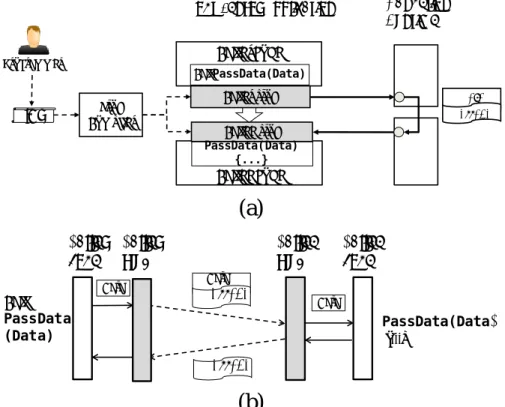
event loop skeleton for Senselet class . . . 30 4.5 The internals of an example RMI PassData(). (a) The stub compiler
generates both caller and callee stubs that translate the RMI into messages. Both main body and senselet can be caller or callee. (b) During the RMI, the caller transfers the data and its control flow to
the callee . . . 32 4.6 The overview of Dandelion runtime architecture . . . 35 4.7 The Dandelion prototype hardware, based on Nokia N900
smartphone (left) and Rice Orbit body sensor (right) . . . 39 4.8 An implementation of FallDetector with senselet . . . 43
5.1 The structure of Reflex. This example asymmetric, heterogeneous hardware architecture is a TI OMAP4-based smartphone with an
added MSP430 processor . . . 52 5.2 State transitions in the Reflex DSM coherence protocol. All
transitions are triggered by requests from a requester. . . 59 5.3 The tri-processor prototype (Top) and its architecture diagram
(Bottom). . . 67 5.4 The average system power consumption of benchmark applications . . 71
5.5 The source lines of code of benchmark applications. Comment or blank lines are excluded. For a column that consists of two parts, the bottom part shows the source lines of the central module; the top
part shows that of the peripheral module(s) . . . 72
5.6 The average requester latency in fetching an object, without and with batch prefetching . . . 75
6.1 K2 in the spectrum of OS structures . . . 83
6.2 The structure of K2 . . . 87
6.3 Refactoring Linux OS services for K2 . . . 88
6.4 The unified kernel virtual address space of K2 . . . 92
6.5 The physical memory management of K2 . . . 95
4.1 The source lines of code in developing in-sensor data processing, with different programming styles . . . 45 4.2 Memory breakdown of sensor runtime, in byte . . . 45 4.3 Memory overhead of senselet executables, in byte and the percentage
of the whole sensor memory. Assume whole memory of 10KB RAM
and 48KB ROM . . . 46 4.4 Execution overhead in common sensor runtime operations, in
processor cycles . . . 47 4.5 Execution overhead in the most common data processing path, in
processor cycles and the percentage of processor time in each
sampling period. FallDetector and Pedometer acquire sensor data at
50Hz, while EKG does at 512Hz. Assume a clock rate of 4MHz . . . . 47
5.1 The processors used in the tri-processor prototype. At run time,
unused processors are turned off to reduce the system idle power. . . 68
6.1 Heterogeneous cores in the two coherence domains of OMAP4 . . . . 86 6.2 Source code changes and additions to the Linux kernel 3.4, which
contains around 10 million SLoC. Much of the OMAP4-specific
6.3 Latencies of physical memory allocations in K2, in 𝜇𝑠. The performance of K2’s main kernel allocator has no noticeable
difference from the Linux page allocator. . . 104 6.4 A breakdown of the latency in a software coherence page fault, in𝜇𝑠. 105 6.5 The major operations of the DMA controller driver, as well as the key
data structures they access. The worst-case overhead due to software cache coherence is also shown. Delay in 𝜇s . . . 106 6.6 DMA throughputs of K2 when the DMA driver is invoked in both
kernels concurrently, in MB/Sec. The throughput differences as
compared to the original Linux are also shown. . . 108 6.7 The major operations of the Linux ramdisk driver, as well as the key
data structures they access. The worst-case overhead due to software cache coherence is also shown. Read or write touches one page of
data. Delay in𝜇s . . . 109 6.8 The major operations of the Linux VFS, as well as the key data
structures they access. The worst-case overhead due to software cache coherence is also shown. The depth of file path is three. Delay in 𝜇s. 111 6.9 Power consumptions of the heterogeneous OMAP4 cores, in mW.
Both cores consumes less than 0.1 mW when inactive. The frequencies with asterisks are used in the benchmarks for testing energy efficiency. 113
Chapter 1
Introduction
Today, mobile platforms have extensively embraced loosely coupled computational resources. In such a platform, resources such as processors, memory, and I/O are physically distributed and operate independently. As there is no hardware cache co-herence, such resources are essentially in multiplecoherence domains, and the domains communicate with message passing primitives provided by the hardware.
1.1
Benefits of Loosely Coupled Resources
Loosely coupled resources offer two key benefits that are unprecedented. First, they enable a high degree of resource heterogeneity and thus can greatly improve system energy efficiency. Today’s mobile devices face a wide range of workloads, from de-manding interactive tasks with rich graphics and high-speed networking to light tasks running in the background such as cloud synchronization and context awareness. A recognized, effective approach to achieve high energy efficiency for such diverse work-loads is to exploit hardware heterogeneity, i.e., executing a workload with hardware component that offers the best power-performance tradeoff. Driven by the pursuit of heterogeneity, mobile architectures with multiple processors that can operate in-dependently are popular in both industry [67, 88] and academia [72, 84, 48, 2]. The resulting hardware architecture is asymmetric with multiple loosely coupled cores that differ in processing power by orders of magnitudes.
Second, (even more) loosely coupled resources open the door to diverse I/O de-vices. Because mobile users usually keep their phones within the arm’s reach [70], smartphone has already served as the personal hub for wearable devices, bridging the latter with human users and the Internet [98]. With providing very rich I/O devices, e.g., a secondary screen, speakers, camera, or various sensors, wireless wear-able devices naturally extend the “sense” of a smartphone and open doors to new applications, such as healthcare. Numerous research prototypes have been reported in literature, and there has been a handful of commercial applications in recent years, e.g. Google Glass [35] and the Nike+iPod Sport Kit [6].
1.2
Challenges to Software
In tapping into loosely coupled resources, the biggest challenge is programmability. Processors from multiple coherence domains essentially constitute a distributed sys-tem. Programming them is known to be difficult to massive third-party programmers, who must maintain consistency for partitioned program components with messages. Not surprisingly, there are very few third-party mobile applications that actually distribute user workloads over multiple coherence domains. Compared to user-level programming, OS engineering is even more challenging. We observe that mobile pro-grams exercise an extensive set of OS components, which requires OS execution to be efficiently replicated over multiple coherence domains. However, all previous work implement a small set of OS services from scratch for a subset of coherence domains, e.g., sensor reading, and assume all other OS services are provided by other domains. The resulting OS services are limited in functionality and hard for application devel-opers to use due to a fragmented system image. What is even worse, constructing those OS services themselves incur high development burden.
User
OS
User-level DSM
Remote Method InvocationSingle
OS Image
Dandelion Reflex
K2
Chip-level
Board-level
Multi-device
More Loosely Coupled
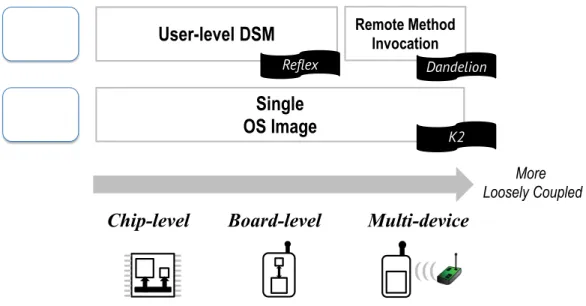
Figure 1.1 : An overview of the thesis work
1.3
Thesis Overview
The theme of this thesis is to address the programmability challenge with system software design, or system support. Our goal is to relieve application developers from directly dealing with loosely coupled resources so that they can easily port legacy applications and develop new ones. While this goal is reminiscent of that of programming other heterogeneous, distributed systems, we face a set of unique challenges when dealing with mobile platforms: extreme architectural asymmetry, energy efficiency, and entrenched programming models.
An overview of the thesis work is shown in Figure 1.1. In exploring the design space of system support, our work is focused on three representative types of integration in loosely coupled mobile architectures, as shown along the horizontal axis of Figure 1.1: i) chip-level integration, namely a mobile System-on-Chip (SoC) with multiple cores that share incoherent memory, ii) board-level integration, namely a mobile device
with multiple processors that share no memory, and iii) multi-device integration, namely a smartphone accompanied by wearable sensors. For these architectures, we further decompose the respective system support into user level and OS level. With user-level support we seek to simplify user program compilation, deployment, and state consistency; with OS-level support we seek to provide programming abstractions for OS development such as writing driver and file systems. We will present the entire work as three closely related projects, as labelled in Figure 1.1.
Chapter 4 presents projectDandelion[47], a user-level framework towards hiding communication details from distributed user program components. Combining both programming and execution support for in-sensor data processing, Dandelion pro-vides transparency on two key aspects: programming style transparency, which makes writing code for wireless sensors very close to developing traditional smartphone ap-plications; target platform transparency, which makes the development, distribution, and deployment of sensor code independent of any particular sensor platform. We experimentally evaluate our prototype with real-world applications, showing that the Dandelion framework reduces the application developers’ burden significantly. Fur-thermore, it does so with an overhead of less than 5% of the memory capacity and less than 3% of the processor time of a typical low-power body sensor.
Chapter 5 presents Reflex [48], a suite of compiler and runtime techniques to-wards offering consistent program state over loosely coupled processors that are of high-power and low-power. The heart of Reflex is a novel software Distributed Shared Memory (DSM) design. The DSM allows code on multiple heterogeneous processors to easily exchange data, even without hardware-coherent memory. The Reflex DSM contributes multiple technical innovations. First, it maintains architectural energy efficiency by using a peripheral processor to serve coherence requests in order to keep
more power-hungry ones in sleep. Second, it creates a shared memory abstraction across processors that differ in processing power by orders of magnitude, and min-imizes disruptions to frequent data processing on peripheral processors. Finally, it employs code instrumentation and aggressive compile-time optimization to greatly improve the DSM performance. Our prototype of Reflex works for a TI OMAP4430 development kit and a tri-processor mobile system built with a commercial smart-phone, 32-bit and 16-bit microcontrollers. Reflex reduces the average power con-sumption by up to 81%. As compared to the message passing paradigm, the DSM reduces the source lines of application code by up to 38%, with less than 5% source code difference from the legacy counterpart.
Chapter 6 presents K2 [50], an experimental OS for mobile SoC with heteroge-neous coherence domains. Through the design of K2, we seek to answer the following question: is it possible to span an OS across multiple coherence domains? In par-ticular, (i) the resulting OS should preserve the established programming models for mobile app development, (ii) the OS itself shall leverage mature operating systems without reinventing wheels, and (iii) the system should deliver the same performance for high-performance applications. Our study shows that one can span an OS across multiple coherence domains by properly refactoring, but without overhauling, existing OS. we identify a shared-most OS model where most OS services are replicated with transparent state coherence for all domains under question and a small, selective set of services operate independently in each domain. Applying the shared-most model, we build the K2 OS, which spans a single system image over multiple coherence domains and thus improves energy efficiency by up to 10x. K2 has met three key design goals. First, it presents a coherent, single Linux image to programmers and therefore pre-serves the widely used programming model; it also provides a familiar programming
abstraction for distributing user workloads among heterogeneous domains. Second, it replicates existing high-level OS services, e.g., device drivers, across multiple do-mains and transparently maintains coherence for them. As a result, K2 is able to reuse most kernel source. Third, it preserves the current level of OS performance by alleviating inter-domain contention: it creates independent instances of low-level services and properly coordinates them; it avoids multi-domain parallelism within a process through scheduling.
The thesis work is a rethinking of the fundamental structure of mobile software stack in face of emerging architectures. Our experiences show that with system soft-ware designed under novel principles, it is feasible for mass mobile programs to exploit loosely coupled resources with existing programming paradigms. Although our de-signs and implementations are based on mobile platforms, as loosely coupled resources become increasingly pervasive in larger-scale systems like manycore servers [10], We hope many of our design principles can benefit them as well.
Chapter 2
Background
To provide the background for the thesis work, we first discuss the characteristics of light tasks in mobile systems, and next review the mobile architectural trend that is moving towards heterogeneity and lacking of hardware cache coherence. We then discuss two major paradigms used for programming loosely coupled and heterogeneous architecture.
2.1
Light Tasks in Mobile Systems
Serving as the personal information hub, today’s mobile devices execute a rich set of ‘background’ tasks, or light tasks. One major category of light tasks is sensing. As mobile systems are embracing a variety of sensors (e.g., either inside a smartphone or connected to the smartphone wirelessly), many emerging applications often con-tinuously use these sensors without user engagement, such as inferring user physical activities and monitoring surrounding environment [74, 54]. Other important light tasks include keeping users connected with social networks and the cloud [96].
Light tasks usually have the following characteristics:
∙ Not performance demanding: Without an awaiting user, light tasks do not directly affect the user experience and thus do not require high processor MIPS.
∙ Mostly IO-bound: Light tasks perform extensive IO operations for exchanging information with the external world. During IO operations, core idle periods
are many, however not long enough for a core to become inactive.
∙ Requiring both user and OS execution: Light tasks not only run user code for application logic, but also invoke diverse OS services such as device drivers [49] and page allocator.
∙ Scheduled to execute throughout daily usage: Light tasks are executed not only when a user is interacting with the device, but also during user’s think periods between interactions and when a user pays no attention. Since user interaction periods are sparse and usually short, most executions of light tasks happen when the entire system is lightly loaded.
∙ High impact on battery life: The nature of frequent executions has a high im-pact on battery life. For instance, a recent study [96] shows that each run of background email downloading reduces device standby time by 10 minutes.
2.2
Trends in Mobile Hardware
2.2.1 Central, Powerful Processor Is Inadequate
To meet the compute demand of modern applications, mobile devices are equipped with powerful cores that have gigahertz frequency and rich architectural features. These powerful cores, however, offer poor energy efficiency for light tasks, due to three sources of inefficiency:
∙ High penalty in entering/exiting active power state. Since strong cores are inac-tive for most of the time, periodic executions of light tasks will inevitably wake them up from time to time.
∙ High idle power. In executing IO-bound light tasks, powerful cores will spend a large number of short periods (of milliseconds) in idle, which are known to consume a large portion of energy in mobile systems [97].
∙ Over-provisioned performance. Although a strong core may increase its energy efficiency by lowering its frequency, shown as ‘DVFS’ in Figure 2.1, the lowest possible frequency and active power are limited by its architecture and fabri-cation process, which still over-provision performance to light tasks with a low performance demand [37].
∙ Far from data source. In a very loosely coupled mobile system, e.g., a smart-phone accompanied by wearable sensors, the strong cores are usually far away from the source of khe data to be processed, such as the sensors. Compared to processing raw data in-place on the sensors, moving them to the central powerful cores over wireless links can be expensive.
2.2.2 Heterogeneous Mobile Architecture
Many have proposed to add simple, low-power processors for mobile devices [2, 72, 84], and for wireless sensor nodes [56, 64, 37], to execute light tasks. Mobile application processors are actually embracing low-power cores [67, 73, 78, 89, 88]. Moreover, sensors intended for mobile devices are also embracing low-power microcontrollers for in-sensor data processing [69, 86]. All result in extremely asymmetric hardware architecture with peripheral processors orders of magnitudes weaker and lower-power than the central processor.
A low-power processor is likely to have a different microarchitecture than the cen-tral, full-fledged processor. This makes software relying on the single ISA inadequate.
Homogeneous
Cores
Non-coherent Shared Memory
or No Shared Memory Shared Memory Coherenet
Multicore ARM big.LITTLE Multi-domain SoC, phone+sensor
Performance
P
ow
er
Heterogeneous
Cores
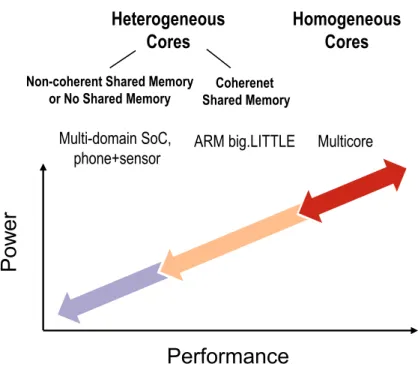
Figure 2.1 : Trend in mobile architectures. Both axes are logarithmic.
For example, a ultra-low power microcontroller core like TI MSP430 is necessary in achieving mWatt power consumption for continuous sensing on smartphones [72]. TI OMAP4, as shown in Figure 2.3, employs ARM Cortex-A9 as the central processor but ARM Cortex-M3 as the newly added microcontroller cores. Compared to the Cortex-A9 cores, the Cortex-M3 cores only support a small subset of instructions while lacking many advanced features such as the SIMD extension.
Next we briefly discuss two typical mobile architectures that embrace heteroge-neous, loosely coupled processors.
Smartphone Accompanied with Wearable Sensors
One typical case of heterogeneous mobile system is a smartphone teaming up with wearable sensors. In this case, the wearable sensors usually embrace efficient compute
Nexus 5
Processor Cores: QCOM Snapdragon 800 (4x 2.3GHz Cortex-A15) Memory: 32 GB Fitbit Flex Processor Core: STM 32L151C6 (32MHz Cortex-M3) Memory: 16 KB Bluetooth Low Energy
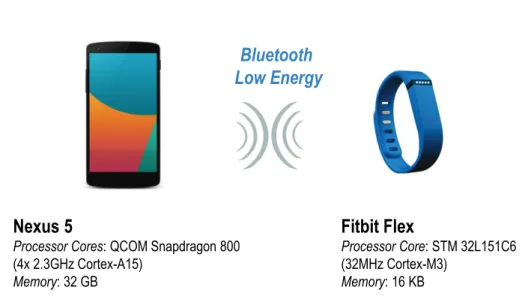
Figure 2.2 : A smartphone (Nexus 5) accompanied by a wearable sensor (Fitbit Flex). Nexus 5 features full-fledged, quad-core Cortex-A15 ARM processors and Fitbit Flex incorporates low-power Cortex-M3 processor. The two devices have separate physical memory and are connected over Bluetooth low energy link
resources, e.g., low-power processors and small physical memory. The processors of smartphone and that of the wearable sensors are connected over wireless link, and do not share any physical memory. Although the efficiency of the wireless link has been significant improved, it is still fairly energy-hungry to move data over the link, compared to local computation. Therefore, the sensors sample raw data in real time, process data at early stage and discard most of the data accordingly.
Figure 2.2 shows a real-world example of such a mobile system, consisting of a smartphone (Nexus 5) and a wearable sensor (Fitbit Flex), which collaborate to serve one mobile user. While Nexus 5 is equipped with gigahertz, powerful processors for cutting-edge user experience, it does not involve in sensor data processing for most of the time; on the other hand, sensor data have been processed on the Fitbit Flex with its low-power Cortex-M3 processor. Only at rare occasions do these two devices
Dual ARM Cortex-A9
System Bus
Per ipher al Int er connec tDual ARM Cortex-M3
Main
Memory
Cache & MMU Cache & MMU
HW Mailbox
Smartphone OS
(e.g. Android)Peripheral OS
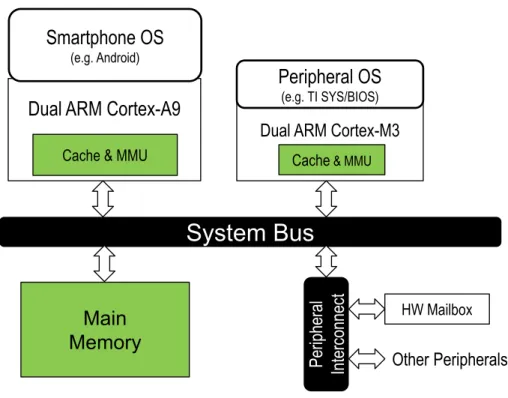
(e.g. TI SYS/BIOS) Other PeripheralsFigure 2.3 : TI OMAP4 mobile Application Processor includes two microcontroller cores based on ARM Cortex-M3 in addition to the usual, dual-core ARM Cortex-A9. The M3 cores run their own real-time OS and do not have a coherent memory view with the A9 cores.
communicate over the Bluetooth low energy link, for instances, when user queries data or interesting events are detected. In such a loosely coupled mobile system, most raw data have been processed and discarded on Fitbit Flex, thus resulting in high energy efficiency overall.
Heterogeneous System-on-Chips(SoCs)
Today’s mobile SoCs incorporate heterogeneous cores with different tradeoffs between performance and power, by placing them in a single or multiple coherence domains.
A handful of heterogeneous SoCs host all heterogeneous cores with a single coher-ence domain [36, 68]. As shown as ‘coherent heterogeneity’ in Figure 2.1, although the introduced heterogeneity indeed widens dynamic power range, the global cache coher-ence becomes the bottleneck for more aggressive energy efficiency, for a few reasons: i) a unified hardware cache coherence mechanism restricts architectural asymmetry, ii) the coherent interconnect itself consumes significant power, and iii) cores co-located in the same coherence domain are likely to suffer from similar thermal constraints.
Incoherent Heterogeneous Processors. Unlike PCs with a symmetric multipro-cessing (SMP) processor, hardware cache coherence is difficulty for smartphones with extremely asymmetric processors. Peripheral processors can barely realize a hard-ware coherence protocol under the tight energy constraint. The micro-architectural difference between strong and weak cores further makes hardware coherency less at-tractive. For instance, TI OMAP4 Cortex-A9 and Cortex-M3 cores physically share non-coherent memory as shown in Figure 2.3. To exchange data, cores of different types need to copy data to and from the memory, and notify each other with the hardware mailbox.
For aggressive energy efficiency, several newer SoCs remove chip-level hardware cache coherence. They embrace multiple coherence domains, each of which can host multiple cores; hardware cache coherence exists within a domain but not across do-mains. Examples include OMAP4 [88], OMAP5 [89], and Samsung Exynos [78]. As shown in Figure 2.1, the absence of hardware cache coherence enables high asymme-try among cores belonging to different domains. For instance, while the lowest power of different cores in the same domain can differ by 6x [82], that of different domains can differ by up to 20x. This allows using weak cores to greatly reduce the three inefficiencies mentioned above.
2.3
Major Programming Paradigms
Due to extreme architectural symmetry, the resulting system is heterogeneous and lacks of coherence. To leverage low-power processors, a developer not only needs to learn a new programming environment but also needs to carefully manage inter-processor data exchange. This is because light tasks often need to exchange data with the rest of the application. Examples of such data include sensing parameters (static or adaptive), intermediate or final results, and control/status variables. Such data can be read or written by multiple code parts. Furthermore, light tasks access the shared data more frequently than its complicated, infrequent counterpart, often by orders of magnitude, due to the cascaded design mentioned in Section 2.1.
Without hardware coherent memory, all existing programming solutions support program state consistency with certain forms of message passing. With systems reported in [84, 9], the developer has to explicitly maintain state consistency between central and peripheral processors. To to so between the A9 cores and Cortex-M cores on TI OMAP4, the developer must use an inter-processor message passing API called Syslink. Not surprisingly, there are very few third-party smartphone applications that actually use a peripheral processor to save energy.
Programming with Message Passing
Message passing is a programming paradigm where distributed code parts commu-nicate by explicitly copying messages, being data or program objects. Programming with message passing for smartphone sensing is a nontrivial task. We next use an example based on OMAP4 to illustrate the reasons. Figure 2.4 shows two code snip-pets excerpted from a simple sensing application, which uses messages to exchange data with the Syslink API provided by TI. The two code snippets are executed on
Cortex-M cores on TI OMAP4, the developer must use an inter-processor message passing API called Syslink. Not surprisingly, there are very few third-party smartphone applications that actually use a peripheral processor to save energy.
2.3.1 Problems with Message Passing
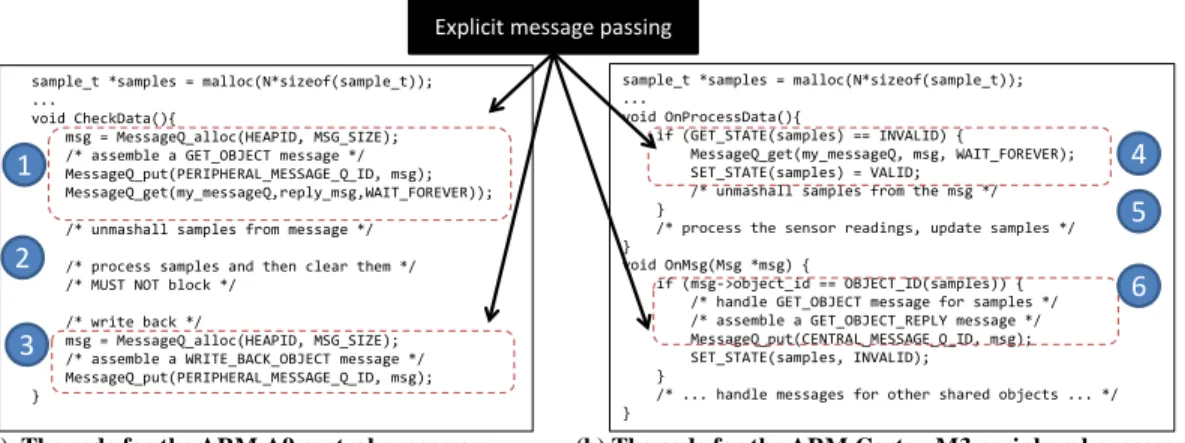
Message passing is a programming paradigm where distributed code parts communicate by explicitly copying messages, being data or program objects. Programming with message passing for smartphone sensing is a nontrivial task. We next use an example based on OMAP4 to illustrate the reasons. Figure 2 shows two code snippets excerpted from a simple sensing application, which uses messages to exchange data with the Syslink API provided by TI. The two code snippets are executed on two different processors, and both use the samples array. The peripheral processor code, running on the Cortex-M3 cores, fills samples as it acquires sensor readings, and the central processor code, running on the Cortex-A9 cores, reads samples and clears historical values when necessary.
In the code, message passing exhibits its well-known drawbacks. First, developers need to synchronize distributed copies of the same object with a customized communication protocol, (1) (3) (4) (6) in Figure 2. Due to the discrepancy of ISAs, developers may need to convert samples among different data formats. For shared objects that contain pointers, e.g., a linked list, the efforts will be more tedious.
The use of message passing is further complicated by the extreme architectural asymmetry. Message-based communication should not interfere with the sensor data processing on the weak, peripheral processors. For example, the computation in (2) should complete in time, because the peripheral processor is stalling its frequent processing task (5) and waiting. Similarly, message handling (6) on the peripheral processor should not be executed so
often in order to avoid delaying the frequent data processing. Finally, for energy efficiency, the developer must arrange the communication so that no message should wake up the central processor from a sleep state.
2.3.2 Problems with Software DSM
The archrival to message passing in programming distributed systems without hardware-coherent memory is software DSM. With a software protocol that coordinates multiple distributed memory components to collaboratively serve memory access, software DSM creates the key illusion of a shared address space. Compared to messages, shared memory is a much more familiar abstraction to smartphone developers. The resulting application code is concise and similar to legacy smartphone code, as shown in Figure 3. However, DSM may introduce communication overhead due to thrashing or unnecessary data transfer.
Reflex resorts to DSM in order to conceal the underpinning messages, with the following key rationales. First, the compiler and runtime can automate the architecture-dependent mechanics of message passing. Second, the overhead of DSM diminishes as the access contention decreases [14]. Fortunately, sensing applications tend to have light access contention, since only the data processing task frequently accesses the shared objects. Finally, with compiler techniques, the overhead can be reduced close to what can be achieved by hand-optimized message passing.
3. OVERVIEW OF REFLEX
Our goal in developing Reflex is to relieve developers from directly dealing with the heterogeneous, distributed platform so that they can easily port legacy applications and develop new ones to leverage peripheral processors for energy efficiency.
(a) The code for the ARM A9 central processor (b) The code for the ARM Cortex-M3 peripheral processor Figure 3: Example code based on shared memory. A lock is used to prevent the data race
lock m; sample_t *samples; /* global variables */ ...
samples = malloc(N*sizeof(sample_t)); ...
void CheckData(){ acquire(m);
/* process samples and then clear them */ release(m);
}
void OnProcessData(){ acquire(m);
/* process the sensor readings, update samples */ release(m);
}
(a) The code for the ARM A9 central processor (b) The code for the ARM Cortex-M3 peripheral processor Figure 2: Example code based on message passing. The code is written for TI OMAP4 based on the Syslink inter-processor message passing API. To make the list concise, we hide low-level code such as message queue management
sample_t *samples = malloc(N*sizeof(sample_t)); ...
void CheckData(){
msg = MessageQ_alloc(HEAPID, MSG_SIZE); /* assemble a GET_OBJECT message */ MessageQ_put(PERIPHERAL_MESSAGE_Q_ID, msg); MessageQ_get(my_messageQ,reply_msg,WAIT_FOREVER)); /* unmashall samples from message */
/* process samples and then clear them */ /* MUST NOT block */
/* write back */
msg = MessageQ_alloc(HEAPID, MSG_SIZE); /* assemble a WRITE_BACK_OBJECT message */ MessageQ_put(PERIPHERAL_MESSAGE_Q_ID, msg); }
1 2
sample_t *samples = malloc(N*sizeof(sample_t)); ...
void OnProcessData(){
if (GET_STATE(samples) == INVALID) {
MessageQ_get(my_messageQ, msg, WAIT_FOREVER); SET_STATE(samples) = VALID;
/* unmashall samples from the msg */ }
/* process the sensor readings, update samples */ }
void OnMsg(Msg *msg) {
if (msg->object_id == OBJECT_ID(samples)) {
/* handle GET_OBJECT message for samples */ /* assemble a GET_OBJECT_REPLY message */ MessageQ_put(CENTRAL_MESSAGE_Q_ID, msg); SET_STATE(samples, INVALID);
}
/* ... handle messages for other shared objects ... */ }
4
6
Explicit message passing
3
5
Figure 2.4 : Example code based on message passing. The code is written for TI OMAP4 based on the Syslink inter-processor message passing API. To make the list concise, we hide low-level code such as message queue management
two different processors, and both use the samples array. The peripheral processor code, running on the Cortex-M3 cores, fills samples as it acquires sensor readings; the central processor code, running on the Cortex-A9 cores, reads samples and clears historical values when necessary.
In the code, message passing exhibits its well-known drawbacks. First, developers need to synchronize distributed copies of the same object with a customized commu-nication protocol, (1) (3) (4) (6) in Figure 2.4. Due to ISA discrepancy, developers may need to convert samples among different data formats. For shared objects that contain pointers, e.g., a linked list, the efforts will be more tedious.
The use of message passing is further complicated by the extreme architectural asymmetry. Message-based communication should not interfere with the sensor data processing on the weak, peripheral processors. For example, the computation in (2) should complete in time, because the peripheral processor is stalling its frequent processing task (5) and waiting. Similarly, message handling (6) on the peripheral
16
Cortex-M cores on TI OMAP4, the developer must use an inter-processor message passing API called Syslink. Not surprisingly, there are very few third-party smartphone applications that actually use a peripheral processor to save energy.
2.3.1 Problems with Message Passing
Message passing is a programming paradigm where distributed code parts communicate by explicitly copying messages, being data or program objects. Programming with message passing for smartphone sensing is a nontrivial task. We next use an example based on OMAP4 to illustrate the reasons. Figure 2 shows two code snippets excerpted from a simple sensing application, which uses messages to exchange data with the Syslink API provided by TI. The two code snippets are executed on two different processors, and both use the samples array. The peripheral processor code, running on the Cortex-M3 cores, fills samples as it acquires sensor readings, and the central processor code, running on the Cortex-A9 cores, reads samples and clears historical values when necessary.
In the code, message passing exhibits its well-known drawbacks. First, developers need to synchronize distributed copies of the same object with a customized communication protocol, (1) (3) (4) (6) in Figure 2. Due to the discrepancy of ISAs, developers may need to convert samples among different data formats. For shared objects that contain pointers, e.g., a linked list, the efforts will be more tedious.
The use of message passing is further complicated by the extreme architectural asymmetry. Message-based communication should not interfere with the sensor data processing on the weak, peripheral processors. For example, the computation in (2) should complete in time, because the peripheral processor is stalling its frequent processing task (5) and waiting. Similarly, message handling (6) on the peripheral processor should not be executed so
often in order to avoid delaying the frequent data processing. Finally, for energy efficiency, the developer must arrange the communication so that no message should wake up the central processor from a sleep state.
2.3.2 Problems with Software DSM
The archrival to message passing in programming distributed systems without hardware-coherent memory is software DSM. With a software protocol that coordinates multiple distributed memory components to collaboratively serve memory access, software DSM creates the key illusion of a shared address space. Compared to messages, shared memory is a much more familiar abstraction to smartphone developers. The resulting application code is concise and similar to legacy smartphone code, as shown in Figure 3. However, DSM may introduce communication overhead due to thrashing or unnecessary data transfer.
Reflex resorts to DSM in order to conceal the underpinning messages, with the following key rationales. First, the compiler and runtime can automate the architecture-dependent mechanics of message passing. Second, the overhead of DSM diminishes as the access contention decreases [14]. Fortunately, sensing applications tend to have light access contention, since only the data processing task frequently accesses the shared objects. Finally, with compiler techniques, the overhead can be reduced close to what can be achieved by hand-optimized message passing.
3. OVERVIEW OF REFLEX
Our goal in developing Reflex is to relieve developers from directly dealing with the heterogeneous, distributed platform so that they can easily port legacy applications and develop new ones to leverage peripheral processors for energy efficiency.
(a) The code for the ARM A9 central processor (b) The code for the ARM Cortex-M3 peripheral processor Figure 3: Example code based on shared memory. A lock is used to prevent the data race
lock m; sample_t *samples; /* global variables */ ...
samples = malloc(N*sizeof(sample_t)); ...
void CheckData(){ acquire(m);
/* process samples and then clear them */ release(m);
}
void OnProcessData(){ acquire(m);
/* process the sensor readings, update samples */ release(m);
}
(a) The code for the ARM A9 central processor (b) The code for the ARM Cortex-M3 peripheral processor Figure 2: Example code based on message passing. The code is written for TI OMAP4 based on the Syslink inter-processor message passing API. To make the list concise, we hide low-level code such as message queue management
...
void CheckData(){
msg = MessageQ_alloc(HEAPID, MSG_SIZE); /* assemble a GET_OBJECT message */ MessageQ_put(PERIPHERAL_MESSAGE_Q_ID, msg); MessageQ_get(my_messageQ,reply_msg,WAIT_FOREVER)); /* unmashall samples from message */
/* process samples and then clear them */ /* MUST NOT block */
/* write back */
msg = MessageQ_alloc(HEAPID, MSG_SIZE); /* assemble a WRITE_BACK_OBJECT message */ MessageQ_put(PERIPHERAL_MESSAGE_Q_ID, msg); } 1 2 void OnProcessData(){ if (GET_STATE(samples) == INVALID) { MessageQ_get(my_messageQ, msg, WAIT_FOREVER); SET_STATE(samples) = VALID;
/* unmashall samples from the msg */ }
/* process the sensor readings, update samples */ }
void OnMsg(Msg *msg) {
if (msg->object_id == OBJECT_ID(samples)) {
/* handle GET_OBJECT message for samples */ /* assemble a GET_OBJECT_REPLY message */ MessageQ_put(CENTRAL_MESSAGE_Q_ID, msg); SET_STATE(samples, INVALID);
}
/* ... handle messages for other shared objects ... */ }
4
6 3
5
Figure 2.5 : Example code based on shared memory. A lock is used to prevent data race
processor should not be executed so often in order to avoid delaying the frequent data processing. Finally, for energy efficiency, the developer must arrange the com-munication so that no message should wake up the central processor from a sleep state.
Programming with Software Distributed Shared Memory (DSM)
The archrival to message passing in programming distributed systems without hardware-coherent memory is software DSM. With a software protocol that coordinates multi-ple distributed memory components to collaboratively serve memory access, software DSM creates the key illusion of a shared address space. Compared to messages, shared memory is a much more familiar abstraction to smartphone developers. The result-ing application code is concise and similar to legacy smartphone code, as shown in Figure 2.5. However, DSM may introduce communication overhead due to thrashing or unnecessary data transfer.
Chapter 3
Related Work
Hardware heterogeneity is a recognized way to improve energy efficiency. Driven by the pursuit of heterogeneity, mobile architecture with loosely coupled resources, that is, multiple processors operating independently without hardware cache coherence, is popular in both industry [67, 88] and academia [72, 84, 48, 2]. Although the goal of abstracting and managing loosely coupled resources has been extensively studied in prior work, the goal brings new twists into the context of mobile computing. Since programming loosely coupled resources share many challenges and solutions with pro-gramming heterogeneous resources, the following discussions will also include resource heterogeneity. We categorize the related work into that of user level and OS level, and discuss them respectively.
3.1
User-level Support
Project Dandelion and Reflex, as presented in this dissertation, are among the first to ease user-level programming for low-power cores in mobile devices. However, the study of user-level abstractions for loosely coupled resources is not new. We next discuss the major categories of abstractions that have been proposed previously. It is important to keep in mind that we face a set of unique challenges when dealing with mobile devices: mature programming languages, energy efficiency and extreme architectural asymmetry.
3.1.1 Direct Programming
In face of loosely coupled resources, the most straightforward approach is to shift the burden to application developers, i.e., directly exposing the facts of discrete program components and fragmented software state to applications, requiring application de-velopers to handle them explicitly. In most heterogeneous systems [2, 84, 94], the developers have to program each processor in the system directly without any trans-parency. Many systems support inter-processor communication with message-like primitives. For example, Hydra [94] supports distributed “offcodes” to communicate with channels. Lime [39] supports code distributed on CPU and FPGA to exchange data through “buffer”, a message-passing abstraction. Compared to programming support presented in this dissertation, programming with message passing can be tedious and error-prone, in particular for mobile applications.
3.1.2 Library-based Approaches
Taking one step further, some systems facilitate application development by abstract-ing resources with a pre-defined set of functions, an approach that is commonly seen in programming wearable devices. Examples include MobiCare [16], CodeBlue [60], and SPINE [41]. In particular, SPINE provides a portable library for in-sensor sig-nal processing. While this approach gains certain programming ease for particular applications that use such pre-defined functions, compared to Dandelion discussed in Chapter 4, it restricted expressiveness in user-level programming.
3.1.3 Virtual Machine
Virtual machines can be used to abstract away heterogeneity. Some systems sup-port programming transparency with a unified OS abstraction or distributed runtime
system, mostly based on a virtual-machine approach [66] to hide ISA variances. Ad-ditionally, type safety, as featured by most language VMs, provides vital information for translating memory objects among address spaces, a central task of distributed shared memory. The VM approach, however, proves to be difficult on low-power pro-cessors [45]. In contrast, Dandelion and Reflex hide ISA heterogeneity with an extra compilation phase that happen on the target device, and explicitly require type-safe programming at user level.
3.1.4 Domain-specific Abstractions
Many programming systems have been proposed for loosely coupled and/or hetero-geneous systems. Most of them define custom programming interfaces to bridge the developer’s code with the underlying architecture. In the context of wireless sensor networks (WSN), solutions such as nesC [31] and protothreads [26] provide node-level programming abstractions. Macro-programming [20, 40, 57] enables developing WSN applications by describing the network-level behaviors.
Qilin [55] provides API for parallelizable computation so that the computation can be dynamically mapped to heterogeneous resources. Merge [51] defines new language constructs to support the map-reduce pattern that fits in parallel execution. Cell-Ss [11] requires annotations of source-code to exploit the task-level parallelism. These custom programming models are specific to their targeted applications, including WSN, scientific, or analytic workloads, making it is difficult for smartphone developers to adopt them. In contrast, our work aims at supporting the mature paradigms of smartphone app development.
3.1.5 Software Distributed Shared Memory
Generally, the idea of creating a shared memory illusion by software with messages, or software DSM, is well-known. There is a rich body of software DSM designs for conventional loosely-coupled distributed systems like workstation clusters. Aiming at minimizing the performance overhead of shared memory, these DSM designs have employed OS kernel support [32], compiler techniques [79] and runtime systems [46, 15, 4]. Also, heterogeneity has been addressed [99]. Most of them rely on hardware MMU support. While they inspire the design of the Reflex DSM, none of them is designed for energy efficiency or the extreme architectural asymmetry. More recently, Hera-JVM [63] realizes a software cache among heterogeneous cores of Cell processor. Unlike the Reflex DSM, it implements the cache coherence in a symmetric fashion and with a coarse granularity, by simply flushing the entire cache of a peripheral processor (i.e. SPE) to the main memory during synchronization. This makes Hera-JVM energy-inefficient and improper for smartphone sensing. Partitioned Global Address Space (PGAS) allows multiple processors (many homogeneous ones [10] or a few heterogeneous ones [77]) that share no coherent memory to logically share a window of shared addresses. Unlike Reflex, such a shared window is implemented with symmetric coherence protocols. ADSM [32] provides a software DSM between CPU and GPU with fully implementing DSM on the CPU, a strategy opposite to the Reflex DSM. Although the strategy is asymmetric, it targets performance instead of energy efficiency and therefore will not work for smartphone sensing applications.
Hardware-coherent memory is also related. While most symmetric multiprocessing (SMP) systems support hardware-coherent memory as exemplified by commercial multicore processors, only a few heterogeneous systems [91, 93] rely on it. As we analyzed in Chapter 5, hardware-coherent memory is difficult, if possible at all, for
low-power peripheral processors concerned by mobile devices.
3.2
OS-level support
While some existing systems have focused on user programming models [48] and poli-cies [72], none offers OS support as K2 does. The lack of OS support will defeat the goal of energy efficiency: as shown by our study of mobile workloads [49], demand-ing and non-demanddemand-ing tasks share an extensive set of OS services, which must be executed on each coherence domain.
3.2.1 Single OS Image
Programming multiple OSes or kernels can be made a lot easier with a single system image. While the accurate definition of a single OS image may vary, we see two aspects are fundamental and related to our work: unified namespaces and unified resource management.
Unified OS Namespace
Many previous work is focused on maintaining unified namespaces without unified resource management. Targeted a cluster of workstations, an OS often consists of a set of distributed services, each of which manages some resources that are local to the corresponding workstation (i.e., a coherence domain). Thus, a single OS image is often created by forwarding OS requests to the corresponding coherence domain. A service may have multiple instances on difference domains; however, such instances manage disjoint sets of resources and still have to communicate with each other frequently.
Examples abundant. For scalability, the V distributed system [19] distributes microkernels over workstations and forwards requests as network messages to
cor-responding OS servers via network. Project OpenSSI [13] refactors and replicates Linux, a monolithic kernel, over multiple workstations of a cluster. Multicelluar OSes such as Hive [17] and Cellular IRIX [81] provide single system images over multiple cells by running independent kernels which cooperate using explicit communication, e.g., RPC. Since kernels are independent, an IO request must be served in the only cell where the IO device is located. Similar software structure has been employed for a single machine. fos [95], Helios [66], and NIX [8] dedicate a set of cores or hardware accelerators to a specific OS service, and pass corresponding service requests as ex-plicit messages. For resource isolation, Tessellation [21] allows certain OS components (called a partition) run on top of a dedicated set of resources. Disco [14], which runs different unmodified OSes on a single machine, does coordination at user level with standard network protocol, thus providing a partial single system image.
Unlike them, K2 cannot rely on request forwarding for a single OS image, which will frequently involve multiple heterogeneous coherence domains and thus under-mines either performance or energy efficiency. In creating a single OS image, K2 calls for not only unified namespaces but also unified resource management: all OS replicas must manage all resources collaboratively.
Unified Resource Management
Unified resource management has been proposed for distributed OSes towards better resource utilization, as statically partitioning resources is wasteful. Many systems fea-ture redesigned local resource managers that cooperate at fine grains [10, 95, 28, 53], which are effective however difficult to be applied to mature mobile OSes. Simi-larly, Libra [3] enables a general-purpose OS and multiple specialized library OSes to share physical memory dynamically; it also employs redesigned memory managers
in the specialized OSes. Unlike K2, most of them are focused on memory resources while leaving out other important resources, e.g., IO and interrupts. Some virtual machines [92] enables resource sharing (in particular physical memory) among mul-tiple guest OSes while minimizing modifications to them. K2 retrofits the idea of balloon driver from virtual machines; in particular, K2 transfers the ownership of physically contiguous memory regions among individual kernels, without assuming any virtualization hardware.
As an extreme design point, vNUMA [18] places a distributed shared memory layer at the hypervisor level, enabling one virtual machine to span over networked physical workstations. This shared-everything approach, although minimizing modi-fications to OS and apps, introduces relatively high communication latency (e.g., that of ethernet) into performance-sensitive OS components, such as page allocator, thus undermining performance. In comparison, with K2 we argue for replicating the state of performance-sensitive OS components for the sake of reduced communication and higher performance.
Maintaining cache coherence with software is a classic approach to hide distributed program state from programmers [46], which has been applied to new incoherence architectures like CPU-GPU system [32] and smartphones [48]. K2 borrows mature designs of software cache coherence, and explores its use on supporting OS services over multi-domain SoCs.
3.2.2 Sharing Reduction in OS
Reducing sharing in OS has been extensively studied for shared memory machines, mostly for scalability. Many argue for structural overhauls. Hurricane [90] organizes OS in a hierarchical way to improve scalability. Barrelfish [10] takes an extreme design
point to make all OS state non-shared by default. fos [95] argues to replicate given OS services to a subset of processors and coordinate them with messages. New pro-gramming abstractions have been proposed, too. Tornado [29] and K42 [5] argue for object-oriented OS designs, enabling each OS service to have its internal mechanism to distribute over SMP. Inspired by them, K2 treats OS services differently in how to replicate them over coherence domains; unlike them, K2 targets reusing legacy OS code rather than a clean-slate implementation. For manycore machines, Corey [12] enables applications to control sharing within processes. Inspired by it, K2 employs NightWatch thread as a mechanism for expressing performance expectation.
3.2.3 Refactoring Mature OS
In reusing mature OSes for new architectures, virtualization and refactoring are two major approaches. While K2 borrows idea from virtual machines for memory manage-ment, the latter usually enforces isolation among OS instances, rather than providing a single system image over them. Refactoring, as done in DrawBridge [71] and Uniker-nels [58] recently, restructures OS while keeping individual OS components. Their approaches are inspiring, but solve a different problem – rearranging OS services vertically across layers. In comparison, for K2 we refactor Linux by replicating OS services horizontally across coherence domains.
Chapter 4
Remote Method Invocation Across Mobile Devices
4.1
Motivation: Tension and Gap
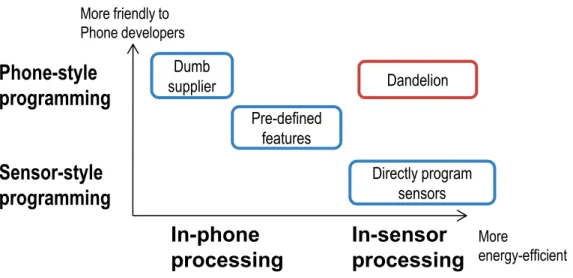
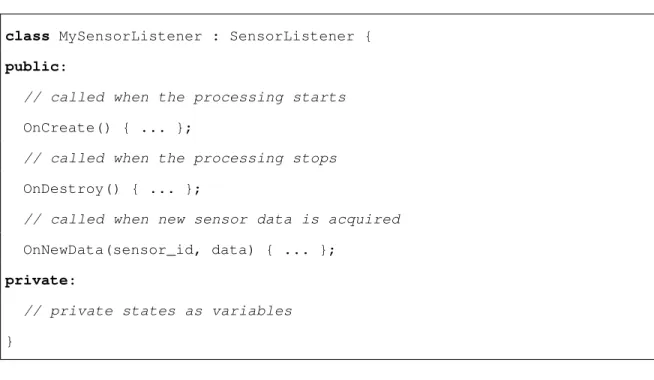
Figure 4.1 shows the tension between system energy efficiency and ease of body sensor application development. At one extreme (ease of development), the developer can treat the sensors as dumb data suppliers and processes the raw data on the smart-phone (“Dumb supplier” in the figure). Figure 4.2 uses a skeleton code to illustrate the smartphone style for processing sensor data, which uses a clear interface in the object-oriented fashion. While very friendly to smartphone developers, this paradigm is extremely energy inefficient because moving excessive raw data over the wireless link consumes a lot of energy, and consequently reduces the battery lifetime of the phone and sensors.
To improve the efficiency, many research prototypes [41, 33] implement a fixed set of sensor routines to support a pre-defined set of data processing in the sensor (“Pre-defined routines” in Figure 4.1). This is similar to the Application Profiles provided by Bluetooth. While this approach improves energy efficiency for some applications, its lack of sensor programmability inevitably restricts developers from creating applica-tions that require novel, application-specific data processing. At the other extreme, the application developers can carefully partition the data processing between the phone and the sensors, and then program both directly. While this paradigm can be very efficient, it usually requires the developer to master sensor node-level
program-More friendly to Phone developers More energy-efficient
In-sensor
processing
In-phone
processing
Phone-style
programming
Sensor-style
programming
Dumb supplier Pre-defined features Directly program sensors DandelionFigure 4.1 : The tension in developing sensor data processing for smartphone body sensor applications
ming, with low-level abstractions that are tightly coupled with various underlying platforms [30, 38, 52, 26], and probably involves a different programming language. For example, TinyOS requires developers using nesC language [31] to write sensor code as a set of software components. In addition, TinyOS requires developers to define events and commands as the interface for each component, and properly wire interfaces together. Although very effective at programming nodes in wireless sensor networks, such programming requirements are foreign to many smartphone developers and are significantly different from existing smartphone programming styles. Macro-programming models at the network-level [20, 40, 57] target relatively large-scale sen-sor networks. The introduction of new language constructs such as new statements, predicates, rules, or task graphs, makes them even more difficult for smartphone pro-grammers to manage. In short, the gap between the smartphone programming style and that of various sensor platforms constitutes a practical barrier for the majority
class MySensorListener : SensorListener {
public:
// called when the processing starts OnCreate() { ... };
// called when the processing stops OnDestroy() { ... };
// called when new sensor data is acquired OnNewData(sensor_id, data) { ... };
private:
// private states as variables }
Figure 4.2 : Skeleton code for data processing on smartphone. This style for sensor data processing shown here is widely adopted by smartphone programming frame-works, including Android, iPhone OS, Symbian S60, and Maemo
of smartphone developers to leverage body sensors and create applications.
4.2
Overview of Dandelion
Our goal is to achieve both high efficiency and ease of development by making sensor programming transparent to the smartphone developers (“Dandelion” in Figure 4.1). By “transparent”, we mean that smartphone developers do not have to deal with the native programming abstraction or hardware/software specifications of the sensor. Our solution toward this goal is Dandelion, a framework that allows smartphone application developers to “program” body sensors by simply writing the code as a smartphone software module. Dandelion achieves such design goal with senselet, a smartphone-style, platform-agnostic programming abstraction for in-sensor data
class MySenselet : public SenseletBase { public: // App-specific initialization void OnCreate() {...}; // App-specific finalization void OnDestroy() {...};
// Receive and process new sensor data
void OnData(data) {...};
private:
// All senselet states are private variables }
// ... in the main body code ... LoadSenseletInstance(MySenselet);
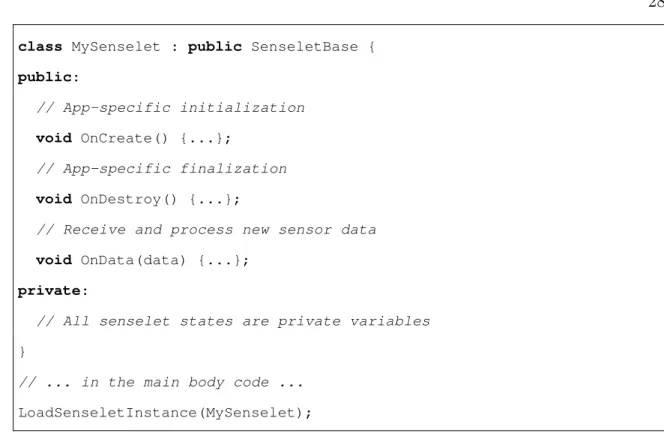
Figure 4.3 : The skeleton code of a Senselet class
processing.
Dandelion supports this abstraction from both the programming aspect (Sec-tion 4.3) and the execu(Sec-tion aspect (Sec(Sec-tion 4.4). For programming support, Dandelion defines the degree of transparency with three key design decisions: a compact set of platform services for senselet to access platform resource, the Remote Method Invo-cation (RMI) mechanism for integrating senselets with the appliInvo-cation code running on the smartphone (called main body in this work), and the two-phase compilation technique for generating senselet executable.
For execution support, Dandelion manages and executes senselets with its dis-tributed middle layer or runtime system. The runtime system consists of a smart-phone runtime component and one or more sensor runtime components. Runtime
components communicate with messages. The smartphone runtime acts as the coor-dinator to command all sensor runtimes, and a sensor runtime fulfills such commands and executes the senselet code.
4.3
Programming Support
Toward making sensor programming transparent, Dandelion targets practical trans-parency. A complete transparency is ideal to the developer: the development and execution of a senselet will be indistinguishable from a smartphone software module. However, such complete transparency is very expensive, if not impossible, given the huge discrepancy between the hardware and software environments on the smart-phone and on body sensors. For example, implementing coherent shared memory across the smartphone and sensors incurs prohibitive overhead.
Dandelion defines practical transparency for senselet with four design decisions: 1) hide platform-dependent programming styles inside the template (Section 4.3.1), 2) choose a compact set of platform services as the unified interface to platform resources (Section 4.3.2), 3) use the RMI mechanism to transparently integrate senselets into the smartphone application (Section 4.3.3), and 4) compile and distribute senselets as platform-independent intermediate representations (IRs) and translate the IRs into platform-specific binaries during application installation (Section 4.3.4). We will discuss the four decisions in details below.
4.3.1 Template for Senselet
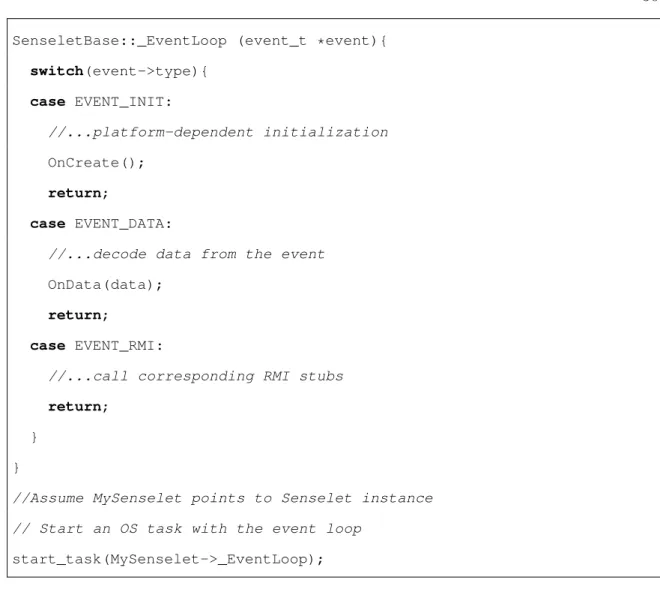
Senselet is the core of Dandelion that abstracts in-sensor data processing. As shown in the object-oriented skeleton code in Figure 4.3, a senselet is a subclass that inherits the virtual base SenseletBase. SenseletBase declares a concise interface as a set of virtual
SenseletBase::_EventLoop (event_t *event){ switch(event->type){ case EVENT_INIT: //...platform-dependent initialization OnCreate(); return; case EVENT_DATA:
//...decode data from the event OnData(data);
return;
case EVENT_RMI:
//...call corresponding RMI stubs
return;
}
}
//Assume MySenselet points to Senselet instance // Start an OS task with the event loop
start_task(MySenselet->_EventLoop);
Figure 4.4 : Pseudo code of a simplified SenseletBase, as a template to wrap an event loop skeleton for Senselet class
methods for concrete senselets. For example, the senselet class overrides OnCreate() to initialize its state, and overrides OnData() to receive new sensor data for processing. Compared to various native sensor programming abstractions, the senselet abstraction has three distinct features: 1) a just-fit interface for data processing, 2) smartphone style programming (very close to the skeleton code shown in Figure 4.2), and 3) platform-independence.
SenseletBase contains the template code written with sensor native programming abstraction, while leaving the implementation of the actual data processing to sense-lets. Essentially, a SenseletBase class plays two important roles. First, it acts as an adaptor between the senselet abstraction and the sensor native programming abstrac-tion. Second, it hides low-level platform configurations, e.g. hardware parameters from the developer.
Since the implementation of a SenseletBase is platform-specific, it is the sensor vendor’s responsibility to provide SenseletBase as a basic library. When a Dandelion application is being installed on a smartphone, the developer-provided senselet code is linked with vendor-provided SenseletBase to generate the final senselet executable, as will be further addressed in Section 4.3.3.
Example: We use a simple example in Figure 4.4 to illustrate how SenseletBase works as a template. Suppose that the sensor platform requires any of its software modules to be coded as an event loop. SenseletBase populates such an event loop in the function _EventLoop(), with dispatching events to the proper methods imple-mented by a concrete Senselet class (e.g. OnStart and OnData).
4.3.2 Platform Services
Dandelion abstracts platform resource as a set of platform services, which resemble system calls in traditional OS. In designing platform services, we seek to strike a balance between their portability and the flexibility of programming; more platform services allow the developer to program senselet in a more flexible way, but they may be supported by fewer platforms.
By examining data processing in a wide range of body sensor applications, both in the market and reported in literature, we identify three core platform services for
tive programming abstractions mentioned in Section
2.1, the
senselet abstraction has three distinct features: 1) a just-fit
interface for data processing, 2) smartphone style
program-ming (very close to the skeleton code shown in Figure 3),
and 3) platform-independence.
SenseletBase contains the
template
code written with sensor
native programming abstraction, while leaving the
imple-mentation of the actual data processing to senselets.
Essen-tially, a SenseletBase class plays two important roles. First,
it acts as an adaptor between the senselet abstraction and the
sensor native programming abstraction. Second, it hides
low-level platform configurations, e.g. hardware parameters
from the developer.
Since the implementation of a SenseletBase is
platform-specific, it is the sensor vendor’s responsibility to provide
SenseletBase as a basic libr