BIROn - Birkbeck Institutional Research Online
Nguyen, C. and Ronald, Angelica (2014) Are autism spectrum disorders
comparable in boys and girls?
An examination of sex differences in
behaviour, cognition and psychopathology in a predominantly low functioning
sample.
Scandinavian Journal of Child and Adolescent Psychiatry and
Psychology 2 (2), pp. 55-65. ISSN 2245-8875.
Downloaded from:
Usage Guidelines:
Please refer to usage guidelines at or alternatively
Research Article Open Access
How do Girls with Low Functioning Autism Compare to Boys with
Autism and Typically Developing Girls with regard to Behavior,
Cognition, and Psychopathology?
Camilla Nguyen, M.Sc1, Angelica Ronald, PhD2
1University of Hertfordshire, Hatfield, UK
2Centre for Brain and Cognitive Development, Department of Psychological Sciences, University of London, UK
*Corresponding author: [email protected]
Abstract
Background: The female autism spectrum disorder (ASD) phenotype is currently underresearched. Girls with ASD may
differ from boys with ASD, yet few studies have tested this hypothesis, particularly among low functioning individuals. This study compared girls and boys with predominantly low functioning ASD and typically developing girls during middle and late childhood across autism symptoms, cognition, sensory overresponsivity, and co-occurring psychopathology.
Methods: Three mental-age–matched groups were compared: girls with ASD (N = 27), boys with ASD (N = 27), and
typically developing girls (N = 17). Their ages ranged from 7 to 19 years old. The majority of individuals in the ASD sample had an intelligence quotient of less than 70. Participants were assessed on standard social cognition and attention to detail tasks. Parents completed behavior questionnaires.
Results: Mean levels of autism symptoms were not significantly different for boys and girls with ASD, and they were
significantly higher than those of typically developing girls. There were some weak trends for boys with ASD to show more compulsive behavior, inattention/hyperactivity and taste sensory overresponsivity than girls with ASD, but differences were not significant after controlling for multiple comparisons. The Block Design task, assessing attention to detail, showed a significant sex difference, with boys with ASD outperforming both girls with ASD and typically developing girls.
Conclusions: Predominantly low functioning girls with ASD differed from typically developing girls but did not differ from
boys with ASD with regard to their levels of autism symptoms, sensory overresponsivity, or co-occurring psychopathology. These data feed into debates about whether ASD assessment tools require sex-specific criteria and to what degree treatment should be tailored to the sex of the individual.
Keywords: autism spectrum disorders, sex differences, low functioning, behavior, cognition.
Introduction
Females with autism spectrum disorders
Both males and females can develop autism spectrum disorders (ASD). However, ASD are up to five times more common among males as compared with females (1). This relationship between sex and ASD has consistently been reported. As a result, in research, females are often underrepresented as compared with males, and they are rarely studied separately from males. A recent report revealed that only 14.2% of all participants in autism intervention research published in four prominent autism journals between 2009 and 2012
were female (2). For these reasons, our current understanding of ASD is heavily based on the male rather than the female ASD phenotype. Symptoms in females appear to be associated with greater etiologic risk (3,4).
Sex differences in core autistic symptoms
research studies of this topic were recently included in a systematic review; meta-analysis revealed sex differences for RSBs but not for social-communicative impairments (7). Overall, females with ASD displayed fewer RSBs than males with ASD starting at the age of 6 years. An independent study with the largest sample size to date (N = 2418) also replicated the finding of fewer restricted interests among females with ASD as compared with males with ASD (8). These differences in the manifestations of RSBs between males and females with ASD may have implications for the diagnosis of ASD (9). Current evidence suggests that, as compared with male, the diagnosis of ASD in females tends to be delayed (10) or missed by clinicians (11).
These findings are mainly based on studies of higher functioning samples with ASD. Only two studies (12,13) in the systematic review by Van Wijngaarden-Cremers and colleagues (7) specifically focused on children with low functioning ASD (i.e., those with an intelligence quotient [IQ] of <70). Neither of these studies compared girls and boys with ASD with regard to their levels of RSBs. Given the heterogeneity of ASD, it is important to investigate whether ASD and RSBs in particular are manifested differently in lower functioning samples. Consistent with the findings from the meta-analysis, Lord and colleagues (14) also reported a sex difference in RSBs among a lower functioning sample (mean non-verbal IQ = 40.43; aged 3 to 8 years), with girls with ASD (N = 91) engaging in fewer RSBs than boys with ASD (N = 382). However, this sex difference finding is limited to lower functioning preschoolers and young children with ASD only. Currently, there are no studies addressing whether males and females with low functioning ASD differ with regard to RSBs after they are 8 years old.
Sex differences in sensory sensitivities and psychopathology in autism samples
Associated autistic features such as sensory sensitivities and psychopathology are also not uncommon among individuals with ASD. Given the high figures of individuals with ASD who experience problems with either sensory sensitivities (95%; 15) or psychopathology (54-70%; 16), there is a growing interest in understanding whether males and females with ASD differ in these areas. As compared with males with ASD, females with ASD demonstrate more problems with internalizing symptoms, including emotional problems and depression (9,17); however, they have equivalent levels of sensory sensitivities (9). These findings are based on children and adolescents between the ages of 3 and 18 years with high functioning ASD. Thus,
these findings may not be generalizable to individuals with low functioning ASD.
Sex differences in cognition in autism samples
Studies investigating differences in cognition between males and females with ASD remain scarce, and, again, they have only focused on higher functioning individuals. Individuals with ASD often show excellent attention to detail (ATTD; 18,19). More recently, using the Block Design (BD) task to test for ATTD, two independent studies reported male superiority for ATTD. Koyama and colleagues (20) reported that females with high functioning ASD (N = 26; mean age = 8.2 years) performed worse on the BD task than males with high functioning ASD (N = 116; mean age = 9.0 years). This finding was also replicated by Bölte and colleagues (21) for a group of high functioning adolescent males (N = 35; mean age = 14.0 years) and females (N = 21; mean age = 14.3 years) with ASD. However, no sex difference in ATTD was found in an adult group of high functioning males (N = 32) and females (N = 32) with ASD on the Embedded Figures Test (22). In terms of social cognition, the research literature suggests that male and female adults with high functioning ASD do not show significant differences with regard to their ability to understand other people’s mental states (16,22,23). In sum, these findings suggest that there are sex differences in ATTD but not in social cognition that are observable among adolescents and adults with high functioning ASD.
greater RSB impairment (11), internalizing problems (17), and social skills deficits (26). To fully capture the uniqueness and implications of being a female with ASD, it is necessary to compare females with ASD directly to TD females and not only to boys with ASD (17,27).
To the best of our knowledge, this is the first study to predominantly focus on lower functioning children and adolescents with ASD and to make comparisons between girls and boys with ASD and TD girls across autism symptoms, cognition, and co-occurring psychopathology, including sensory overresponsivity (SOR). In line with past research, we predicted that girls with ASD would differ from TD girls but not from boys with ASD with regard to social-communicative impairments, sensory problems, and social cognition. Consistent with previous research findings, we hypothesized that girls with ASD would have lower levels of RSB impairment than boys with ASD but higher levels of RSB impairment than TD girls. Furthermore, we also predicted that girls with ASD would have more internalizing problems than boys with ASD and TD girls. Lastly, we predicted that girls with ASD would perform equivalent to TD girls but worse than boys with ASD in the area of ATTD.
Methods
Participants
Seventy-one children between 7 and 19 years old (M =13.67 years; SD = 2.90 years; 27 boys with ASD, 27 girls with ASD, and 17 TD girls) took part in this study. Children with ASD were recruited from five registered special educational needs (SEN) schools in London, United Kingdom. Three of the schools catered to children with ASD only, whereas the other two schools catered to children with ASD as well as to those with intellectual disabilities and emotional, behavioral, and physical difficulties. Children attending SEN schools in the United Kingdom each have personalized documented statutory statements specifying their diagnoses and specific educational needs as set out by each child’s Local Education Agency (28). Confirmation of participants’ ASD diagnoses were sought from SEN schools and parent reports. Schools had to first verify that the child was on the SEN register and then confirm that the child’s SEN statement specified a diagnosis of ASD. In addition, parents of children with ASD had to provide full information about the diagnoses of their children, the place and age of diagnosis, and the name of the clinician who made the diagnosis. The TD girls were recruited from a local primary school in London and had no diagnosis of ASD or learning difficulties as confirmed by school and parent reports. Schools
were asked to send out a questionnaire package to parents of the 71 participating children. A total of 63 parent questionnaire packages from parents of 20 girls with ASD, 26 boys with ASD, and 17 TD girls were returned (88.7%). An independent t-test showed that differences in chronological age were not present for children with ASD whose parents completed the questionnaire as compared with those whose did not complete the questionnaire (t = 1.47; df = 52; p = .15). The University of Birkbeck’s Department of Psychological Science and the National Autistic Society’s Research Ethics Committee both granted ethical approval for this study. Each family received an incentive of £5 to complete this study. Written consent from parents was obtained for all participants in this study.
Measures
The administration of assessments was conducted by one researcher (CN) who had been trained in Applied Behavior Analysis (ABA) and who had 3 years of experience working with children with ASD.
IQ assessment. Depending on their age, participants were administered either the Wechsler Intelligence Scale for Children-Revised (WISC-R; 29) or the Wechsler Abbreviated Scale of Intelligence (WASI; 30).
Core and associated autistic features. The Social Communication Questionnaire (SCQ; 31), the Repetitive Behavior Scale-Revised (RBS-R; 32), the Sensory Over-Responsivity Inventory (SensOR Inventory; 33) and the Strengths and Difficulties Questionnaire (SDQ; 34) were employed. These instruments were selected because they have excellent psychometric properties for quantifying core and associated autistic features and because they had been previously employed for similar age and participant groups.
Theory of mind. Participants who demonstrated a mental age of 4 years or more were asked to perform the Sally-Ann false belief task (35). Parti-cipants with mental ages of less than 4 years were given spontaneous play (36,37) and joint attention tasks (38), because these are more suitable for lower functioning children and adolescents with ASD. Specific instructions and scoring information for these tasks are described in Appendix A.
Attention to detail. Each participant was given a version of either the WISC-R (29) or the WASI’s (30) BD task.
Procedures
of 40 minutes per session. The total testing time varied between 20 minutes and 1 hour and 20 minutes, depending on the participant’s abilities. The testing was performed in this order: IQ assessment, including the BD, followed by either spontaneous play and joint attention or the Sally-Ann false belief task, depending on the participant’s mental age. Parents completed the questionnaires in their own time.
Statistical analysis
If data were missing for more than half of the items on a scale, then the total score was coded as missing and excluded from the analysis.
The Kolmogorov-Smirnov tests revealed that the SCQ, RBS-R, SensOR Inventory, and SDQ scales were not normally distributed (all p values were <.05). As such, univariate nonparametric Kruskal-Wallis tests (rather than multivariate analyses of variance) were conducted to compare the raw scores of the three groups (girls with ASD, boys with ASD, and TD girls) for the SCQ, RBS-R, SensOR Inventory, and SDQ scales. As a result of the increased risk of family-wise error in multiple comparisons, adjusted p-values using the Bonferroni correction were applied to the number of tests within a scale. Significant findings were followed up with Mann-Whitney post hoc tests to examine two specific planned contrasts on the SCQ, RBS-R, SensOR Inventory and SDQ scales: 1) girls with ASD versus boys with ASD; and 2) girls with ASD versus TD girls. A second Bonferroni correction was applied to the two planned contrasts to control for type 1 errors across all tests within each scale.
A one-way analysis of variance was conducted to examine children’s performance on the BD test. Significant findings were followed up with the Tukey honest significant difference post-hoc test. The Sally-Ann false belief task was recorded as either “Passing” or “Not passing” for the children in the three groups. A 2*3 Pearson’s chi-squared test with an exact significance test was employed, because three cells had an expected count of less than 5. Independent t-tests were conducted to compare girls and boys with ASD with regard to joint attention and spontaneous play measures. A Bonferroni correction was employed within each measure.
Results
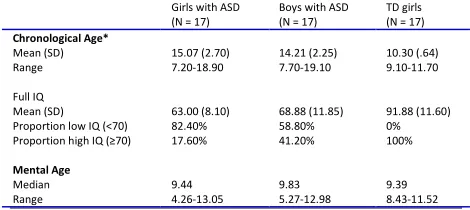
Table 1 lists participant descriptives. We obtained full IQ scores from 17 girls and 17 boys with ASD, and their results did not demonstrate any significant differences (t[32] = –1.69; p = .10; r = 0.08). We found that 71% of the children with ASD were low
functioning (IQ of <70) and that the high functioning individuals (IQ of ≥70) had IQ scores between 70 and 100. There was no significant difference in IQ distribution (i.e., low vs. high) between girls and boys with ASD (χ2 [1, N = 34] = 2.27; p = .13). The 17 girls and 17 boys with ASD from whom we obtained full IQ scores were matched for mean mental age with 17 TD girls. Mental age was cal-culated by using the formula method (IQ = Mental age/Chronological age) (39), because participants’ IQs and chronological ages were already known to the researchers. Although the TD girls had lower chronological ages than the participants with ASD, no significant difference was found for mean mental age across the three groups (H[2] = 0.47; p = .80).
[image:5.595.309.544.487.592.2]As a result of their noncompliance, minimal verbal, or nonverbal communication, 10 girls and 10 boys with ASD were classified as untested on the WISC-R or WASI. These participants were suspected of having IQs of less than 45. They were still included in the study because the aim was to examine differences and similarities across the three groups with regard to core and associated autistic features and thinking styles in children and adolescents with and without ASD, irrespective of IQ performance and language level. An indepen-dent t-test showed that the chronological ages of the children for which IQ could not be measured was significantly higher than those of other children from whom IQ could be obtained (t = 3.39; df = 69; p = .001).
TABLE 1.Participant characteristics
Girls with ASD (N = 17)
Boys with ASD (N = 17)
TD girls (N = 17)
Chronological Age*
Mean (SD) Range
15.07 (2.70) 7.20-18.90
14.21 (2.25) 7.70-19.10
10.30 (.64) 9.10-11.70
Full IQ Mean (SD) Proportion low IQ (<70) Proportion high IQ (≥70)
63.00 (8.10) 82.40% 17.60%
68.88 (11.85) 58.80% 41.20%
91.88 (11.60) 0% 100%
Mental Age
Median Range
9.44 4.26-13.05
9.83 5.27-12.98
9.39 8.43-11.52
ASD, Autism spectrum disorder; TD, typically developing.
*Chronological age data available for N = 71 (27 girls with ASD, 27 boys with ASD, 17 TD girls).
but not for smell SOR (H(2) = 1.27, p = .53) or movement SOR (H(2) = 7.81, p = .02), after Bonferroni correction (.0071), and on all six SDQ
[image:6.595.79.517.160.690.2]scales (H(2) = 11.07-32.42, all ps < .001, after Bonferroni correction (.008).
TABLE 2. Descriptive statistics and Mann-Whitney tests of parent-reported Social Communication Questionnaire, Repetitive Behavior Scale-Revised, Strengths and Difficulties Questionnaire, and the Sensory Over-Responsivity Inventory scales by group
Scale ASD Girls
(N=20) ---ASD Boys (N=26) ---TD Girls (N=17) ---Statisticsa --- ESb --- Statisticsc ---ESd --- Median (range) Median (range) Median (range)
U p r U p r
Social Communication Questionnaire
Total 29.00 (16.00-34.00)
29.00 (16-36.00)
4.00 (0-7.00)
259.50 .99 -.001 0 <.001* -.85 Social interaction 12.00
(4.00-15.00)
12.00 (6.00-15.00)
0 (0-3.00)
323.50 .54 -.09 0 <.001* -.86 Communication 8.50
(4.00-12.00)
8.50 (5.00-13.00)
1.00 (0-3.00)
240.50 .66 -.06 0 <.001* -.86 Repetitive stereotyped behaviors 5.50 (1.00-8.00) 6.00 (3.00-6.00) 0 (0-4.00)
241.50 .68 -.06 17.00 <.001* -.78
Repetitive Behavior Scale-Revised
Total 22.50 (7.00-67.009
31.50 (2.00-87.00)
1.00 (0-16.00)
207.50 .24 -.17 11.50 <.001** -.80 Stereotypic 4.00
(0-18.00)
7.50 (0-24.00)
0 (0-6.00)
187.00 .10 -.24 48.50 <.001** -.64 Self-injurious 5.00
(0-18.00)
1.50 (0-11.00)
0 (0-2.00)
216.40 .33 -.14 59.00 <.001** -.58 Compulsive behavior 2.50
(0-15.00)
4.00 (0-14.00)
0 (0-5.00)
161.50 .03 -.32 112.00 <.001** -.31 Ritualistic/sameness 7.50
(0-30.00)
12.50 (0-32.00)
0 (0-8.00)
228.00 .48 -.10 26.50 <.001** -.73 Restricted interests 2.00
(0-7.00)
3.00 (0-9.00)
0 (0-1.00)
207.50 .24 -.17 29.50 <.001** -.76
Strengths and Difficulties Questionnaire
Total problem 17.00 (9.00-29.00)
21 (6.00-32.00)
6.00 (1.00-13.00)
194.50 .15 -.21 6.00 <.001** -.82 Emotional symptoms 4.00
(2.00-9.00)
5.00 (0-10.00)
2.00 (0-5.00)
231.00 .52 -.10 72.00 .002** -.50 Conduct problems 1.50
(0-7.00)
2.00 (0-8.00)
0 (0-2.00)
212.50 .29 -.16 79.00 .004** -.47 Hyperactivity/inattenti on 5.00 (1.00-10.00) 7.50 (2.00-10.00) 2.00 (0-7.00)
159.00 .02 -.33 54.50 <.001** -.59 Peer problems 6.00
(2.00-10.00)
6.00 (2.00-8.00)
1.00 (0-5.00)
234.50 .57 -.08 11.00 <.001** -.80 Prosocial behavior 3.50
(0-10.00)
4.50 (2.00-10.00)
9.00 (2.00-10.00)
222.50 .40 -.12 44.00 <.001** -.64
Sensory Over-Responsivity Inventory
Total 9.50 (1.00-42.00)
15.00 (0-55.00)
3.00 (0-10.00)
221.00 .39 -.13 47.50 .001*** -.62 Tactile 4.50
(0-18.00)
6.00 (0-27.00)
2.00 (0-6.00)
226.50 .46 -.11 63.00 .001*** -.54 Visual 0
(0-3.00)
1.50 (0-4.00)
0 (0-1.00)
188.00 .09 -.25 132.00 .16 -.23 Smell 0
(0-3.00) 0 (0-5.00) 0 (0-2.00) - - - - Taste 1.00
(0-4.00)
3.00 (0-9.00)
0 (0-1.00)
146.00 .01 -.38 103.50 0.27 -.36 Auditory 3.00
(0-18.00)
3.00 (0-18.00)
0 (0-2.00)
238.50 .63 -.07 60.00 <.001** *
-.57 Movement .50
(0-5.00) .50 (0-6.00) 0 (0-2.00) - - - -
ASD, Autism spectrum disorder; r = Pearson’s r coefficient (small r = .10,;medium r = .3; large r = .5); TD, typically developing
aMann-Whitney U test between girls with ASD and boys with ASD b
Calculation of effect size between girls with ASD and boys with ASD on Mann-Whitney U test
c
Mann-Whitney U test between girls with ASD and TD girls
d
Calculation of effect size between girls with ASD and TD girls on Mann-Whitney U test *Significant at the Bonferroni-adjusted level of .006
Follow-up Mann-Whitney tests on the SCQ results using an adjusted p value of <.006 showed that girls with ASD were not significantly different from boys with ASD (all p values were >.006). Girls with ASD also had significantly greater autistic impairment as compared with TD girls (all p values were <.001) on all subscales.
Follow-up Mann-Whitney tests on the RBS-R results showed no significant differences between boys and girls with ASD on any of the subscales, although there was a trend for boys with ASD to show more compulsive behavior (p = .03) than girls with ASD, but the difference was not significant after a second Bonferroni-adjusted p value of .004. As expected, girls with ASD had significantly more repetitive, restricted, and stereotyped behaviors than TD girls (all p values were <.001).
[image:7.595.310.530.87.186.2] [image:7.595.311.541.539.667.2]Follow-up Mann-Whitney tests on the SensOR Inventory results showed that boys and girls with ASD did not differ on any subscales when using a second adjusted p value of .0036. However, there was a trend for boys having greater symptoms of SOR on the taste scale than girls with ASD (p = .01). Girls with ASD showed greater symptoms of SOR than TD girls on the total, tactile, and auditory scales (p = .001) but not on other SOR subscales. Table 3 shows that more than three fourths of both girls and boys with ASD reached the clinical criteria for SOR as compared with only 1 of the 17 TD girls. The relationship between the type of group and the tendency toward SOR was significant (χ2 [2, N = 63] = 26.87; p < .001).
Follow-up Mann-Whitney tests on the SDQ results showed a trend toward boys with ASD having greater levels of hyperactivity and inattention than girls with ASD (p = .02). However, this trend, along with other adaption and psychopathology problems, did not reach significance with the new adjusted p value of .004. Girls with ASD showed fewer prosocial behaviors (p < .001) and greater adaption and psychopathology problems (all p values were <.004) as compared with TD girls. Table 3 shows that none of the TD girls scored within the abnormal range for psychopathology. On the contrary, nearly three quarters of the boys with ASD (73.1%) and more than half of the girls with ASD (53.0%) scored within the clinical criteria for abnormal psychopathology. The relationship between the type of group and adaption and psychopathology was significant (χ2 [2, N = 63] = 37.84; p < .001).
The majority of TD girls passed the Sally-Ann test (94.10%), followed by boys with ASD (82.40%) and girls with ASD (64.70%). However, no significant differences were found between the groups with regard to passing the Sally-Ann false belief test (χ2 [2, N = 51] = 4.73; exact p = .12).
TABLE 3.Proportion of sample falling above cutoffs on the sensory over-responsivity and adaption and psychopathology scales*
ASD Girls (N = 20) --- N (%)
ASD Boys (N = 26) --- N (%)
TD Girls (N = 17) --- N (%) SensOR Inventory Present SOR Absent SOR 16 (80.0) 4 (20.0) 20 (76.9) 6 (23.1) 1 (5.9) 16 (94.1) SDQ Normal Borderline Abnormal 4 (20.0) 5 (25.0) 11 (55.0) 4 (15.4) 3 (11.5) 19 (73.1) 17 (100.0) - -
ASD, Autism spectrum disorder; SDQ, Strengths and Difficulties Questionnaire;
SensOR Inventory, Sensory Over-Responsivity Inventory; SOR, sensory over-responsivity; TD, typically developing.
*The cutoff point for SOR was the presence of four or more tactile or auditory items on the SensOR Inventory (see ref. 33). Scores on the SDQ were used to divide the participants into normal (0 to 13), borderline (14 to 16), and abnormal (17 to 40) categories (see ref. 34).
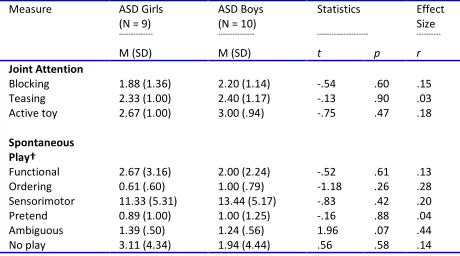
Joint attention and spontaneous play were assessed in 20 children with ASD (10 boys and 10 girls) who had mental ages of less than four years. Joint attention data for one participant (one girl) and spontaneous play data for two participants (one boy and one girl) were excluded from further analyses in response to noncompliance during testing. As shown in Table 4, separate independent t-tests involving an adjusted p-value of .017 demonstrated no differences between girls and boys with ASD in terms of engagement in eye contact in the blocking, teasing, and joint attention categories. Further separate independent t-tests for spontaneous play also indicated that girls and boys with ASD did not differ from each other in the production of functional, ordering, sensorimotor, pretend, ambiguous play, and no play categories after Bonferroni correction (.008).
TABLE 4.Mean scores, standard deviations, and inferential statistics for joint attention and spontaneous play by group*
Measure ASD Girls (N = 9)
---ASD Boys (N = 10) ---Statistics ---Effect Size ---M (SD) M (SD) t p r
Joint Attention Blocking Teasing Active toy 1.88 (1.36) 2.33 (1.00) 2.67 (1.00) 2.20 (1.14) 2.40 (1.17) 3.00 (.94) -.54 -.13 -.75 .60 .90 .47 .15 .03 .18 Spontaneous Play† Functional Ordering Sensorimotor Pretend Ambiguous No play 2.67 (3.16) 0.61 (.60) 11.33 (5.31) 0.89 (1.00) 1.39 (.50) 3.11 (4.34) 2.00 (2.24) 1.00 (.79) 13.44 (5.17) 1.00 (1.25) 1.24 (.56) 1.94 (4.44) -.52 -1.18 -.83 -.16 1.96 .56 .61 .26 .42 .88 .07 .58 .13 .28 .20 .04 .44 .14
ASD, Autism spectrum disorder; M, mean, r = Pearson’s r coefficient; SD, standard deviation.
*Maximum score for blocking, teasing, and active toy was four respectively. On spontaneous play, maximum score for each category of play was 20 with high scores indicating better social cognition performance.
†Spontaneous play data were available for 9 girls with ASD and 9 boys with ASD.
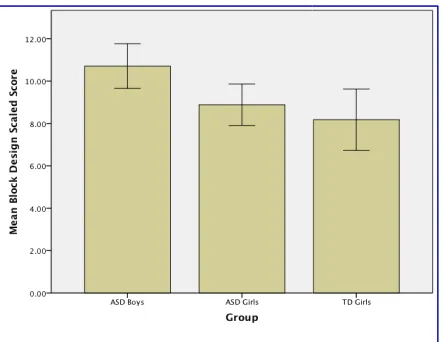
that there was a significant main effect of group on the BD task (F[2, 48] = 5.52; p = .007;
Further analysis involving the Tukey honest signi ficant difference post-hoc test showed that boys with ASD performed significantly better on the BD task than girls with ASD (p < .05), whereas girls with ASD and TD girls did not differ with regard to the performance of this task (p > .05).
FIGURE 1. Error bar chart of the mean scaled scores on the Block Design by group. Equal sample size in each of the three groups (N =17).
Discussion
The existing research on sex differences in ASD has reported subtle differences across behavioral symptoms and cognitive domains. In the present study, we examined the female ASD phenotype by comparing girls and boys with predominantly low functioning ASD during childhood and adolescence to TD girls. In addition to noting a sex difference with regard to ATTD among individuals with ASD, our findings indicated that girls with predominantly low functioning ASD were similar to boys with predominantly low functioning ASD and that they were, as expected, significantly different from TD girls.
The similarities between girls and boys with ASD with regard to RSBs are surprising considering that a body of research suggests that females with ASD show fewer impairments in RSBs than do boys with ASD (7-9,14). Although a similar sex difference trend in compulsive behavior emerged in the present study (p = .03), the difference did not become significant after multiple testing comparisons. Although the current study focused predominantly on a lower functioning sample, the research evidence from a prior meta-analysis (7) was based on studies of higher functioning samples with ASD only. Taking into account of the heterogeneity of individuals with ASD, different patterns of RSB
effect of group on = .007; r = .43). Further analysis involving the Tukey honest
signi-hoc test showed that boys with ASD performed significantly better on the BD .05), whereas girls with ASD and TD girls did not differ with regard to
> .05).
Error bar chart of the mean scaled scores on the Block Design by group. Equal sample size in each of the three groups (N
The existing research on sex differences in ASD has reported subtle differences across behavioral symptoms and cognitive domains. In the present study, we examined the female ASD phenotype by comparing girls and boys with predominantly low during childhood and adolescence to TD girls. In addition to noting a sex difference with regard to ATTD among individuals with ASD, our findings indicated that girls with predominantly low functioning ASD were similar to boys with oning ASD and that they were, as expected, significantly different from TD
The similarities between girls and boys with ASD with regard to RSBs are surprising considering that a body of research suggests that females with ASD in RSBs than do boys with Although a similar sex difference trend in compulsive behavior emerged in the = .03), the difference did not become significant after multiple testing comparisons. Although the current study focused predominantly on a lower functioning sample, the analysis (7) was based on studies of higher functioning samples with ASD only. Taking into account of the heterogeneity of individuals with ASD, different patterns of RSBs
between males and females with ASD may be more observable in the high functioning ASD population. It might be the case that higher functioning females with ASD have managed to develop skills to camouflage their behavioral impairments (40). Lower functioning females with ASD, on the other hand, may lack the capacity to develop such skills. Among younger children with low functioning ASD, Lord and colleagues (14) reported more RSBs among boys than girls. Unlike in the present study, those researchers recruited a larger sample size with a very narrow age range; they used direct obser vation rather than parent reports, and they did not control for multiple testing comparisons. Thus, sampling and methodologic differences between current study and that of Lord a
be responsible for the inconsistent findings involving lower functioning individuals with ASD. Overall, our findings support the notion that lower functioning boys and girls with ASD have similar presentations of the core symptoms of ASD (12,13,17,41,42).
Furthermore, there were no differences between girls and boys with ASD in terms of SOR aside from boys with ASD showing slightly more taste SOR as compared with girls with ASD. Thus, the present study did not replicate the findings of Lai and colleagues (16), who reported fewer sensory issues among high functioning male adults as compared with female adults. One possible reason could be that those researchers used the Autism Diagnostic Interview-Revised (43), which is not specifically designed to detect sensory issues. Alternatively, sex differences in SOR may exist in higher functioning adults but not in predominantly lower functioning children with ASD. Our findings indicated that up to 80% of girls and boys with ASD have sensory issues.
frequency of both boys and girls with ASD being affected by SOR; this was reported both in the present study and previous studies (15,44).
Like SOR, psychopathology was also common. In the present study, a high percentage of both boys (73.1%) and girls (55.0%) with ASD met the criteria for abnormal psychopathology. Nonetheless, our findings suggested that psychopathology was equally represented in girls and boys with ASD, except for a trend (p = .02) towards boys with ASD displaying higher levels of hyperactivity and inattention as compared with girls with ASD. Our sex trend mirrors previous teacher-reported (9) and parent reported (45) findings for higher functioning children and adolescents with ASD, which indicated that hyperactivity and inattention were more often present in the male phenotype rather than the female phenotype. It is also notable that twin studies have reported a higher degree of genetic between males and females with ASD may be more observable in the high functioning ASD population. It might be the case that higher functioning females with ASD have managed to develop skills to camouflage their behavioral impairments (40). ing females with ASD, on the other hand, may lack the capacity to develop such skills. Among younger children with low functioning ASD, Lord and colleagues (14) reported more RSBs among boys than girls. Unlike in the present study, ted a larger sample size with a very narrow age range; they used direct obser-vation rather than parent reports, and they did not control for multiple testing comparisons. Thus, sampling and methodologic differences between current study and that of Lord and colleagues may be responsible for the inconsistent findings involving lower functioning individuals with ASD. Overall, our findings support the notion that lower functioning boys and girls with ASD have similar presentations of the core symptoms of ASD
Furthermore, there were no differences between girls and boys with ASD in terms of SOR aside from boys with ASD showing slightly more taste as compared with girls with ASD. Thus, the present study did not replicate the findings of Lai and colleagues (16), who reported fewer sensory issues among high functioning male adults as compared with female adults. One possible reason could be that those researchers used the Autism Revised (43), which is not gned to detect sensory issues. Alternatively, sex differences in SOR may exist in higher functioning adults but not in predominantly lower functioning children with ASD. Our findings indicated that up to 80% of girls and boys with ASD have sensory issues. There was a high frequency of both boys and girls with ASD being affected by SOR; this was reported both in the present study and previous studies (15,44).
[image:8.595.59.280.191.362.2]overlap between traits of ASD and attention-deficit/hyperactivity disorder among males than females (46), which suggests that these conditions are more likely to co-occur in males than females for genetic reasons.
Individuals with ASD were compared for social cognition and ATTD; sex differences were detect-able for the latter but not the former. The present study replicated the findings of previous studies, which found that males and females with ASD had equivalent levels of impairments in social cognition (16,22,23). Not being able to understand other people’s mental states (36), as suggested by impaired social cognition, may also explain the social communication difficulties underlying ASD at the behavioral level (47).
Our findings from the BD task are consistent with those of previous studies. In general, girls with ASD perform equivalent to TD girls (21) but worse than boys with ASD (20,21). Our findings suggest that girls with ASD are more similar to TD girls than boys with ASD with regard to ATTD. This suggests that superior ATTD is not a universal feature of the autistic brain but rather a feature of the male ASD phenotype. Therefore, it is possible to speculate that interventions such as visual guidance may be suitable for boys but not girls with ASD (21). This intervention has been shown to help with the reduction of both executive malfunctioning and RSBs in ASD (48). However, a limitation of the current study is the exclusion of a TD male group. It may be that the observed sex difference in ATTD was not ASD specific; however, without a control group of TD boys, our study could not make such conclusion. Thus, it may be necessary for future studies to include both TD male and female groups to investigate ASD-specific and non–ASD-specific sex differences.
One limitation of this study is that the number of participants was small. Nonetheless, the present study had a similar number of female participants as past studies that reported sex differences for ASD (49,50). The weak sex difference trends across RSBs, SOR, and psychopathology may become significant with a larger sample (8). This study also lacked perfect mental age matching. We could not compose full IQ scores for children with IQ scores of less than 45, who were predominantly nonverbal. Therefore, it is possible that lower functioning girls and boys with ASD may differ with regard to their IQs and mental ages, respectively. Furthermore, the correction needed for multiple testing comparisons may have increased type 2 errors. The Sally-Ann task might have been too easy for our participants with mental ages of 4 years or older, because more than 60% of the children with ASD passed the test. Hence, our findings may not be a true reflection of
the social cognition difficulties associated with ASD. The authors of this study did not assess diagnoses of ASD in the sample themselves but rather relied on information from specialist schools, SEN statements, and parents. This may have introduced some error into the study. One possible source of error may be that some individuals do not have ASD but rather have severe learning disabilities or attention-deficit/hyperactivity disorder; it is known that a considerable degree of “diagnostic substitution” can occur for individuals who require clinical attention and specialist schooling. It is notable that individuals considered to have ASD according to the parent, school, and SEN sources all scored above the cutoff on the SCQ, which is a well-respected screen for ASD. Given the heterogeneity of individuals with ASD, our findings may be representative of lower functioning but not higher functioning individuals with ASD.
At present, impairment requirements and symptom criteria for the diagnosis of ASD are not sex specific (6). Most screening and diagnostic tools do not employ different thresholds or items for assessing ASD in males and females. One study found that some specific items improved an instrument’s ability to capture the female ASD phenotype (41); example items include “Avoids demands” and “Very determined.” Our findings suggest that existing measures employed here do not detect mean sex differences in levels of autism
symptoms, social cognition, SOR, and
psychopathology in lower functioning children with ASD during childhood and adolescence. The possibility remains that sex differences in symptoms are present but that currently available measures are not sensitive to these phenotypic sex differences. These data can inform debates regarding whether ASD-related assessment tools require sex-specific criteria or thresholds and to what degree treatment should be tailored to the sex of the individual.
References
1. Centers for Disease Control and Prevention. Prevalence of autism spectrum disorders – Autism and developmental disabilities monitoring network, 14 Sites, United States, 2008. Morbidity and
Mortality Weekly Report 2012;61(3):1-18. Available:
http://www.cdc.gov/mmwr/preview/mmwrhtml/ss6103a1.htm
(accessed 17 April 2012).
2. Edwards TL, Watkins EE, Lotfizadeh AD, Poling A. Intervention research to benefit people with autism: How old are the participants? Res Autism Spectr Disord 2012;6(3); 996-9.
4. Jacquemont S, Coe BP, Hersch M, Krumm N, Bergmann S, Beckmann J.S, et al. A higher mutational burden in females supports a “female protective model” in neurodevelopmental disorders. Am J Hum Genet 2014;94(3):415-25.
5. Wing L, Gould J. Severe impairments of social interaction and
associated abnormalities in children: epidemiology and
classification. J Autism Dev Disord 1979;9(1):11-29.
6. American Psychiatric Association. Diagnostic and Statistical Manual of Mental Disorders (Fifth Ed.). Arlington, VA: American Psychiatric Publishing; 2013.
7. Van Wijngaarden-Cremers PJM, Van Eeten E, Groen WB, Van Deurzen PA, Oosterling IJ, Van Der Gaag RJ. Gender and age differences in the core triad of impairments in autism spectrum disorders: A systemic review and meta-analysis. J Autism Dev Disord 2014;4(4):627-35.
8. Frazier TW, Georgiades S, Bishop SL, Hardan AY. Behavioral and cognitive characteristics of females and males with autism in the Simons Simplex Collection. J Am Acad Child Adolesc Psychiatry 2014;53(3):329-40.
9. Mandy W, Chilvers, R, Chowdury U, Salter G, Seigal A, Skuse D. Sex differences in autism spectrum disorder: Evidence from a large sample of children and adolescents. J Autism Dev Disord 2012;42(7):1204-1313.
10. Beeger S, Mandell D, Winjker-Holmes B, Wenderbosch S, Rem D, Stekelenburg F, et al. Sex differences in the timing of identification among children and adults with autism spectrum disorders. J Autism Dev Disord 2012;43(5):1151-6.
11. Dworzynski K, Ronald A, Bolton P, Happe F. How different are girls and boys above and below the diagnostic threshold for autism spectrum disorders? J Am Acad Child Adolesc Psychiatry 2012;51(8):788-92.
12. Tsai LY Beisler JM. The development of sex differences in infantile autism. Br J Psychiatry 1983;11(2):165-73.
13. Volkmar FR, Szatmari P, Sparrow SS. Sex differences in pervasive developmental disorders. J Autism Dev Disord 1993;23(4):579-91.
14. Lord C, Schopler E, Revicki D. Sex differences in autism. J Autism Dev Disord 1982;12(4):317-30.
15. Tomchek SD, Dunn W. Sensory processing in children with and without autism: A comparative study using the Short Sensory Profile. Am J Occup Ther 2007;61(2):190-200.
16. Lai M-C, Lombardo MV, Pasco G, Ruigrok ANV, Wheelwright SJ, Sadek SA, et al. A behavioural comparison of male and female adults with high functioning autism spectrum conditions. PloS One 2011;6(6):e20835.
17. Solomon M, Miller M, Taylor SL, Hinshaw SP, Carter CS. Autism symptoms and internalizing psychopathology in girls and boys with autism spectrum disorders. J Autism Dev Disord 2012;42(1):48-59.
18. Shah A, Frith U. (1983). An islet of ability in autism: a research note. J Child Psychol Psychiatry 1983;24(4):613-20.
19. Mottron L, Burack JA, Larocci G, Belleville S, Enns JT. Locally oriented perception with intact global processing among adolescents with high-functioning autism: evidence from multiple paradigms. J Child Psychol Psychiatry 2003;44(6): 904-13.
20. Koyama T, Kamio Y, Inada N, Kurita H. Sex differences in WISC-III profiles of children with high-functioning pervasive developmental disorders. J Autism Dev Disord 2009;39(1):135-41.
21. Bölte S, Duketis E, Poustka F, Holtmann M. Sex differences in cognitive domains and their clinical correlates in higher-functioning autism spectrum disorders. Autism 2011;15(4):497-511.
22. Lai M-C, Lombardo MV, Ruigrok ANV, Chakrabarti B, Wheelwright SJ, Auyeung B, et al. Cognition in males and females
with autism: similarities and differences. PloS One 2012;7(10): e47198.
23. Baron-Cohen S, Wheelwright S, Hill J, Raste Y, Plumb I. The “Reading the mind in the eyes” Test Revised Version: A study with normal adults, and adults with Asperger syndrome or high-functioning autism. J Child Psychol Psychiatry 2001;42(2):241-51.
24. Fombonne E. Epidemiology of autistic disorder and other pervasive developmental disorders. J Clin Psychiatry 2005;66(Suppl 10):3-8.
25. Koenig K. Girls growing up on the autism spectrum: What parents and professional should know about the pre-teen and teenage years (Review of the book by Nichols S, Moravcik GM, Pulver Tetenbaum S, 2009). J Autism Dev Disord 2009;40(8):1042-3.
26. Head AM, McGillivray JA, Stokes MA. Gender differences in emotionality and sociability in children with autism spectrum disorders. Molecular Autism 2014;5(19):1-9.
27. Koenig K, Tsatsanis K. Pervasive developmental disorders in girls. In: Bell-Dolan D, Foster S, Mash EJ. (Eds). Behavioural and emotional problems in girls. New York: Kluwer Academic/ Plenum; 2005.
28. Special educational needs and disability Act 2001. Chapter 10.
Retrieved from http://www.legislation.gov.uk/ukpga/2001/
10/contents
29. Wechsler D. Manual for the Wechsler Intelligence Scale for Children – Revised. New York: Psychological Corporation; 1974.
30. Wechsler D. Manual for the Wechsler abbreviated scale of intelligence. San Antonio, TX: Psychological Corporation; 1999.
31. Rutter M, Bailey A, Lord C. Social communication questionnaire (SCQ). Los Angeles: Western Psychological Services; 2003.
32. Bodfish SL, Symons FJ, Parker DE, Lewis MH. Varieties of repetitive behaviour in autism: Comparisons to mental retardation. J
Autism Dev Disord 2000;30(3):237-43.
33. Schoen SA, Miller LJ, Green KE. Pilot study of the Sensory Over-Responsivity Scales: Assessment and inventory. Am J Occup Ther 2008;62(4);393-406.
34. Goodman, R. The Strengths and difficulties questionnaire: A research note. J Child Psychol Psychiatry 1997;38(5):581-6.
35. Baron-Cohen S, Leslie AM, Frith U. Does the autistic child have a “theory of mind”? Cognition 1985;21(1):37-46.
36. Baron-Cohen S. Autism and symbolic play. Br J Dev Psychol 1987;5(2):139-48.
37. Morgan B, Maybery M, Durkin K. Weak Central Coherence, Poor Joint Attention, and Low Verbal Ability: Independent Deficits in Early Autism. Dev Psychopathol 2003;39(4):646-656.
38. Phillips W, Baron-Cohen S, Rutter M. The role of eye contact in goal detection: Evidence from normal infants and children with autism or mental handicap. Dev Psychopathol 1992;4(3):375-83.
39. Wechsler D. Equivalent test and mental ages for the WISC. J Consult Psychol 1951;15(5):381-4.
40. Wing L. Asperger’s syndrome: a clinical account. Psychol Med 1981;11:115-29.
42. Holtmann M, Bölte S, Poustka F. Autism spectrum disorders: Sex differences in autistic behaviour domains and coexisting psychopathology. Dev Med Child Neurol 2007;49(5):361-6.
43. Lord C, Rutter M, Le Couteur A. Autism Diagnostic Interview-Revised: a revised version of a diagnostic interview for caregivers of individuals with possible pervasive developmental disorders. J Autism Dev Disord 1994;24:659-85.
44. Leekam SR, Neito C, Libby SJ, Wing L, Gould J. Describing the sensory abnormalities of children and adults with autism. J Autism Dev Disord 2001;37(5):894-910.
45. May T, Cornish K, Rinehart NJ. Gender profiles of behavioural attention in children with autism spectrum disorder. J Atten Disord 2012:1-9. Epub ahead of print 21 August 2012. doi:10.1177/ 1087054712455502.
46. Taylor MJ, Charman T, Robinson EB, Plomin R, Happe F,
Asherson P, et al. Developmental associations between traits of autism spectrum disorder and attention-deficit/hyperactivity disorder: A genetically-informative, longitudinal twin study. Psychol Med 2013;43(8):1735-46.
47. Silliman ER, Diehl SF, Huntley Bahr R, Hnath-Chisolm T, Zenko CB, Friedman, SA. A new look at performance on Theory-of-Mind Tasks by adolescents with autism spectrum disorder. Language, Speech, and Hearing Services in School 2003;34:236-52.
48. Schopler E, Brehm SS, Kinsbourne M, Reichler RJ. Effect of treatment structure on development in autistic children. Arch Gen Psychiatry 1971;24(5):415-21.
49. Carter AS, Black DO, Tewani S, Connolly CE, Kadlec MB, Tager-Flusberg H. Sex differences in toddlers with autism spectrum disorders. J Autism Dev Disord 2007;37(1): 86-97.
50. Hartley SL, Sikora DM. Sex differences in autism spectrum disorder: An examination of developmental functioning, autistic symptoms, and coexisting behaviour problems in toddlers. J Autism Dev Disord 2009;39:1715-22.
Acknowledgements
Appendix A. Complete instructions and scoring for social cognition tasks
Sally-Ann false belief task. In the Sally-Ann task (35), participants were told a story accompanied by toy props. “This is Sally. Sally has a basket. This is Ann. Ann has a box. Sally has a marble and she puts it in her basket and leaves the room. Ann takes the marble from Sally’s basket and puts it in her box. Ann leaves the room. Sally comes back to the room.” The researcher then asks the participant, “Where will Sally look for her marble?”
Evidence of intact theory of mind was scored 1 point if the participant could take into account the representation of Sally’s belief and 0 points if the participant failed to represent Sally’s belief. The Sally-Ann task took approximately one minute to administer.
Spontaneous play. On the basis of previous studies (36,37), two 5-minute spontaneous play trials were administered to the participants with different sets of toys: 1) a kitchen toy set; and 2) a toy medical kit. In both trials, soft animals were included, and sponges were used for object substitution. When the participant arrived in the room, the first set of toys was spread on a table. The researcher gave the same instructions to each participant: “You can play and do anything you want with the toys.” The 5-minute trial began when the child reached for the toys. If the participant did not initiate play after 30 seconds, the researcher verbally prompted the participant by saying, “Play with toys.” The same verbal prompt was delivered a second time if the participant still had not begun playing after another 30 seconds. The researcher began the 5-minute trial regardless of the participant’s response after the second verbal prompt. After the first trial, the toys were substituted with the second set of toys. The same procedure was repeated. The researcher did not model any play for the participants. During each trial, play was rated at every 15-second interval as falling into one of six categories: functional, ordering, sensorimotor, pretend play, ambiguous, or no play. The definitions of these ratings were based on the original assessment (36). In sum, 40 sequences were recorded for the two 5-minute trials.
Joint attention. Three joint attention experiments were used: blocking, teasing, and active-toy experiments (38). A series of toys were provided to the participants to choose from and play with. In the blocking experiment, the researcher blocked the participant’s hands for 5 seconds after he or she was visually and manually engaged with a toy. In the teasing experiment, the experimenter tempted the participant with the same toy as used in the blocking experiment. When the child reached out for the toy, the researcher withdrew the toy. In the active-toy experiment, the researcher used two mechanical toys, a walking/roaring dinosaur and an electric car, to provoke a mixed response of uncertainty and