38-1
38.1 Introduction
and Background
Th is chapter introduces the reader to several important and inter-related issues in deafness, language literacy, and computer acces-sibility. Th roughout this discussion, the chapter will motivate the use of sign language technologies in the interface of comput-ing systems to improve their accessibility for deaf signers.1 Th e
chapter discusses the advantages of sign language interfaces for deaf signers (for a discussion of other technologies for deaf and hard of hearing users, see, e.g., Hanson, 2007), and highlights important applications of this technology, as well as the chal-lenges that arise when integrating sign language technologies into real applications. Many of the sign language generation and understanding technologies discussed in this chapter are still in the research stage of development, and so another focus of this chapter is to explain what makes this technology challenging to build, survey the progress of the fi eld, and discuss current issues that researchers are tackling. Th is chapter will help the reader understand what technologies are currently available and what direction the fi eld is expected to take in the coming decades.
A question that might fi rst arise is why such interfaces are needed. By and large, interactions with computers involve 1 In this chapter, individuals with hearing loss are considered as being deaf
or hard of hearing, the terminology designated by the World Federation of the Deaf (What Is Wrong with the Use of Th ese Terms: “Deaf-Mute,” “Deaf and Dumb,” or “Hearing-Impaired”? National Association of the Deaf, http://www.nad.org/site/pp.asp?c=foINKQMBF&b=103786).
reading or writing text. Deaf signers, at fi rst blush, would not appear to be disadvantaged in their ability to read and write. However, interfaces requiring reading and writing also have the potential to disenfranchise many deaf users (see also Chapter 6 of this handbook). As this may seem counterintuitive, the chap-ter begins with a discussion of deafness, sign language, and lit-eracy to indicate why this is the case.
38.1.1 Deafness, Sign Language, and Literacy
Millions of deaf and hard of hearing people worldwide use a sign language to communicate. Sign languages are naturally occurring languages with linguistic structures (e.g., grammars, vocabularies, word order, etc.) distinct from spoken languages. For instance, American Sign Language (ASL) is the primary means of communication for an estimated 500,000 people in the United States (Mitchell et al., 2006). ASL is a full natural language that includes various linguistic phenomena that make it distinct from English (Lane et al., 1996; Neidle et al., 2000; Liddell, 2003).
Th ere are a number of factors that determine whether an individual with hearing loss will use a sign language, includ-ing family circumstances, educational experiences, age of onset of hearing loss, and degree of hearing loss. Signers comprise a deaf community, whose membership is determined more by a shared language than by degree of hearing loss (Padden and Humphries, 1988, 2005). In fact, people who experience hear-ing loss as adults tend not to become signers or members of this
38
Sign Language in the Interface:
Access for Deaf Signers
38.1 Introduction and Background ...38-1Deafness, Sign Language, and Literacy • Sign Languages
38.2 Producing Sign Language Output ...38-4
Sign Language Video • Animations of Sign Language • Generation and Translation Systems
38.3 Understanding Sign Language Input ...38-8
Recognition • Understanding
38.4 Sign Language in Applications ...38-10
Sign Language on a User Interface • Sign Language in Communication Systems • Sign Language Captioning for Media • Applications Focused on Sign Language
38.5 Conclusion ...38-14 Acknowledgments ...38-14 References ...38-14
Matt Huenerfauth and Vicki L. Hanson
community. Contrary to popular expectation, sign languages are not universal (Klima and Bellugi, 1979); countries and locales around the world have their own native sign languages shared by members of deaf communities in those areas.
Important for the present discussion is the fact that these signed languages are not based on the spoken languages of the region. People are oft en surprised to learn, for example, that ASL is more similar to French Sign Language, from which it origi-nated, than it is to British Sign Language (BSL). Th us, despite the common written language shared by the deaf communi-ties in America and Great Britain, the sign languages of these two communities are not similar (Lane, 1976). Deaf individuals oft en acquire a sign language as their fi rst language and are most fl uent and comfortable in this fi rst language. For these individu-als, sign language interfaces are highly desirable.
Sign language interfaces are a necessity for that subset of the deaf population with diffi culty in reading and writing. Despite the fact that many deaf individuals are skilled readers, not all deaf signers develop this level of profi ciency. Th e reasons may be varied, but this phenomenon is replicated worldwide, regardless of sign language or written language of the country. For example, studies have shown that the majority of deaf high school gradu-ates in the United Stgradu-ates have only a fourth-grade English read-ing level (Holt, 1993)—this means that deaf students around age 18 have a reading level more typical of 10-year-old hearing stu-dents. Th is literacy issue has become more signifi cant in recent decades, as new information and communications technologies have arisen that place an even greater premium on written lan-guage literacy in modern society.
To focus the discussion in this chapter and to keep it more concrete, examples from ASL will be primarily used. Th ere are many other sign languages used around the world that are also the subject of computational research: British Sign Language, Japanese Sign Language, Polish Sign Language, and others. Th ese languages are linguistically distinct from ASL—and from each other. While each language has its own distinct grammar and vocabularies, they share many features with ASL: the use of multiple parts of the signer’s body in parallel, the use of locations in space around the signer to represent entities under discussion, and the modifi cation of individual signs to indicate subtleties of meaning. Th us, the majority of technologies developed for one of these languages can therefore be adapted (by changing the vocabulary of signs and some of the grammar rules) for use with other sign languages. Some of this work for other sign languages will be discussed later in this chapter.
38.1.1.1 Deaf Accessibility Tools and English Literacy
Many accessibility responses for deaf users simply ignore part of the problem—oft en designers make the assumption that the deaf users of their tools have strong English reading skills. For example, television closed captioning converts an audio English signal into visually presented English text on the screen; how-ever, the reading level of this text may be too high for many deaf viewers. While captioning makes programming accessible to a large number of hearing, deaf, and hard of hearing users, a
number of deaf users may be cut off from important informa-tion contained in news broadcasts, educainforma-tional programming, political debates, and other broadcasts that have a more sophis-ticated level of English language. Communications technologies like teletype telephones (sometimes referred to as telecommuni-cations devices for the deaf or TDDs) similarly assume the user has English literacy. Th e user is expected to both read and write English text to have a conversation. Many soft ware designers incorrectly assume that written English text in a user interface is always accessible to deaf users. Few soft ware companies have addressed the connection between deafness and literacy, and so few computer user interfaces make suffi cient accommodation for deaf users.
A machine translation system from English text into ASL animations could increase the accessibility of all of these tech-nologies for signers. Instead of presenting written text on a television screen, telephone display, or computer monitor, each could instead display ASL signing. An automated English-to-ASL machine translation (MT) system could make information and services accessible when English text captioning is too com-plex, or when an English-based user interface is too diffi cult to navigate.
In addition, technologies for recognizing sign language could also benefi t deaf signers. Th e ability to input commands to a computing system using ASL would make the interaction more natural for deaf signers, and the ability of the system to translate sign language input into English text or speech could open addi-tional avenues of communication for deaf signers with low levels of English literacy.
Th e ultimate sign language interface tool would be one that could recognize sign language input while also having the abil-ity to output sign language from spoken utterances or text. Such a tool would allow easy interaction between deaf signers and hearing speakers. It would also allow deaf signers natural and easy access to computers and other devices. However, as will be discussed later in this chapter, a great deal of research remains to be done to make this tool a reality. Today, both production and, even more so, recognition systems are in relatively early stages of development.
38.1.2 Sign Languages
Th ere is a common misconception that the reason why many deaf people have diffi culty reading text is that it is presented in the form of letters/characters in a writing system. It would follow that if every word of a written language sentence was replaced with a corresponding sign (the assumption is also made that such a correspondence always exists), then deaf signers would be able to understand the text. Th is is generally not true. In fact, deaf individuals can be observed signing word for word as they read text. Th us, they have no trouble with print, per se. Aft er signing each word in an English sentence, however, they may not have understood the meaning of the sentence because of the grammatical diff erences between the languages (Hanson and Padden, 1990). By and large, presentation of ASL signs in
TAF-ER628X-08-1002-C038.indd 2
English word order (and without the accompanying ASL lin-guistic information contained in facial expressions, eye gaze, etc.) would not be understandable to a deaf user. Th e diff erences between English and ASL are signifi cant enough that fl uency in one language does not imply fl uency in the other. For an ASL signer, reading English is analogous to an English speaker read-ing a foreign language.
38.1.2.1 Other Forms of Signing Communication
Th ere are many forms of signing communication that are not full languages; for instance, Signed English (SE) is a form of manual signing that is distinct from ASL but is not a full natural language. Th ere are several diff erent styles of SE communica-tion, but all of them encode an English sentence into a set of signs performed by the signer’s hands. SE uses many of the same signs as ASL (and some additional signs of its own). SE retains English sentence structure and word order, and it is most com-monly used in educational settings. Fingerspelling is another method of signing communication in which the letters of the English alphabet are conveyed using special handshapes to spell words during signing. Signers typically reserve fi ngerspelling for titles, proper names, and other specifi c situations. Th e extensive use of English-like structure leads to a nonfl uent ASL communi-cation that is diffi cult to understand.
38.1.2.2 Some Sign Language Linguistic Issues
To illustrate the complexity of sign languages, and why this presents such a technical challenge for machine translation, this section discusses some interesting phenomena that occur in ASL. Many of the issues discussed in the following have paral-lels in other sign languages used around the world.
ASL is a visual language in which the signer’s facial expres-sion, eye gaze, head movement, shoulder tilt, arm movements, and handshapes convey linguistic information; however, it is not enough to know how a signer’s body moves to understand an ASL sentence. It is also necessary to remember how the “signing space” around the body has been fi lled with imaginary place-holders that represent entities under discussion (Meier, 1990; Neidle et al., 2000). Th ese locations are a conversational state
that signers must remember. During a conversation, when a new entity is mentioned, a signer can use various ASL constructions to associate that entity with a 3D location in the signing space:
Determiners and certain post-noun-phrase adverbs point •
out a 3D location for an entity (Neidle et al., 2000). Some nouns can be signed outside their standard location •
to associate the entity to which they refer with a 3D loca-tion in the signing space.
Aft er establishing placeholders in space (Neidle et al., 2000), the movements of many other ASL constructions are spatially parameterized on these locations:
Personal, possessive, and refl exive pronouns involve •
pointing movements toward the placeholder location of the entity being referred to.
Some ASL verbs change their movement path, hand •
orientation, or other features to indicate the 3D placeholder location of their subject, object, or both. What features are modifi ed and whether this modifi cation is optional depends on the verb (Padden, 1988; Liddell, 2003). While signing ASL verb phrases, signers can use combina-•
tions of head-tilt and eye-gaze to indicate a verb’s subject and object (Neidle et al., 2000).
While signing possessive pronouns or noun phrases, sign-•
ers can use their head-tilt to indicate the possessor and their eye-gaze to indicate the possessed entity (Neidle et al., 2000).
Signers can tilt their torso toward locations in the signing •
space on opposite sides of their body when conveying a contrastive relationship between two entities (this is oft en called “contrastive role shift ”).
By changing a verb’s movement path or by performing head-tilt and eye-gaze during verb phrases signing, the identity of the subject/object of the sentence can be expressed without per-forming a noun phrase for each. If their identity is conveyed this way, the signer may optionally drop these noun phrases from the sentence (Neidle et al., 2000). Signers also oft en topicalize one of the noun phrases in a sentence—establishing that entity as an important focus of discussion. To topicalize a noun phrase, it is performed at the start of the sentence (instead of at its original place in the sentence) with the signer’s eyebrows raised. Because a topicalized noun phrase is no longer performed at the sub-ject or obsub-ject position in the sentence, the role it fulfi lls in the sentence could be ambiguous. Verbs with movement modifi ca-tions or head-tilt/eye-gaze indicate the identity of their subject and object and can disambiguate sentences that have undergone topicalization movement.
Generally, the locations chosen for this pronominal use of the signing space are not topologically meaningful; that is, one imaginary entity being positioned to the left of another in the signing space doesn’t necessarily indicate that the two entities are located the fi rst at the left of the second in the real world. Other ASL expressions are more complex in their use of space, and position invisible objects around the signer to topologi-cally indicate the arrangement of entities in a 3D scene being discussed. ASL constructions called classifi er predicates allow signers to use their hands to represent an entity in the space in front of them and to position, move, trace, or re-orient this imaginary object to indicate the location, movement, shape, or other properties of some corresponding real-world entity under discussion. A classifi er predicate consists of the hand in one of a set of semantically meaningful shapes as it moves in a 3D path through space in front of the signer. For example, to convey the sentence “the car drove up to the house and parked next to it,” signers use two classifi er predicates. Using a handshape for bulky objects, they move one hand to a location in front of their torso to represent the house. Next, using a moving vehicle handshape, their other hand traces a 3D path for the car that stops next to the house. To produce these two classifi er predicates, there must
be a spatial model of how the house and the car in the scene are arranged (Huenerfauth, 2004).
Th e three-dimensional nature of classifi er predicates makes them particularly diffi cult to generate using traditional com-putational linguistic methods designed for written languages. Instead of producing a string of signs that convey the informa-tion about the scene (as a string of words might be arranged to produce a written language sentence), during classifi er predi-cates, signers actually convey 3D information directly to their audience using the space in front of their bodies. During other spatial constructions, the signer’s own body is used to represent a character in the narrative (oft en called narrative role shift or
body classifi ers); signers show comments and actions from the perspective of people under discussion. Signers can also use the signing space in these diff erent ways simultaneously to convey meaning (Liddell, 2003).
Written/spoken languages typically lengthen a sentence by appending morphemes or adding words to incorporate addi-tional information. Sign languages, however, make use of their many channels to incorporate additional information by modi-fying the performance of a sign, performing a meaningful facial expression during a sentence, or making use of the space around the signer. Th is leads to the interesting fi nding that the rate of proposition production is similar in signed and spoken lan-guages, despite the fact that a sign takes longer to produce than does a word (Klima and Bellugi, 1979). A sign language sentence consists of several simultaneous independently articulated parts of the body: the eye gaze; the head tilt; the shoulder tilt; the facial expression; and the location, palm orientation, and handshape of the signer’s two hands. Temporally coordinating these channels over time is an important part of a correct ASL utterance—if the timing relationships between movements of diff erent parts of the body are not correct, then the meaning of the ASL sentence is typically aff ected. For instance, the direction in which the eyes gaze during the performance of an ASL verb sign can be used to indicate the object of that verb, but the eye gaze must occur dur-ing the verb sign itself to convey this meandur-ing.
38.2 Producing Sign Language Output
For spoken languages, a computer system can display writ-ten text onto the screen for the user. For sign languages, this approach is generally not possible. Th e coordinated use of mul-tiple parts of a signer’s body during a sign language performance and the use of 3D space around the signer (especially during classifi er predicates) can be challenging to encode in a written representation. While several sign language writing systems have been proposed, most are diffi cult to use for people who are not linguists (Newkirk, 1987) and some involve drawing sym-bolic two-dimensional diagrams of sign movements (Sutton, 1998). Th us, none have gained signifi cant popularity among the deaf community.
Computer-friendly notation schemes have also been devel-oped (Prillwitz et al., 1989; Kuroda et al., 2001) and have been used by some sign language researchers (Bangham et al., 2000;
Marshall and Sáfár, 2004); however, as with sign language writ-ing systems, they have not been adopted by signers for writwrit-ing. Without a community of users that accept and have developed literacy skills in one of these writing systems, none can be used as output on a sign language interface. Th erefore, the output must be displayed in the form of video or animation of a human-like character signing.
38.2.1 Sign Language Video
To address these literacy issues, a number of applications have been developed that display videos of humans performing sign language. Th ese interfaces have been employed not only for mak-ing audio and speech materials accessible to signers (e.g., Petrie et al., 2004; Eft himiou and Fotinea, 2007; Kennaway et al., 2007; Link-it, 2007; RNID, 2007), but also for teaching reading and writing to deaf signers (e.g., Padden and Hanson, 2000; AILB, 2007). For example, Petrie et al. (2004) created a sign interface that used signed videos to present tooltip information in an application. Deaf signers were found to overwhelmingly prefer the sign video over spoken (video), graphical, and text informa-tion. For instructional purposes, Hanson and Padden (1990) displayed stories in ASL and print (English), allowing young deaf signers to compare the two and learn about correspon-dences between ASL and English. Research showed that these children were able to use their fi rst language (ASL) to improve comprehension of written sentences and to help in the writing of English.
While using videos of human sign language performances can be appropriate when there are a fi nite set of sentences that a system must ever convey to the user (or when there is a single message that it needs to convey that is known ahead of time), it is diffi cult to use videos as the basis for a computer system that must generate/assemble novel signed sentences.
One might imagine that sign language generation system could be created by recording a dictionary of videos containing a large number of signs performed by the same human signer (stand-ing in approximately the same location in the camera frame). To build novel sentences, it might be expected that it is suffi cient to simply concatenate together a set of videos—one for each sign in the sentence—to produce the output video. Unfortunately, there are three major challenges with this approach: (1) smoothing the transitions between the signs on each video so that the assem-bled output video does not appear jumpy, (2) handling signs whose movement paths are calculated based on a complex set of 3D factors (and are not known until performance time), and (3) handling the many possible combinations of movements on the diff erent parts of the signer’s body (a diff erent version of each sign would need to be recorded for every possible combination of facial expression, head tilt, eye gaze, shoulder tilt, etc.).
It is quite diffi cult to reassemble samples of video of individ-ual signs into a coherent-looking presentation of a sign language message. Most successful sign language generation systems have instead chosen to create animations of a 3D humanlike character that moves to perform a sign language message. Th is
TAF-ER628X-08-1002-C038.indd 4
approach has the advantage of allowing the system to more eas-ily blend together individual signs into a smooth-looking sign language sentence, as well as to generate sentences that involve more complex modifi cations/infl ections to the standard diction-ary form of a sign to accommodate grammatical requirements of the language. For instance, many sign language verb forms can modify their movement path to indicate the subject/object in the signing space. It would be diffi cult to pre-record a diff er-ent version of each verb sign for the motion path between every possible starting/ending location in the signing space. Using an animation-based approach, the system can instead synthesize a particular version of a performance that may never have been recorded from a human signer.
38.2.2 Animations of Sign Language
A major area of Natural Language Processing (NLP) research is the design of soft ware that can translate a sentence from one lan-guage into another automatically. Th e process of automatically translating from a sentence in a source language into a sentence in a target language is generally referred to as machine transla-tion or simply translation. Broadly speaking, machine transla-tion soft ware can be thought of as operating in several stages:
1. If the input to the soft ware is an audio recording of some-one speaking, then speech recognition soft ware is used to convert the sounds into a text string for each sentence. 2. Th is written text sentence (in the source language) is
analyzed by linguistic soft ware to identify its syntactic structure.
3. A semantic representation of the sentence is produced that represents its meaning.
4. If multiple sentences are being translated as a group (i.e., a paragraph or document), then the soft ware may need to reorganize the way in which the sentences are sequenced or how concepts are introduced (according to the linguis-tics of the target language).
5. For each output sentence (which will be produced in the target language), a semantic representation is produced for what information content that sentence should convey. 6. Th e syntactic structure of each sentence is determined
(e.g., the soft ware plans the verb, subject, and object of each sentence).
7. A written language text string is produced for each sen-tence (from its syntactic representation).
8. If the desired output of the soft ware is an audio presenta-tion of the target language sentence spoken aloud, then speech synthesis soft ware is used to convert from the writ-ten language text string into an audio fi le.
NLP researchers also study how to build soft ware that focuses on a subset of the processing steps required for machine trans-lation soft ware. For example, in some applications, the goal is not to translate between languages, but instead the task is to convey some information using sentences in a human language. Th is task is known as natural language generation or simply
generation, and it loosely corresponds to the processing steps 5 to 7. Th us, generation can be thought of as a subset of the transla-tion process—specifi cally, it is the fi nal half of the process dur-ing which a sentence is constructed from semantic information. Th e lack of a written form for most sign languages means that these traditional processing stages work somewhat diff erently. Instead of a written string, many sign language systems will create some type of script (generally in a proprietary format for each system) that specifi es the movements for an animated char-acter. Instead of speech output, sign language systems produce an animation of a humanlike character performing the sentence (based on the information encoded in the script). In the fi eld of sign language computational linguistics, the focus has generally been on building soft ware to translate from written language into sign language (rather than on sign to text translation)—par-tially motivated by several accessibility applications that would benefi t from technology that translates in this direction.
Th e remainder of this section will describe several sign lan-guage animation systems; these systems vary in the extent to which they implement the NLP processing steps listed at the beginning of this section. For example, sign language synthesis systems convert from a script of a sign language performance into an animation; the task of such systems is analogous to that of the text-to-speech synthesis soft ware (step 7 in the previous numbered list). Th e sign language translation systems face a greater technical challenge; they must address all of the complex steps in a machine translation process from written text into sign language animation.
38.2.2.1 Virtual Signing Characters
Research into virtual reality human modeling and animation has reached a point of sophistication where it is now possible to con-struct a model of the human form that is articulate and respon-sive enough to perform sign languages. Th e level of quality of such human avatar animations has increased such that human signers can now view the onscreen animations and successfully interpret the movements of the avatar to understand its mean-ing (Wideman and Sims, 1998). However, just because graphics researchers know how to move the character, this doesn’t mean that sign language generation soft ware is available. Given a writ-ten language text or some other semantic input representation, a computational linguistic component would need to tell the ani-mated character what to do (assuming the correct instruction set for the interface between the linguistics and the animation components has been determined).
Graphics researchers have built many types of animated human characters for use in simulations or games; some have developed characters specifi cally to perform sign language movements (Wideman and Sims, 1998; Elliot et al., 2005, 2008; Huenerfauth, 2006b). A major challenge in creating an animated signing character is ensuring that the character is suffi ciently articulate to perform the necessary hand, arm, face, head, and eye movements that are required to perform a particular sign language. Graphics researchers have incorporated anatomical information to produce more accurate models of the human
body; attempts to animate sign language have motivated devel-opments in representing facial expression (Craft et al., 2000), thumb articulation (McDonald et al., 2001), and joint movement (Tolani et al., 2000; Zhao et al., 2000).
38.2.2.2 Sign Language Animation Scripts
A sign language animation system must decide what message it plans to convey and then produce a sign language output script for an animated character to follow; the format of this linguistics-animation interface specifi cation is an open area of research. Some sign language animation scripts represent the movements of individual signs in a lexicon, and others are used to encode the syntactic structure of entire sentences. Various sign language generation projects have invented their own script format, and each approach has advantages and disadvantages that aff ect the system’s output quality.
A common approach for representing a sign language sentence performance is to use a string of glosses, words in the local writ-ten language that loosely correspond to the meaning of particu-lar signs. For instance, there is a somewhat conventional set of English words that are used to identify each sign in ASL. When an animation system uses a string-of-glosses representation to specify the sign language sentence prior to animation, they typi-cally augment the representation with limited facial expression
and body movement information (Zhao et al., 2000; Marshall and Sáfár, 2004). Unfortunately, this approach encodes the non-manual portions of the performance in a very limited manner, and it does not handle ASL phenomena in which the movement paths of the hands are determined by the way the signer associ-ates objects with locations in space around the body (i.e., there is not a gloss for every variation of those signs).
Other approaches to symbolically specifying a sign language performance for an animated character encode more detail about the movements that compose individual signs. Th ese approaches allow the system to specify a sign language perfor-mance that includes phenomena that are more complex than a simple concatenation of a string of manual signs, and they also allow the system to encode the way in which the movements of the signer should blend from one sign to the next (Speers, 2001). Because they encode information at a subsign level, some of these representations are not specifi c to encoding a single sign language—for example, the Signing Gesture Markup Language (SiGML) was designed to encode British, Dutch, and German Sign Language—and potentially many others (Bangham et al., 2000). Newer sign language specifi cation scripts have included better support for encoding the simultaneous movement of mul-tiple parts of the signer’s body, which must be temporally coordi-nated (Huenerfauth, 2006a). Th is particular representation can also use information about how the locations in space around the signer have been associated with objects under discussion to calculate novel motion paths for the hands—thus enabling it to more easily encode complex sign language phenomena (Huenerfauth, 2006b).
38.2.2.3 Sign Language Synthesis Systems
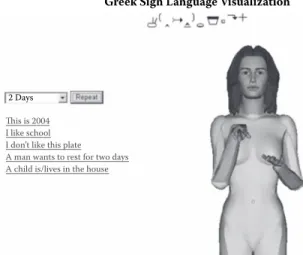
Some research projects have focused primarily on the fi nal por-tion of the sign language producpor-tion process: the synthesis step from a sign language specifi cation to an animation of a human-like character. Th ese systems are generally not linguistic in nature; they oft en employ sophisticated models of human fi g-ures, restrictions on the articulatory capabilities of the human form, graphic animation technology, and databases of stored ASL sign animations to produce a smooth and understandable presentation of the sign language message. Th ese systems can be loosely categorized along a concatenative versus articulatory axis (Grieve-Smith, 1999, 2001). Concatenative systems assemble an animation by pasting together animations for the individual signs that compose the message; generally, these systems apply some form of smoothing operation so that the resulting output does not appear jerky (Ohki et al., 1994; Bangham et al., 2000; Petrie and Engelen, 2001; Petrie et al., 2005; Vcom3D, 2007). Articulatory systems derive an animation at run-time from a motion-script by reading the movement instructions from this symbolic script and then manipulating a model of a human fi gure (Messing and Stern, 1997; Grieve-Smith, 1999, 2001; Lebourque and Gibet, 1999; Bangham et al., 2000; Saksiri et al., 2006). Articulatory systems have greater potential for producing the variety of movements that compose a fl uent sign language FIGURE 38.1 Th e virtual human character from an American Sign
Language generation system. (From Huenerfauth, M., Generating American Sign Language Classifi er Predicates for English-To-ASL Machine Translation. PhD dissertation, Computer and Information Science, University of Pennsylvania, Philadelphia, 2006. Copyright held by author.)
TAF-ER628X-08-1002-C038.indd 6
performance and for adapting to new advances in the under-standing of sign language linguistics (see Figure 38.2).
If a designer wants to incorporate sign language animations into an application, then one way to do this is to use one of the sign language synthesis systems mentioned previously. Th e designer must be profi cient in sign language, and he must be able to anticipate the entire set of sign language messages that the application would need to display. Th e designer would then hand-code each sign language performance for the animated character (using the script format), and then this script can be passed off to the synthesis system to produce the animation out-put (possibly at run-time). Th is design approach can work for applications in which a small number of user interface prompts must be expressed in sign language, but it would not work well for a system that needed to deliver media content to users (since this content would not be known ahead of time). Th e require-ment that the programmer be profi cient in sign language can also make this design approach impractical. For these reasons, some natural language processing researchers are studying ways to generate sign language output from a written language input specifi cation or other data source. Th is way, developers with-out expertise in sign language could incorporate sign language animation technology into their applications that use changing content.
38.2.3 Generation and Translation Systems
Th is section describes several systems that produce sign language animation output from an input that is an English (or other written language) sentence to be translated or from some other input data source of content to be conveyed to the user. Th ere is a spectrum of system designs: from some systems that merely produce a transliteration of a written language sentence to other systems that produce a grammatically correct sign language
performance. Th ose systems that are transliterations of a writ-ten language provide for automatic sign generation (with almost no human intervention required), but they provide less of an accessibility advantage for deaf signers. Th e systems with correct sign language output are more complex to implement (and until machine translation technology further improves they will still require a human intermediary to check the correctness of their output), but they have the potential to make more information and services accessible to deaf signers by translating informa-tion from written language text into sign language animainforma-tion.
38.2.3.1 Fingerspelling Systems
While some fi ngerspelling animation systems simply concat-enate pictures or animations of sign language fi ngerspelled letters, more sophisticated systems manipulate a human hand model to create a natural fl ow and timing between the letters (Davidson et al., 2000, 2001). Much of this soft ware has been designed not for communicative purposes but rather for sign language education—people learning to interpret fi ngerspelling at more fl uent speeds can use these educational systems to auto-matically produce an animation to practice with. An animation of a human character fi ngerspelling every word of an English sentence would generally not be understandable to a deaf user with low levels of written language literacy (since it is merely an encoding of the original text). However, as discussed previously, sign languages sometimes use fi ngerspelling for proper names, titles, and other specifi c words; therefore, fi ngerspelling soft ware is an important subcomponent of a full written language-to-sign language translation system.
Researchers are also studying how to build other impor-tant subcomponents of a complete written language-to-sign language translation system. Some have explored the design of sign animation databases (Crasborn et al., 1998; Furst et al., 2000) and soft ware tools for linguistic informants to help build these databases (Wolfe et al., 1999; Toro et al., 2001). Some research-ers have used motion-capture data glove technology to collect 3D coordinates of a signing performance (Ohki et al., 1994; Lu et al., 1997; Bangham et al., 2000; Verlinden et al., 2001), and others have generated sign animations from some style of sym-bolic encoding of each sign (Lu et al., 1997; Grieve-Smith 1999, 2001).
38.2.3.2 Transliteration Systems
Transliteration systems convert from text to sign, retaining the word order and some grammatical structures from the text in the sign output. Th ere have been several previous research sys-tems designed to convert from English into Signed English or into an English-like form of pseudo-ASL signing (Grieve-Smith, 1999, 2001; Bangham et al., 2000). With little structural diver-gence between English text and Signed English animation, the architecture of these systems is typically a simple dictionary look-up process. For each word of the English input text string, the system will look up the correct sign in the Signed English dictionary (containing animations of each sign), and create an output animation that concatenates together all of the signs
Greek Sign Language Visualization
2 Days This is 2004 I like school I don’t like this plate A man wants to rest for two days A child is/lives in the house
FIGURE 38.2 Screenshot from an application that synthesizes ani-mations of Greek Sign Language. (From Karpouzis, K., Caridakis, G., Fotinea, S-E. and Eft himiou, E., Computers & Education, 49, 54–74, Elsevier, 2007.)
in the sentence into a complete animation. Children and deaf adults with low English literacy skills, who would be the target users of English-to-ASL machine translation soft ware, would not generally fi nd this form of English-like signing understandable. While Signed English output may be more understandable for deaf signers than a fi ngerspelling system, actual sign language animation of ASL would be more useful.
38.2.3.3 Sign Language Translation Systems
Th ere have been several research projects that have focused on generating animations of sign language using a written language input string. Th ese systems analyze the linguistic structure of the input text. Th e grammatical structure, word order, and vocabulary of the text are translated into the appropriate sign language grammatical structure, word order, and vocabulary. Such systems produce a script that specifi es the sign language performance—generally using sign language synthesis soft ware to produce an actual animation output in which a humanlike character performs the sign language sentence.
Th ere are several dimensions along which the quality of these translation systems can be measured: the variety of grammati-cal structures they can understand or generate; the subtlety of variations they can generate for individual signs; the vocabu-lary size (of written language words or sign language signs); the degree to which they correctly use the face, eyes, and body of the signer; whether or not they can use the space around the signer to position objects under discussion; whether or not they can generate complex spatial phenomena in sign language (such as classifi er predicates); whether they produce smoothly mov-ing and realistic animations of a signer; and whether the sign language translation they select for the written language input sentence is accurate/understandable.
Early demonstration systems were capable of producing only a small number of sentences with a limited variety of grammar structures. While those systems did not have the robustness needed for full translation, they helped identify the complexities involved in building higher-quality translation systems. Th ese short-lived projects also played an important role in develop-ing animation dictionaries of specifi c signs for various sign lan-guages. Translation systems have been created for ASL (Zhao et al., 2000; Speers, 2001), Chinese Sign Language (Xu and Gao, 2000), German Sign Language (Bungeroth and Ney, 2004), Irish Sign Language (Veale et al., 1998), Japanese Sign Language (Ohki et al., 1994; Lu et al., 1998; Tokuda and Okumura, 1998; Adachi et al., 2001), Polish Sign Language (Suszczańska et al., 2002), Sign Language of the Netherlands (Verlinden et al., 2001), and others.
More recent sign language translation systems have been designed that can handle richer linguistic phenomena, be more easily scaled up to handle large vocabularies, are actually deployed in sample applications, or that can handle complex linguistic phenomena in sign language. Recent projects have focused on a number of sign languages, including, for exam-ple, ASL (Davidson et al., 2001; Huenerfauth, 2006a,b), British Sign Language (Marshall and Sáfár, 2004, 2005; Sharoff et al., 2004), Greek Sign Language (Karpouzis et al., 2007), Irish Sign
Language (Morrissey and Way, 2005), Japanese Sign Language (Shionome et al., 2005), and South African Sign Language (van Zijl and Barker, 2003).
Current sign language systems still require the intervention of a human to ensure that the sign language output produced is accurate. As the quality and linguistic coverage of these systems improve over time, it eventually may be possible for computer interface designers to request automatic translation of written language text into sign language animations. Th e long-term goal of research on sign language generation and translation is broad-coverage systems that can handle a wide variety of written language input sentences and successfully translate them into sign-language animations. Th e sign language sentences that are created should be fl uent translations of the original written lan-guage text, and they should be able to incorporate the full range of linguistic phenomena of that particular sign language. In the coming years, sign language translation systems should be able to more accurately translate sentences with a broader vocabu-lary and structure, successfully use the space around the signer’s body to represent objects under discussion, and generate more complex linguistic phenomena, such as spatial verbs (Marshall and Sáfár, 2005) or classifi er predicates (Huenerfauth, 2006b).
38.3 Understanding Sign
Language Input
Deaf signers may benefi t not only from interfaces that change text into sign language, but also from interfaces that can rec-ognize signing. Sign recognition has the goal of automatically converting the sign language performance of a human user into a computational representation of the performance—that allows the computer to identify the meaning of the user’s sign-ing and possibly to later translate it into text or speech. Th ese technologies have been investigated for a number of years, pri-marily to address the need to facilitate communication between signers and nonsigners. Th ey also have the potential to provide an alternative means of natural language input to computers. While individual projects have focused on particular sign lan-guages, the statistical nature of most research in this area makes this technology easily adaptable to a variety of sign languages.
A key diff erence between sign language recognition and the more general problem of gesture recognition is that the linguis-tic structure of sign language input can be used by some machine learning techniques to help determine the likelihood of predict-ing the next sign a human will perform based on the frequency of some signs following others or the syntactic structure of the sentence. Th us, despite the more complex body movements of sign language, the fact that the performance has a linguistic structure can help guide the recognition process.
Some attempts at recognizing and understanding sign lan-guage performed by humans have focused solely on the recog-nition of fi ngerspelling (Takahashi and Kishino, 1991; Bowden and Sarhadi, 2002). Fingerspelling recognition alone, however, will not be greatly benefi cial to deaf signers, given the same liter-acy issues discussed previously. However, because fi ngerspelling
TAF-ER628X-08-1002-C038.indd 8
is sometimes used during sign language, a fi ngerspelling recog-nizer would be a necessary subcomponent of a full sign language recognition system.
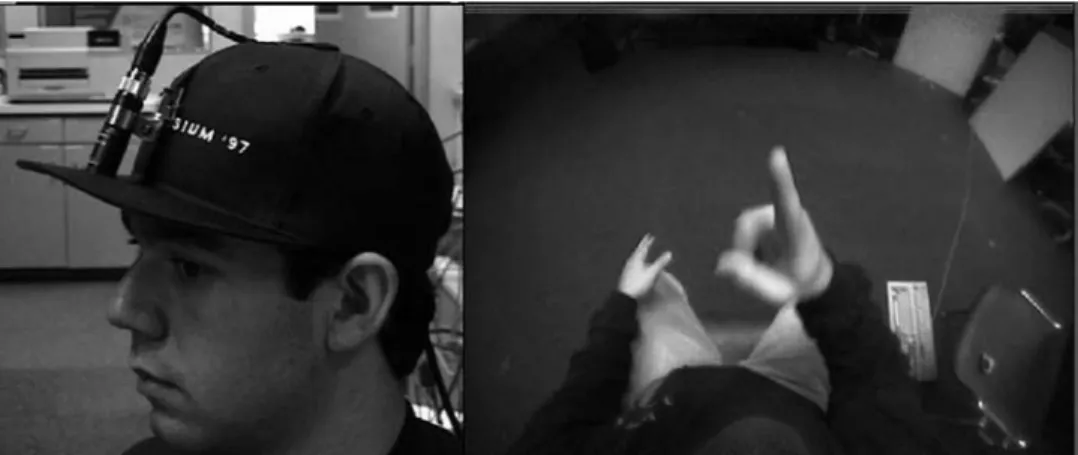
Sign recognition systems have used two types of technol-ogy: camera-based systems (Bauer and Heinz, 2000; Xu et al., 2000; Vogler and Metaxas, 2001; Kapuscinski and Wysocki, 2003; Starner et al., 2004; Zhang et al., 2004; Yang et al., 2005) and motion-capture-based systems (Waldron and Kim, 1995; Braff ort, 1996; Vamplew, 1996; Liang and Ouhyoung, 1998; Cox et al., 2002; Yuan et al., 2002; Brashear et al., 2003; Vogler and Metaxas, 2004). Th e camera-based systems capture video of a human sign language performance and use machine vision soft ware to locate the parts of the signer’s body in the image, identify the 3D location of each part of the body, identify the confi guration (pose or handshape) of that part of the body, and then attempt to identify the sign (or other aspect of the sentence) that the person is performing. Th e motion-capture systems use a variety of sensors (e.g., infrared light beacons, radiofrequency sensors, or gyroscopes) to identify the location or angle of parts of the signer’s body. Th e signer will wear a set of motion-capture cybergloves and sometimes other sensors on the body as part of a motion-capture suit. Th ese systems use the data from the sen-sors to calculate the location and confi guration of parts of the signer’s body, and then they identify what subportion of a sign language sentence is currently being performed.
Just as the task of producing a sign language animation could be broken into several stages (generation, synthesis, etc.), the work of a sign language input system can be divided into two important subtasks: recognition and understanding.
38.3.1 Recognition
In the recognition phase, the individual elements of the perfor-mance must be identifi ed. While some researchers have attempted
to recognize the linguistic elements of facial expressions used during a sign language performance (Vogler and Goldenstein, 2005), most systems focus on the linguistic elements of the sign-er’s hands and attempt to identify only the individual signs in the sentence. Various factors can make the recognition of parts of the signing performance a diffi cult task: variations in lighting condi-tions, diff erences in appearance between signers, changing hand-shapes or facial expressions/appearance, occlusion of parts of the body, blending of signs into one another during a performance, grammatical modifi cations to signs that cause them to vary from their standard dictionary form, and other variations in the way that sentences are performed by diff erent signers (intersigner variation) or the same signer on diff erent occasions (intrasigner variation).
Depending on the application, it is possible to make the task of a sign language recognizer easier by asking the signer to per-form sign language at a slower speed, asking the signer to pause briefl y between each sign that is performed (Waldron and Kim, 1995; Grobel and Assam, 1997), limiting the vocabulary size supported, restricting the variety of sentences that can be per-formed (e.g., fi xed list of sentences that can be identifi ed, small set of sentence templates, a limited grammar, a grammar with-out some complex sign language features, etc.), allowing the recognizer to process data offl ine (instead of real-time), train-ing the system to identify the signtrain-ing of a strain-ingle person (instead of a variety of signers), and so on. Most work on sign language recognition is based on statistical learning approaches such as neural networks (Murakami and Taguchi, 1991; Vamplew, 1996), independent component analysis (Windridge and Bodden, 2004), or hidden Markov models (Bauer and Kraiss, 2001; Brashear et al., 2003; Vogler and Metaxas, 2004; Yang et al., 2005). Research on recognizing continuous signing (full sentences without pauses added between signs) for a variety of sign languages is surveyed in Loeding et al. (2004).
FIGURE 38.3 A sign recognition system using a hat-mounted camera that obtains an overhead image of the signer’s hands. (From Brashear, H., Starner, T., Lukowicz, P., and Junker, H., Using multiple sensors for mobile sign language recognition, in the Proceedings of the 7th IEEE International Symposium on Wearable Computers, 21–23 October 2003, White Plains, NY, pp. 45–52, Elsevier, IEEE, 2003.)
38.3.2 Understanding
During the second phase of a sign language input system (the understanding phase), the system will attempt to determine the meaning of a sentence that the person is signing. Th e challenges that arise during this phase are primarily linguistic in nature and are similar to those encountered by researchers attempt-ing to build natural language understandattempt-ing soft ware for other languages. If the sign language input is being used as part of an application that only expects to receive a small set of pos-sible commands (or receive input sentences that discuss only a limited set of topics), then the task of the understanding system is somewhat easier. Because most research on sign recognition is still in the early phases of development, there has been little computational linguistic research on the understanding of sign language input (since without high-quality sign recognition systems, there is less current need for soft ware to perform the understanding phase). Th ere has been some work on translat-ing from sign language input into written language output (Wu et al., 2004), but since the accuracy level (and vocabulary size) is oft en quite limited for most recognition systems, work on this understanding phase is still preliminary.
38.4 Sign Language in Applications
With the proliferation of computers and Internet technology in modern society, it is important for someone to be able to access computers to fully participate in society, culture, government, and communication. Because of the dominance of print on the web, there is a danger that a digital divide will disenfran-chise those deaf users who are not skilled readers. In addition, the increased use of broadband communications, media, and Internet technology is making the transmission of audio and video more common, creating other potential sources of dif-fi culty for deaf users. Th e information on the auditory chan-nel of this media is inaccessible to deaf users without special captioning, and text captioning alone may not be readable by all deaf users. Technology presented earlier in this chapter that can generate animations of sign language or understand sign language input can be used to increase the accessibility of computers and other forms of information technology for these users.
38.4.1 Sign Language on a User Interface
Computer interfaces typically contain large amounts of infor-mation presented in the form of written language text. Th is writ-ten text can take many forms: elements of the interface (such as the labels on buttons or menus), the content on the computer (names of fi les, textual information inside documents), or media displayed on the computer (web pages from the Internet, captioning text on streaming media). It is commonplace for soft -ware developers to create user interfaces that can be localized/ internationalized into diff erent languages. Th e major diff erence
between localizing soft ware for a sign language is that since there is generally no written form, the sign language translation can-not be written on the buttons, menus, or application windows of the computer screen.
More research is needed to determine how to best display sign language on an interface. For instance, for users with partial lit-eracy skills, it may be desirable to simultaneously display the text and corresponding sign on an interface, rather than removing the text when signing is displayed. However, without more user-based studies, it is unclear what design is best for deaf users with various levels of written language literacy. Human-Computer interaction (HCI) research is needed to determine how to design user interfaces that allow deaf users to direct their attention on an interface containing a mix of onscreen written language text and an animated signing character in one portion of the interface.
Earlier in this chapter, a linguistic phenomenon present in many sign languages, namely classifi er predicates, was dis-cussed. During these constructions, signers draw a miniature version of a scene that they are discussing in the air in front of their bodies using linguistically determined handshapes and movements to show the arrangement or motion of objects. Because of the complex and unusual nature of this phenom-enon, most sign language animation systems are not designed to generate them. Th is is unfortunate because it would be extremely useful for an onscreen sign language character to be able to perform classifi er predicates when it is part of the interface of a computer system (Huenerfauth, 2007). Since the sign language cannot be statically written on elements of the interface, the animated character will frequently need to refer to and describe elements of the surrounding screen when giv-ing instructions about how to use the system. When discuss-ing a computer screen, a human signer will typically draw an invisible version of the screen in the air with her hand and use classifi er predicates to describe the layout of its components and explain how to interact with them. Aft er the signer has drawn the screen in this fashion, she can refer to individual elements by pointing to their corresponding location in the signing space. Making reference to the onscreen interface is especially important when a computer application must com-municate step-by-step instructions or help-fi le text. Written language-illiterate users may also have limited computer experience; so, conveying this type of content may be espe-cially important.
For computer soft ware developers who wish to make their pro-grams accessible to deaf signers, using a sign language generation system to produce animations in help systems may be more practi-cal than videotaping a human signer. Th ere would be a signifi cant investment of resources needed to record and update such videos, and there is another challenge: variations in screen size, operating system, or user-confi gured options may cause the icons, frames, buttons, and menus on an interface to be arranged diff erently. An animation-based sign language system may be able to produce variations of the instructions for each of these screen confi gura-tions dynamically—producing a video of a human signer for each would be impractical.
TAF-ER628X-08-1002-C038.indd 10
38.4.2 Sign Language in
Communication Systems
Th ere are some forms of communication technology that allow deaf signers to interact with sign language; for instance, vid-eo-phone services, video relay services, and Internet webcam systems. In all of these systems, signers who are in two geo-graphically remote locations can communicate using a video camera and a display screen that shows the other signer. When two signers are interacting with such a system, the communi-cation is generally accessible (aside from occasional video qual-ity or time delay issues with these technologies that may impair communication). However, when video relay systems involve a human sign language interpreter who is facilitating a meet-ing with both deaf and hearmeet-ing participants, it can be diffi cult to maintain a smooth conversational fl ow due to the inability of users to make eye contact correctly via videophone or to see the body movements of remote conversational participants. Researchers are investigating various technologies to improve the turn-taking interactions in video conference interpreted settings (Konstantinidis and Fels, 2006).
While these video-based services off er an exciting new com-munication option for deaf signers, they are still only deployed in a limited fashion. Th ere is signifi cant expense in the video con-ferencing equipment and in hiring a sign-language interpreter when both hearing and deaf participants wish to communicate. Th e necessary video quality needed for sign language is also not yet possible to transmit over most wireless phone networks; so,
these applications are generally limited to nonmobile settings. In lieu of video-based technologies, many deaf people use teletype telephones (TTYs), TDDs, two-way text pages, mobile phone text-messaging, or Internet-based instant-message programs for day-to-day communication. Unfortunately, all of these means of communication still require strong written language read-ing and writread-ing skills to interact with hearread-ing persons. Soft ware to automatically translate from written language text into sign language animation (to be displayed on the screen of these com-munication devices) could be used to make these technologies more accessible to deaf signers with low levels of written lan-guage literacy.
38.4.2.1 Future Potential of Speech-to-Sign Devices
Translation technology also has exciting future applications when combined with speech recognition soft ware. By incor-porating a microphone, speech-to-text soft ware, and a written language-to-sign-language translation component into a hand-held computer, one could produce a conversational interpreting tool to provide real-time interpreting services for deaf signers in contexts where hiring a live interpreter would be impossible. It is important to note that all of these technologies (speech recog-nition, language understanding, machine translation, sign lan-guage generation, sign lanlan-guage synthesis) have the potential to make errors during their processing. In fact, none of these tech-nologies are currently able to perform anywhere near the level of humans at these activities. When embedded into an application FIGURE 38.4 Screenshot of a web site augmented with a sign language animated character from the European Union’s eSIGN project. (From Elliott, R., Glauert, J., Kennaway, J., Marshall, I., and Safar, E. (2008), Universal Access in the Information Society, 6, 375–391.)
in which one technology provides the input for the next one in a pipelined architecture, these errors can aggregate. Prototype systems like this have been built for a limited set of sentences (Sagawa et al., 1997) and if the domain of language use is thus limited, then the accuracy rate of speech and translation tech-nologies increases—making their immediate use more practical. For instance, the TESSA project was a prototype system devel-oped to facilitate interactions between hearing and deaf people during transactions in a post offi ce (Cox et al., 2002). It will take many more years of development of each of these technologies, however, for handheld speech-to-sign devices to be able to reach a usable level of accuracy for everyday interactions.
38.4.2.2 Translation Quality and Ethical Considerations
Th is issue of soft ware errors applies to any setting in which trans-lation soft ware will be used to translate written language text into sign language (or vice versa). No machine translation system between any pair of languages is perfect—even those developed for languages that have been computationally studied for several decades. Sign languages have been the focus of such research for a much shorter time, and translation technology for them will continue to develop for many years to come. In applications in which users understand that the translations may not be perfect and that they cannot fully trust the translation provided, many machine translation technologies for written languages have been successfully deployed. For instance, people browsing a web site in a language they do not speak can use online machine translation soft ware to produce a version of the page in their local language. While the translation may not be perfect, users can get the basic meaning of the page (and perhaps request a full translation of the page by a human translator at a later time). Similarly, in the near future, deaf signers may be able to benefi t from machine sign lan-guage translation technologies in various applications as long as they are aware that signed translations may not be as accurate as those provided by human interpreters.
It will be a challenge for future accessibility designers to determine when machine sign language translation technologies reach a “good enough” level of linguistic coverage and accuracy such that they feel their users will begin to benefi t from the sign language animations they provide. (Technology for understand-ing sign language input and translatunderstand-ing it into written language output will develop later over time.) Th ese developers must weigh the implications of providing imperfect sign language translations of written language material versus providing no translation (and potentially leaving the material inaccessible for many users). Sign language computational linguists should make the limitations of their translation soft ware clear so that potential users (such as soft ware developers) can use the tech-nology appropriately.
It is essential for developers of accessibility soft ware not to overestimate the accuracy of sign language animation technolo-gies, and it is equally important for them to understand the lim-ited benefi ts that animations of signed transliteration systems (such as Signed English) have for users with limited written
language literacy. Given the relatively young state-of-the-art of sign language technologies, service providers (e.g., governments, companies, media outlets, etc.) must be careful not to prema-turely deploy these technologies in the name of accessibility. Th e goal of sign language translation systems has generally been to provide additional assistance to deaf signers in settings in which human interpreters are not possible, not to replace interpret-ers in settings in which they are currently deployed. Sign lan-guage interpreters perform valuable services in many situations, allowing for fl uent two-way communication between deaf and hearing people. No computer system is capable of providing the same level of sophisticated and subtle translation that a qualifi ed professional interpreter can. Th e development of sign language translation technology will take several more decades, and the burden falls to technologists to inform potential users of the cur-rent state-of-the-art and its limitations.
38.4.3 Sign Language Captioning for Media
Many deaf or hard of hearing people with literacy challenges can have diffi culty understanding the written language text on the captioning provided with television programs, Internet media content, or at some live events. Th ere exists some contro-versy about the language level to be used for captioning. Simply put, the issue revolves around the question of whether captions should be verbatim transcripts or whether simplifi ed captioning should be provided. Verbatim captioning is generally preferred by users themselves, even though it may not be accessible to some (National Institutes of Health, 2002). Instead of providing simplifi ed written language text, automatic translation soft ware could be used to convert this text into a sign language animation that could be displayed for these users. Of course, many of the translation quality and ethical issues discussed in the communi-cations section previously also apply when translating captions into sign language animation for deaf signers.
Th ere are several options as to how television captioning text could be made more accessible for deaf signers in the future. Broadcasters could run translation soft ware on their written language closed captioning text (to produce a sign language animation script). If the transmission is not of a live event (and the broadcasters have some linguistic expertise in sign lan-guage), then they could manually fi x any translation errors in the sign language script. Finally, they could transmit the script over the network, and sign language synthesis soft ware on the user’s receiving device (e.g., television, computer) would gener-ate the animation of a humanlike character performing the sign language sentences specifi ed by the script. Various approaches for the transmission of this alternative captioning would need to be explored, and standards for the transmission of the script would need to be established. Alternatively, the sign language animation could be synthesized prior to transmission and sent as a secondary video feed with the original signal. If this video-feed approach is used, then more bandwidth may be required in the transmission but potentially fewer standards would need to be established.
TAF-ER628X-08-1002-C038.indd 12
Similar English literacy issues arise when deaf signers need to access nonelectronic written materials. Deaf students who need to read classroom textbooks or deaf adults who wish to access magazines, printed government publications, and other docu-ments could benefi t from a tool that incorporates a text scanner, optical character recognition soft ware, and a written language-to-sign language translation component to make this infor-mation more accessible. Just like the speech-to-sign handheld system described previously, systems that rely on multiple stages of processing with potentially imperfect technologies can aggre-gate the errors made at one stage (and pass them on to the next). However, in this case, optical character recognition soft ware has reached a suffi cient level of accuracy that a scanner-based system could become practical as the quality of sign language transla-tion technology continues to improve.
38.4.4 Applications Focused on Sign Language
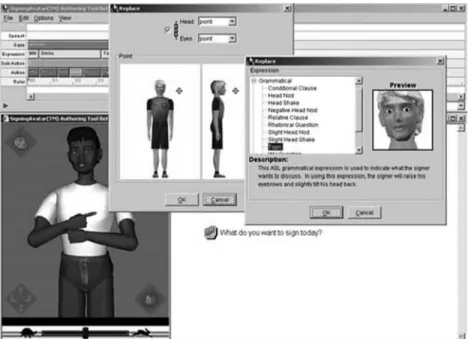
Th e previous sections have discussed ways in which standard computer applications, communications tools, and media could be made more accessible for deaf signers. However, the devel-opment of sign language generation and recognition technol-ogy actually makes several new types of computer applications possible that may benefi t deaf signers. Instead of translating content that was originally created in a written language, these applications would include original content in the form of sign language animation. Educational soft ware can be created to help users learn sign language literacy skills (by watching sign language animations or performing sign language that is rec-ognized by the system) or to help users learn other academic content (through explanation in the form of sign language ani-mation). Sign language scripting soft ware can also be created to allow users to create and edit sign language animations much like word-processing soft ware allows editing of written language content.
38.4.4.1 Educational Tools to Learn Sign Language
Soft ware to teach users sign language could also benefi t from sign language generation and recognition soft ware. Animation technology could be used to produce demonstrations of sign language using virtual human characters, which the user could view from any angle, zoom in or out, and slow down (more easily than a videotape). Recognition technology is being used to allow users to practice performing sign language sentences, and the system could provide the user with feedback about his perfor-mance (Brashear et al., 2006). Written language to sign language translation technology could also be incorporated into edu-cational soft ware—it could translate novel sentences into sign language and demonstrate them for the user. Th is would allow the user to request particular sentences that she is interested in learning, and the animation technology could make the educa-tional soft ware more engaging and interactive.
Like all computerized language learning soft ware, a sign lan-guage learning program may help users feel more comfortable learning a language than they would with classroom instruction
or in-person conversational practice. While live interaction is extremely important for language learning, sometimes students are too intimidated to enroll in classes. Th ese issues are particu-larly important when considering the case of hearing parents who should learn sign language because they have learned their child is deaf (or has special communication needs that make the use of sign language appropriate). Th e complex emotions that these parents sometimes experience when learning about their child’s status can make them uncomfortable or resistant to enrolling in formal sign language classes. A computer program that could teach these parents basic sign language could be an extremely useful way to get them interested in the language and build their confi dence to enroll in sign language learning activities.
38.4.4.2 Educational Tools to Learn through Sign Language
Sign language generation technology also has important appli-cations in educational computer programs for deaf and hard of hearing students. Just like the “Sign Language on a User Interface” section discussed previously, educational programs could have a user interface with a sign language character on the screen to help students better understand the information presented and use the soft ware. Th e user interface of any stan-dard children’s educational program could be extended with an onscreen character in this way. It would also be possible to build educational soft ware especially for deaf students with original content in the form of sign language animations (instead of translating content originally designed in a written language and for hearing students). Particularly eff ective in this context would be content addressing issues of particular interest to deaf students or using culturally appropriate storylines or scenarios (Hanson and Padden, 1990); it could also take advantage of the rich capabilities of sign languages to convey spatial concepts or narratives to teach important content.
38.4.4.3 Sign Language Word Processing or Scripting Software
Because nearly all sign languages lack a standard orthography and writing system that is widely accepted by their users, it is currently very diffi cult to store, process, and transmit sign lan-guage via computer. Video is currently the best means for cap-turing information in sign language, and while digital video editing soft ware and faster Internet connections are making video easier to work with on a computer, sign language still remains a much less computer-friendly language than written languages. As sign language generation and translation technol-ogies are being developed, researchers are designing new com-puter encodings of sign language that should be easier for users to store, edit, process, and transmit with computer technology. Th ese representations are much smaller in size than video, and they can be modifi ed prior to being turned into animation by sign language synthesis soft ware. In this way, it may be possible to produce sign language word-processing (or sign-processing) soft ware that could allow people to write, edit, and replay sign language information on their computer. Aside from increasing