IJPSR (2018), Volume 9, Issue 4 (Research Article)
Received on 14 June, 2017; received in revised form, 13 March, 2018; accepted, 18 March, 2018; published 01 April, 2018
SYNTHESIS AND CHARACTERISATION OF CHALCONE BASED COPOLYESTERS AND THEIR ANTICANCER ACTIVITY
D. Lakshmi Devi, R. Aswini and S. Kothai *
Department of Chemistry, Ethiraj College for Women, Chennai - 600008, Tamil Nadu, India.
ABSTRACT: Breast cancer is one of the most common causes of death in women. Chalcone exhibit chemopreventive and antitumor effects. As a part of proactive approach in the fight against breast cancer, two copolyesters using varying chalcone diols as monomer and varying aliphatic and aromatic acid chlorides were synthesised by solution polycondensation method. The two copolyesters were characterized by solubility and viscosity measurements. The structure of the copolyesters was established by FT-IR, 1H NMR, 13C NMR and MALDI. The monomer and copolyesters were studied for their anticancer activity using MCF-7 Cell Line and their cytotoxic effect were studied on VERO Cell Line by MTT assay. The IC50 values were calculated using the Software Graph Pad Prism Version 7 and ED50 plus v 1.0. The Selectivity index indicates that the chalcone HHEP and the two copolyesters are good anticancer agents and the chalcone MHEP is cytotoxic. The Selectivity index were found to be more than two, these copolyesters can be targeted individually or in combination with cancer drug in chemotherapy.
INTRODUCTION: Cancer refers to any malignant growth or tumor caused by abnormal and uncontrolled cell division. Breast cancer is one of the most common cancers in women. Death from cancer worldwide are projected to continue rising, with an estimated 131 millon death in 2030. Chalcones are a class of natural compounds that widely exist in a variety of plant species. They are commonly known as yellow pigments in flowers and are also widely distributed in various parts (roots, rhizomes, heartwood, leaves, flowers and seeds) 1.
QUICK RESPONSE CODE
DOI:
10.13040/IJPSR.0975-8232.9(4).1589-93
Article can be accessed online on:
www.ijpsr.com
DOI link: http://dx.doi.org/10.13040/IJPSR.0975-8232.9(4).1589-93
Chalcone derivative have shown anti-cancer, antimalarial, anti-inflammatory 2, anti-bacterial, anti-filarial, antifungal and anti-oxidant activity 3. Concerning the chemical structural level, these compounds are open-chained molecules, in which the two aromatic rings are joined by a three-carbon α, β- unsaturated carbonyl system (1,3-diphenyl-2-prop-1-one).
A large number of chemical structures have been studied, and it was reported that hydroxyl-derivatives of chalcones display marked anti-proliferative effects on cancer cells. These groups are likely necessary for the chemotherapy agents 4. The principal aim of our work is the discovery of novel cytotoxic and anticancer agents. In the present study, we have synthesized two chalcone diols by acid catalysed claisen condensation method. Using those chalcone as monomers and varying acid dichlorides two copolyesters were Keywords:
Chalcones diols, Copolyesters, MTT assay, IC50, Selectivity index
Correspondence to Author: S. Kothai
PG and Research, Department of Chemistry, Ethiraj College for Women, Chennai - 600008, Tamil Nadu, India.
synthesied to study their enhanced biological activity 5, 6, 7. The newly synthesized chalcone diols and polyesters are further screened for their anticancer activity.
MATERIALS AND METHODS:
Synthesis of Chalcone Diols: The two monomer chalcone diols namely (2E)-1-(4-hydroxy phenyl) 3-(4 hydroxy -3- ethoxy phenyl) prop-2- ene -1- one [HHEP] and (2E)- 1-( 4 hydroxy-3- methoxy phenyl)- 3-( 4 hydroxy -3- ethoxy phenyl) prop- 2- ene -1 -one [MHEP] were synthesized and reported 8.
Synthesis of HHEP: Dry HCl gas (generated as a result of reaction between concentrated sulphuric acid and dry crystals of NaCl) was passed through a well cooled solution of 3g of 4- hydroxy -3- ethoxy benzaldehyde and 2.7g of 4 -hydroxy
acetophenone in 100 ml of absolute ethanol taken in a 250 ml RB flask under stirring conditions. The precipitate is poured into ice cold distilled water and allowed to settle, filtered, dried and recrytallised from methanol.
Same method was adopted to synthesise MHEP and both were reported 8.
Synthesis of Copolyesters:
Synthesis of PIOH: Taken 1g of HHEP in 100 ml RB flask. Added 10 ml of dry DMF stirred till it is dissolved, then added 0.3573 g of isophthaloyl chloride and 0.1586 g of oxalyl chloride, temperature was raised to 120 °C and maintained at 120 °C. Left the reaction to proceed for 12 h. After the reaction time, quenched in 50 ml of n -hexane, filtered, dried, powered. It is then reprecipitated from methanol.
FIG. 1: SYNTHESIS OF HHEP FIG. 2: SYNTHESIS OF PIOH
Same method was adopted to synthesise PIOM and both were reported 8. The structure of the copoly- esters was established by FT-IR, 1H NMR, 13C NMR and MALDI. Table 1 gives information
[image:2.612.131.487.318.452.2]regarding the monomers used in the synthesis of the two copolyesters, their respective copolyester code, percentage of yield and inherent viscosities.
TABLE 1: MONOMERS USED, COPOLYESTER CODE, PERCENTAGE OF YIELD AND INHERENT VISCOSITIES Diol Diacicd chloride-I Diacicd chloride-II Copolyester code Percentage yield Inherent Viscosity (cP)
HHEP Isophthaloyl chloride Oxalyl chloride PIOH 78 1.2890
MHEP Isophthaloyl chloride Oxalyl chloride PIOM 85 1.0578
Cytotoxic Studies: The anticancer activity of samples on MCF-7 cells were determined by the MTT assay cells (1x10⁵/well) were plated in 0.2 ml of medium/well in 96-well plates. Incubate at 5% CO₂ incubator for 72 h. Then, add concentrations of the samples in 0.1% DMSO for 48 h at 5% CO₂
incubator. After removal of the sample solution and washing with phosphate-buffered saline (pH 7.4), 20µl/well (5mg/ml) of
3-(4,5dimethyl-2-thiazolyl)-2,5-diphenyl-tetrazolium bromide (MTT) in
phosphate-buffered saline solution was added. After 4 h incubation, 1 ml of DMSO was added.
Viable cells were determined by the absorbance at 540nm. Measurements were performed and the concentration required for a 50% inhibition of viability (IC50) was determined graphically. The effect of the samples on the proliferation of MCF-7 cells was expressed as the % cell viability, using the following formula:
A540 of treated cells A540 of control cells
Using the Graph Pad Prism, the IC50 values are calculated and compared with ED plus v 1.0.
From this Selectivity index was found using the following formula:
IC50 values of normal cell line
IC50 values of cancer cell line
RESULTS AND DISCUSSION: The two synthesized chalocone based copolyesters were characterized by viscosity measurement, solubility study and spectroscopic methods FT-IR, 1H and 13C NMR and MALDI. Cytotoxic study was carried out using MTT assay. Solubility of the two copolyesters was determined in various solvents and reported 8. The outcome reveals that they are found to be highly polar solvents, partially soluble in moderately polar solvents but absolutely insoluble in least polar solvents. The inherent viscosity value of the two copolyesters PIOH, PIOM was determined in DMAc solution at 30 °C using Ubbelohde Viscometer and were found to be 1.0189 and 1.0632 dL/g respectively as presented in Table 1 reveals that these copoly-esters have high molecular weight .
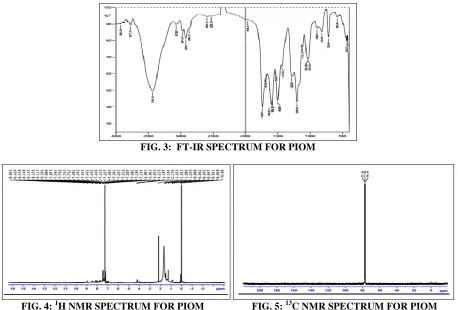
[image:3.612.78.536.366.676.2]Spectral Studies: FTIR spectrum of the two copolyesters namely PIOH, PIOM were recorded by making use of Shimadzu FT-IR instrument. The FT-IR spectrum of the two copolyesters displayed distinctive absorption in the range of 1750-1768 cm-1 owing to ester C=O stretching frequency. Nuclear Magnetic Resonance (NMR) spectroscopy is useful for characterizing the polymer samples. The 1H and 13C NMR spectra of the two copolyesters were recorded with BRUKER AV III 500 MHz NMR instrument in DMSO-d6 solvent and TMS as internal standard. The aromatic protons were observed in the range 7.0 to 8.2 ppm. The vinyllic protons attached to carbonyl carbon are observed in the ranges of 6.6 to 6.9 ppm. The vinyllic protons attached to phenyl rings are observed in the ranges of 4.3 to 4.5 ppm. The methoxy protons in the chalcone moiety were observed in the range 3.1 to 3.4 ppm. The methylene protons observed in the range of 2.2 to 2.9 ppm and the methyl protons in 1.3 to 1.7 ppm.
FIG. 3: FT-IR SPECTRUM FOR PIOM
FIG. 4: 1H NMR SPECTRUM FOR PIOM FIG. 5: 13C NMR SPECTRUM FOR PIOM
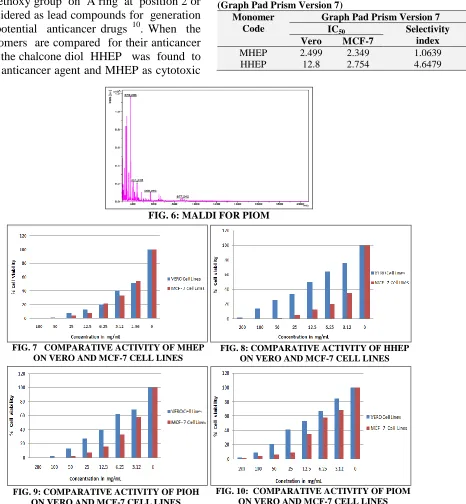
MALDI: MALDI-Mass spectrum was useful in finding the molecular weight of the polymeric samples. MALDI -Mass spectrum of PIOM is shown in the Fig. 6. The Molecular weight of the
polymer was found to 877.242 experimentally, which is in nearly in agreement with the theoretical molecular weight.
In-vitro Cytotoxic Effect of Chalcones:
Anticancer activity of chalcone might be due to molecular alteration such as induction of apoptosis, DNA and mitochondrial damage, inhibition of angiogenesis, tubulinn inhibition, kinases inhibition and also drug efflux protein activities 9. Aromatic chalcones with hydroxyl group, methoxy group on A ring at position 2 or 3 are considered as lead compounds for generation of new potential anticancer drugs 10. When the two monomers are compared for their anticancer activities, the chalcone diol HHEP was found to be good anticancer agent and MHEP as cytotoxic
effect. When the two copolyesters are compared for their anticancer activities both are found to be good anticancer agents because the aromatic ring has substituent alkoxy groups at the chalcone backbone.
TABLE 2: IC50 AND SELECTIVITY INDEX VALUES
OF MONOMERS ON VERO AND MCF- 7 CELL LINE (Graph Pad Prism Version 7)
Monomer Code
Graph Pad Prism Version 7 IC50 Selectivity
index Vero MCF-7
MHEP 2.499 2.349 1.0639
[image:4.612.97.563.157.661.2]HHEP 12.8 2.754 4.6479
FIG. 6: MALDI FOR PIOM
TABLE 3: IC50 AND SELECTIVITY INDEX VALUES OF COPOLYESTERS ON VERO AND MCF- 7 CELL LINE(GRAPH
PAD PRISM VERSION 7 AND ED50 PLUS V 1.0)
Copolyesters Code
Graph Pad Prism Version 7 ED50 Plus V 1.0
IC50 Selectivity index IC50 Selectivity index
Vero MCF-7 Vero MCF-7
PIOH 9.351 4.387 2.1315 8.73 3.24 2.69
PIOM 14.71 7.286 2.0189 14.99 6.274 2.38
FIG. 8: COMPARATIVE ACTIVITY OF HHEP ON VERO AND MCF-7 CELL LINES FIG. 7 COMPARATIVE ACTIVITY OF MHEP
ON VERO AND MCF-7 CELL LINES
FIG. 9: COMPARATIVE ACTIVITY OF PIOH ON VERO AND MCF-7 CELL LINES
Literature survey indicates that when the selectivity index is greater than two for a material under investigation it can be good anticancer agents 11. The Selectivity index of the monomer HHEP and the copolyesters PIOH and PIOM are found to be more than two. Hence they can be targeted at the Breast Cancer Cell Lines as good anticancer agents.
CONCULSION: Two chalcone (HHEP and MHEP) were synthesized and characterized. These chalcone as monomers diols were used and two copolyesters were synthesized using different diacid chloride namely oxalyl chloride and isophthaloyl chloride by polycondensation method. These are characterized and evaluated for their anticancer activity. The selectivity index reveals that one of the monomer (HHEP) and two copolyesters are potent anticancer agents. Hence they can be used as a anticancer agents. This study can be further extended on drug conjugates targeting MCF-7 Cell Line.
ACKNOWLEDGEMENT: Nil
CONFLICTS OF INTEREST: Nil
REFERENCES:
1. Zhang EH, Wang RF, Guo SZ and Liu B: An update on anticancer activity of naturally occuring chalcones.
Hindawi Publishing Corporation Evidence - Based complementary and Alternative medicine volume 2013; Article ID 815621.
2. Kakati D and Sarma JC: Microwave assisted solvent free synthesis of 1, 3-diphenylpropenones. Chemistry Central Journal 2011; 1-7.
3. Prabhakar V, Balasubramanian R, Sathe P, Krishna CM and Juvekar A: In-vitro anticancer activity of mono-substituted chalcone derivatives. International Journal of Tumor Therapy 2014; 3(1): 1-9.
4. Bonfili L, Cecarini V, Amicil M and Kellar JN: Activity of novel quinoxaline-derived chalcones on in-vitro glioma cell proliferation. Reprositorio Institucional PUCRS. Eur J Med Chem 2012; 48: 255-64.
5. Rosa DV, Cristiano F, Mariagrazia D, Cristiana G, Antonella R, Federica B, Franco OR, Salvatore M and Giovanni S: Cancer-Chemother, Pharmacol 2000; 46: 305-12.
6. De Vincenzo R, Scambia G, Benedettipanici P, Ranelletti FO, Bonanno G, Ercoli A, Monache FD, Ferrari F, Piantelli M and Mancuso S: Anticancer Drud Des 1995; 10: 481-90.
7. Lopez SN, Castelli MV, Zacchini SA, Dominguez JN, Lobo G, Jaime CC, Cortes JCG, Ribas JC, Devia C, Ana MR, Ricardo Bioorg DE: Med. Chem 2001; 9: 1999-2013. 8. Devi DL, Jonathan DR and Kothai S: Biocidal efficacy of synthetic copolyesters having chalcone moiety. Journal of Chemical and Pharmaceutical Research 2016; 8(3): 1041-1046.
9. Manik Das and Kunal Manna: Chalcone scaffold in Anti cancer Armamentasicm, A molecular insight.
10. Divekar K, Swamy S and Murugan V: Synthesis, characterization and anti-cancer activity of some pyrazoline derivative. International Journal of Pharma-ceuticals and Phytopharmaceutical Research.
11. Bhavana J, Kalaivani MK and Sumathy A: Indian Journal of Experimental Biology 2016; 54: 379-385.
All © 2013 are reserved by International Journal of Pharmaceutical Sciences and Research. This Journal licensed under a Creative Commons Attribution-NonCommercial-ShareAlike 3.0 Unported License.
This article can be downloaded to ANDROID OS based mobile. Scan QR Code using Code/Bar Scanner from your mobile. (Scanners are available on Google Playstore)
How to cite this article: