ISSN 0218-1940.
Downloaded from:
Usage Guidelines:
Please refer to usage guidelines at
or alternatively
AUGMENTING BUG LOCALIZATION WITH PART-OF-SPEECH AND INVOCATION
YU ZHOU
College of Computer Science and Technology,
Nanjing University of Aeronautics and Astronautics 210006, China [email protected]
YANXIANG TONG
State Key Laboratory for Novel Software Technology, Nanjing University 210023, China
TAOLUE CHEN
Department of Computer Science, Middlesex University, London, United Kingdom
JIN HAN
School of Computer and Software,
Nanjing University of Information Science and Technology 210044, China [email protected]
Bug localization represents one of the most expensive, as well as time-consuming, activi-ties during software maintenance and evolution. To alleviate the workload of developers, numerous methods have been proposed to automate this process and narrow down the scope of reviewing buggy files. In this paper, we present a novel buggy source file lo-calization approach, using the information from both the bug reports and the source files. We leverage the part-of-speech features of bug reports and the invocation relati-onship among source files. We also integrate an adaptive technique to further optimize
the performance of our approach. The adaptive technique discriminatesTop 1 andTop
N recommendations for a given bug report and consists of two modules. One module
is to maximize the accuracy of the first recommended file, and the other one aims at improving the accuracy of the fixed defect file list. We evaluate our approach on six large-scale open source projects, i.e., ASpectJ, Eclipse, SWT, Zxing, Birt and Tomcat. Compared to the previous work, empirical results show that our approach can improve the overall prediction performance in all of these cases. Particularly, in terms of the
Top 1 recommendation accuracy, our approach achieves an enhancement from 22.73%
to 39.86% for ASpectJ, from 24.36% to 30.76% for Eclipse, from 31.63% to 46.94% for SWT, from 40% to 55% for ZXing, from 7.97% to 21.99% for Birt, and from 33.37% to 38.90% for Tomcat.
Keywords: software engineering; bug localization; information retrieval; bug report.
1. Introduction
Bug tracking systems (BTS) are a class of dedicated tools to keep track of bug-related issues for software projects. They provide critical supports and are widely used by developers during software development and maintenance phases. Usually, a new software project may set up an account in a robust BTS, such as Bugzilla, to gather potential defects. If multiple shareholders of the software, such as deve-lopers, testers or even users, come across a defect, they can resort to the BTS and create an issue report to describe the situation. When a bug report is received and confirmed, it will be assigned to a developer for fixing [37]. The developer must first carefully read the bug report, especially the descriptive parts (e.g., “Summary” and “Description”) and elicit the keywords such as class names or method names, and then review source code files to find and fix the buggy parts. The above activity is indeed time-consuming and tedious, especially for large projects with thousands of source files. Manual localization requires high expertise and imposes a heavy bur-den to developers, which inevitably hampers productivity. Therefore, it is highly desirable to automate this process and recommend potential buggy source files to developers with a given bug report.
In recent years, some researchers have proposed various approaches to produce a ranking list of buggy files for processing a bug report [33]. The ranking list can nar-row down a developer’s search scope and thus help enhance debugging productivity. The basic technique of these approaches is standard information retrieval (IR). It returns a ranking list of buggy files based on the similarity scores between the tex-tual parts of a bug reports and the source code. However, the important information of bug reports does not only come from the textual information, but also from other parts. For example, Sisman et al. extended the IR framework by incorporating the histories of defects and modifications stored in versioning tools [25]. The histories might complement the vague description in the textual parts of the bug reports and improve the accuracy of ranking buggy files. Indeed, the source files are coded in some specific programming language, such as Java or C++, which, compared to natural languages, have different grammatical/semantic features. Therefore, traditi-onal natural language processing techniques from IR field cannot be applied directly to extract the discriminative features of the source code. In light of this, Saha et al. utilized code constructs and presented astructured IR based technique [23]. They divided the code of each file into four parts, namely, Class, Method, Variable and Comments. Furthermore, the similarity score between a source file and a bug report was calculated by summing up the eight similarity scores between the source files and bug reports. In [37], Zhou et al. integrated the information of file length and similar bugs to strengthen the traditional Vector Space Model. After that, many other researchers have explored combining other attributes of the bug reports and the source code to further improve the accuracy of bug localization [29,34,32].
76225
Move the ExternalAntBuildfileImportPage to use the AntUtil support.
The ExternalAntBuildFileImportPage duplicates a lot of funcationality now presented in AntUtil.
org.eclipse.ant.internal.ui.AntUtil.java
org.eclipse.ant.internal.ui.model.AntElementNode.java org.eclipse.ant.internal.ui.model.AntModel.java
Fig. 1: Bug Report example
consider the part-of-speech features of underlying words in the bug reports. The part-of-speech, simply “POS” or “PoS” for short, represents any particular category of words which have similar grammatical properties in nature language, such as noun, verb, adjective, adverb, conjunction, etc. Words with the same part of speech generally display similar behavior in terms of syntax, and play similar roles within the grammatical structure of sentences. In reality, to understand the meaning of a bug report, part-of-speech of each word in a sentence is of particular importance. For example, after traditional IR-based preprocessing, the summary of Eclipse Bug Report #84078: “RemoteTreeContentManager should override default job name” is transformed into “RemoteTreeContentManag override default job name”. The noun “RemoteTreeContentManager” directly indicates the buggy file, and the noun phrase “job name” is the substring of a method in the buggy file. By contrast, the verb “override” does not exist in the defect file and the adjective “default” is not a discriminative word for Java code. Thus these words actually provide very little help during debugging.
Textual similarity can indeed help identify potential buggy source files. For ex-ample, Figure 1 illustrates a textual snippet of a real bug report (ID: 76255) from Eclipse 3.1 and the bug-fix information. Both the summary and the description focus on the source file “AntUtil.java” and the file is indeed at the first place of the ranking list, but the rest two fixed files “AntElementNode.java” and “Ant-Node.java” contributing to this defect are at the 4302nd and the 11459th places on the same list ranked solely by similarity [37]. In this case, we observe that most fixed files for the same bug report have invocation relationship between them. For example, the file “AntUtil.java” invokes the other two files. Such underlying logical relationship cannot be captured by the grammatical similarity. This fact motivates us to combine the invocation information with the traditional IR based methods to improve the accuracy of buggy source files identification.
report itself. Namely, the class names or method names of the buggy files exist in the bug reports. Motivated by this, in our approach, we filter the source files and only preserve the class names and method names to reduce the noisy localization for the localized bug reports. However, this process also introduces potential issues. If a bug report is a localized one, this method indeed can lift up the rankings of its buggy files. However, this process might also introduce potential problems, i.e., this filtering strategy could also lift other irrelevant files up to the top places as a side effect. Moreover, if a bug report is not a localized one – for example, the bug report does not contain class names or method names but its buggy files are ranked high on the list – this filtering strategy will reduce their rankings.
In light of the above considerations, we need a more comprehensive approach to combine different sources of information to give a more accurate buggy source file localization based on bug reports. We believe that different types of words in bug reports contribute differently to the bug localization process and are worth treating distinctively. Our approach takes the part-of-speech of index terms as well as the underlying invocation relationship into account. In order to take advantages of the localized bug reports and avoid the decrease of global performance, we use different ranking strategies forTop1 andTopN recommendations, and propose an adaptive approach, taking the demand of the developers into account.
The main contributions of this paper are as follows:
(1) We propose a part-of-speech based weighting method to automatically adjust the weight of terms in bug reports. Particularly, we emphasize the importance of noun terms. This method sets different weights to terms from the summary and description parts in bug reports in order to distinguish their importance. (2) We consider the invocation relationship between source code files to lift up
the ranking of the files that are invoked by the file mentioned in bug reports with the highest similarity scores. This method can help increase the global performance, likeMRRa.
(3) We propose an adaptive approach to maximize the accuracy of recommenda-tions. The approach sets a selection variableopt ∈{true, false} for users. We conduct a comparative study on the same dataset in [37], which confirms the performance improvement by our approach.
This paper is based on our previous work [27], but with significant extensions. We doubled the size of our empirically studied cases—from three to six open source projects—to minimize the external threats to validity. Moreover, we optimize the process of rendering invocation relationship. In our previous paper [27], we simply used the string-based match to find the invocation files of the highest score file which is easy to implement. However, the performance of this method (implemented in module 2 of our approach; cf. Section 3) is rather poor and the invocation relation
has to be calculated each time. In order to reduce the overhead, we produce the invocation corpus for module 2 which can be reused once derived.
The rest of the paper is organized as follows. Section 2 describes the background of our work. Section 3 presents the part-of-speech oriented weighting method and our adaptive defect recommendation approach. We experiment with open source data and discuss the results in Section 4. Section 5 and Section 6 give the threat to validity and related work. We conclude the paper in Section 7.
2. Background
2.1. Basic Ranking Framework
IR is a process to find the contents in a database related to the input queries. The matching result is not unique, but consists of several objects with different degrees of relevance, forming a ranking list [19]. The basic idea of defect localization using IR is to compute the similarity between textual information of a given bug report and the source code of the related project. It takes the summary and description parts of a bug report as a query, the source files as documents, and ranks the relevance depending on similarity scores.
To identify relevant defect source files, the textual part of bug reports and source code are typically transformed into a suitable representation respecting a specific model. In our approach, we use theVector Space Model (akaTerm Vector Model) [?] which represents a query or a file as a vector of index terms.
In order to transform texts into word vectors more efficiently, we need to pre-process the textual information. The traditional text prepre-processing involves three steps: first, we replace all non-alphanumeric symbols with white spaces, and split texts of bug reports into a stream of terms by white spaces. Second, meaningless or frequently used terms called stop word, such as propositions, conjunctions and articles, are all removed. Usually, the stop word list of the source code is totally different from natural language documents and is always composed of particular words relying on programming languages. Third, all remaining words are transfor-med into their basic form by the Poster Stemming Algorithm, which can normalize the terms with different forms.
After preprocessing, we take the rest terms of bug reports as index terms to build vector spaces which represent each bug report and source file as vectors. The weight of an index term in a bug report is based on itsToken Frequency (TF)in the bug report and its Inverse Document Frequency (IDF) in the whole bug reports. The same goes for the weight of an index term in a source file. We assume that the smaller the angle of two vectors is, the closer the two documents represented by the two vectors are [8].
2.2. Part-of-Speech Tagging
etc. Because a term can represent more than one part of speech at different sen-tences, and some parts of speech are complex or indistinct, it becomes difficult to perform the process exactly. However, research has improved the accuracy of POS tagging, giving rise to various effective POS taggers such as TreeTagger, TnT (based on the Hidden Markov model), Stanford tagger [4,10,12]. State of the art taggers highlight accuracy of circ 93% compared to the human’s tagging results.
In recent years, researchers have tried to help developers in program comprehen-sion and maintenance by analyzing textual information in software artifacts [1]. The IR-based framework is widely used and the POS tagging technique has demonstra-ted to be effective for improving the performance [5,24]. Tian et al. have investigated the effectiveness of seven POS taggers on sampled bug reports; the Stanford POS tagger and TreeTagger achieved the highest accuracy up to 90.5% [26].
In our study, the textual information of bug reports is composed in natural lan-guage. As mentioned before, we have discovered that the noun-based terms are more important for bug localization. Therefore, we have made use of POS tagging techni-ques to label the terms and adjusted the weight of the terms in vector transforming accordingly.
2.3. Evaluation Metrics
Three metrics are used to measure the performance of our approach.
(1) Top N is the number of buggy files localized in top N (N=1, 5, 10) of the returned results. A bug is related to many buggy files and if one of the buggy files is ranked in topN of the returned list, we consider the bug to be located in top N. Of course, the higher the metric value is, the better our approach performs.
(2) MRR (Mean Reciprocal Rank) is a statistic measure for evaluating the process that produces a sample of the ranking list to all queries. The reciprocal rank of a list is the multiplicative inverse of the rank of the first correct answer. The mean reciprocal rank is the average of the reciprocal ranks for all queriesQ:
M RR= 1
|Q|
|Q| X
i=1
1
ranki (1)
where ranki is the rank of the first correct recommended file to bug report i
and|Q|is the number of all bug reports.
(3) MAP (Mean Average Precision)is a global measurement for all of the ranking lists. It takes all of the rankings of the buggy files into account. There are possibly several relevant source code files corresponding to a bug report, the
Average Precision (AP)for a bug reportk can be computed as:
APk = |S| X
k=i
P(k)×pos(k)
New Bug Report
Source Files
Text Filtering
Similarity Scores
Invoking Files
File length Tagging Preprocessing
Preprocessing Indexing VSM Represention
Final Recommendation
opt
Module 1
Module 2
opt
Query
[image:8.595.152.455.163.334.2]Index
Fig. 2: The Overview of Our Approach
where|S|is the number of source files, andpos(k) is the indicator representing whether or not the file at rankk is a real defect. P(k) is the precision at the given cut-off rankk. MAP is the mean of the average precision values for all bug reports.
3. Approach
Our approach consists of two interconnecting modules and a parameter opt. The two modules are:
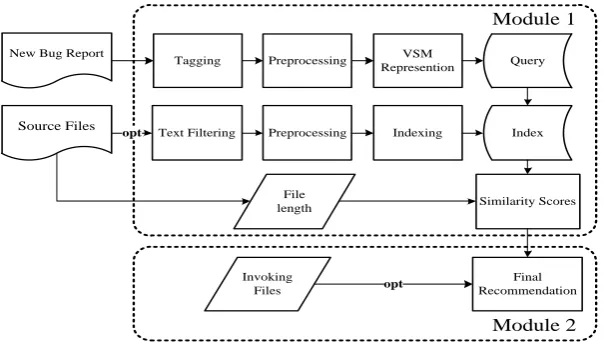
• Module 1 is a revised Vector Space Model combining with part-of-speech orien-ted weighting method. A ranking list for a certain bug report will be produced. In this module, we use a revised Vector Space Model to represent the bug re-port and index the source code files for similarity calculation. The proposed weighting method was applied automatically to adjust the weight of each term based on its tag. We note that the way of filtering the source code is determined by the parameteropt.
• Module 2is based on the results ofmodule 1. We use the invocation relationship to further augment the accuracy of the results. In this module, we will search the summary and description parts of a bug report for the class-name terms. If the corresponding source files of the class have been ranked high inmodule 1, their invoking files will be raised accordingly in the ranking lists.
Ajde does not support new AspectJ 1.1 compiler options
[image:9.595.213.403.169.304.2]Ajde/NNP does/VBZ not/RB support/VB new/JJ AspectJ/NN 1.1/CD compiler/NN
Fig. 3: The Tagging Results
Our approach mainly uses POS tagging technique to mark up the part-of-speech of each term in bug reports and the invocation relationship between source files can be generated from code comprehension techniques, such as static analysis. Figure 2 gives an overview of our approach. The details will be elaborated below.
3.1. Module 1 – Similarity Calculation
In this module, the similarity scores between the new bug report and the candidate source files are calculated, and then an initial ranking list is produced. It’s highly important that the part-of-speech must be tagged before the text preprocessing. Namely, the inputs to the POS tagger are all complete sentences. We use the-state-of-the-art POS tagger Stanford-Postaggerb to mark all of the terms of the bug reports.
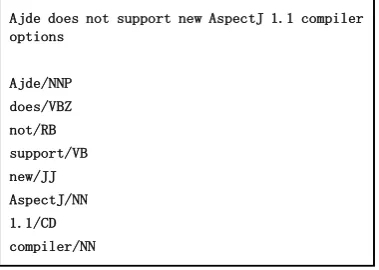
Figure 3 illustrates the tagging results for the summary of AspectJ (Bug ID: 29769). The output includes words of the sentences and their parts of speech which have been defined in the English tagging model of Stanford-Postagger. We can see that the words “Ajde”, “AspectJ”, “complier” and “options” are all noun terms. We duplicate the terms marked as “NN (noun, singular or uncountable)”, “NNS (noun, plural)”, “NNP (proper noun, singular)” and “NNPS (proper noun, plural)” three times and other terms twice to increase the weights of noun-based terms. Moreover, this weighting strategy wouldn’t increase the dimension of Vector Space Model and thus it need not keep the markings until the calculation step. We aim to highlight the nouns comparing to others, thus the weights of the terms with all noun types increase without any difference.
The descriptive parts, i.e., description and summary, of a bug report are regarded as a query, but the significance of these two parts is different [14]. In order to highlight the summary, we follow the heuristics from [30] to increase its terms’
frequency twice of that of the description. For source files, we filter the source code before preprocessing, and set the Boolean parameter opt to determine what kind of files are recommended. Because the empirical cases studied in our paper are programmed in Java, we leverage API of Eclipse JDT, namelyASTParser, to parse the source code.ASTParsercan analyze the main components of a source file, such as classes, methods, statements and annotations. The source code can be parsed as a compilation unit. By calling the methods of this API, we can remove some useless elements in the source code. In our approach, all annotations of source code are filtered out. Moreover, if the value of the parameteropt is set to be true, only class names and method names of the source files will be reserved. We take the filtered source code files as documents and the weight-processed bug reports as queries. In this way, we can build a Vector Space Model to represent both texts based on the index terms of bug reports and source code. The weight wt,d of a term t in a documentdis computed based on theterm frequency (tf )and theinverse document frequency (idf ), which are defined as follows:
wt,d=tft,d×idft (3)
wheretft,d andidftare computed as:
tft,d=ft,d
td (4)
idft=log( nd
nt) (5)
Here, ft,d is the number of the occurrences of term t in document d and td is the total number of terms document d includes. nd refers to the number of all documents andntis the number of documents containing termt. Thus,wt,dis high if the occurrence frequency of termtin document dis high and the termt seldom exists in other documents. Obviously, if a term appears 5 times in a document, its importance shouldn’t be 5 times compared to the ones appearing once [19]. In view of this point, we usethe logarithm variant to adjusttft,d [6]:
tft,d= log(ft,d) + 1 (6)
The similarity score between a query and a document is the cosine similarity cal-culated by their vector representations computed above:
Simt,d=
Pm
i=1wti,q×wti,d q
Pm i=1w
2
ti,q× q
Pm i=1w
2
ti,d
(7)
where mis the dimension of the two vectors andwti,q (resp.wti,d) represents the weight of termti in queryq (resp. documentd).
interval, namely (0.5,1.0). To this end, we first compute the average length avgof all source files and then calculate the standard deviationsdas:
sd= r Pn
i=1(li−avg)2
n (8)
wherenis the total number of source files.li is the length of source code filei. We have an interval (low, high) which is defined as:
low=avg−3×sd, high=avg+ 3×sd (9)
and the lengthli of the source file will be normalized asnorm:
norm=
0.5, li≤low, (10)
6.0× (li−low)
high−low, low < li< high, (11)
1.0, li≥high. (12)
The coefficientlensis computed as:
lens= e norm
1 +enorm (13)
Finally, the similarity score between a bug report (the query) and a source code file (the document) can be calculated as:
Simt,d=lens×
Pm
i=1wti,q×wti,d q
Pm i=1w
2
ti,q× q
Pm i=1w
2
ti,d
(14)
We then obtain all of the similarity scores of source files and bug report and thus form a ranking list according to the scores.
3.2. Module 2 – Invocation based calibration
As usual, the summary only depicts one obvious defect file and seldom contains methods of other buggy files, resulting in poor performance of locating the other hidden buggy files. In order to increase the ranking of all buggy files and improve the overall performance, we also leverage the invocation information between high-ranked buggy files to increase scores of the other buggy files.
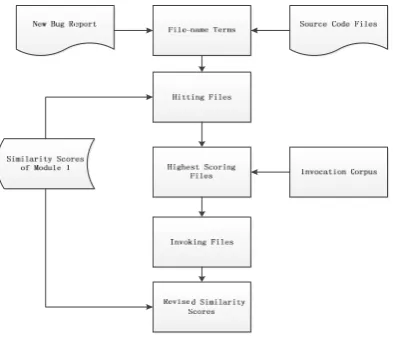
The textual information of a bug report has been processed already and may include one or more class-name terms. We define the source files corresponding to the class-name terms ashitting files, and the hitting file which ranks the highest on the initial ranking list produced bymodule 1ashf. We hypothesize that thehf has the highest possibility to be the defective source file. Figure 4 shows the detailed processing of the invoking method. First, we extract all class-name terms of a new bug report r and collect the hitting files corresponding to these terms. Next, we select the highest ranking source file hf of the hitting files. We then review the invocation corpus to find the invocation files. At last, the final score (F Scorer,inf) of the invoking fileinf inModule 2 is calibrated as follows:
Fig. 4: The Detail of Module 2: Invoking Method
whereSimr,hf is the similarity score between the highest scored filehfof thehitting file and the bug reportr, andSimr,inf is the similarity score between the fileinf invoked by hf and the bug report r. a is the parameter of the formula which is different in various projects to further adjust the weight ofSimr,inf.
The most important part ofmodule 2 is the invocation corpus which is automa-tically produced in advance by programs based on API ofCall Hierarchy in Eclipse. The structure of the invocation corpus of a project is similar to that of its source code. In order to find the invocation files ofhf, we need to locate the class folder by utilizing the package name of thehf. There is a list of method folders under the class folder and there are two main folders in these method folders, namely callers and callees which consist of the invocation information ofhf. Then, by reading the files of these two folders and extracting the invocation information, we can collect the invocation files of hf. The invocation corpus is calculated once and stored as a repository for future use. Module 2 of our approach aims to improve the perfor-mance for bug localization by adjusting the similarity scores of invoking files. This invocation method can be combined with most IR-based bug localization appro-aches, including BugLocator. Of course, the coefficients combining the invocation method and the other two original parts of BugLocator should be updated.
3.3. Adaptive Strategy
Table 1: The Details of Dataset
Projects #Bugs #Source Files Period
AspectJ 286 6485 07/2002-10/2006
Eclipse 3.1 3075 12863 10/2004-03/2011
SWT 3.1 98 484 10/2004-04/2010
ZXing 20 391 03/2010-09/2010
Birt 4166 9765 06/2005-12/2013
Tomcat 851 2174 07/2002-01/2014
performance ofTop N (N = 5, 10)must be considered and we find that keeping all of the essential elements of the source files except annotation is better.
On top of that, we propose an adaptive approach which can maximize the per-formance of bug localization recommendation. Our adaptive strategy is based on the analysis of properties in source code files and bug reports, which is implemented by a parameteropt set by developers. The parameter controls both the element fil-tering of source code files and the output of the overall approach shown in Figure 2. Whenopt is set to betrue, it means developers want a decisive file to the bug, and other elements of source files except for class names and method names must be removed before text preprocessing. The output of our recommendation is then a single file. Otherwise, it means that a list ofN (N = 5, 10)files would be provided. The output of the our recommendation is thenN candidate files accordingly.
4. Experiments
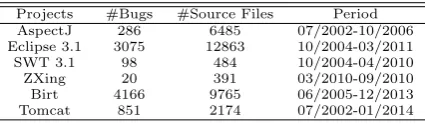
To evaluate our approach, we conduct an empirical study and use the same four cases as in [37], i.e., AspectJ, Eclipse, SWT and ZXing. To demonstrate an even broader applicability, we also include another two cases, i.e., Birt and Tomcat. The information of the dataset is given below in Table 1. We compare our approach with the rVSM model of BugLocator (α = 0). BugLocator is an IR-based bug localization approach proposed in [37], it consists of two main parts, i.e., ranking based on source code files and ranking based on similar bugs. The parameter α is the coefficient combining the scores obtained from querying source code files (rVSMScore) and from similar bug analysis (SimiScore). Namely, when αis set to be 0, BugLocator ranks based on rVSMScore solely.
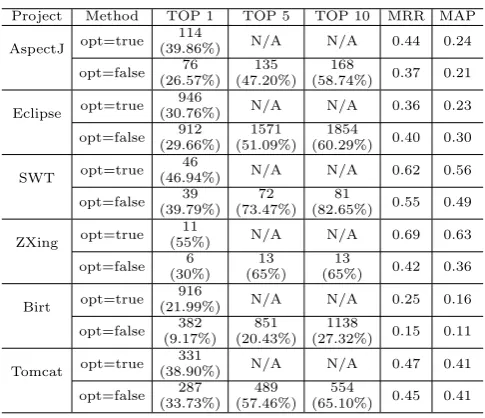
Table 2: The Performance of Our Approach
Project Method TOP 1 TOP 5 TOP 10 MRR MAP
AspectJ opt=true 114
(39.86%) N/A N/A 0.44 0.24 opt=false 76
(26.57%) 135 (47.20%)
168
(58.74%) 0.37 0.21
Eclipse opt=true 946
(30.76%) N/A N/A 0.36 0.23
opt=false (29.66%)912 (51.09%)1571 (60.29%)1854 0.40 0.30
SWT opt=true 46
(46.94%) N/A N/A 0.62 0.56 opt=false 39
(39.79%) 72 (73.47%)
81
(82.65%) 0.55 0.49
ZXing opt=true 11
(55%) N/A N/A 0.69 0.63
opt=false 6 (30%)
13 (65%)
13
(65%) 0.42 0.36
Birt opt=true 916
(21.99%) N/A N/A 0.25 0.16 opt=false 382
(9.17%) 851 (20.43%)
1138
(27.32%) 0.15 0.11
Tomcat opt=true 331
(38.90%) N/A N/A 0.47 0.41 opt=false 287
(33.73%) 489 (57.46%)
554
(65.10%) 0.45 0.41
Eclipse bugs (51.09%), 72 SWT bugs (73.47%), 13 ZXing bugs (65%), 851 Birt bugs (20.43%) and 489 Tomcat bugs (57.46%) whose fixed files are at theTop5 and 168 AspecJ bugs (58.74%), 1854 Eclipse bugs (60.29%), 81 SWT bugs (82.65%), 13 ZXing bugs (65%), 1138 Birt bugs (27.32%) and 554 Tomcat bugs (65.10%) whose fixed files are at theTop10. Besides, the results ofMRRandMAPwhenoptistrue are better than the ones whenopt isf alsein all of the cases but Eclipse, because the result ofTop 1 contributes more to the performance of MRR and MAP than the results ofTop 5 andTop10, while in Eclipse the difference between theTop 1 recommendation is very marginal.
Method 1 defines the process of locating the bugs in our approach when opt’s value is true and Method 2 represents another process of locating the bugs when
opt’s value is false.Method 1 takes advantage of the localized bug reports and filters out more noisy data, contributing more to the accuracy ofTop 1 recommendation. From the results of Top 1 for the six projects with the two methods, we have observed that the results ofTop 1 withMethod 1 are better than the results ofTop 1 with Method 2 for all of the six projects which confirms the above idea. With the increasing scale of bug reports, the localized bug reports also get increased and play a dominant role in bug localization leading to the better performance of Top 1.
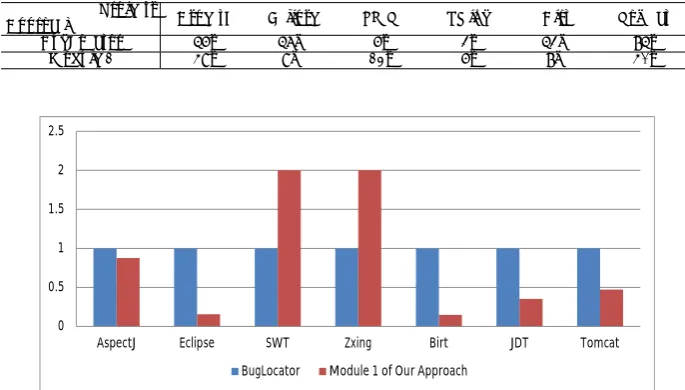
Table 3: The Execution Time of BugLocator (α= 0) and Module 1 of Our Approach (m: minute; s: second)
````
````
Approach
Projects
AspectJ Eclipse SWT ZXing Birt Tomcat
BugLocator 56s 57m 6s 3s 53m 85s
Module 1 49s 9m 12s 6s 8m 40s
0 0.5 1 1.5 2 2.5
AspectJ Eclipse SWT Zxing Birt JDT Tomcat
BugLocator Module 1 of Our Approach
Fig. 5: The Trend of Execution time for The Two Approaches of Comparison
for AspectJ, Eclipse, SWT, ZXing, Birt and Tomcat is 56 seconds, 57 minutes, 6 seconds, 3 seconds and 85 seconds respectively. The execution time of the module 1 of our approach is 49 seconds, 9 minutes, 12 seconds, 6 seconds and 40 seconds respecitvely. Although the time cost of our approach for SWT and ZXing is higher compared to that of BugLocator, from Table 3, we can find the larger the project is, the better advantage our approach can achieve. Figure 5 pictorially illustrates the execution time comparison of the two approaches. Because the execution time of the six projects is not at the same level, we set the execution time of each project using BugLocator as the unit time 1 and represent the time cost of our approach as the proportion of the execution time of BugLocator. We can discover that the
module 1 relatively decreases the execution time and is more efficient. Moreover, the larger the source code and bug reports are, the more time-saving themodule 1
is.
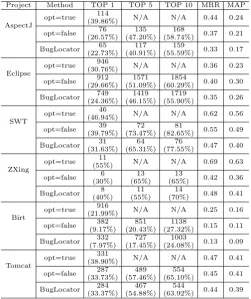
We have compared the performance of our approach to BugLocator without similar bugs because we try to emphasize the importance of part-of-speech and invocation relationship between source files and don’t combine the similar bugs. Table 4 compares the accuracy of our approach with BugLocator. As we can see, the performance of both methods of our approach is better than BugLocator without using similar bugs.
0.2 0.25 0.3 0.35 0.4 0.45 0.5 0.55 0.6
TOP 1 TOP 2 TOP 3 TOP 4 TOP 5 TOP 6 TOP 7 TOP 8 TOP 9 TOP 10
AspectJ-True AspectJ-False
(a) AspectJ
0.25 0.3 0.35 0.4 0.45 0.5 0.55 0.6 0.65
TOP 1 TOP 2 TOP 3 TOP 4 TOP 5 TOP 6 TOP 7 TOP 8 TOP 9 TOP 10
Eclipse-True Eclipse-False
(b) Eclipse
0.05 0.1 0.15 0.2 0.25 0.3
TOP 1 TOP 2 TOP 3 TOP 4 TOP 5 TOP 6 TOP 7 TOP 8 TOP 9 TOP 10
Birt-True Birt-False
(c) Birt
0.3 0.35 0.4 0.45 0.5 0.55 0.6 0.65 0.7
TOP 1 TOP 2 TOP 3 TOP 4 TOP 5 TOP 6 TOP 7 TOP 8 TOP 9 TOP 10
Tomcat-True Tomcat-False
[image:16.595.127.483.265.531.2](d) Tomcat
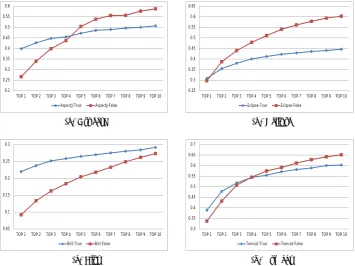
Fig. 6: The Performance Comparison of Method 1 and Method 2 in Four Cases.
Table 4: The Comparison of BugLocator(α= 0) and Our Approach
Project Method TOP 1 TOP 5 TOP 10 MRR MAP
AspectJ
opt=true 114
(39.86%) N/A N/A 0.44 0.24 opt=false 76
(26.57%) 135 (47.20%)
168
(58.74%) 0.37 0.21 BugLocator 65
(22.73%) 117 (40.91%)
159
(55.59%) 0.33 0.17
Eclipse
opt=true (30.76%)946 N/A N/A 0.36 0.23
opt=false 912 (29.66%)
1571 (51.09%)
1854
(60.29%) 0.40 0.30 BugLocator 749
(24.36%) 1419 (46.15%)
1719
(55.90%) 0.35 0.26
SWT
opt=true 46
(46.94%) N/A N/A 0.62 0.56 opt=false 39
(39.79%) 72 (73.47%)
81
(82.65%) 0.55 0.49 BugLocator (31.63%)31 (65.31%)64 (77.55%)76 0.47 0.40
ZXing
opt=true 11
(55%) N/A N/A 0.69 0.63
opt=false 6 (30%)
13 (65%)
13
(65%) 0.42 0.36 BugLocator 8
(40%) 11 (55%)
14
(70%) 0.48 0.41
Birt
opt=true (21.99%)916 N/A N/A 0.25 0.16
opt=false 382 (9.17%)
851 (20.43%)
1138
(27.32%) 0.15 0.11 BugLocator 332
(7.97%) 727 (17.45%)
1003
(24.08%) 0.13 0.09
Tomcat
opt=true 331
(38.90%) N/A N/A 0.47 0.41 opt=false 287
(33.73%) 489 (57.46%)
554
(65.10%) 0.45 0.41 BugLocator (33.37%)284 (54.88%)467 (63.92%)544 0.44 0.39
bugs.
Whenopt is set to befalse, our approach recommends n candidate files based on the ranking list of a bug report to the developers. More defect files ranked attop N (N=5,10)may give right inspiration to the developers for finding the location of buggy files. Our approach increases the precision of defect files intop N (N=5,10)
effectively. The performance enhancement is about 3.84% inTop 1, 6.29% inTop 5
and 3.15% inTop 10 for AspectJ, about 5.30% inTop 1, 4.94% inTop 5 and 4.39% inTop 10 for Eclipse, about 8.16% inTop 1, 8.16% inTop 5 and 5.10% inTop 10
for SWT, about 10% in Top 5 for ZXing, about 1.20% in Top 1, 2.98% in Top 5
and 3.24% inTop 10 for Birt and about 0.36% inTop 1, 2.58% inTop 5 and 1.18% inTop 10 for Tomcat. It is interesting to discover that our approach improve most inTop 5 on average.
AspectJ with 286 bug reports fromTop 1 toTop 10.AspectJ-TruemeansMethod 1
andAspectJ-False meansMethod 2. It is obvious that the performance ofMethod 1
increases sharply atTop 1 and then slows down. ForMethod 2, the results increase quickly fromTop 1 toTop 10 at almost the same speed and get better afterTop 5
thanMethod 1.
For the Eclipse project with 3075 bug reports, only the Top 1 of Method 1
is still better than the Top 1 of Method 2. The results of Method 1 from Top 2
to Top 10 are all worse than that of Method 2. The discovery above is shown in Figure 6(b). As we can see, only the Top 1 ofMethod 1 is better even though the scale of bug reports increase from 286 of AspectJ to 3075 of Eclipse. This is also the case for the Tomcat project, illustrated by Figure 6(d). However, Birt project exhibits different properties. From Figure 6(c), we can observe that the performance ofMethod 1 is continuously better thanMehtod 2, although the difference between them is decreasing. The fact indicates a converging trend of the two methods. The general suggestion is that, if developers want a recommended file, with our approach they can make use ofMethod 1. If they wantN (N=5,10)recommended files instead, they should make use ofMethod 2.
5. Threats to Validity
In this section, we discuss the possible threats to the validity in our approach, mainly the concerns of data validity and invocation validity.
(1) Data Validity. The experimental dataset we used are all programmed by Java and the keywords of bug reports are mainly class names or method names which make the VSM model more effective than other IR-based models. The performance oftop 1 gets better when we only reserve class names and method names in source code and the results oftop 5, top 10 decrease at this situation and we can get the rule that class names and method names contribute to the results oftop 1. But we just used the dataset of Zhou et al [37] and two others to assure the fair comparison. Thus, whether or not this heuristic fits all of the Java projects still requires further studied to confirm.
6. Related Work
Software debugging is time-consuming but also crucial in software life cycles. Soft-ware defect localization becomes one of the most difficult tasks in the debugging activity [31]. Therefore, automatic defect localization techniques that can guide programmers are much-needed. Dynamical bug localization approaches can help developers find defects based on spectrum [2]. A commonly-used method of these approaches is to produce many sets of successful runs and failed runs for computing suspiciousness of program elements via program slicing. The granularity of suspici-ousness elements can be a method or a statement. Although the dynamic approach can locate the defect to a statement, the generation of test cases and its selection are also complex [3].
Many researchers have tried to use static information of bugs and source code for coarse-grained localization [18]. They proposed some IR-based approaches com-bining with some useful attributes of software artifacts and defined the suspicious buggy files depending on the similarity scores between bug reports and source files. Usually, IR-based models are used to represent the textual information of the bug report and source code, such as Latent Sematic Indexing (LSI), Latent Dirichlet Allocation (LDA) and Vector Space Model (SVM), which is feasible for numerical calculation [11,22,28]. But these works did not consider the POS features of the underlying reports. Gupta et.al [9] attempted to use the POS tagger to help under-stand the regular, systematic ways a program element is named, but they did not apply the technique to the field of bug localization.
Apart from the efforts in defect localization, there is another thread of relevant work on the bug report classification [36]. Before applying the bug localization techniques, it must be confirmed that the selected bug reports describe the real bugs and then their fixed files are extracted for evaluation, which may save much time and reduce potential noise [15]. A lot of research has been conducted for reducing the noise in bug reports [13]. They used the text of the bug reports and predicted the bug reports to be bug or non-bug with many techniques [7]. Zhou et al. proposed a hybrid approach by combining both text mining and data mining techniques to automate the prediction process [38].
Our approach leverages nature language processing techniques adjusting the weight of terms depending on their part-of-speech, and takes advantage of heuristics in bug reports to balance the importance of summary and description. Kochhar et al. discovered that the existence of class names in summary or description of bug reports makes contributions to bug localization, which inspires us to proposeMethod 1 of our adaptive approach [15].
7. Conclusion and Future Work
In software life cycles, maintenance is the most time-consuming and highly cost phase. An in-time bug fixing is of crucial importance. To mitigate the work of soft-ware developers, in this paper, we propose an adaptive approach to recommending potential defective source files given a certain bug report. We take advantages of POS tagging techniques and the logical invocation relationship between source files and present an automatic weighting method to further improve the performance. As far as we know, this is the first work considering the underlying POS features in bug reports for bug localization. The evaluation results on six large open-source pro-jects demonstrate the feasibility of our adaptive approach and also indicate better performance compared to the baseline work, i.e., BugLocator.
In the future, we plan to integrate more features of program to our approach, such as similar bugs, version history and dynamic information. The aim is to propose a more adaptive approach for more complex user demands. More technically, the
module 2 of the our approach will be refined to decrease the number of noisy files, which may produce further enhancement. Moreover, our approach will be expanded to utilize other kinds of dataset, such as bug reports of commercial projects and unresolved bug reports, to demonstrate a broader applicability.
Acknowledgments
The work was partially funded by the Natural Science Foundation of Jiangsu Pro-vince under grant No. BK20151476, the National Basic Research Program of China (973 Program) under grant No.2014CB744903, the National High-Tech Research and Development Program of China (863 Program) under grant No.2015AA015303, the Collaborative Innovation Center of Novel Software Technology and Industria-lization, and the Fundamental Research Funds for the Central Universities under grant No.NS2016093. Taolue Chen is partially supported by the ARC Discovery Project (DP160101652), the Singapore Ministry of Education AcRF Tier 2 grant (MOE2015-T2-1-137), and an oversea grant from the State Key Laboratory of Novel Software Technology, Nanjing Unviersity.
References
[2] Abreu, R., Zoeteweij, P., Van Gemund, A.J.: Spectrum-based multiple fault localiza-tion. In: Automated Software Engineering, 2009. ASE’09. 24th IEEE/ACM Interna-tional Conference on, pp. 88–99. IEEE (2009)
[3] Bandyopadhyay, A.: Improving spectrum-based fault localization using proximity-based weighting of test cases. In: Automated Software Engineering (ASE), 2011 26th IEEE/ACM International Conference on, pp. 660–664. IEEE (2011)
[4] Brants, T.: Tnt: a statistical part-of-speech tagger. In: Proceedings of the sixth con-ference on Applied natural language processing, pp. 224–231. Association for Com-putational Linguistics (2000)
[5] Capobianco, G., Lucia, A.D., Oliveto, R., Panichella, A., Panichella, S.: Improving ir-based traceability recovery via noun-based indexing of software artifacts. Journal of Software: Evolution and Process25(7), 743–762 (2013)
[6] Croft, W.B., Metzler, D., Strohman, T.: Search engines: Information retrieval in practice. Addison-Wesley Reading (2010)
[7] ˇCubrani´c, D.: Automatic bug triage using text categorization. In: In SEKE 2004: Proceedings of the Sixteenth International Conference on Software Engineering & Knowledge Engineering. Citeseer (2004)
[8] Gomaa, W.H., Fahmy, A.A.: A survey of text similarity approaches. International Journal of Computer Applications68(13), 13–18 (2013)
[9] Gupta, S., Malik, S., Pollock, L., Vijay-Shanker, K.: Part-of-speech tagging of pro-gram identifiers for improved text-based software engineering tools. In: Propro-gram Com-prehension (ICPC), 2013 IEEE 21st International Conference on, pp. 3–12. IEEE (2013)
[10] Hasan, F.M., UzZaman, N., Khan, M.: Comparison of different pos tagging techniques (n-gram, hmm and brills tagger) for bangla. In: Advances and Innovations in Systems, Computing Sciences and Software Engineering, pp. 121–126. Springer (2007) [11] Islam, A., Inkpen, D.: Semantic text similarity using corpus-based word similarity
and string similarity. ACM Transactions on Knowledge Discovery from Data (TKDD) 2(2), 10 (2008)
[12] J.Asmussen, D.: Survey of pos taggers-approaches to making words tell who they are. DK-CLARIN WP 2.1 Technical Report (2015)
[13] Kim, S., Zhang, H., Wu, R., Gong, L.: Dealing with noise in defect prediction. In: Software Engineering (ICSE), 2011 33rd International Conference on, pp. 481–490. IEEE (2011)
[14] Ko, A.J., Myers, B.A., Chau, D.H.: A linguistic analysis of how people describe soft-ware problems. In: Visual Languages and Human-Centric Computing, 2006. VL/HCC 2006. IEEE Symposium on, pp. 127–134. IEEE (2006)
[15] Kochhar, P.S., Tian, Y., Lo, D.: Potential biases in bug localization: Do they mat-ter? In: Proceedings of the 29th ACM/IEEE international conference on Automated software engineering, pp. 803–814. ACM (2014)
[16] LaToza, T.D., Myers, B., et al.: Visualizing call graphs. In: Visual Languages and Human-Centric Computing (VL/HCC), 2011 IEEE Symposium on, pp. 117–124. IEEE (2011)
[17] Le, T.D.B., Thung, F., Lo, D.: Predicting effectiveness of ir-based bug localization techniques. In: Software Reliability Engineering (ISSRE), 2014 IEEE 25th Internati-onal Symposium on, pp. 335–345. IEEE (2014)
[18] Lukins, S.K., Kraft, N., Etzkorn, L.H., et al.: Source code retrieval for bug localiza-tion using latent dirichlet allocalocaliza-tion. In: Reverse Engineering, 2008. WCRE’08. 15th Working Conference on, pp. 155–164. IEEE (2008)
retrie-val, vol. 1. Cambridge university press Cambridge (2008)
[20] Murphy, G.C., Kersten, M., Findlater, L.: How are java software developers using the elipse ide? Software, IEEE23(4), 76–83 (2006)
[21] Ostrand, T.J., Weyuker, E.J., Bell, R.M.: Predicting the location and number of faults in large software systems. Software Engineering, IEEE Transactions on31(4), 340–355 (2005)
[22] Rao, S., Kak, A.: Retrieval from software libraries for bug localization: a comparative study of generic and composite text models. In: Proceedings of the 8th Working Conference on Mining Software Repositories, pp. 43–52. ACM (2011)
[23] Saha, R.K., Lease, M., Khurshid, S., Perry, D.E.: Improving bug localization using structured information retrieval. In: Automated Software Engineering (ASE), 2013 IEEE/ACM 28th International Conference on, pp. 345–355. IEEE (2013)
[24] Shokripour, R., Anvik, J., Kasirun, Z.M., Zamani, S.: Why so complicated? simple term filtering and weighting for location-based bug report assignment recommenda-tion. In: Proceedings of the 10th Working Conference on Mining Software Reposito-ries, pp. 2–11. IEEE Press (2013)
[25] Sisman, B., Kak, A.C.: Incorporating version histories in information retrieval based bug localization. In: Proceedings of the 9th IEEE Working Conference on Mining Software Repositories, pp. 50–59. IEEE Press (2012)
[26] Tian, Y., Lo, D.: A comparative study on the effectiveness of part-of-speech tag-ging techniques on bug reports. In: Software Analysis, Evolution and Reengineering (SANER), 2015 IEEE 22nd International Conference on, pp. 570–574. IEEE (2015) [27] Tong, Y., Zhou, Y., Fang, L., Chen, T.: Towards a novel approach for defect
loca-lization based on part-of-speech and invocation. In: Internetware, 2015 the Seventh International Symposium on. ACM (2015)
[28] Wang, Q., Parnin, C., Orso, A.: Evaluating the usefulness of ir-based fault localization techniques. In: Proceedings of the 2015 International Symposium on Software Testing and Analysis, pp. 1–11. ACM (2015)
[29] Wang, S., Lo, D.: Version history, similar report, and structure: Putting them together for improved bug localization. In: Proceedings of the 22nd International Conference on Program Comprehension, pp. 53–63. ACM (2014)
[30] Wang, X., Zhang, L., Xie, T., Anvik, J., Sun, J.: An approach to detecting duplicate bug reports using natural language and execution information. In: Proceedings of the 30th international conference on Software engineering, pp. 461–470. ACM (2008) [31] Wen, W.: Software fault localization based on program slicing spectrum. In:
Procee-dings of the 34th International Conference on Software Engineering, pp. 1511–1514. IEEE Press (2012)
[32] Wong, C.P., Xiong, Y., Zhang, H., Hao, D., Zhang, L., Mei, H.: Boosting bug-report-oriented fault localization with segmentation and stack-trace analysis. In: Software Maintenance and Evolution (ICSME), 2014 IEEE International Conference on, pp. 181–190. IEEE (2014)
[33] Wong, W.E., Debroy, V.: A survey of software fault localization. Department of Com-puter Science, University of Texas at Dallas, Tech. Rep. UTDCS-459(2009) [34] Ye, X., Bunescu, R., Liu, C.: Learning to rank relevant files for bug reports using
domain knowledge. In: Proceedings of the 22nd ACM SIGSOFT International Sym-posium on Foundations of Software Engineering, pp. 689–699. ACM (2014)
[35] Zhang, H.: An investigation of the relationships between lines of code and defects. In: Software Maintenance, 2009. ICSM 2009. IEEE International Conference on, pp. 274–283. IEEE (2009)
analysis. Science China Information Sciences58(2), 1–24 (2015)
[37] Zhou, J., Zhang, H., Lo, D.: Where should the bugs be fixed? more accurate informa-tion retrieval-based bug localizainforma-tion based on bug reports. In: Software Engineering (ICSE), 2012 34th International Conference on, pp. 14–24. IEEE (2012)