Brookman-Byrne, Annie and Mareschal, Denis and Tolmie, A.K. and
Dumontheil, Iroise (2018) Inhibitory control and counterintuitive science and
maths reasoning in adolescence. PLoS One , ISSN 1932-6203. (In Press)
Downloaded from:
Usage Guidelines:
Please refer to usage guidelines at or alternatively
Inhibitory control and counterintuitive science and maths reasoning in
adolescence
Annie Brookman-Byrne1,2, Denis Mareschal1,2, Andrew K. Tolmie2,3, Iroise Dumontheil1,2*
1 Centre for Brain and Cognitive Development, Department of Psychological Sciences,
Birkbeck, University of London, London, UK
2 Centre for Educational Neuroscience, University of London, London, UK
3 Department of Psychology and Human Development, UCL Institute of Education,
University College London, London, UK
* Corresponding author
Abstract
Existing concepts can be a major barrier to learning new counterintuitive concepts
that contradict pre-existing experience-based beliefs or misleading perceptual cues. When
reasoning about counterintuitive concepts, inhibitory control is thought to enable the
suppression of incorrect concepts. This study investigated the association between inhibitory
control and counterintuitive science and maths reasoning in adolescents (N=90, 11-15 years).
Both response and semantic inhibition were associated with counterintuitive science and
maths reasoning, when controlling for age, general cognitive ability, and performance in
control science and maths trials. Better response inhibition was associated with longer
reaction times in counterintuitive trials, while better semantic inhibition was associated with
higher accuracy in counterintuitive trials. This novel finding suggests that different aspects of
inhibitory control may offer unique contributions to counterintuitive reasoning during
adolescence and provides further support for the hypothesis that inhibitory control plays a
role in science and maths reasoning.
Introduction
The acquisition of abstract concepts reflecting an understanding of how elements in
the world relate to one another underpins school-based learning of science and maths [1].
These abstract concepts go beyond what is immediately perceptually available, and
sometimes go against prior experience, beliefs or perceptual evidence. Learning new
concepts is therefore constrained by pupils’ ability to overcome conflicting information.
Conceptual change, the process of acquiring a new explanatory framework for a certain
phenomenon, has been argued to be a key challenge faced by science educators [2], requiring
[3]. Similarly, in maths, when learning and applying new concepts, pupils can be misled by
prior beliefs, generalisation of previous learning (e.g. in the case where for integers 5 > 2
while for fractions 1/5 < 1/2) [4] or perceptual evidence (e.g. when a larger surface area may
not be associated with a larger perimeter, see Fig 1b) [5-7]. While students used to be thought
to learn new concepts through the replacement, reorganisation, or restructuring of previously
held concepts [3,8], newer research suggests that prior beliefs remain in the face of new
evidence and can lead to science and maths misconceptions that are notoriously resistant to
change, persisting throughout school education and well into adulthood [1,6,9,10]. For
example, a study with adults educated in science found that accuracy was lower and response
times longer in statements where naïve and scientific theories were inconsistent (i.e.
counterintuitive), compared to statements consistent across naïve and scientific theories (i.e.
intuitive) [11]. This is evidence of an ongoing requirement to suppress intuitive responses
even when the correct answer has been learnt.
Inhibitory control, the ability to suppress a prepotent response or irrelevant
information, is thought to allow the suppression of naïve theories, incorrect strategies, or
misleading perceptual cues during counterintuitive reasoning in science and maths [1,12-17].
A better understanding of the learning of science and maths is particularly important, as these
disciplines are of enormous economic impact, are compulsory subjects in primary and
secondary school, and are considered particularly difficult subjects to learn [18,19].
Most previous research exploring the cognitive processes behind science and maths
misconceptions has been performed on children [12,16,19-21] or adults [13,14,17]. The
current study investigated the role of inhibitory control in counterintuitive reasoning, i.e.
reasoning about concepts where a misconception may be held, during adolescence, a period
when inhibitory control continues to develop [22] and individuals learn increasingly
Inhibitory control has been classified in various ways. Nigg [25], for example,
outlined eight kinds of inhibition, while others tend to group inhibitory control into two
categories [26]. Behavioural, or response inhibition, is the suppression of a motor response,
whereas interference control, or semantic inhibition, is the suppression of meaning in the face
of conflict. In a simple Go/No-Go response inhibition task, rapid frequent responses are made
to Go stimuli, with infrequent non-responses to No-Go stimuli [27]. Errors of commission
occur when the dominant Go response has not been successfully inhibited in a No-Go trial. In
a complex version, No-Go events are determined by both the current and previous trial [27].
As the complex Go/No-Go requires participants to keep the current and previous trial in mind
to perform accurately, it provides a measure of inhibitory control in the context of a cognitive
load. In a Stroop semantic inhibition task, conflicting information is presented simultaneously
and the less salient aspect of the stimulus is responded to while the dominant aspect is
inhibited [28]. The Stroop therefore requires the suppression of one type of meaning
alongside the processing of another. Performance on the simple Go/No-Go [29,30], complex
Go/No-Go [29], and Stroop [22,31] tends to improve through adolescence. Attempts to
establish the extent of overlap between response and semantic inhibition have yielded mixed
results [32,33], indicating that measures of inhibition are influenced by different underlying
mechanisms [34], but are not totally independent [26]. With this in mind, the current study
measured both response and semantic inhibition, in order to establish the individual roles that
each might play in counterintuitive reasoning.
The link between science and maths reasoning in general, or counterintuitive
reasoning specifically, and inhibitory control has been examined across development using
correlational, priming, and neuroimaging studies. Evidence from correlational studies
suggests that children with better inhibitory control perform better on science problems
experimenter drop a ball down one of three opaque tubes that crossed over [35]. Three- and
four-year-olds were asked to point to the opaque container where the ball landed. The most
common error was to choose the container directly beneath the opening of the tube,
suggesting that the toddlers’ gravity theory (that the ball would fall in a straight trajectory)
was not successfully inhibited in favour of an object solidity theory (that the ball would
follow the solid tube). Since looking time paradigms reveal an understanding of object
solidity at this age [36], the authors argued that the task engaged a number of strategies, and
that selection of the correct strategy depended on the inhibition of incorrect strategies. This
interpretation was further supported by a positive correlation between tubes task performance
and inhibitory control as measured by a gift delay task [35]. In biology, mature biological
understandings of life, death, and bodily functions were predicted in five- to seven-year-olds
by an aggregate measure of executive function that reflected performance on tasks requiring a
combination of shifting, working memory, and either response inhibition or semantic
inhibition [19]. Although the executive function measure was not purely inhibitory control,
the authors suggested that inhibitory control is one skill that enabled the suppression of naïve
biological theories when a mature conceptual understanding was shown. The picture is,
however, inconsistent, as inhibitory control was not related to science performance in other
studies in 11-year-olds [37] or 12- to 13-year-olds [38,39].
In the domain of maths, overlapping strategy use in problem solving is a particular
demonstration of the maintenance of multiple concepts and theories over the course of
learning, rather than the replacement of old concepts by new concepts. An examination of
strategy use in four- and five-year-olds solving maths sums found that even when new, more
sophisticated strategies had been learnt, children continued to use old strategies [40,41]. The
concurrent existence of multiple strategies suggests that inhibitory control is likely to be
alternatives. When inhibitory control was measured directly through a Stroop task,
performance in three- to six-year-olds was associated with scores on a standardised maths test
in one experiment, and with magnitude comparison in another [21]. Similarly, a study of 11-
to 14-year-olds found that maths achievement was correlated with both numerical and
non-numerical semantic inhibitory control [20]. A further maths study investigated inhibitory
control in 14-year-olds who were instructed to use a new strategy for solving algebra word
problems [42]. Better response and semantic inhibitory control predicted higher accuracy as
well as fewer intrusions of the previous strategy [42], indicating that inhibitory control
suppressed the previous strategy in effective maths reasoning. As with science, inhibitory
control does not always relate to school performance, as evidenced by one study where 5- to
6-year-olds’ inhibition did not predict maths achievement [43]. A meta-analysis showed a
modest overall association between inhibitory control and maths in young children [44].
These studies investigated overall associations between inhibitory control and general maths
performance, but did not specifically focus on counterintuitive reasoning.
A few studies have used priming to probe the role of inhibitory control in
counterintuitive maths reasoning. Nine-year-olds performed better on a counterintuitive
number conservation trial if they were primed to inhibit through the successful inhibition of
an incongruent Stroop trial [45]. Ten-year-olds performed better on a number conservation or
class inclusion task when primed by a trial from the other task requiring the inhibition of a
misleading strategy [12]. In a further study spanning three age groups, children (~ 12 years
old), adolescents (~ 15 years old) and adults showed slower response times when a probe
problem with congruent relational term and arithmetic operation (“more than” > addition)
followed a prime problem with incongruent relational term and arithmetic operation (“more
solving these arithmetic counterintuitive problems required the inhibition of an incorrect
strategy [16].
Neuroimaging work on logical and scientific reasoning in adults has consistently
shown that the inhibition of pre-existing beliefs, misleading perceptual-biases, and intuitive
heuristics during counterintuitive reasoning is associated with the activation of the anterior
cingulate cortex and the prefrontal cortex, notably the inferior frontal cortex and dorsolateral
prefrontal cortex, thought to reflect the recruitment of greater cognitive control for
counterintutive vs. intuitive reasoning [12,14,17,46-49]. Further consistent evidence comes
from Houdé and colleagues [50], who attempted to shift adult’s responses from a perceptual
bias to logical reasoning in a rule falsification task and showed that this shift was associated
with increased recruitment of prefrontal, versus posterior, brain regions, which was
interpreted as reflecting their inhibition of a misleading strategy.
The research summarised above suggests that naïve theories, prior knowledge, and
misleading perceptual cues are inhibited during successful science and maths reasoning.
Adolescents are faced with increasingly complex, and sometimes counterintuitive, science
and maths concepts through compulsory school curricula, while their inhibitory control
abilities are still developing. The current study aimed to investigate the association between
inhibitory control and counterintuitive science and maths reasoning in 11- to 15-year-olds.
A novel science and maths misconceptions task was designed to measure adolescents’
ability to give the correct (although counterintuitive) answer when faced with problems
known to be associated with misconceptions. Only misconceptions relevant to the curriculum
for 11- to 14-year-olds (Key Stage 3 for England) were included, based on consultation with
curricula [23,24] and student study guides [51,52] to ensure validity. While previous studies
focused on just one or two misconceptions [13,17,49], the aim here was to cover a wide range
problems that did not require counterintuitive reasoning (but were related to the
counterintuitive concepts) were also included, to account for discipline-specific factors such
as knowledge and interest in science and maths, however our predictions and analyses
focused on the importance of inhibitory control for counterintuitive reasoning specifically,
rather than for science and maths achievement in general (e.g. [20]). The youngest
participants were at the start of the Key Stage 3 curriculum in England (and the start of
secondary school), and the oldest had completed the Key Stage 3 curriculum, allowing the
inclusion of the same problems for all participants.
Both response and semantic inhibition were measured to investigate the possible
unique influence of these aspects of inhibitory control. Response inhibition was measured
using a simple and complex Go/No-Go adapted from Watanabe et al. [53], to investigate the
possibility that response inhibition in the context of higher cognitive load, namely a 1-back
working memory load, would be more associated with complex science and maths reasoning,
where information may need to be maintained and manipulated while the answer is worked
out, compared to inhibitory control within a simpler task. Previous research has shown that
simple and complex Go/No-Go tasks are associated with different brain networks [27].
Semantic inhibition was measured with a numerical Stroop adapted from Khng and Lee [34].
It was hypothesised that better semantic inhibitory control, evidenced by less
interference effect on accuracy and reaction time (RT) in the numerical Stroop task, would
allow participants to better solve the conflict between their naïve belief or misleading
perceptual information and the correct answer, and that they would therefore show more
accurate and faster responses on the science and maths misconception problems, relative to
non-counterintuitive control problems. It was also hypothesised that better response
inhibition, evidenced by higher accuracy in simple and complex No-Go trials, would also be
responses. As science and maths problem solving typically requires the maintenance of some
information in working memory, and as misconceptions in particular may elicit competition
between, and comparison of, intuitive and counterintuitive responses, it was finally
hypothesised that performance in complex No-Go trials would show a greater association
with science and maths misconception performance than performance in simple No-Go trials.
Methods
This project received approval from the Department of Psychological Sciences Ethics
Committee, Birkbeck College University of London [reference approval number: 141552].
Participants
Ninety pupils with no neurological or developmental disorders, from an English
secondary school where most students are from minority ethnic heritages, and the proportion
of free school meals (determined by parental income-related benefits) is well above average,
took part (Table 1). Letters were sent to parents of 11- to 15-year-olds (in Years 7 to 10),
inviting their children to take part. Written informed parental consent was obtained, where
parents confirmed that their children had no neurological or developmental disorders.
Participants aged 11 or 12 years verbally consented, while 13- to 15-year-olds provided
written consent, in accordance with the guidelines of the local ethics committee, which
Table 1. Participant Characteristics.
WASI Vocabulary WASI Matrix Reasoning
Age (years)
Girls:
Boys Raw scores
Standardised
scores Raw scores
Standardised scores Age
group n M (SD) Range n M (SD) M (SD) M (SD) M (SD)
12y 25 12.14 (0.30) 11.75 – 12.67 13:12 33.01 (3.51) 105.82 (8.63) 19.00 (3.46) 103.54 (13.28) 13y 25 13.26 (0.31) 12.75 – 13.75 17:8 33.12 (3.69) 102.16 (9.87) 18.12 (3.14) 97.45 (10.41) 14y 21 14.32 (0.29) 13.92 – 14.75 9:12 33.71 (5.02) 100.65 (12.08) 19.67 (2.92) 101.22 (11.14) 15y 19 15.21 (0.35) 14.75 – 15.75 12:7 35.26 (3.21) 101.43 (7.94) 18.32 (4.06) 95.19 (13.27)
Age groups did not differ in raw Vocabulary scores, p = .238, raw Matrix Reasoning scores,
p = .423, or gender distribution, p = .332.
Tasks
Science and maths misconceptions
The science and maths misconceptions task was administered on a laptop. On each
trial, participants read a statement relating to science or maths, and pressed one of two keys to
indicate whether they thought the statement was correct or incorrect. There were 48
problem-sets, each addressing one curriculum-related misconception where the intuitive response is
incorrect, based on research findings (e.g. [6,7,54]).
Each problem-set contained four problems (Fig 1). A Misconception-False problem
presented a false statement based on a counterintuitive concept, while a Misconception-True
problem presented a true statement based on the same counterintuitive concept. All
misconception problems required counterintuitive reasoning; the intuitive response was
incorrect. Varying the nature of the statements was necessary to counterbalance left/right
answers across the experiment: Including Misconception-False problems only would have led
to the correct answer being “Incorrect” on all trials. Note that it was expected that accuracy
and RT might be influenced by true or false statement type, since it might be easier to give a
Fig 1.Example Problem-Sets for (a) Science and (b) Maths. Text and image size has been
increased to enhance legibility. Correct and incorrect ‘buttons’ remained on the screen to
remind participants which key to press.
Knowledge and interest in the topic and task-general factors such as processing speed
and attention, were controlled for with problems where no misconception was expected
(Control-False, Control-True) (Fig 1). Efforts were made to ensure that misconception and control problems were matched on statement length, positive versus negative wording, and
terminology. It was anticipated that RTs would be faster and accuracy higher in control trials
(where counterintuitive reasoning is not required) compared to misconception trials.
Fig 1 presents two examples of problem-sets. The science problem-set (Fig 1a) refers
to the misconception that heavy objects fall faster than lighter objects. To correctly solve the
Misconception problems, participants need to inhibit their naïve belief that the weight of
objects matters in this situation. The Control problems also refer to the fall of objects, but in
this case the concept is that objects fall to the ground if they are not supported. As this is not
a misconception participants do not have to inhibit a prior belief. The maths problem-set (Fig
1b) refers to the misconception that a shape with a larger area will also have a larger
[image:12.595.78.519.78.254.2]perception of the larger area of the purple figure compared to the orange figure, which is
misleading and irrelevant, and instead focus on assessing the perimeter of the two shapes.
The Control problems also ask about perimeters but in this case the area and perimeters of the shapes are consistent, therefore there is no misleading perceptual information to inhibit to
obtain the correct answer. It was expected that participants with better inhibitory control
would be able to answer Misconception problems more quickly (as the incorrect belief or
irrelevant perceptual information is more quickly inhibited) and accurately (as the correct
belief or correct perceptual information is eventually selected) than those with poorer
inhibitory control, who might answer intuitively, or take longer to inhibit the incorrect belief
or irrelevant perceptual information.
Twenty-six problem-sets were science-based. Biology topics included living
organisms, cells, inheritance, genetics, and plants (8 problem-sets). Chemistry topics included
pollution, atoms, pure and impure substances, heating, and melting (7 problem-sets). Physics
topics included force, the solar system, electricity, gravity, waves, and temperature (11
problem-sets). Maths topics included fractions, decimals, angles, algebra, shape,
transformations, statistics, probability, and graphs (22 problem-sets). One hundred and
twenty-six problems were accompanied by images (biology: 28/32; chemistry: 18/28;
physics: 36/44; maths: 44/88) that were sometimes essential for the problem, sometimes
provided further explanation, and sometimes simply relevant to keep the task engaging. In all
cases the Misconception-True/False and Control-True/False problems were matched as well
as possible in terms of text and images presented, ensuring all participants saw similar stimuli
across conditions, and allowing the comparison of participants’ performance across
conditions. See S1 Fig for more example problem-sets.
Two sequences of 96 trials were created by distributing problems such that each
further sequences were created by reversing the presentation order of the original sequences.
Each participant thus completed 24 of each of the four problem-set types (
Misconception-False, Misconception-True, Control-Misconception-False, Control-True). Participants were assigned to a sequence pseudo-randomly, ensuring each age group contained the range of sequences.
Stimuli remained on the screen until a response was made, and the task lasted 11 min on
average including self-timed breaks every 24 trials. Accuracy and RT were recorded.
Inhibitory control
Simple and complex versions of a Go/No-Go task, measuring response inhibition, and
a numerical Stroop task, measuring semantic inhibition, were administered on a laptop (Fig
Fig 2. Example Time Course of Events in the Inhibitory Control Tasks. (a) In the simple
Go/No-Go, participants pressed the left or right key to indicate the location of the green
square (Go trials), but withheld their response when the square was red (No-Go trials). (b) In
the complex Go/No-Go, participants pressed the left or right key to indicate the location of
the coloured square (Go trials), but withheld their response when a blue square followed a
yellow square (No-Go trials). In both tasks 25% of trials were No-Go, as in previous studies
(e.g. [29]), so that non-responses were infrequent and thus harder to inhibit, and the
inter-stimulus interval was jittered between 600 and 800 ms. (c) In the numerical Stroop,
participants pressed the key corresponding to the number of digits on the screen. On
congruent trials, the number of digits and the digits themselves matched, while on
incongruent trials they differed and participants had to inhibit the representation of the digits.
Fifty percent of trials were incongruent as in prior tests of semantic inhibition (e.g. [21]) to
maintain high levels of conflict and allow accuracy and RT comparisons between trial types.
Stimuli remained on the screen until the participant responded or for a maximum of 1500 ms.
Wechsler Abbreviated Scale of Intelligence (WASI)
The Vocabulary and Matrix Reasoning subtests of the WASI-II [55] were
administered using the stimulus book to control for the contribution of general cognitive
ability to science and maths performance (Table 1). The Vocabulary subtest requires
participants to explain the meaning of words, while the Matrix Reasoning subtest requires
participants to choose a picture that completes a pattern.
Participants were tested in a quiet space in school for approximately 45 min during
the school day. The experimenter described each computerised task, emphasising that
responses should be given as quickly and accurately as possible. The tasks were performed in
the following order: simple Go/No-Go, complex Go/No-Go, numerical Stroop, science and
maths misconceptions, WASI Vocabulary, and WASI Matrix Reasoning. Two experimenters
collected the data, testing 74 and 16 participants respectively. Participants were given no
results and no rewards for taking part, and it was explained that their responses would remain
anonymous and independent of school assessments.
Statistical analysis
Mean RTs are reported for all trials in the science and maths misconceptions task,
since RTs for incorrect trials are of interest here, reflecting the time spent to reason about a
counterintuitive concept, even if the resulting answer is incorrect. Mean RTs are reported for
correct trials only in the inhibitory control tasks (RTs for correct Go trials only in the
Go/No-Go). Examination of boxplots across tasks showed outliers, so exclusionary criteria were put
in place before analysis commenced. Participants whose mean accuracy or RT was further
than ±3.29 standard deviations away from the group mean were excluded from analyses of
the task on which they were an outlier, as standardised scores outside that range are cause for
concern [56]. Effect sizes are reported as partial eta squared (ηp2). For simplicity of reporting,
age groups are referred to according to the mean age of the group (for example, 12y refers to
12-year-olds, the Year 7 participants whose ages ranged between 11.75 and 12.67). Main
effects of Age group were followed up with three planned tests assessing differences between
12y and 15y, 13y and 15y, and 14y and 15y, since the greatest differences were anticipated in
In the science and maths misconceptions task, three participants were excluded due to
low accuracy (one 13y) or slow RT (one 12y, one 13y), leaving a final N=87 participants.
Two (Trial type: control, misconception) x two (Discipline: science, maths) x two (Statement
type: true, false) x four (Age group: 12y, 13y, 14y, 15y) mixed model repeated measures
ANOVAs were performed on accuracy and RT. Three participants were excluded from the
simple Go/No-Go task, and two participants were excluded from the complex Go/No-Go
tasks (see S1 File). Analyses of age effects in the three tasks are reported in S1 File.
Participants excluded from any individual task analysis were also excluded from the
regression analyses (final ns: 12y: n=20, 13y: n=22, 14y: n=21, 15y: n=18), leaving a total
N=81. Correlations were run between the variables of interest to examine collinearity and
assess associations between measures across the whole sample. Hierarchical multiple
regressions investigated whether inhibitory control variables could account for individual
differences in science and maths misconception accuracy and RT.
Regression models added the control variables using the enter function in block 1: age
in months, WASI Vocabulary and Matrix Reasoning raw scores, and science and maths
control performance. These variables were expected to have an influence on the outcome
measure, but were not the primary predictive variables of interest. Raw WASI scores were
entered rather than standardised scores so that scores were directly comparable across ages.
Go/Go variables were entered stepwise in block 2: simple Go accuracy, complex
No-Go accuracy, simple No-Go accuracy, complex No-Go accuracy, simple No-Go RT, complex No-Go RT.
Stroop variables were entered stepwise in block 3: accuracy cost (congruent minus
incongruent), RT cost (incongruent minus congruent), congruent accuracy, and congruent
RT.
Inclusion of separate Go/No-Go and Stroop blocks allowed for investigation of
inclusion of variables that do not necessarily reflect inhibition (such as Go accuracy or
congruent Stroop RT) enabled examination of the possibility that general processing speed or
accuracy alone were the most important predictors of performance, rather than inhibition per
se.
Follow up exploratory regressions were run on science and maths separately, to
examine possible discipline-specific effects and to explore whether directions of association
were consistent. All follow up models included the control variables and the inhibitory
control variables identified in the science and maths combined regressions, using the enter
method.
Results
Science and maths misconceptions
In line with the design of this task, participants tended to give the correct answer in
control trials, with a mean accuracy of 82.2% (Table 2), while they made more errors on
misconception trials, where the mean accuracy was 54.7%. While this is close to chance
performance (50%), S2 Fig shows a histogram of mean accuracy in each of the 96 science
and maths misconception trials demonstrating that participants answered correctly more often
on some trials than others. This indicates that the accuracy in misconception trials is not
attributable to chance performance (guesses) on all problems.
A two (Trial type: control, misconception) x two (Discipline: science, maths) x two
(Statement type: true, false) x four (Age group: 12y, 13y, 14y, 15y) mixed model repeated
measures ANOVA performed on accuracy showed main effects of Trial type and Statement
type, with greater accuracy in control compared to misconception trials, and true compared to
Table 2. Accuracy and RT Estimated Marginal Means in the Science and Maths
Misconceptions Task.
Accuracy (%) RT (ms)
M (SE) M (SE)
Main effects
Trial type pF < .001, η(1, 83) = 816.73,
p2 = .908
F(1, 83) = 310.32,
p < .001, ηp2 = .789
Control 82.2 (0.8) 5156 (134)
Misconception 54.7 (0.9) 6683 (190)
Discipline n.s., p = .367 pF < .001, η(1, 83) = 55.73, p2 = .402
Science 68.1 (0.9) 5598 (147)
Maths 68.9 (0.7) 6240 (180)
Statement type pF < .001, η(1, 83) = 38.64,
p2 = .318
F(1, 83) = 5.26,
p = .024, ηp2 = .060
True 72.5 (0.8) 5837 (158)
False 64.4 (1.1) 6002 (168)
Age group F(3, 83) = 5.61,
p = .001, ηp2 = .169 n.s., p = .631
12y 65.3 (1.3) 6149 (301)
13y 66.5 (1.3) 5856 (307)
14y 69.2 (1.4) 6073 (322)
15y 72.8 (1.5) 5601 (338)
Interaction effects
Trial type Statement type pF = .001, η(1, 83) = 11.48,
p2 = .121 n.s., p = .076
Control True 84.8 (0.9) 4986 (136)
False 79.6 (1.1) 5327 (153)
Misconception True 60.2 (1.1) 6688 (199)
False 49.3 (1.4) 6678 (204)
Discipline Statement type pF < .001, η(1, 83) = 67.73,
p2 = .449
F(1, 83) = 14.15,
p < .001, ηp2 = .146
Science True 75.8 (1.1) 5406 (146)
False 60.3 (1.4) 5791 (159)
False 68.5 (1.1) 6214 (193)
These main effects were modulated by a significant interaction between Trial type and
Statement type (Table 2), which was followed up with two repeated measures ANOVAs on
control and misconception accuracy. The interaction was attributable to less difference in
accuracy between true and false statements in control trials, F(1,83) = 11.33, p = .001, ηp2 =
.120, compared to misconception trials, F(1,83) = 28.57, p < .001, ηp2 = .256. There was an
additional significant interaction between Discipline and Statement type, whereby the
difference between true and false statements was significant for science trials, F(1,83) =
84.75, p < .001, ηp2 = .505, but not maths trials, p = .629 (Table 2). Accuracy increased with
age and the pattern of age increase differed between science and maths (see S1 File for a
description of Age group effects on accuracy).
The same ANOVA was performed on RT. There were main effects of Trial type,
Discipline, and Statement type, with longer RTs in maths compared to science,
misconception compared to control trials, and false compared to true trials (Table 2). There
was no main effect of Age group on RT. As for accuracy, there was a significant interaction
between Discipline and Statement type, which was followed up with two further repeated
measures ANOVAs. There was a significant difference between true and false statements for
science, F(1,83) = 20.50, p < .001, ηp2 = .198, with longer RTs for false trials(Table 2), while
there was no significant difference between true and false trials for maths, p = .589. No other
interaction was significant, p’s > .1.
In summary, the main finding of interest was lower accuracy and longer RTs in
misconception compared to control trials. This is consistent with the hypothesis and design of
the paradigm, since it was anticipated that intuitive responses would be incorrect and
also found for false statements compared to true statements in science, but not maths. Maths
RTs were longer than science RTs overall. Finally, improved performance with age was
reflected in accuracy only and more prolonged in science than maths.
Inhibitory control
The results of the inhibitory control tasks are summarised in Table 3 and detailed in
S1 File. Briefly, participants showed the expected poorer performance in No-Go trials of the
Go/No-Go tasks and in incongruent trials of the numerical Stroop, reflecting the inhibitory
[image:21.595.65.439.383.729.2]control demands of these trials.
Table 3. Accuracy and RT Estimated Marginal Means in the Inhibitory Control Tasks.
Simple
Go/No-Go Go/No-Go Complex Numerical Stroop
M (SE) M (SE) M (SE)
Accuracy (%)
Trial type
Go/Congruent 96.4 (0.4) 84.5 (1.0) 96.1 (0.4)
No-Go/Incongruent 84.7 (1.3) 53.6 (2.0) 80.1 (1.2)
Age group
12y 86.7 (1.4) 69.2 (2.2) 84.3 (1.3)
13y 91.5 (1.4) 67.7 (2.1) 89.2 (1.3)
14y 92.4 (1.5) 68.2 (2.3) 89.5 (1.4)
15y 91.4 (1.6) 71.3 (2.5) 89.4 (1.5)
RT (ms)
Trial type
Go/Congruent 346 (3) 400 (6) 671 (9)
No-Go/Incongruent a a 779 (11)
Age group
12y 354 (7) 400 (11) 745 (18)
13y 353 (7) 399 (10) 752 (19)
14y 348 (7) 413 (11) 700 (20)
15y 330 (7) 388 (12) 703 (21)
Regression analyses
Correlations between the variables of interest were examined (Table B in S1 File) and
assumptions regarding multicollinearity were met. An initial hierarchical multiple regression
(Table 4) investigated whether inhibitory control measures could account for variance in
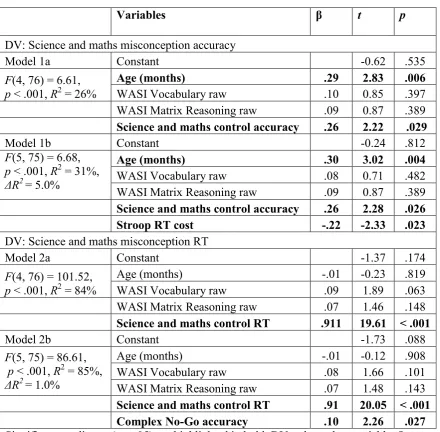
science and maths misconception accuracy. The first model (1a) with age, WASI Vocabulary
and Matrix Reasoning raw scores, and science and maths control accuracy as predictors, was
significant, explaining 26% of the variance. Age and science and maths control accuracy
were significant predictors of misconception accuracy. Stroop RT cost was selected using a
stepwise approach in model 1b, uniquely accounting for 5% of the variance. Greater Stroop
RT cost was associated with lower misconception accuracy. No Go/No-Go variables were
selected by the model.
The second regression investigated misconception RT. The first model (2a) with age,
WASI Vocabulary and Matrix Reasoning raw scores, and science and maths control RT as
predictors, was significant, explaining 84% of the variance. Only science and maths control
RT was a significant predictor of misconception accuracy. Complex No-Go accuracy was
selected in model 2b, uniquely accounting for 1% of the variance. Greater complex No-Go
accuracy was associated with higher misconception RT. No Stroop variables were selected by
Table 4. Regression Models for Science and Maths Combined.
Variables β t p
DV: Science and maths misconception accuracy
Model 1a Constant -0.62 .535
F(4, 76) = 6.61,
p < .001, R2 = 26%
Age (months) .29 2.83 .006
WASI Vocabulary raw .10 0.85 .397
WASI Matrix Reasoning raw .09 0.87 .389
Science and maths control accuracy .26 2.22 .029
Model 1b Constant -0.24 .812
F(5, 75) = 6.68,
p < .001, R2 = 31%,
ΔR2= 5.0%
Age (months) .30 3.02 .004
WASI Vocabulary raw .08 0.71 .482
WASI Matrix Reasoning raw .09 0.87 .389
Science and maths control accuracy .26 2.28 .026
Stroop RT cost -.22 -2.33 .023
DV: Science and maths misconception RT
Model 2a Constant -1.37 .174
F(4, 76) = 101.52,
p < .001, R2 = 84%
Age (months) -.01 -0.23 .819
WASI Vocabulary raw .09 1.89 .063
WASI Matrix Reasoning raw .07 1.46 .148
Science and maths control RT .911 19.61 < .001
Model 2b Constant -1.73 .088
F(5, 75) = 86.61,
p < .001, R2 = 85%,
ΔR2= 1.0%
Age (months) -.01 -0.12 .908
WASI Vocabulary raw .08 1.66 .101
WASI Matrix Reasoning raw .07 1.48 .143
Science and maths control RT .91 20.05 < .001
Complex No-Go accuracy .10 2.26 .027
Significant predictors (p < .05) are highlighted in bold. DV = dependent variable; β =
standardised coefficients.
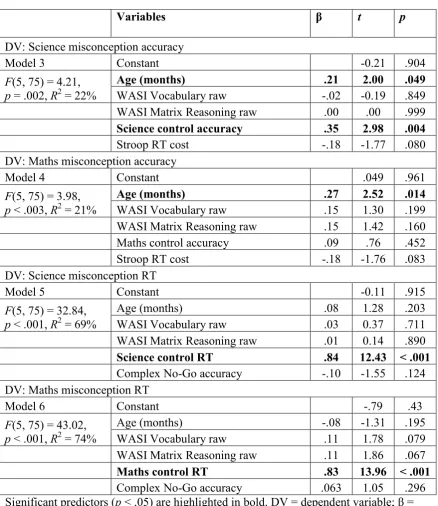
Follow up exploratory regressions (Table 5) examined the extent to which these
associations held for science and maths individually, adding the inhibitory control variables
with the enter method. Stroop RT cost was not a significant predictor of science (model 3) or
maths (model 4) misconception accuracy, although the p-values were at trend and the
accuracy was not a significant predictor of science (model 5) or maths (model 6)
misconception RT. This time the coefficient was positive for maths, as with the combined
[image:24.595.67.506.201.708.2]analyses, but negative for science.
Table 5. Regression Models for Science and Maths Separately.
Variables β t p
DV: Science misconception accuracy
Model 3 Constant -0.21 .904
F(5, 75) = 4.21,
p = .002, R2 = 22%
Age (months) .21 2.00 .049
WASI Vocabulary raw -.02 -0.19 .849
WASI Matrix Reasoning raw .00 .00 .999
Science control accuracy .35 2.98 .004
Stroop RT cost -.18 -1.77 .080
DV: Maths misconception accuracy
Model 4 Constant .049 .961
F(5, 75) = 3.98,
p < .003, R2 = 21%
Age (months) .27 2.52 .014
WASI Vocabulary raw .15 1.30 .199
WASI Matrix Reasoning raw .15 1.42 .160
Maths control accuracy .09 .76 .452
Stroop RT cost -.18 -1.76 .083
DV: Science misconception RT
Model 5 Constant -0.11 .915
F(5, 75) = 32.84,
p < .001, R2 = 69%
Age (months) .08 1.28 .203
WASI Vocabulary raw .03 0.37 .711
WASI Matrix Reasoning raw .01 0.14 .890
Science control RT .84 12.43 < .001
Complex No-Go accuracy -.10 -1.55 .124
DV: Maths misconception RT
Model 6 Constant -.79 .43
F(5, 75) = 43.02,
p < .001, R2 = 74%
Age (months) -.08 -1.31 .195
WASI Vocabulary raw .11 1.78 .079
WASI Matrix Reasoning raw .11 1.86 .067
Maths control RT .83 13.96 < .001
Complex No-Go accuracy .063 1.05 .296
Significant predictors (p < .05) are highlighted in bold. DV = dependent variable; β =
In summary, the regression analyses revealed unique roles for response and semantic
inhibition in reasoning about science and maths misconceptions. Both response inhibition
(complex No-Go accuracy) and semantic inhibition (Stroop RT cost) were predictors of
performance when science and maths misconceptions were combined. Proficiency in
semantic inhibition was more important for predicting misconception accuracy, while
proficient response inhibition was more important for predicting longer RTs when addressing
misconception problems.
Discussion
The current study investigated the role of inhibitory control in counterintuitive science
and maths reasoning in adolescence. It was hypothesised that better inhibitory control would
be associated with better performance in science and maths misconception problems, when
controlling for performance on related problems, age, and general cognitive ability. Ninety
adolescents were tested on response and semantic inhibition and a novel science and maths
misconceptions task. Both response and semantic inhibition were associated with
performance in science and maths misconception trials, beyond performance in control trials
and individual differences in general cognitive ability or age. This was the first study to
consider the unique roles of response and semantic inhibition in this context, demonstrating
that response inhibition may be more related to RTs in counterintuitive reasoning, while
semantic inhibition may be more related to accuracy. General performance on the science and
maths misconceptions task will be considered first, followed by inhibitory control findings;
finally the association between inhibitory control and science and maths misconception
Science and maths misconceptions
As anticipated, accuracy was lower and RTs slower for misconception trials,
indicating that reasoning about counterintuitive curriculum-related concepts leads to
misconceptions in this age group, even in the oldest participants who should have a good
understanding of these concepts having covered them all at school. Only small age effects
were observed, in line with standardised assessment findings that only small improvements
are made in maths within this age range [6].
The reduction in accuracy in false trials compared to true trials was greater for
misconception than control trials, which may be due to increased cognitive demand in false
trials. To arrive at the correct response, the participant must first read the statement and detect
an error, then possibly generate the true statement internally before deciding that the
statement presented is false. This may explain why it is easier to answer a true statement
correctly, especially if it is counterintuitive. This pattern of performance was observed in
science trials only, which may be explained by the inclusion in maths of nine problem-sets
containing equations, where both true and false trials require a mental calculation, which
should limit any specific increase in cognitive demand for false trials. It should also be noted
that a higher proportion of science trials were accompanied by a picture (79% vs. 50%) which
cannot be ruled out as a source of difference between the two disciplines.
Overall, these findings support the previous literature that misconceptions due to
intuitive reasoning exist in this age range [7,54]. Although we used a novel task, which has
not been extensively validated, the inclusion of problems that cover the curriculum broadly is
Inhibitory control
The inhibitory control tasks showed a degree of improvement with age, echoing
findings in the literature [22]. Some measures of inhibitory control were moderately
correlated with each other, with the highest correlations between RT measures, likely
representing processing speed [57] rather than inhibition per se. There was a marginal
negative correlation between the two inhibitory control measures that were selected by the
regression model: Higher complex response inhibition accuracy was associated with lower
semantic inhibition RT cost. This suggests that response and semantic inhibition are partially
related, in keeping with previous literature [26], whereby the ability to make less impulsive
motor responses is linked to the ability to suppress irrelevant stimuli with less interference.
The role of inhibitory control in counterintuitive science and
maths reasoning
Both response and semantic inhibition were associated with science and maths
misconception performance when controlling for age, general cognitive ability, and control
performance. In line with our first hypothesis, a smaller difference in RT between
incongruent and congruent Stroop trials, suggesting less interference and better semantic
inhibition, was associated with higher accuracy on misconception trials. These results fit with
the proposal that semantic inhibition may allow suppression of naïve beliefs or irrelevant
perceptual information in order to reach the correct answer to counterintuitive problems. Note
that while the Stroop task was selected to measure semantic inhibition, it requires suppression
of a motor response to some extent [58], so this measure may partly implicate response
that the model included age, general cognitive ability (verbal and non-verbal), and
performance in related science and maths control trials. The fact that the association is
observed after inclusion of control trials as a covariate in the analyses is consistent with the
idea that semantic inhibitory control may play a specific (or more important) role in science
and maths counterintuitive reasoning rather than science and maths reasoning more broadly.
The ability to withhold a response in the complex Go/No-Go was associated with
longer RTs on misconception trials. Therefore, contrary to our hypothesis, good response
inhibition is not associated with better performance in the science and maths misconceptions
task. However, a possible interpretation is that good response inhibition may afford more
time for consideration of the response, with a less impulsive pattern of responding.
Individuals may not necessarily eventually choose the correct response, but they may be able
to spend more time thinking about their response and evaluate competing alternative answers.
The complex Go/No-Go measured inhibitory control within the context of a cognitive
load. The regression model’s selection of a complex rather than simple Go/No-Go variable
implicates individual differences in the ability to manage combined response inhibition and
working memory demands. The use of this ability is exemplified by a maths misconception
problem that requires counting items and calculating probabilities, and holding this
information in mind while considering how it applies to the statement. This account is
consistent with suggestions that beliefs must be held in working memory during reasoning,
before the incorrect response is inhibited [19]. Future work could measure a purer form of
working memory in a separate task to assess the extent to which working memory makes a
unique contribution outside of the context of inhibitory control.
The discipline-specific analyses had reduced power due to the smaller number of
trials, in addition to the different number of pictures within the stimuli, so must be interpreted
suggest that misconceptions in science and maths show similar associations to semantic
inhibition, with potentially different associations with response inhibition: Higher complex
No-Go accuracy was associated with shorter responses in science but longer response in
maths. However, these exploratory analyses did not reach significance so further research
would be necessary to determine discipline-specific associations. Further distinctions could
also be made within disciplines. For example, although not focusing on counterintuitive
reasoning, previous research found an association between numerical dot comparison
inhibition and procedural maths but not conceptual or factual maths in adolescents [20].
It is possible that the completion of the inhibitory control tasks before the science and
maths task may have led to increased inhibitory control use in the latter due to practice
effects. Nonetheless, short breaks between tasks, which included talking to the researcher,
may have dissipated any such effects. Further, any effect will have applied to all participants,
and there remains poorer accuracy in misconception problems compared to control problems.
Finally, future work should consider the possibility that different types of inhibition
specifically allow the suppression of different types of misconception. The current study did
not categorise types of misconception, and contained a mixture of those due to misleading
perceptual cues, previously held beliefs, and prior experiences. While the focus here was on
covering a broad set of problems, it would be interesting to establish specific links between
types of inhibitory control and misconceptions of different origins. Further, intervention
studies could assess the impact of inhibitory control training in the context of science and
maths learning. This would help to establish the extent to which the association between
inhibitory control and counterintuitive reasoning is a causal one; something that the current
paper could not address directly. The evidence so far suggests that encouraging learners to
inhibit their immediate responses might lead to improved counterintuitive reasoning in
Conclusions
The associations seen in this novel study suggest that both response inhibition and
semantic inhibition play a role in counterintuitive science and maths reasoning problems that
are curriculum-related. The results are in line with the idea that inhibition is required to
overcome misleading perceptual cues [45] or old theories that are still present [13,17], and
that old theories remain present [1,14], rather than being replaced or restructured through
learning [3,8]. As argued by Houdé [15], this study provides further evidence that poor
reasoning partly reflects poor inhibitory control as opposed to simply poor logic or
understanding. The present study focused on curriculum-related science and maths problems
and adolescence. The results are therefore relevant for secondary education and suggest that
individual differences in inhibitory control may play a role in science and maths academic
outcome.
Acknowledgements
We thank the children and school who took part, and Jessica Massonnié for help with
data collection.
References
1. Mareschal D. The neuroscience of conceptual learning in science and mathematics.
Curr Opin Behav Sci. 2016;10: 114-118. doi: 10.1016/j.cobeha.2016.06.001.
2. Carey S. Science education as conceptual change. J Appl Dev Psychol. 2000;21(1):
13-19. doi: 10.1016/S0193-3973(99)00046-5.
3. Vosniadou S. Conceptual change and education. Hum Dev. 2007;50(1): 47-54. doi:
4. McNeil NM, Alibali MW. Why won’t you change your mind? Knowledge of
operational patterns hinders learning and performance on equations. Child Dev. 2005;
76(4): 883-899. doi: 10.1111/j.1467-8624.2005.00884.x.
5. Rousselle L, Palmers E, Noël M-P. Magnitude comparison in preschoolers: What
counts? Influence of perceptual variables. J Exp Child Psychol. 2004;87(1): 57-84. doi: 10.1016/j.jecp.2003.10.005
6. Ryan J, Williams J. Children’s mathematics 4-15: Learning from errors and
misconceptions. Maidenhead, UK: Open University Press; 2007.
7. Stavy R, Tirosh D. How students (mis-)understand science and mathematics: Intuitive
Rules. New York: Teachers College Press; 2000.
8. Posner GJ, Strike KA, Hewson PW, Gertzog WA. Accommodation of a scientific
conception: Toward a theory of conceptual change. Sci Educ. 1982;66(2): 211-227. doi: 10.1002/sce.3730660207.
9. Allen M. Misconceptions in primary science. 2nd ed. Maidenhead, UK: Open
University Press; 2014.
10.Vosniadou S. Examining cognitive development from a conceptual change point of
view: The framework theory approach. Eur J Dev Psychol. 2014;11(6): 645-661. doi: 10.1080/17405629.2014.921153.
11.Shtulman A, Valcarcel J. (2012). Scientific knowledge suppresses but does not
supplant earlier intuitions. Cognition, 2012;124: 209-215. doi: 10.1016/j.cognition.2012.04.005.
12.Borst G, Poirel N, Pineau A, Cassotti M, Houdé O. Inhibitory control efficiency in a
Piaget-like class-inclusion task in school-age children and adults: A developmental negative priming study. Dev Psychol. 2013;49(7): 1366-1374. doi:
10.1037/a0029622.
13.Brault Foisy L-M, Potvin P, Riopel M. Masson S. Is inhibition involved in
overcoming a common physics misconception in mechanics? Trends Neurosci Educ. 2015; 4(1): 26-36. doi: 10.1016/j.tine.2015.03.001.
14.Dunbar KN, Fugelsang JA, Stein C. Do naïve theories ever go away? Using brain and
behaviour to understand changes in concepts. In: Lovett M, Shah P, editors. Thinking with data. New Jersey, USA: Lawrence Erlbaum Associates; 2007. pp. 193-205.
15.Houdé O. Inhibition and cognitive development: Object, number, categorization, and
reasoning. Cogn Dev. 2000;15: 63-73. doi: 10.1016/S0885-2014(00)00015-0.
16.Lubin A, Vidal J, Lanoë C, Houdé O, Borst G. Inhibitory control is needed for the
resolution of arithmetic word problems: A developmental negative priming study. J Educ Psychol. 2013;105(3): 701-708. doi: 10.1037/a0032625.
17.Masson S, Potvin P, Riopel M, Brault Foisy L-M. (2014). Differences in brain
activation between novices and experts in science during a task involving a common misconception in electricity. Mind Brain Educ. 2014;8(1): 44-55. doi:
10.1111/mbe.12043.
18.Lortie-Forgues H, Tian J, Siegler RS. (2015). Why is learning fraction and decimal
arithmetic so difficult? Dev Rev. 2015;38: 201-221. doi: 10.1016/j.dr.2015.07.008.
19.Zaitchik D, Iqbal Y, Carey S. The effect of executive function on biological reasoning
in young children: An individual differences study. Child Dev. 2014;85(1): 160-175. doi: 10.1111/cdev.12145.
20.Gilmore C, Keeble S, Richardson, S, Cragg L. The role of cognitive inhibition in
21.Merkley R, Thompson J, Scerif G. (2015). Of huge mice and tiny elephants:
Exploring the relationship between inhibitory processes and preschool maths skills. Front Psychol. 2015;1903(6): 1-14. doi: 10.3389/fpsyg.2015.01903.
22.Leon-Carrion J, García-Orza J. Pérez-Santamaría FJ. Development of the inhibitory
component of the executive functions in children and adolescents. Int J Neurosci. 2004;114(10): 1291-1311. doi: 10.1080/00207450490476066.
23.Department for Education. (2013a). Mathematics programmes of study: Key stage 3.
24.Department for Education. (2013b). Science programmes of study: Key stage 3.
25.Nigg JT. On inhibition/disinhibition in developmental psychopathology: Views from
cognitive and personality psychology and a working inhibition taxonomy. Psychol Bull. 2000;126(2): 220-246.
26.Verbruggen F, Liefooghe B, Vandierendonck A. The interaction between stop signal
inhibition and distractor interference in the flanker and Stroop task. Acta Psychol. 2004;116(1): 21-37. doi: 10.1016/j.actpsy.2003.12.011.
27.Simmonds DJ, Pekar JJ, Mostofsky SH. Meta-analysis of go/no-go tasks
demonstrating that fMRI activation associated with response inhibition is task-dependent. Neuropsychologia. 2008;46(1): 224-232. doi:
10.1016/j.neuropsychologia.2007.07.015.
28.Stroop JR. Studies of interference in serial verbal reactions. J Exp Psychol.
1935;18(6): 643-662. doi: 10.1037/h0054651.
29.Humphrey G, Dumontheil I. Development of risk-taking, perspective-taking, and
inhibitory control during adolescence. Dev Neuropsychol. 2016;5641: 1-18. doi: 10.1080/87565641.2016.1161764.
30.Tamm L, Menon V, Reiss AL. Maturation of brain function associated with response
inhibition. J Am Acad Child Adolesc Psychiatry. 2002;41(10): 1231-1238. doi: 10.1097/00004583-200210000-00013.
31.Comalli PE Jr, Wapner S, Werner H. Interference effects of Stroop color-word test in
childhood, adulthood, and aging. J Genet Psychol. 1962;100: 47-53. doi; 10.1080/00221325.1962.10533572.
32.Miyake A, Friedman NP, Emerson MJ, Witzki AH, Howerter A, Wager TD. The
unity and diversity of executive functions and their contributions to complex “frontal lobe” tasks: A latent variable analysis. Cogn Psychol. 2000;41(1): 49-100. doi: 10.1006/cogp.1999.0734.
33.Huizinga M, Dolan CV, van der Molen MW. Age-related change in executive
function: Developmental trends and a latent variable analysis. Neuropsychologia. 2006; 44(11): 2017-2036. doi: 10.1016/j.neuropsychologia.2006.01.010.
34.Khng KH, Lee K. The relationship between Stroop and stop-signal measures of
inhibition in adolescents: Influences from variations in context and measure estimation. PLoS One. 2014;9(7): e101356. doi: 10.1371/journal.pone.0101356.
35.Baker ST, Gjersoe NL, Sibielska-Woch K, Leslie AM, Hood BM. Inhibitory control
interacts with core knowledge in toddlers’ manual search for an occluded object. Dev Sci. 2011;14: 270-279. doi: 10.1111/j.1467-7687.2010.00972.x.
36.Hood B, Cole-Davies V, Dias M. Looking and search measures of object knowledge
in preschool children. Dev Psychol. 2003;39(1): 61-70. doi: 10.1037/0012-1649.39.1.61.
37.Mayer D, Sodian B, Koerber S, Schwippert K. Scientific reasoning in elementary
38.Rhodes SM, Booth JN, Campbell LE, Blythe RA, Wheate NJ, Delibegovic M. Evidence for a role of executive functions in learning biology: Executive functions and science. Infant Child Dev. 2014;23: 67-83. doi: 10.1002/icd.1823.
39.Rhodes SM, Booth JN, Palmer LE, Blythe RA, Delibegovic M, Wheate NJ. (2016).
Executive functions predict conceptual learning of science. Br J Dev Psychol, 34, 261-275. doi: 10.1111/bjdp.12129.
40.Siegler RS. Children’s Thinking. 3rd ed. Upper Saddle River, NJ: Prentice Hall; 1998.
41.Siegler RS, Jenkins E. How children discover new strategies. New Jersey: Lawrence
Erlbaum Associates, Inc; 1989.
42.Khng KH, Lee K. Inhibiting interference from prior knowledge: Arithmetic intrusions
in algebra word problem solving. Learn Individ Differ. 2009;19(2): 262-268. doi: 10.1016/j.lindif.2009.01.004.
43.Monette S, Bigras M, Guay M-C. The role of executive functions in school
achievement at the end of Grade 1. J Exp Child Psychol. 2011;109(2): 158-173. doi: 10.1016/j.jecp.2011.01.008.
44.Allan NP, Hume LE, Allan DM, Farrington AL, Lonigan CJ. Relations between
inhibitory control and the development of academic skills in preschool and kindergarted: A meta-analysis. Dev Psychol. 2014:50(10): 2368-2379.
45.Linzarini A, Houdé O, Borst G. When Stroop helps Piaget: An inter-task positive
priming paradigm in 9-year-old children. J Exp Child Psychol. 2015;139: 71-82. doi: 10.1016/j.jecp.2015.05.010.
46.Fugelsang JA, Dunbar KN. Brain-based mechanisms underlying complex causal
thinking. Neuropsychologia. 2005;45(8): 1204-1203. doi: 10.1016/j.neuropsychologia.2004.10.012.
47.Goel V, Dolan RJ. Explaining modulation of reasoning by belief. Cognition.
2003;87(1): B11-B22. doi: 10.1016/S0010-0277(02)00185-3.
48.Prado J, Noveck IA. Overcoming perceptual features in logical reasoning: a
parametric functional magnetic resonance imaging study. J Cogn Neurosci. 2007;19(4): 642-657. doi: 10.1162/jocn.2007.19.4.642.
49.Stavy R, Babai R. Overcoming intuitive interference in mathematics: insights from
behavioral, brain imaging and intervention studies. ZDM. 2010;42(6): 621-633. doi: 10.1007/s11858-010-0251-z.
50.Houdé O, Zago L, Mellet E, Moutier S, Pineau A, Mazoyer B, et al. Shifting from the
perceptual brain to the logical brain: The neural impact of cognitive inhibition training. J Cogn Neurosci. 2000;12(5); 721-728. doi: 10.1162/089892900562525.
51.Parsons R, Gannon P. KS3 science: Complete study and practice. Newcastle upon
Tyne, UK: Coordination Group Publications Ltd; 2014.
52.Parsons R. KS3 maths: Complete study and practice. Newcastle upon Tyne, UK:
Coordination Group Publications Ltd; 2014.
53.Watanabe J, Sugiura M, Sato K, Sato Y, Maeda Y, Matsue Y, et al. The human
prefrontal and parietal association cortices are involved in No-Go performances: An event-related fMRI study. Neuroimage. 2002;17(3): 1207-1216. doi:
10.1006/nimg.2002.1198.
54.Driver R, Squires A, Rushworth P, Wood-Robinson V. Making sense of secondary
science: Research into children’s ideas. Classic ed. New York: Routledge; 2015.
55.Wechsler D. Wechsler abbreviated scale of intelligence (WASI-II). 2nd ed. San
Antonio, TX: Pearson; 2011.
56.Field A. Linear models: Looking for bias. 2012. Available from:
57.Kail R. Processing time decreases globally at an exponential rate during childhood and adolescence. J Exp Child Psychol. 1993;56(2): 254-265. doi:
10.1006/jecp.1993.1034.
58.van Veen V, Carter CS. Separating semantic conflict and response conflict in the
S1 Fig. Example Problem-Sets in (a) Science and (b) Maths.
S2 Fig. Histogram of Mean Accuracy in the 96 Science and Maths Misconception Problems. The range of mean accuracy observed suggests that although the mean overall
Inhibitory control and counterintuitive science and maths
reasoning in adolescence: Supporting information (S1)
Here we present the method and results of the inhibitory control tasks, and further
accuracy analyses from the science and maths misconceptions task, from the paper
‘Inhibitory control and counterintuitive science and maths reasoning in adolescence’.
Supplementary methods
Inhibitory control tasks
The simple and complex Go/No-Go tasks were computerised measures of response
inhibition adapted from Watanabe et al. [1]. Familiarisation and practice phases for both tasks
consisted of ten trials. In the familiarization phase, coloured squares (green squares in the
simple task; yellow or blue squares in the complex task) appeared on the left or right of the
screen, and participants pressed the corresponding key, using their index or middle finger, to
indicate the location of the square. This was repeated until participants made two errors or
fewer. In the practice phase, No-Go trials, where the response must be withheld, were
introduced (red squares in the simple task; a blue square following a yellow square in the
complex task) (Fig 2 in main text). The practice phase was repeated until participants made
no more than one No-Go error out of three No-Go trials. Test phases followed, and included
80 trials, with 25% No-Go trials, and a self-timed break half-way through. The square’s
location and fixation duration were pseudo-randomised so that for every set of ten trials, 50%
of stimuli appeared on the left, and fixation duration was randomly chosen from a uniform
distribution between 600 and 800 ms. Responses were not recorded for the first 100 ms after
trial. There were never two No-Go trials in a row. Accuracy and RT were recorded, and the
two Go/No-Go tasks lasted a total of six min on average.
The numerical Stroop task, adapted from Khng and Lee [2] provided a computerized
measure of semantic inhibition (Fig 2 in main text). The aim in this task was to press the key
corresponding to the number of elements on the screen (between one and four). In the
familiarization phase, the elements were asterisks. The four number keys were located in the
centre of the keyboard, labelled with stickers, and participants were instructed to use the
index and middle fingers of their left and right hands, such that the fingers corresponded to
numbers one to four from left to right. The familiarization phase was repeated until
participants responded correctly on 11 out of 12 trials. This conservative threshold ensured
that mapping between fingers, keys and responses had been achieved. In the first practice
phase, consisting of 24 trials, the stimuli were single digit numbers, and participants
continued to respond to the number of elements (digits) shown. These were all congruent
trials, where the digit matched the number of elements (e.g., “1” or “3 3 3”). The second
practice phase contained only incongruent trials, where the digit did not match the number of
elements (e.g., “4 4” or “1 1 1 1”). The second practice contained just two trials, and was
repeated until participants got both correct. This ensured that participants understood the task
but did not get too much practice.
The test phase contained 50% congruent and 50% incongruent trials presented in four
blocks of 24 trials. The same pseudo-random trial order was used across participants, such
that each block contained one of each possible incongruent trial and three of each congruent
trial. There was a self-timed break between each block. Accuracy and RT were recorded, and
the task took four and a half min on average. This numerical version of the Stroop task
allowed a more intuitive mapping between numbers and keys as compared to non-ordinal
Statistical analysis
Mean RTs of the inhibitory control tasks are reported for correct trials only. The
simple and complex Go/No-Go tasks were analysed separately. Three participants were
excluded from the simple Go/No-Go analysis because of low accuracy (one 12y, one 13y) or
high RT (one 12y) leaving a final N=87 participants. Two participants were excluded from
the complex Go/No-Go analysis, because of low accuracy (one 12y) or an inability to pass
the practice (one 12y) leaving a final N=88 participants. Four participants were excluded
from the Stroop task because of low accuracy (one 12y, one 13y) or because they were
unable to perform the task due to a hand injury (one 13y, one 15y) leaving a final N=86
participants. Two (Trial type: Go, No-Go or congruent, incongruent) x four (Age group: 12y,
13y, 14y, 15y) mixed model repeated measures ANOVAs were run on accuracy scores in
each of the three tasks and on RT in the Stroop task. One-way ANOVAs examined the effect
of Age group (12y, 13y, 14y, 15y) on Go RT in the simple and complex Go/No-Go tasks
separately.
Supplementary results
Age results for accuracy in the science and maths misconception task
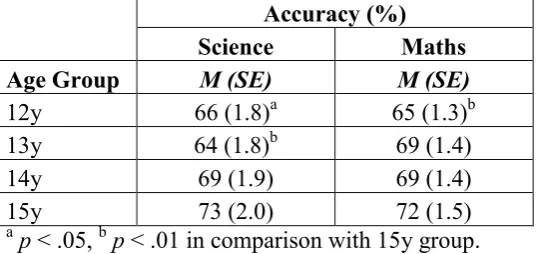
There was a main effect of Age group on accuracy, F(3, 83) = 5.61, p = .001, ηp2 =
.169. Follow-up planned comparisons revealed significant differences between 12y and 15y,
p < .001, 13y and 15y, p = .002, and marginal differences between 14y and 15y, p = .077,
each of which demonstrated increasing accuracy with age (see Table 2 in main text).
There was a significant interaction between Discipline and Age group F(3, 83) = 3.68,
p = .015, ηp2 = .117. Follow-up repeated measures ANOVAs performed separately in each