BIROn - Birkbeck Institutional Research Online
Yuan, C. and Wu, B. and Li, X. and Hu, W. and Maybank, Stephen J. and
Wang, F. (2016) Fusing R features and local features with context-aware
kernels for action recognition. International Journal of Computer Vision 118
(2), pp. 151-171. ISSN 0920-5691.
Downloaded from:
Usage Guidelines:
Please refer to usage guidelines at
or alternatively
Fusing
R
Features and Local Features with Context-aware
Kernels for Action Recognition
Chunfeng Yuan · Baoxin Wu · Xi Li · Weiming
Hu · Stephen Maybank · Fangshi Wang
Received: date / Accepted: date
Abstract The performance of action recognition in video sequences depends significantly on the representation of actions and the similarity measurement between the representa-tions. In this paper, we combine two kinds of features extracted from the spatio-temporal interest points with context-aware kernels for action recognition. For the action representa-tion, local cuboid features extracted around interest points are very popular using a Bag of Visual Words (BOVW) model. Such representations, however, ignore potentially valuable information about the global spatio-temporal distribution of interest points. We propose a new global feature to capture the detailed geometrical distribution of interest points. It is calculated by using the 3DRtransform which is defined as an extended 3D discrete Radon transform, followed by the application of a two-directional two-dimensional principal com-ponent analysis. For the similarity measurement, we model a video set as an optimized probabilistic hypergraph and propose a context-aware kernel to measure high order relation-ships among videos. The context-aware kernel is more robust to the noise and outliers in the data than the traditional context-free kernel which just considers the pairwise relationships between videos. The hyperedges of the hypergraph are constructed based on a learnt Ma-halanobis distance metric. Any disturbing information from other classes is excluded from each hyperedge. Finally, a multiple kernel learning algorithm is designed by integrating the
l2 norm regularization into a linear SVM classifier to fuse theRfeature and the BOVW
representation for action recognition. Experimental results on several datasets demonstrate the effectiveness of the proposed approach for action recognition.
C. Yuan, B. Wu and W. Hu
National Laboratory of Pattern Recognition, Institute of Automation, CAS, Beijing, China E-mail: cfyuan, bxwu, [email protected]
X. Li
College of Computer Science and Technology, Zhejiang University, Hangzhou, China E-mail: [email protected]
S. Maybank
Department of Computer Science and Information Systems, Birkbeck College, London, UK E-mail: [email protected]
F. Wang
Keywords Action recognition·spatio-temporal interest points ·3D Rtransform · hypergraph·context-aware kernel
1 Introduction
Recognition of human actions [29] [8] [60] in videos has many potential applications, such as smart surveillance, human-computer interface, video indexing and browsing, automatic analysis of sports events, and virtual reality. However, it is a challenging task because of geometric variations between intra-class objects or actions, as well as changes in scale, ro-tation, viewpoint, illumination, and occlusion. Many modern action recognition approaches are based on spatio-temporal interest points via the Bag of Visual Words (BOVW) mod-el [17] [42] [12]. The local interest point features are more robust to noise, occlusion, and geometric variations than global (or large-scale) features. However, most BOVW based rep-resentations utilize the local appearance or motion information (e.g. HOG, HOF [16]) of spatio-temporal volumes (e.g. cuboids around interest points), without considering the lo-cations of interest points. In other words, they rely mainly on the discriminative power of individual local cuboid descriptors, whilst ignoring potentially valuable information about the global spatio-temporal distribution of interest points.
In this paper, we propose a novel method to extract a global feature from the locations of interest points for a video sequence. We focus on the geometrical distribution of inter-est points in 3D space and characterize them from the perspective of geometry. The 2DR transform [38], as an improved representation of the 2D Radon transform, has been shown to provide effective feature representations of human shapes and silhouettes in images [46]. The 3D discrete Radon transform [35] [7] has been successfully applied to object classifica-tion in 3D models. However, the 3DRtransform is little utilized. We deduce the form and properties of the 3DRtransform, based on the 3D discrete Radon transform, and apply the 3DRtransform to the representation of spatio-temporal interest points for the task of action recognition [53]. Afterwards, we apply (2D)2PCA [57] to theRtransform, to reduce the
di-mension of the obtained feature. The obtainedRfeature has several unique advantages: (1) 3DRtransform captures the specific global distribution of spatio-temporal interest points; (2) It is invariant to geometry transformations and robust to noise, both of which are required for the effective action representation; (3) It is easy to compute and avoids the non-trivial task of foreground object segmentation and the problems involved in the BOVW method such as selecting the optimal spatio-temporal descriptor, clustering for constructing a code-book, and selecting codebook size.
Fig. 1: The flowchart of the proposed approach for action recognition.
hyperedge have the same action class. Hence, the context of a video captured by the opti-mized probability hypergraph is not mixed with the videos from other classes and can assist in improving the classification performance. The combination of the proposed context-aware kernel and the pairwise kernel produces a more accurate method of measuring the similar-ities between videos. Finally, we introduce a multiple kernel learning (MKL) algorithm to automatically determine the optimal combination of pairwise kernels and context-aware k-ernels both based on two features. The MKL algorithm integrates thel2norm regularization
into a linear SVM classifier for action recognition. Since the MKL objective function is non-smooth, we propose a new efficient optimization algorithm to minimize it. To sum up, the proposed approach fuses different features, and also captures the underlying contextual information from videos. Fig. 1 shows the flowchart of the proposed approach for action recognition.
The contributions of this paper are summarized below.
– A Rfeature based on the 3DRtransform is proposed to capture the specific global spatio-temporal distribution of interest points. It is complementary to the convention-al BOVW action representation method. The 3D Rtransform has some invariance to geometrical transformations and robustness to noise.
– A context-aware kernel is developed via an optimized probability hypergraph to measure the high order relationships among videos and enhance the classification performance. Moreover, the context-aware kernel is less sensitive to noise than the traditional pairwise similarity kernel.
have identical labels. In this way, hyperedges stay “pure” without disturbance from other class videos. The resulting context-aware kernel is more suitable for classification.
– The multiple kernel learning algorithm is employed for action recognition. It can effi-ciently incorporate the pairwise kernels and context-aware kernels of multiple features to improve the recognition performance.
The remainder of the paper is organized as follows. Section 2 gives a review of the re-lated work. Section 3 introduces the proposedRfeature. Section 4 describes the proposed optimized probability hypergraph based-context-aware kernel and the multiple kernel learn-ing algorithm for action classification. Section 5 reports experimental results on five human action datasets. Section 6 concludes the paper.
2 Related Work
Action recognition includes two essential steps: action representation and classification based on the representations. To address this task, many papers propose an effective fea-ture or combine multiple feafea-tures to improve the representation ability. Other papers harness discriminative classification methods to accurately distinguish videos with different action classes. In the following three sections we provide a brief review on three aspects of this research that are most related to our work.
2.1 Geometrical Construction of Local Interest Points for Action Representation
Several algorithms have been proposed to integrate geometrical information into the BOVW model. A common way is to use multi-scale pyramids [18] or spatio-temporal grids [16] [6] to produce a coarse description of the feature layout. These algorithms uniformly divide the 3D space into spatio-temporal grids and then compute the histogram of local features in each grid. Niet al. [25] propose an adaptive motion feature pooling scheme that utilizes human poses as side information.
Co-occurrence patterns encoding partial geometrical information are more discrimina-tive than individual features, and have been applied in action recognition. Savareseet al. [31] propose spatial-temporal correlograms to model the temporal co-occurrence patterns of spatial-temporal features for action recognition. Yuanet al. [54][55] discover meaningful spatially co-occurrence patterns of visual words using frequent itemset mining (FIM). Such visual collocation patterns have better representation power and are less ambiguous than in-dividual visual features. Moreover, they are statistically more meaningful and effective than the frequent itemsets. These patterns belong to one type of co-occurrence pattern, namely the conjunction form (AND). In [56][47], two types of co-occurrence patterns, the conjunction (AND) and disjunction (OR) of binary features, are discussed. In [56], a two-stage frequen-t pafrequen-tfrequen-tern mining mefrequen-thod is proposed frequen-to discover frequen-the opfrequen-timal co-occurrence pafrequen-tfrequen-terns wifrequen-th minimum empirical error from a noisy training dataset. In [47], a novel branch-and-bound search-based mining method is proposed to mine both AND/OR co-occurrence patterns at arbitrary orders directly in one stage, and it is order of magnitude faster than previous two-stage mining algorithm.
(tracklets). These tracklets describe most of short-term motion contained in a video. Gaidon et al. [9] further propose a spectral divisive clustering algorithm to decompose the motion content of a video into a hierarchy of data-driven parts by using hierarchical clustering on the set of tracklets. These dense trajectories based methods achieve exciting performance on many complex datasets. Trajectories are extracted depending on dense sampling which guarantees a good coverage of foreground motion as well as of the surrounding context but with a large increase in the computation complexity.
Recently, Bregonzioet al. [3] propose a different approach in which clouds of interest points are accumulated for different spatio-temporal windows and several features are ex-tracted from the point clouds. These features include shapes, speeds, and the relationship between clouds and object areas. However, computing these features involves some non-trivial steps such as reliable object detection and segmentation. Subsequently, these features are quantified by the BOVW model, and then each video is represented as a histogram. The
Rfeature proposed below is also extracted from the cloud of interest points but the extrac-tion method is completely different. It utilizes the locaextrac-tion informaextrac-tion of interest points and does not require object detection. It is a global feature without needing to map into a visual word based on the BOVW model like the cloud feature in [3].
2.2 Multiple Feature Combination for Action Representation
Usually, different features emphasize different aspects of actions and are suitable for differ-ent datasets. It is natural to fuse them to improve the performance. A large number of feature fusion approaches have recently appeared in the literature for action recognition.
In [22], two types of features, a quantized vocabulary of local cuboid features and a quantized vocabulary of spin-images, are used. A fusion framework is developed, based on the concept of Fiedler embedding. Different entities are embedded into a common Euclidi-an space, thus enabling the use of simple EuclidiEuclidi-an distEuclidi-ances for discovering relationships between features. Wanget al. [43] combine two types of features for better action represen-tation, namely the quantized vocabulary of cuboid features and the quantized vocabulary of silhouette projection (SP) histograms. The feature fusion is realized in a simple way by di-rectly concatenating the cuboid features and SP features together. Finally, they apply the GP classification model for action recognition. In [37], four features are extracted, including two kinds of local descriptors, namely 2D and 3D SIFT descriptors, both based on 2D interest points, and two kinds of holistic features, namely Zernike moments from single frame and a motion energy image. The basic idea of feature fusion is to concatenate all the feature vectors produced by different approaches to form a larger feature vector as the input to a classifier such as Support Vector Machine (SVM). Mikolajczyk and Uemura [24] use local descrip-tors and optical flow information to form a vocabulary forest of local motion-appearance features to recognize actions. Wang and Yuan [44] use two features for the action repre-sentation, namely histograms of oriented gradients (HOG) and motion boundary histograms (MBH) extracted from dense appearance trajectories. They perform spectral clustering in different feature types separately and capture co-occurrence patterns across multiple feature types. Under a novel transductive learning formulation, the spectral clustering results in dif-ferent feature types and the formed co-occurrence patterns influence each other to improve the clustering or classification performance for visual recognition.
di-rect relation with local cuboid features. In this paper, we combine the local cuboid feature with a new kind of holistic feature which summarises information from the whole video sequence and is based on the spatio-temporal interest points.
2.3 Classification Methods for Action Recognition
During the recognition phase, many methods are adopted including probabilistic graphical models (such as hidden Markov models [34]), dynamic Bayesian networks [15], boosting [47], the Support Vector Machine (SVM), the Nearest Neighbor Classifier (NNC), and latent topic models [26] etc.. Among them, the SVM method is most popular by virtue of its effectiveness for recognition and its simplicity in use. The success of SVM depends on the design of appropriate similarity kernels. In general, most existing SVM methods exert pairwise similarity kernels. This type of kernel is actually based on a graph, in which vertices are videos and edge weights indicate the similarities between two videos. Hence only the pairwise relationship between two samples is considered and any higher order relationships are ignored. Hypergraph learning [52] addresses this problem, because a set of vertices is connected by a hyperedge. When a dataset is represented by a hypergraph, hyperedges can be viewed as the contexts of samples, and the samples with their contexts are used to generate the similarity kernel. This kernel differs from the pairwise similarity kernel and is called a context-aware kernel.
Hypergraph learning has achieved promising performance in many applications. For ex-ample, Lianget al. [21] introduce a content-sensitive hypergraph to represent the image and then utilize an incremental hypergraph partitioning to generate candidate regions for the fi-nal salient object detection. Zhanget al. [58] construct a feature correlation hypergraph to model high order relations among multimodal features for object recognition in images. Li et al. [20] construct three types of hypergraphs: the pairwise hypergraph, theknearest neigh-bor (kNN) hypergraph, and the high order over-clustering hypergraph. They further design a discriminative hypergraph partitioning criterion for face recognition and handwritten digit recogniton. Huanget al. [10] propose a probabilistic hypergraph ranking for image retrieval, and Yuet al. [52] propose an adaptive hypergraph learning for image classification. Hong et al. [11] propose a novel classification method based on structured SVM and hypergraph regularization (Hyper-SSVM) for action recognition in motion capture data. A trade-off pa-rameter is used to balance the structured relevance and the regularization item. Our method also leverages the hypergraph for action recognition, but the usage of the hypergraph is totally different from that in [11] . Honget al. [11] introduce a hypergraph regularization item into the optimization objective of a structured SVM framework, where the correlations of similar samples in the training process are taken into consideration by the hypergraph regularization. However, in our method we model a video set as an optimized probability hypergraph and propose a context-aware kernel based on the hypergraph to directly measure high order relationships among videos.
Existing hypergraphs are usually constructed based on theknearest neighbor method. Each image is taken as a “centroid” vertex and a hyperedge is formed by a centroid and itsk
nearest neighbors [20]. Huanget al. [10] assign each vertex to a hyperedge in a probabilistic way and propose a probabilistic hypergraph. Instead of generating a hyperedge for each vertex, Yuet al. [52] generate a group of hyperedges by varying the neighborhood size
multiple classes. This mixing of the information from different classes is likely to reduce the classification performance. Our paper improves the hypergraph construction algorithm by considering label information and forming ‘pure’ hyperedges, such that action recognition performance is improved.
3RFeatures and Local Features Based on Spatio-Temporal Interest Points
Spatio-temporal interest point methods have been extensively studied in the field of video representation. Among all the methods, the histogram representation of the local cuboid features around interest points is widely used for its simplicity and efficiency. However, the histogram representation only utilizes the local appearance/motion information of inter-est points and ignores their location information. Therefore, we propose a globalRfeature based on the interest point location information to complement the local motion feature for joint video representation. In the following, we first briefly introduce the histogram rep-resentation based on the BOVW model. Then we describe the proposedRfeature and its properties.
3.1 Histogram Representation Based on Spatio-temporal Interest Points
We first perform the spatio-temporal interest point detection for a given video using the Harris3D detector [17]. Afterwards, we employ the HOG/HOF feature [42] to describe the cuboid extracted around each interest point. So, a videoVis denoted as{(ˆxi,αi)}, 1≤i≤N, where ˆxiis the spatio-temporal position vector of theith detected interest point,αiis the HOG/HOF feature, andNis the total number of interest points detected in the video.
For the BOVW based representation, local HOG/HOF features {α1,· · ·,αm}from a training set are quantized to form a codebook (i.e. BOVW) by using thek-means clustering method. Each HOG/HOF feature is mapped into a visual word in the BOVW. Then, each video is represented as a histogram with regard to all visual words, formulated as:
H=(n1,n2,· · ·,nd), (1)
wherenidenotes the occurrence frequency of theithvisual word in this video, anddis the number of visual words.
3.2 TheRFeature Based on Spatio-Temporal Interest Points
The proposedRfeature is based on the 3DRtransform of the video sequence. The 3DR transform is an extension of the 3D Radon transform. Thus, we first perform the 3D Radon transform on the video sequence with detected interest points. The minimal spatio-temporal window containing all the interest points extracted from a video is regarded as a 3D model. LetMrepresent this 3D model and f(x) be the binary function defined on the 3D model, wherex=(x,y,t) denotes the position of a point inM. The binary functionf(x) is defined as:
f(x)=
{
1 ifxis an interest point, namelyx∈ {ˆxi,1≤i≤N}
0 otherwise. (2)
KTH: boxing KTH: handclapping KTH: handwaving KTH: jogging KTH: running KTH: walking
2 46 81012141618 2 4 6 8 10 12 14 16 18
24 681012141618 2 4 6 8 10 12 14 16 18
2 46 81012141618 2 4 6 8 10 12 14 16 18
2 46 81012141618 2 4 6 8 10 12 14 16 18
24 681012141618 2 4 6 8 10 12 14 16 18
2 46 81012141618 2 4 6 8 10 12 14 16 18
10 20 30 40 50 60 10 20 30 40 50 60
10 20 30 40 50 60 10 20 30 40 50 60
10 20 30 40 50 60 10 20 30 40 50 60
10 20 30 40 50 60 10 20 30 40 50 60
10 20 30 40 50 60 10 20 30 40 50 60
[image:9.595.74.417.68.208.2]10 20 30 40 50 60 10 20 30 40 50 60
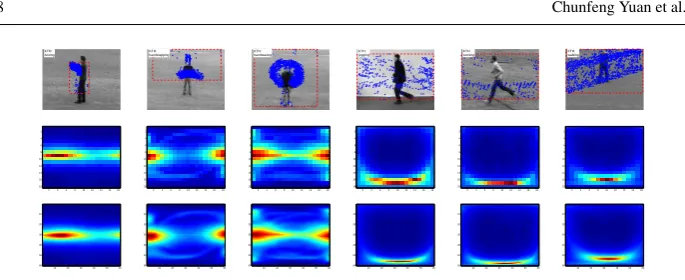
Fig. 2: The 3DRtransform of six videos belonging to different action classes in the KTH dataset. From the first row to last row: interest points in blue,Rtransform by sampling (θ, ϕ) with an internal 10, andRtransform by sampling (θ, ϕ) with an internal 2.
The 3D discrete Radon transform is defined by summing the interpolated samples of a discrete 3D array lying on planes which satisfy certain constraints [35]. Let{xj}Jj=1be all the 3D points in the arrayM. The 3D discrete Radon transform of the f(x) is defined by [7]:
Tf(η, ρ)=
J
∑
j=1
f(xj)δ(xTjη−ρ)=
N
∑
i=1
δ(ˆxTiη−ρ), (3)
whereJis the total number of points inM,ηis a unit vector in 3D space,ρis a real number, andδ(·) is the Dirac delta function. The unit vectorηusing spherical coordinates is written as:η=[cosϕsinθ,sinϕsinθ,cosθ], whereθis the polar angle measured from a fixed zenith direction andϕis the azimuthal angle in thexy-plane from thex-axis. Thus, equation (3) is rewritten in a spherical coordinate system as:
Tf(ρ, θ, ϕ)= J
∑
j=1
f(xj,yj,tj)·δ(xjcosϕsinθ+yjsinϕsinθ+tjcosθ−ρ). (4)
whereρis the distance from a plane to the origin and this plane is normal to the directionη. The 3D Radon transform can be easily calculated, but it is not invariant to translation, scaling and rotation [38]. To overcome this problem, we define theRTransform of the 3D Radon transform, inspired by theRTransform of the 2D Radon transform proposed in [38]. The 2DRtransform is defined as the integral of the square of the 2D Radon transform over the parameterρ. Therefore, we define the 3DRtransform as follows:
Rf(θ, ϕ)=
∫ ∞
−∞T
2
f(ρ, θ, ϕ)dρ . (5)
Observed from equations (4) and (5), each interest point is first projected into all planes with parameters (ρ, θ, ϕ) and then theRtransform is obtained by the integral of the square of projections overρ. Therefore, the 3DRtransform efficiently describes the geometrical dis-tribution of interest points. Afterwards, we perform scale normalization to theRtransform by the following equation:
R′
f(θ, ϕ)=
Rf(θ, ϕ) maxθ,ϕ{Rf(θ, ϕ)}
The minimum value of theRtransformRf(θ, ϕ) is non-negative. By the normalization de-fined in (6), the values of the scaled versionR′f(θ, ϕ) are in the range of 0 to 1. The scale normalization makesRf(θ, ϕ) achieve the robustness to scaling variation. In our application to human action recognition, several videos may differ widely in the numbers of the detected interest points, because the length of the video and the action intensity in videos are both different. According to (3), the different numbers of interest points cause scaling variation ofRf(θ, ϕ). Therefore, we employ the normalization defined in (6) to reduce the influence caused by the different numbers of interest points.
TheRtransformRf(θ, ϕ) represents the distribution of interest points. By sampling two parametersθandϕ,Rf(θ, ϕ) yields a 2D matrix. Fig. 2 shows the 3DRtransform of six videos belonging to different action classes in the KTH dataset. In the first row, all the interest points detected in a video are superposed on a single frame. It can be seen that the geometrical distribution of interest points varies according to different action classes and is very helpful for improving the action recognition accuracy. The second and third rows respectively exhibit the 3DRtransform obtained by sampling (θ, ϕ) in the range of 1 to 180 degrees, firstly in intervals of 10 degrees and secondly in intervals of 2 degrees. The more samples ofθandϕ, the more detailed the characterization of the interest points’ distribution, but the larger the size of the matrix.
In order to reduce the dimension and improve the robustness of theRfeature, we ap-ply the 2-Directional 2-Dimensional PCA, i.e. (2D)2PCA, to the matrix obtained from the
Rtransform. The (2D)2PCA, introduced in [57], simultaneously calculates 2DPCA in the
row and column directions and obtains higher recognition accuracy than PCA and two-dimensional PCA (2DPCA) [50]. LetR∈Rm×nbe the matrix obtained from theRtransform for a video sequence, let{Rk,k =1,2,· · ·,M}be the corresponding matrices of all theM video sequences in a video set, and letR = (1/M)∑Mk=1Rk be the mean matrix of the set. Then the covariance matrixS of the video set and its transposed matrixS′are evaluated by:
S = 1
M
M
∑
k=1
(Rk−R)T(Rk−R) ,
S′ = 1
M
M
∑
k=1
(Rk−R)(Rk−R)T . (7)
It has been proven that the optimal projection matrixPis constructed from the orthonor-mal eigenvectors ofS corresponding to the plargest eigenvalues. The optimal projection matrixQ is obtained by computing the eigenvectors ofS′ corresponding to theqlargest eigenvalues. After projecting each matrix{Rk,k=1,2,· · ·,M}ontoPandQ, we obtain the low-dimensional matrixGk ∈Rq×pcorresponding toRkas follows.
Gk =QTRkP . (8)
Finally, we use the resulting low-dimensional matrixGkas the final feature.
transform over the parameterρ. There arem×nplanes, wheremandnare the sampling numbers of parametersθandϕrespectively. Letldenote the variation range of parameter ρ, andlis less than or equal toN, the number of interest points in a video sequence. In experiments,mandnare set to 18, andNis about 1000. The computational complexity of the R feature isO(Nmnl), which in this case is aboutO(108) arithmetical operations.
3.3 The Properties of theRFeature
In this subsection, we derive the following properties of the proposed newRTransform. For a scale factorα, we have
1 α2
∫ ∞
−∞T
2
f(αρ, θ, ϕ)dρ= 1 α3
∫ ∞
−∞T
2
f(ν, θ, ϕ)dν= 1
α3Rf(θ, ϕ). (9)
For a spatio-temporal translation by (x0,y0,t0), we have
∫ ∞
−∞T
2
f(ρ−x0cosϕsinθ−y0sinϕsinθ−t0cosθ, θ, ϕ)dρ
=
∫ ∞
−∞T
2
f(ν, θ, ϕ)dν=Rf(θ, ϕ). (10)
For the rotation with angles (θ0, ϕ0), we have
∫ ∞
−∞T
2
f(ρ, θ+θ0, ϕ+ϕ0)dρ=Rf(θ+θ0, ϕ+ϕ0). (11)
From (9), the amplitude of theRtransform changes from 1/α2to 1/α3for a scale factor
α. From (11), the R transform is changed fromRf(θ, ϕ) toRf(θ+θ0, ϕ+ϕ0) for the rotation
with angles (θ0, ϕ0). This means that the phase ofRf changes by (θ0, ϕ0), and the amplitude
ofRf does not change. Therefore, from equations (9)-(11) we can see: first,Rtransform is invariant to translation; second, scaling leads to amplitude scaling; and third, rotation results in phase shift. These properties make theRtransform useful for representing the distribution of interest points for action recognition.
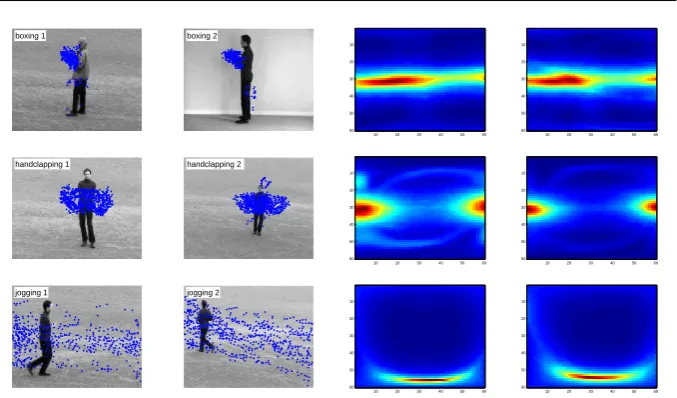
As the above analyzed, the obtainedRfeature is invariant to some geometric transfor-mations. Moreover, it is tolerant to noise in interest points because theRtransform is robust to small perturbations of parts of the shape[46]. Besides, the (2D)2PCA has a certain ability
boxing 1 boxing 2
10 20 30 40 50 60 10
20 30 40 50 60
10 20 30 40 50 60 10
20 30 40 50 60
handclapping 1 handclapping 2
10 20 30 40 50 60 10
20 30 40 50 60
10 20 30 40 50 60 10
20 30 40 50 60
jogging 1 jogging 2
10 20 30 40 50 60 10
20 30 40 50 60
10 20 30 40 50 60 10
[image:12.595.79.418.80.279.2]20 30 40 50 60
Fig. 3: The robustness of theRfeatures for six videos belonging to three action classes in the KTH dataset. TheRfeatures in the third column respectively correspond to the videos in the first column, and TheRfeatures in the fourth column respectively correspond to the videos in the second column.
4 Optimized Probability Hypergraph based Context-aware Kernels for Action Recognition
Given the two representations of each video, our aim is to obtain the labels of test videos from the labeled training videos. The crucial step in this process is to compute the similari-ties between videos, and build kernel matrices based on the similarisimilari-ties. In most approaches, the kernel matrix is computed based on the pairwise comparisons of videos, but such ker-nels are sensitive to noise, outliers, and so on. In this section, we propose two context-aware kernels to model the high-order relationship among the videos.
We first propose ak-nearest neighbor (kNN) based probability hypergraph for context-aware kernel construction. This probability hypergraph is built in an unsupervised way, in which videos from different action classes may be put into the same hyperedge. As a result, the kernel obtained from this hypergraph may involve some disturbance and not classify video reliably. This may tend to increase the probability of classification errors. In order to solve this problem, we propose an optimized probability hypergraph based on distance met-ric learning. Finally, the pairwise kernels and context-aware kernels, both computed from all features, are combined together by multiple kernel learning for action classification.
4.1 Thek-nearest Neighbor Based Probabilistic Hypergraph for Context-aware Kernel Construction
Assume thatV={v1,v2,· · ·,vn}is a finite set of videos, andAis ann×naffinity matrix overVwhereA(i,j)∈[0,1] measures the similarity between videosviandvj. We define
A(i,j)=exp(−∥vi−vj∥2/σ2), whereσis the average distance among all vertices. In most action recognition methods, the affinity matrix Ais directly used as the kernel and input into the SVM classifier. However,Aconsiders only the pairwise relationships between two videos, and it ignores the higher order relationships. If the representation of a video is inac-curate and corrupted, the pairwise similarities may change significantly. Modeling the high order relationships among videos alleviates this problem and improves the classification performance.
In order to explore the high order relationships among videos, we employ a hypergraph construction mechanism. We regard each video in the dataset as a vertex and construct a probabilistic hypergraph G = (V,E,w) with the vertex setV, the hyperedge setE, and the hyperedge weight vectorw. The hyperedge setEis a family of subsets ofVsuch that
∪
e∈E = V. Each hyperedgeeiis assigned a positive weightw(ei), which is computed as follows:
w(ei)=∑ vj∈ei
A(i,j). (12)
In our method, a hyperedge connects a centroid vertex and itsknearest neighbors, and a hyperedge is generated for each vertex. There arenhyperedges, and each hyperedge con-nectsk+1 vertices. Therefore, the hypergraphGcan be represented by a| V | × | E | incidence matrixH:
h(vi,ej)=
{
A(j,i) ifvi∈ej,
0 otherwise. (13)
The incidence matrix describes the vertex-to-hyperedge relationship and determines the hy-pergraph structure. According to the formulation above, a vertexviis “softly” assigned to
ejbased on the similarityA(j,i) between verticesviandvj, wherevjis the centroid vertex ofej. In this way,Gis a probabilistic hypergraph [10], which describes not only the high-er ordhigh-er grouping information but also the local relationship between vhigh-ertices within each hyperedge. Based onh, the degree of a vertexv∈ Vis defined byd(v)=∑e∈Ew(e)h(v,e). The degree of a hyperedgee∈ Eis defined asδ(e)=∑v∈Vh(v,e). We useDv,De, andWto denote the diagonal matrices containing the vertex degrees, the hyperedge degrees, and the hyperedge weights respectively.
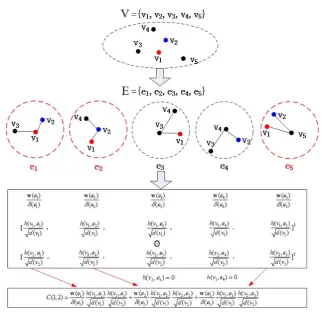
Based on these definitions, the similarityC(i,j) between videosviandvjin akNN based probabilistic hypergraph is defined as:
C(i,j)=
n
∑
t=1
w(et) δ(et)
h(vi,et)
√
d(vi)
h(vj,et)
√
d(vj)
. (14)
The first term w(et)
δ(et) measures the average weight of a hyperedge. The second term h√(vi,et)
d(vi) = h(vi,et)
√∑
e∈Ew(e)h(vi,e)
characterizes the normalized vertex-to-hyperedge membership between vi
andet. Thus, the hypergraph similarityC(i,j) can be interpreted as the inner product of two vertex-to-hyperedge vectors [h√(vi,e1)
d(vi),· · ·, h√(vi,en)
d(vi)]
T and [h√(vj,e1)
d(vj),· · ·, h√(vj,en)
d(vj)
]T. The
corre-sponding matrix form of equation (14) is:C =D−
1 2
v HW D−e1HTD
−1 2
v . Our hypergraph simi-larity matrixC is closely related to the hypergraph Laplacian matrix [59]. In [59], the hy-pergraph Laplacian matrix is defined as∆=I−Θ, whereIdenotes the identity matrix and Θis exactly the same as our hypergraph similarity matrixC.
Fig. 4: A simplified illustration for the context-aware kernel construction based on the prob-ability hypergraph. Assume that the vertex setV = {v1,v2,· · ·,v5}. For each vertex, we
construct a hyperedge containing the connections between this vertex and its 2 nearest neigh-bors.
The five dashed circles represent five hyperedges. Finally, as in (14), the similarity between two vertices is computed as the weighted inner product of the two corresponding vertex-to-hyperedge vectors.
4.2 Optimized Probability Hypergraph for Context-aware Kernel Construction
The crucial issue in defining a hypergraph is the hyperedge construction which determines the hypergraph structure. In the above subsection, each hyperedge is constructed by the
context-aware kernel construction. The Mahalanobis distance metric is learnt with a large margin nearest neighbor (LMNN) algorithm [49].
Assume a training video set consisting ofnlabeled videos{(vi,yi)}ni=1, wherevi ∈Rd is the video action representation andyi ∈ {1,2,· · ·,c}is the action label. Here,cis the number of classes. The Mahalanobis distance between two videosviandvjis defined as
dM(vi,vj)=∥L(vi−vj)∥=
√
(vi−vj)TM(vi−vj), (15)
whereL:Rd →Rdis a linear transformation to be learned, and the matrixM= LTLis a symmetric positive definite matrix parameterizing the Mahalanobis distance metric induced by the linear transformationL. WhenMis equal to the identity matrix,dM is the Euclidean distance in the affinity matrixAdefined in the above subsection. We aim at learning a linear transformationLsuch that under the metric (15), theknearest neighbors of a vertex belong to the same class as the vertex, while samples from different classes are separated by a large margin. In order to learn this linear transformation, for each video we identify itsk
nearest neighbors within the videos with the same class as itsk target neighbors, and its other neighboring videos with different class labels as itsimpostorsbased on the Euclidean metric. Specifically, for an inputviand its target neighborsvj, its impostorvkis defined as:
dM(vi,vk)2−dM(vi,vj)2=∥L(vi−vk)∥2− ∥L(vi−vj)∥2≤1. (16)
In a word, the impostorvkof an input is any differently labeled sample that invades any of its target neighbors plus unit margin. We define a set of triplesS ={(i,j,k) :yj=yi,yk ,yi}, wherexiis an input,xjis an target neighbor ofxi, andxkis an impostor ofxi. The LMNN algorithm learns the transform matrixLof a Mahalanobis metric which keeps each inputxi closer to itstarget neighborsthanimpostorsby a large margin. By introducing nonnegative slack variables{ξi jk}for all triplets (i,j,k)∈S, the optimization problem can be formulated as a semidefinite program (SDP) as follows:
min M
∑
(i,j)∈S
dM(xi,xj)2+c
∑
(i,j,k)∈S ξi jk
subject to: (i,j,k)∈S
(1)dM(xi,xk)2−dM(xi,xj)2≥1−ξi jk (2)ξi jk ≥0
(3)M≥0. (17)
This optimization function consists of two competing terms. The first term penalizes large distances between each input and its target neighbors in order to makeknearest neighbors with the same label be closer. The second term penalizes the impostors in order to keep impostors maintain a large margin of distance and do not threaten to “invade” their corre-sponding target neighbors. Moreover, this function is optimized locally and does not require that all similarly labeled samples be tightly clustered. It can be solved by standard online SDP solvers. Since impostors are sparse and few constraints are active in our case, we em-ploy a speedup solver [49] based on sub-gradient descent in both the matricesLandM. In [49], it is shown that this speedup solver works much faster than generic solvers.
this hypergraph is similar to that in the above subsection except that the new feature set is used. The computational complexity of this step isO(n2), wherenis the number of video sequences. Finally, we obtain a new context-aware similarity matrixCo based on this op-timized probabilistic hypergraph by the analytical formula defined in (14). This formula involves matrix inversion and multiplication, where the matrix inversion is only required for diagonal matrices and the involved matrixHis very sparse. Since this context-aware similar-ity matrix is directly obtained by an analytical formula without iteration, its computational complexity is not high.
In the experiments, the linear transformationLis learnt using the training set. Since our aim is to solve the offline classification problem, we use both the training and test videos to build the hypergraph and the context-aware kernels. But during this processing, we just utilize their features without the action label information. Besides, we can deal with unseen test samples in an online way. At first, we use the training set to construct one hypergraph (denoted asGold). Next, when each unseen test sample arrives we build a hyperedge for this test sample using itsk-nearest neighbors from the training set and then add this hyperedge into the hypergraphGoldto form a new hypergraph,Gnew. InGnew, the hyperedges involving vertices in the training set are not updated in order to save computational time. In this paper, the video representationviis the histogram feature or theRfeature as described in Section 3. We compute a context-aware similarity matrixCofor each kind of feature and thus obtain two context-aware similarity matrices in total.
4.3 Multiple Kernel Learning for Action Classification
For each video sequence, we extract two features, the histogram feature based on the BOVW model and theRfeature. Utilizing each video feature, we compute a pair-wise similarity kernel and a context-aware kernel based on the optimized probability hypergraph. Thus four kernels are obtained in total. To automatically determine the optimal combination of kernels, we introduce the Multiple Kernel Learning (MKL) algorithm [39] [13] to assign optimal weights to different kernels.
As in subsection 4.2, a set of training samples S = {(vi,yi)}ni=1 is given, wherevi ∈
{Hi,Gi}includes the histogram featureHicomputed by (1) and theRfeatureGicomputed by (8) of an input action video, andyiis an action class label associated withvi. According to the definitions in subsections 4.1 and 4.2, we obtain a set ofn×nbase kernel matrices {K1,K2,K3,K4}with the forms defined as follows
K1(i,j)=A(Hi,Hj),
K2(i,j)=A(Gi,Gj),
K3(i,j)=Co(Hi,Hj),
K4(i,j)=Co(Gi,Gj), (18)
whereAdenotes the pairwise affinity kernel andCodenotes the context-aware kernel based on the optimized probability hypergraph. The optimal kernel matrix K is defined as the linear combination of the base kernel matrices
K=
4
∑
l=1
Algorithm 1: Minimax optimization of Multiple Kernel Learning
Input: a set of training samplesS={(vi,yi)}ni=1, and base kernel matrices{K1,K2,K3,K4}.
Initialization: Sett←0 and initializeΛ0randomly.
repeat
1: ComputeKtby equation (19).
2: Solve the dual problem with a fixed kernelKtand regularizationr(Λt) using an SVM solver and obtain the optimal solutionα∗.
3: Compute∇D(Λt) through equation (27).
4: Use the projected gradient descent to update the base kernel weightΛt through equation (28).
5: Updatet←t+1;
untilconverged
output:α∗andΛ∗=Λt.
whereΛ=[λ1, λ2, λ3, λ4]T is a weight vector. The objective of the MKL is to learn a
pre-dictor function with the form
f(A)=ωTϕ(V)+b, ω∈Rd(H), b∈R, (20)
whereϕ:V → His a feature mapping from the original input video spaceVto a Hilbert spaceH and the feature mapping is implicitly represented byK(vi,vj)=ϕ(vi)Tϕ(vj). We include a regularization of base kernel weights in an SVM framework. Since the two types of features are complementary, and the pairwise kernel and high-order context-aware kernel are also complementary, the four base kernels to be combined are complementary. So there should be a smoothness constraint on the weights of the base kernels to keep their diver-sity. Therefore, we applyl2−normregularization, in the formr(Λ)=∑4i=1λ2i. The primal optimization problem is
min ω,b,ξ,λ
1 2ω
Tω+C
1
n
∑
i=1
ξi+C2r(Λ), (21)
subject to yi(ωTϕ(vi)+b)≥1−ξi, ξi≥0, 1≤i≤n, (22) λl>0, 1≤l≤4, (23)
whereωcorresponds to the support vectors, andC1,C2are two constants controlling the
importance of hinge loss and regularization on kernel weights respectively. The whole op-timization problem is similar to that of the standard C-SVM, except an additional regular-izationr(Λ) in the objective function (21) and the additional constraintsλl>0 in (23). Let
1denote a vector with all its entries equal to 1, and letYbe a diagonal matrix with action class labels on its diagonal. The corresponding dual problem is described as
min
Λ D(Λ), (24)
whereD(Λ)=max α 1
Tα−1 2α
TY KYα+C
2r(Λ), (25)
subject to 1TYα=0, 0≤α≤C1, Λ≥0, (26)
The minimax algorithm proceeds in two stages to calculateαandΛiteratively. In the first stage,Λis fixed so thatr(Λ) and K are constants, andD is the standard SVM dual with kernel matrixK. Therefore, we can use any SVM solver to maximizeDand obtain the optimal solutionα∗. In the second stage,α∗is fixed andD(Λ) is estimated by the projected gradient descent method. As proved in Lemma 2 of [5],Dcan be differential with respect toΛas ifα∗did not depend onΛ. The derivatives ofD(Λ) are given by
∂D
∂λl = 2C2λl−
1 2α
∗TY K
lYα∗, 1≤l≤4. (27)
The weights are updated and projected to a feasible set by the following equation
λt+1
l =max(0, λ t l−s
t∂D ∂λl
), (28)
where st is the step size determined by the Armijo rule [1] to ensure convergence. The projection defined in equation (28) always ensures thatΛ≥0. The two stages are repeated until convergence.
The whole minimax optimization algorithm is shown in Algorithm 1. The output of Algorithm 1 is the optimal parametersα∗andΛ∗. Given a new unlabeled video sequence
v={H,G}, we obtain a video graph kernelK∗(v,vi) based on the learned parameterΛ∗by equations (18) and (19). Finally, the action class of this test video is determined by the sign of∑ni=1α∗iyiK∗(v,vi)+b∗.
This MKL algorithm works fairly fast and its computational complexity is acceptable. At the first step, we employ a fast SVM solver [33] whose run time required to obtain a solution of accuracyϵisOe(1/ϵ). The second step is the projected gradient descent which is very easy to perform. Moreover, recent work focuses on developing fast solvers to train SVM and MKL for large-scale datasets, and applying these work to our method will make it faster. For example, Kloftet al.[13] develop two fast interleaved optimization strategies for MKL.
5 Experiments
We tested our approach on five human action datasets: the KTH dataset [32], the robustness dataset [2], the UCF sports dataset [30], the UCF films dataset [30], and the Hollywood2 dataset [23]. Representative frames from the four datasets are shown in Fig. 5. We emphasize that, unlike many other systems, our approach requires no preprocessing steps such as object segmentation and tracking.
5.1 Parameter Evaluation for the ProposedRFeature
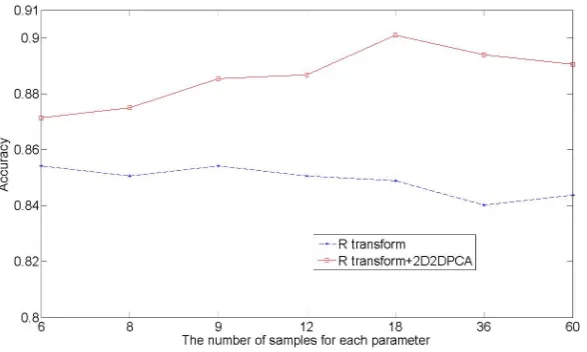
There are two parametersθandϕin the 3DRtransform used to compute the proposedR feature. We evaluated the effect of the sampling intervals of these two parameters on theR feature on the KTH dataset. Moreover, we tested to see if the performance is improved by ap-plying (2D)2PCA to refine the feature obtained from theRtransform. We performed leave-one-person-out cross-validation to make the performance evaluation on the KTH database.
Fig. 5: Sample frames from video sequences of the KTH dataset (the top row), the UCF sports dataset (the second row), the UCF feature films dataset (the third row), and the Hol-lywood2 dataset (the bottom row).
Fig. 6: Recognition accuracy obtained by theRtransform feature and the (2D)2PCA feature with respect to seven different samplings of the two parametersθandϕon the KTH dataset.
5, and 3. The blue curve is the obtained recognition accuracy using theRtransform feature without (2D)2PCA, and the red curve is the recognition accuracy using the (2D)2PCA to
refine theRtransform feature. From Fig. 6, the following points are observed.
(1) The sampling frequency has little influence on the final result. The best accuracy of 91.67% was obtained when the sampling intervals ofθandϕwere both set to 10. (2) The features obtained by (2D)2PCA yield a higher recognition accuracy in most
[image:19.595.97.391.301.477.2]1020 304050 60 10 20 30 40 50
60 1020 304050 60 10 20 30 40 50
60 1020 3040 5060 10 20 30 40 50
60 10 203040 5060 10 20 30 40 50
60 10 203040 5060 10 20 30 40 50
60 102030 405060 10 20 30 40 50
60 102030 405060 10 20 30 40 50
60 1020 304050 60 10 20 30 40 50
60 1020 304050 60 10 20 30 40 50
60 1020 3040 5060 10 20 30 40 50 60
1020 304050 60 10 20 30 40 50
60 1020 304050 60 10 20 30 40 50
60 1020 3040 5060 10 20 30 40 50
60 10 203040 5060 10 20 30 40 50
60 10 203040 5060 10 20 30 40 50
60 102030 405060 10 20 30 40 50
60 102030 405060 10 20 30 40 50
60 1020 304050 60 10 20 30 40 50
60 1020 304050 60 10 20 30 40 50
60 1020 3040 5060 10 20 30 40 50 60
02040 6080100120 0 0.02 0.04 0.06 0.08 0.1 0.12 0.14
020 406080100120 0 0.05 0.1 0.15 0.2 0.25
020 406080 100120 0 0.02 0.04 0.06 0.08 0.1 0.12 0.14 0.16 0.18 0.2
0204060 80100120 0 0.05 0.1 0.15 0.2 0.25 0.3 0.35
0204060 80100120 0 0.05 0.1 0.15 0.2 0.25 0.3 0.35
02040 6080100120 0 0.05 0.1 0.15 0.2 0.25
02040 6080100120 0 0.05 0.1 0.15 0.2 0.25 0.3 0.35
02040 6080100120 0 0.02 0.04 0.06 0.08 0.1 0.12 0.14 0.16 0.18 0.2
020 406080100120 0 0.02 0.04 0.06 0.08 0.1 0.12 0.14 0.16 0.18 0.2
020 406080 100120 0 0.02 0.04 0.06 0.08 0.1 0.12 0.14 0.16 0.18 0.2
02040 6080100120 0 0.05 0.1 0.15 0.2 0.25 0.3 0.35
020 406080100120 0 0.05 0.1 0.15 0.2 0.25 0.3 0.35
020 406080 100120 0 0.05 0.1 0.15 0.2 0.25
0204060 80100120 0 0.05 0.1 0.15 0.2 0.25 0.3 0.35
0204060 80100120 0 0.05 0.1 0.15 0.2 0.25 0.3 0.35
02040 6080100120 0 0.05 0.1 0.15 0.2 0.25 0.3 0.35 0.4 0.45
02040 6080100120 0 0.1 0.2 0.3 0.4 0.5 0.6 0.7
02040 6080100120 0 0.05 0.1 0.15 0.2 0.25 0.3 0.35 0.4 0.45 0.5
020 406080100120 0 0.05 0.1 0.15 0.2 0.25 0.3 0.35 0.4 0.45 0.5
[image:20.595.73.418.74.244.2]020 406080 100120 0 0.05 0.1 0.15 0.2 0.25 0.3 0.35 0.4 0.45
Fig. 7: Representative frames,Rfeatures and histogram features of 20 videos from the ro-bustness dataset. The top two rows from left to right and from top to bottom are the represen-tative frames of videos for walk when swinging a bag, walk when carrying a briefcase, walk with a dog, walk with knees up, limping, moonwalk, walk with occluded feet, normal walk, walk occluded by a ”pole”, walk in a skirt, and walk in ten different viewpoints (varying between 0 and 81 relative to the image plane with steps of 9) respectively. The remaining rows show the correspondingRfeatures and histogram features.
These points demonstrate thatRtransform feature is an effective descriptor and the (2D)2PCA
further improves the discrimination of theRtransform feature. In all other experiments on the five datasets, we set the sampling intervals ofθandϕto 10 and employed (2D)2PCA on
theRtransform to obtain the finalRfeature in the form of an 18×18 matrix.
5.2 Robustness Evaluation for the ProposedRFeature
We evaluated the robustness of the proposedRfeature with respect to challenging factors such as changes in viewpoint, changes in clothes and motion styles, etc. We performed ex-periments on the robustness dataset [2]. The robustness dataset includes two video sequence sets, the deformed set and the multi-view set. The deformed set includes ten test video se-quences of people walking in various difficult scenarios in front of different non-uniform backgrounds. The multi-view set includes ten sequences respectively showing the “walk” action captured from a different viewpoint (varying between 0 and 81 relative to the im-age plane with steps of 9). The representative frames of all videos in robustness dataset are shown in the top two rows of Fig. 7.
not change very much. Therefore, in this case theRfeature is more efficient due to capturing the whole geometric information.
The classification results of these two methods are listed in Table 1. Since the test sam-ples have large intra-class variance and many of them have small inter-class difference from some samples with the “jog” or “run” classes in the training set, it is difficult to classify all test samples correctly. For the histogram feature based method, 5 out of 20 videos in the robustness dataset are wrongly classified. The algorithm in [27] correctly classified 9 se-quences on the deformed set and 6 sese-quences on the multi-view set, with all the confusions being between the walking and jogging classes. Wanget al. [45] only tested on the deformed set and correctly classified 8 sequences as listed in Table 1. However, the proposed R feature based method is better for dealing with cases in which there are large intra-class variance and small inter-class difference, and achieved a correct classification of all the videos. This shows that theRfeature has relatively low sensitivity to considerable changes in scale, view-point and clothes, high irregularity in walking forms, etc.
In order to further evaluate the proposed R feature, we performed the experiments where some “jog” videos from the KTH dataset are used as the test set together with the robustness dataset. Hence, there are two action classes, “walk” and “jog”, in the test set. Specifically, we chose the robustness dataset and all four “jog” videos performed by one person in the KTH dataset as the test set, and used the remaining videos in the KTH dataset as the training set in each run. The final results were the averages from 25 runs, since there are in total 25 subjects in the KTH dataset. We tested two methods, the histogram feature based method and theRfeature based method. The histogram feature based method achieved accuracies of 75% and 80.21% for the “walk” class and the “jog” class respectively. The R feature based method achieved accuracies of 100% and 83.33% for the “walk” class and the “jog” class respectively. The R feature based method outperforms the histogram feature based method for both action classes. Moreover, when the test set included the “jog” videos, the R feature based method still achieved a correct classification of all the “walk” videos in the robustness dataset.
5.3 Parameter Evaluation for the Context-aware Kernel
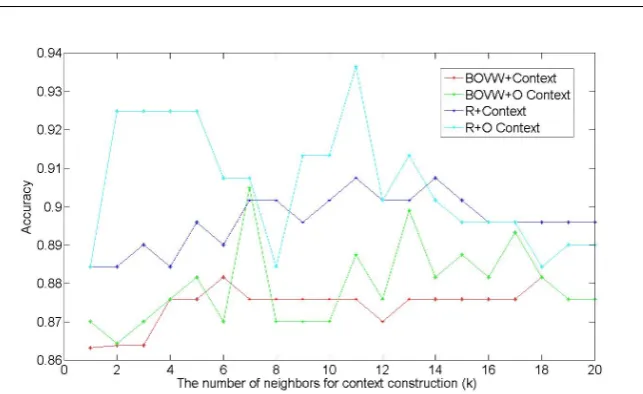
We have proposed two kinds of context-aware kernels, one based on thekNN probabilistic hypergraph and the other one based on an optimized probabilistic hypergraph. Both of these two kernels have only one parameterk, which is the number of neighbors for hyperedge construction. We evaluated the parameterkon the KTH dataset. In the BOVW model, the size of codebook was set to 500. We tested four methods as follows.
(1) The BOVW based histogram feature was used. The final kernel for SVM classification was the combination of the pairwise kernel and the context-aware kernel constructed from thekNN probabilistic hypergraph. This method is referred to as ‘BOVW+Context’. (2) The BOVW based histogram feature, was still used, but the final kernel for SVM clas-sification was the combination of the pairwise kernel and the context-aware kernel con-structed from the proposed optimized probabilistic hypergraph. The optimized proba-bilistic hypergraph is obtained by a large margin nearest neighbor (LMNN) algorithm. This method is referred to as ‘BOVW+O Context’ which differs from ‘BOVW+Context’ just in adding the distance metric learning based on LMNN.
Table 1: Recognition results for Wang and Suter[45] method, the BOVW method, and the proposedRfeature method on the robustness dataset.
Test Sequence Wang and Suter[45] BOVW R feature walk with swinging a bag walk walk walk walk with carrying a briefcase walk walk walk walk with a dog run walk walk walk with knees up walk walk walk walk with limping walk jog walk
moonwalk jump jog walk
walk with occluded feet walk walk walk normal walk walk walk walk walk occluded by a ”pole” walk walk walk walk in a skirt walk walk walk
Test Sequence BOVW R feature Walk in 00 walk walk
Walk in 90 walk walk
Walk in 180 walk walk Walk in 270 walk walk Walk in 360 walk walk Walk in 450 walk walk
Walk in 540 walk walk
Walk in 630 jog walk
Walk in 720 jog walk
Walk in 810 jog walk
Fig. 9: Recognition accuracies of four methods with respect tok, the number of neighbors for context construction, on the UCF sports dataset.
(4) The proposedRfeature was used together with the combination of kernels in method (2). This method is referred to as ‘R+O Context’.
Fig. 8 shows the experimental results of the above four methods, with values of param-eterkin the range 1 to 20. From Fig. 8, it can be seen that the accuracy does not vary much withk. But, whenkis less than or equal to 5, the accuracies are a little higher than most of those whenk is larger than 5. This is probably because that there are large intra-class variances for the videos with same action class. On the KTH dataset, each person performs each class of actions four times. Hence, the four videos with the same action performed by one person are usually very similar but a number of videos with the same action performed by different persons differ greatly.
Besides, from Fig. 8 it can be seen that the optimized probabilistic hypergraph based context-aware kernel approaches (‘BOVW+O Context’, ‘R+O Context’) outperform the
kNN probabilistic hypergraph based context-aware kernel approaches (‘BOVW+Context’, ‘R+Context’) in most cases. However, the improvement of ‘BOVW+O Context’ compared with ‘BOVW+Context’ is not very large for the following reasons. On the KTH dataset, for each action class there are about 100 samples. By the leave-one-person-out cross-validation, there are still about 96 samples for each action class in the training set. So for ‘BOVW+Context’, theknearest neighbors in the construction of the probabilistic hypergraph have the same ac-tion class as the centroid vertex with a large probability, whenkranges from 1 to 20. In this situation, the optimized probabilistic hypergraph learnt by LMNN in ‘BOVW+O Context’ is similar to the probabilistic hypergraph in ‘BOVW+Context’. Therefore the improvement is only marginal.
Fig. 10: Recognition accuracies of four methods with respect tok, the number of neighbors for context construction, on the feature films dataset.
to 3 in order to achieve relatively good results and at the same time to reduce computational cost.
5.4 Experiments on the KTH Database
The KTH video database contains six types of human actions (walking, jogging, running, boxing, hand waving and hand clapping) performed by 25 subjects in four different sce-narios: outdoors, outdoors with scale variation, outdoors with different clothes and indoors. There are in total 599 sequences in the dataset. We performed leave-one-person-out cross-validation to make the performance evaluation. In each run, 24 subjects’ videos were used as the training set and the remaining one person’s videos as the test set. The final results were the averages from 25 runs.
Table 2: Comparison of three groups of methods on the KTH dataset.(%)
KTH box hand clap hand wave jog run walk Average BOVW 95.83 90.63 95.83 75.00 80.21 92.71 88.37 R 94.79 95.83 92.71 82.29 89.58 94.79 91.67 BOVW+Context 95.83 92.71 95.83 75.00 81.25 94.79 89.23 BOVW+O Context 96.88 92.71 95.83 77.08 79.17 94.79 89.41 R+Context 96.88 94.79 92.71 85.42 88.54 98.96 92.88 R+O Context 100 91.67 93.75 89.58 88.54 98.96 93.75 feature-fusion 98.96 97.92 95.83 86.46 90.63 95.83 94.27 kernel-fusion 97.92 98.96 95.83 87.50 88.54 98.96 94.61 Yuanet al.[53] BOVW+R 97.92 95.83 94.79 85.33 89.58 97.92 93.23 Yuanet al.[53] R+BOVW 100 98.96 96.88 87.50 89.58 100 95.49 ours 98.96 100 100 89.58 93.75 100 97.05
.95 .03 .01 .00 .01 .00 .02 .96 .02 .00 .00 .00 .04 .03 .93 .00 .00 .00 .00 .00 .00 .82 .10 .07 .00 .00 .00 .09 .90 .01 .00 .00 .00 .05 .00 .95
box handclap handwave jog run walk
box handclaphandwavejog run walk
Fig. 11: The confusion matrices for the proposed methods on the KTH dataset. The left one is based on the proposedRfeature. The right one is based on the two features and our MKL approach.
For the similarity kernel-level fusion approach, we separately computed the similarity matrix for each feature, and then utilized the weighted sum of the two obtained similarity matrices as the final kernel of SVM, which is formulated as follows:
K2(vi,vj)=αA(Hi,Hj)+(1−α)A(Gi,Gj), (29)
whereαis the weight coefficient and is decided by the cross-validation method. Yuanet al.[53] use one feature for context selection and a second feature for context-aware ker-nel computation. Since two features are used for these two steps, there are two methods, ‘BOVW+R’ and ‘R+BOVW’ with the former for context calculation and the latter for ker-nel calculation. Our fusion method combined four kerker-nels via multiple kerker-nel learning for action classification described in Subsection 4.3.
Table 2 lists the three groups of experimental results on the KTH dataset. Fig. 11 shows the confusion matrices of theRfeature based method and our fusion method on the KTH dataset. Table 2 shows the following points.
(2) All the context-aware kernel based methods (‘BOVW+Context’, ‘BOVW+O Context’, ‘R+Context’, ‘R+O Context’) outperform the corresponding traditional pairwise kernel based methods (‘BOVW’, ‘R’). Both of the context-aware kernels improve the recogni-tion performance.
(3) The optimized probabilistic hypergraph based context-aware kernel methods (‘BOVW+O Context’, ‘R+O Context’) outperform thekNN probabilistic hypergraph based context-aware kernel methods (‘BOVW+Context’, ‘R+Context’). It demonstrates that the opti-mized probabilistic hypergraph further enhances the performance by utilizing the dis-tance metric learning based on LMNN. This is because that the disdis-tance metric learning makes hyperedges in the optimized probabilistic hypergraph be pure and then prevents interference of other action classes.
(4) The methods for fusing two features all achieve higher accuracies than the single fea-ture based methods. TheRfeature and the BOVW model based histogram feature are complementary and their combination improves action recognition.
(5) Our fusion method obtains higher accuracy than the other two common fusion methods, which demonstrates the effectiveness of our proposed fusion strategy.
5.5 Experiments on the UCF Sports Dataset
The UCF sports dataset consists of 150 action videos including 10 sport actions, diving, golf swinging, kicking, weightlifting, horseback riding, running, skating, swinging Bench, swinging from side angle, and walking. It contains a natural pool of actions featured in a wide range of scenes and viewpoints, and in unconstrained environments.
The UCF sports database was tested in a leave-one-out manner, cycling through the test videos one at a time, following [30] [14] [51]. In the BOVW model, the size of the codebook was 800. On the UCF sports database, we performed three groups of experiments similar to those on the KTH dataset. The results are shown in Fig. 12. Similar results to those for the KTH dataset were obtained. This demonstrates the effectiveness of our proposedRfeature and fusion method on a realistic and complicated dataset. The overall average accuracy for the UCF dataset using our method is 90.67%.
Fig. 12: Comparison of three groups of methods on the UCF sports dataset. (a) is the recog-nition accuracy comparison of the single feature based methods. (b) is the recogrecog-nition accu-racy comparison of the four context-aware kernel methods. (c) is the recognition accuaccu-racy comparison of three fusion methods.
5.6 Experiments on the UCF Feature Films Dataset
.64.21 .00 .00 .07 .00 .00 .07 .00 .00 .11.56.00 .06 .00 .11 .06 .00 .06 .06 .00 .001.0.00 .00 .00 .00 .00 .00 .00 .00 .00 .001.0.00 .00 .00 .00 .00 .00 .08 .00 .00 .08 .50 .17 .00 .17 .00 .00 .00 .23 .00 .00 .00.69.00 .00 .08 .00 .00 .00 .00 .00 .00 .001.0.00 .00 .00 .00 .00 .00 .00 .05 .00 .00.95.00 .00 .00 .08 .00 .00 .00 .00 .00 .08.77.08 .00 .00 .00 .00 .00 .09 .00 .05 .00.86
Dive Golf Lift Kick Ride Run Skate Swing1 Swing2 walk
[image:28.595.86.394.82.214.2]DiveGolfLift KickRideRunSkateSwing1Swing2walk
Fig. 13: The confusion matrices for the proposed methods on the UCF sports dataset. The left one is based on the proposeRfeature. The right one is based on the two features and our MKL method.
Table 3: Comparison of our method with state-of-the-art methods on the KTH and UCF sport datasets. (%)
KTH UCF sport Our method 97.05 90.67
Bregonzioet al.[3] 93.17 -Bregonzioet al.[4] - 86.9 Sunet al.[37] 94.0 -Yeffet and Wolf [51] 90.1 79.2 Wanget al.[42] 92.1 85.6 Kovashkaet al.[14] 94.53 87.27 Leet al.[19] 93.9 86.5 Wanget al.[40] 94.2 88.2 Yuanet al.[53] 95.49 87.33
method shows a higher performance. Bregonzioet al.[4] achieve an accuracy of 96.75% which is a little lower than our method on the UCF feature films dataset. But Bregonzioet al.[4] achieve an accuracy of 86.90% which is much lower than our 90.67% on the UCF Sport dataset.
5.7 Experiments on the Hollywood2 Dataset
[image:28.595.166.324.319.428.2]Table 4: Comparison of our method with state-of-the-art methods on the UCF feature films dataset. (%)
Kiss Slap Average Rodriguezet al.[30] 66.4 67.2 66.8 Yeffet and Wolf [51] 77.3 84.2 80.75 Oshinet al.[28] 82.4 77.2 79.8 Wuet al.[48] 97.6 94.4 96.0 Bregonzioet al.[4] 97 96.5 96.75 BOVW 85.4 89.4 87.4 R 95.8 83.1 90.7
Ours 98.96 95.29 97.24
Table 5: Comparison of our method with state-of-the-art methods on Hollywood2 dataset. (%)
3D SIFT R HOG[42] HOF[42] mAP 49.68 42.84 39.4 45.8
Ours Wang[42] Le[19] Wang[40] mAP 57.39 47.7 53.3 58.3
feature. Wanget al.[40] utilized four features (trajectory, HOG, HOF, and MBH) and em-ployed a dense sampling strategy. The result is 54.6% using the KTL tracking. Our method achieves comparable results to Wanget al.[40]. The proposedRfeature does not achieve the best result among the one feature based method, but the combination with the SIFT feature highly improves the performance.
6 Conclusions
In this paper we have presented a new action recognition framework based on spatio-temporal interest points. First, we have proposed a new holistic descriptor, the 3DRtransform on spatio-temporal interest points, to capture the detailed global geometrical distribution. Sec-ond, we have proposed a new context-aware kernel to measure the similarity of video repre-sentations. The context-aware kernel models high-order relationships among video in order to overcome the disadvantage of the traditional pairwise context-free kernel, which is sensi-tive to noise and outliers in the data. Moreover, an optimized hypergraph has been proposed for context-aware kernel construction. It makes the context have the same action class as the centroid and prevents disturbance from other classes. Experimental results on several datasets have demonstrated the effectiveness of our proposedRfeature and context-aware kernel method.
[image:29.595.144.345.277.320.2]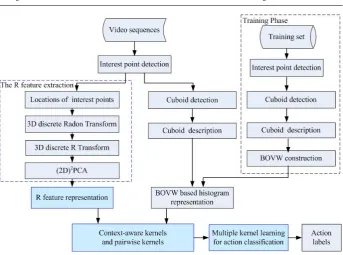

![Table 1: Recognition results for Wang and Suter[45] method, the BOVW method, and theproposed R feature method on the robustness dataset.](https://thumb-us.123doks.com/thumbv2/123dok_us/8867431.940625/22.595.108.382.122.578/table-recognition-results-suter-theproposed-feature-robustness-dataset.webp)