http://dx.doi.org/10.4236/am.2014.58104
Uncertainty in a Measurement of Density
Dependence on Population Fluctuations
Hiro-Sato NiwaNational Research Institute of Fisheries Science, Yokohama, Japan Email: [email protected]
Received 25 February 2014; revised 25 March 2014; accepted 1 April 2014
Copyright © 2014 by author and Scientific Research Publishing Inc.
This work is licensed under the Creative Commons Attribution International License (CC BY).
http://creativecommons.org/licenses/by/4.0/
Abstract
This article discusses the question of how elasticity of the system is intertwined with external stochastic disturbances. The speed at which a displaced system returns to its equilibrium is a measure of density dependence in population dynamics. Population dynamics in random envi-ronments, linearized around the equilibrium point, can be represented by a Langevin equation, where populations fluctuate under locally stable (not periodic or chaotic) dynamics. I consider a Langevin model in discrete time, driven by time-correlated random forces, and examine uncer-tainty in locating the population equilibrium. There exists a time scale such that for times shorter than this scale the dynamics can be approximately described by a random walk; it is difficult to know whether the system is heading toward the equilibrium point. Density dependence is a con-cept that emerges from a proper coarse-graining procedure applied for time-series analysis of population data. The analysis is illustrated using time-series data from fisheries in the North At-lantic, where fish populations are buffeted by stochastic harvesting in a random environment.
Keywords
Population Dynamics, Stochastic Difference Equation, Noise Color, Coarse Graining, Ecological Time-Series
1. Introduction
examining the time-series data of 1198 species, demonstrated a relationship between length of monitoring and increasing evidence for density dependence. However, the duration of a time-series necessary to distinguish a regulated population trajectory from a random walk is still uncertain [4] [5].
A relevant serious concern is the issue of noise color: how does the presence of serial correlation in the exter-nal stochastic forcing affect the density dependence in a population? Solow [6] demonstrated that, when a statis-tical test of density dependence being applied to time series generated by a correlated random walk, the propor-tion of simulapropor-tions for which the null hypothesis (random walk model) was rejected was far greater than the sig-nificance level for negatively correlated variations (blue noise), and much smaller for positive autocorrelation (red noise). The effects of colored environmental variations on modulating the population elasticity have not been analyzed quantitatively.
This article investigates the analysis of ecological time-series when the aim is to measure density dependence in the demographic processes. The equilibration time [7] [8] of the stochastic process is an informative summary measure of the dynamics of a system, describing a key property of population dynamics [9] [10]. The reciprocal of equilibration time approximates the speed of return to the equilibrium point, i.e. the elasticity (expressing the same concept as the term “density dependence” or “negative feedback” in population dynamics). The objective of this article is to explore the relation between the length of monitoring and the uncertainty in measuring densi-ty dependence: how long of a time-series is required to be able to discriminate between densidensi-ty-dependent signal and external noise in the ecological systems? I start with a linear approximation of a discrete-time population dynamics model [11]-[16], where populations fluctuate slowly under locally stable (not periodic or chaotic) dy-namics with low to moderate elasticity [17]. The analysis is illustrated using time-series of annual census of ex-ploited fish populations in the North Atlantic.
2. Population Dynamics
2.1. Discrete-Time Langevin Equation
The population renewal process S t
( )
of marine exploited fishes, responding to stochastic harvesting in a sto-chastic environment, is described by a discrete-time dynamics( )
1(
( )
)
( ) ( ) ( )
1 1S t+ = Λ S t S t + Ξ + −t Y t+ (1) with a growth-survival factor Λ dependent on spawner abundances S, i.e. the escapement of adults from the harvest Y. The population biomass grows as a result of, not only growth of the surviving escapees in body weight, but also of recruitment of offspring Ξ. During year t an amount Y t
( )
is harvested with a fraction( )
1 e− −F t to the harvestable adult population, where F t
( )
=ln 1 +Y t( ) ( )
S t denotes the fishing mortality. All density dependence is assumed to be exerted by the adult population S [16]. It is a common observation that recruitment is unrelated to egg numbers over a wide range of spawner abundances [18]-[20]. Stochasticity enters the population dynamics in two ways, both as environmental variation mirrored by recruitment variability and as variation in the fishing mortality. Recruitment is presumed to track autocorrelated fluctuations in environmental variables. Fishers would expect this year to get as much catch as last year; there would also be some kind of in-ertia of fisheries management. There exist memory effects: adjacent values in the time-series of recruitment and catches-to-escapement ratio are correlated [21].In a stationary state (with equilibrium quantities denoted by the “” subscript), Equation (1), log-transformed, gives ln 1
(
−w)
+F=lnΛ( )
S with the stationary fishing mortality F=ln 1(
+Y S)
, where w= Ξ(
S+Y)
is the stationary ratio of each year’s recruitment to the harvestable adult population. The relative deviations from equilibrium point are denoted as n t
( )
=ln(
S t S( )
)
, η1( )
t =wln(
Ξ( )
t Ξ)
, and η2( )
t =F−F t( )
. Natural and human-caused forces(
η η1+ 2)
are considered as external disturbances. On the assumption that we are free to change Ξ and F independently of S around the equilibrium point, linearizing (log-transformed) Equation (1) yields a difference equation(
) ( )
( )
2(
)
1
1 i 1
i
n t n t γn t η t
=
+ − = − +
∑
+ (2)tem-porally structured noise, ηi’s are both assumed to be described as a first-order autoregressive, AR(1), process
with serial correlation coefficients λ ∈ −i
(
1,1)
and driven by mean-zero iid shocks. The linear stochastic dif-ference Equation (2) is a discrete-time analogue of the Langevin equation driven by AR(1) processes. The auto-regression coefficients are calculated by using the von Neumann’s ratio [22] [23], the ratio of the mean square successive difference σ∆2ηi to the variance ση2i for AR(1) variable ηi, that is,2 2
1 2
i i
i η η
λ = −σ∆ σ . Equation (2) is iterated to give the ∆t-year difference of population size
(
) ( )
(
)
( )
2 1(
)
0 0 1 0 1 t t j i i j
n t t n t λ n t λ η t t j
∆ − ∆
= =
+ ∆ − = − − +
∑∑
+ ∆ − (3)with λ0= −1 γ .
2.2. Equilibration Time
The population process with multiple decay-rate constants
(
−lnλi,i∈{
0,1, 2}
)
is considered to calculate the asymptotic decay-time constant Teq, i.e. the total equilibration time; the approach follows Roughgarden [11]. Let σˆη2i =ση2i(
1−λ λ0 i)
. Taking the mean squares over Equations (2) and (3) mediates the following tworela-tions, respectively,
2
2 2 2 2
1
ˆ 2
i
r n i n
i
η
σ σ γ σ λ σ
=
= −
∑
(4)with the ratio of the mean square successive difference 2 r
σ to the variance 2 n
σ in population size n t
( )
, and( )
2 2 2(
)
0 1
ˆ
1 1
i
n i i
t i
t η
γ ∞ ρ σ− σ λ λ
∆ = =
∆ = + −
∑
∑
(5)with the autocorrelation function of series n t
( )
at lag ∆t years( )
2 2 2 00 1 0 ˆ , i t t t i n i i i t η λ λ
ρ λ σ σ λ
λ λ ∆ ∆ ∆ − = − ∆ = + −
∑
(6)where the correction (the second term on the right-hand-side) is due to memory effects of external perturbations. From the recursion,
( )
21 0 0(
)
j i
i j
n t =
∑ ∑
= ∞= λ η t−j , a corollary to Equation (5) is obtained:(
)
(
)
2
2 2 2
0 0
1
ˆ
1 i 1 .
n i
i
η
σ λ λ σ λ
=
=
∑
+ − (7)Equations (4) and (7) yield the quadratic equation for the elasticity γ
(
)
22 2 2 2
1
1 i.
n r
i
η
γ σ γ σ σ
=
+ − =
∑
(8)Thus, the (linear) response of a system to external perturbations is expressed in terms of fluctuation properties of the system in equilibrium. The elasticity and the variance of population fluctuations cannot be independent, but they are related to each other in the equilibrium system [24].
The average relaxation time of population fluctuations defines the total equilibration time Teq as follows [24]
( )
(
eq)
0 0
exp .
t t
t t T
ρ
∞ ∞
∆ = ∆ =
∆ = − ∆
∑
∑
(9)After the time Teq memory of the initial conditions is lost: the deviation from the equilibrium is expected to decay away in an exponential fashion with a time constant given by the equilibration time Teq. The total elastic-ity with respect to change in population size measures the strength D of total density dependence [10] [16]:
( ) ( ) ( )
En t+ −1 n t n t =n= −Dn,
i.e. the expectation of change in population size given n t
( )
=n is equal to 100 × D percent negative feedback. Since the total density dependence is the asymptotic multiplicative growth rate of population per year,(
)
ln 1 D
de-pendence reads
eq
1 1 e T .
D= − −
Therefore, the density dependence D and the variance of population fluctuations are related to each other through the relation D−1=
∑
∞∆ =t 0ρ( )
∆t with Equation (5).2.3. Indeterminacy in Population Dynamics Equation (2) with (8) yields
(
) ( )
( )
(
)
2 2 2 1 2 2 2 1 1 1 1 i in n i
r r n r
i t
n t n t n t
η
η
σ σ
γ γ γ
σ σ σ σ
σ = = + + − = − + − +
∑
∑
(where each term is standardized), implying that, if a population is governed by slowly damped dynamics
(
0< <γ 1)
, external noises mask signals for evidence of deterministic behavior of the system. Unless the popu-lation exhibits damped-oscillator dynamics (i.e. over-compensation, 1< <γ 2), the relationship between r t( )
and n t
( )
is characterized by large variance in growth rate; most of the changes in population size occur in a density-independent manner. If a perturbation brings the system away from the equilibrium point such that(
)
(
2 2 2)
1 1n n r
n >σ + −γ γ σ σ , then the deterministic signal becomes visible over the noise; using Equations (4)
and (5) this inequality reduces to
c π n
n σ L
with
(
1 eq)
c 1 2 e 1 π.
T
L = + −
When one performs some observations for L years, the uncertainty in locating the population equilibrium,
[ ]
SD
n n
∆ = , i.e. the standard deviation of the sample mean n=
∑
Lt=1n t( )
L, propagates into the density de- pendence. The variance of n is written as [13] [16],[ ]
2(
)
2, 1
Var n =σn
∑
i jL= ρ i−j L . Making use of the expli-cit form for the autocorrelation function (6) yields
[ ]
2( )
0
Var n 2 1
t
n t
L L
σ ∞ ρ ζ
∆ = = ∆ − +
∑
with(
)
(
)
(
)
(
)
(
)
(
)
2 20 0 0 0
2 2 2 2
1 0
0 0
2 1 ˆ 2 1 1
.
1 1 1
i
L L L
i i
i
i n i i
η
λ λ σ λ λ λ λ λ
ζ
λ λ
σ
λ = λ λ
− − − = − − − − −
∑
− − By virtue of Equation (9), a time-equilibrium uncertainty relation is obtained:
( )
3 2c π ,
n
n σ L L L−
∆ = + (10)
where
( )
L−3 2 denotes a remainder term of order L−3 2 given by 3 2 c π 4L L
ζ − . Thus, L
c provides another
measure of the time scale of population dynamics, and reads
( )
1c 2π eq eq
L = T + T− for D<1 with large valued eq
T . Any observation over a short duration is associated with large indeterminacy. The supposed population equilibrium lnS (chosen as the sample mean) and the length of time-series data are complementary: the un-certainty of population equilibrium is decreased by increasing the duration of observation. Lc is designated the
2.4. Coarse Graining
Let CL be the degree of certainty, with which the supposed equilibrium lies within the bounds
( ) ( )
En t n t 0:
(
)
Pr 2 π
L n
C = n ≤σ
for normally distributed population fluctuations (with the true (population) standard deviation σn). This is
equivalent to Pr
(
n ∆n 2L Lc)
. Let[ ]
⋅±(
=∑
{t n t( )0}[ ]
⋅ #n t( )0)
be the sample mean, taken under the con-dition that n is larger (smaller) than the supposed equilibrium point, where #n t( )0 is the number of observa- tions n t
( )
0 in the time-series. The negative relationship of conditional sample mean of growth rate,[ ]
r ±, versus[ ]
n± is expected to be visible with a probability CL. The larger the probability CL, the more accuratelythe density dependence D is measured from the population time-series.
In order to calculate the probability CL, I analyze the time-series at different resolutions by constructing a
coarse-grained time-series. Let ⋅ and ⋅ be the ceil and the floor functions. The coarse-grained time-series is built by taking the average inside a non-overlapping moving window with Teq data points,
( )
( )( )
eq eq eq eq eq 1 1, 1, , .
j T
T
i j T
n j n i T j L T
= − + =
∑
= The coarse-grained time-series are considered to be serially independent. Accordingly, the uncertainty of population equilibrium (the standard deviation of the mean) is calculated to be
eq 1 2 eq SD , T n n L T ∆ =
and the statistic
eq eq 1 2 eq SD T T n n
n = n L T
∆
(11)
has a standard Gaussian distribution. In reality, we only have the sample standard deviation. So, replacing
eq
SDnT in Equation (11) by the square root of the sample variance,
(
eq( )
(
)
)
eq 1 2 2 eq 1 1 L T Tj n j L T
= −
∑
,yields a statistic which has Student’s t-distribution with L T eq − 1 degrees of freedom (d.f.); we can use the Student’s t-statistic to see how good the estimate of equilibrium population size. The value of CL, i.e. the
integral of Student’s t-PDF between ± 2L Lc , quantifies the ability to infer density dependence from a given (long) observation time-series, and 2L Lc is the two-tailed 100× −
(
1 CL)
percentage point of Student’st-distribution with d.f.=L T eq −1. Accordingly, the following holds
( )
(
)
c 1 2 eq
2 1
L
C
L L =t − L T − (12)
(precisely the left-hand-side involves the remainder term of order L−1 2). After L years’ observation the negative relationship is visible with a probability of CL. Equation (12) with L=Lc and Lc=2πTeq yields
(
)
Pr 2 0.784
L
C = n ∆ ≤n = , implying that, when the observation series is longer than Lc years, the negative
reads 1−CL; the sample mean growth rate
[ ]
r ±0 will then be observed, even when L>Lc. The densitydependence will be invisible with a probability of 1−CL, that is, it has a tendency to overshoot and to leave the
center point n (i.e. sample average). 2.5. North Atlantic Fisheries
Empirical analysis [21] [25] suggests that population time-series from the North Atlantic fisheries are asymptot-ically stationary. The notion of asymptotic stationarity means that the probability density function of the variable monitored over a wide time interval exists and it is uniquely defined. The logarithmic changes in annual spawn-er abundance, r t
( )
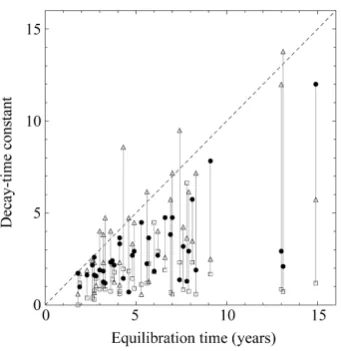
, are Gaussian distributed and the observed mean r’s are not significantly different from zero. There is no important overall trend in spawner abundance, as expected in the equilibrium system [3].I now apply the theory for measuring density dependence to time series of North Atlantic commercial species, which are the same as the fish stocks analyzed in [26]; there are 38 populations of ten species, cod (Gadus mor-hua), haddock (Melanogrammus aeglefinus), herring (Clupea harengus), mackerel (Scomber scombrus), plaice (Pleuronectes platessa), saithe (Pollachius virens), sardine (Sardina pilchardus), sole (Solea solea), sprat (Sprattus sprattus), and blue whiting (Micromesistius poutassou). Data are extracted from the 2008 working group reports of the International Council for the Exploration of the Sea (ICES) [27]. The length of examined time-series ranges from 23 to 60 years. Estimates of model parameters are plotted against the equilibration time
eq
T in Figure 1. The estimates of D and Lc are 0.06≤ ≤D 0.43 and 11.5≤Lc≤93.7 years.
For a sufficiently long ∆t, Equation (3) with medium elasticity
(
− <1 λ0<1)
yields(
) ( )
( )
(
)
,n t+ ∆ −t n t = −n t +η∞ t+ ∆t
where η∞ denotes time-independent random forcing with mean 0 and variance 2 n
σ . This coarse-grained equa-tion implies that, while for n<σn the signals (∆t-year growth rate) are at the level of noise, if the system is displaced
(
n >σn)
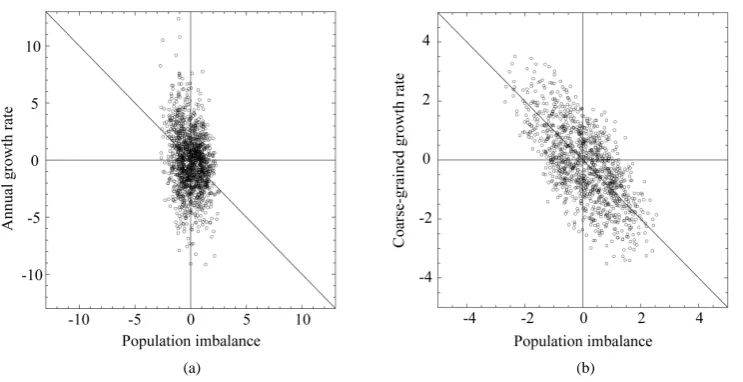
away from the equilibrium point, the negative relationship becomes visible over the noise on time scales longer than the marginal, equilibration time. Figure 2 demonstrates that though, when plotting annual growth rate against population size, the relationship well looks like a shotgun pattern, when(
eq)
( )
y=n t+ T −n t is plotted against x=n t
( )
, the negative feedback effects are visible, i.e. y0 forn
[image:6.595.229.400.462.638.2]x±σ .
Figure 1. Estimates of decay-time constants of the North Atlantic systems. The equilibration time Teq of each population is compared
with the decay-time constants
(
−1 lnλi,i∈{
0,1, 2}
)
inherent in the system and for the time-series of recruitment and catches-to- escapement ratio. The solid circles refer to λ0, and the open squares[image:7.595.131.503.80.271.2]
(a) (b)
Figure 2. Population growth diagram of the North Atlantic fishes on fine- and coarse-grained time- scales. (a) The diagrams of annual growth rate (divided by total density dependence D) versus popu-lation abundance of the examined fishes are aggregated and plotted. (b) The coarse-grained diagrams demonstrate that the negative relationship is visible between Teq-year growth rate and population
im-balance from equilibrium. The axes are scaled by σn. The lines represent y = −x.
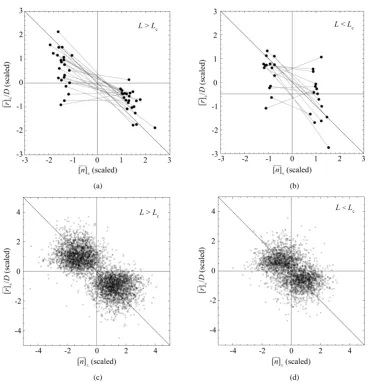
After averaged over sizes n0 in the time-series data over L>Lc years, the negative relationship can be
seen with a predicted probability CL0.78, whereas the dependence of
[ ]
r ± on[ ]
n ± in the data comprisingc
L<L years is rather vague (upper panels ofFigure 3). Besides, I perform simulations to validate the criterion for visibility of density-dependent relationship. For simulations based on the population equation of motion (2) with the AR(1) model for the variations in the recruitment and the fishing mortality, I use parameter values that are obtained by analyzing the ICES time-series data sets. When plotting the simulated diagrams of mean growth rate versus mean abundance, conditioned on n0, for the populations observed over L>Lc years, the data
are divided into two piles; for L<Lc, the gap between the piles is closed up (lower panels ofFigure 3). Of
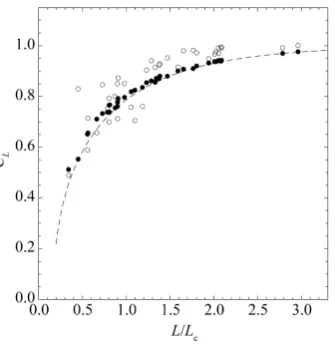
1000 simulations for each population, the proportion of simulations in which the negative feedback on the sam-
ple mean growth rate is observed (i.e.
[ ]
r ±0) is plotted inFigure 4.3. Intertwining of Stochastic Processes
In this section, I discuss the effects of multiple noise sources and noise color on measuring density dependence.
3.1. Delayed Density Dependence
Recently, Ives et al. [10] developed a pragmatic approach based on the autoregressive moving average (ARMA) model to assessment of ecological time-series, and identified the lagged structure in the data as the ARMA order. The time-lagged density-dependent effect in population fluctuations appears: the direction of annual change in population size depends on the past population trajectory.
Consider the system perturbed by multiple noise sources, where external perturbations ηi follow AR(1) with
autoregression coefficient λi, driven by mean-zero iid random shocks εi, under the assumption of mutual
in-dependence of ηi’s (i=1,,p−1; note that the results obtained in the above section can be generalized to an
arbitrary number of environmental variables). Start by picking a variable η1 to eliminate, and substitute
( ) ( )
( )
1( )
1 0 1 2
p i i
t n t n t t
η λ −η
=
= − − −
∑
into both sides of the AR(1) equation η1(
t+ =1)
λη1 1( )
t +ε1(
t+1)
; this procedure, repeated to eliminate ηi(
i=2,,p−1)
one by one from the simultaneous equations, yields the ARMA(
p p, −2)
model( )
(
)
2(
)
1 0
p p
n t τn t τ t
τ τ
β τ − τ
= =
=
∑
− +∑
α ε⋅ −
(a) (b)
[image:8.595.129.503.82.467.2]
(c) (d)
Figure 3. Mean behavior of fish populations in the North Atlantic. Shown are the diagrams (scaled by 2∆n) of mean growth rate (divided by D) versus mean abundance, conditioned on a current population imbalance n t( )0. For the populations observed over L > Lc years (panel (a)), the
neg-ative feedback becomes statistically visible with a probability of CL0.78. For 15 of the 38 popu-lations examined, the time-series data comprise L < Lc years (panel (b)). In panels (c) and (d)
(show-ing the counterparts of panel (a) and (b), respectively), the simulated growth diagrams of North At-lantic fish populations are depicted. 100 pairs for each population are piled up.
i
β and αij are extracted by expanding the right-hand-side of the following pth- and
(
p−2)
nd-degree poly-nomials(
)
1
0 0
,
p p
p
i i
x τ x
τ τ
β − − λ
= =
= − −
∑
∏
(13)( )
(
)
12 2
0 1
, 1, 2, , 1.
p p
p
j i
i i j
x τ x j p
τ
τ α λ
− −
− −
= = ≠
= − = −
∑
∏
Since the characteristic equation for the pth-order AR component is
∑
ip=0βixp i− =0, the roots are found from Equation (13) to be λi(
i=0,1,,p−1)
. We see that the delayed density dependence in population dynamicsFigure 4. Degree of certainty. The values of CL are plotted against
L/Lc (solid circles for the North Atlantic fish populations). The
dashed line is calculated from Equation (12) with the approxima-tion Lc = 2πTeq. The open circles read CL estimated from 1000
si-mulated data sets.
( )
2(
)
( )
(
)
( )
2(
) ( )
1(
)
3 2
0 0 0
1 i 1 i j 1 i 3 ,
i i j i
n t n t n t n t τ t
τ
λ λ λ λ τ
= < = =
∆ = −
∑
− ∆ −∑
+ ∆ −∏
− +∑
α ε⋅ + −where ∆ denotes the differencing operation, and
{ }
ε( )
t is a sequence of two-dimensional independent ran-dom vectors. This third-order stochastic difference equation of population motion does not have an oscillatory solution (except for the period of two years), because λi’s are restricted between ±1. Figure 1 shows that thetime constant of the dominant mode (with the slowest decay rate determined by the maximum eigenvalue) disa-grees with the equilibration time Teq. The differential coefficient of Teq with respect to the variance ση21, for fixed constant λ1, is readily seen from Equation (5), as
(
)
21 1
eq 2
2 1
2 const
T
Q η
η λ
λ λ σ
σ =
∂
= − −
∂
with
(
)
(
) (
) (
)(
)
eq
2
1 2
eq 0 2 2
4
0 0 0
1
e 1 1
,
1 1 1 1
T
i i
n i i
i T Q
λ
σ λ λ λ λ λ
=
=
− +
=
− + − −
∏
∏
where the variance ση21 varies linearly with the variance of ε1. Accordingly, the equilibration time Teq is not determined solely by the eigenvalues λi’s, but depends on the amplitude σn of population fluctuations through
the driving noise εi of the AR(1) process ηi
( )
t .3.2. Noise Color
I have shown that apparently density-independent influences, which arise from colored environmental variations, modulate the population elasticity. In the following let us further analyze the impact of color of environmental variation on the total density dependence in a population. Here, for mathematical simplicity, the effects of re-cruitment fluctuations η1 are only taken into account on the variance in population abundance, where the
in-herent elasticity γ of the system is a given constant; the variance ση21 varies with the value of AR(1) coeffi-cient λ1 (the variance of ε1 is fixed at a constant).
(a) (b)
[image:10.595.127.501.85.351.2]
(c) (d)
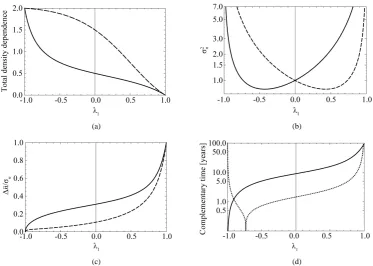
Figure 5. Effects of noise color on population processes. The total density dependence D (panel (a)), the variance 2
n
σ of population fluctuations (panel (b), semi-log scale), the uncertainty ∆nσn of
population equilibrium (panel (c)), and the complementary time (Lc+πζ L) including the re-
mainder term (panel (d), semi-log scale) are plotted as a function of environmental autocorrelation λ1,
where L = 30 and the inherent elasticity γ of the system is fixed as λ0(= −1 γ)=0.5 (solid line) or
−0.5 (dashed line). In panel (b), 2
n
σ is divided by the variance of population process driven by white noise. In panel (d), the dotted line represents the equilibration time Teq (indicating −1 ln 1−D for
D > 1), where λ0 = 0.5.
The total density dependence D decreases when redness of noise color is increased (an increase in the autocor-relation is denoted “increased redness”), and D→0 as λ →1 1 for any γ ∈
(
0, 2)
. The reduction in neg-ative feedback on population growth leads to a slowing down of the equilibration process: population fluctua-tions have very long relaxation times and the system returns to equilibrium very slowly. In the limit D→0, the population imbalance follows a random walk irrespective of the values of γ. In a blue environment, D→2 as
1 1
λ → − for any γ. In the limit D→2, the system is expected to behave as n t
(
+ = −1)
n t( )
+ε(
t+1)
(with a mean-zero iid random variable ε( )
t ), which is iterated to yield n t( ) ( )
+ =1 n t− +1 ε( ) ( )
t+ −1 ε t ; consequently, the amplitude jitter in the population oscillation exhibits a random-walk property and is non-sta- tionary (regardless of the value γ). In the limit λ → −1 1, while the system exhibits negative feedback, thepopulation is not regulated. Both λ → ±1 1 lead to reduction in population regulation, resulting in unstable
dy-namics: the amplitude σn of population fluctuations diverges asymptotically. Either way, λ0
(
= −1 γ)
0, the variance 2n
σ reaches a minimum at λ1= − +λ0
( )
λ03 . Note from Equation (13) that when∑
iλ =i 0, the temporal correlation of population fluctuations significantly decreases (fluctuations become white in time) and the population follows rapidly mean-reverting stochastic process. The effect of an increase in redness of noise is to enhance the uncertainty in locating the population equilibrium and the complementary time. In the limit1 1
λ → , we are far from the allowed certainty in measuring density dependence, ∆n σn →1 for any γ, re- gardless of L. It is also confirmed that ∆ → ∞n in both the limits λ → ±1 1; while in the limit λ → −1 1, the un-
certainty of population equilibrium diverges less rapidly than the standard deviation of population fluctuations,
4. Concluding Remark
Analyzing a stochastic process with slowly damped dynamics, I have derived the expression of complementarity between uncertainty in locating the population equilibrium and length of monitoring. The complementarity rela-tion imposes a limit on the degree of certainty to which a measurement of density dependence is known. The complementarity is an essential criterion for disentangling density-dependent signals from external noise in the population process. Looking at a long time-scale makes the negative feedback on population fluctuations visible. It is difficult to know whether the system is heading toward the equilibrium point in the time-series of length less than the complementary time. This implies that density dependence is a concept that emerges from applying a proper coarse-graining procedure for time-series analysis.
The approach taken in this article is based on linear approximation of a nonlinear stochastic model. A linear approximation applies for “small” perturbations from an equilibrium point, where the “smallness” should be measured relative to the range of the uncertainty of population equilibrium. Because a large uncertainty exists in determining the population equilibrium from short observation series in ecology, it is probable that the system spends most of its time “near” the equilibrium point; a linear approximation would be usually enough accurate.
References
[1] Sibly, R.M. and Hone, J. (2002) Population Growth Rate and its Determinants: An Overview. Philosophical Transac-tions of the Royal Society of London B, 357, 1153-1170. http://dx.doi.org/10.1098/rstb.2002.1117
[2] Hassell, M.P., Latto, J. and May, R.M. (1989) Seeing the Wood for the Trees: Detecting Density Dependence from Existing Life-Table Studies. Journal of Animal Ecology, 58, 883-892. http://dx.doi.org/10.2307/5130
[3] Brook, B.W. and Bradshaw, C.J.A. (2006) Strength of Evidence for Density Dependence in Abundance Time Series of 1198 Species. Ecology, 87, 1445-1451. http://dx.doi.org/10.1890/0012-9658(2006)87[1445:SOEFDD]2.0.CO;2 [4] Connell, J.H. and Sousa, W.P. (1983) On the Evidence Needed to Judge Ecological Stability or Persistence. American
Naturalist, 121, 789-824. http://dx.doi.org/10.1086/284105
[5] Hixon, M.A., Pacala, S.W. and Sandin, S.A. (2002) Population Regulation: Historical Context and Contemporary Challenges of Open vs. Closed Systems. Ecology, 83, 1490-1508.
http://dx.doi.org/10.1890/0012-9658(2002)083[1490:PRHCAC]2.0.CO;2
[6] Solow, A.R. (1990) Testing for Density Dependence: A Cautionary Note. Oecologia, 83, 47-49. http://dx.doi.org/10.1007/BF00324632
[7] Beddington, J.R. and May, R.M. (1977) Harvesting Natural Populations in a Randomly Fluctuating Environment. Sci- ence, 197, 463-465. http://dx.doi.org/10.1126/science.197.4302.463
[8] Shepherd, J.G. and Horwood, J.W. (1979) The Sensitivity of Exploited Populations to Environmental “Noise”, and the Implications for Management. Journal du Conseil International pour l’Exploration de la Mer, 38, 318-323.
http://dx.doi.org/10.1093/icesjms/38.3.318
[9] Ives, A.R., Dennis, B., Cottingham, K.L. and Carpenter, S.R. (2003) Estimating Community Stability and Ecological Interactions from Time-Series Data. Ecological Monographs, 73, 301-330.
http://dx.doi.org/10.1890/0012-9615(2003)073[0301:ECSAEI]2.0.CO;2
[10] Ives, A.R., Abbott, K.C. and Ziebarth, N.L. (2010) Analysis of Ecological Time Series with ARMA(p, q) Models.
Ecology, 91, 858-871. http://dx.doi.org/10.1890/09-0442.1
[11] Roughgarden, J. (1975) A Simple Model for Population Dynamics in Stochastic Environments. American Naturalist,
109, 713-736. http://dx.doi.org/10.1086/283039
[12] Royama, T. (1981) Fundamental Concepts and Methodology for the Analysis of Animal Population Dynamics, with Particular Reference to Univoltine Species. Ecological Monographs, 51, 473-493. http://dx.doi.org/10.2307/2937325 [13] McArdle, B.H. (1989) Bird Population Densities. Nature, 338, 628. http://dx.doi.org/10.1038/338628a0
[14] Lundberg, P., Ranta, E., Ripa, J. and Kaitala, V. (2000) Population Variability in Space and Time. Trends in Ecology & Evolution, 15, 460-464. http://dx.doi.org/10.1016/S0169-5347(00)01981-9
[15] Jonzén, N., Ripa, J. and Lundberg, P. (2002) A Theory of Stochastic Harvesting in Stochastic Environments. American Naturalist, 159, 427-437. http://dx.doi.org/10.1086/339456
[16] Lande, R., Engen, S., Sæther, B.-E., Filli, F., Matthysen, E. and Weimerskirch, H. (2002) Estimating Density Depen- dence from Population Time Series Using Demographic Theory and Life-History Data. American Naturalist, 159, 321- 337. http://dx.doi.org/10.1086/338988
http://dx.doi.org/10.1137/1.9780898719147
[18] Shepherd, J.G. and Cushing, D.H. (1990) Regulation in Fish Populations: Myth or Mirage? Philosophical Transactions of the Royal Society of London B, 330, 151-164. http://dx.doi.org/10.1098/rstb.1990.0189
[19] Walters, C. and Parma, A.M. (1996) Fixed Exploitation Rate Strategies for Coping with Effects of Climate Change.
Canadian Journal of Fisheries and Aquatic Sciences, 53, 148-158. http://dx.doi.org/10.1139/f95-151
[20] Dixon, P.A., Milicich, M.J. and Sugihara, G. (1999) Episodic Fluctuations in Larval Supply. Science, 283, 1528-1530. http://dx.doi.org/10.1126/science.283.5407.1528
[21] Niwa, H.S. (2006) Recruitment Variability in Exploited Aquatic Populations. Aquatic Living Resources, 19, 195-206. http://dx.doi.org/10.1051/alr:2006020
[22] von Neumann, J. (1941) Distribution of the Ratio of the Mean Square Successive Difference to the Variance. Annals of Mathematical Statistics, 12, 367-395. http://dx.doi.org/10.1214/aoms/1177731677
[23] Bulmer, M.G. (1975) The Statistical Analysis of Density Dependence. Biometrics, 31, 901-911. http://dx.doi.org/10.2307/2529815
[24] Kubo, R., Toda, M. and Hashitsume, N. (1991) Statistical Physics II. Nonequilibrium Statistical Mechanics. 2nd Edi-tion, Springer-Verlag, Berlin. http://dx.doi.org/10.1007/978-3-642-58244-8
[25] Niwa, H.S. (2007) Random-Walk Dynamics of Exploited Fish Populations. ICES Journal of Marine Science, 64, 496- 502. http://dx.doi.org/10.1093/icesjms/fsm004
[26] Sparholt, H., Bertelsen, M. and Lassen, H. (2007) A Meta-Analysis of the Status of ICES Fish Stocks during the Past Half Century. ICES Journal of Marine Science, 64, 707-713. http://dx.doi.org/10.1093/icesjms/fsm038