Image Encryption using Modified 4 out of 8 code and
chaotic map
Sunil Kumar K.M
LecturerDept. of Telecommunication Engineering KIT,Tiptur
Karnataka
Kiran
M.TechDept. of E and C Engineering Mce,Hassan
Karnataka
Anand U Hiremath
LecturerDept. of Telecommunication Engineering KIT,Tiptur
Karnataka
ABSTRACT
Recently, several image encryption schemes based on chaotic maps have been proposed. Most of them hinder the system performance, security, and suffer from the small key space problem. This pa-per presents a image encryption using modified 4 out of 8 code and chaotic map. Generally image encryption involves permuta-tion and substitupermuta-tion network. Here permutapermuta-tion is done by using chaotic map and using modified 4 out of 8 code carrier image is generated with the help of alpha-numeric keywords and also spe-cial characters. Substitution done by performing XOR operation between permuted image and carrier image to get a encrypted im-age. Simulations have been carried out and the results demonstrate the superior security and high efficiency of the proposed scheme.
General Terms:
Information security, Image encryption
Keywords:
4 out of 8 code, Carrier image, Chaotic map
1. INTRODUCTION
Image is one of the most important information representation styles and is widely used in many applications like military communication, telemedicine, medical images, etc. Images are often exchanged between two parties over insecure networks. Therefore, the protection of image data from intercepting, copying, and destruction has become a hot problem studied by experts and researchers. Image encryption is the process of realigning the orig-inal image into an incomprehensible one that is non-recognizable in appearance, disorderly and unsystematic..
Zhi-liang Zhu [8] presented A chaos-based symmetric image en-cryption scheme using a bit-level permutation. Bit level permu-tation is not only changes the position of the pixel but also al-ters its value. Here image cryptosystem employing the Arnold cat map for bit-level permutation and the logistic map for diffu-sion. G.A.Sathish Kumar et.[2] all proposed A Novel algorithm for image encryption by integrated pixel scrambling plus diffusion [IISPD] utilizing duo chaos mapping applicability in wireless sys-tems.The algorithm makes use of full chaotic property of logistic
map and reduces time complexity. The algorithm calculates the per-muting address for row by bit xor´ıng the adjacent pixel values of original image. Similarly, the algorithm calculates the permuting address for column by bit xor´ıng the adjacent pixel values of origi-nal image.The diffusion is performed after scrambling and is based on two chaotic maps.Prasanna et. el [5] have presented an image encryption method with magnitude and phase manipulation using carrier images. Here they used the concept of carrier images and one dimensional Discrete Fourier Transform for encryption pur-pose and it deals with private key cryptosystem, works in the fre-quency domain. Ahmed A.abd El-Latif et.al have proposed a hy-brid chaotic system and cyclic elliptic curve for image encryption and provides a external secret key of 256 bit and one generalized chaotic logistic map. using the cyclic elliptic curve to derive gen-erated key stream are mixed with key sequences[1]. Panduranga H.T presented a novel image encryption using 4 out of 8 code. it is a unique 8 bit code in which each nibble is having 2 ones and two zeros to create a 36 different 8 bit number. We have 26 alpha-bets and 10 numerals to form 36 alphanumeric characters. These alphanumeric characters are assigned with unique codes of 4 out of 8 codes[3]. ZhiZhong et. al[9] proposed a novel double image encryption method utilizing double pixel scrambling technique and random fractional Fourier domain encoding. One of the two orig-inal images is encoded into the phase of a complex signal after being scrambled by one matrix, and the other original image en-coded into its amplitude after being scrambled by another matrix. The complex signal is then encrypted into stationary white noise by utilizing double random phase encoding in fractional Fourier domain. By applying the correct keys with fractional orders, the random phase masks and the pixel scrambling operation, the two original images can be retrieved without cross-talk. Narendra K Pareek [4] proposed the image encryption scheme using a secret key of 144-bits. Here in the substitution process, image is divided into blocks and subsequently into color components. Each color components are modified by performing bit-wise operation which depends upon the secret key as well as few most significant bits of its previous and next color components. Analysis is done using entropy and other parameter.
2. BASICS OF 4 OUT 8 CODE
we made one consideration that each nibble must have 2 number of ones and 2 number of zeros. In the below table we listed all 36 pos-sible combinations of the 4 out of 8 code and each code is assigned to an alphanumeric character. Since 26 alphabets (capital letters or small letters) and 10 numerals forms to give 36 alphanumeric char-acters, this code is more suitable to assign a unique code to each alphanumeric character.
2.1 Modified 4 out 8 code
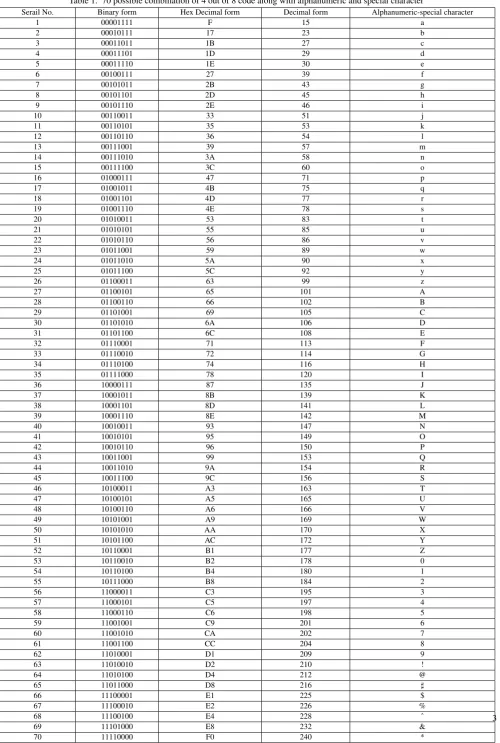
Modified 4 out of 8 code is 8 bit length with 4 number of ones and 4 number of zeros. Here we are not taking any consideration like each nibble must have 2 number of ones and 2 number of ze-ros. Here only consider that total number of ones in byte is four. According to modified 4 out of 8 code , we listed all 70 possible combinations of the 4 out of 8 code and each code is assigned to an alphanumeric character and also special character. Since 26 small letters i.e a to z, 26 capital letters i.e A to Z, 10 numerals and 8 special characters forms to give 70 alphanumeric and special char-acters, this code is more suitable to assign a unique code to each alphanumeric character and special characters. Generated 4 out of 8 code shown in Table 1 .
3. CHAOTIC MAP
An important step in any digital chaotic encryption is the selection of the map. Chaotic maps have different behavior regarding com-plexity, chaotic properties cycle length, chaotic interval, periodic windows, etc., sensitivity to initial conditions and reaction to tra-jectory perturbations, etc., that influence the structure or behavior of the chaotic encryption system. In fact, some systems have been broken for not considering the weaknesses of the chosen chaotic map and efficiency, it is desirable to provide some independency between the cryptosystem and the chaotic map under consideration. This independency means that, a full knowledge of the selected chaotic map is not needed to fulfill the security and efficiency re-quirements of a good cryptosystem.
For their mathematical simplicity there are two options: logistic map and tent map. The logistic map is represented by
Xn+1=rXn(1−Xn) (1) The logistic map chaotic signal used has primary values of
X0∈[0,1]andr∈[3.57,4].
4. PROPOSED METHOD
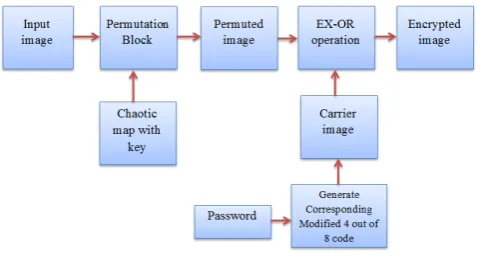
Block diagram of Proposed method as shown in Figure 1 . The proposed Block diagram consists of permutation and carrier im-age generation block.Initially input imim-age of size m∗n is applied to permutation block. Input image is permuted using chaotic map to produce permuted image.
4.1 Permutation using chaotic map
The detailed permutation procedure is described as follows:
Step 1:consider the input image of size m∗n.
Step 2:convert input image into one dimensional vector .
Step 3:based on initial key x0 and using chaotic map Eq.1 with r=3.9999 generates chaotic sequence of the iteration of m*n and obtain chaotic sequences as
X=x1, x2, x3, .xm∗n
[image:2.595.325.564.79.208.2]Step 4:The chaotic sequences X is sorted in ascending order and
Fig. 1. Block diagram of proposed method
stores the index values into another variables index.
Step 5:According to the index values , one dimensional vector is permuted and converted back into matrix.
Step 6:Get permuted image.
4.2 Carrier image Generation
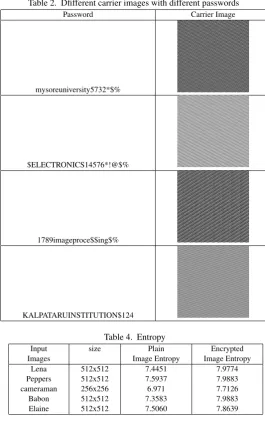
As we enter the different keywords, each keyword is taken and rearranged in a matrix form of size equal to the size of original image. If the length of the keyword is very small then the same keyword is repeated till the length is become equal to size of original image. By using luck up table of the alphanumeric special character and modified 4 out of 8 code as shown in Table 1 , a carrier image is created. Depending on the number of keywords number of carrier image is generated. different carrier images generated using different passwords as shown in Table 2 .
Finally the permuted image and Carrier image generated from mod-ified 4 out of 8 code undergo Ex-or operation to produce Encrypted image.
5. EXPERIMENTAL RESULTS AND PERFORMANCE ANALYSIS
5.1 Statistical analysis
In the proposed encryption algorithm, the diffused image is ran-domly distributed. This is shown by a test on the histograms of the cipher-images in Section 5.1.1, the information entropy of the cipher-image in Section 5.1.2the correlations of adjacent pixels in the plain-image and cipher image in Section 5.1.3, Analysis of differential attack in section5.1.4.
5.1.1 Histogram analysis. An image histogram illustrates that how pixels in an image are distributed by plotting the number of pixels at each gray scale level. The distribution of cipher-text is of much importance. More specifically, it should hide the redundancy of text and should not leak any information about the plain-text or the relationship between plain-plain-text and cipher-plain-text.Table 3 shows the histograms of plain-images and its ciphered images gen-erated by the proposed scheme respectively. It’s clear from that the histograms of the cipher-images are fairly uniform and significantly different from that of the plain image and hence do not provide any clue to employ statistical attack.
5.1.2 Information entropy analysis. In information theory, en-tropy is the most significant feature of disorder, or more precisely
Table 1. 70 possible combination of 4 out of 8 code along with alphanumeric and special character
Serail No. Binary form Hex Decimal form Decimal form Alphanumeric-special character
1 00001111 F 15 a
2 00010111 17 23 b
3 00011011 1B 27 c
4 00011101 1D 29 d
5 00011110 1E 30 e
6 00100111 27 39 f
7 00101011 2B 43 g
8 00101101 2D 45 h
9 00101110 2E 46 i
10 00110011 33 51 j
11 00110101 35 53 k
12 00110110 36 54 l
13 00111001 39 57 m
14 00111010 3A 58 n
15 00111100 3C 60 o
16 01000111 47 71 p
17 01001011 4B 75 q
18 01001101 4D 77 r
19 01001110 4E 78 s
20 01010011 53 83 t
21 01010101 55 85 u
22 01010110 56 86 v
23 01011001 59 89 w
24 01011010 5A 90 x
25 01011100 5C 92 y
26 01100011 63 99 z
27 01100101 65 101 A
28 01100110 66 102 B
29 01101001 69 105 C
30 01101010 6A 106 D
31 01101100 6C 108 E
32 01110001 71 113 F
33 01110010 72 114 G
34 01110100 74 116 H
35 01111000 78 120 I
36 10000111 87 135 J
37 10001011 8B 139 K
38 10001101 8D 141 L
39 10001110 8E 142 M
40 10010011 93 147 N
41 10010101 95 149 O
42 10010110 96 150 P
43 10011001 99 153 Q
44 10011010 9A 154 R
45 10011100 9C 156 S
46 10100011 A3 163 T
47 10100101 A5 165 U
48 10100110 A6 166 V
49 10101001 A9 169 W
50 10101010 AA 170 X
51 10101100 AC 172 Y
52 10110001 B1 177 Z
53 10110010 B2 178 0
54 10110100 B4 180 1
55 10111000 B8 184 2
56 11000011 C3 195 3
57 11000101 C5 197 4
58 11000110 C6 198 5
59 11001001 C9 201 6
60 11001010 CA 202 7
61 11001100 CC 204 8
Table 3. Resultant Encrypted Images and its histogram of proposed method
Input Image Histogram Encrypted Image Histogram password
mysoreuniversity5732*$%
$ELECTRONICS14576*!@$%
1789imageproce$$ing
KIRAN$SUNIL14756
KALPATARUINSTITUTION$124
unpredictability. To calculate the entropy H(X) of a source x, we have:
H(X) =
n
X
i=1
P r(xi) log2
1
P r(xi)
(2)
where X denotes the test image,xidenotes theithpossible value in X, and Pr(xi) is the probability of X =xi, that is, the probability of pulling a random pixel in X and its value is xi. For a truly random source emitting 2N symbols, the entropy is H(X)=N. therefore, for a ciphered image with 256 gray levels, the entropy should ideally be H(X)=8. If the output of a cipher emits symbols with entropy less than 8, there exists certain degree of predictability, which threatens its security [6]. The entropies for plain image and ciphered images using various images are calculated in Table 4. Apparently, the pro-posed algorithm is much closer to the ideal situation. This means that information leakage in the encryption process is negligible and the cryptosystem is secure against entropy attack.
5.1.3 Analysis of correlation of adjacent pixels. For an ordinary image having definite visual content, each pixel is highly correlated with its adjacent pixels either in horizontal, vertical or diagonal di-rection. However, an efficient image cryptosystem should produce the cipher image with sufficiently low correlation in the adjacent pixels. The visual testing of the correlation of adjacent pixels can be done by plotting the distribution of the adjacent pixels in the plain image and its corresponding cipher image. The correlation distribution of two horizontally adjacent pixels, two vertically adjacent pixels and two diagonally adjacent pixels of the plain image and the cipher image produced by the proposed scheme is shown in Table 5, respectively.It is clear that the strong correlation between adjacent pixels in plain image is greatly reduced in the
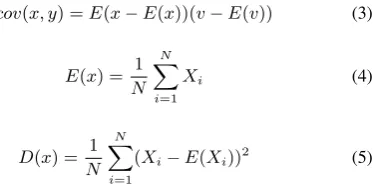
cipher image produced by the proposed scheme. To quantify and compare the correlations of adjacent pixels in the plain and cipher image, the following procedure is carried out. First, randomly select 1000 pairs of adjacent pixels in each direction from the plain image and its ciphered image. Then, calculate the correlation coefficientrx,yof each pair by using the following four formulas:
cov(x, y) =E(x−E(x))(v−E(v)) (3)
E(x) = 1
N
N
X
i=1
Xi (4)
D(x) = 1
N
N
X
i=1
(Xi−E(Xi))2 (5)
where x and y are grayscale values of two adjacent pixels in the image and N denotes the total number of samples, cov(x, y) is co-variance, D(x) is co-variance, E(x) is mean.
Fig. 2 shows Horizontal,vertical and diagonal directional pixel val-ues of plain image and cipher image respectively.
5.1.4 Analysis of differential attack. A well-designed encryption algorithm should be highly sensitive to plain-image and keys, so a slight change in plain-image or keys will make the cipher-image quite different. If an encryption scheme contains no confusion or diffusion stage, it would easily be destroyed by differential attacks. In order to confirm whether the proposed encryption algorithm is sensitive to plain image and keys, this paper brings out two tests: Number of pixels change rate (NPCR) and Unified average
[image:4.595.369.556.453.547.2]Table 5. Correlation coefficients of two adjacent pixels in plain-image and ciphered-images of proposed method.
Plain image Encrypted Image
Image Horizontal Vertical Diagonal Horizontal Vertical Diagonal
Lena 0.9691 0.9841 0.9842 -0.0058 0.0017 0.0035
Peppers 0.9733 0.9764 0.9809 -0.0008 0.0001 0.0022
Babon 0.8652 0.7524 0.7567 -0.0017 -0.0018 0.0001
Cameraman 0.9333 0.9565 0.9564 -0.0516 0.0227 0.0262
Elaine 0.9738 0.9695 0.9697 0.0090 -0.0098 -0.0079
Table 2. Dfifferent carrier images with different passwords
Password Carrier Image
mysoreuniversity5732*$%
$ELECTRONICS14576*!@$%
1789imageproce$$ing$%
KALPATARUINSTITUTION$124
Table 4. Entropy
Input size Plain Encrypted
Images Image Entropy Image Entropy
Lena 512x512 7.4451 7.9774
Peppers 512x512 7.5937 7.9883
cameraman 256x256 6.971 7.7126
Babon 512x512 7.3583 7.9883
Elaine 512x512 7.5060 7.8639
ing intensity (UACI) [7]. The equation to calculate UACI is Eq. 6
U ACI= 1
M∗N
X
i,j
|C1(i, j)−C2(i, j)|
255 ×100% (6)
Where, M stands for images width, N stands for images height, c1(i,j) means the gray-scale value of cipher-image in position (i,j), and c2(i,j) means the gray-scale value of the new cipher-image which is the encryption result of modified plain image that has just one different pixel to the original plain-image. NPCR can be
calcu-(a) (b) (c)
(d) (e) (f)
Fig. 2. Correlations of two adjacent pixels for lena image of size512∗512 (a) horizontal direction of the plain image, (b) horizontal direction of the ci-pher image, (c) vertical direction of the plain image, (d) vertical direction of the cipher image, (e) diagonal direction of the plain image, and (f) diagonal direction of the cipher image.
Table 6. NPCR and UACI of Proposed method
Image NPCR(%) UACI(%)
Lena 99.5724 27.8096
Peppers 99.6067 30.3366 cameraman 99.6063 34.1013
Babon 99.7311 32.0549
Elaine 99.5007 24.4800
lated by Eq. 7
N P CR= P
i,j
D(i, j)
M×N ×100% (7)
Where, M stands for images width, N stands for images height and where D(i,j) defined as follows
D(i, j) =
1 if C1(i,j)6=C2(i,j); 0 if C1(i,j)=C2(i,j).
When one bit of a pixels gray-scale value in the plain image is changed, then a new plain image is generated from the original one. Encrypt the two images with the same secret keys, then take cipher images into Eqs. 6 and 7 and results are shown in Table 6. From the Table 6 results we can find that our algorithm is very sensitive to tiny changes in the plain image, even if there is only one bit difference between two plain images, the decrypted images will be completely different.
6. CONCLUSION
[image:5.595.38.304.169.593.2]process to get a highly distorted image with respect to original im-age. Simulation results show that the NPCR, UACI and information entropy of the proposed schemes are better than existing method. All these results justify the superior security and computational ef-ficiency of our cryptosystems.
7. REFERENCES
[1] Xiamu Niue Ahmed A. Abd El-Latif. A hybrid chaotic system and cyclic elliptic curve for image encryption.PInt. J. Electron. Commun. (AE), 2012.
[2] V.Vivekanand G.A.Sathish Kumar, K.Bhoopathy Bagan. Novel algorithm for image encryption by integrated pixel scrambling plus diffusion [iispd] utilizing duo chaos mapping applicability in wireless systems.Procedia Computer Science, 2011. [3] Naveenkumar S.K Panduranga H.T. A novel image encryption
method using 4 out of 8 code. Inproc. CommV09, 2009. [4] Narendra K Pareek. Design and analysis of a novel digital
im-age encryption scheme.
[5] Prasanna SRM. An image encryption method with magni-tude and phase manipulation using carrier images.IJCS, page 132137.
[6] Joseph P. Noonan Yue Wu. Shannon entropy based random-ness measurement and test for image encryption.Information Sciences, pages 1–23, 2011.
[7] Joseph P. Noonan Yue Wu and Sos Agaian. Npcr and uaci ran-domness tests for image encryption. Multidisciplinary Jour-nals in Science and Technology, Journal of Selected Areas in Telecommunications (JSAT), November 2011.
[8] Kwok-wo Wong Hai Yu Zhi-liang Zhu, Wei Zhang. A chaos-based symmetric image encryption scheme using a bit-level permutation.Information Sciences, 181:11711186, 2011. [9] ZhiZhong. Double image encryption using double pixel
scram-bling and random phase encoding. Optics Communications, 2012.