Munich Personal RePEc Archive
Performance of Primary Cooperatives in
India: An Empirical Analysis
Misra, Biswa Swarup
Xavier Institute of Management Bhubaneswar
2006
Performance of Primary Cooperatives in India:
An Empirical Analysis
Biswa Swarup Misra1
Abstract
Cooperatives as an institution in India are more than a century old. With more than a lakh
grass root level cooperatives, their presence is formidable. Notwithstanding, impressive gains
made by cooperatives in terms of their rural outreach and coverage of small and marginal
farmers, their financial health has been a matter of concern. The study is an attempt to enquire
into the factors which impact financial health of cooperatives reflected through their recovery
performance. The empirical findings suggest that government should allow the cooperatives to
evolve in a natural manner rather than through initial official encouragement and subsequent
intervention. Government’s contribution to share capital of cooperatives should be stopped. There
is also a need to revisit the issue of appropriate member size for a base level cooperative so that
cooperative principles are internalized amongst members. Very large cooperatives should be
avoided both in principle and practice.
Key Words: Cooperatives, Government and Recovery JEL Classification: G21, H19
Cooperatives were institutionalized in India in the beginning of the twentieth
century to help the rural peasantry meet its genuine credit requirements by promoting
member driven and self governed institutions. The legal basis for Cooperatives was
provided through the enactment of Cooperatives Credit Societies Act, 1904. Apart from
meeting credit requirements, cooperatives were supposed to herald a new worldview of
development through mutual support and encouraging thrift. Over time, they have
evolved as an integral part of the multi agency framework for credit delivery in India.
With more than 1.06 lakh outlets, averaging one ground level credit cooperative for every
1
six villages, the cooperative system has a total membership of more than 120 million
rural people making it one of the largest rural financial systems in the world2.
Commercial banks and regional rural banks (RRBs), the two other purveyors of credit in
the multi agency framework, have also increased their rural penetration with nearly
50,000 rural/semi-urban branches. However, the cooperatives dominate in their reach to
the rural hinterland both in terms of the number of clients and accessibility to the small
and marginal farmers and other poorer segments of the population. In terms of number of
agricultural credit accounts, the short term cooperative credit system (STCCS) has 50%
more accounts than the commercial banks and RRBs put together.
Notwithstanding their formidable presence in terms of number and reach, their
financial health has been a matter of perennial concern. While the commercial banks and
RRBs had a gross NPA level of 3.3 percent and 7.26 percent respectively3, the overdues
for cooperatives were as high as 32.48 percent as on March 2006. The poor financial
health of the cooperatives leads one to surmise whether the cooperatives can be seen as
sustainable financial entities. Though their financial condition had been precarious, a lot
of hope was pinned on the cooperatives’ ability to bring about an all round development
of the rural economy in India. This can be appreciated from the legendary statement,
‘cooperatives have failed; cooperatives must succeed’ made by the All India Rural Credit
Survey Committee (AIRCS) way back in the year 1954. State partnership was introduced
in the cooperatives around mid 1950s with a view to transform them as effective vehicles
of development, after fifty years of their existence. It has been another fifty years since
the initial days of state partnership with cooperatives. Notwithstanding the state
2
Repot of the Committee on Financial Inclusion (Chairman - C. Rangarajan)
3
involvement and guidance in the activities of the cooperatives, their financial
performance has been dis-satisfactory. This raises a fundamental concern as to what went
wrong with government intervention in the working of the cooperatives and further
whether such intervention in case of cooperatives is desirable.
Numerous Commissions and Committees have gone into the problems afflicting
cooperatives and suggested measures to secure their financial viability. The latest among
the Committees is the Vaidynathan Committee, which was mandated to chalk out an
implementable action plan for reviving rural cooperative banking institutions. The
Vaidynathan Committee has made wide-ranging recommendations including that for
retiring government capital from the cooperatives to make them viable. Though the ills
associated with government intervention in cooperatives are well documented there has
been little empirical validation to the problems associated with government interventions.
Apart from government association, there are certain less highlighted but quite
important issues relating to cooperatives, which might be responsible for their poor
performance. One major weakness of the cooperatives in India has to do with design of
their organisational form. The idea of successful cooperatives was borrowed from the
Raiffeisen community in Germany. In the initial design, a typical feature that contributed
to the success of cooperatives is the ‘peer pressure’ amongst members. The ideal size
suggested for a cooperative that would ensure peer pressure was between 90 to 100
members4. With average member size of more than 11755, peer pressure, the
quintessential for the success of cooperatives is missing in India. To what extent this
deficiency in the organisational form of cooperatives has a bearing on the performance of
4
This was suggested by the Maclagan Committee on Cooperation in the year 1915.
5
PACS also needs to be studied. In addition, the manner in which cooperatives in India
conduct their business in terms of resource mobilisation and fund deployment could also
have an impact on their performance. In this backdrop, the present study makes an
attempt to enquire into such factors that influence the performance of the PACS and the
role-played by the government in a broader context.
The rest of the study is organised in five segments. Section-I: provides a brief
review of the evolution of the rural cooperatives in general and that of rural cooperative
banking institution with more specifics in the post independence period. Some stylised
facts relating to the functioning of PACS is discussed in Section-II. The methodology of
the empirical analysis to decipher the influence of different factors on performance of
cooperatives is discussed in Section: III. Section-IV discusses the empirical results.
Concluding observations based on the empirical results are presented in section-V
Section-I
Evolution of the PACS
The India Cooperatives Act 1904 was formulated under the British political
dispension. The socio economic scenario prevailing at those time and subsequent
economic and political events had a bearing on their evolution. The growth of
cooperatives was modest till independence, which got a Philip after independence. The
very outlook towards cooperatives underwent a significant change after independence
and especially, during the second five-year plan. The conditions created by the Second
World War, the emphasis on intensive and rapid rural development in the post-war
reconstruction programmes of State Governments and the channeling of state aid through
co-operative institutions contributed to their steady quantitative expansion after
Independence. At the time of the first plan, there were 1.81 lakh Societies with a
cooperatives of various types6 proliferated, agricultural societies accounted for more than
80 per cent of the total. The cooperative movement constituted an important economic
and social force when the country embarked on the planning process in the year 1951.
The first plan tried to leverage these institutions for all round development of the rural
areas and especially the agriculture sector. This plan recognized that division of the
needs, activities and assets of a villager into mutually exclusive parts such as credit,
production, sale etc., is somewhat artificial. As such, the plan envisioned one multi
purpose co-operative in each village that will cater to the multiple needs of its members.
The first plan set an advance target of at least Rs. 100 crores per annum to the cultivators
through the cooperatives. During the course of this plan the All India Rural Credit
Survey committee (AIRCS) was appointed in the year 1951. The recommendations of
AIRCS shaped the future of cooperatives in India.
The AIRCS committee viewed cooperatives as the panacea to the multi faceted
problem of rural India. The implementation of recommendation of AIRCS Committee
lead to emergence of State partnership at all levels of cooperatives in the form of share
capital contribution, provision of technical, managerial and financial assistance of
different kinds to cooperatives. With government involvement, cooperatives came to be
perceived as agencies of the State rather than an autonomous member based economic
enterprises. Subsequently, in an attempt to simplify, rationalise and modernise the
existing laws relating to cooperatives a Model Bill was formulated based on the
recommendations of the Committee on Cooperative Law, during the Second five year
plan. This Model Bill was supposed to help the State governments to comprehensively
6
amendment their respective cooperative laws. The Model Bill also sought to facilitate the
implementation of schemes of cooperative development under the Second Five Year
Plan. An important feature of the Model Bill was to include a specific Chapter regarding
‘State Aid’ to cooperative societies. This Chapter included a number of provisions
regarding the direct and indirect partnership of State in cooperative institutions and also
for grant of loans, subsidies, and guarantees to cooperative institutions.
The emphasis on cooperatives continued in the subsequent five-year plans. The
decade up to the 1990s marked active government intervention, which led to the
degeneration of cooperatives from autonomous member driven bodies to appendages of
the State. There was a paradigm shift in the State’s approach to cooperatives with the
implementation of the recommendations of the AIRCS in the year 1954 which envisaged
State partnership. The Mirdha Committee while assessing the growth of cooperative
movement in the year 1965 had observed that Government policy of deliberate expansion
of cooperatives had led to politicisation of cooperatives and entrenchment of vested
interests in their management. The Committee observed that cooperatives had drifted
much away from their objectives and ideology. Based on the observations of the Mirdha
Committee, the Conference of State Ministers of Cooperation recommended stringent
provisions in cooperative legislation to curb vested interests in the year 1969.
Accordingly, the cooperative legislation in most of the States incorporated provisions,
which destroyed autonomous and democratic character of cooperatives. Some of these
restrictive provisions included ‘Registrar can amend bye-laws of the cooperatives’,
‘government can nominate Directors on the Committee of Management’, ‘government
can annul the resolution of cooperative societies’, ‘Supersession/suspension of
etc. Government’s interference in the activities of the cooperatives reached its nadir in
1977 when democratically elected Management Committees of Cooperatives were
supersessed in nine states with a change in Government at the central level. The
restrictive provisions in the cooperative laws had rendered the cooperatives to be viewed
as government entities. The character of the cooperatives in the 1950 to 1990 period had
changed from member centric to state-centric.
The decades of the 1990s witnessed attempts at unshackling the cooperative
sector from the bondages of the government and restore the democratic character of the
cooperatives. With the efforts and persuasions of the National Cooperative Union of
India and Cooperative Development Foundation of Andhra Pradesh, the Planning
Commission of India appointed an Expert Committee to prepare a Model Cooperative
Bill to restore genuine Character of Cooperatives based on Cooperative Principles. The
Expert Committee under the Chairmanship Chaudhary Brahm Prakash submitted its
report and Model Cooperative Bill to Planning Commission in the year 1991. The Brahm
Prakash Committee emphasised the need to make cooperatives self-reliant, autonomous
and fully democratic institutions and proposed a Model Law. Progress in implementing
the suggestions was tardy because of the states' unwillingness to dilute their powers over
cooperatives.
The passage of the Mutually Aided Cooperative Societies Act by the Andhra
Pradesh government in 1995, however, marked a significant step towards reforms.
Following the example of Andhra Pradesh, eight other States viz., Bihar, Chhattisgarh,
Jammu and Kashmir, Jharkhand, Karnataka, Madhya Pradesh, Orissa and Uttaranchal
have passed similar legislation to govern and regulate mutually aided cooperatives. In all
member-centric, without any State involvement or financial support. They provide for
cooperatives registered under the old law to migrate to the new Act. Subsequent
Committees on cooperatives notably those headed by Jagdish Capoor, Vikhe Patil and V.
S. Vyas have all endorsed this recommendation and strongly supported replacing existing
laws with the proposed Model Law. These Committees have also recommended
revamping and streamlining the regulation and supervision mechanism, introducing
prudential norms and bringing cooperative banks fully under the ambit of the Banking
Regulation Act, 1949. To facilitate the implementation of these reforms, they proposed
that governments provide viable cooperative credit institutions with financial assistance
for recapitalisation. Summary recommendation of different committees on cooperatives
in the post independent period is given in Annex-1.
A system overhaul of the cooperatives has been suggested by the Vaidyanathan
Committee, which had the mandate to recommend an implementable action plan for
reviving rural cooperative banking Institutions, taking cure from the commendations of
previous committees in this regard. The Vaidyanathan Committee was also mandated to
suggest ‘an appropriate regulatory framework and the amendments which may be
necessary for the purpose in the relevant laws’, ‘to make an assessment of the financial
assistance that the Cooperative Banking Institutions will require for revival’, ‘the mode
of such assistance’, ‘sharing pattern and phasing of the financial assistance’ and also ‘to
suggest any other measures required for improving the efficiency and viability of Rural
Cooperative Credit Institutions’. The Task Force dwelled upon how the State
and auditors of the short-term credit cooperatives. The principle of mutuality7 from
which cooperatives all over the world derive their strength, has been missing in India. It
noted that the “borrower-driven” cooperative credit system in India is characterized by
conflict of interest and has led to regulatory arbitrage, recurrent losses, deposit erosion,
poor portfolio quality and a loss of competitive edge for the cooperatives. The Task Force
Report also recognised that there is an impasse in the laws governing
Cooperative-banking institutions in the country as cooperation is a State subject while Cooperative-banking
activities are regulated by a Central Act. Further, the Task Force took cognizance of the
poor quality of internal control systems, human resources, house keeping and audit in the
cooperatives. The Vaidyanathan Committee has suggested an implementable Action Plan
with substantial financial assistance for recapitalisation subject to introduction of strict
legal and institutional reforms together with technical assistance for human resource
development, establishment of a common accounting system and computerisation. It is
widely held that the implementation of the Revival Package would result in strong and
robust cooperatives in a conducive legal and institutional environment. At the macro
level, the Revival Package is expected to promote growth with social justice and greater
financial inclusion.
An Important aspect related to cooperatives, which the Vaidyanathan Committee
addressed is the equity contribution by the State governments. The Committee
recommended that the cooperative credit institutions should return the equity contribution
obtained from State Governments. The Task Force also recommended that soft loan
support be provided to cooperatives, which lack the resources required to return
7
government equity. NABARD has been identified as the nodal agency to implement the
recommendations. The States are in different stages of implementation of the
recommendations of the Committee. Though it has been the contention of many of the
committees and task forces that government’s involvement in the affairs of the
cooperatives is detrimental to them, there is no empirical basis backing such an assertion.
The Vaidaynathan Committee had cautioned against dilution or cherry picking of
its recommendations for the effectiveness of the revival package. Inspite of its repeated
cautions, one finds substantial dilution in the Committee’s recommendation at the
implementation stage8. For instance, the Committee had recommended for retirement of
government equity over time but subsequently it has been decided to retain 25 per cent of
government equity in cooperatives. Another recommendation that Registrar of
Cooperatives should retreat from the governance and other aspects relating to
cooperatives has been modified to entrust with them a consultative role. More
importantly, the eligibility conditions for the cooperatives to avail the revival package
have also been diluted. The recovery norm of more than or equal to 50 percent for the
PACS as suggested by the Vaidyanatahn Committee has been lowered to 30 per cent.
Also there has been a complete relaxation of the norm relating to gross interest margin as
a proportion to operating expenses. Similarly the eligibility norms set for the District
Central Cooperative Banks to avail for revival package have been completely withdrawn.
With such gross dilution in the original recommendation, one doubts the efficacy of the
revival package in reinventing the cooperatives.
8
Another dimension on which the different Committees enquiring into the
performance of the credit cooperatives have maintained a stoic silence is on the issue of
appropriate membership size for a Cooperative. This is important because ‘peer
pressure’, which the members exert on one another for repayment of loans, is crucial to
the success of the cooperative model. And it is a matter of common observation that the
element of peer pressure gradually weakens as the membership size grows in any
voluntary association of people such as cooperatives. With substantive growth in
membership size, one can conjecture that intensity of peer pressure has weakened in the
base level cooperatives. This puts a question mark on sustainability of cooperatives.
Whether growth in membership size has a bearing on the performance of the PACS is a
matter of enquiry, which has received very little attention in the existing literature on
cooperatives. Section-II reviews the literature on cooperatives to identify the various
factors, which could possibly have a bearing on their performance.
Section-II Literature Review
The literature on cooperatives is predominantly narrative. Empirical work using
macro level data on cooperatives is conspicuous by their absence. Whatever little
empirical work concerning cooperatives is available is based on case studies. While some
case studies employ primary data obtained through surveys others make use of balance
sheet information. Kulandaiswamy and Murugesan (2005) made an attempt to evaluate
the performance of PACS in its various dimensions using a comprehensive yardstick of
performance. They have studied 30 PACS for a ten-year period using thirteen
performance parameters in the selected development blocks of western Tamil Nadu using
field survey data. Kulandaiswamy and Murugesan employ scoring procedure validated by
classify PACS into three performance categories viz, poor, moderate and good. Their
study found working capital, total loans outstanding, total business turnover, overdues,
net worth and loans to weaker sections as relevant and valid performance indicators for
PACS. Based on their study, they have advocated measures such as re-capitalization,
amalgamation, bringing down overdues and improving the overall efficiency of PACS.
Based on the available literature, eight broad categories of indicators have been
developed namely organizational (structural), functional, self-reliance, profitability, cost,
democratic, participation and social efficiency to evaluate and quantify the performance
of PACS. Instead of identifying drivers of performance, Harper and Roy (1997)
employed a two-step procedure to identify the some critical factors, which seem to be
generally associated with the success of cooperatives. In the first step, a questionnaire
with eleven pairs of contrasting statements was sent to a number of individuals and
institutions in Indian and United Kingdom to develop a set of hypothesis describing
factors key to success of the cooperatives. The first stage analysis brought out a set of
views such as ‘groups should avoid being linked to any particular group’, ‘Group should
focus on one activity only to ensure manageability’, ‘Group should have members with
different skills and abilities’ etc. on which there was more unanimity in their influencing
the success of cooperatives. In the second stage, a sample of eighteen successful
cooperatives and other group enterprises were selected to test the hypothesis obtained in
the first stage and draw inferences. Though this study employed a novel approach, given
its narrow scope in terms of coverage, the inferences has to be taken with due care.
A broad overview of performance indicators for cooperatives is provided in
Murugesan (2007). Performance under each broad indicator category is evaluated using
groups viz, liquidity, operational, productivity and profitability ratios to study the
financial performance of nine select PACS in West Godavari District of Andhra Pradesh.
Some studies have used financial viability analysis comprising analysis of income and
expenditure pattern, profit and loss pattern and break-even analysis of business (advances
plus deposits) and also for its assets and liabilities to comment on the viability of
cooperatives in the specific context of Maharastra (Shah, 2002). Case studies though have
their own merits; the findings can’t be genreralised across a broad spectrum. However, it
is difficult to trace any attempt at the individual researcher level to examine the
performance of PACS on a broad canvas i.e., across the states. State level ratio analysis
of the comparative performance of PACS has been attempted by a number of Committees
and Commissions that were set to look into different dimensions of the problem
concerning cooperatives. However, parametric estimate of the different factors governing
the performance of PACS is one area, which has not been explored. This study attempts
to build an empirical model to draw certain inferences about the performance of PACS
over time. Before we develop the empirical model, what follows is a discussion on
certain stylised facts on the performance of the PACS in Section-III.
Section-III Sylised Facts
The cooperative system in India has got an involved structure. The co-operative
banking structure in India comprises of two main components, viz., urban co-operative
banks and rural co-operative credit institutions. While urban co-operative banks have a
single tier structure, rural cooperatives have a complex structure. It has different
segments to cater to the short term and long-term credit needs. The short-term
cooperative credit structure (STCCS) is organized in a three-tier structure. Within the
Diagram-1
credit societies (PACS) at the village level form the base level, the district central
co-operative banks (DCCBs) are placed at the intermediate level and the State co-co-operative
banks (StCBs) function at the apex. The STCCS mostly provide crop and other working
capital loans primarily for a short period to farmers and rural artisans. Further, the
structure of rural co-operative banks is not uniform across the States and varies
significantly from one State to another. Some States have a unitary structure with the
State level banks operating through their own branches, while others have a mixed
structure incorporating both unitary and federal systems. Diagram-1 spells out the broad
structure of the short-term cooperative credit in India.
The primary societies have undergone restructuring from time to time. Changing
frequent restructuring of PACS through liquidation and amalgamation. As such, the
number of PACS in the country across the decades has shown wide fluctuations. With as
high as more than two lakh primary societies in the year 1960-61, their number has
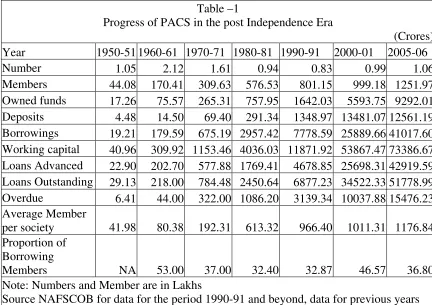
halved in 2005-06 (Table-1). While it is perfectly normal to expect periodic shake-ups in
a particular sector or industry where the inefficient units are forced to liquidate or wind
up, the restructuring of the cooperatives in India have been engineered by the
government. More importantly, the notion of viability has been changed quite frequently
as such the performance of the PACS have been measured on a varying yardstick. Not
withstanding the restructuring of PACS, the membership growth of PACS has been
impressive. The total members of PACS which was 4.4 million in 1950-51 has grown 28
fold in the year 2005-06 with an annual growth of 6.3 per cent. PACS, which used to
cover only 1.2 percent of the population of the country in the year 1950-51, embrace
more than 11 percent of an increasing population. Though both number of PACS and
their membership has grown, the average member per society which used to be 42 per
society in 1951-51 has increased more than 28 times to 1176 in 2005-06. With such large
number of member, it is difficult if not impossible to ensure peer pressure amongst
members of the primary society, which was so vital in the initial design of cooperatives
for their success. As the cooperatives now lend for a host of purposes, with growing
membership size, it becomes all the more difficult to have a strong element of vigilance
amongst the members. While average members per society have increased by 15 times,
average borrowers per society have increased by only 10 times between 1960-61 and
2005-06. The proportion of borrowing members was highest at 53 per cent in 1960-61,
which gradually declined to 33 per cent in 1990-91. Though there was some
Table –1
Progress of PACS in the post Independence Era
(Crores) Year 1950-51 1960-61 1970-71 1980-81 1990-91 2000-01 2005-06
Number 1.05 2.12 1.61 0.94 0.83 0.99 1.06
Members 44.08 170.41 309.63 576.53 801.15 999.18 1251.97 Owned funds 17.26 75.57 265.31 757.95 1642.03 5593.75 9292.01 Deposits 4.48 14.50 69.40 291.34 1348.97 13481.07 12561.19 Borrowings 19.21 179.59 675.19 2957.42 7778.59 25889.66 41017.60 Working capital 40.96 309.92 1153.46 4036.03 11871.92 53867.47 73386.67 Loans Advanced 22.90 202.70 577.88 1769.41 4678.85 25698.31 42919.59 Loans Outstanding 29.13 218.00 784.48 2450.64 6877.23 34522.33 51778.99 Overdue 6.41 44.00 322.00 1086.20 3139.34 10037.88 15476.23 Average Member
per society 41.98 80.38 192.31 613.32 966.40 1011.31 1176.84 Proportion of
Borrowing
Members NA 53.00 37.00 32.40 32.87 46.57 36.80 Note: Numbers and Member are in Lakhs
Source NAFSCOB for data for the period 1990-91 and beyond, data for previous years are taken from INDIASTAT.
year 2000-01, the proportion of borrowing members is a paltry 37 per cent as on 2005-06.
These numbers defy the general feeling that people become members of cooperatives to
avail a loan. The data suggests two things. Either there are motives other than availing
credit at work to become a member of a cooperative or else it could be that members who
are interested to avail credit are denied the opportunity. Evidence from case studies
reveals that both factors are at work9. Membership of a cooperative provides an identity
to the member as well as a platform to meet their socio-political aspirations. Further,
many members are averse to borrowing as a matte of philosophy of life. More
importantly, members who might be interested in getting a loan find it difficult to avail
the same in the present scheme and design of loan disbursement. At present, agricultural
loans through the cooperatives are made available through Kisan Credit Card (KCC).
9
Land ownership is a pre requisite for obtaining KCC. In many parts of India where
tenancy farming is prevalent, farmers who are the actual tillers of land but do not own
land are deprived of KCC and agricultural loan. Even farmers having a KCC, the
elaborate credit disbursal process may be acting as a deterrent. An overview of the
process involved in disbursal of credit through the cooperatives is given in Annex-3. This
is particularly the case for cooperatives, which do not disburse credit.
The PACS are spread all over the country with impressive business growth over
the years. The various business indicators like deposit mobilization, borrowings and
working capital have grown at roughly 15 per cent per annum in the fifty-five year period
between 1950-51 and 2005-06. The loans advanced by the PACS have always exceeded
their deposits as they borrow heavily from the higher tiers to cater to the credit needs of
their members. The PACS, however, have fared poorly in their management of the
deployed funds. While in the fifty-five period under scrutiny, loans per member grew at
7.8 per cent per annum; the overdues grew at a still higher 8.4 per cent per annum. Seen
in terms of borrowing members, the situation looks much more critical. While loans
advanced per borrowing member have increased 42 times between 1960-61 and 2005-06,
the overdues increased by 69 times per borrowing member over the same time period.
The high proportion of overdues of the PACS has adversely affected their financial
performance. While 44321 PACS were making profits another 53026 were incurring
losses as on 2005-06. Further, the aggregate losses of the PACS at Rs. 1920 crore,
outweighed the profits of Rs. 7193 crore. Hence, it is a matter of enquiry if we an identify
some broad determinants of the performance of the PACS at the macro level, which can
Section III Data and Methodology
While modelling the performance of an entity, the first issue that confronts one is
the choice of an appropriate indicator of ‘performance’. For a financial institution,
performance ultimately boils down to some indicator of profitability. However, for a
cooperative institution, an appropriate indicator of performance goes beyond profitability.
Performance of a cooperative should also be judged by its ability to inculcate the
principles of cooperation amongst its members. At the same time, the long-term viability
of a PACS is a must if it were to cater to the needs of its members. While profits are
easily identifiable, determining viability is a tricky issue. As norms for viability has been
changing, the ability of a PACS to recycle funds can be considered as a reasonably good
indictor of the viability. Ability to recycle funds to a great extent depends on the recovery
performance of the PACS. Recovery of loans to some extent would also reflect whether
the members of the society appreciate the ‘principle of cooperation’, ceteris paribus. As
such, we have preferred recovery performance as an indicator of the health of the PACS.
As far as variables affecting the recovery performance of a PACS are concerned, both
qualitative and quantitative factors play an important role.
The success of base level cooperatives such the PACS, which have individuals as
member, to a great extent depends on the internalization of the principle of cooperation.
Peer pressure ensures recovery in a cooperative. It has been already hypothesized that
peer pressure weakens as member size of a cooperative grows. Thus growing member
size of cooperatives is likely to have an adverse impact on recovery. To study the impact
of growing member size of the cooperatives on their recovery performance, we have used
Average member size of cooperatives as another explanatory variable in the empirical
It has been repeatedly pointed out by different Committees that government
patronage has done more harm than good by inducing indulgence on part of the members.
Instead of feeling responsible for the success of their cooperative and behaving diligently,
members perceive government involvement as some sort of guarantee against
bankruptcy. The most tangible form of government’s involvement is contribution to the
share capital of PACS. With government’s involvement, cooperatives are perceived to be
charitable institutions where members treat loans as grants. To ascertain whether
government’s involvement is really detrimental to recovery effort of the PACS, we
consider government’s contribution to the capital as one of the explanatory variable. As
far as the business of the PACS is concerned, they lend funds to members obtained by
way of deposits and borrowings from higher tiers of the cooperative credit system.
Cooperatives garner deposits from their members and also form the general public.
However, the PACS restrict membership with full voting rights only to borrowers.
Non-borrowing depositors are treated as nominal members without voting rights. The
Vaidyanathan Committee observed that such practice is not only inconsistent with
cooperative principles and democratic functioning but also logically inconsistent, as fund
providers have no say in the management of their own money.
To assess whether denial of voting rights to the non borrowing depositors have a
bearing on the performance of the PACS, we have considered share of deposits in the
working capital as another explanatory variable. As far as borrowed funds are concerned,
they are obtained from the middle tier central cooperative banks and the PACS are
accountable for its diligent application. It is expected that as share of borrowed funds rise
as a proportion of working capital, there is a compulsion for the PACS to be more
efforts. To ascertain what kind of effect the borrowed funds as a proportion of working
capital exerts on the performance of PACS, we have considered share of borrowings in
working capital as another explanatory variable.
One of the chief motivations for an individual to become a member of the
cooperative, in most cases, is to avail funds. The safety of funds lent out often is crucially
dependent on the purpose and duration for which the loan is sanctioned. Broadly PACS
grant credit both for agricultural and non-agricultural purposes10. Agricultural credit
accounts for the maximum proportion in their loan portfolio. Keeping in view the diverse
needs of agricultural operations, loans of varying maturities are sanctioned. Loans up to
eighteen months for carrying out seasonal agricultural operations are treated as short term
and loans beyond eighteen months and up to sixty months are labeled as medium term.
The recovery of the short-term agricultural loan may differ from that of agricultural loan
with a medium term horizon, as different types of risks may be associated with them.
While vagaries of nature may affect recovery of short-term loans, recovery of
non-agricultural loan would depend on proper assessment of the credit need and effective
credit monitoring, ceteris paribus. To consider the impact of the loan mix of PACS on
their recovery performance, we have considered the proportion of medium term
agricultural loan to short-term agricultural loan as another variable. Further, we use
growth in the food credit (GFC) as a conditioning variable
Based on the above discussion, to ascertain the impact of the various factors on
the performance of the PACS, time series regression models have been used. Equation
(1) describes the specification of the model. Equation (1) can be estimated by least
10
squares. Growth in food credit is used as a conditioning variable that represent the state
of activity in the agriculture sector.
RECOVERYt = C+η1AVGMEMt +η2 GOVCAPt +η3DEPTOBORt+η4LOMEDTOSHORTt+η5GFCt + εi,t (1)
Where,
η1,η2,η3,η4 and η5 are parameters to be estimated.
AVGMEM ⇒ Average members per society
GOVCAP ⇒ Share of Government Capital as a proportion of working capital.
DEPTOBOR ⇒ Deposits of the PACS a proportion of its borrowings.
LOMEDTOSHORT ⇒ Medium term loans as proportion of short-term loans
GFC ⇒ Growth in food credit by the Banks
εi,t⇒ Error term
The subscripts t refers to the time dimension, which is yearly in our case.
Equation (1) can be estimated by ordinary least square method. However, time series
models are susceptible to serial correlation in the residual. The simplest and most widely
used model of serial correlation is the first-order autoregressive, or AR (1), model. The
AR (1) model incorporates the residual from the past observation into the regression
model for the current observation. To account for serial correlation an auto regressive
specification of first order AR (1) is also estimated. Given the small sample size, the
specification is confined to a first order auto regressive process.
RECOVERYt = C+η1AVGMEMt +η2 GOVCAPt +η3DEPTOBORt+η4LOMEDTOSHORTt+η5GFCt
+AR(1) + εi,t (2)
The study covers the period 1988-2005. NAFSCOB is the sole agency, which collects
and compiles information on the PACS functioning across the country. NAFSCOB
publishes information for PACS on some key parameters. Absence of balance sheet of
individual PACS by some national level organisation puts practical constrains on the kind
of analysis that can be done for the PACS. The study is based on PACS functioning
Section IV Empirical Results
The fit of the AR (1) model is roughly comparable to that of the model without
the AR (1) specification. In such a situation the information criteria becomes a guide for
model selection. The Akiake and Schwarz information criteria measure the distance of
the specified model from the “true” model. As such a smaller value of AIC and SBC
criteria is preferred in choosing between alternative model specifications. As the model
with AR (1) specification has got lower values, for both the Akaike and the Schwarz
information, it is preferred11. All variables in the AR (1) specification is highly
significant. We now discuss the broad picture, which emerges from the estimations.
First, as has been surmised by a number of studies, increasing contribution by
Government to the share capital of PACS is found to be detrimental to the recovery
performance of the PACS. The negative effects of government intervention seem to
outweigh the positives flowing from government association. Second, as membership
size grows in the PACS, it is detrimental for the recovery. This result is significant as
most of the Committees and Commissions of late, who have enquired into the problem of
cooperatives, have not addressed the issue of optimal member size. While the Maclagan
Committee in the year 1914 had stressed for smaller size cooperatives, the preference in
the planning period has been for bigger size cooperatives for viability. This is a classic
case of missing the woods for the trees. In its zeal to promote cooperatives in a big way,
the Government ignored some basic principles of cooperatives, which is key to their
success. Cooperative since their inception were conceptualised as a small and neatly firm
11
group of people where more than material means, the moral pressure which the members
exert on each other is key to their success. Peer pressure ensures recovery and recycling
Table-4: Least Square Estimation Results
Simple OLS OLS with AR
Independent Variables
Coefficient P-Value Coefficient P-Value
Constant 127.1231 9.178 144.4344 12.252
AVGMEM -0.0132 -1.734 -0.0211 -2.537
GOVCAP -22.8877 -4.845 -26.4546 -6.535
DEPTOBOR -0.1692 -1.756 -0.2976 -3.496
LOMEDTOSHORT -0.3328 -2.642 -0.2910 -2.389
GFC -0.0316 -2.233 -0.0552 -4.307
AR term -0.3630 -2.326
Adjusted R2 0.70 0.77
Akaike Information Criterion 5.16 4.91
Schwarz Information Criterion 5.45 5.25
DW STATSTICS 2.24 2.21
of funds and contributes to the success of cooperatives. Peer pressure, however, is diluted
as membership size grows. As such, the advocates of cooperatives in its early days had
favoured small sized cooperatives. This basic principle of cooperation was turned upside
down in the post independence era in India. Cooperatives were seen as a panacea to all
the ills of the rural India given their wide presence across the length and breadth of the
country. Government found in the cooperatives a mechanism to reach out to the rural
poor without having any regard for the fundamental factors, which contributed to their
success. There are States in India where the average membership size is even more than
5000. The much-hyped Vaidyanathan Committee also has not addressed the issue of ideal
Third, as deposits as a proportion of borrowings rise, recovery is adversely
affected. This is perhaps because of the fact that non-borrowing depositors do not have
adequate representation in the functioning of a PACS. We have already seen that, the
proportion of non-borrowing member is quite high for the PACS. To that extent, there is
less accountability in the use of the funds mobilised through deposits. The Vaidyanathan
Committee has also pointed out this anomaly that the members whose fund is being
deployed, does not have a say in the working of the PACS. Unlike for deposits, PACS are
accountable to the higher tiers for the funds borrowed from them. As such when deposits
rise in proportion to borrowings, recovery is adversely affected.
Fourth, as far as loan composition is concerned, the short term loans seems to be
more amenable to recovery than the medium term loans. As proportion of medium term
loan vis-a-vis short term loans rise, recoveries are adversely affected. To get a better
explanation of why this is so, perhaps one has to look into the composition of the loan
portfolio of the PACS. Without detailed information, one plausible explanation could be
that medium terms loans unlike the short-term loans are exposed to greater uncertainty
because of the elongated repayment period.
Section –V
Concluding observations
This study was an attempt to decipher the factors, which contribute to the
financial health of the PACS, which form the base of the short-term cooperative credit
structure prevalent in India. The study considered recovery performance of the PACS as
the most suitable indicator of their performance. Unlike the extant literature on
cooperatives which is primarily narrative and in some instances based on case studies, the
present study was an empirical model based attempt to examine certain hypotheses
government’s involvement has done more harm than good for the cooperatives?’,
‘whether high proportion of non borrowing members loosens accountability in the
cooperative structure and contributes to their deterioration of financial health?’ are well
discussed in the literature. However certain other issues like the impact of member size
and mix of the loan portfolio on the performance of the PACS were also studied.
The results indicate that as the PACS have drifted from some of the core
principles of cooperation, their recovery performance has suffered. As membership size
has grown over the years in case of the PACS, their recovery has taken a beating because
peer pressure, which ensures recovery, has gradually weakened. Thus there is a need to
relook into the issue of optimal member size of the cooperatives in the interest of their
viability. This is a neglected aspect in the present-day literature on cooperatives but
merits attention from all stakeholders. In conformity with popular perception,
government’s contribution to the share capital is found to be detrimental for the recovery
performance of the PACS. Government’s contribution in share capital not only gives it a
hand to meddle with the affairs of the PACS; it might also be inducing indulgence
amongst members because of the comfort of government bail out in case of difficulty.
The latest amendment in the Vaidyanthan Committee’s recommendation that
Government can retain 25 per cent of equity capital in case of PCAS needs to seriously
given a second thought. The attempt should be either to completely dislodge government
equity in the PACS or not to consider the PACS as cooperatives but to accept them as
quasi government ventures for which the parameters of performance needs to be
revisited. The study also found that as deposits grow in proportion to borrowings, the
recovery performance is adversely affected. This is perhaps for the reason that
in the PACS. This makes a case for allowing the depositors of the PACS to be given
voting rights so that they can have a say in the management of their own funds. This will
also make the base level cooperatives more democratic in nature.
References:
Aiyar M.S. (1994), “Cooperatives and the Need for Constitutional Amendment”, P.L.N. Raju Memorial Lecture, Cooperative Development Foundation, mimeograph.
Bhuimali Anil (2003), “Rural Cooperative and Economic Development”, Sarup and Sons, New Delhi.
Chalam, G.V. and Prasad, A. (2007), “An Evaluation of Financial Performance of Cooperative Societies in Andhra Pradesh (A Study of Selected PACS in West Godavari District)”, Indian Cooperative Review Vol. 45, No.1, pp.42-58.
Datta Samar K.(2004), “Cooperatives in Agriculture” in State of the Indian Farmer: A Millennium Study (edited), Vol. 24, Academic Foundation New Delhi.
Datta S.K., Kapoor S. (1995), “Collective Action, Leadership and Success in Agricultural Cooperative”, Oxford and IBH Publishing Co. Pvt. Ltd. New Delhi.
Dwivedi R.C. (2005), “Hundred Years of Cooperative Movement in India”, Centre for Promotion of Cooperatives. Vol. I.
Garg M.C. and Joshi N.N. (1997), “Cooperative Credit and Banking: Strategies for Development” (edited) Deep & Deep Publications, New Delhi.
Government of India (1915), “Report of the Committee on Cooperation in India”, printed by Reserve Bank of India, President Sir E.D. Maclagan.
Government of India (2001), “Report of the Joint Committee on Revitalisation Support to Cooperative Credit Structure”, Ministry of Finance, Chairman, Balasaheb Vikhe Patil. Government of India (2004), “Task Force on Revival of Cooperative credit Institutions”, Chairman, A Vaidyanatahn.
Jalal R.S.(1996), “Rural Cooperatives in India”, Anmol Publications Private Ltd., New Delhi.
Jugale, V. Koli Band, P.A, (2005), “Reasserting the Cooperative Movement in India”,
Serials Publications (edited), New Delhi,
Kainth Gursharan Singh (1998), “India’s Rural Cooperation”, Regency Publications, New Delhi.
Kulandaiswamy, V. and Murugesan, P(2004), “Performance of PACS - An Empirical Evaluation”, Indian Cooperative Review Vol.42, No.2 pp. 122-30.
Lakshmanan, C and Dharmendran, A (2007), “Impact of NPAs on the Performance Variables in Chennai Central Cooperative Bank”, Indian Cooperative Review, Vol 44, No.4, pp.291-297.
Mathur B.S. (1990), “Cooperation in India - A Critical Analysis of the Cooperative Movement in India’s Planed Economy”, Sahitya Bhawan, Agra, India.
Ministry of Agriculture, Government of India (1987), “Ardhnareeswaran Committee on Democratization and Professionalization of Cooperative Management”, Department of Agriculture and Cooperation, Ministry of Agriculture.
Murugesan, P (2007), “Performance Indicators of PACS”, Indian Cooperative Review, Vol.45, No.2 pp. 110-116.
Nadkarni R.V. (2007), “Origin and Development of Cooperation in India”, 1904-1951, in
Hundred Years of Cooperative Development in India, NCUI.
Government of India, “Five-Year Plan Documents”, Planning Commission, New Delhi. Government of India (1991), Report of the Committee on Model Cooperatives Act, Planning Commission, Government of India, New Delhi.
Rajagopalan S. (2004), “Cooperative Legislation in India”, in S.K. Datta (Ed.) State of the Indian Farmer, Ministry of Agriculture, Government of India.
Sharma B.D. (2007), “Cooperative Legislation: From State Control to Autonomy and Independence of Cooperatives”, in Hundred Years of Cooperative Development in India, NCUI.
Reddy Suresh Y and Reddeppa A Reddy (1997), “Cooperatives and Rural Development”,
Anmol Publications Pvt. Ltd, New Delhi.
Reserve Bank of India (2000), “Report of the Task Force to Study the Cooperative Credit System and Suggest Measures for its Strengthening”, Chairman: Jagdish Kapoor.
Sargan, J.D. (1964), “Wages and Prices in the United Kingdom: A Study of Econometric Methodology” in Hart P.E., Mills G. and Whitaker J.K. (eds): Econometric Analysis for National Economic Planning, Butterworth Co, London, pp. 25-63.
Raikar, A.V. (2006), “Cooperative Credit Institutions in India-An Overview”, Indian Cooperative Review, Vol. 44, No.1, pp.1-20.
Singh, F and Singh, B (2006), “Profitability of the Central Cooperative Banks in Punjab - A Decomposition Analysis”, Indian Cooperative Review, Vol. 44, No.1, pp. 41-55.
Sujata.V (2007), “Financial Performance of Krishna Cooperative Central Bank Ltd.”,
Annex-1
Chronology of events shaping the Functioning of cooperatives in India (Post–Independent period)
All India Rural Credit Survey Committee (AIRCS) (1954)
Not only recommended State partnership in terms of equity but also partnership in terms of governance and management.
Recommended linking of credit with marketing
Suggested to enlarging the area of operation of cooperatives. The recommendations of AIRCS Committee were primarily responsible for the conversion of Cooperative from peoples’ institutions to Government cooperatives',
Committee on Cooperative Law (S.T.Raja)
Formulated a model Bill for guidance of State governments to proceed for comprehensive amendment to their cooperative laws. Argued for State aid to cooperatives by incorporating a specific Chapter on ‘State Aid to Cooperatives’ in the Model Bill.
All India Rural Credit Review Committee, 1964(B.Venkatappaiah)
Suggested viability norms, rehabilitation of societies, setting up of Small Farmers’ Development Agency and disbursal of investment credit through cooperatives
Committee on Cooperation, 1965 (Mirdha Committee)
Recommended that only needy people should be admitted as members.
Audit of cooperatives should be independent of the Cooperative Department in the States.
Contribution ought to be made to cooperative education fund
Santhanam Committee, 1969
The scale of cultivation finance should include a reasonable amount towards the consumption expenses of the member’s family.
Village societies should be empowered to pursue action under the land revenue recovery provisions to drive up recovery.
Margin between lending rate by PACS to members and its borrowing rate from the DCCBs should be three percent
National Commission on Agriculture, 1971
To establish a new type of organization, ‘farmer service societies (FSS)’ at the base level to provide all types of credit, technical guidance and a full package of services especially to small farmers to develop their farms in an integrated manner. FSS could be financed either by commercial banks or cooperatives banks. The FSS scheme was put into operation in 1973-74 in almost al states
To cover effectively large areas of operation say a block or population of 10,000 so that a cooperative could function as a viable unit.
To provide for a two third representation to enable weaker sections to have a say in the society.
Special Study Group, 1971
Recommended the organization of Large Sized Agricultural Multi Purpose Cooperative Societies (LAMPS) in tribal areas as the bottom structure to provide all types of credit under a single roof, technical guidance and arrangement for marketing of agricultural and tribal based products.
R.G.Sariya Committee, 1972
Suggested coverage of 50 percent of total villages, 30 percent of total village population and 25 percent of total marketable surplus under cooperatives.
Hazari Committee, 1975 Recommended integration of the short term and long term cooperative credit structure.
The integration was supposed to avoid splitting up of security; ensure a single contact point for farmers and enhance the profitability of primary societies.
No consensus could be reached on the Committee’s recommendations.
National Commission on Agriculture (1976)
Recommended for setting up of farmers' service cooperative societies with an active support from the Nationalised Banks.
Sivraman Committee, 1981(CRAFICARD)12
NABARD was created as apex institutions in rural finance and the responsibility of monitoring and regulating the rural credit institutions were transferred to it.
Agricultural Credit Review Committee, 1989(A.M.Khusro)
Recommended viability norms for PACS
Suggested for preparation of block development plans and training to officials of PACS.
It also recommended setting up of an apex bank ‘National Cooperative Bank of India’ to cover the entire cooperative credit. Suggested a conscessional rate of interest for small and marginal farmers at 1.5 percent above the highest interest rate of deposits. The interest rate for other agricultural borrowers should be free from any regulations but subject to an interest rate ceiling of 15.5 per cent.
Chaudhary Brahm Prakash Committee, 1991
Committee suggested to restore the democratic character of cooperatives, to curtail the power of Registrar and to confer full autonomy to the cooperatives.
Prepared a Model Bill to amend the flaws in present legislation on Cooperatives. The Bill sought to grant financial and administrative autonomy to the Cooperatives. Andhra Pradesh was the first state to take lead in this direction followed by others like Rajasthan, Kerala etc.
Task Forces to study the Cooperative Credit System and suggest measures for its strengthening, 2000 (Capoor Committee)
Granting of autonomy and strengthening the member driven character of cooperative institutions.
The duality of control should cease and the Banking Regulation Act 1949 be made fully applicable to cooperative credit Institutions.
The cooperatives be allowed to deploy its funds outside the ‘cooperative fold’ by entering into housing loans, consumer loans, consortium financing, financing of services, distribution of insurance products, etc.
Suggested for the voluntary amalgamation of cooperatives based on the economies of scale and revitalisation package for cooperatives to be based on financial, operational, organisational and systematic considerations.
12
Expert Committee on Rural Credit (Vyas Committee), 2000
It recommended for speedy implementation of the recommendation of Capoor Committee;
To adopt the Model Bill drafted by the Brahm Prakash Committee by all the States;
To restore financial health of the PACs, DCCBs and StCBs. To scrap the cadre system IN cooperatives
To Integrate the short term and long term credit structures:
Effective steps and support from the State for the prompt recovery of NPAs.
Balasaheb Vikhe Patil Committee, 2002
This Committee was mandated to suggest a revitalisation package for the Cooperatives.
The Committee concluded that the NPAs settlement is crucial for the improvement of the health of the cooperatives and hence efforts should be made to work out the modalities for the one time settlement of NPAs.
The financial burden associated with revitalisation of cooperatives may be shared by the Union and State governments in the ratio of 60:40 and in a proportion of 90:10 for the state of-Jammu & Kashmir and the North Eastern states.
Advisory Committee on Flow of Credit to Agriculture and other Related Activities from the Banking System (Vyas Committee, 2004)
Pointed out that credit disbursement would considerably increase if investment and production credit were integrated and scales of finance used at the district level were reviewed and readjusted in line with requirements of modern, market oriented capital-intensive agriculture using newer technologies and superior inputs.
Linkages between production and marketing should be strengthened by increasing pledge finance, credit for marketing and introduction of advances against warehouse receipts.
Outsourcing certain development agents like SHGs, NGOs, members of panchayati raj institutions, village functionaries, farmer’s clubs etc. would help banks expand their outreach without adding proportionately to their costs.
If the multi tier cooperative structure adds to the transaction costs, there would be a case for eliminating one of the tiers.
Good PACS could seek synergies with commercial banks if their functioning is hampered by weaker DCCBs,
Task Force on the Revival of Cooperative Credit Institutions, 2004.
Task Force (2004) stressed the need to revitalise the cooperative credit institutions by providing financial assistance to wipe off the accumulated losses and to strengthen the capital base.
The need for a financial package was estimated to be Rs.14,839 crores to be shard by the Union and State Governments.
Annex-2
Vaidyanathan Committee: Revised Eligibility Criteria for Revival Package Institutions Original Criteria Revised Criteria
PACS 1) Gross Interest Margin
should be more than or equal to 50 per cent of operating expenses and
2) Recovery should be more than or equal to 50 per cent 50% of demand
Loan recovery of at least 30 per cent of the demand as
on 30th June 2004.
State Government will be under obligation to determine the future set up of ineligible PACS with recovery level of less than 30 per cent.
The quantum of financial assistance will be determined through Special Audit of Accounts of PACS, DCCB &
OSCB as on 31st March 2004.
Govt. of India may consider relaxing the eligibility norm for PACS / DCCBs for North Eastern States, Scheduled Areas & Tribal Districts.
.
DCCBs Positive net worth and those
with negative net worth with deposit erosion of less than 25 per cent.
All DCCBs are eligible.
SCBs Positive net worth and those
with negative net worth with deposit erosion of less than 25 per cent.
Annex-3
Here we discuss the credit sanctioning process in PACS, which do not disburse credit to
the members directly. Sanctioning of credit to the members of a PACS is an involved process,
which may take more than a month. Upon an application for loan, the PACS first scrutinize credit
requirement of the members and recommend the same to the DCCBs. DCCBs are the disbursing
agencies of credit. PACS, which does not undertake banking business, the credit to the farmers is,
dispensed from the DCCB branches through the KCCs. As per the present arrangement13, PACS
fix the credit limit for the borrowers, which are scrutinized by the Cooperative Extension Officer
(CEO) and are ratified14 by the Block Level CEO. The approved credit limit list of the PACS
members are submitted to that branch of DCCB under which the PACS falls. The branch manager
of the DCCB, however, has no authority to sanction loans to the members of the PACS. The
DCCB branch, instead, approves the credit limits for the farmers based on the recommendations
of the Local Advisory Committee (LACs). The LAC is headed by a Chairman cum Director who
is appointed by the Board of the concerned DCCB. The LAC has a loan sanctioning power up to
Rs. 50,000 for agricultural purposes. The farmer, who is a member of the PACS travels to the
concerned branch of DCCB to avail the sanctioned credit.
Many a times, the CEO who scrutinizes the loan is not available as he is a field officer
without a specified office. Generally one CEO covers four to five villages. His unavailability at a
defined location at a defined time makes loan application a cumbersome process. As the loan
application needs to be recommended by the block level cooperation officer also, his availability
also delays the loan sanctioning process. Even after meeting all these hassles when the credit
limit is sanctioned, the farmer has to visit long distances to the branches of DCCB to avail the
loan. On some occasions, the farmer has to visit more than once to get the sanctioned loan as
defined by KCC credit limit. All this adds to the woes of the farmers in availing credit through
the mechanism of cooperatives. Given these hassle, the village moneylender often appears to be a
better alternative though the interest rate charged by him is much more. It must be recognized that
timely availability of credit is if not more than at least of equal importance as the cost of credit.
13
The process outlined here is based on first hand information gathered from a few PACS operating in Bihar. The procedural aspects followed in other States might be different.
14