Performance Evaluation of Non-linear Equalizer using
Different Modulation Techniques
Haritha.T
Pvpsit, JNTU Kakinada Kanuru, Vijayawada-7
AndhraPradesh, India.
Ramakrishna.M
Pvpsit, JNTU Kakinada Kanuru, Vijayawada-7
Andhra Pradesh, India.
S.Sri Gowri,
Ph.DS.R.K Institution of technology, JNTUK , Vijayawada ,AP India
D.ElizabethRani
,
Ph.D.
GITAMS, GITAM University, Visakhapatnam, Andhra Pradesh India
ABSTRACT
An equalization technique based on nonlinear Hammerstein type filters to combat the inter symbol interference (ISI) effect is proposed. This technique is nothing but nonlinear generalization of the linear equalizer. Linear frequency selective fading channels in presence of additive white Gaussian noise is considered using DPSK and QAM modulation techniques in this work. Simulation results shows that the proposed technique is found superior compared to when linear equalizer is used. Better BER performance at moderate and higher SNRs is achieved for M-QAM modulation. Results also show better MSE performance than the linear structure.
Keywords
Channel Equalization, Frequency Selective Fading Channels, Hammerstein Filter, QAM, DPSK.
1.
INTRODUCTION
Generally in frequency selective channels, the input signal after being transmitted suffer from inter-symbol interference (ISI) and noise. In order to reduce these effects, an optimum receiver based on maximum likelihood sequence estimation (MLSE) is designed. MLSE which is a non-linear method has high computational complexity that increases exponentially with the channel memory length. Therefore in frequency selective channels, MLSE is replaced by suboptimum receivers. Linear and decision feedback equalizers (DFE) are the most common techniques [1]. Linear equalizer (LE) is simply a linear transversal filter with a limited number of taps. Linear transversal filters are used in DFE as feed-forward and feedback blocks. Many other equalization techniques are presented in practice to reduce ISI effect[1-3].
In this paper, discussion is on generalized nonlinear structure for channel equalization that is based on Hammerstein type filters. Normally this technique is performed on frequency selective fading channels. Hammerstein filter is a nonlinear polynomial filter which is used in many applications. Some of them are system identification [4],[5], modeling[6],[7], echo cancellation[8],[9] and noise cancellation[10]. Hammerstein decision feedback equalization (HDFE) is used in fiber-
wireless channel for compensation of nonlinear distortion in the electrical-to optical converter [11], [12].
In the next section a system model is presented. Section III introduces the nonlinear Hammerstein equalization technique.. Simulation results and discussions are presented in section IV, before concluding the paper in section V.
2.
SYSTEM MODEL
In this section the equivalent low-pass discrete time model of the system is considered. DPSK and M-QAM modulation techniques are employed in this system.. A frequency selective fading channel modeled by a tapped delay line with L taps is considered to be:
]
...
[
h
1h
2h
L]H
(1)
Where hi is the random gain of the ith tap. These components are assumed to be real valued zero-mean Gaussian random
variables with variance
hi2 . Further, they are assumed uncorrelated and normalized to unity, i.e.:
1
1 2
L
i
E
h
i(2)
The channel fading is assumed to be slow, such that the tap gains do not vary during one data frame. It is also assumed that the frequency selective fading channel has a specific power delay profile (PDP), which is the profile of the mean square values of the tap gains. The received signal which is corrupted by ISI and noise is expressed as
Li
h
ix
n
i
w
n
n
y
1
(
1
)
(
)
)
(
(3)
Where w(n) is a real-valued zero-mean white Gaussian noise with variance
w2 . Eq. (3) can be expressed in matrix form:)
(
)
(
)
(
n
HX
n
W
n
y
(4)
Where H is the channel vector and X(n) is the received data vector, defined as:
T
L
n
x
n
x
n
x
n
X
(
)
[
(
)
(
1
)
....
(
1
)
(5)
3.
GENERALISED HAMMERESTEIN
EQUALIZATION TECHNIQUE
3.1
Equalizer Model
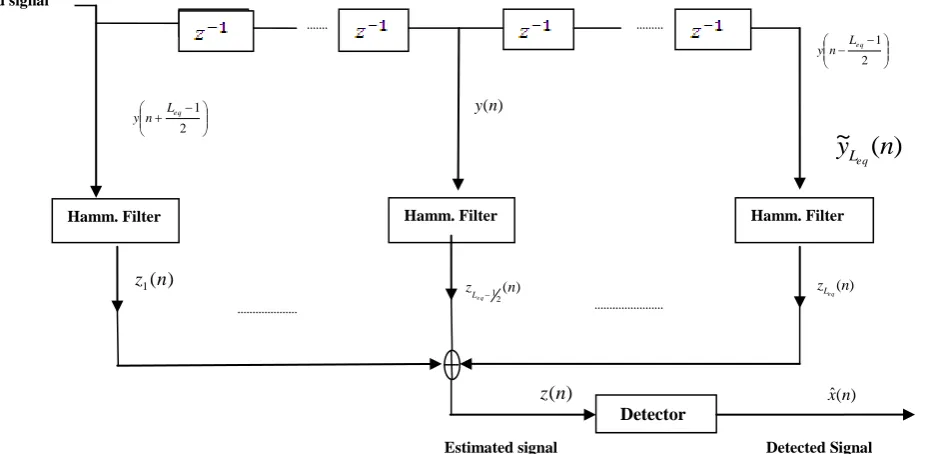
The block diagram of Generalized Hammerstein Equalization technique (GHE) is shown in below Fig 1. Here the received signal is passed through a delay line with
L
eq taps. Then,the signal at every tap is applied to a Hammerstein filter of order D. The output polynomial of the ith filter is then
D odd k k k i iky
n
g
n
) ( 1
i
(
)
~
(
)
Z
eq
L
i
for
1
,
2
....
....
(6)
Where
g
ikis the kth coefficient of the output polynomial of the ith filter, and~
y
i(
n
)
is defined as the signal at ith tap, i.e.:eq eq
i
fori
L
L
i
n
y
n
y
1
,
2
,...
2
1
)
(
~
(7)The summation of Eq. (6) contains only the odd powers. It can be shown that the terms containing the even powers are equal to zero. The filters outputs are summed to produce the equalizer output
z
(
n
)
Leqi d odd k k i ik
y
n
g
n
z
1 1( )
(
)
~
)
(
(8)
Eq. (8) when expressed in matrix form:
)
(
)
(
n
G
Y
n
z
HT H(9)
Where
G
His a Leq
(
D
1
)
/
2
1
vector that consists ofcoefficients
g
ik andY
H(
n
)
is a1
2
/
)
1
(
D
eq
L
vector defined as:
odd
D
n
y
n
y
n
y
n
y
n
Y
T TD T
T T
H
(
)]
,
~
...
)
(
~
)
(
~
)
(
~
[
)
(
1 3 5 (10)where
Y
~
P(
n
)
is aL
eq vector defined by using Eq. (7):T P L P
P
P
y
n
y
n
y
n
Y
eq
(
)]
~
...
)
(
~
)
(
~
[
~
2 1
(11)
Z(n) is an estimate of the transmitted symbol x(n) To minimize the mean square error we have to find out the coefficients
g
ik . The output decision xˆ(n) is obtained bypassing Z(n) through a hard detector
3.2
Calculation of the coefficients
The MSE criterion is used for calculating the coefficients of Hammerstein filters from the training mode. The training mode having the transmitter sends a training sequence, let us assume that it is known to receiver as the desired signal d(n).The difference between the desired and estimated values gives the error signal which is given by the eq.
)
(
)
(
)
(
)
(
)
(
n
d
n
z
n
x
n
z
n
e
(12)
The cost function is defined as below:
)
(
{
e
2n
E
(13)
The coefficients are computed so as to minimize
.Using Eqs. (9) And (12) in (13), we get:
{[
(
)
(
)][
(
)
H]}
T H H
T
H
Y
n
x
n
Y
G
G
n
x
E
H T H H T H H T H H T H G n Y n Y E G G n Y n x E n x n Y E G n X E )} ( ) ( [ )} ( ) ( { )} ( ) ( [ )] ( [ 2 (14)If we define the L
eq
(
D
1
)
/
2
1
cross correlation vector:)}
(
)
(
{
Y
n
x
n
E
P
H
H(15)
And the L
eq
(
D
1
)
/
2
Leq
(
D
1
)
/
2
autocorrelation matrix:)}
(
)
(
{
Y
n
Y
n
E
2 1
eq L n y
2 1
eq L n
y y(n)
) (
1 n
z ( )
2 1 n
z
eq
L zLeq(n)
z(n) xˆ(n)
Fig. 1Generalized Hammerstein Equalizer
And note that
E
{
x
(
n
)
Y
HT(
n
)}
P
HTH T H H T
H
P
P
G
G
,andE
{
x
2(
n
)}
1
, we obtain:H H T H H T
H
P
G
R
G
G
1
2
(17)
This is a quadratic function of vector
G
Hwith a single globalminimum. To minimize
, we need to have:0
(18) Where
is the gradient operator From Eqs. (17) and (18) and using the gradient properties we can write:0
2
2
R
HG
HP
H(19)
Finally, the coefficients of Hammerstein filters are obtained by solving Eq. (19):
H H
H
R
P
G
1(20)
Assuming that
R
H1is invertible.4.
SIMULATION RESULTS
0 5 10 15 20 25 30 35 40 10-4
10-3 10-2 10-1 100
SNR
BER
[image:3.595.42.509.82.309.2]Average BER for GHE and LE systems with Leq =3 and D=5 GHE: Leq = 3, D =5 LE: Leq = 3
Fig. 2 Average BER for GHE & LE systems for Leq= 3
and D=5
Hamm. Filter Hamm. Filter Hamm. Filter
Detector
)
(
~
y
n
eq L
Received signal
0 5 10 15 20 25 30 35 40 10-5
10-4 10-3 10-2 10-1 100
SNR
BER
[image:4.595.63.276.70.719.2]Average BER for GHE and LE systems with Leq =5 and D=5 GHE: Leq = 5, D =5 LE: Leq = 5
Fig.3Average BER for GHE & LE systems for Leq=5,
D = 5
0 5 10 15 20 25 30 35 40
10-4 10-3 10-2 10-1 100
SNR
BER
Average BER for GHE and LE systems with Leq =3 and D=7
GHE: Leq = 3, D =7 LE: Leq = 3
Fig. 4 Average BER for GHE & LE systems for Leq=3, D =7
10-1 100
Average BER for GHE and LE systems with Leq =5 and D=7 GHE: Leq = 5, D =7 LE: Leq = 5
0 5 10 15 20 25 30 35 40 10-4
10-3 10-2 10-1 100
SNR
BER
Average BER for GHE and LE systems with Leq =1D=5, Leq =3 D=5,Leq =5 D=5
[image:4.595.334.522.73.473.2]GHE: Leq = 1, D =5 LE: Leq = 1 GHE: Leq = 3, D =5 LE: Leq = 3 GHE: Leq = 5, D =5 LE: Leq = 5
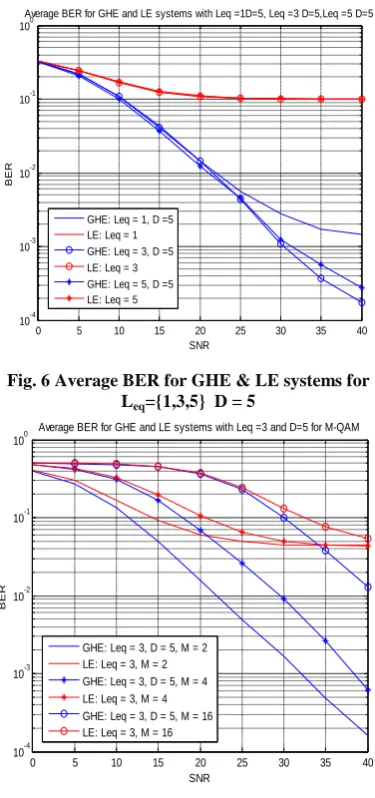
Fig. 6 Average BER for GHE & LE systems for Leq={1,3,5} D = 5
0 5 10 15 20 25 30 35 40 10-4
10-3 10-2 10-1 100
SNR
BER
Average BER for GHE and LE systems with Leq =3 and D=5 for M-QAM
GHE: Leq = 3, D = 5, M = 2 LE: Leq = 3, M = 2 GHE: Leq = 3, D = 5, M = 4 LE: Leq = 3, M = 4 GHE: Leq = 3, D = 5, M = 16 LE: Leq = 3, M = 16
Fig 7 Average BER for GHE & LE systems for Leq=3,
D = 5 for M= (2, 4, 16)
4.1
Conclusions:
[image:4.595.67.272.522.708.2]The BER of GHE decreases drastically for moderate to high SNR values. The above results are obtained provided the modulation technique being used is DPSK. Performance of the proposed GHE and LE is also carried out for fixed order and fixed number of taps for different values of the M-QAM modulation scheme and found that as the value of M increases BER also increases. Excellent performance for the proposed GHE is obtained for M = 2 as shown in fig
4.2
Results: MSE
0 5 10 15 20 25 30 35 40 10-2
10-1 100
SNR
M
S
E
Average MSE for GHE and LE systems with Leq =3 and D=5 GHE: Leq = 3, D =5 LE: Leq = 3
[image:5.595.328.515.75.237.2]Fig. 8 Average MSE for GHE & LE systems for Leq =3 and D = 5
0 5 10 15 20 25 30 35 40 10-2
10-1 100
SNR
M
S
E
[image:5.595.63.265.190.583.2]Average MSE for GHE and LE systems with Leq =5 and D=5 GHE: Leq = 5, D =5 LE: Leq = 5
Fig. 9 Average MSE for GHE & LE systems for Leq =5
and D = 5
0 5 10 15 20 25 30 35 40
10-2 10-1 100
SNR
M
S
E
Average MSE for GHE and LE systems with Leq =3 and D=7
GHE: Leq = 3, D =7 LE: Leq = 3
Fig. 10 Average MSE for GHE & LE systems for Leq =3
and D =7
0 5 10 15 20 25 30 35 40
10-2 10-1 100
SNR
M
S
E
Average MSE for GHE and LE systems with Leq =5 and D=7
[image:5.595.67.263.192.369.2]GHE: Leq = 5, D =7 LE: Leq = 5
Fig. 11 Average MSE for GHE & LE systems for Leq =5
and D =7
0 5 10 15 20 25 30 35 40
10-2 10-1 100
SNR
M
S
E
Average MSE for GHE and LE systems for Leq =1D=5,Leq =3 ,D=5,Leq =5 ,D=5
GHE: Leq = 1,D =5 LE: Leq = 1 GHE: Leq = 3, D =5 LE: Leq = 3 GHE: Leq = 5, D =5 LE: Leq = 5
Fig. 12 Average MSE for GHE & LE systems for
[image:5.595.68.263.408.568.2] [image:5.595.329.525.476.644.2]0 5 10 15 20 25 30 35 40 10-2
10-1 100
SNR
M
S
E
Average MSE for GHE and LE systems with Leq =3 and D=5 for M-QAM
[image:6.595.69.283.74.251.2]GHE: Leq = 3, D = 5, M = 2 LE: Leq = 3, M = 2 GHE: Leq = 3, D = 5, M = 4 LE: Leq = 3, M = 4 GHE: Leq = 3, D = 5, M = 16 LE: Leq = 3, M = 16
Fig. 13 Average MSE for GHE & LE systems for Leq=3,
D = 5 & M= (2, 4, 16)
4.3
MSE Conclusions:
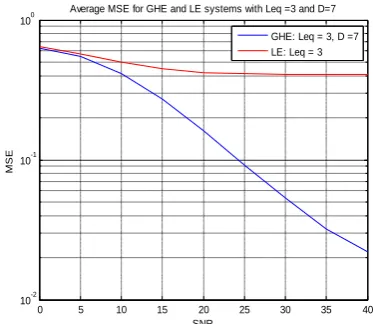
The performance of the proposed GHE is found to be superior to the linear equalizer in terms of its average Mean Square Error (MSE) for different SNR values. Significant out performance is obtained for GHE systems at moderate and high values of SNR. Fig. 8 and 9 reveals that as the number of taps increases for fixed order of the filter the MSE decreases considerably. Observing fig. 10 and 11 it can be concluded that as the order of the filter is increased for two different values of the taps the performance of the proposed GHE is almost same as the previous results but significant improvement is seen at high SNR values ie when the SNR values are in the range of 30 to 40.
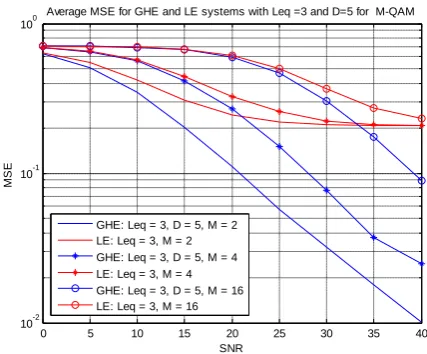
Comparing the results obtained from the fig. 12 considerable improvement in the performance of the GHE is seen at moderate to high SNR values. The Modulation technique used for the above results is DPSK. Performance of the proposed GHE and LE is also carried out for fixed order and fixed number of taps for different values of the M-QAM modulation scheme and found that as the value of M increases MSE also increases. Superior performance for the proposed GHE is obtained for M = 2. The decrease in MSE is considerable at moderate to high SNR values as shown in fig 13.
5.
REFERENCES
[1] J. G. Proakis, and M. Salehi, Digital Communications, 5th ed., Newyork:McGraw-Hill, 2008.
[2] C. Krall, K. Witrisal, G. Leus, and H. Koeppl, “Minimum mean square error equalization for second order Volterra systems,” IEEE Trans. On Signal Processing, vol. 56, no. 10, pp. 4729-4737, October, 2008..
[3] M. W. Kwan, and C. W. Kok, “MMSE equalizer for MIMO-ISI channel with shorten guard period,” IEEE Trans. Signal Processing,vol. 55, no. 1, pp. 389-395, January, 2007.
[4] J. Jeraj and V. J. Mathews, “A stable adaptive Hammerstein filter employing partial orthogonalization of the input signals,” IEEE Trans.Signal Processing, vol. 54, no. 4, pp. 1412-1420, April, 2006.
[5] N. Kalouptsidis, and P. Koukoulas, “Blind identification of Volterra-Hammerstein systems,” IEEE Trans. Signal Processing, vol. 53, Issue 8, Part 1, pp.2777 - 2787, Aug. 2005.
[6] F. Mkadem and S. Boumaiza, “Extended Hammerstein behavioral model using artificial neural networks,” IEEE Trans. Microwave Theory and Techniques, vol. 57, no. 4, pp. 745-751, April, 2009.
[7] J. M. Le Caillec, “Time series modeling by a second-order Hammerstein system,” IEEE Trans. Signal Processing, vol. 56, no. 1, pp. 96-110, January,2008.
[8] K. Shi, X. Ma and G. Tong Zhou, “Acoustic echo cancellation using a pseudocoherence function in the
presence of memoryless nonlinearity,”IEEE
Trans.Circuits and Systems, vol. 55, no. 9, pp. 2639-2649, October,2008.
[9] K. Shi, G. T. Zhou and M. Viberg, “Compensation for nonlinearity in a Hammerstein system using the coherence function with application to nonlinear acoustic echo cancellation,” IEEE Trans. Signal Processing, vol.55, no. 12, pp. 5853-5858, December, 2007.
[10] D. Zhou and V. DeBrunner, “Efficient adaptive nonlinear filters for nonlinear active noise control,” IEEE Trans.Circuits and Systems, vol. 54,no. 3, pp. 669-681, March, 2007.
[11] X. N. Fernando, A. B. Sesay, “A Hammerstein type equalizer for the Wiener type fiber wireless channel,” in
Proc. IEEE Conf. PACRIM '01,Aug. 2001, vol. 1, pp. 546-549.