ISSN 2250-3153
Effects of Personality and Emotional Intelligence on
the Performance of Senior High School Teachers
through Motivation and Job Satisfaction
Dewi Urip Wahyuni1
Sekolah Tinggi Ilmu Ekonomi Indonesia Surabaya, Indonesia E-mail: [email protected]
DOI: 10.29322/IJSRP.9.04.2019.p8839
http://dx.doi.org/10.29322/IJSRP.9.04.2019.p8839
ABSTRACT
The purpose of the study was to analyze the effects of personality and emotional intelligence on the performance of private senior high school teachers in East Surabaya through motivation and job satisfaction. Results showed that personality had no effect on motivation, emotional intelligence had an effect on motivation, personality had no effect on job satisfaction, emotional intelligence had an effect on job satisfaction, personality had no effect on teacher performance, emotional intelligence had no effect on teacher performance and job satisfaction had an effect on teacher performance.
Index Terms: personality, emotional intelligence, teacher performance, motivation
I. INTRODUCTION
Education is a conscious effort to make quality human resources useful for the state and nation. Human resources constitute an invaluable asset since the advancement of a nation lies in its resources. Quality resources will lead to an advancement for the country. Thus, education is required to improve human resources. Education is of paramount importance to create human resources capable of development towards advancements.
Personality represents an important factor for a teacher to adapt to where he or she is. The personality of an educator should be built continuously to adjust to the environment. This is manifested by the daily behavior, so that personality can provide an example for learners. According to McShane and Glinov (in Wahyuni, 2016), “personality is the relative stable pattern of behaviors and consistent internal states that explain a person’s behavioral tendencies”. According to Ulug etal. (2011), the behavior and approach of the teacher is directly accepted and copied by students, which puts great responsibilities on the teachers.
Emotional intelligence is one’s ability to manage emotions effectively with regard to their environment. According to Robbins and Judge (2011: 147), emotional intelligence is the ability to detect and manage emotional cues and information. A teacher should be able to manage emotions since learners consist of various kinds of characters in order for teacher−learner harmony.
Motivation is an encouragement or enthusiasm for achieving a set goal. According to Mathis and Jackson (in Bangun, 2012: 312), motivation is one’s desire to perform an action to achieve a goal. A teacher with a high motivation will seek to develop his or her professionalism for the benefit of their learners.
Job satisfaction is an assessment of the work being done. According to Badriyah (2015: 227), job satisfaction is among the highly important factors to obtain optimal results. Each person has a different level of job satisfaction depending on the work done. When someone is satisfied with their work, he or she will work optimally to get job satisfaction. A teacher should teach his or her students with happiness and a sense of love for his profession in order to achieve his or her goals.
Teachers’ high performance is required to teach students; thus, teachers with a high motivation to educate their students are required. According to Bangun (2012: 211), performance is the outcome of a work achieved by someone on the basis of job requirements. Failure or success of learners lies in the teachers; thus, reliable and professional teachers in their respective fields are required.
In reality, there remains many learners acting violently to their fellow learners and even some of them have killed their teachers. Among the causes are dissatisfaction with the teachers, disrespect to the teachers, and the feeling of being treated unfairly. Responding to this phenomenon, the role of teachers should be improved since teachers set an example for their students; thus, teachers should have a good personality, capability and intelligence to better their students.
II. THEORETICAL REVIEW
ISSN 2250-3153
Personality is a character possessed by each individual. Therefore, each individual has a different personality. Teacher personality is of paramount importance to teach students since whatever is done by the teacher will be followed by their students. In this era, teachers have an onerous duty of guiding their students to become better. According to Wahyuni (2016), personality is important and related to a person’s behavior and will also build his loyalty to the company he works for when he is facing a dilemma of choice whether to stay at the company or looking for a new place to work. There are five dimensions of personality, known as the Big Five Dimensions, replicated by Norman (1963), Borgata (1964), Digman and Takemoto Chock (1981), and Norman (1963) in Keshavarzi and Amiri (2016): the factors were initially labeled as extraversion or surgency (talkative, assertive, energetic), agreeableness (good natured, cooperative, trustful), conscientiousness (orderly, responsible, dependable), emotional stability vs. neuroticism (calm, not neurotic, not easily upset), and culture (intellectual, polished, independent-minded).
Emotional Intelligence
Emotional intelligence is the ability of an individual, in this case a teacher, to manage their emotions with regard to their students. A teacher is required to be patient in order for the learners to feel being paid attention and protected by their teachers. Students of private high school have different behaviors and characters, requiring patience to make them compliant with their teachers’ instructions. According to Marya in Wahyuni (2013), emotional intelligence is an individual’s ability to use his feelings optimally to face himself and the pressures from the surrounding environment. According to Slovey (in Goleman, 1999: 58), some aspects that should be considered with regard to emotional intelligence are: 1) to recognize self-emotion, which is the self-awareness or the ability to recognize feelings as it occurs; 2) to manage emotions, which is the ability to handle emotions in order to reveal the feelings harmoniously so as to achieve balance within the individual; 3) to motivate oneself, which is the ability to organize emotions as a means to achieve goals; 4) to recognize others’ emotions, which is the ability to empathize; 5) to foster a relationship, which is the ability to recognize each individual’s emotions and control it.
Motivation
Teacher motivation is crucial to achieve of teaching and learning process. According to Mustafa and Othman (2010), teachers also need to have high motivation as well as knowledge and expertise. Moreover, there is a parable stated that the higher teacher’s motivation, the higher their work performance is. Motivation is the major factor so that what teachers need should be fulfilled. To date, teachers always accept what it is in terms of facilities, infrastructure, and salary, despite the fact that what they receive is far from enough. Therefore, teachers should be motivated to work in order to be enthusiastic to carry out their duties and seek to create new methods to make their learners capable of studying well. According to Robbins and Judge (2008: 205), motivation is the process that acts for the direction and persistence of effort toward attaining a goal. Thus, teacher motivation should be paid attention to make them enthusiastic to carry out their profession. According to Koesmono (2013), motivation factors can be viewed intrinsically and extrinsically. The intrinsic factors are everything that comes from inside an individual to meet his or her needs. It includes the desire to grow, the need for social relationships and the desire to excel. The extrinsic factors are everything that comes from outside an individual to meet his or her needs. It includes salary, rewards and social security.
Job Satisfaction
Job satisfaction is highly important for a teacher. A teacher may feel satisfied with his or her job when his or her expectations are fulfilled. According Koesmono (2013), job satisfaction is a comparison between expectations and what has been achieved by someone. Thus, an individual is said to feel satisfied when their expectations are met or even exceeded. When expectations are met, there will be demotivation. In this case, demotivation should not occur in teachers since it will lead to decreased teacher performance. According to Hasibuan (2008: 202), job satisfaction is a pleasant emotional attitude. The following is the points to consider with regard to job satisfaction: 1) enjoying the job; 2) loving the job; 3) morale; 4) discipline; 5) work performance. A study conducted by Brahmasari and Suprayetno (2008) showed that motivation and organizational culture have a positive and significant effect on employee job satisfaction.
Teacher Performance
Teacher performance is an activity performed by a teacher in the learning process. According to Koesmono (2004), performance is in essence the success of an employee in doing a job for a certain period of time based on the predetermined conditions. The variables directly or indirectly affecting performance are: personality, commitment, and behavior. According to Regulation of the Minister of State Apparatus Empowerment and Bureaucratic Reform No. 16 of 2009 on Teacher Functional Positions and Credit Codes, the components of teacher performance include: to develop science, to prepare lesson plans, to carry out learning activities, to guide students’ extracurricular activities, to analyze the outcome of the learning process assessment, ability to compile syllabus, ability to assess and evaluate the learning outcomes of the subjects taught, scientific publication activities, ability to prepare the learning curriculum, timeliness to start learning activities, timeliness to come to school, ability to develop teaching materials, willingness to accept other tasks outside teaching, ability to guide novice teachers, and ability to create learning climate. There are 15 indicators of teacher performance that should be paid attention by teachers in performing their duties.
Hypotheses
ISSN 2250-3153
1. Personality has an effect on motivation of private high school teachers in East Surabaya.
2. Emotional intelligence has an effect on motivation of private high school teachers in East Surabaya. 3. Personality has an effect on satisfaction of private high school teachers in East Surabaya.
4. Emotional intelligence has an effect on job satisfaction of private high school teachers in East Surabaya. 5. Personality has an effect on performance of private high school teachers in East Surabaya.
6. Emotional intelligence has an effect on performance of private high school teachers in East Surabaya. 7. Motivation has an effect on job satisfaction of private high school teachers in East Surabaya.
8. Job satisfaction has an effect on performance of private high school teachers in East Surabaya.
III. RESEARCHMETHODOLOGY Types of Research
The present study was quantitative, meaning that the approach was based on the use of numbers for statistical analysis.
Population and Samples
The population of the study was certified teachers of 12 private A-accredited high school in East Surabaya, they are Dr sutomo with 10 teachers, Petra 5 with 10 teachers, 17 Agustus with 10 teachers, GIKI 3 with 7 teachers, IPIEMS with 7 teachers, Luqman Al Hakim with 5 teachers, Maryam with 4 teachers, YPPI 1 with 15 teachers, ST Stanislous with 12 teachers, Muhammadiyah 2 with 29 teachers, Kr YBPK with 5 teachers and ST Hendrikus with 4 teachers. The total are 118 teachers.
Sampling Technique
Samples were taken by using the cluster proportional random sampling technique. According to Sugiyono (2007: 218), the cluster proportional random sampling is sampling by region. The samples of the present study were certified teachers of private senior high schools in East Surabaya. Sampling was performed by using the Solvin formula (in Sanusi, 2014: 101) as follows:
n = 1 + NeN 2
where: n = sample size N = population size
e = margin of error (in percent)
The population size of the study was 118.
Thus, the sample size of the study as calculated by the formula is:
n = 1 + 118 (0.05)118 2=1 + 118 (0.0025) =118 1.295 = 91.11118
The number of samples was 91; since the number was less than 100, data was processed by using SEM with Partial Least Square (PLS) regression analysis.
Data collection technique
Data were collected by distributing questionnaires to certified teachers of A-accredited senior high schools.
OperationalDefinition of Variables
Personality is a character possessed by each individual. According to Robbins and Judge (2008 : 132), there are five indicators that shape an individual’s personality:
a. Extraversion : I hang out with all my friends and teachers at school. b. Agreeableness : I run the teaching profession with confidence.
c. Conscientiousness : I carry out my duties as a teacher with full responsibility.
d. Emotional Stability: I can control my emotions when dealing with learners with a variety of characters. e. Culture : As a teacher I will continuously learn to increase knowledge.
Emotional intelligence of a teacher is an ability to manage emotions properly in dealing with learners. According to Slovey (in Goleman, 1999: 58), there are five indicators of emotional intelligence:
a. To recognize emotions : I am able to control emotions. b. To manage emotions : I am able to manage emotions properly. c. To motivate myself : I am able to organize emotions to achieve goals.
ISSN 2250-3153
e. To foster a relationship : I am able to recognize emotions of each individual.
Work motivation is a teacher’s impetus to carry out his or her profession passsionately. According to Koesmono (2013), the indicators of motivation are as follows:
a. Intrinsic factors : I want to be a high-performing teacher. b. Extrinsic factors : I obtain a salary that meets my wishes.
Job satisfaction is an individual’s feelings of things related to his or her profession as a teacher. According to Hasibuan (2008: 202), there are several indicators:
a. Enjoying the job : I enjoy my current profession. b. Loving the job : I love teaching profession.
c. Morale : I will obey all the rules and norms as a teacher.
d. Discipline : I will be disciplined in undertaking the teaching profession. e. Work performance: I will be a high-performing teacher.
Teacher Performance
Teacher performance is an activity performed by a teacher in the learning process. According to Regulation of the Minister of State Apparatus Empowerment and Bureaucratic Reform No. 16 of 2009 on Teacher Functional Positions and Credit Codes, the components of teacher performance (in Wahyuni, 2014) include:
1. To develop science: The principal appeals to the teachers to develop science by taking a higher level study or attending seminars.
2. To prepare lesson plans: The principal appeals to the teachers to plan well.
3. To carry out learning activities: The principal appeals to the teachers to carry out the learning activities properly. 4. To guide students’ extracurricular activities: The principal appeals to the teachers to guide the learners’ extracurricular
activities in addition to teaching them.
5. To analyze the outcome of the learning process assessment: The principal analyzes the learning process undertaken by teachers.
6. Ability to compile syllabus: The principal appeals to the teachers to arrange syllabus properly.
7. Ability to assess and evaluate the learning outcomes of the subjects taught: The principal evaluates teachers’ learning outcomes.
8. Scientific publication activities: The principal appeals to the teachers to undertake scientific publication activities. 9. Ability to prepare the learning curriculum: The principal appeals to the teachers to develop the learning curriculum. 10. Timeliness to start learning activities: The principal appeals to the teachers to be timely in starting learning activities. 11. Timeliness to come to school: The principal appeals to the teachers to be on time to come to school.
12. Ability to develop teaching materials: The principal appeals to the teachers to develop teaching materials.
13. Willingness to accept other tasks outside teaching: The principal appeals to the teachers to be willing to accept outside tasks in addition to teaching.
14. Ability to guide novice teachers: The principal calls for senior teachers to coach novice teachers. 15. Ability to create learning climate: The principal calls for teachers to create a pleasant learning climate.
Research Instruments
The research instrument of the present study was questionnaires distributed to private high school teachers in East Surabaya. The questionnaires consisted of a number of structured items representing the indicators of each of the research variables adopted from previous studies considered to have proven their reliability and validity. The items of the questionnaires were in the form of multiple choice questions, in which each item consisted of five alternative answers. The respondents’ answers were scored in Likert-type scale of 1 to 5 according to Sarmanu (2003: 9) and Indriantoro and Supomo (2002: 104): strongly disagree was scored 1, Disagree was scored 2, Slightly agree was scored 3, Agree was scored 4, Strongly Agree was scored 5.
The items of the questionnaire were tested for validity and reliability. The tests were performed to determine whether the questionnaire has the ability to measure what it intends to measure.
Data analysis technique
Data analysis is an activity to process data collected from the field or the library into a set of results, both in the form of new findings and validity of the hypothesis. The present study used the partial least squares (PLS) regression analysis and results of the outer and inner model testing.
Outer Model
At this stage, each variable (personality, emotional intelligence, work motivation, job satisfaction and teachers performance) was tested for validity and reliability. The test for the outer model included:
1. Convergent validity test
ISSN 2250-3153
According to Ghozali 2006: 78), in the early stages of the development of a measurement scale the loading factor of 0.5 to 0.6 is considered adequate and valid. The present study used a loading factor of 0.60.
2. Reliability test
The reliability of a construct can be determined by the reliability score and the Average Variance Extracted (AVE) value of the construct. A construct is considered to a have high reliability when the score is 0.70 and AVE is above 0.50.
Inner Model
An inner model is used to determine the relationships among constructs, significance values and R-squared values of the research model.
Research Description
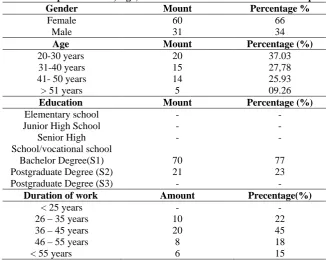
The object of the present study was all private senior high school teachers in East Surabaya. The number of respondents was 91, consisting of both male and female teachers. The data can be seen as follows:
Respondents’ Characteristics
[image:5.595.133.460.271.534.2]Respondents’ characteristics consisted of gender, age and education. Respondents were certified private senior high school teachers of A-accredited schools. Teacher performance could be measured after being certified.
Tabel 1 : Deskription Gender, Age, Education and duration of work for responden
Gender Mount Percentage %
Female 60 66
Male 31 34
Age Mount Percentage (%)
20-30 years 31-40 years 41- 50 years > 51 years
20 15 14 5 37.03 27,78 25.93 09.26
Education Mount Percentage (%)
Elementary school - - Junior High School - -
Senior High School/vocational school
- -
Bachelor Degree(S1) Postgraduate Degree (S2) Postgraduate Degree (S3)
70 21 - 77 23 -
Duration of work Amount Precentage(%)
< 25 years - - 26 – 35 years
36 – 45 years 46 – 55 years
10 20 8 22 45 18 < 55 years 6 15
Table 1 shows that a total of 60 (66%) teachers was female and a total of 31 (34%) teachers was male. In terms of education, the majority (70% or 70) of teachers were undergraduate and 21 teachers were holders of postgraduate degree.
In terms of age, the majority (45% or 20) of respondents were aged 36 to 45 years, 22% or 10 respondents aged 26 to 35 years, 15% or 6 respondents aged >55 years, 18% or 8 respondents aged 46 to 55 years, and no respondent aged <25 years.
IV. RESULTS AND DISCUSSION Outer ModelTest
An outer model, often called an outer relation or a measurement model, specifies the relationship among the variables studied and their indicators. The following is the steps of an outer model test:
a. Convergent Validity
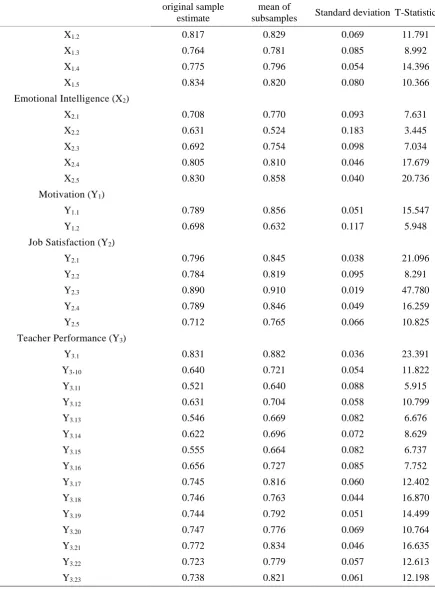
The convergent validity of a measurement model with reflexive indicators can be seen from the correlations between the item/indicator scores and the construct scores. However, in the scale development of a research, a loading factor of 0.50 to 0.60 is acceptable (Ghozali, 2006: 40). The correlations between the indicators and constructs are as follows:
Tabel 2 : Convergent Validity
original sample estimate
mean of
subsamples Standard deviation T-Statistic Personality (X1)
ISSN 2250-3153
original sample estimate
mean of
subsamples Standard deviation T-Statistic X1.2 0.817 0.829 0.069 11.791
X1.3 0.764 0.781 0.085 8.992
X1.4 0.775 0.796 0.054 14.396
X1.5 0.834 0.820 0.080 10.366
Emotional Intelligence (X2)
X2.1 0.708 0.770 0.093 7.631
X2.2 0.631 0.524 0.183 3.445
X2.3 0.692 0.754 0.098 7.034
X2.4 0.805 0.810 0.046 17.679
X2.5 0.830 0.858 0.040 20.736
Motivation (Y1)
Y1.1 0.789 0.856 0.051 15.547
Y1.2 0.698 0.632 0.117 5.948
Job Satisfaction (Y2)
Y2.1 0.796 0.845 0.038 21.096
Y2.2 0.784 0.819 0.095 8.291
Y2.3 0.890 0.910 0.019 47.780
Y2.4 0.789 0.846 0.049 16.259
Y2.5 0.712 0.765 0.066 10.825
Teacher Performance (Y3)
Y3.1 0.831 0.882 0.036 23.391
Y3.10 0.640 0.721 0.054 11.822
Y3.11 0.521 0.640 0.088 5.915
Y3.12 0.631 0.704 0.058 10.799
Y3.13 0.546 0.669 0.082 6.676
Y3.14 0.622 0.696 0.072 8.629
Y3.15 0.555 0.664 0.082 6.737
Y3.16 0.656 0.727 0.085 7.752
Y3.17 0.745 0.816 0.060 12.402
Y3.18 0.746 0.763 0.044 16.870
Y3.19 0.744 0.792 0.051 14.499
Y3.20 0.747 0.776 0.069 10.764
Y3.21 0.772 0.834 0.046 16.635
Y3.22 0.723 0.779 0.057 12.613
Y3.23 0.738 0.821 0.061 12.198
As shown in Table 6, Personality (X1), as measured by the 5 indicators, Emotional Intelligence (X2), Motivation (Y1), Job
Satisfaction (Y2) and Teacher Performance (Y3) indicate a convergent validity > 0.5; thus, it is considered valid.
b. Discriminant Validity
[image:6.595.42.478.57.647.2]Discriminant validity describes the ability of each indicator to make a difference between its construct and other constructs. When an indicator belongs to another construct, it means that the indicator does not have a good discriminant validity. In the discriminant validity test, the first condition to be met is that the AVE value must be greater than 0.50, as shown in Table 7 below:
Tabel 3 : Nilai AVE
ISSN 2250-3153
Personality (X1) 0.618
Emotional Intelligence (X2) 0.543
Motivation (Y1) 0.555
Job Satisfaction (Y2) 0.634
Teacher Performance (Y3) 0.572
As shown in Table 7, the AVE value in for the indicator that measure the construct can be considered as having a good discriminant validity. This means that all the construct variables are considered reliable.
The cross-loading output of the data processing is shown in the following table: Tabel 4 : Cross Loadings
Personality (X1)
Emotional Intelligence (X2)
Motivation (Y1)
Job Satisfaction (Y2)
Teacher Performance (Y3)
X1.1 0.739 0.368 0.397 0.380 0.323
X1.2 0.817 0.248 0.199 0.384 0.230
X1.3 0.764 0.292 0.221 0.280 0.247
X1.4 0.775 0.305 0.371 0.318 0.259
X1.5 0.834 0.393 0.571 0.508 0.306
X2.1 0.223 0.708 0.240 0.204 0.248
X2.2 0.234 0.631 0.310 0.184 0.228
X2.3 0.185 0.692 0.347 0.244 0.282
X2.4 0.113 0.805 0.738 0.537 0.324
X2.5 0.173 0.830 0.824 0.666 0.450
Y1.1 0.245 0.316 0.789 0.298 0.319
Y1.2 0.087 0.681 0.698 0.527 0.228
Y2.1 0.488 0.523 0.634 0.796 0.484
Y2.2 0.228 0.698 0.688 0.784 0.420
Y2.3 0.395 0.932 0.287 0.890 0.603
Y2.4 0.277 0.354 0.285 0.789 0.353
Y2.5 0.355 0.329 0.429 0.712 0.366
Y3.1 0.243 0.469 0.505 0.427 0.831
Y3.10 0.331 0.838 0.810 0.649 0.940
Y3.11 0.194 0.490 0.401 0.302 0.521
Y3.12 0.339 0.822 0.791 0.639 0.931
Y3.13 0.228 0.527 0.462 0.322 0.546
Y3.14 0.324 0.448 0.379 0.453 0.622
Y3.15 0.310 0.430 0.339 0.410 0.555
Y3.2 0.176 0.317 0.347 0.385 0.656
Y3.3 0.265 0.545 0.511 0.417 0.745 Y3.4 0.219 0.370 0.427 0.336 0.746
Y3.5 0.344 0.439 0.543 0.517 0.744
Y3.6 0.207 0.322 0.251 0.335 0.747
Y3.7 0.216 0.390 0.554 0.453 0.772
Y3.8 0.198 0.524 0.495 0.482 0.723
ISSN 2250-3153
The cross-loading values in Table 4, show that the indicators of each construct variable have a convergent validity > 0.5, meaning that all the indicators used in the present study are valid.
c. Composite Reliability
The composite reliability test was performed under condition that when the composite reliability value is >0.60, it is interpreted as highly satisfying (Ghozali, 2006 : 98).
Tabel 5 : Composite Reliability
Composite Reliability Personality (X1) 0.890
Emotional Intelligence (X2) 0.854
Motivation (Y1) 0.713
Job Satisfaction (Y2) 0.896
[image:8.595.56.452.374.649.2]Teacher Performance (Y3) 0.929
Table 5 shows that the composite reliability of all the variables are reliable so that each construct can be used as the research variable and for further analysis.
Inner ModelTest
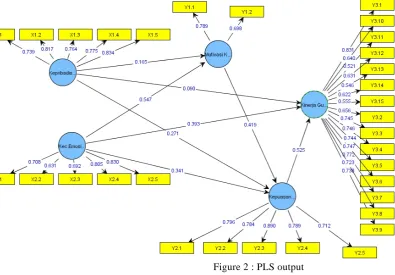
An inner model or structural model testing was performed to determine the relationships among constructs, the significance value and the R-squared of the research model. The structural model was evaluated by using the R-squared for the t-test of dependent constructs and the significance of the structural path coefficients, based on the PLS outputs, as shown by the following figure:
Figure 2 : PLS output
The inner weights as shown by Figure 2 above show that personality and emotional intelligence has an effect on work motivation, job satisfaction and teacher performance, as shown in the following structural equations.
Structural Equations
Work Motivation (Y1) = 0.165 Personality (X1) + 0.547 Emotional Intelligence (X2)
Job Satisfaction (Y2) = 0.341 Emotional Intelligence (X2) + 0.419 Motivation (Y1)
ISSN 2250-3153
The model with PLS was started by looking at the squared for each latent dependent variable. Changes in the R-squared can be used to assess for the substantive effects of certain latent independent variables on the latent dependent variables. The endogenous latent variables in the structural model have the R2 of 0.67, indicating that the model was
“good”; a R2 of 0.33 indicates that the model is “moderate” and a R2 of 0.19 indicates that the model is “weak” (Ghozali,
2006: 87). The PLS output is as described below:
Tabel 6 : Nilai R-Square
R-square
Motivation (Y1) 0.387 Job Satisfaction (Y2) 0.550 Teacher Performance (Y3) 0.613
The variables Personality (X1) and Emotional Intelligence (X2) that had an effect on Motivation (Y1) had a R2 of
0.387, indicating that the model was “moderate”, and the variables Emotional Intelligence (X2) and Motivation (Y1) that
had an effect on job satisfaction (Y2) had a R2 of 0.550, indicating that the model was “moderate”. Personality (X1),
Emotional Intelligence (X2) and Job Satisfaction (Y2) that had an effect on teacher performance (Y3) had a R2 of 0.613,
indicating that the model was “moderate”.
The structural model fit can be seen from the Q2 as follows:
Q2 = 1 – [(1 – R1)*(1 – R2) *(1 – R3)]
= 1 – [(1 – 0.387)*(1 – 0.550) *(1 – 0.613)] = 1 – [(0.613)*(0.450)*(0.387)]
= 1 - [0.107] = 0.893
The Q2 shows that the model fits the study since it is above zero.
Hypothesis Testing
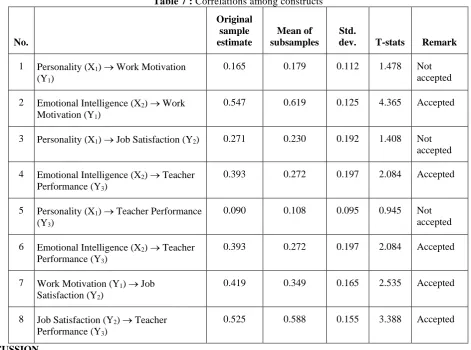
[image:9.595.59.531.419.769.2]The hypotheses can be tested on the basis of the t-statistic in Table 11.
Table 7 : Correlations among constructs
No.
Original sample estimate
Mean of subsamples
Std.
dev. T-stats Remark
1 Personality (X1) → Work Motivation
(Y1)
0.165 0.179 0.112 1.478 Not accepted 2 Emotional Intelligence (X2) → Work
Motivation (Y1)
0.547 0.619 0.125 4.365 Accepted
3 Personality (X1) → Job Satisfaction (Y2) 0.271 0.230 0.192 1.408 Not
accepted 4 Emotional Intelligence (X2) → Teacher
Performance (Y3)
0.393 0.272 0.197 2.084 Accepted
5 Personality (X1) → Teacher Performance
(Y3)
0.090 0.108 0.095 0.945 Not accepted 6 Emotional Intelligence (X2) → Teacher
Performance (Y3)
0.393 0.272 0.197 2.084 Accepted
7 Work Motivation (Y1) → Job
Satisfaction (Y2)
0.419 0.349 0.165 2.535 Accepted
8 Job Satisfaction (Y2) → Teacher
Performance (Y3)
0.525 0.588 0.155 3.388 Accepted
ISSN 2250-3153
Table 11 shows that:
1. Personality (X1) has no effect on Motivation (Y1) since the T-statistics is 1.478, or smaller than 1.96; thus, hypothesis
H1 is not accepted. Teacher personality is of paramount importance. In addition to undertaking their profession, a
teacher should also serve their learners so that they feel noticed. However, in the present study, teacher personality was not taken into account, leading to the decreased motivation. This is because teachers are incapable of undertaking their profession properly, making many learners disrespectful of their teachers. In many cases, there were learners daring to fight their teachers when the latter seeking to enforce order in the classroom, dreaded teachers, teachers disrespecting their learners by talking bad about them in front of the class. Results of the present study are not consistent with those of Nyarko et.al. (2016) that the personality characteristics would significantly predict their motivation on academic achievement.
2. Emotional Intelligence (X2) has a significant positive effect on Motivation (Y1) since the T-statistics is 4.365, or
greater than 1.96; thus, hypothesis H2 is accepted. A teacher should have a good emotional intelligence to manage his
or her emotions in the face of the learners so that he or she will be enthusiastic to carry out his or her profession. Learners have different characters, representing the teacher’s task to manage their emotions to guide their learners to learn properly and follow all the teacher’s advices. Results of the present study are consistent with those of Asy’ari et al. (2014) that there was a significant positive relationship between emotional intelligence and learning motivation of the students of SMK Assa’adah Sampurnaan Bungah; the higher the emotional intelligence of the students, the higher the students’ learning motivation would be. Results of the present study are inconsistent with those of Dewi et al. (2016) that emotional intelligence does not affect teacher performance through achievement motivation.
3. Personality (X1) has no effect on Job Satisfaction (Y2) since the T-statistic is 1.408, or smaller than 1.96; thus,
hypothesis H3 is not accepted. A teacher’s improper personality will lead to job dissatisfaction. Senior high school
teachers had not have adequate personality, primarily in terms of internalizing their role as a teacher. This is proven by the fact that there are still teachers who are not discipline by skipping work during the teaching hours for a side job, ignoring their duties as a teacher. In fact, there are teachers failing to master their subject matters due to indolence to learn, making them lacking creativity and innovativeness. Results of the present study are inconsistent with those of Alsuwailem andElnaga (2016) that personality traits have a significant effect on job performance.
4. Emotional Intelligence (X2) has a positive significant effect on job satisfaction (Y2) since the T-statistics is 1.997, or
greater than 1.96; thus, hypothesis H4 is accepted. A teacher should be able to manage his or her emotions properly,
especially in the face of learners in order to achieve the desired job satisfaction in which the learners follow all the teacher’s directions. Being a teacher of senior high school requires a high level of patience to avoid misperception. Results of the present study are consistent with those of Anari, N. N (2012) that there is a positive and significant relationship between Emotional Intelligence and Job Satisfaction among primary school teachers. It means that higher the level of Emotional Intelligence the higher the job satisfaction is.
5. Personality (X1) has no effect on Teacher Performance (Y3) since the T-statistic is 0.945, or smaller than 1.96; thus,
hypothesis H6 is accepted. This is because a teacher has not been able to appreciate his or her role as a teacher, despite
the undergraduate diploma and certification. Many teachers ignores it since they feel that the salary they receive is not enough to support their family, even to take a higher level of education. As a result, many teachers are not wholeheartedly undertaking their profession. Even worse, the teaching profession serves as only a side job, rather than a demand or a call. Results of the present study do not support those of Angmalisang (2011) that personality has a significant effect on teacher performance.
6. Emotional Intelligence (X2) has a significant positive effect on Teacher Performance (Y3) since the T-statistics is
2.084, or greater than 1.96; thus, hypothesis H7 is accepted. Emotional intelligence is a necessity to a teacher in
managing emotions in order to be cautious with regard to teaching the learners in a senior high school since they need a lot of attention. They are the generation of the nation whose character must be build to create human resources useful for the nation. Results of the present study are consistent with those of Naqvi et al.(2016) that there is relationship between emotional intelligence and performance of secondary school teachers. It means that increase in the level of emotional intelligence enhances the performance of secondary school teachers at secondary school level. According to Dewi et al. (2016), emotional intelligence has a positive and significant effect on teacher performance.
7. Motivation (Y1) has a significant positive effect on Job Satisfaction (Y2) since the T-statistics is 2.535, or greater than
1.96; thus, hypothesis H5 is accepted. Motivation is an impetus that leads a teacher to always be passionate in carrying
out his or her profession. Being a teacher is a highly noble duty and often referred to as an unsung hero since a teacher is capable of creating future generations of character who later can lead this nation toward progress. Teachers would be satisfied and happy to see the learners who succeeded. Results of the present study are consistent with those of Arifin (2015) that work motivation has a positive and significant effect on teacher job satisfaction.
8. Job Satisfaction (Y2) has a significant positive effect on teacher performance (Y3) since the T-statistics is 3.388, or
greater than 1.96; thus, hypothesis He is accepted. Teacher job satisfaction is crucial to improve their performance as reflected by the learning achievement achieved by the learners. According to Chamundeswari (2013), there is a significant difference in job satisfaction and performance of teachers. Furthermore, Arifin (2015) argues that job satisfaction has a positive and significant effect on performance, meaning that the higher the teacher job satisfaction the higher the teacher performance would be.
ISSN 2250-3153
In conclusion, personality has no effect on work motivation. A teacher who fails to make the learners enjoy the learning process in the classroom would always be bad-tempered in the course of the learning process.
Emotional intelligence has an effect on motivation. Results indicated that a teacher should be able to manage his or her emotions in order for the learners to follow his or her directions to become high-achievers.
Personality has no effect on job satisfaction. Results indicated that the personality of a teacher is supported by the individual’s appreciating his or her role as a teacher. A teacher not appreciating the teaching profession would not be comfortable or unhappy to undertake his or her profession despite the certification.
Emotional intelligence has an effect on job satisfaction. Results indicated that emotional intelligence of a teacher in controlling emotions is needed to perform their duties as a teacher. Teachers are public figures whose attitudes and behaviors will be followed by his or her students.
Personality has no effect on teacher performance. Results indicated that teachers were not able to appreciate his or her teaching profession, despite the diploma and certification. The diploma and certification cannot guarantee that a teacher will have good behavior towards their teaching profession.
Emotional intelligence has an effect on teacher performance. Results indicated that managing emotions for a teacher is crucial to direct learners in the right direction. They are the next generation of the nation who will continue the struggle to bring Indonesia towards progress and eliminate inferiority to other countries.
Motivation has an effect on job satisfaction. Results indicated that giving motivation to learners in senior high schools is highly required since this may lead to passion for advancements and realization of ambitions.
Job satisfaction has an effect on teacher performance. Results showed that successful learners will make their teachers happy since the lessons given by teachers can be received well and applied to the community.
Referencess
[1] Alsuwailem, A and A.A. Elnaga. 2016. Exploring The Relationship Between Personality and Job Performance “ New Approach “. International Journal Of Business and Management Invention. Vol. 5, ISSUE 12. Pp. 43-53 ISSN online 2919-8028
[2] Anari, N.N. 2012. Teacher: Emotional Intelligence, Job Satisfaction and Organizational Commitment. Journal Of Workplace Learning. Vol. 24, ISSUE 4, pp. 256-269
[3] Angmalisang, H. 2011. Pengaruh Kepribadian Guru Terhadap Kinerja Mengajar. Elektromatika. Vol. 1, No.1 Maret
[4] Arifin, H. M. 2013. The Influence Of Comptetence, Motivation and Organisational Culture to High School Teacher Job Satisfaction and Performance. International Education Studies. Vol. 8, No. 1 ISSN 1913-9020
[5] Asy’ari, M., IGAA. N. Ekayati dan A. Matulessy. 2014. Konsep diri, Kecerdasan Emosi dan Motivasi Belajar Siswa. Persona,
Jurnal Psikologi Indonesia, vol. 3. No.01, hal. 83-89
[6] Badriyah, M. 2013. Manajemen Sumber Daya Manusia. Bandung : Penerbit Pustaka Setia [7] Bangun, W. 2012. ManajemenSumber Daya Manusia. Jakarta : Penerbit Erlangga.
[8] Brahmasari, I dan A. Suprayetno. 2008. Pengaruh Motivasi Kerja, Kepemimpinan dan Budaya Organisasi Terhadap Kepuasan Kerja serta dampaknya pada Kinerja Perusahaan ( studi kasus pada PT. Pei International Wiratama Indonesia ). Jurnal Manajemen Dan Kewirausahaan, Vol. 10 No. 2
[9] Chamundeswari. 2013. Job Satisfaction and Performance Of School. International Journal Of Academic Research In Business and Social Sciences. Vol. 3, No.5 ISSN : 2222 – 6990
[10] Dewi, E.R., P. Bundu dan S. Tahmir. 2016. The Effect of Emotional Intelligence, Competence and Interpersonal Communication On the Performance Of Senior High School Teachers Through Achievement Motivation in Mahasiswa, Indonesia. The New Educational Review, Vol. 11, N0. 9 DOI : 10.12973/ijese
[11] Ghozali, I. 2006. Aplikasi Analisis Multivariate dengan Program SPSS. Cetakan ke empat. Semarang : Universitas Diponegoro
[12] Golemen, D. 1999. Working with Emotional Intelegence : Kecerdasan Emosi untuk mencapai Puncak Prrestasi. Jakarta : PT. Gramedia.
[13] Indrianto dan Supomo. 2002. Metodologi Penelitian Bisnis : untuk Akuntansi dan Managemen. Yogyakarta : BPFE
[14] Koesmono, T. 2004. Pengaruh Kepribadian Terhadap Komitmen Organisasi Dan Perilaku Serta Kinerja Karyawan Pada Perusahaan Perkayuan Di Jawa Timur. Jurnal Manajemen dan Akutansi Unika Widya Mandala. Surabaya : Vol. 4, No. 3, Desember 2004, Hal 235 – 247.
[15] ___________ 2013. Pengaruh Motivasi, Budaya Organisasi, Kepemimpinan Transformasional, Transaksional Terhadap Kepuasan Kerja dan Komitmen Organisasional Guru SMA Swasta Kristen Petra. Jurnal Mitra Ekonomi dan Manajemen Bisnis, Vol. 4, No. 1 April 2013.
[16] Keshavarzi, A and H. Amiri. 2016, The Effect of Teacher’s Personality and Corrective Feedback on EFL Learners’Motivation. Journal Of Applied Linguistics and Language research. Volume 3,ISSUE 5, pp.118 – 129
[17] Mustafa, M and N. Othman. 2010. The effect of work motivation on Teacher’s work performance in Pekanbaru senior high school, Riau, Province, Indonesia. Sosiohumanika. Vol.3, No. 2
ISSN 2250-3153
[19] Nyarko, K.,N.Kugbey., C.M. Amissah and B.Q. Dedzo. 2016. The Influence of The Big Five Personality and Motivation On Academic Achievement Among University Students in Ghana. British Journal of Education Society & Behavioural Science. 13(2): 1-7 ISSN : 2278 - 0998
[20] Robbins , S.P and T. Judge. 2008. Perilaku Organisasi. Terjemahan. Jakarta : Salemba empat.
[21] Singh, B and A. Kumar. 2016. Effect of Emotional Intelligence and Gender On Job Satisfaction of Primary School Teachers. European Journal Of Educational Research. Vol. 5, ISSUE 1. ISSN : 2165-8714
[22] Sugiono. 2007. Metode Penelitian Bisnis. Bandung: CV Alfabet.
[23] Ulug, M.,M.S. Ozden and A. Eryilmaz. 2011. The Effects Of Teachers’Attitudes On Students’ Personality and Performance.
Procedia Social and Behavioral Sciences 30. 738 -742
[24] Wahyuni, D.U. 2013. Pengaruh Komitmen Organisasional, Kecerdasan Emosional dan Kepribadian Terhadap Kinerja Guru SMK Swasta di wilayah Surabaya Barat. Jurnal Mitra Ekonomi dan Manajemen Bisnis, Vol. 4, No. 1 April 2013. [25] ____________ 2016. Influence of Organizational Culture and Personality to theWork Motivation and Performance of
Employees Through The Organizational Commitment as Mediating Variables For Medical Analist Officers at The BIO-Test Company in Surabaya, East Java. European Journal of Business and Management. Vol. 8, No. 26