“Pick And Write”: Learning through PicLits
Siti Norfauziana Binti MohdSah
*, Mohanavadivu Subramaniam*, Melor Md Yunus**, Parilah Md Shah**
*
Post Graduate Student, Faculty of Education, Universiti Kebangsaan Malaysia
**Associate Professor,Faculty of Education, Universiti Kebangsaan Malaysia
DOI: 10.29322/IJSRP.8.12.2018.p8494 http://dx.doi.org/10.29322/IJSRP.8.12.2018.p8494
Abstract—21stcentury educational pedagogy emboldens the facilitation of learning with a range of digital technologies. Integration of technology encourages and provides opportunities for learners to think critically and creatively. Thus, language teaching is also employing initiatives to be part of the technological advancement especially in teaching ESL. In line to that, emergence of various digital tools requires educators to identify the suitability and acceptance among the learners to ensure the effectiveness of the integration. Therefore, this study aims to investigate the students’s acceptance of using Piclits as a digital tool to help them enhance their writing skill. Hence, this study employed a survey design distributed to 32 Year 4 pupils in a primary school in Selangor. Data were gathered using a questionnaire containing 10 items to obtain perceptions from the respondents on the usage of Piclits. The collected data were then analysed and reported using frequencies and percentages. The analysis of the questionnaire survey reflected most of the pupils having a positive feedback on integrating Piclits in their writing activity. The findings would be beneficial to ESL language teachers as it could be an added resource to assist them in teaching the writing skill and encourage pupil’s interest towards getting them to write. However, it is suggested that teachers may also look into error correction feedback while using this tool as a means of enhancing writing skills among students.
Index Terms- digital tools, writing skills, Pic-Lits, acceptance
I. INTRODUCTION
echnology advancement is making a storm globally across various areas especially in education field. Integration of technological tools in teaching and learning has been quite encouraging. Technological approach promotes in building learner’s competency to function effectively in the modern era of technology advancement and globalization. [1]
The importance of technology based learning in teaching and learning practices has also been highlighted by the Malaysian Ministry of Education through Malaysian National Education Blueprint (2013-2025). In the drive to become a developed nation and create globally competent individuals to meet the 21stcentury skills, integration of ICT in education is crucial.
Lately, most educators in the country are taking up the challenge to be innovative in their teaching and learning so that they stay relevant to the students. Therefore, in order to create a 21st century learning environment two main criteria needs to be looked upon, which are the availability of the technological facilities and also the adaptation of digital tools by teachers in classroom teaching and learning practices. [2]
In completion of primary education, students are required to sit for a national examination at the end of primary schooling which is known as the Ujian Pencapaian Sekolah Rendah (UPSR). Students are tested on 4 core subjects with total of 6 examination papers to be answered. With regards to the English subject examination, students are required to answer English Paper 1 and Paper 2 under the latest introduction of Ujian Pencapaian Sekolah Rendah (UPSR) English Examination format in 2016. AsIen (2017) claims that it is even a bigger nightmare for the pupils, including the teachers as the English papers were now divided into two papers (English Paper 1 and English Paper 2). This is due to the rising concerns among teachers in overcoming student’s difficulties in writing skills such as forming correct sentences. Moreover, the papers are evaluated majorly on writing component which requires students to be able to master the writing skills in order to perform. Therefore it is crucial that pupils grasp the skill rather well to score excellently during the years in upper primary level. In order for them to write a whole composition they need to be guided step by step beforehand. At the same time, by integrating technology in early stages would enhance student’s interest towards building their writing skill. As mentioned by Harmer [3]who pinpoints that as educators “we need to build up creative writing bit by bit starting with phrases and sentences before expecting whole compositions.”
conducted to investigate the reach of specific technological tools in enhancing learning interest especially in language learning.[5]It is also stated that more research needs to be conducted to get insights of the technology utilization in enhancing the writing skills as a minimal number of studies were reported. [5]
As mentioned before, the effectiveness of employing tools such as web based technology relies on the suitability and the acceptance the learners too. Thus, this study is intends to identify the acceptance level among upper primary students in using Pic-Litsas a medium to improve their writing skills.
II. LITERATURE REVIEW
A. Using Digital Tools in Language Learning
Many studies have highlighted the positive impact of using technological tools to strengthen writing skills among ESL learners.[5],[6],[7], [ 8] [9 ]
Assimilating digital tools such as Web technologies allows students to be independent learners where they become more interactive and attentive. This indirectly lessens the reliance on teachers and encourages independent learning.[5]In a study conducted by Hiradhar [10] found that technology based language learning increased learner’s performance in writing even in the tertiary level.
A study by Bal, [11]found that in school reading and writing showed negative results among middle school students whereas out of school reading and writing through digital tools showed positive impact. This shows students are positive towards integrating technology in learning. Another research by Ramdani[12] found “Voki” a digital tool utilization in an English classroom improved the speaking skills among secondary school students drastically. Technology enhanced learning seem to take astrong stand in cultivating students interest in learning especially when it comes to learning English as a second language.
Usage of digital tools especially in writing skills provides a few advantages such as elimination of poor handwriting, opportunity for learners to correct quickly and its visibility encourages collaborative learning. [3] This provides a new outlook at learning the skill especially in this era of meeting the 21st century skills rather than practicing the conventional route of teaching writing.
B. Teaching Writing Skills
Among the language skills present, writing skill has been extensively observed as a significant skill in the Teaching and Learning of the English language especially among upper Primary students. This attention could be due to the prominent role of the writing skill in the Ujian Pencapaian Sekolah Rendah (UPSR) which is the sole compulsory National examination in the primary level. English assessment under this examination offers two separate papers which tests students on various forms
of writing genres. Therefore, teaching of writing skills has been receiving a great attention.
Although the teaching of writing is exam driven, writing plays a crucial role in encouraging the comprehension and critical thinking which is part of literacy.[8, 9]Writing is a challenging skill as it requires high level of linguistics ability as well as grammatical capability too. On the other hand, [8] mentioned that it could also be challenging for students to be engaged in writing lessons if, it is conducted in a traditional approach.
The Technology Acceptance Model (TAM) used in this present study was mainly adopted from Lee et al. [14], which was adapted from Davis (1989). The reason for using this framework is because this is the most widely used framework in investigating students’ acceptance on technology tools used in the classroom (Bakar & Bidin 2014; Boonsiritomachai & Pitchayadejanant 2018; Cigdem et al. 2016; Elmén 2013; Lee et al. 2005; Park 2009). In this study three constructs are adapted to study the student’s acceptance in using Pic-lits in writing. TAM is a suitable medium that could be conducted to obtain students perception of using technology in the learning practices. [5]
C. Pic-Lits for Teaching Writing
To date, pictures are being a prominent part of daily life through applications such as Instagram, Facebook and smart gadgets cameras across ages.[15]Pic-Lits is a creative site featuring attractive photographs to inspire students to match them with words selected from the word bank or added free style. It is a fun, engaging and an interactive way to improve literacy via writing. As the saying goes, a picture is worth a thousand words. Presence of visual aids as a tool to support the teaching and learning process has been in practice for a long time. Visual aids can be useful intermediate for students in learning certain vocabulary or sentences structures and further enhance the learner’s mastery of the skill.[16]
The integration of Pic-Litsin a language class is intended to encourage and provide an engaging strategy to pupils in the upper primary to write through photographs and word banks digitally instead of traditional pencil and paper practice. Research on human brain processes have revealed that images are processed much faster than it does for words. In fact, pictures tend to stay longer in the long term memory as compared to texts. [16]
III. METHODOLOGY
A. Participants
The participants of this study were Year Four students at a primary school in Shah Alam. The students were chosen randomly by the teacher. The students have a lower English proficiency based on their first semester examination results. The students will sit for their Ujian Penilaian Sekolah Rendah (UPSR), a national level examination in two years’ time. In this examination, English will be tested mainly in two skills, which are Reading and Writing.
B. Instrument
A questionnaire on student’s acceptance on using PICLITS in ESL classroom was distributed to the students. The administered questionnaire in this study was to investigate students’ acceptance on using Piclits as a digital tool to enhance writing skills. The questionnaire was adapted from Davis (1989) and [14] The questionnaire was translated into the Malay Language as the respondents are in primary school and still at the beginners level of proficiency. To make sure students understand well, the teacher was present to provide assistance and explanation to students who are unclear with the items. The items were measured on three-points Likert scale ranging from 1 to 3 (1 = Yes, 2 = I’m not sure, 3 = No).
The Technology Acceptance Model (TAM) in the present study was mainly adopted from[14], which was adapted from Davis (1989). The reason for using this framework is because this is the most widely used framework in investigating students’ acceptance on technology tools used in the classroom (Bakar & Bidin 2014; Boonsiritomachai & Pitchayadejanant 2018; Cigdem et al. 2016; Elmén 2013; Lee et al. 2005; Park 2009)
C. Procedure
Students were exposed to Piclits during Engish lessons prior to the distribution of the questionnaires. Students were able to have hands-on activities using Piclits during the lessons. The questionnaire was distributed to the students to investigate respondents’ acceptance on using Piclits in their writing class.
D. Data Analysis.
The data was analysed manually by using the frequency counts as the researcher only wanted to conduct a study to investigate students’ acceptance on Piclits.
IV. FINDINGS AND DISCUSSIONS
Fig. 1. As According to figure 1, majority of the respondents answered ‘Yes” for three out of four items under Ease of Use. 79% respondents answered yes for the overall ease of use According to figure 1, respondents believe that it is easy to use Piclits. Ease of use is important because that the performance benefits of usage are out- weighed by the effort of using the application (Davis 1989). As the respondents are year 4 primary students, it is vital to investigate whether or not their perceive Piclits as easy to be used as it can contribute to their stress and anxiety in learning English.
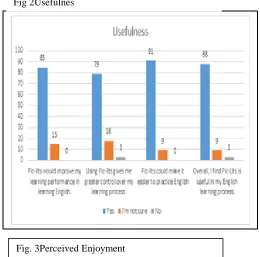
[image:3.612.315.569.92.302.2]Fig. 2. Around 88% respondents believe that Piclits is useful in their English learning process. This is because, pictures can grab the attention of some people who have less interest in reading, for example. (Elmén 2013). Pictures and videos are are also found to help with the understanding of L2 materials better than just verbal instruction. (Mueller 1980). Therefore, Piclits can be considered as a suitable tool to attract this type of students as reading and writing are interconnected and can be learned together, instead of in segregation. (Calhoun & Calhoun 1999)
[image:3.612.313.573.474.731.2]Fig 1.1 Ease Of Use
Fig 2Usefulnes
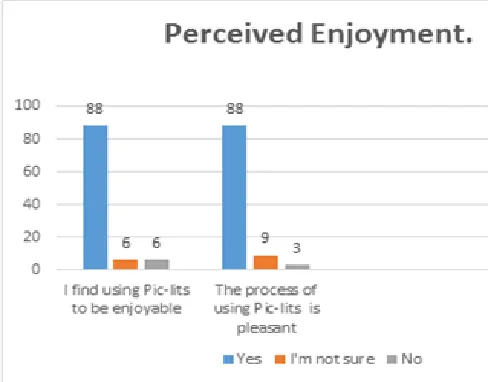
Fig. 3. 88% of the respondents believe that using Piclist is enjoyable and pleasant. This couldn’t be argued as recent statistics have shown that the primary use of the Internet for students and youth is for fun and enjoyment (Lee et al. 2005). Teachers have to take advantage on this matter as there are a lot of teaching tools that can be found in the internet that suits students’ needs in the 21st century learning. Students nowadays interact better with interactive learning instead of the traditional classroom environment. One of the way is using web-based learning. The development of web-based learning environment promotes learning and thinking such as synthesis thinking, conceptual thinking, application thinking and critical thinking, promoting potential of the brain, enhancing expert mental models and creative thinking (Kanjug & Chaijaroen 2012). Piclits is considered a suitable web-based learning tools as it can be used widely through a different range of level, as mentioned in Bloom’s Taxonomy. Therefore, teachers not only can use it to develop students’ full potential in writing, students can fully enjoy their learning process as they can explore and have fun at the same time.
Overall, almost all items have a high percentage of positive feedback from respondent. Only one item under Ease of Use where 79 percent of the respondents are not sure whether or not they make errors frequently while using Piclits. This may be because the teacher was focusing more on exposing Piclits to the students and therefore have minimal intervention on students’ errors during the lesson.
V. CONCLUSION
The emergence of information technologies is changing how students write. (Whithouse 2005). Therefore, educators need to step up to the trend in order to attract student’s interest and attention. Hence, digital tools such as Piclits could be a best option as it goes hand in hand with what teachers need today, a tool that can connect with students and at the same time provide a learning experience.
This study contributes to the knowledge on the investigation of students’ acceptance towards web-based learning. In this study,
students enjoyed and believed that Piclitscould be a potential tool to be used in line with 21st century approach. This study also contributes to the debate on teachers’ trust on primary students’ readiness on technology-based lesson in class. Most teachers are skeptical that primary school students have short attention span and need extensive supervision when internet is being used. During this research however, students were very focused and engaged in the lesson.
It is necessary to point out that this research was conducted in a short period of time and on a small number of respondents. The respondents were chosen randomly and therefore their proficiency level could not be determined in this study.
REFERENCES
[1] Higgins S, Xiao Z, Katsipataki M. The impact of digital technology on learning: A summary for the education endowment foundation. Durham, UK: Education Endowment Foundation and Durham University. 2012 Nov. [2] Garba, Sani Alhaji, Byabazaire Yusuf, and Abdul Hamid Busthami.
"Toward the Use of Technology and 21st Century Teaching-learning Approaches: The Trend of Development in Malaysian Schools within the Context of Asia Pacific." International Journal of Emerging Technologies in Learning (iJET) 10.4 (2015): 72-79.
[3] Harmer, J. (2007). The Practice of English Language Teaching. Fourth Edition. Cambridge: Pearson Longman.
[4] Ghavifekr S, Rosdy WA. Teaching and learning with technology: Effectiveness of ICT integration in schools. International Journal of Research in Education and Science. 2015 Mar 2;1(2):175-91
[5] Yunus MM, Hashim H,Mohd Jaafar NF,Hazli MZ,Zairidan NI,Sahal NA ESL Learners’ Acceptance Towards the Use of Technology in Enhancing Writing Skills.Journal of Advance Research in Dynamical & Control Systems.2018:1712-1718
[6] Said NE, Yunus M, Doring LK, Asmi A, Aqilah F, Li LK. Blogging to enhance writing skills: A survey of students’ perception and attitude. Asian Social Science. 2013 Nov 28;9(16):95.
[7] Emirmustafaoğlu, A. & Gökmen, D.U. 2015. The Effects of Picture vs. Translation Mediated Instruction on L2 Vocabulary Learning. Procedia - Social and Behavioral Sciences199: 357–362. http://linkinghub.elsevier.com/retrieve/pii/S187704281504570X
[8] Madut IT, Yunus MM. Popsicle Simile: An Innovative Tool in Promoting Creative Writing among Rural Primary School ESL Learners. InInternational Conference on Education 2017 May 8 (pp. 425-431). [9] Alkhataba, Eid Hamoudeh Ahmed and Abdul-Hamid, Samsiah and Ibrahim,
Bashir, Technology-Supported Online Writing: An Overview of Six Major Web 2.0 Tools for Collaborative-Online Writing (March 27, 2018). Arab World English Journal (AWEJ) Volume 9. Number 1. March 2018 . Available at SSRN: https://ssrn.com/abstract=3151131 or
http://dx.doi.org/10.2139/ssrn.3151131
[10] Hiradhar P. Effectiveness of technology enabled language enhancement program to develop the written communication skills of ESL learners at tertiary level.2012
[11] Bal M. Reading and Writing Experiences of Middle School Students in the Digital Age: Wattpad Sample. International Journal of Education and Literacy Studies. 2018 Apr 30;6(2):89-100.
[12] Ramdani AS. THE USE OF VOKI AS A MEDIA TO SUPPORT THE ENHANCEMENT OF FIRST GRADE STUDENTS’SPEAKING SKILLS AT SMPN 4 TAMBUN SELATAN. Jurnal Inovasi Pendidikan MH Thamrin. 2018;2(1).
[13] Rahamat RA, Shah PM, Din RO, Puteh SN, Aziz JA, Norman HE, Embi MA. Measuring learners’ perceived satisfaction towards e-learning material and environment. WSEAS Transactions on Advances in Engineering Education. 2012;9(3):72-83
[14] Lee, M.K.O., Cheung, C.M.K. & Chen, Z. 2005. Acceptance of Internet-based learning medium: The role of extrinsic and intrinsic motivation.
Information and Management42(8): 1095–1104.
Attitudes. In: Chinese as a Second and Foreign Language Education. Palgrave Macmillan, Singapore
[16] Baker L. How Many Words Is a Picture Worth? Integrating Visual Literacy in Language Learning with Photographs. InEnglish Teaching Forum 2015 (Vol. 53, No. 4, pp. 2-13). US Department of State. Bureau of Educational and Cultural Affairs, Office of English Language Programs, SA-5, 2200 C Street NW 4th Floor, Washington, DC 20037.
[17] Arroba Muñoz JM. Authentic digital storytelling in the english speaking skill (Master's thesis, Universidad Técnica de Ambato. Dirección de Posgrado. Maestria en la Enseñanza del Idioma Inglés como Lengua Extranjera).
[18] Kang GY. Playing With Digital Tools With Explicit Scaffolding. The Reading Teacher. 2018 May;71(6):735-41.
[19] Mueller, G.A. 1980. Visual Contextual Cues and Listening Comprehension: An Experiment. The Modern Language Journal64(3): 335–340.
[20] Bakar, M.S.A. & Bidin, R. 2014. Technology Acceptance and Purchase Intention towards Movie Mobile Advertising among Youth in Malaysia.
Procedia - Social and Behavioral Sciences130: 558–567. http://linkinghub.elsevier.com/retrieve/pii/S1877042814029759.
[21] Boonsiritomachai, W. & Pitchayadejanant, K. 2018. Determinants affecting mobile banking adoption by generation Y based on the Unified Theory of Acceptance and Use of Technology Model modified by the Technology Acceptance Model concept. Kasetsart Journal of Social Sciences 1–10. https://doi.org/10.1016/j.kjss.2017.10.005.
[22] Calhoun, E.F. & Calhoun, E.F. (t.th.). Beginning Reading and Writing g i n h c a e T WITH THE PICTURE WORD INDUCTIVE MODEL.
[23] Cigdem, H., Ozturk, M. & Topcu, A. 2016. Vocational college students’ acceptance of web-based summative listening comprehension test in an EFL course. Computers in Human Behavior61: 522–531. http://dx.doi.org/10.1016/j.chb.2016.03.070.
[24] Davis, F.D. 1989. Perceived Usefulness , Perceived Ease of Use , and User Acceptance of lnformation Technology. MIS Quarterly13(3): 319–340.
http://links.jstor.org/sici?sici=0276-7783(198909)13:3%3C319:PUPEOU%3E2.0.CO;2-E.
[25] Elmén, I. 2013. Pictures as an aesthetical tool in English language teaching [26] Kanjug, I. & Chaijaroen, S. 2012. The Design of Web-based Learning
Environments Enhancing Mental Model Construction. Procedia - Social
and Behavioral Sciences46: 3134–3140.
http://linkinghub.elsevier.com/retrieve/pii/S1877042812017612.
[27] Mueller, G.A. 1980. Visual Contextual Cues and Listening Comprehension: An Experiment. The Modern Language Journal64(3): 335–340.
[28] Park, S.Y. 2009. An Analysis of the technology acceptance model in understanding university students’ behavioral intention to use e-learning
research hypotheses. International Forum of Educational Technology & Society12(3): 150–162.
[29] Surendran, P. 2012. Technology Acceptance Model : A Survey of Literature. International Journal of Business and Social Research2(4): 175– 178.
[30] Rietdijk, S., van Weijen, D., Janssen, T., van den Bergh, H., & Rijlaarsdam, G. (2018). Teaching writing in primary education: Classroom practice, time, teachers’ beliefs and skills. Journal of Educational Psychology
[31] G. O. Young, “Synthetic structure of industrial plastics (Book style with paper title and editor),” in Plastics, 2nd ed. vol. 3, J. Peters, Ed. New York: McGraw-Hill, 1964, pp. 15–64.
[32] W.-K. Chen, Linear Networks and Systems (Book style). Belmont, CA: Wadsworth, 1993, pp. 123–135.
[33] H. Poor, An Introduction to Signal Detection and Estimation. New York: Springer-Verlag, 1985, ch. 4.
[34] B. Smith, “An approach to graphs of linear forms (Unpublished work style),” unpublished.
[35] E. H. Miller, “A note on reflector arrays (Periodical style—Accepted for publication),” IEEE Trans. Antennas Propagat., to be published.
[36] J. Wang, “Fundamentals of erbium-doped fiber amplifiers arrays (Periodical style—Submitted for publication),” IEEE J. Quantum Electron., submitted for publication.
[37] Ien LK, Yunus MM, Embi MA. Build Me Up: Overcoming Writing Problems Among Pupils In A Rural Primary School In Belaga, Sarawak, Malaysia. Jurnal Pendidikan Humaniora. 2017;5(1):1-7.
AUTHORS
First Author – Siti Norfauziana Binti Mohd Sah, Post Graduate
Student, Faculty of Education, Universiti Kebangsaan Malaysia
Second Author –Mohanavadivu Subramaniam, Post Graduate
Student, Faculty of Education, Universiti Kebangsaan Malaysia
Third Author – Melor Md Yunus, Associate Professor, Faculty
of Education, Universiti Kebangsaan Malaysia
Fourth Author – Parilah Md Shah, Associate Professor, Faculty
of Education, Universiti Kebangsaan Malaysia