Determinants of Loan Repayment Performance:
Evidence from in Small and Medium Enterprises: In
Case of Gurage Zone: Ethiopia
Mesele Shiferaw*, Mulugeta Abuye**,
*Assistant professor of Accounting and Finance, Wolaita Sodo University, Wolaita Sodo Ethiopia **MSc, in Finance and Investment, Wachemo University, Hossana Ethiopia
DOI: 10.29322/IJSRP.9.11.2019.p9523
http://dx.doi.org/10.29322/IJSRP.9.11.2019.p9523
Abstract-
Micro finance institutions have a significant role for the development of one’s country economic
development by providing a credit and also a saving service for those productive clients. This study was
conducted with the aim of analyzing the factors that influence micro-finance loan repayment practice using
primary data collected through self-administered questionnaire. The researcher used both primary and
secondary sources of information to gather relevant data. Questionnaires are distributed to the employees of
the organization and the information gathered is analyzed accordingly. A total of 7 employees were taken by
using judgmental/purposive sampling method to select sample respondents from the total populations. The
primary data were collected through interview and questionnaires because they are most appropriate
instrument to collect relevant data and to identify major problems that affect loan repayment practice of the
institution, the secondary data were collected by reviewing different literatures regarding the research subject.
The Researcher used descriptive type of analysis with the help of graph, chart, tables and percentage to analyze
the necessary data that was collected from the organization for both primary and secondary method of data
collection. Based on the findings of the study, the study revealed that the credit term, credit monitoring,
collateralized loan and loan supervision by the institution assign as the causes of nonperforming loan.
Key Terms: Micro-Finance; Loan Repayment Practice; Economic Development And Micro Finance Institutions
I. INTRODUCTION
Micro-finance institutions (MFIs) are those institutions which provide micro credit, saving and other services for those who are
productive borrowers. The formal and informal sectors are the principal sources of finance for any investment or business that can be
under taken at micro, small-scale and large-scale level in an economy. The major financial institutions in the formal financial sector in
Ethiopia are commercial bank of Ethiopia (CBE) and development bank of Ethiopia (DBE).
Solomon (2006) noted that the banks serve big businessmen and disregard poor households and bankable many small-scale credit-worthy businessmen with their viable investment ventures are denied access to institutional credit because they couldn’t afford the
required collateral. He also indicated that,” over all; the prevailing operation of the formal financial institution in many low income
access to institutional credit was very limited in Ethiopia. Because of this limited access the majority of the poor get financial services through informal sources like money lenders, Iqub, Idder, merchants’ friends and relatives etc. The formal financial sources have not
interested in delivering credit to the poor. Micro finance such like Gurage credit and saving institution play an important role to
equally serve the poor borrowers as when they purposely need to be productive.
Gurage credit and saving institution was initially established in October 1995 by getting license from National Bank of Ethiopia as a
micro finance intermediary share company and began its work by providing micro-credit services for those poor’s who are biased by
the major financial institutions . A loan is a debit evidence by which specifies among other things the principal amount and interest
rate and the date of repayment. In it loan entails the revocation subject aspects for a period of time between the lender and the
borrower. In practice any material object may be lent. Acting as loan is one of the principal tasks of financial institutions issuing of
debt contract such as bond is typical source of fund.
Credit is recognized as the important financial services that contribute to the success of business venture. This success intern believes
to contribute towards economic development. However existence of credit facility alone not necessarily result in supporting of
economic development unless and other ways it would be accumulated by the existence of conductive to the efficient utilization of
credit fund. Loan recover is the main factor to determine the quality of loan assets of financial institutions. Lower recovery indicates
erosion of the institution effectiveness to provide the expected services.
Repayment practice is a critical feature of credit, because persistent or continuous poor payment ultimately leads to financial failure in
any hand or financial institution. Different factors can hinder the loan estimated recovery practice of Gurage credit and saving
institution that should be investigated for the precaution of the institution.
II. Justification and likely benefits of the study
Lending represents the typical services of micro-finance institutions provide for the productive borrowers. Loans are the dominant
asset and represents 50-75% of the total amount at most micro-finance institutions, generate the largest share of operating income and
represent the institutions greater risk exposure. Moreover its contribution to the growth of any country is huge in that they are the main
intermediaries between depositors and those in need of fund for their variable projects thereby ensure that the money available in
economy is always put to good use. Therefore, managing loan in a proper way not only has positive effect on the micro-finance
institutions practice but also on the borrower firms and a country as a whole. (Mac Donald & Koch, 2006).
Failure to manage loans, which make up the largest share of the institutions asset, would likely lead to the way of high level of
non-performing loans. As whole credit is generally accepted, that is put to productive use, results in a good return. But credit provision is
such a risky business that, in addition to other reasons of varied nature it may involve fraudulent and opportunistic behavior. The
practice of Gurage credit and saving institution has been impressive since there establishment they are expressing default problems
that can be observe from the financing loan report.
In 2006 Gurage credit and saving institution provides a loan services for about 1970 borrowers. The amount of total disbursement is
Birr37,158,457.20. Among the total amount of disbursements about Birr37,158,457.20 17,932,126 is repaid and the rest
21,169,593.18 is (i.e. about 42.34% of the loan is not repaid on time (financial report of 2006).
Brhanu(2001) argues that default problems destroy lending capacity as the flow of repayment declines transferring lenders into
welfare agencies, instead of a viable financial institution, it incorrectly penalize credit-worthy borrowers whenever the screening
mechanism is not efficient. Loan default may also deny new applicants access to credit as the micro-finance institution cash flow
management problems arguments in direct proportion to the increasing default problems.
operates are important determinants of loan repayment (Dereje etal; 2005, Belayneh, 2006). Moreover, in exploring micro-finance
repayment problems in the informal sector in (Addisu, 2006) found that repayment capacity increased with education level. Addisu
also found that borrowers who planned their business activities in advance or who had prior experience were least likely to default in
their loan repayment. In contrast, they found that the levels of monthly sales were directly related to non-repayment of loans. Efrem
and Ibrahim (2003) in their study on determinants of loan repayment practice in Bahirdar town identifies loan size, age of
beneficiaries, household size, and number of years of formal education and occupation as the key predictors of loan repayment.
Therefore, these situations triggered the researcher to look at the issues in the area closely and deeply in order to give clear description
of the problems from various conditions of the institution. Thus, the study was aimed to assess the factors affecting loan repayment
practice of Gurage credit and saving institution, Emdebir branch.
III. Significance of the study
This study would provide benefits for the following concerning bodies. It provides relevant information and suggestion about loan
repayment practices. It is also important for the top level managers of GurageSaving and Credit Institution to recognize the loan
granting procedures that they shall acquire from the program for their efficiency. It also helps future researchers by serving as a
reference. It is particularly important for Gurage Saving and Credit Institution and there by improve its future loan repayment practice.
IV. RESEARCH METHODOLOGY
The researcher used descriptive type of research design, the reason behind is that the research intention is concerned with arranging,
summarizing, and presenting numerical data in the form of table with percentage and frequency that the reader understands easily. It is
expected to be suitable in order to assess the factors affecting loan repayment practice of Gurage saving and credit institution Emdebir
branch.
Target Population
The target population for this study is employees of Gurage saving and credit institution Emdebir branch. The total number of
employees in this local micro finance institution is 15. Among them 10 are males and 5 are females.
Sample Size and Sampling Technique
The target population for this study was employees of Gurage saving and credit institution Emdebir branch and they are 15 in total.
Therefore, the research has used purposive or judgmental sampling technique and approach managers and all loan officers working in
these institutions. The reason behind the selection of these two categories is that because they are working at front line and have
expertise knowledge and experience in the area more than other staffs.In addition, there are a total of 5 loan officers working in the
MFIs. Therefore, the participants of this study were 2 Branch Managers and 5 Loan Officers. Therefore, the total numbers of
participants of the study were 7 in number.
Data Type and Source
The researcher used both quantitative and qualitative types of data. The reason for using both quantitative and qualitative is that to
better understand the research problem by combining both numeric value from quantitative research and the detail of qualitative
research.The researcher used both primary and secondary source of data to assess the factors affecting loan repayment practice of
Gurage saving and credit institution Emdebir branch. Primary sources were collected from sample respondents through questionnaire
and interview and secondary sources were obtained from different literature reviews, Gurage saving and credit institution, Internets,
Method of Data Collection
The researcher prepared both questionnaires and interviews in order to collect sufficient and relevant data from employees of Gurage
saving and credit institution. Questionnaires are prepared to employees of the Gurage saving and credit institution in order to gather
relevant information and it includes both open-ended and close-ended questions. Unstructured interviews prepared to gather additional
information from the top level management of Gurage saving and credit institution Emdebir branch.
Data processing and Analysis
After all the data were collected the researcher organize the necessary data by using tabulation and percentage method to evaluate the
various data obtained during the data collection period. The necessary data were gathered, analyzed, processed and interpreted made
and finally the recommendation is forwarded.
Ethical Considerations
Educational researchers, as well as researchers from all other domains, must consider the ethical principles of right and wrong in
relation to their researcher study. Different research bodies have developed ethical standards in conducting research. From these, the
researcher must consider the following in terms of ethics
The data to be collected would be kept confidential data exclusively used for academic purpose only Treatment of participants
Responsibility to society
Kept confidential government offices sensitive information
V. PRESENTATION, ANALYSIS AND INTERPRETATION OF DATA
This section deals with the presentation, analysis, and interpretation of data gathered through questionnaire and interview. The first
part of this chapter deals with the characteristics of the respondents. The remaining part deals with presenting, analyzing and
interpreting data of the problems under the study.
Characteristics of the Respondents
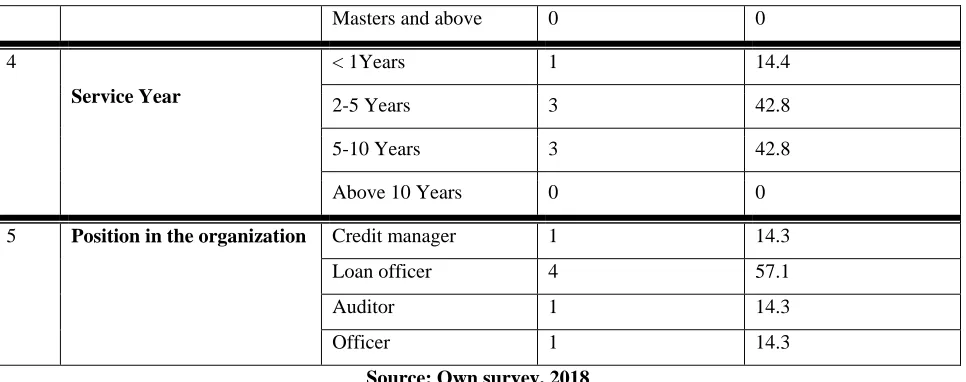
Based on the information obtained from the respondents self report in the questionnaire, the bio-data of the study group was examined
in terms of sex, age, educational level (qualification), year of experience and position in the organization. Table 1 below summarizes
[image:4.612.61.550.525.731.2]the data about the research subjects.
Table 1: Characteristics of the Respondents
No Item Category Frequency Percentage (%)
1 Sex
Male 5 71.4
Female 2 28.6
2 Age
Below 25 2 28.6
25-30 4 57.1
31-40 1 14.3
Above 40 0 0
3 Educational level
12 Grade complete 0 0
Certificate 0 0
Diploma 2 28.6
Masters and above 0 0
4
Service Year
< 1Years 1 14.4
2-5 Years 3 42.8
5-10 Years 3 42.8
Above 10 Years 0 0
5 Position in the organization Credit manager 1 14.3
Loan officer 4 57.1
Auditor 1 14.3
Officer 1 14.3
Source: Own survey, 2018
Answering the sex of research participants out of the total respondents, the majority 5(71.4%) of the respondents are male where as
2(28.6%) of them are females. This indicates that the institutions credit department is male dominated.
Regarding respondents` age, the majority 2(34.6%) and 4(27%) was in the age group of above 40 and 31-40 years respectively. In
addition, 1(23%) fall in the range between 25-30 and below 25 years age interval. Thus, this implies that under normal circumstances,
they were matured enough and can express ideas related to the study consistently and with better understanding. Therefore, their
judgments and opinions can be taken as acceptable to the study.
In item 3 of the same table, credit officers were requested to respond about their educational qualification. According to the response,
the majority 5(71.4%) of credit officers were first degree holder and the rest 2(28.6%)were diploma holders. There is no second
degree and certificate in the organization according to the respondents. Therefore, since the respondents are educated enough, the
organization is more productive by its employees.
As indicated in the above table according to the respondents’ year of service in the organization, 1(14.4%) of the respondents are
experienced less than one year, 3(42.8%) of them are experienced 2-5 years, 3(42.8%) of them are experienced 5-10 year in the
organization. This indicates that most of credit officers are worked in the organization for relatively long time and few of them are
fresh or new for the organization. Therefore, since most of credit officers are experienced in the organization and they have adopted
any conditions in the organization, they work properly for the productivity of the organization.
Regarding credit officers position in the organization, the majority 4(57.1%) of them are loan officers and the rest credit manager,
[image:5.612.67.550.55.246.2]auditor and officers accounts 42.9% of the total employees.
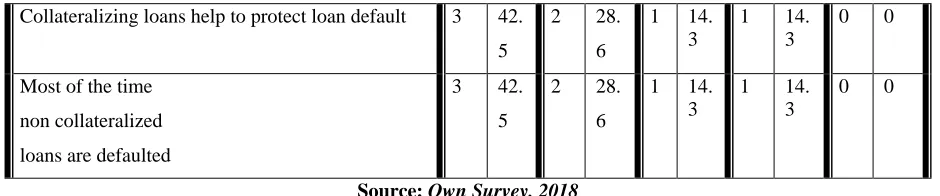
Table 2: The role of collateralized loan and nonperforming loan
The role of collateralized loan and
nonperforming loan
St
ron
gl
y
ag
ree
Ag
ree
Neutral
Disagree Stron
gl
y
disagre
e
Frequenc % y Frequenc % y Frequenc% y Frequenc % y Frequenc % y
Collateralized loans perform well in the institution 2 28.
6
3 42.
5
1 14.
3
1 14.
3
Collateralizing loans help to protect loan default 3 42.
5
2 28.
6
1 14. 3
1 14.
3
0 0
Most of the time
non collateralized
loans are defaulted
3 42.
5
2 28.
6
1 14. 3
1 14.
3
0 0
Source: Own Survey, 2018
Collateral (also known as warranty) is the asset that borrowers pledged for the institution to compensate the institution’s risk in the
time of loan default (Sinkey, 2002), and it is considered as a secondary source of repayment (MacDonald, 2003).
In the table 2 above we have observed that 3(42.5%) of respondents were agreed that collateralized loan is performed well in the
institution. As a result this study has got knowledge that institutions are not granting loan without any collateral. Besides 2(28.6%) of
the respondents are strongly agreed that collateralized loan is performed well in the institution and only 1(14.3%) of the population
disagrees on that and no respondents strongly disagree in the issue.
In the same table of item 2, out of the total respondents the majority42.5% of credit officers are strongly agreed that collateralized loan
is help to protect loan from default. As a result, the study reaches on an understanding that since the properties of the borrower’s such
as home, automobile and other furniture are behind them as collateral and become sold if they default to repay the loan and have no
any other way to repay the lender, they repay the loan with compliance to the agreement. So collateral (warranty) is used to reduce the
risk of granting a loan by increasing the chance of the creditor recovering the amounts that become due to the borrower. Moreover,
2(28.6%),1(14.3%) and 1(14.3%) of the respondents are agree, neutral and disagree respectively that collateralized loan helps to
protect loan default. Similarly, in item 3 of the same table the majority of respondents 3(42.5%) strongly agreed on non collateralized
[image:6.612.72.542.56.154.2]loans are defaulted.
Table 3: The relevant of credit term on loan repayment practice
The relevant of credit term on loan repayment
practice St ron gl y ag ree Ag ree Neutral
Disagree Stron
gl
y
disagre
e
Frequenc % y Frequenc % y Frequenc% y Frequenc % y Frequenc % y
Credit term is significant to determine loan
repayment practice in the institution
3 42.
5
2 28.
6
1 14.
3
1 14.
3
0 0
With growth in credit term comes growth on loan
default.
4 57.
2
1 14.
3
1 14. 3
1 14.
3
0 0
Borrowers default because they don’t understand
credit terms well.
1 14.
3
2 28.
6
1 14.
3
3 42.
5
0 0
Poorly negotiated credit terms lead to loan non
practice
4 57.
2
2 28.
6
0 0 1 14.
3
0 0
Source: Own Survey, 2018
In financial institutions credit term has a significant effect for the occurrence of nonperforming loan (Abreham, 2002). In the table 3
repayment practice in the institution. In addition to this 28.6%, 14.3%, 14.3% of the respondents are agree, neutral and disagree
respectively.
Regarding growth of credit the majority of credit officers of the institution which is4(57.2%) of them strongly agreed that when the
credit term becomes growth the chance of loan default is highly increased. As a result, the study got knowledge that credit term is one of the main determinants for the repayment practice of the institution’s loan, and the credit term grows the chance of loan default
becomes increase. On the other hand, only one respondent for eachwhich is 28.6% of the total respondents responded agree, neutral
and disagree respectively that with the growth of credit term the chance of loan default becomes increased.
In the same table of item 3, most of the respondents i.e. 3(42.5%) are disagreed that borrowers default to repay the loan is not related
with the misunderstanding of credit term. This entails that borrowers are clearly understand the credit term.
The last row of the same table entails, poorly negotiated credit term leads to loan nonpractice about 4(57.2%) of the respondents are
strongly agreed. Accordingly, if the lenders have a good deal about the credit term for the borrowers, the borrowers are in a better
[image:7.612.73.539.274.583.2]position to pay the debt.
Table 4: Significance of loan supervision
The significance of loan supervision on
repayment practice St ron gl y ag ree Ag ree Neutral
Disagree Stron
gl
y
disagre
e
Frequenc % y Frequenc % y Frequenc% y Frequenc % y Frequenc % y
The institution supervises the borrowers after loan
granting
2 28.
6
4 57.
2
0 0 1 14.
3
0 0
The institution supervises the borrowers before
granting loan
1 14.
3
3 42.
5
1 14. 3
1 14.
3
1 14.
3
Loan supervision is relevant for the repayment
practice
5 71.
4
2 28.
6
0 0 0 0 0 0
A borrower without loan supervision become
defaulted for repayment
4 57.
2
2 28.
6
1 14. 3
0 0 0 0
Institutions with high supervision faces little
nonperforming loan
3 42.
5
2 28.
6
1 14. 3
1 14.
3
0 0
Source: Own Survey, 2018
Loan supervision is the follow up of the institution about for what purpose and how the borrowers are used the money they lend from
the institution for the best utilization of money provided as a loan (Adisu, 2006).
From the table 4 above it is observed that 4(57.2%) of the respondents are agreed that the institution is supervise the borrowers when
the loan is going to granting. From this survey result the study got knowledge that the institution has supervision policy to grant a loan
for the creditworthy borrowers. In other ways, 2(28.6%) and 1(14.3%) of the respondents are strongly agreed and disagreed the
institution supervises the borrowers to grant a loan.Moreover, 4(57.2%) of the respondents are strongly agreed that a borrowers
without any supervision becomes defaulted for repayment and 3(42.5%) of the respondents also strongly agreed that the institutions
if the institution provides a great supervision for the borrowers when they decide to grant loan they have a better practice for the
repayment of loan wisely.
Difficulties that faces during the repayment period
As the respondents tell there are different difficulties that face during the period of repayment. Those are borrowers used the loan they
get from the institution for unintended purposes such as ceremony, wedding clothing and others. Due to this they cannot be profitable
rather than being the owner of much accrued debts and they cannot pay the loan properly based on the agreement. And other
difficulties that face during the repayment the repayment period are Unwillingness of borrowers to pay their loan.
Due to little knowledge of borrowers about the amount interest paid they are not good to repay the principal with its
interest.
They have bad feelings with the institutions during the due date of the loan. Generally borrowers are not good to repay their loan timely.
Incentives made by the institution for those who are creditworthy borrowers
Respondents say different things about the incentives made by their institutions for those creditworthy borrowers. Some of these are: Getting a trust by the institution.
Granting a loan as the amount they want. Get a loan at any time they want.
Provide a loan by grouping collateral and also without any collateral. Appreciating them by different awards and so on.
To sum up, all the respondents says about the institution’s loan system it is a poor oriented to make the productive borrowers being achievable and self reliant. It is also backed by collateral for the warranty of institution’s risk due to the borrowers default to repay their loan. The respondents also say that the institution is the cornerstone for the development of the country’s economy by providing
a loan service for any intelligent and productive borrow
VI. .CONCLUSION AND RECOMMENDATION
Conclusion
The general objective of this research is identifying the factors that affect loan repayment practice of Gurage credit and saving
institution, Emdeber branch. A number of specific research questions are developed based up on the general objective of the research.
A self administered questionnaire for the purpose of obtains a primary data from the targeted respondents. According to the
respondents view the result of the study showed that there are most likely occurrence of effects that affect loan repayment practice of
Gurage credit and saving institution, Emdeber branch. It is presented bellow.
This study find out collateral is one among the main requirements for assuring the lending institution’s repayment practice of loan
provided for the clients. Due to this most of the time financial institutions did not grant a loan without any collateral. When the
institution have done so it is helpful to ensure the borrowers full commitment, provide as a security if the borrowers are defaulted
for repayment, protect the borrowers deviation from performing the planned action at the time of credit extension. Since bounding
the borrower with high valuable collateral make a feeling for them not to lose the property due to defaulting to repay their loan.
Therefore borrowers become in a good position to repay the debt.
credit term becomes long it is not the borrower’s poor knowledge about credit term rather it is the negligence of the borrowers so,
the institution is cautious when there is a growth of credit term since it approaches to loan default.
In addition, the institution made a strict monitoring to ensure the practice of loan. The institution monitors the borrower’s property
and gives an attention what the borrowers have been made by the money they lend from the institution. The institutions have
many possible alternatives to monitor the borrowers. Amongst this one of the best methods is visiting to understand the progress of the borrower’s business operation and giving an advice as necessarily important, and encouraging the repayment practice. Besides, the institution made loan supervision about for what purpose the borrowers need a loan, how they are going to use the
loan and also their productiveness of using a loan. Such supervisions are a key factor for the clients better productivity and the
assurance of repayment practice of the institution since the borrowers achievement is also great for little occurrence of
nonperforming loan in the institution.
Finally the study investigate that even if there are some difficulties faced at the time of loan repayment with the borrowers there is
also an interesting condition with those credit worthy borrowers who are really productive and achievable and the institution have
an incentive mechanisms for such borrowers. Among the incentives some of them are provide a loan without collateral, granting a
loan as the amount they want and at any time they want, giving different awards, getting a trust by the institution and so on.
Recommendation
Based on the above the research findings and conclusion the following recommendation are suggested.
The institution should made an assessment on the loan’s normality periodically so as to know the indicators of loan practice including profitability, management’s level of activity and this ensures the assets which are utilized effectively and for
productive purpose.
Collateral is decisive for the decision of lenders whether to provide a loan or not the institution is better to continue giving
more attention on the property (like house, automobile e.t.c) of borrowers taking it as a collateral since it is used to assure the
borrowers commitment to pay the debt.
The institution is also advised to strengthen their attention on monitoring the borrowers attentively as they have done before
to make them productive by assessing the businesses intended to operate by the loan which is provided.
In making the negotiation about the credit term the institution should not be shallow rather it is expected to be strong.
Because poorly negotiated credit term leads to the growth of credit term even if the borrowers have knowledge about
the credit term which is the indicator of loan default as investigated in the analysis of the research.
Loan supervision is has a key role for the practice of the institution. This because if the institution supervises the borrower it
is easy to know what the borrower intends to operate, and give an advice how to utilize the money they borrowed. By doing
so since the credit is invested on the outlined purpose the borrowers become achievable and there will not be nonperforming.
As a result, the institution is ought to strengthen their supervision system than what they have been made before at the time of
deciding to provide a loan for the borrowers.
VII. REFERENCES
Abafita 2003. ‘Microfinance and loan repayment practice: A Case Study of the Oromia Credit and Savings Share Company (OCSSCO) in Kuyu’, MSc thesis, Addis Ababa University, Addis Ababa.
Abraham. (2004). determinants of loan repayment in oromia credit saving and shre company. Abreham. (2002). credit term determines the loan repayment practice. A.A.
Abreham G.2002. A ‘Loan repayment and its Determinants in Small-Scale Enterprises Financing in Ethiopia: Case of private borrowers Around Zeway Area’, M. Sc. Thesis, AAU.
Addisu. (2006). factors affecting loan repayment practice.
Assefa B.A. (2002). Factors influencing loan repayment of rural women in Eastern Ethiopia. Ethiopia, : the case of Dire Dawa Area’, A Thesis presented to the school of graduate studies, Alemaya Univeristy,.
Berhanu A. (2005). Determinants of formal source of credit loan repayment practice of smallholder farmers. Ethiopia, the case of north western Ethiopia, North Gondar’, M.Sc. Thesis, Alemaya Univeristy, Ethiopia.
Ibrahim, E. &. (2003). detwrminants of loan repayment practice. Bahirdar.
Jaffee Dwight, and Joseph Stiglitz, 1990. Credit Rationing, in Handbook of Monetary Economics, Credit Rationing, in Handbook of Monetary Economics, Vol. II, Ed. By Ben (Vol. Vol. II). (N. H. Ed. By Benjamin M. Friedman and Frank H. Hahn, Ed.)
Jaffee M. Dwight1971. Credit Rationing and the Commercial Loan Market, An Econometric Study of the Structure of the Commercial Loan Market. ,John Wiley and Sons,Inc.U.S.A., 1971.
MacDonald, K. &. (2003). collateral is a secondary source of repayment.
Mensah, 1999. Bank Credit provision and Practice Measurement: The Experience of Rural Banking in Ghana,. Masters Thesis 1999. Pischke, 1991; Vigano, 1993; Kitchen, 1989.
SchumpeterJ.A.,1933. The Theory of Economic Development,. Oxford University press, 1933. Sinkey. (2002). collateral is used to componset the institution at the time of loan default. solomon. (2006). smalescale interprise and loan repayment practice.
AUTHORS First Author – MESELE SHIFERAW(MSc. In Accounting and Finance)
Certified Trainer of International Financial Reporting Standard (IFRS)
Assistant professor of accounting and finance
College of business and economics, Wolaita Sodo University, southern Ethiopia, east Africa
Phone address,+251-964082933
Personal mail address:[email protected]