INFLUENCE OF MANAGERIAL TRAINING ON THE
PERFORMANCE OF MICRO AND SMALL
ENTERPRISES IN KISII COUNTY
Samuel Ongoncho
1Patrick Ngugi
2Romanus Odhiambo
3Mary Kamaara
4PhD candidate, Jomo Kenyatta University of Agriculture and Technology, Kenya1
Senior Lecturer, College of Human Resource Development, Jomo Kenyatta University of Agriculture and Technology, Kenya2 Deputy Vice Chancellor, Academic Affairs, Jomo Kenyatta University of Agriculture and Technology, Kenya 3 Lecturer, College of Human Resource Development, Jomo Kenyatta University of Agriculture and Technology, Kenya 4
ABSTRACT: The main aim of this study was to establish the relationship between training and the performance of micro and small enterprise in Kisii County, Kenya. The objective of the study was to establish the relationship between managerial training and the performance of MSEs in Kisii County. A descriptive survey design was used to carry out the study. The target population was 12,772 owner managers. The sample size was 384 which obtained through simple stratified random sampling where 9 strata were studied. Data was collected using questionnaires, interview schedules and observation checklist. Data was analyzed using Statistical Package for Social Sciences (SPSS) version 20.0 computer software. The hypothesis was also tested using the t- test. Results of the managerial training were found to be satisfactory in explaining performance of micro and small enterprises in Kisii County. This was supported by coefficient of determination also known as the R square of 75.7%. This means that independent variable explain 75.7% of the variations in the dependent variable which is performance of micro and small enterprises in Kisii County. The ANOVA results indicate that the overall model was statistically significant. This was supported by an F statistic of 214.536 and the reported p value (0.000) which was less than the conventional probability of 0.05significance level. Regression of coefficients showed that managerial training and performance of micro and small enterprises in Kisii County had a positive and significant relationship (r=2211681.748 p=0.000. The R2 before moderation was 75.7% but after moderation the R2reduced to 49.6%. This implies that legal requirements reduce the performance of micro and small and enterprises in Kisii County. The study concluded that managerial training influences the performance of micro and small enterprises in Kisii County. It was recommended that that more managerial training should be organized for Micro and Small Enterprises in Kisii County.
Keywords: Managerial training, Performance, Results Oriented
1. Introduction
This study focused on Managerial training and the performance of micro and small enterprises in Kisii County. Micro and small enterprises have become economic drivers in not only our country Kenya but also Kisii County. However, critics of micro and small enterprises argue that despite the much resource the country and counties have spent in training MSEs the gains have not been commensurate with the huge sums of money spent during the training process. MSEs still continue dying every year according to a survey carried out in 2016 by the Kenya National Bureau of Statistics. This trend continues to worry not only the country’s policy makers but also county policy makers.
Simpson et al. (2012) indicated that there is no or little consensus on how to measure performance of MSEs, which best suited for particular business organization Thus, Performances are variously measured and the perspective are tied together and consistently monitored from the organization’s context. Approaches which best suits to measure small business performance, conceivably lacks universality. However, the selection of performance measures that reflect the true situation of small business with some degree of certainty and reliability is indeed a crucial process. Financial and non-financial measures of performance includes but not limited to: profitability, total assets, return on investment, sales volume, employment size, capital employed, market share, customer satisfaction, productivity, turnover, delivery time, employees turnover and other.
gender, level of education and length of relationship between the firm and the bank, length of loan period, collateral and availability of financial information. Ijeoma and Ezejiofor (2013) asserted that corporate governance has contributed significantly in ensuring accountability and transparency in order to improve performance of MSEs and facilitating achievement of their social responsibilities in its environment. Furthermore corporate governance assist in providing structures which the objective of the MSEs is set and means of attaining those objectives and monitoring performances to ensure that effective and efficiency in operations are achieved.
Njoora and Kyalo (2014) in their study asserted that credit influenced the growth MSEs. They recommended that more formal credit facilities be availed to MSEs under favorable conditions. They further said that the Kenyan government should strengthen and built the capabilities of institutions that generate and implement programmes for MSEs development. Msipah, Chavunduka, Jengeta, Mufudza and Nhemachena (2013) asserted that the secret behind successful business venture largely depends on entrepreneurial skills. They noted that there is need for government and other relevant stakeholders to put in efforts in training artisanal engineers in business management skills and technical skills to enhance their sustainability. They further noted that entrepreneurs require training and advice on specific areas such as: compiling a business plan, market research, identifying business and market opportunities, marketing and advertising, entrepreneurial skill trainings, financial and cash flow planning, networking opportunities among others.
Howieson (2007) provide a list of reasons why MSEs are reluctant to adopt a broad structure, these are: cost in terms of money and time, creating additional work, the fear of being naïve or ignorant by other directors or shareholders and belief that a bureaucracy will destroy the ability to respond quickly. The last few decades have witnessed several changes in the world economic system: consolidating trend of globalization and liberalization of economies. Economic downtown indicated further that it is not the big companies which are only efficient machineries to rotate the economic cycle: rather MSEs are the most trusted vehicles that lead any economy towards salvation but the realization has possibly not brought everything best for MSEs, rather it has opened up a sea of challenges. There are new business orders in the advent of information technology – opening up or market dominated by medium and big domestic companies, transnational companies which has brought new line of business strategies and supply chain, hitherto unknown to traditional business model which dominates the MSEs sector. Africa is plagued with corruption. African countries are ranked among the world’s highest rate of corruption.
This creates an environment in which according to Taylor (2012) hinders the performance of even the basic business functions. Akinruwa, Awolusi and Ibojo (2013) examined the determinants of Micro and Small Enterprises (MSEs) Performance in Ekiti State, Nigeria: A Business Survey Approach. The result finds that government focus should be on provision of all determinants that will enhance the thriving of MSEs performance, creates avenue that will give room for sharing experience among business owners finally, adequate information should be made to create awareness and need to patronize the home made product. Aworemi, Abdul-Azeez, and Opoola (2010) examined the Impact of Socio-Economic Factors on the Performance of Small-Scale Enterprises in Osun State, Nigeria. The result finds that integrated approach to the development of individual entrepreneurial capacity and promotion of sustainable small-scale enterprises.
Donglin (2009) measured the performance of MSEs in the Information and Communication Technology Industries. The result shows that an effective performance management system for Information Communication Technology (ICT), MSEs should help the companies to formulate right strategies that can especially manage the uncertainty of the external environment in their development. Krishna et al. (2012) in their study on the factors affecting the performance of MSEs in Malaysia proved that there is a significant positive relationship between the use of marketing information as well as the application of information technology and the performance of MSEs.
Eniola (2014) examined the role of MSEs firms performance in Nigeria. The result shows that the role MSEs performance in the national growth in Nigeria cannot be overemphasized. The performance of MSEs and its contributions has manifested and shown that they are a major area to be researched to assist the policy makers and the MSEs, owners to encourage an enabling and conducive environment for MSEs to perform more. SitiNur and Nelson (2011) explored a literature analysis on business performance for MSEs – Subjective or Objective Measures? The result shows that examining and expanding the taxonomy of business performance and in shedding light on future research in any discipline that focuses on measuring performance (Eniola, Entebang and Sakariyau 2015).
Kamunge, Njeru and Tirimba (2014) in their study found out that availability of management experience is a key factor affecting the performance of MSEs in Limuru Town Market. This has the potential of leading to improved business performance. The other key factors that were found to affect performance of MSEs in Limuru Town Market positively were: access to business information, government policy and regulations, access to infrastructure and access to finance.
2. Literature Review
Ans (2011), Mohammed and Obeleagu (2014) and Agbim (2013) explains management training as the acquisition of management skills regarding business planning, organizing, directing and quality control of assets and human resources. They said that for MSEs to succeed they need to train their employees the best practices in management. Jayawarna and Macpherson (2006) noted that poor management skills are still highlighted as one of the significant contributory factors in the failure of the MSEs. In his study, he found out that less than 20% of MSEs last more than 6 years a confirmation that management training could be an important component in MSEs growth.
Arafat and Ahmed (2012) found out that MSEs play a vital role in economic growth, poverty alleviation and rapid industrialization of the developing countries. MSEs are significant in underlying countries economic growth, employment generation and acceleration of industrialization. The government of Bangladesh discovered the importance of MSEs hence highlighting it in the industrialization policy, 2010. They found out that MSEs in Bangladesh would face intense competition from the international markets. Human resource is the greatest asset that MSEs need to succeed. A well trained workforce is critical in the growth of MSEs. This study has not however considered the fact that in management training of MSEs, only training the workforce and ignoring the other management aspect is preparing to fail completely.
Tiftik and Zincirkiran (2013) asserted that knowledge and skill of enterprise managers and mid scaled companies against management activities and growing management scale are gradually becoming complex in environment where there are globalization, information economy, rapidly changing information and communication technologies, new market opportunities and economic crisis makes adaptation to change very complicated. Since entrepreneurs are inadequate by means of time and information level emerging new specialization areas, information being vital value, relations of enterprise environment gaining importance and organization structures becoming complex enterprise also needs other managers. They further noted that there is need for managers to comprehend changes and to respond to these changes with new approaches.
Gholami, Sulaiman and Ramayah (2013) holds that training MSEs in innovation is a good idea but management training of MSEs need to be broadened to include other managerial issues that are extremely critical to MSEs survival which their study failed to address. They also realized that knowledge sharing has a higher factor loading compared with other knowledge management practices, and financial performance has higher factor compared with other organizational components. They further noted that MSEs knowledge management practices can play a significant role in improving productivity, financial performance, staff performance, innovation, work relationships, and customer satisfaction and thus improving MSEs organization performance. They further suggested that knowledge management practices are the critical elements for promoting the performance of MSEs. This study concentrated on knowledge management and has thus failed to address critical management training issues that hinder MSEs performance such as team building among others.
Srinivas (2013) and Jerome (2013) in their studies on quality management practices in rural and urban MSEs found that rural firms are performing at a higher level of sophistication and experience in quality management practices. They further said that total quality management is the major drive for quality management practices implementation. Managing quality at the expense of other management aspects will imply low budgetary applications to these other management aspects and consequently poor programmes in management training of MSEs that will be a disaster to MSEs growth and survival.
3. Methodology
The study used a descriptive survey design, which deals with the collection of data from the members of a sample for the purpose of estimating one or more population parameters. Descriptive survey design like the scientific model, will be based on precise definition of the problem to be studied, standardized research methods, representative samples and other smaller groups with a view of making generalizations of the population under study. By using the descriptive survey method, questions in questionnaires were posed to respondents thus facilitating investigations that will answer the stated research questions.
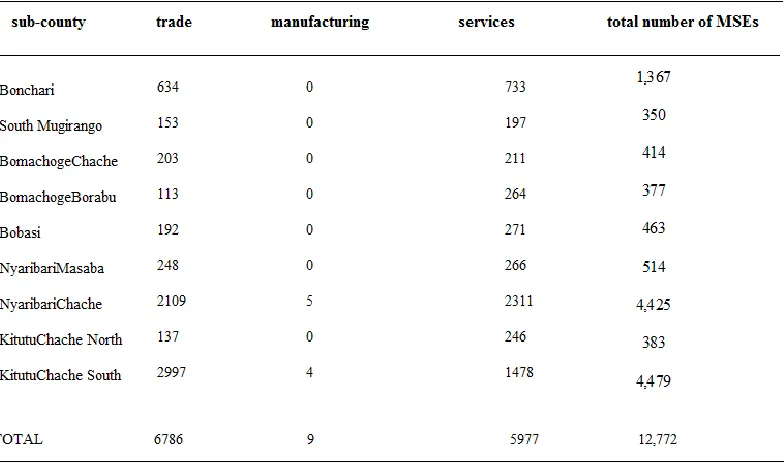
Table 1: Distribution of micro and small enterprises in Kisii County by sub-counties
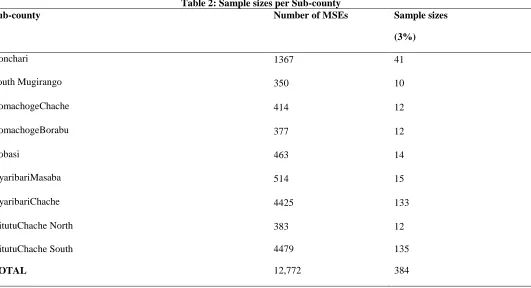
This study has nine strata, with a total population of 12,772 MSEs. This therefore means that simple stratified random sampling was employed when conducting the study. The table 1 indicates the population distribution per stratum. The study adopted stratified random sampling technique which is aimed at selecting a group of subjects for the study in such a way that their attributes represented the larger group from which they are to be drawn. According to Mugenda and Mugenda, (2013) the size of a sample influences the detection of significant differences, relationships and interactions. Critical factors in determining sample size include the population size, the desired level of precision, the level of confidence and the degree of variability of attributes being measured Since the population of the required characteristics was estimated at 50% (p=0.5), the sample size was determined as follows according to Saunders et al. (2009):
n = Z2pq
d2
where: n = estimated sample size if the target population is greater than 10,000.
Z = standard normal deviate at the required confidence level (value for selected alpha level (1.96)
p= the proportion of the target population estimated to have characteristics being measured.
q=1-P
d = the level of statistical significance set (0.05).
Executing the formula, the distribution of the target population and the corresponding sample size will be 384. In order to get proportionate allocation of the sample in the different sub-counties, the following formula was used;
Sample size in the Sub-County=Number of enterprises in the Sub-county
Number of enterprises in the County × sample size
Table 2: Sample sizes per Sub-county
Primary data was collected using a questionnaire whereas secondary data was got from published reports. The researcher obtained permission to commence his study from the National Commission for Science Technology and Innovation (NACOSTI) upon production of introductory letter from the Director School of Graduate Studies and an approved proposal. The research permit was produced to the CEC trade and all the sub county commissioners for permission to collect data in the sub counties. Similarly, chiefs, Assistant chiefs and clan elders were informed about the intended visit to collect data and research work in their respective arrears. The study targeted respondents in their business premises and working places. Out of 384 MSEs selected from Kisii County 38 were used in piloting. They were selected randomly to include all the 9 strata that were studied.
This study used the Cronbach's alpha as a measure of internal consistency. Cronbachs Alpha Coefficient value of 1.0 indicates a perfect reliability while that of below 0.70 will indicate low reliability. Content validity was ensured through piloting. Construct validity was achieved through the review of the theories that formed the major themes of the study and will establish the existence of the constructs and finally external validity was achieved through generalization of the findings of the studies.
This study yielded both qualitative and quantitative data which was analyzed using descriptive and inferential statistics. In this study, measures of central tendency and spread were analyzed descriptively using the mean, mode, median and the standard deviation. Relationships between the variables were analyzed inferentially using Regression Analysis. The data collected was first edited to correct the errors if any, coded and then analyzed using the Statistical Package of Social Sciences (SPSS) version 20.0 computer software which enabled in the manipulation and transformation of variables into desired forms for the purpose of analysis. The analyzed data was then presented using tables, pie charts and graphs such as bar graphs, histograms and ogives.
Regression analysis was conducted to determine the relationship between training and the performance of micro and small enterprises. Regression analysis was also conducted to examine the weight of each variable against the dependent variable. Performance of micro and small enterprises was regressed against managerial training. The equation was expressed as follows;
Where:
Yp = performance of micro and small enterprises.
βo =constant (co efficient of intercept)
Sub-county Number of MSEs Sample sizes (3%)
Bonchari 1367 41
South Mugirango 350 10
BomachogeChache 414 12
BomachogeBorabu 377 12
Bobasi 463 14
NyaribariMasaba 514 15
NyaribariChache 4425 133
KitutuChache North 383 12
KitutuChache South
TOTAL
4479
12,772
135
X1 = managerial training
= error term
4. Summary of Findings, Conclusions and Recommendations 4.1 Summary of Findings
[image:6.612.55.410.260.297.2]The number of questionnaires, administered to all the respondents, was 384. A total of 350 questionnaires were properly filled and returned from the respondents. This represented an overall successful response rate of 91.1%. According to Mugenda and Mugenda (2003), a response rate of 50% or more is adequate. Babbie (2004) also asserted that return rates of 50% are acceptable to analyze and publish, 60% is good and 70% is very good. Further, Cooper and Schindler (2003) also argues that a response rate exceeding 30% of the total sample size provides enough data that can be used to generalize the characteristics of a study problem as expressed by the opinions of the respondents in the target population. Based on these assertions, the response rate of 91.1% was adequate for the study.
Table 4.1: Pilot Test Results Variable Cronbach alpha Critical value conclusion
Management training .863 7 Reliable
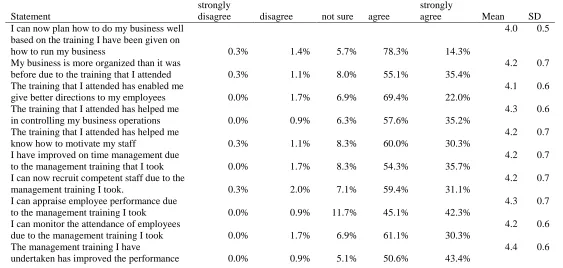
To establish the relationship between managerial training and the performance of MSEs in Kisii County, a Likert scale of 1 to 5 (1 = strongly disagree, 2 = Disagree 3 = Neutral, 4 = Agree, 5 = strongly agree) was used and the mean response rate from the micro and small enterprise owners calculated. For the purposes of interpretation 4 & 5 (agree and strongly agree) were grouped together as agree, 1 & 2 (strongly disagree and disagree) were grouped as disagree while 3 was neutral. The results of this study are as depicted in the Table .Regarding the statement that the enterprise owner can now plan how to do the business well based on the training that was given on how to run my business, majority of the respondents 92.8% (78.3% +14.3%) agreed to the statement.
The results had a mean response of 4.0 with a standard deviation of 0.5. This means that there was low variation in the responses from the respondents implying that most of the respondents could now plan for their business based on the training given. Majority of the respondents 90.5% (55.1% + 35.4%) agreed that the business is more organized than it was before due to the training that they attended. The results had a mean response of 4.2 with a standard deviation of 0.7.This means that there was a low variation in the responses from the respondents with regard to organization of the business.
Table 4.2: Managerial training and the performance of MSEs in Kisii County
Statement
strongly
disagree disagree not sure agree
strongly
agree Mean SD
I can now plan how to do my business well based on the training I have been given on
how to run my business 0.3% 1.4% 5.7% 78.3% 14.3%
4.0 0.5
My business is more organized than it was
before due to the training that I attended 0.3% 1.1% 8.0% 55.1% 35.4%
4.2 0.7
The training that I attended has enabled me
give better directions to my employees 0.0% 1.7% 6.9% 69.4% 22.0%
4.1 0.6
The training that I attended has helped me
in controlling my business operations 0.0% 0.9% 6.3% 57.6% 35.2%
4.3 0.6
The training that I attended has helped me
know how to motivate my staff 0.3% 1.1% 8.3% 60.0% 30.3%
4.2 0.7
I have improved on time management due
to the management training that I took 0.0% 1.7% 8.3% 54.3% 35.7%
4.2 0.7
I can now recruit competent staff due to the
management training I took. 0.3% 2.0% 7.1% 59.4% 31.1%
4.2 0.7
I can appraise employee performance due
to the management training I took 0.0% 0.9% 11.7% 45.1% 42.3%
4.3 0.7
I can monitor the attendance of employees
due to the management training I took 0.0% 1.7% 6.9% 61.1% 30.3%
4.2 0.6
The management training I have
undertaken has improved the performance 0.0% 0.9% 5.1% 50.6% 43.4%
[image:6.612.26.589.465.733.2]of my business
Average 4.2 0.6
Another 91.4% (69.4% + 22.0%) of the respondents indicated that the training that they attended has enabled them to give better directions to my employees. The results had a mean response of 4.1with a standard deviation of 0.6.This means that there was a low variation in the responses from the respondents with regard to giving give better directions to my employees. The study also sought to find out the extent to which training had helped respondents in controlling their business operations.
Results of the study showed that 92.8 % (57.6%+35.2%) of the respondents agreed to the statement. The results had a mean response of 4.1 with a standard deviation of 0.6. This means that there was low variation in the responses from the respondents with regard to controlling their business operations. With regard to the statement that the training that they attended had helped me know how to motivate my staff 90.3% (60.0% + 30.3%), agreed to the statement. The results had a mean response of 4.2 with a standard deviation of 0.7. This means that there was low variation in the responses from the respondents. Further, regarding the statement I have improved on time management due to the management training that I took. Majority of the respondents 88.0% (54.3%+35.7%) agreed to the statement.
The results had a mean response of 4.2 with a standard deviation of 0.7. This means that there was low variation in the responses from the respondents. Further the respondents were asked to respondent on the statement that they can now recruit competent staff due to the management training they took. Majority of the respondents 88.0% (59.4%+31.1%) agreed to the statement. The results had a mean response of 4.2 with a standard deviation of 0.7. This means that there was low variation in the responses from the respondents. Regarding the statement that they can appraise employee performance due to the management training they took, majority of the respondents 87.4% (45.1%+42.3%) agreed to the statement. The results had a mean response of 4.3 with a standard deviation of 0.7. This means that there was low variation in the responses from the respondents.
Further, the respondents were asked to respond on the statement that respondents can now monitor the attendance of employees due to the management training they took,majority of the respondents 91.4% (61.1% +30.3%) agreed to the statement. The results had a mean response of 4.3 with a standard deviation of 0.7. This means that there was low variation in the responses from the respondents. Finally regarding the statement that the management training I have undertaken has improved the performance of my business, majority of the respondents 94.0% (50.6% +43.4%) agreed to the statement. The results had a mean response of 4.4 with a standard deviation of 0.7. This means that there was low variation in the responses from the respondents. The results agree with that of Arafat and Ahmed (2012) that a well trained workforce is critical in the growth of MSEs.
Jayawarna and Macpherson (2006) also noted that poor management skills are still highlighted as one of the significant contributory factors in the failure of the MSEs. The results agree also with that of Magableh and Al-Mahrouq (2007) management skills and entrepreneurship skills affect SMEs performance and success. The results are also in agreement with Mungai (2012) that business management training had a positive effect on the entrepreneurs and as such, new products and services were introduced in the enterprise after the training. Overall, the average mean of the responses was 4.2 which means that majority of the respondents were agreeing to the statements in the questionnaire. The standard deviation was 0.6 meaning that the responses were clustered around the mean response.
The results presented in Table 4.3 present the fitness of model used of the regression model in explaining the study phenomena.
Table 4.3 Model Fitness
Model R R Square Adjusted R Square Std. Error of the Estimate
.749a .562 .560 4470385.13486
a. Predictors: (Constant), management training
Management training was found to be satisfactory in explaining performance of micro and small enterprises in Kisii County. This is supported by coefficient of determination also known as the R square of 56.2%. This means that Management training explain 56.2%of the variations in the dependent variable which is performance of micro and small enterprises in Kisii County. Results of the model fitness back up the study by Srinivas (2013) and Jerome (2013) that quality management practices influences performance of rural and urban MSEs.
Table 4.4: Analysis of Variance
Model Sum of Squares Df Mean Square F Sig.
Regression 8906974501288114.000 1 8906974501288114.000 445.698 .000b
Residual 6954551452386170.000 348 19984343253983.246
Total 15861525953674284.000 349
[image:8.612.47.575.208.566.2]Table 4.4 provides the results on the analysis of the variance (ANOVA). The results indicate that the overall model was statistically significant. Further, the results imply that the independent variable is a good predictor of MSEs performance in Kisii county. This was supported by an F statistic of 445.698 and the reported p value (0.000) which was less than the conventional probability of 0.05significance level. The results agree with that of Arafat and Ahmed (2012) that a well trained workforce is critical in the growth of MSEs. Jayawarna and Macpherson (2006), noted that poor management skills are still highlighted as one of the significant contributory factors in the failure of the MSEs. Regression of coefficient results is presented in Table 4.5.
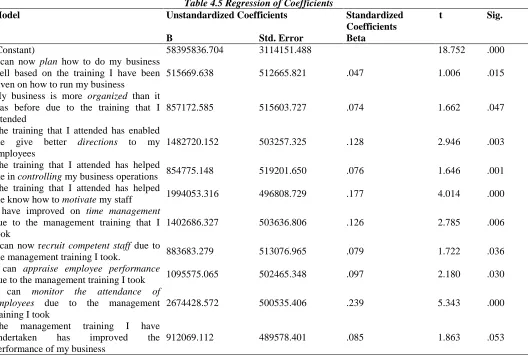
Table 4.5 Regression of Coefficients
Model Unstandardized Coefficients Standardized Coefficients
t Sig. B Std. Error Beta
(Constant) 58395836.704 3114151.488 18.752 .000
I can now plan how to do my business well based on the training I have been given on how to run my business
515669.638 512665.821 .047 1.006 .015
My business is more organized than it was before due to the training that I attended
857172.585 515603.727 .074 1.662 .047
The training that I attended has enabled me give better directions to my employees
1482720.152 503257.325 .128 2.946 .003
The training that I attended has helped
me in controlling my business operations 854775.148 519201.650 .076 1.646 .001 The training that I attended has helped
me know how to motivate my staff 1994053.316 496808.729 .177 4.014 .000
I have improved on time management due to the management training that I took
1402686.327 503636.806 .126 2.785 .006
I can now recruit competent staff due to
the management training I took. 883683.279 513076.965 .079 1.722 .036
I can appraise employee performance
due to the management training I took 1095575.065 502465.348 .097 2.180 .030 I can monitor the attendance of
employees due to the management training I took
2674428.572 500535.406 .239 5.343 .000
The management training I have undertaken has improved the performance of my business
912069.112 489578.401 .085 1.863 .053
Regression of coefficients showed that planning as a result of training and MSE performance had a positive and significant relationship (r=515669.638, p=0.015).The results also revealed that organization skills as a result of training and MSE performance had a positive and significant relationship (r=857172.585, p=0.047). The results also revealed that give better directions to employees because of the training received and MSE performance had a positive and significant relationship (r=1482720.152, p=0.003). The results also revealed that controlling the business operations as a result of the training received and MSE performance had a positive and significant relationship (r=1994053.316, p=0.000).
The results further showed that monitoring attendance of employees and MSE performance had a positive and significant relationship (r=2674428.572, p=0.000). Finally, that management training undertaken and MSE performance had a positive and significant relationship (r=912069.112, p=0.053).
The results agree also with that of Magableh and Al-Mahrouq (2007) management skills and entrepreneurship skills affect SMEs performance and success. The results are also in agreement with Mungai (2012) that business management training had a positive effect on the entrepreneurs and as such, new products and services were introduced in the enterprise after the training.
Table 4.6:.Optimal Model for managerial training Model Unstandardized Coefficients Standardized
Coefficients
t Sig. B Std. Error Beta
(Constant) -23995660.894 1301485.978 -18.437 .000
Managerial training 5727167.449 271281.212 .749 21.112 .000
Regression of coefficients showed that management training and MSE performance had a positive and significant relationship (r=5727167.449, p=0.000). This was supported by a calculated t-statistic of 21.112 which is larger than the critical t-statistic of 1.96. The results agree with Gholami, Sulaiman and Ramayah (2013), that training MSEs in innovation is a good idea but managerial training of MSEs need to be broadened to include other managerial issues that are extremely critical to MSEs survival which their study failed to address.
Srinivas (2013) and Jerome (2013) in their studies on quality management practices in rural and urban MSEs found that rural firms are performing at a higher level of sophistication and experience in quality management practices. They further said that total quality management is the major drive for quality management practices implementation.
Y = -23995660.894+ 5,727,167.449X1
WhereY = MSE performance
X1 is managerial training
The Hypothesis to be tested was that is no significant relationship between managerial training and the performance of MSEs in Kisii County. The hypothesis was tested by using simple linear regression and determined using p-value The acceptance/rejection criteria was that, if the p value is greater than 0.05, we fail to reject the Ho1 but if it’s less than 0.05, the Ho1 is rejected. Therefore the null
hypothesis is that there is no significant relationship between managerial training and the performance of MSEs in Kisii County.
The null hypothesis was that there is that is no significant relationship between managerial training and the performance of MSEs in Kisii County. Results in Table 7 show that the p-value was 0.000. This was supported by a calculated t-statistic of 21.112 which is larger than the critical t-statistic of 1.96. The null hypothesis was therefore rejected. The study therefore adopted the alternative hypothesis that there is a significant relationship between managerial training and the performance of MSEs in Kisii County. The findings agree with those of Mungai (2012) that business management training has a positive effect on SME performance.
4.2 Conclusions
The study concluded thatmanagerial training and MSE are positively and significantly related. For MSEs to succeed they need to train their employees the best practices in management. Poor management skills are highlighted as one of the significant contributory factors in the failure of the MSEs. In conclusion, the aspects of managerial training that are important to performance include training on planning, organizing, directing, controlling, motivating, time management, Recruitment, Appraising and monitoring.
4.3 Recommendations
It was found that management training influences the performance of micro and small enterprises in Kisii County. It is recommended that business management trainings are organized for micro and small enterprise owners. This will enable them to acquire management skills regarding business planning, organizing, directing and quality control of assets and human resources. For MSEs to succeed they need to train their employees the best practices in management.
REFERENCES
Abdullahi, M. S., Awang, Z., Abubakar, A., Umar, K., Bala, M., Khalid, S. S., & Shamsu, S. (2015); The influence of training on business success in Nigeria: Case of registered small and medium scale enterprises (SSEs) in Kano State, Nigeria, Scholars Journal of Economics, Business and Management,4(3),28-42.
Abor, J, Biekpa, N, (2007) - Corporate debt policy of Small and Medium Enterprises in Ghana: University of Stellenbosch, South Africa.
Agbim, K. C. (2013). The Relative Contribution of Management Skills to Entrepreneurial Success: A Survey of Small and Medium Enterprises (SSEs) in the Trade Sector. OSR Journal of Business and Management5(2), 111-126.
Fadahunsi, F. (2012). The Growth of Small Businesses: Towards A Research Agenda, American Journal of Economics and Business Administration.4 (1):105-115. ISSN 1945-5488
Aldrich, H. E., & Martinez, M. (2010).Entrepreneurship as social construction: a multilevel evolutionary approach. In Z. J. Acs& D. B. Audretsch (Eds.), Handbook of entrepreneurship research. New York: Springer.
Ariyo, D. (2009). Small firm are the backbone of Nigeria economy. Africa Economic Analysis, Africa Enterprises Information Service, Bridgnorth United Kingdom
Arregle, J.; Hitt, M. A., Sirmon, D. G., & Very, P. (2007).“The development of organizational social capital: Attributes of family firms”, in Journal of Management Studies,44(3), 36-44.
Barney, J. B. (1986). Strategic factor markets: Expectations, luck and business strategy. Management Science Journal, Vol. 32, No. 1, pp. 1231−1241.—. 1991. “Firm resources and sustained competitive advantage”, in Journal of Management, 17, (2) 99−120.
Barrick, M.R., & Mount, M.K. (2003).The Big Five personality dimensions and job performance: A Meta-Analysis. Personnel Psychology.
Bruhn, M, Miriam, W. & & Bilal, Z. (2012). Stimulating Managerial Capital in Emerging Markets: The Impact of Business and Financial Literacy for Young Entrepreneurs”,Mimeo. World Bank
Chiliya, N., & Roberts-Lombard, M. (2012). Impact of level of education and experience on profitability of small grocery shops in South Africa. International Journal of Business Management & Economic Research, 3(1), p462.
Cole, M., Schaninger, W., & Harris, S. (2007). The workplace social network exchange: a multilevel, conceptual examination. Group & Organization Management, 27(1)240-262.
Donaldson, L. & Davis, J. (1994). Boards and company performance: research challenges the
Døving, E. & Gooderham, P. (2008). “Dynamic capabilities as antecedents of the scope of related diversification: the case of small firm accountancy practices”, in Strategic Management Journal, 29(1)120-136.
Eunseong, C. & Mushin, L. (2005). An exploratory study on contingency factors affecting R&D performance measurement, International Journal of Manpower.; 26(6):502-512.
Fatoki, O. (2012). The Impact of Ethics on Availability of Trade credit to new small and Medium Sized Enterprises. South Africa
Frankfort-Nachmias, C., & Nachmias, D. (1996), Research Methods in the Social Sciences (5th Ed). New York St. Martin’s Press.
Fred, A. F., Gordana, P., &, A. (2008).Relationship between quality management practices and the performance of small and medium size enterprises (SSEs) in Ghana. International Journal of Quality & Reliability Management, 25(7)250-269.
Gefen, D., & Ridings, C. (2002). Implementation team responsiveness and user evaluation of customer relationship management: a quasi-experimental design study of social exchange theory. Journal of Management Information Systems, 19(1), 47-69.
Chong, G. H. (2008). Measuring performance of small-and medium sized enterprises: the grounded theory Approach, Journals of Business and Public affairs, 2(1)180-195. ISSN 1934-7219
Hellriege, I. D., & Jackson, S. E. (2008).Management. 2nd South Africa Edition. Oxford: Oxford
Jayawarna, D., Macpherson A., & Wilson, A. (2007): Training Commitment and Performance in Manufacturing SSEs Incidence, Intensity and Approaches. Journal of Small Business and Enterprise Development, 14,(3) 26-39.
Kisaka, E. S. & Mwewa, N. M. (2014), “Effects of Micro-credit, Micro-saving and Training on the Growth of Small and Medium Entreprises in Machakos County in Kenya”, Research Journal of Finance and Accounting, 7 (2), 43 – 49.
Kiveu, M. (2008).Factors Influencing ICT Adoption by Small and Medium Enterprises: A case of Thika
Klijn, E.H., J. Edelenbos & B. Steijn (2010). Trust in governance networks; its impact and outcomes, Administration and Society, 42 (2): 193-221
Latha, K.L. & Murthy, B. (2009). The motives of small scale entrepreneurs: an exploratory study. South Asian Journal of Management, 16: 91-108
MacInnes, J., Cressey, P., & Eldridge, J. (1985). Just managing: Authority and democracy in industry (Milton Keynes, Open University Press).
Magableh, I., & Kharabsheh, R. (2011). The Determinants and Impact of Training: the Case of SSEs in Jordan. International Journal of Economics and Finance, 5(2), 52-72.
Miladi, A. I. (2014). Governance for SMEs: Influence of leader on organizational culture. International Strategic Management Review, 2(1), 21-30.
Miller, M., Godfrey, N., Levesque, B., & Stark, E. (2009).The Case for Financial Literacy in Developing Countries: Promoting Access to Finance by Empowering Consumers. World Bank, DFID, OECD, and CGAP joint note, Washington, DC: World Bank (Retrieved February 18, 2012)
Mugenda, O.M. and Mugenda, A, G. (2003). Research methods.Quantitative and Qualitative Approaches, Acts Press, Nairobi-Kenya.
Mungai, B. (2012). The Relationship between Business Management Training and Small and Medium-sized Enterprises' Growth in Kenya. Unpublished PhD Thesis, Kenyatta University.
Mungai, B. (2012). The Relationship between Business Management Training and Small and Medium-sized Enterprises' Growth in Kenya. Unpublished PhD Thesis, Kenyatta University.
Njoroge, C. W., & Gathungu, J. M. (2013). The effect of entrepreneurial education and training on development of small and medium size enterprises in Githunguri District-Kenya. International Journal of Education and Research, 1(8), 1-22.
Purateera, T. (2009), Influence factors affecting management of small enterprises in Northeast Thailand.International Business & Economics Research Journal, 8(2), 41-46.
Baldwin, R. & Black, J. (2007). Really Responsive Regulation, LSE Law Society and Economy Working Paper 1(11).
Radipere, S., & Dhliwayo, S. (2014). The role of gender and education on small business performance in
Shaw, K. L. (2007). “Personnel economics: The economist’s view of human resources”, in Journal of Economic Perspectives, 21(3),244-256.
Sheehan, M. (2013). Human resource management and performance: Evidence from small and medium-sized firms,”in International
Small Business Journal, online publication, DOI: 10.1177/0266242612465454.
Sriniva, D., (2013), Quality management practices in rural and urban SSEs Strategic plan of ministry of Trade printed April (2009)
Teece, D. J., Pisano, G. & Shuen, A. (1997). Dynamic capabilities and strategic management. Strategic Management Journal, 18(1), 76-87.
Umar F., (2015). What is Interview Schedule? Definition and Types, International Journal of Science and Research (IJSR)
Business and Information (ICBI) 20 October 2011. [On-line].Available: http://www.kln.ac.lk/fcms /ICBI 2011/ images /ICBM/dccs/Microsoft%20Word%20-%20ENP001.pdf [Accessed: 18 Aug. 2011].
Weston, J. F. & Brigham, E.F. (1981). Managerial finance, 7th ed., Dryden Press, Hinsdale
White, M., Hill, S., McGovern, P., Mills, C., & Ssesaton, D. (2003). High-performance’ management practices, working hours and work–life balance, in British Journal of Industrial Relations, 41(2), 175−195.
Yahya, A. Z., Othman, M. S., & Shamsuri, A. L. S. (2012). The impact of training on small and medium enterprises (SMEs) performance. Journal of Professional Management, 2(1), 15-25.