Women's, Gender, and Sexuality Studies Theses Institute for Women's, Gender, and Sexuality Studies
Spring 5-3-2017
Picturing Queer Death: Alternative Instantiations
of Temporality within Process Art
Jainey Jung Yeon Kim
Georgia State University
Follow this and additional works at:https://scholarworks.gsu.edu/wsi_theses
This Thesis is brought to you for free and open access by the Institute for Women's, Gender, and Sexuality Studies at ScholarWorks @ Georgia State University. It has been accepted for inclusion in Women's, Gender, and Sexuality Studies Theses by an authorized administrator of ScholarWorks @ Georgia State University. For more information, please [email protected].
Recommended Citation
Kim, Jainey Jung Yeon, "Picturing Queer Death: Alternative Instantiations of Temporality within Process Art." Thesis, Georgia State University, 2017.
WITHIN PROCESS ART
by
JAINEY JUNG YEON KIM
Under the Direction of Susan Talburt, PhD
ABSTRACT
During the AIDS epidemic of the 1980s, the U.S.’ hegemonic heteronormative society saw
AIDS as an epidemic threat to the future rather than as a threat to the present, which helped mark
queer bodies affected by the virus as being erasable and replaceable. In response to this rise in fear
and rage as the only potential affective productions of AIDS-related deaths, much of the queer art
produced during this time sought to capture the permanence as well as ephemerality of queer desire
and mourning. This project seeks to locate these alternative instantiations of temporality within queer
art’s vivification of death during this time period in order to disrupt the narrative of
chrononormativity—as passage of time being only linear and one-directional—that is employed by
neoliberal biopolitics to police and exclude subaltern bodies. To do so, this thesis applies a critical
visual analysis to two photography pieces and two process art pieces that depict forms of loss or
death by way of a reparative reading that is affectively driven and motivated by desire, pleasure, and
curiosity.
WITHIN PROCESS ART
by
JAINEY JUNG YEON KIM
A Thesis Submitted in Partial Fulfillment of the Requirements for the Degree of
Master of Arts
in the College of Arts and Sciences
Georgia State University
Copyright by Jung Yeon Kim
WITHIN PROCESS ART
by
JAINEY JUNG YEON KIM
Committee Chair: Susan Talburt
Committee: Tiffany King
Megan Sinnott
Electronic Version Approved:
Office of Graduate Studies
College of Arts and Sciences
Georgia State University
DEDICATION
This thesis is dedicated to my mother and father who charted unknown temporalities and spaces
ACKNOWLEDGEMENTS
I would like to express my gratitude to Dr. Susan Talburt for her consistent presence and much
needed guidance not only throughout my research and writing process, but throughout my entire
Masters career at Georgia State University. I would also like to thank Dr. Tiffany King for
encouraging me as an artist and scholar, and Dr. Megan Sinnott for exposing me to visual
anthropology and different feminist methodologies. They were pivotal in providing insight into my
project and in helping me to formulate my thesis. I am forever grateful to the entire department of
Women’s, Gender, and Sexuality Studies for always greeting me with open spaces and open libraries
from which I learned and consumed new knowledge. I also would like to thank Dr. Julie Kubala, my
pedagogy teacher and mentor, and my cohort members Sam, Quita, Lesia, Sarah, and Candice for
always being there and sharing this entire experience with me. Geoffrey, thank you for holding my
hand through this entire roller coaster of a process and for providing me with support and much
TABLE OF CONTENTS
ACKNOWLEDGEMENTS ... V
LIST OF FIGURES ... VII
1 INTRODUCTION ... 1
2 LITERATURE REVIEW ... 3
2.1 Time as a Neoliberal Regime of Truth ... 4
2.2 Death as Signified ... 7
2.3 Art as Signifier ... 12
3 THE BECOMING PHOTOGRAPHS ... 26
3.1 Candy Darling on Her Deathbed ... 26
3.2 “Untitled” (Peter Hujar) ... 35
4 INSTALLATION ART ... 42
5 CONCLUSION ... 50
LIST OF FIGURES
Figure 1 Ebony G. Patterson, "Invisible Presence: Bling Memories." (2014) ... 13
Figure 2 Ebony G. Patterson, “Invisible Presence: Bling Memories.” (2014) ... 13
Figure 3 "Untitled" Abu Ghraib (2003) ... 15
Figure 4 Felix Gonzalez-Torres, “Untitled” (Go-Go Dancing Platform). (1991) ... 18
Figure 5 Peter Hujar, "Candy Darling on her Deathbed." (1973) ... 26
Figure 6 David Wojnarowicz, "Untitled" (Peter Hujar). (1989) ... 35
Figure 7 Felix Gonzalez-Torres, "Untitled" (billboard of an empty bed). (1991) ... 42
1 INTRODUCTION
There is a certain voyeuristic pleasure involved in the process of witnessing death as a
subject in queer art—specifically art produced during the AIDS crisis in the mid-1970s through
the late 1990s—that, for all intents and purposes, should be judged as an “inappropriate”
response to the heaviness of death. I feel this pleasure, this inappropriate response, when my eyes
meet Candy Darling’s gaze staring back at me but not seeing me from within Peter Hujar’s
photograph. “If queerness marks the excess of something always unassimilable that troubles the relentlessly totalizing impulse of informing normativity,”1 then queer art exists to open up and
“democratize all experiences by translating them into images,”2 including experiences of
pleasure and desire in a period that demanded that the only heteronormative moral response to
AIDS and its queer carriers be rage and fear. If queer art has endless potential as a “kernel of a
potentiality that is transmitted to audiences… [and] facilitates modes of belonging, especially minoritarian belonging,”3 then I wish to provide interpretations of the works of Peter Hujar,
David Wojnarowicz, and Felix Gonzalez-Torres that resist chrononormative politics and instead
bring into possibility a way of belonging and existing within an alternative rhizomatic
temporality.
For the purposes of my thesis, I situate queer death specifically within the timeframe of
the AIDS crisis, during which queerness became hypervisible through an intensification of death
and disease scripted within a linear temporality of hetero- and homo-normativity. Under this
particular truth of chrononormative temporality, proper heteronormative subjects are always
1 Dinshaw, Carolyn, et al. “Theorizing Queer Temporalities.” GLQ: A Journal of Lesbian and Gay Studies 13:2-3
(2007), 189.
2 Sontag, Susan. On Photography. London, Great Britain: Penguin Books Ltd (1978), 5.
3 Muñoz, Jose Esteban. Cruising Utopia: The Then and There of Queer Futurity. New York: NYU Press (2009),
supposed to be progressing and productive. As time is always moving forward, so should the
proper citizen always look towards futurity and be productive. Within this narrative of linear
time, the past, present, and future are always separate and cannot exist simultaneously. However,
in postmodernist art of the late twentieth century, which developed alongside postmodern
theories of disillusionment and disidentification, queer artists sought to develop their structures
of feelings and experiences outside of the identities and subjectivities shaped and enforced on
them through biopolitical regimes of truth4 like linear time. To disrupt this totalizing, limited
notion of linear time, we must begin to consider a new direction that pushes us to regard the real
potential of imaginaries in art as pushing into what the hegemonic neoliberal system would have
us believe to be impossible.
My thesis research explores and disrupts this dominant ideology5 of linear temporality, situating the construct of the progress narrative as a central regulatory function of maintaining
the myth of the ideal neoliberal subject that produces the excluded queer and subaltern6 body. I disrupt the myth of linear time by engaging with photographic and installation art pieces as
places of potential in which participants experience moments of alternative temporality in which
the past, present, and future all exist simultaneously. This research lends itself to a Deleuzean
analysis of rhizomatic structures to define temporality as [dis]identifying from the linear
structural assumption underlying chronobiopolitical progress narratives.
4 Foucault, Michel. The Birth of Biopolitics: Lectures at the College de France 1978-79 (New York: Palgrave
Macmillan, 2004), 185.
5 Althusser, Louis. “Ideology and Ideological State Apparatuses.” Lenin and Philosophy and Other Essays (Monthly
Review Press, 1971). Web
6 Spivak, Gayatri Chakravorty. “Can the Subaltern Speak?” Can the Subaltern Speak?: Reflections on the History of
2 LITERATURE REVIEW
This thesis explores the significance of “inappropriate” positive affective productions like
pleasure, playfulness, and desire that can be present in the temporality of art pieces when
studying the subjectivity of death in photographic and performance art to see how particular art
pieces create ruptures in temporality. To do so, this research plugs into the ongoing
conversations within what I have categorized as three different fields of literature. First, in order
to deconstruct chrononormative linear temporality and the naturalization of certain regimes of
truth within heteronormativity, I explore the current literature surrounding hetero- and
homo-normativity and chronobiopolitics as developed by Foucault, Bersani, and Lemke.
Most importantly, I am interested in the coexistence of homonormativity,
homoprotectionism, and homophobia as it focuses on the construct of linear time as a tool used
by the biopolitical Western society to claim modernity and regulate the proper gay citizen
subject. This includes the theory of interpellation developed by Althusser and the ideas of time
and history as theorized by Elizabeth Freeman. Second, I enter conversations surrounding queer
death as an amorphous process that artists seek to signify within their art by looking at Thomas Nagel’s symposium on death in conjunction with Deleuze and Guattari’s rhizomatic structure.
The affective productions of loss and melancholy surrounding death become particularly
prominent within many of the literatures regarding death and its construction, and I situate my
research within this conversation in regards to how the artworks of Peter Hujar, David
Wojnarowicz, and Felix Gonzalez-Torres work as signifiers of a specific type of queer death to
shape and create affective productions that subvert the dominant societal feeling-state of rage
Third, I locate my research within the literature surrounding art as the signifier of death in
two parts: the picture and the installation. Here, I focus on the literature of Roland Barthes,
Susan Sontag, and W. J. T. Mitchell to develop the definition of pictures and photography in an
effort to further the discourses surrounding the temporality of art that is always becoming. It is in
this section where the interlocutors of an art piece—the artist, the audience, the curator, and the
subject—begin to be fleshed out with Foucault’s work on the infinite relation between translation
and the image being translated—ekphrasis, the gap in which affective responses are produced
and unmediated. In this last section of my literature review, I further develop the idea of the
different participants and witnesses of art in its installation form by expanding on the
conversations happening around performance and installation art pieces through Muñoz and
Michael Warner, because the theories of disidentification and the public/private binary are key to
viewing art as an experience of nonlinear temporality.
2.1 Time as a Neoliberal Regime of Truth
What, then, is Time? I know well enough what it is, provided that
nobody asks me; but if I am asked what it is and try to explain, I
am baffled.7
In his series of lectures titled “Birth of Biopolitics,” Foucault formulates the idea that the
delimitation between state and society marks the turn from liberalism into neoliberalism.
Neoliberalism, as Foucault defines it, is a political rationality that merges the social sphere with
the economic sphere as a means to reduce state services and shift the language of responsibility
and morality onto the individual subject body. Within neoliberalism, there is a shift in
governmentality and social regulation “in the sense that subjects are increasingly conceived and
conceive themselves as entrepreneurs of the self, who attempt to maximize their human capital.”8
As Thomas Lemke goes on to explain:
The neoliberal forms of government feature not only direct intervention by means
of empowered and specialized state apparatuses, but also characteristically
develop indirect techniques for leading and controlling individuals without at the
same time being responsible for them. The strategy of rendering individual
subjects "responsible" (and also collectives, such as families associations, etc.)
entails shifting the responsibility for social risks such as illness, unemployment,
poverty, etc. and for life in society into the domain for which the individual is
responsible … The key feature of the neoliberal rationality is the congruence it
endeavors to achieve between a responsible and moral individual and an
economic-rational individual. It aspires to construct responsible subjects whose
moral quality is based on the fact that they rationally assess the costs and benefits
of a certain act as opposed to other alternative acts.9
This “neoliberal rationality” roots itself through different regimes of truth, the types of discourse
that get accepted as truth and established as hegemonic within the system in power. For example,
in neoliberalism the language of morality becomes ascribed onto economic responsibility, and
the neoliberal subject replaces the regulatory mechanisms of the state as a self-regulating subject,
or human capital, of the free market. Therefore, neoliberalism becomes a determining factor in
the societal and governmental response to AIDS in the form of what Leo Bersani calls
8 Oksala, Johanna. “Johanna Oksala on Foucalt, Marx and Neoliberal Subjects.” Theory, Culture & Society. Web. 9 Lemke, Thomas. “’The Birth of Bio-Politics’—Michel Foucalt’s Lecture at the College de France on Neo-Liberal
“malignant aversion,” in which the funding for research and treatment for AIDS was delayed, a
push was made towards testing rather than curing, and policies were made that had more to do
with protecting straight communities from being penetrated rather than with saving queer
communities. More specifically, in response to AIDS, “a public health crisis [was] treated like an unprecedented sexual threat” brought on by the queer body and its inability to police and
regulate its own desires, and there was a “general tendency to think of AIDS as an epidemic of
the future rather than a catastrophe of the present.”10 Therefore, during the AIDS epidemic, queer
bodies within the neoliberal system became synonymous with death caused by an individual
moral failure and sexual threat.
I engage with the term chronobiopolitics from a Foucauldian perspective in which we
understand neoliberalism to be a configuration of power relations that is not only an
intensification of capitalism and capitalist exploitation of bodies, but also a system that creates
biopolitical regimes of truth11 that establish social practices necessary for the sustainment of neoliberalism as absolute. In this thesis, I situate linear temporality and chrononormativity as one
such example of a regime of truth that neoliberalism asserts on the queer body with AIDS in
order to regulate the individual subject body. Elizabeth Freeman describes this regulatory
structure of temporality as such:
Naked flesh is bound into socially meaningful embodiment through temporal
regulation: binding is what turns mere existence into a form of mastery in a process I’ll refer to as chrononormativity, or the use of time to organize individual
human bodies toward maximum productivity. And I mean that people are bound
10 Bersani, Leo. “Is the Rectum a Grave?” AIDS: Cultural Analysis/Cultural Activism 43 (1987), 198-199.
11 Foucault, Michel. The Birth of Biopolitics: Lectures at the College de France 1978-79 (New York: Palgrave
to one another, engrouped, made to feel coherently collective, through particular
orchestrations of time: Dana Luciano has termed this chronobiopolitics, or “the
sexual arrangement of the time of life” of entire populations.12
The heteronormative structuring of social reality works under this very assumption of a
chrononormativity that is linear and progressive, in which milestone markers of individual
development—grade school graduation, college, career development and advancement, creating
a nuclear family—are enforced and adhered to properly. The failure to adhere to this
chrononormative timeline is seen as a failure to produce and mature into a moral, responsible
member of society. Particularly in regards to productivity and the individual responsibility to maximize one’s own “human capital,” time becomes synonymous with money, and every minute
becomes a commodity that must be capitalized on. Linear time becomes central to the
organization and the maintenance of the commercial structure of society: hourly wages, monthly
rent, time-interest rates, and built credit over time—things that visibly queer bodies of the late
twentieth century did not often get access to.
2.2 Death as Signified
Man stands aghast when, thinking deeply about the problem of death, he
becomes aware that it means the elimination of "this my very self who
am conscious in the here and now." This is awful. Awful, more than
anything else.13
12 Freeman, Elizabeth. Time Binds: Queer Temporalities, Queer Histories. Durham: Duke University Press (2010), 3. 13 Kishimoto, Hideo. “My View of Life and Death: While Tarrying in a State of Life-Hunger.” Contemporary
In developing the idea of death as the act and happening of a moment rather than a form of religious compulsion or cultural faith, I use the word “death” in this discussion to refer simply
to the process in which the body dies. It is important to note that there are different religious
ideologies of death that construct narratives of life after death, like the Christian promise of
heaven or the Samsara doctrine of cyclic existence called reincarnation. However, in my thesis, I am strictly interested in opening up secular modernity’s dominant ideology of queer
AIDS-related death as the ultimate failure of productivity. What I mean is, the questions of whether a
soul exists and outlives the body in death or not become unimportant. Instead, within
chrononormativity, the live queer body is seen as something to be feared, and the death of a
queer body is brought into the realm of the hypervisible as a spectacle, while at the same time
marked as insignificant in its expendability and replaceability. Chrononormativity
instrumentalizes queer death as a tool of managing the proper citizen body. As Elizabeth
Freeman describes:
Pierre Bourdieu declared that strategies of power consist of “playing on the time,
or rather the tempo, of the action,” mainly through managing delay and surprise.
Yet this chronopolitics extends beyond local conflicts to the management of entire
populations: both the state and the market produce biopolitical status relations not
only through borders… but also through temporal mechanisms. Some groups have their needs and freedoms deferred or snatched away, and some don’t…
Some events count as historically significant, some don’t… Most intimately,
up on the official time line, whose own time lines do not synchronize with it, are
variously and often simultaneously black, female, and queer.14
Within this thesis, I am concerned with the distinction between this idea of queer death and
unacknowledged life in which queer bodies are viewed as nonexistent even when they are alive,
and how this situates them as always being familiar with the proximity of death.
Therefore, moving away from a spiritual understanding, I wish to define death as a
process, one in which there are interlocutors—the experiencers being the dying, those who are
affected, and those who witness and therefore are also affected in order to counter the narrative
of queer death as always being tragic. Echoing Sharon Holland, I am interested in the “phenomenon of the space of death… and the dead who inhabit such space in direct
juxtaposition and perhaps contradistinction to our societal notions about what it means to be ‘living’ in the first place.”15 In this understanding of death, it ceases to be an end, a permanence,
or a beginning of the afterlife because there is a constant reproduction of death through those
who are affected and are being affected, and at the same time there is also an ephemerality of
death that exists for the dying subject. This ongoing resonance is significant because the concept
of death as a temporal termination of present life situates it as only existing as something that has
passed and therefore we mourn, or something that is impending in our future and therefore we
fear.
On a linear timeline, death is assumed to mark the end of the line, and secular neoliberal
thinking would have us believe that to exit the timeline without having been a productive, good
citizen is an evil or bad thing. However, this view of death and temporality is limiting because it
14 Freeman, 57.
is only applicable to those productive subjects who are already accepted as being on the
appropriate timeline of neoliberal progress. As Thomas Nagel states:
If we are to make sense of the view that to die is bad, it must be on the ground
that life is a good and death is the corresponding deprivation or loss, bad not
because of any positive features but because of the desirability of what it removes.
We must now turn to the serious difficulties which this hypothesis raises,
difficulties about loss and privation in general, and about death in particular.16
Subaltern bodies who live in a permanent state of oppression are always in a process of slow death, which refers to “the physical wearing out of a population and the deterioration of people
in that population that is very nearly a defining condition of their experience and historical existence.”17 Heteronormative neoliberal subjects are taught to fear death, just as they are taught
to fear deviating from a linear timeline and other assumed norms within hegemonic society.
There is a parallel drawn between death and exclusion from the neoliberal myth of progress that
is significant in the biopolitical regulation of bodies; to be labeled abnormal is to die a social
death, defined by Lisa Marie Cacho as an ineligibility for personhood.18 However, death is inevitable, and all of us “become aware of the commonality of death long before we have to
confront it in its singularity as our own death.”19
We—the proper straight neoliberal subjects—are always exposed to and implicated in the
othering of others, just as we are exposed to death constantly throughout life. The neoliberal
subject is also always aware of their own progression towards death, and fights any hint of the
16 Nagel, Thomas. “Death” Noûs 4.1 (1970), 75.
17 Berlant, Lauren. “Slow Death (Sovereignty, Obesity, Lateral Agency).” Critical Inquiry 33 (2007), 754.
18 Cacho, Lisa Marie. Social Death: Racialized Rightlessness and the Criminalization of the Unprotected. New York:
NYU (2012), 6.
fact that their own bodies become less and less productive on their prescribed timeline. In this
way, the view that death is bad because it constitutes a movement off and away from the
productive linear timeline not only erases the potential of an alternative rhizomatic temporality,
but also the existence of subaltern bodies that are already living within such alternatives. An
assumed linear movement through time erases the experience of death as a moment in which
multiple temporalities exist simultaneously, and it is this simultaneity that I wish to engage with in art’s production of death as playful transience and haunting permanence.
Queer death and its affective productions, I argue, exist as a rhizome in which each
moment of change or development of affect and temporality (beginning, ending, past, present,
future) is a juncture that is not an accumulation of experiences. Rather, it becomes rooted in Deleuze and Guattari’s principle of asignifying rupture:
Every rhizome contains lines of segmentarity according to which it is stratified,
territorialized, organized, signified, attributed, etc., as well as lines of
deterritorialization down which it constantly flees. There is a rupture in the
rhizome whenever segmentary lines explode into a line of flight, but the line of
flight is part of the rhizome. These lines always tie back to one another. That is
why one can never posit a dualism or a dichotomy, even in the rudimentary form
of the good and the bad.20
The rupture is asignifying when it resists territorialization. Death as a process is such a moment
of asignifying rupture in rhizomatic temporality, which is then defined through its relationality to the interlocutor’s experiences rather than the biopolitical neoliberal notion of death as finality
and ending. In this model of rhizomatic death and time, the hegemonic notion of death as final to
20 Deleuze, Gilles, and Félix Guattari. "Introduction: Rhizomes." A Thousand Plateaus: Capitalism and Schizophrenia.
progress becomes merely another line of flight—a fraction of the experience. I will explore how
these affective processes caused by death on individual bodies work through emotions like loss,
grief, pain, and haunting to interpellate the good neoliberal subject into a structured linear time of productivity, overlaying Susan Sontag’s developments of pain and Eve Tuck and C. Ree’s
haunting as existing alongside how neoliberalism regards the suspension of life—no matter how
temporary—as a misfortune.
2.3 Art as Signifier
To ask, what do pictures want? Is not just to attribute to them life and
power and desire, but also to raise the question of what it is they lack,
what they do not possess, what cannot be attributed to them.21
Art Politik
Shifting the definition of death into an amorphous process creates space for the artworks
of Peter Hujar, David Wojnarowicz, and Felix Gonzalez-Torres to be signifiers of the processes
of death as a political movement. Ai Weiwei, a contemporary Chinese artist and political activist, in an interview once claimed that “if somebody questions reality, truth, facts; [it] always
becomes a political act.”22 Particularly for those who are oppressed, art can be a very poignant
and powerful tool that helps challenge and break open the regimes of truth that keep in place
hegemonic systems of power. A very visible example of one such art is Ebony G. Patterson’s performance piece titled “Invisible Presence: Bling Memories.” This performance piece is a
perfect example of the ways in which art can give voice to bodies that have been othered and
exploited by the myth of the perfect neoliberal subject.
21 Mitchell, W.J.T. What do Pictures Want? The Lives and Loves of Images. Chicago: The University of Chicago Press
(2004), 10.
Figure 1 Ebony G. Patterson, "Invisible Presence: Bling Memories." (2014)
[image:23.612.86.529.387.692.2]In Patternson’s original performance, a procession of people holding 50 coffins decorated
with feathers, tassels, and sequins of vivid colors performed marching down the streets of
Kingston for Bacchanal Jamaica, also known as Jamaica Carnival. The performers were
preceded by a marching band playing traditional Jamaican funeral songs transformed into reggae
and dancehall—a funerary practice that is common in lower-income communities in Jamaica
where those who have been deemed valueless by hegemonic society are celebrated and given
value in death by their families and community. This performance piece not only explores the
alternative cultural rituals of funerals and death in Jamaica in which death is celebrated and
glorified, it also creates a vehicle for remembrance of those who are invisible and marginalized
in society. If chronobiopolitics claims through linear temporality that untimely death is the end
and ultimate failure to productivity, here we see an instantiation of death being celebrated as the
overcoming of the silent and invisible existence of the subaltern.23 This art brings the voice of
the subaltern oppressed group into the sphere of the public hegemonic group and forces the two
spheres to share in a moment of alternative instantiation of death and temporality. This kind of
participatory nature of art that draws in multiple interlocutors—the performer, the artist, and the
audience—becomes foundational to creating spaces of shared alternative habitability.
To further elucidate the importance of “an alternative instantiation of humanity that does
not rest on the mirage of the western [neoliberal ideology] as the mirror image of human life as such,”24 I draw from Weheliye’s Habeas Viscus to explore the idea of the marginalized subject’s
body as being a singular, specific example excluded from the potential of universality.
23 Spivak, 21-78.
24 Weheliye, Alexander G. Habeas Viscus: Racializing Assemblages, Biopolitics, and Black Feminist Theories of the
Chrononormativity in neoliberalism,25 as well as regulatory and ideological state apparatuses,26 functions by enacting violence upon othered bodies, and this violence is made justifiable and
acceptable through the assurance of the incommunicability of pain. This confidence of incommunicability is explored in depth by Nicole Archer in her article “Security Blankets:
Uniforms, Hoods, and the Textures of Terror,” in which Archer writes about the power of
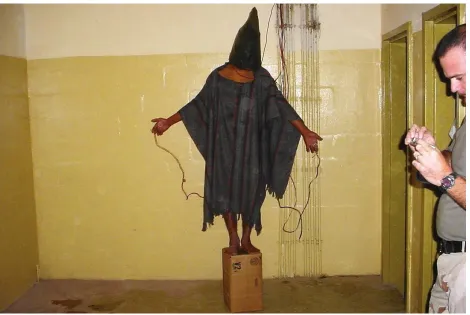
illegibility and anonymity through the discussion of the violence of hooding. Archer references a
very famous photograph of a torture scene from Abu Ghraib in which a man, whom the audience
is supposed to assume to be a suspected terrorist, with a hood covering his entire head is standing
on a box with his arms spread out to his sides with wires hanging off of them.
Figure 3 "Untitled" Abu Ghraib (2003)
25 Jakobsen, Janet. “Can Homosexuals End Western Civilization as We Know It?: Family Values in a Global
Economy.” Queer Globalization/Local Homosexualities. New York: New York U Press (2002), 49-70.
[image:25.612.74.544.317.632.2]By using this photo as an example, Archer claims that hooding renders its victim
invisible and therefore insignificant, and promises that the victim will not be able to relate their
pain to the audience, which allows state-sanctioned violence to be enacted on the body without
shame or guilt. However, with the circulation of the image through reproductions of the
photograph, the assurance of incommunicability is erased, which produces shame and guilt
within its audience. Hooded figures, particularly in photography like that which Nicole Archer
analyzes, become symbolic of illegible subaltern bodies who exist outside of the linear
temporality of neoliberalism. These bodies are failed subjects who were abjected from the
promise of futurity, much like the queer body with AIDS, and the illusion of their silence as symbolized by the hood makes it easier to justify the subaltern body’s slow death under
oppression.
The oppressors see the affects of pain, loss, and haunting as existing outside of the
possibility of articulation, and Weheliye’s analysis of the erasure of black feminist scholars and
theorists falls under the violence of an erasure of history and culture in which they are expelled
from the linear progress narrative of neoliberalism. Not only are othered queer bodies of failed
neoliberal assimilation excluded from the promise of futurity, their contributions to history are also erased. Weheliye’s clarification of the violent and ever-present force of racializing
assemblages helps us to see how erasure and exclusion work to regulate which bodies are
allowed to partake in the myth of climbing the neoliberal linear timeline and which bodies are
exploited and expended to build and sustain said timeline. Habeas Viscus reads to me like a call
for alternative political and theoretical canons that incorporate marginalized scholarly thought as
not just particularlized minor sections of academia, but as significant contributors to
break down what neoliberal hegemony builds as regimes of truth in order to enable the
possibility of alternate modes of being. Specifically, by engaging with Archer’s article “Security
Blankets: Uniforms, Hoods, and the Textures of Terror "along with Weheliye’s Habeas Viscus,
this thesis works to understand how hegemonic regimes of truth spread through control of
language and communication in regards to temporality and the incommunicability of death.
Art Ephemeral
In his book Disidentifications: Queers of Color and the Performance of Politics,José
Esteban Muñoz fleshes out the possibility of art as a method of political resistance against the
dichotomized public/private minoritarian subjectivity enacted upon queer bodies. Throughout
this thesis, I utilize this particular idea of disidentification by Muñoz to engage with the analysis
of private/public binaries presented in art. By engaging with the different processes of
space-making and time-space-making found in the multiple visual mediums of performance art, film, porn,
mass media and literature, among other installations of visual culture, Muñoz explores how the
act of disidentification as a tool of reclaiming agency works amidst the relations between theory
and practice. But rather than advocating for a permanent existence disassociated from dominant
discourses defining space/time, Muñoz addresses and focuses on the possibility of a subversive
freedom from the colonizing societal regulations found in the mundane and ordinary. This
method of using art as a medium for disidentification with the dominant discourses and
ideologies that occupy and regulate the space in which the performer, artist, and audience
become blurred and undefined is also translatable to how these bodies experience temporalities
within the moment of art.
Throughout the book, Muñoz consistently engages with a vast collection of visual works
argument. For instance, he pulls from televisual activist Zamora’s work on MTV’s The Real
World to explore how minoritarian subjectivity is disseminated and publicized. He analyzes the
performance of drag superstar, Vaginal Crème Davis, to see how certain oppressed bodies
resisted whitewashing and heteronormative protocols. In one of his most effective engagements
with an artist and their performance, Muñoz analyzes how the installations of Felix
Gonzalez-Torres work to disidentify the subjects at play from hegemonic chrononormative formations. For
example, Gonzalez-Torres’ work Untitled (Go-Go Dancing Platform) positions “a dark young
man, who is probably Latino, go-go dancing on a platform surrounded with lights.
Figure 4 Felix Gonzalez-Torres, “Untitled” (Go-Go Dancing Platform). (1991)
He wears jockey shorts and a red T-shirt that he strips off during his routine.”27 This dancer’s performance—a dance to music that he alone experiences through headphones—disrupts the
assumption of a cohesive, linear temporality in which it is being performed and pushes the
audience into having to disidentify with their surroundings. The performer dances to a beat that
is not recognizable to the audience, and thus a dissonant temporal space is created. Yet there is
still an intimate connection between the performer and audience through the nakedness of the
dance outside of shared temporalities that emphasizes the possibility of shared abject spaces as
affect-laden and private, even as the display of the performance in front of an audience thrusts
the piece into the public space. I engage with Muñoz’ methods in analyzing specific art pieces,
which utilize both visual and art analysis, to provide a comprehensive analysis of the affective
and political impacts that can be made through art. Muñoz’s methods, alongside Sontag,
Freeman and Deleuze and Guattari’s theoretical frameworks, create the backbone of my research
as I search for alternate instantiations of temporality within the inappropriate emotional
responses that are produced by the way death is portrayed in the productions of Peter Hujar,
David Wojnarowicz, and Felix Gonzalez-Torres.
Specifically with the reproductive powers of photographs and installation art, this thesis
explores how the rhizomatic temporality of the artworks manifests in the medium itself, because
the existence of the photograph itself confuses the concept of temporality and death. As Barthes
argued,
The photograph’s immobility is somehow the result of a perverse confusion
between two concepts: the Real and the Live; by attesting that the object has been
real, the photograph surreptitiously induces belief that it is alive, because of that
eternal value; but by shifting this reality to the past (“this-has-been”), the
photograph suggests that it is already dead.28
The photograph immortalizes the subject and the decisive moments of time within a single
immobile frame, and thus it brings the past into the present for the audience, and promises that
the subject will continue to be reproduced in the future. However, as Barthes describes, the
photograph is also mortal in that it is born through the exposure of film to light, and then it ages
and eventually fades. Therefore, in this one medium, immortalization and ephemerality coincide
to create a wonderfully playful and perverse instantiation of time and existence. Because
photography creates this existence of transitory suspension in time for the subject that it captures,
photographs capturing death also suspend death into an unproductive space of playfulness in an
alternative instantiation of temporality.
The skewing of temporality that Barthes describes also works similarly within installation
pieces. Installation process art pieces are reproduced repeatedly through different installations in
different moments of time, promising a futurity to the subject that it captures. However, the
performances themselves are always ending, and therefore cannot be seen as productive. This
constant reproduction of an unproductive subject through photography and installation art
disorients the grief of death, its subject, and displaces it with what Heidegger names “wonder”—
a playful fantasy—of why things exist.29
Methodology Art Temporal
Throughout this research, I explore how the interlocutors of the queer art creation
process—the artist, the subject, and the audience—are ejected into an othered space of broken
temporality that provides imaginaries of the possibility of alternate modes of being. Also, if
violence on subaltern bodies is justified and made more acceptable by the assurance of the
incommunicability of pain, does art provide an instantiation of shared experience between the
participating bodies that disrupts this justification? To delve into these questions, within this
thesis I use critical visual culture theory and visual analysis to look at three different pieces of
art. A critical visual methodology is helpful in understanding the social and cultural effects of
images that work as representations and interpretations of the world. These images that are
produced in the photographs are important tools in defining the relations of power that existed
within society at the moments when the images were captured. A critical visual methodology,
therefore, helps us to understand how subaltern ways of viewing the world are obscured, and
even erased by, the images put forth by dominant normative culture.
Throughout my research, I make connections among Deleuze and Guattari’s rhizomatic restructuring of temporality, Elizabeth Freeman’s theories of chrononormativity, and Gayatri
Spivak’s ideas on the incommunicability of the state of being subaltern, all while keeping in
conversation with Muñoz’ methods of art and performance analysis in four parts. First, I define and situate queer death as being a spectacle that is instrumentalized by the state’s
chronobiopolitics to produce specific emotion cultures of fear and shame within the queer
community and fear and rage within the proper heteronormative citizen body during the AIDS
and waste in the neoliberal order of the AIDS crisis and exploring its potential of
communicability through the visual images produced in photography. Second, I define what it
means for photography to be seen as a signifier of death and its affective productions, asserting
its necessity in developing new directions of understanding temporality. I illustrate the political
potential of art in regards to the ways in which the works provide new languages through which
regimes of truth like linear temporality and sexual morality may be evaluated, and how
temporality becomes decentered and deconstructed within the asynchronicity of a photograph’s
constant state of becoming. Third, I take these two developed frameworks and combine them to
analyze the images produced in Peter Hujar, David Wojnarowicz, and Felix Gonzalez-Torres’
photographic works. I explore how this specific medium of art illustrates the significance of the
pleasures and desires that are evoked alongside instantiations of alternative temporalities, as the
medium of photography as a print or installation explores the alternative affects and
temporalities present in death that are at once disruptive and captivating of dominant
heteronormative ideologies.
The three pieces of art that exemplify the political potential of embracing impossibility
that I analyze are broken up loosely into two parts: a print photographic image section and an
installation photographic image section. The photography pieces that I study are “Candy Darling
on her Deathbed” by Peter Hujar and “Untitled” (Peter Hujar) by David Wojnarowicz. The
installation photography piece I look at is Felix Gonzalez-Torres’s “Untitled” (billboard of an
empty bed).
In Peter Hujar’s photography piece titled “Candy Darling on her Deathbed,” I map the
workings of temporality as it becomes blurred between the past of the subject captured, the
the piece. I also specifically pull out the subjectivity of Candy Darling and how her presence in
the photo, along with her positioning and pose, brings about a queer desire to the subject matter
of death that exists in the medium. I engage with the significance of the ephemerality of the
flowers placed within the scene, and tie together the above-mentioned themes as central to a
composition that creates a space of alternative instantiation of temporality and affectivity of
death—what I will refer to as rhizomatic temporality.
In a similar fashion, when analyzing David Wojnarowicz’s “Untitled” (Peter Hujar) I
focus on what the picture wants—what W.J.T. Mitchell calls the “metapicture”—by reflecting on
the posturing of the face and the clear visual imagery of death that is present within the frame
through Hujar’s slightly open eyes and ajar mouth. I assess the tight framing of the picture and
analyze how the lack of scenery in the frame serves to build a stronger setting for the
instantiation of death, and I particularly call upon the lights and shadows of this piece to pull out
the affective productions that result from the image. Specifically when analyzing these
photographs, I adhere to the guidelines for analyzing art as outlined and defined by the article “Visual Rhetoric/Visual Literacy: Writing About Photography” published by the writing studio
from Duke University, to discuss the form of the artwork.30 Also important to note, I compare the two photography pieces’ affective productions to show the multiple different types of
affective responses that can arise from death in its various stages as a subject matter.
In my analysis of the images, I view the photographs through a critical visual culture lens
in which the analysis happens within a subaltern model of the picture, one in which the question is shifted “from what pictures do to what they want, from power to desire, from the model of the
dominant power to be opposed, to the model of the subaltern to be interrogated or (better) to be
invited to speak.”31 To ask these questions, I reckon with images not just as imitations or
representations of the subjects that the artworks portray, but rather as animated beings that
demand a reparative reading—a reading that is affectively driven and motivated by desire,
pleasure, and curiosity.32 I believe that this type of reparative reading can be done through a specifically visual and art analysis-based approach, outlined by W.J.T. Mitchell in What Do
Pictures Want? and also as explored by Muñoz by example in Disidentifications, that pulls
heavily on both the form and subject matter of the artworks. I focus on the different subject
matter that is present within the image by exploring the lighting, the exposure, and the
perspective from which the picture is taken. I refrain from engaging with the artist and his
background to show the potential that pure imagery holds. It is my hope that this type of
approach will open up the dialectics of power in our relations with art and concretely show how
new types of impossible languages are opened up through the medium of photography that
would not exist otherwise.
When analyzing the photograph installation work “Untitled” (billboard of an empty bed), I turn to affect theory and use Eve Sedgwick’s theory of reparative reading of words and images
to explore the “pleasure and curiosity… directed toward the textures, the sensuous feel, of one’s
objects of study,”33 in this case death and art, to assess the impact of art participation on the
interlocutors of the process. With this piece, I also include the artist as a crucial participant, for
the entire process of art creation becomes central to the affective meaning of the creation of the
piece. The blurring of the private and public sphere becomes especially important within the
photography installation piece because of the artwork’s dependency on space as part of its image
31 Mitchell, 33.
32 Sedgwich, Eve Kosofsky. “Paranoid Reading and Reparative Reading, Or, You’re so Paranoid, You Probably Think
This Essay is About You.” Touching Feeling. Durham: Duke University Press (2002), 146.
making and cultivation of emotion-states. This differentiation between my analysis of the
photographic pieces and installation art piece is significant because the process installation art
pieces are not within the realm of pure imagery. Rather, they are works of art that are continually
being produced and reproduced through different installments and interactions with different
audiences in public spaces. To document how Gonzalez-Torres’ process art subverts linear
temporality through the creation of a constant recreation of ephemerality, I rely on Helena Reckitt’s ideas of reenactments as tools34 that reform and shape events, things, and art from
history into ephemeral subjects. Through recreation, the linear temporality of hegemonic
ideology is destabilized.
3 THE BECOMING PHOTOGRAPHS
[image:36.612.82.531.161.608.2]3.1 Candy Darling on Her Deathbed
Before entering into the visual analysis of the image, I believe it is necessary, for the
purposes of this thesis, to first engage with the temporality surrounding the identity of Candy
Darling, the subject of the photograph, because of the ways in which her trans womanhood
marks her as being unable to participate in producing a neoliberal chronobiopolitical futurity. In
fact, queer bodies like Candy Darling are always in a process of slow death. Moreover, Candy
Darling is marked for death through the nation’s attitudes towards queer bodies in which public queerness “asserts full access to one’s sexual identity and political being and then seems to
conflate the two”35 where “[it is] then possible to say that what makes a subject queer is her/his
relationship, both performatively and literally with death and that this relationship is of national concern.”36 Because the hypervisibility of queerness in dominant culture is always centered
around queer death, the queer body is seen as one that is unable to invest in a neoliberal futurity.
Proper, normative citizen-subjects under chronobiopolitics are taught to fear death, just as they
are taught to fear deviating from a linear timeline and other assumed norms within hegemonic
society. It seems important to this analysis, then, to think upon Eric Stanley’s question, “What
then becomes of the possibility of queer life, if queerness is produced always and only through
the negativity of forced death and at the threshold of liberation?”37
Specifically, during the time of Peter Hujar’s photographs, which took place in New
York in the wake of the AIDS crisis of the late 1970s, queer death marked a particular kind of
failure within a system of chronobiopolitics that simultaneously evoked fears of replaceability
and of wastefulness. Simultaneously, the nation saw a rise in homophobia and intensification in
35 Holmes, Amanda. “That Which Cannot Be Shared: On the Politics of Shame.” The Journal of Speculative
Philosophy 29:3 (2015), 416.
the marginalization and dehumanization of queer life. Stanley addresses this dichotomy of queer
death and life through Agamben’s theory of bare life later in his text:
For Agamben, bare life signals a kind of stripped-down sociality, skillfully
articulated via his reading of the Nuremburg Laws enabled through a legal state of
exception. If for Agamben bare life expresses a kind of stripped-down sociality or
a liminal space at the cusp of death, then near life names the figuration and feeling
of nonexistence, as Fanon suggests, which comes before the question of life might
be posed. Near life is a kind of ontocorporal (non) sociality that necessarily throws
into crisis the category of life by orientation and iteration.38
Indeed, overwhelming numbers of queer people living with HIV/AIDS experience a
disproportionate amount of structural and interpersonal violence. Especially during the AIDS
epidemic, there was a rise in reactionary violence induced by fear and rage. The hegemonic
heteronormative response to queerness in the late twentieth century—and I would argue even
now—was one that only had space for negative feeling states. On the other hand, identifying
with death and being in a constant intimate proximity with death also allows the queer artist and
subject body, in this particular case Candy Darling and Peter Hujar, to acknowledge that death is
not necessarily the spectacle of bereavement and loss that discourses focusing on protecting
those with life in chrononormativity make it out to be. This kind of expulsion from the dominant
narrative meant that many HIV-positive young queer folks found themselves free from the constraints of having to adhere to neoliberalism’s forward thinking. They didn’t have to worry
about building a savings to sustain themselves when they were older or playing the proper
productive citizen, because this was before treatments for HIV/AIDS were available, and they
felt that they were facing certain death before they could get old enough to reap the rewards of
policing their young bodies. The young queer body became the embodiment of a radical
counter-culture defined by a live-in-the-moment mentality, completely antithetical to the
chronobiopolitical narratives of progress and futurity. Through the photographing of a young
trans woman on her deathbed, Peter Hujar questions this constant need for productivity and
subverts the narrative of the failed chrononormative subject, and subsequently disrupts the idea
of a singular linear timeline.
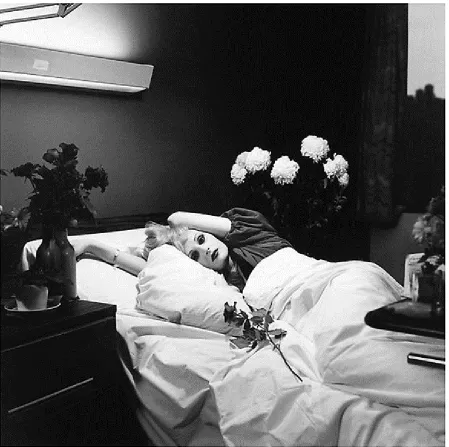
Peter Hujar’s “Candy Darling on her Deathbed” is a black and white image in which Candy
Darling is depicted casually posing on a hospital bed. Most of her figure, from the chest down, is
covered by the white sheet of the hospital bed in a way that the sheets hug and accentuate her
figure. A part of her face and her arms are also obscured by a white pillow in a way that fills
most of the frame with soft, white fabric rather than the figure of Darling herself. A tray table
juts into the picture on the right side of the image, cropped so that it is recognizable, but so that
the objects placed upon it are obscured, with the exception of a few flower petals indicating the
presence of a bouquet of flowers. Also in the foreground of the image, dark, wilting flowers rest
on the bedside table, while in the background, fresh white flowers protrude from behind the
figure of Darling so that Darling’s figure is framed throughout the picture by the ephemerality of
the three distinct groups of flowers. Darling herself is thrust into this life cycle of flowers with
the placement of a single flower resting on the bed in front of her. There are three light sources
present within the image, the brightest and most recognizable being the light fixture above the
bed. Dim fill light streams in from a cropped window on the top right of the frame, and the
We, the audience and perhaps speculatively the photographer Peter Hujar as well, enter
the photograph through Candy Darling’s gaze—or perhaps it is more accurate to say that we
become passive observer, pulled in and arrested by Darling’s black gaze as it is even more
off-putting and made even more mesmerizing by her stark white face. In her gaze lies, again, the lure
that sends inappropriate chills of desire and pleasure down my spine, even as I know I am
meeting eyes with a subject that is always dying and already dead. In her face, I cannot find any
trace of the fear or rage that we have been told was the proper, the only one necessary and
allowed at the very least, emotion culture of the time in which the image was produced. Instead, I
see a mundane matter-of-factness that belies acceptance, and by identifying with death, Darling is able to “participate in a simultaneous embrace and repudiation of death’s spectacle.”39 Her
gaze also situates the audience as a close friend or intimate participant in her queerness and
dying process. At the same time, as the audience, we must contend with the fact that Darling’s
alluring gaze never in fact sees us or is intended for us. Susan Sontag says about the photographs of Diane Arbus, a photographer who utilized the frontality and direct gaze of the “freaks” she
photographed to produce a certain aesthetic and effect:
In the normal rhetoric of the photographic portrait, facing the camera signifies solemnity, frankness, the disclosure of the subject’s essence. That is why
frontality seems right for ceremonial pictures… What makes Arbus’s use of the
frontal pose so arresting is that her subjects are often people one would not expect
to surrender themselves so amiably and ingenuously to the camera. Thus, in Arbus’s photographs, frontality also implies in the most vivid way the subject’s
cooperation. To get these people to pose, the photographer has had to gain their confidence, has had to become “friends” with them.40
The hospital room is an intimate and private space reserved for loved ones and
confidants, and therefore being present within this space through the image thrusts the
audience into the space of private intimacy even as they observe physically from within a
public space. In those furtive, stolen glances, the onlooker is arrested in both an
alternative time and space as, for a moment, we lock eyes with Candy Darling and
become implicated in the bare, trusting gaze of the subject being shared with the
photographer through the camera lens.
The image of Candy Darling in her dying state produces two very distinct levels of
indexical knowledges. The photograph is beautiful, as is Candy Darling. She is clearly in a
hospital room. This informs us of the studium of the photograph. But the punctum pierces us
through the image, perhaps through, or perhaps in spite of, the studium—she is going to die.
Roland Barthes, in his response to a photograph of a young Lewis Payne who was at the time of
the photograph waiting to be hanged for the attempted assassination of the Secretary of State W. H. Seward, describes his response to the “going to die” subject as such:
But the punctum is: he is going to die. I read at the same time: This will be and
this has been; I observe with horror an anterior future of which death is the stake.
By giving me the absolute past of the pose (aorist), the photograph tells me death
in the future. What pricks me is the discovery of this equivalence… Whether or
not the subject is already dead, every photograph is this catastrophe. This
punctum, more or less blurred beneath the abundance and the disparity of
contemporary photographs, is vividly legible in historical photographs: there is
always a defeat of Time in them: that is dead and that is going to die.41
First, the three different sets of flowers, which move the viewer through the photograph and
create a natural frame around Candy Darling, all depict different stages of dying and decay in a
way that alludes to the inevitability of death. Flowers are the quintessential symbol of
ephemerality, and yet, by becoming frozen through photography in their different stages of life
and decay, they are thrust into a permanence that merges the past, present, and future of the
flowers together into the photographic image. Through the creation of the image, the flowers are
ejected into a space of alternative temporality that opposes the notion of linear temporality found
in chrononormativity. Therefore, in the image, Candy Darling is encased within a never-ending
process of alternative temporality through the framing created by the triangle of flowers.
Secondly, the alternative temporality of the always “going to die” subject of Candy
Darling within Peter Hujar’s photograph emanates from the corpsing of the setting in which the
image of the photograph exists. Not only is the hospital a conventionally understood place of
birth, life, decay, and death, it is also a place in which the tension of stasis—a constant waiting—
coexists with constant urgent activity. Patients are always waiting for the restoration of their
health—the narratives around illnesses seem to commonly be that life is put on hold. Yet others,
like Candy Darling, are waiting to die, while patients are also constantly doing—taking
medicine, receiving treatment, and actively fighting for recovery. Thirdly, as mentioned before,
the subject of Candy Darling is captured in this photograph in her process of corpsing, which
defines the punctum42 of this specific photograph as “Time, the lacerating emphasis of the noeme
41 Barthes, 96.
(“that-has-been”).”43 This illustrates a moment in which the past and future exist simultaneously as an anterior future, because we know that the subject of the photograph is going to die and yet
is alive in the moment of the image. While in chrononormative temporality we accept the past as
lost time and the future as what we approach but have not yet reached, the corpsing of Candy Darling and her surroundings in Hujar’s photograph causes the interlocutors of the photograph—
the artist, the audience, and the subject—to share in each other’s temporal space. Roland Barthes
describes this disruptive and disorienting experience in this way:
These two little girls looking at a primitive airplane above their village… how
alive they are! They have their whole lives before them; but also they are dead
(today), they are then already dead (yesterday). At the limit, there is no need to
represent a body in order for me to experience this vertigo of time defeated.44
The photograph immortalizes the subject and the decisive moments of time within a single
immobile frame, and thus it brings the past into the present for the audience and also promises
that the subject will continue to be reproduced in the future. However, as Barthes describes, the
photograph is also mortal in that it is born through the exposure of film to light, and then it ages
and eventually fades. Therefore, in this one medium, immortalization and ephemerality coincide
to create a wonderfully playful and absolutely perverse instantiation of time and existence.
Because photography creates this existence of transitory suspension in time for the subject that it
captures, photographs capturing death also suspend the corpse into an unproductive space of
pleasure in an alternative instantiation of temporality. This constant reproduction of an
43 Barthes, 96.
unproductive subject through photography disorients the grief of queer death, its subject, and displaces it with what Heidegger names “wonder”—a playful fantasy—of the living image.45
The culmination of these moments of conflation between the unproductive always dying
subject and the living image that exist within “Candy Darling on her Deathbed” causes those
who experience the photograph to experience what Barthes felt while looking through historical
photographs: a vertigo resulting from linear time’s failure to fully explain or encompass the
temporality of the image. The photograph illuminates the need to understand temporality as
something more complex and rhizomatic.46 According to Deleuze and Guattari, “most modern methods for making series proliferate or a multiplicity grow are perfectly valid in one direction,
for example, a linear direction, whereas a unity of totalization asserts itself even more firmly in another, circular or cyclic, dimension.”47 While chrononormativity built on a linear notion of
time is valid within neoliberal heteronormative dominant narratives, it is exactly because its laws
fail to encompass bodies that fall outside of the linear direction of dominant discourse that we
must shift our understanding of temporality as existing on a rhizome.
45 Silverman, Kaja. “All Things Shining.” Loss. Los Angeles: University of California Press (2003), 325-326. 46 Deleuze, Gilles, and Félix Guattari. "Introduction: Rhizomes." A Thousand Plateaus: Capitalism and Schizophrenia.
Minneapolis: U of Minnesota (1987). Print.
3.2 “Untitled” (Peter Hujar)
Like the analysis of “Candy Darling on her Deathbed,” I believe it is important to
understand the context in which this photograph “Untitled” by David Wojnarowicz was created,
because in photography, the existence and presence of the subject captured within the image is
never metaphoric, but rather indexical. It is a trace—a truth of the subject having been there and
having posed in front of the lens. Similarly, the intent with which the photographer captures the
subject is equally as important to the creation of an image. For the photograph to have been
created, the photographer had to deem that subject at that very moment in time important enough
to arrest and preserve onto film. In the case of this photograph, Wojnarowicz’ main goal was to build an archive of Peter Hujar, his lover and photography mentor. In his essay, “Living Close to
the Knives,” Wojnarowicz explains:
And his death is now as if it’s printed on celluloid on the backs of my eyes…
Then the still camera: portraits of his amazing feet, his head, that open eye
again—I kept trying to get the light I saw in that eye… I mean just the essence of
death; the whole taboo structure in this culture the mystery of it the fears and joys
of it the flight it contains this body of my friend on the bed this body of my brother my father my emotional link to the world this body I don’t know this pure
death this event produces in bystanders contains more spirituality than any words
we can manufacture.48
I feel that it is important to mention that I do not want to erase the reality that all of the
photographs included in this research are steeped through and through in desolation, pain, and
heartbreak. Wojnarowicz makes that clear in the rhythm of his words, the desperate longing of
his writing. Part of the importance of studying these photographs is to acknowledge that the
deeply painful, private affects are thrumming through the camera into the image. Although the
AIDS epidemic was one in which many queer lives were taken, the hypervisibility and spectacle
through which these deaths were represented and used erased the fact that these very public
sensations were a culmination of moments of private losses from within the queer community.
Ann Cvetkovich thinks through this idea of the importance of archival works surrounding
queer knowledge and emotions49 because there was such a strong push of chronobiopolitics during the AIDS epidemic that sought to erase queer interpersonal emotions within private
spheres by overwriting them with forced feeling cultures of public shame and fear. Wojnarowicz uses the moment immediately following Hujar’s death—depicted within these sets of images—to
create an affective space for queer intimacies through an exploration of loss and melancholy, but
also is able to capture love, desire, and beauty alongside these ostensibly negative emotions. This
is why I find it so important to point out that the photographing of these moments captured in the
images allows the artists to articulate moments that they encounter in the private sphere in which
the artist is grieving, and these emotions are so strongly present that just witnessing these images
is enough to make accessible those affective productions into the public. However, the audience
does not always receive these emotions as intended or felt, but rather reassembles the negative
and the desirable into something private and personal, and by doing so participates in a queering
of temporality.
David Wojnarowicz’ “Untitled” (Peter Hujar) is made up of three black and white
photographs that are all different parts that make up one image. The first frame contains a cropped image of Peter Hujar’s face post-mortem from the shoulder up. The image is framed
tightly to the profile so that the only other thing visible besides Hujar’s head, neck, deeply