PERFORMANCE ASSESSMENT OF BIM MANAGERS USING
MULTI-SOURCE FEEDBACK METHOD - A PILOT STUDY
Faiq M. S. Al-Zwainy
College of Engineering, Al-Nahrain University, Iraq E-Mail: [email protected]
ABSTRACT
In order to assure an objective assessment of BIM managers' performance, standards to assess the skills and competence of construction professionals in using Building Information Modeling (BIM) got to be set. This paper aims at creating some rating criteria to assess the performance of BIM managers in Iraq through a pilot study. A new technique of performance assessment known as Multi-Source or 360° feedback method was employed for this purpose aided by a questionnaire form specially designed to match the technique and the purpose. The Center of Engineering Consultancy at the Ministry of Industry and Minerals was chosen to implement the pilot study for it is the first firm that initiates the application of BIM in Iraq. It was found that performance assessment of the BIM managers is quite different among constituents (bosses, peers, staff, contractors and clients) especially when compared to the BIM managers' self-assessment which was always over-estimated. The highest degree of assessment was found to be (3.975) out of (5) degrees for the best BIM manager. This indicates the necessity of adopting such objective approach in the organization culture instead of personal judgment of bosses. As a result, the use of Multi-Source feedback method in assessing the performance of BIM managers proved to be successful and can be used in other firms in the Iraqi construction sector.
Keywords: BIM manager, 360° feedback method, self-appraisal, sub-ordinates appraisal, superior’s appraisal, peer appraisal.
INTRODUCTION
Many authorities have defined building information modelling according to their own understanding. United States' National Building Information Modelling Standard, issued by the National Institute of Building Sciences, states that BIM is "a digital representation of physical and functional characteristics of a facility. As such it serves as a shared knowledge resource for information about a facility forming a reliable basis for decisions during its lifecycle from inception onward" (NIBS, 2007).In opinion of Al-Zwainy et al's 2017, Building Information Modelling, basically, is the process of fabricating the actual reality within the virtual reality by combining the design with a database based on introducing parameters to develop various significantly rich information to simulate each object's properties, creating extra dimensions to be represented; in order to reach the optimized solutions for different aspects of the building (such as building design, building sustainability, facility management, safety management and risk management) before initiating the actual construction.
Davtalaba and Delgadob 2014 defined BIM is “an IT enabled approach that involves applying and maintaining an integral digital representation of all building information for different phases of the project lifecycle in the form of a data repository”. For the time being, BIM can be converted from easy information storage to a rostrum which was capable of implement several types of analysis based on original data (Motawa and Carter, 2013).
BIM is vastly adopted in project management because it has most important in infrastructure industry, but it is not used effectively and utilized misconceived. in point of fact, Building Information Modelling acts as a data and an information backbone for project managers, which if it combines with novel technologies, it can have
developed performance efficiencies. Therefore, BIM helps in integrated the stakeholders’ collaboration through the construction projects life cycle (Faiq et al, 2017).
BIM managers are accountable and responsible for planning human resources, information, data and model itself during engineering projects. Thus, BIM managers require tools and skills that might be like to the tools and skills of engineering project managers such as communication skills and teamwork skills, while also requiring deeper skills in BIM such as understanding BIM standards and BIM workflow (Rahimi et al, 2016). Therefore, finding managers capable of handling building information modelling technologies is a courageous and a challenge, and lack of intelligent knowledgeable practitioners with BIM hinders the construction sector from moving into the building information modelling epoch.
The BIM manager's topic in construction sector has become one of vital subject of the study recently, and must be importance for the professional project managers to become key players in the BIM environment – the ‘BIM managers’.
In order to prove that BIM is a useful and profitable technique for stockholder and project manager, such study was effective and infallible since the features are not far more than the risks and defiance but also harmonious with the function of project manager, as realized in the several knowledge areas according to PMBOK. Therefore, must have to bear in mind that BIM manager cannot replace project manager, where, BIM manager decrease and diminishes the prolix, redundant and normal works and it simplify raw data processing.
client or owner. Consultants are part of the designer’s group. Construction engineer and architect engineer first design the building. Upon, the completion of the design stage, the construction manager also is known as general contractors in the traditional method for the construction project (Abdulsame et al, 2014). BIM can be applied clearly and freely right in beginning of the construction project. The warm collaboration of the designer engineer and the builder engineer can yield to using the BIM as a powerful and efficient process. BIM technique, construction models and design models were identified. Design models build by architect and engineers was expected to be completed at scale of detail of two dimensional construction documents. Construction model developed by the construction contractor is equivalent to modelling of shop drawings and related knowledge and information. Developer of model can be update files and are responsible for dimensional accuracy of model. Distinct models can be linked to each other to form a optimum model. The optimum model can be utilized for several objectives inclusive design, clash detection and maintenance purposes. (Abdulsame et al, 2014).
Nowadays, infrastructure projects managers recently have started to adopt BIM, but these projects need to be completed with an efficient and experienced BIM manager.
Research Aim
The labor force is of great importance in all fields of work because it is the efficient tool for any development process when it is best used and provides a suitable working environment. In the construction sector, this is more important because the human factor dominates the other factors influencing the production process because many of the work sections in this sector depend on the human element and the role of machinery and equipment is limited to some kind.
The aim of this study is to highlight the importance of the use of modern technologies in evaluating the performance of the project managers in infrastructure projects. Where, this contribution specifically lies in evaluating and measuring the performance of BIM manager by using 360° system based on standards of performance in project management.
Research Justifications
The justification for the research can be summarized as follows:
a) The application of 360 techniques as a modern technology in the construction sector of Iraq has become an urgent necessity to ensure the success of the management process of infrastructure projects, in addition to keeping pace with the global technological development that most engineering companies need.
b) Lack of local and international studies on the subject of performance evaluation using 360 techniques in infrastructure projects.
c) There is a clear weakness in the process of evaluating the performance of BIM managers in the construction sector in Iraq in general, because of the use of old methods suffer from poor accuracy, speed and unreliability.
d) Lack of documentation of performance evaluation rates for BIM managers.
Research hypotheses
Based on the above-mentioned justifications, the following research hypothesis could be formulated:
(Construction companies in the Republic of Iraq need to use modern methods and advanced techniques for the purpose of evaluating the performance of BIM managers in the infrastructure projects; based on mathematical equations of high accuracy and easy to use).
RESEARCH METHODOLOGY
The methodology of the research requires two scientific methods according to successive and sometimes overlapping stages in order to achieve the objectives of the research as follows:
a) Literature review style.
b) Practical application style.
The first method was to review the local and international literature, sources, journals, studies, research and scientific publications in this field, and published in the Internet and develop a general research structure to collect the following information:
a) Study of the literature of the BIM managers.
b) Studying the methods of evaluating performance, especially the 360 technique, determining its requirements and the factors influencing its selection.
In the second method, the necessary data were collected through the open questionnaire and the closed questionnaire as well as through the field co-operation of some of the infrastructure projects through which the documents of these projects were used in the research.
BIM Managers
innovation and heterodoxy to occur within their construction companies and in collaboration between stakeholders of project. They deputize project team in order to realize with the level of complexity associated with a workflow of BIM. BIM Managers help project team to align their tools and skills with the added benefits offered by rule-based and data-centric delivery of engineering projects (Dominik, 2016).depict what BIM Managers do was hard operation. in past, manager was associated with responsibilities for overseeing BIM model development, and now, manager more associated with technology strategies, knowledge management, operations organization. The validity and speed of development BIM based on BIM Manager. According to the larger team of stakeholders BIM encompasses, there exists a growing attention of the BIM Manager’s role into specialized duties: One of important of the role of model managers emerges, who assist in-house teams on construction projects, at times complemented by particularism in building information modeling librarians. In other hand, Model coordinators specialize in the oversight of the several integration of BIM. BIM managers may now also report to design technology leaders or project information managers who directly report to top management. In some cases, a company's calls for a strategic BIM Manager. All of the above descriptions depend on the characteristic and size of companies. In construction companies, the BIM Manager may well be tasked to incorporate all those roles, while acting as BIM Modeler and architect in engineering project. (Dominik, 2016).
Likely to be BIM Managers become ancient and their responsibilities will become section of management for construction project. A perfect number of activities for change management will have been constructed and construction strip globally will accommodate BIM as a matter of course in their project acceptance approaches. In now, construction sector still goes through a major transition in adopting BIM. BIM Managers need to equilibrium between appropriate and possible. Their strategic view will influence which opportunities can and should be aligned with the cultural and professional state of their companies. They also help to map out how such alignment can be achieved. Also, BIM Managers may not be the absolute decision makers in facilitating change. In the end, BIM Managers are the ones who stock top management with decision support in order to do so and they are the ones responsible for BIM application “on the land.” (Dominik, 2016).
360° feedback method
Many organizations have performance-appraisal system. These usually operate on an annual basis and involve an interview with the line manager and use of pre-interview question sheet. Most criticisms of this system stem from the use of measures which are very difficult to assess and of rating scales which generally lead to assessors taking the ‘middle-road’ as an easy opinion. Competence-based assessment as the basis of performance appraisal provides a more specific measure of performance. To use the full potential of competence
based assessment within performance appraisal often requires a complete rethinking of the existing process and a broader view of appraisal as one part of a wider performance management system.
The 360-degree evaluation technique relies on the systematic collection of data and information by a group of stakeholders for the purpose of evaluating individuals in a neutral and logical manner. (Kankana, 2018).
The methods of evaluating traditional performance are based on the assessment of individuals from top to bottom, that is, presidents assess the principals, and this process is accompanied by many weaknesses, and as a result of technological development, the evaluation technique has emerged 60 degrees, and this proved by the superiority of traditional methods, through its reliance on independence in evaluation and impartiality as well as multiple sources of evaluation. (Kankana, 2018).
The 360-degree appraisals technique is based on a variety of standards that contribute to the effective and accurate evaluation of engineers. These standards must be realistic and applicable to the most accurate collection of data and information, providing fair and interpretable assessments. (Espinilla, 2013).
360 -degree appraisals are a questionnaire based on process that collects structured feedback from a large quantity of references around the behavior and manner of a person at work. For every person, close questionnaire on behaviors are achieved by the persons, by the staff they manage, patron, peers, and boss. Conclusions are collected into a feedback report, in which data and information from every reference is given separately. This was provided to the person who then policy how to developed on competencies and developed individual performance. Studies have display fairness, solidity, and accuracy, also, acceptability the feed-back operation was increase while inputs were drawing from various references (Kankana, 2018).
Number of studies on the subject of 360-degree technology is very little, especially as it focused in the fields of Health Business (Çınar and Vardarlıer, 2014) and human resource practice (Tarus, 2014) and education (Rasheed et al., 2011) while there is only one study in the field of project management (Al-Zwainy and Al-Marsomi, 2016). Al-Zwainy and Al-Marsomi confirm the potential of the use of 360° system in esteeming the performance of construction managers in Iraq.
Methodology of 360-degree appraisal system
Figure-1. Stages of 360-degree appraisal.
There are five main steps to applying methodology to 360-degree appraisal system as following: a) Diagnostic of Goal
b) Collecting Data c) Data Analysis d) Discussion of Results
Diagnostic of goal
For evaluate the performance of BIM managers in infrastructure projects, there are ten criteria of performance evaluation, these criteria represented the goal of performance evaluation has been selected these ten criteria for being most impact in evaluation of the BIM managers as follows:
a) Decision Making and Problem Solving b) Knowledge
c) Intelligence and cleverness d) Management
e) Leadership and colonelcy f) Human Resource Management
g) Productive efficiency and Improvement h) Relationships and Communications i) Job ethics
j) Personal Appearance
Collecting data
This step involves selecting a sample of BIM stakeholders to participate in the assessment process, and this sample should be selected randomly to avoid bias in the assessment process. The selection of persons involved in the evaluation process must be confidential and credible to ensure that the correct information is obtained.
In this study, the research sample was selected, represented by the Engineering Center in the General Company for Design and Implementation of Projects in the Ministry of Industry and Minerals in Iraq, which is considered important and vital facilities for engineering design works for industrial and oil projects, fertilizer projects, energy projects and infrastructure.
There are three stages for collecting data and information:
A. In the first phase, an open questionnaire was held with all members of the Engineering Center for the purpose of demonstrating the importance of the 360-degree evaluation process and reviewing its benefits and advantages.
B. In the second stage, the selected persons (reviewers) were selected for the purpose of the evaluation process, as following:
a) BIM manager who is selected to conduct self-evaluation for him represent as a Self-Appraisal, b) another BIM manager represent as a Peer Appraisal, c) the direct supervisor (director of the engineering
center) (Supervisor Appraisal) and
d) the beneficiary (BIM contractor) represent as a (Customer Appraisal) and
e) BIM engineer represent as a (Subordinates Appraisal) C. In the third stage; questionnaire as a scientific tool
was used to collect raw data related with Performance Assessment of BIM Managers according to the following steps:
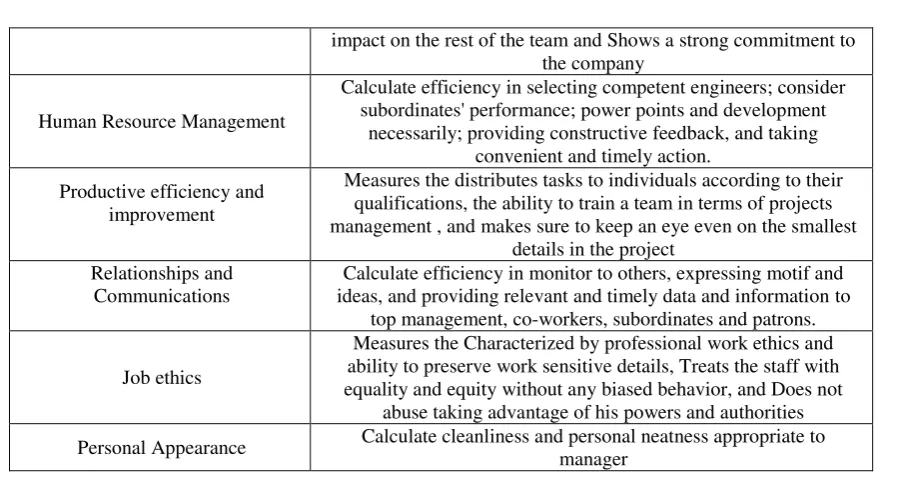
a) Planning and layout the questionnaire form and determined the lines of questions depending on the data and information gained from the literature review as shown in Table-1.
b)
Delivery the questionnaire form to the team BIM in order to answer the questions of questionnaire.Table-1. Criteria of performance appraisal.
Criteria Description
Solution Problems and Decision Making
Calculate effectiveness in grasp problems and making timely, executive decisions.
Knowledge
Deem manager's dexterity level, knowledge, skills and understanding of all phases of the work and those requiring
improved dexterity, experience and skill.
Intelligence and cleverness Ability to anticipate project performance within the near future and Ability to put acquired knowledge into application
Management
Calculate efficiency in planning, design, arrangement and efficiently handling operations, and identifying new techniques
impact on the rest of the team and Shows a strong commitment to the company
Human Resource Management
Calculate efficiency in selecting competent engineers; consider subordinates' performance; power points and development
necessarily; providing constructive feedback, and taking convenient and timely action.
Productive efficiency and improvement
Measures the distributes tasks to individuals according to their qualifications, the ability to train a team in terms of projects management , and makes sure to keep an eye even on the smallest
details in the project Relationships and
Communications
Calculate efficiency in monitor to others, expressing motif and ideas, and providing relevant and timely data and information to
top management, co-workers, subordinates and patrons.
Job ethics
Measures the Characterized by professional work ethics and ability to preserve work sensitive details, Treats the staff with equality and equity without any biased behavior, and Does not
abuse taking advantage of his powers and authorities
Personal Appearance Calculate cleanliness and personal neatness appropriate to manager
Data analysis
In this study, For the purpose of organization, arrangement, and simplification, the analysis of statistical was performed through SPSS v24 software, which displays mathematical equations in an easy form and well controllable, and referring to general statistic theory, the Arithmetic Mean (AM) is given by:
(1)
[image:5.595.77.529.81.325.2] [image:5.595.226.513.430.755.2]Table-2 shows the ratings utilized to ensure commonality of parlance and uniformity on total ratings, where used the Likert scale (five scale) for each axis.
Table-2. Description of scale ratings.
Scale description Descriptive
frequency Class interval
Weight value (WV)
Poor and Unsatisfactory Poor 0-1 0.5
Marginal and beneath
Expectations Accepted 1-2 1.5
Meets Requirements and
Expectations Good 2-3 2.5
Overtop Requirements and
Expectations Very Good 3-4 3.5
Outstanding and eminent Excellent 4-5 4.5
Also, the radar technique was utilized in statistics analysis and tests to display how much the hiatus at every axis, the radar technique is as well-known and famous as a spider map or web chart or star map. Web chart is a photographic tool of show multifactor information in figure of a two dimensional map of more than three quantitative factors appear on axes begins from the same spot. In this study, data collection can be obtained from BIM team (BIM Manger, BIM Contractor, Bosses, BIM Engineering) as shown in Figure-2.
DISCUSSIONS OF RESULTS
Table-3. displays the result of evaluation performance for BIM manager in Engineering Center in the General Company for Design and Implementation of
Projects in the Ministry of Industry and Minerals in Iraq, as a first stage BIM manager (self- Appraisal), the final result equal to 4.15 with Excellent.
Table-3. Qualification of BIM tea.
Function position Specialists
(Academic degree)
Type of appraisal
Experience years Director of the
Engineering Center
Sustainability Engineering
Ph.D. Supervisor 25
BIM manager Project Management
Ph.D. Self 20
BIM Engineer Structure Engineering
MSc Subordinates 10
BIM Contractor Energy Engineering
MSc Customer 13
Another BIM manager Project Management
Ph.D. Peer 15
Table-4. Results of self- appraisal for BIM manager.
Criteria Result Descriptive
frequency Decision Making and Problem Solving 4.5 Excellent
Knowledge 4.5 Excellent
Intelligence and cleverness 4 Excellent
Management 4 Excellent
Leadership and colonelcy 4 Excellent
Human Resource Management 3.5 Very Good
Productive efficiency and Improvement 4.5 Excellent
Relationships and Communications 3.5 Very Good
Job ethics 5 Excellent
Personal Appearance 4 Excellent
Average 4.15
In the second stage of evaluation performance process for BIM manager, Table-5 shows the results of the evaluation for Direct Supervisor (Supervisor Appraisal), Another BIM manager (Peer Appraisal), BIM
Engineer (Subordinates Appraisal), and BIM Contractor (Customer Appraisal), the final result equal to 3.125with Very Good.
Table-5. Results of BIM team appraisal for BIM manager.
Criteria
Result of BIM team
Average Supervisor
appraisal
Peer appraisal
Subordinates appraisal
Customer appraisal Decision Making and
Problem Solving 3.5 4 3 2 3.125
Knowledge 3.5 4 3 3.5 3.5
Intelligence and
cleverness 3 3.5 3 2 2.875
Management 3 3.5 3 2 2.875
Leadership and
Human Resource
Management 2.5 3 3.5 3.5 3.125
Productive efficiency
and Improvement 3.5 4 3 2 3.125
Relationships and
Communications 2.5 3 3 5 3.375
Job ethics 4 4.5 3 2 3.375
Personal Appearance 3 3.5 3 2 2.875
Average 3.15 3.65 3.1 2.6 3.125
The researcher used the radar chart to show the differences between the BIM manager's assessment and the assessment rate for BIM team (supervisor appraisal, peer appraisal subordinates, appraisal customer appraisal), noting that the BIM manager has given himself a higher
rating by 4.15 degree, while BIM team give 3.15 degree for BIM manager. Therefore, conclusion that each the variances in the assessment criteria were unfavorable (negative) with -1.025
Figure-3. RADAR chart.
The final degree of appraisal was very good (3.975) as shown in Table-6., this refers to the agreement
on the lack of the shortcoming in any of the assessment criteria or standards in behavior of BIM manager.
Table-6.Summary of results for BIM manager appraisal.
Criteria
self- appraisal
A
BIM team- appraisal
B
Differences C=(B-A)
Degree of appraisal D=5-C
Descriptive frequency
F decision making and
problem solving 4.5 3.125 -1.375 3.625 Very Good
knowledge 4.5 3.5 -1 4 Excellent
intelligence and
cleverness 4 2.875 -1.125 3.875 Very Good
management 4 2.875 -1.125 3.875 Very Good
human resource
management 3.5 3.125 -0.375 4.625 Excellent productive efficiency
and improvement 4.5 3.125 -1.375 3.625 Very Good relationships and
communications 3.5 3.375 -0.125 4.875 Excellent
job ethics 5 3.375 -1.625 3.375 Very Good
personal appearance 4 2.875 -1.125 3.875 Very Good
average 4.15 3.125 -1.025 3.975 Very Good
CONCLUSIONS
The most important conclusions of this study are as follows:
a) 360-degree appraisal system can be considered easy with saving time and cost, therefore it can be used to evaluate the performance of BIM managers in The Center of Engineering Consultancy at the Ministry of Industry and Minerals in Iraq.
b) Ten Criteria were used to measuring the performance of the BIM Manger (decision making and problem solving, knowledge, intelligence and cleverness, management, leadership and colonelcy, human resource management, productive efficiency and improvement, relationships and communications, job ethics and personal appearance)
c) 360-degree appraisal system has proved to be an unbiased technique, as it is based on the evaluation philosophy on many BIM stakeholders, namely the bosses, BIM contractor, BIM engineer, and BIM Manger
d) Radar chart shows the differences between the BIM manager's assessment and the assessment rate for BIM team, noting that the BIM manager has given himself a higher rating by 4.15 degree, while BIM team give 3.15 degree for BIM manager. therefore, conclusion that each the variances in the assessment criteria were unfavorable (negative) with -1.025, therefore final degree of appraisal was very good (3.975)
RECOMMENDATION
The main recommendations of this study are: a) Adopting multi-source feedback Method in the
evaluation of stakeholders in the management of construction projects.
b) Adopting multi-source feedback Method in the curricula of universities.
c) Develop this current study by transforming the evaluation process into an electronic system.
REFERENCES
[1] Abdulsame F, Sajad F., Mohammad H., Mayram F. and Behroz F. 2014. Appraising effectiveness of Building Information Management (BIM) in project management. Procedia Technology. 16, 1116-1125.
[2] Zwainy F. M. S., Ibrahim A. Mohammed and Al-Shaikhli K. A. 2017a. Diagnostic and Assessment Benefits and Barriers of BIM in Construction Project Management. Civil Engineering Journal. 3(1): 63-77.
[3] Cınar F. and Vardarlier P. 2014. Establishment of Individual Performance Evaluation System in a Health Business and a Pilot Practice. Procedia-Social and Behavioral Sciences. 150, 384-393.
[4] Davtalaba O. and Delgado J. L. 2014. Benefits of 6D BIM for Facilities Management Departments for Construction Projects–A Case Study Approach. Presented at the ISARC.
[5] Dominik H. 2016. The BIM Manager’s Handbook: Guidance for Professionals in Architecture, Engineering, and Construction. John Wiley & Sons Ltd.
[6] Espinilla M., Andr´es R. de, and Mart´ınez F.J. 2013. A 360-Degree Performance Appraisal Model Dealing with Heterogeneous Information and Dependent Criteria. Information Sciences. 222(10): 459-471.
[7] Faiq M. S. Al-Zwainy, Kamil A. K. Al–Shaikhli, Ibrahim A. Mohammed, Salah Kh. Zamiem. 2017. BIM in Project Management. Al Thakera Publishing & Distribution House, Baghdad, Iraq.
[8] Faiq M. S. Zwainy, Mohammed S. Kh. Al-Marsomi. 2017. Developing a Novel Approach for Evaluation Performance of the Engineering Departments Managers Using 360° Technique. Eurasian Journal of Science & Engineering. 2(2): 56-67.
[9] Kankana M. 2018. 360 - Degree Appraisal-A Performance Assessment Tool. www.researchgate.net/, [accessed Aug 27 2018].
[11]National Institute of Building Sciences NIBS. 2007. National Building Information Modelling Standard (NBIMS).
[12]Rahimi R., Suleiman A., Pingbo T. and Steven K. 2016. Comparing Building Information Modeling Skills of Project Managers and BIM Managers Based on Social Media Analysis. Procedia Engineering. 145, 812-819.
[13]Rasheed S., Dahsh E., and Radhi J.2011. Evaluating the Performance of Heads of Scientific Departments using the Entrance Feeding Reverse 360 Degrees. Periodical of Management and Economics - University of Qadisiya. 10-21.