S T U D Y P R O T O C O L
Open Access
The efficacy and safety of
Baoji Tablets
for
treating common cold with summer-heat
and dampness syndrome: study protocol
for a randomized controlled trial
Rui-zhi Feng
1, Jian-qin Lv
1, Angela K Johnson
2, Juan D Montoya
3and Bing Mao
1*Abstract
Background:Despite the high incidence and the economic impact of the common cold, there are still no effective therapeutic options available. Although traditional Chinese medicine (TCM) is widely used in China to treat the common cold, there is still a lack of high-quality clinical trials. This article sets forth the protocol for a high-quality trial of a new TCM drug,Baoji Tablets, which is designed to treat the common cold with summer-heat and dampness syndrome (CCSDS). The trial is evaluating both the efficacy and safety ofBaoji Tablets.
Methods/design:This study is designed as a multicenter, phase II, parallel-group, double-blind, double-dummy, randomized and placebo-controlled trial. A total of 288 patients will be recruited from four centers. The new tablets group are administeredBaoji Tablets0.9 g and dummyBaoji Pills3.7 g. The old pills group are administered dummy
Baoji Tablets0.9 g andBaoji Pills3.7 g. The placebo control group are administered dummyBaoji Tablets0.9 g and dummyBaoji Pills3.7 g. All drugs are taken three times daily for 3 days. The primary outcome is the duration of all symptoms. Secondary outcomes include the duration of primary and secondary symptoms, changes in primary and secondary symptom scores and cumulative symptom score at day 4, as well as an evaluation of treatment efficacy. Discussion:This is the first multicenter, double-blind, double-dummy, randomized and placebo-controlled trial designated to treat CCSDS in an adult population from China. It will establish the basis for a scientific and objective assessment of the efficacy and safety ofBaoji Tabletsfor treating CCSDS, and provide evidence for a phase III clinical trial.
Trial registration:This study is registered with the Chinese Clinical Trial Registry. The registration number is ChiCTR-TRC-13003197.
Keywords:Common cold, Summer-heat and dampness syndrome,Baoji Tablets, Traditional Chinese medicine, Randomized controlled trial
Background
The common cold is the conventional term used to de-scribe a mild, self-limited, viral, upper respiratory tract in-fection and it is the most prevalent disease experienced by humans [1]. Symptoms usually include a sore or scratchy throat, sneezing, coughing, hoarseness, runny nose, nasal obstruction and mild general symptoms like fever,
headache, chills and not feeling well in general [2]. How-ever, in clinical practice, symptoms caused by the common cold vary from person to person, and cold to cold. Well over 200 viruses are implicated in the cause of the com-mon cold [3]. Acom-mong these pathogenic viruses, adenovi-ruses and enteroviadenovi-ruses can even cause diarrhea [4-6]. It has been reported that acute upper respiratory infection is the most common discharge diagnosis in emergency de-partments and the second most common diagnosis in physician offices [7,8]. In the United States, the costs asso-ciated with noninfluenza viral respiratory infections are
* Correspondence:[email protected]
1Department of Integrated Traditional and Western Medicine, West China
Hospital of Sichuan University, 37 Guoxue Lane, Chengdu 610041, Sichuan Province, People’s Republic of China
Full list of author information is available at the end of the article
estimated at 40 billion dollars each year, including indirect and direct costs [9]. Despite the high incidence and the economic impact of the common cold, no effective etio-logical treatment has been proven. Treatment thus mainly comprises symptomatic relief [10]. Although various treat-ments are used in clinical practice nowadays, few of them are supported by any solid evidence.
Dissatisfaction with conventional treatments offered by Western medicine has resulted in many patients seek-ing help from complementary and alternative medicine. Traditional Chinese medicine (TCM), a 5000-year-old ancient system of medicine, has been used to treat a wide range of diseases, including the common cold. The TCM treatment for common cold is based on the differ-entiation of symptoms and signs, such as fever, fatigue, headache, aversion to cold, nausea and vomiting, nasal discharge, stuffy nose, tongue proper, tongue coating and condition of pulse. With a totally different system of concepts and theories for etiology, TCM divides colds into three categories: wind-heat syndrome, wind-cold syndrome and summer-heat and dampness syndrome. Among them, the common cold with summer-heat and dampness syndrome (CCSDS) is most commonly seen in midsummer and it is primarily characterized by aversion to cold, fever, diarrhea, nausea and vomiting. According to the basic principles of TCM, CCSDS is treated by disper-sing summer-heat and resolving dampness, as well as im-proving the spleen’s transportation function.
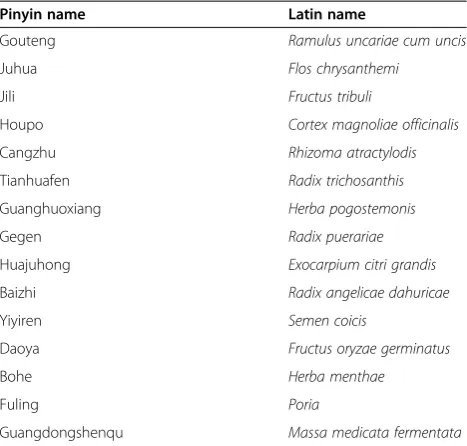
A new TCM drug, Baoji Tablets, is manufactured by Wanglaoji Pharmaceutical Co Ltd, Guangzhou, China. It is a new dosage form ofBaoji Pills, which is an old and famous traditional Chinese preparation in the form of tiny round balls, 3 to 5 mm in diameter, used for treat-ing CCSDS. This patented drug is made of active treat- ingre-dients from the Chinese herbs listed in Table 1, which have all been approved by the China Food and Drug Ad-ministration (CFDA) [11]. Preclinical pharmacologic ex-periments showed that it can disperse summer-heat, resolve dampness and improve the spleen’s transporta-tion functransporta-tion. Furthermore, no evidence of an adverse or toxic effect has been found in toxicological studies. The preclinical studies were completed by Professor Rujun Wang and her research team from the new drug deve-lopment research center of Guangzhou Traditional Chinese Medical University. Their studies have not yet been published.
The objective of this well-designed randomized con-trolled trial is to evaluate the efficacy and safety of Baoji Tablets by comparing it with the commonly used trad-itional preparationBaoji Pills, as well as with a placebo, for patients with CCSDS. In this study, the investigators hypothesize that the duration of all symptoms will be shorter in the new tablets group. Additionally, it is expected that the new drug will be safe for oral administration.
Methods/design Design
This study is designed as a multicenter, phase II, parallel-group, double-blind, double-dummy, randomized and placebo-controlled trial. The trial protocol is conducted in accordance with the Good Clinical Practice Guidelines and the Declaration of Helsinki (2008) [12]. This study has been authorized by the CFDA (Approval No. 2009L00225) and ethics approval has been obtained from local ethics com-mittees, including the West China Hospital of Sichuan Uni-versity Clinical Trials and Biomedical Ethics Committee, the Ethics Committee of the Affiliated Hospital of Jiangxi College of TCM, the Clinical Research Ethics Committee of Fujian Institute of TCM and the Ethics Committee of Guangxi Traditional Chinese Medical University. In addition, the study is registered with the Chinese Clinical Trial Registry (ChiCTR-TRC-13003197). The study is fi-nancially supported by Wanglaoji Pharmaceutical Co Ltd, Guangzhou, China. This funding source had no role in the design of this study and does not have any responsibility for analyses, interpretation of the data or the decision to sub-mit results, other than providing test drugs. Trained re-search nurses introduce the trial to patients, and give them information sheets and consent forms. All patients have to give their written informed consent prior to enrollment. The study’s flow chart is shown in Figure 1.
Patient population and setting
[image:2.595.305.539.100.323.2]A total of 288 Chinese patients, who fulfill the screening criteria, will be enrolled at four large comprehensive hospitals in China: 1) West China Hospital of Sichuan University, 2) the Affiliated Hospital of Jiangxi College of TCM, 3) Fujian Institute of TCM and 4) Ruikang Table 1 Standard formulation ofBaoji Tablets
Pinyin name Latin name
Gouteng Ramulus uncariae cum uncis
Juhua Flos chrysanthemi
Jili Fructus tribuli
Houpo Cortex magnoliae officinalis
Cangzhu Rhizoma atractylodis
Tianhuafen Radix trichosanthis
Guanghuoxiang Herba pogostemonis
Gegen Radix puerariae
Huajuhong Exocarpium citri grandis
Baizhi Radix angelicae dahuricae
Yiyiren Semen coicis
Daoya Fructus oryzae germinatus
Bohe Herba menthae
Fuling Poria
Hospital of Guangxi Traditional Chinese Medical Uni-versity. Each center will recruit the same number of pa-tients. In other words, 72 patients will be recruited at each hospital. A research assistant in each center will re-cruit patients through advertisements in local hospitals.
Western medicine diagnostic criteria for the common cold
First, patients have to answer ‘yes’ to either of the fol-lowing questions: A) Do you think that you have a cold? B) Do you think you are coming down with a cold? Sec-ond, patients have to report at least one of following four symptoms established previously as Jackson’s cri-teria [13]: 1) nasal discharge, 2) nasal obstruction, 3) sneezing and/or 4) a sore throat.
Diagnostic criteria for TCM syndrome differentiation
The TCM diagnosis of summer-heat and dampness syn-drome is based on the Guidelines for Clinical Research of New Chinese Medicine [14]. For a patient to be diag-nosed with summer-heat and dampness syndrome, he/ she will have at least two of each of the primary and sec-ondary symptoms listed in Table 2, as well as the TCM signs for the tongue and pulse.
Inclusion criteria
Diagnosis of common cold according to Western medicine
Diagnosis of summer-heat and dampness syndrome according to TCM
Aged between 18 and 65 years old
Presents within 48 hours after onset of common cold-like symptoms
Able to understand and sign written informed consent
Exclusion criteria
Patients with acute herpetic pharyngitis, acute viral pharyngitis, acute herpetic laryngitis, acute viral laryngitis, acute conjunctivitis or acute tonsillitis Patients with acute bacterial gastroenteritis Patients with serious primary diseases of the heart,
liver, kidney, blood system or endocrine system Patients with acute lower respiratory diseases,
[image:3.595.58.539.88.386.2]tumors or AIDS Figure 1Study flow chart.
Table 2 Traditional Chinese medicine diagnostic criteria
Category Symptoms and signs
Primary symptoms Aversion to cold, fever, diarrhea, nausea and vomiting
Secondary symptoms Fatigue, headache, abdominal discomfort, poor appetite, belching
TCM signs for the tongue Reddish tongue, greasy tongue coating
[image:3.595.305.539.645.732.2]Patients with alanine aminotransferase levels 1.5 times higher than the upper limit of normal
reference values, abnormal blood creatinine, positive urine protein qualitative test, blood leukocyte count < 3.0 × 10⁹/L or > 10.0 × 10⁹/L, neutrophil
percentage > 80% or stool routine test using a high power objective finds white blood cell count > 1, pus cells or phagocytes
Patient’s body temperature > 38.5°C
Patients taking any medication before the study for relief of symptoms
Pregnant women, hoping to become pregnant women, lactating women
Patients who have an allergic constitution or are allergic to the trial medicine
Mentally or legally disabled patients
Patients who are participating or participated in another drug clinical trial within the prior 3 months
Other criteria
Participants who meet any of the following criteria are withdrawn from the study:
Voluntarily quitting Misdiagnosis
Using forbidden drugs or treatments in the course of the trial
Patient’s actual usage of trial drug is < 80% or > 120% of the required dosage
Unable to complete the scheduled follow-up The patient’s condition worsens during the study
and they need hospital treatment
The patient cannot complete the study due to adverse events or other reasons
Patients who are withdrawn are not replaced.
The whole study will be terminated or suspended early if any of the following occur:
Serious adverse event
Poor curative effect is found during the study Significant deviation from the protocol Flawed protocol
The pharmaceutical supervisory and administrative department decides to terminate the study for any reason
The sponsors decide to terminate the trial due to management or funding problems
Concomitant treatments and forbidden drugs
Use of any other Western therapy or Chinese medicine to relieve symptoms, which may affect the analysis of the final results, is strictly prohibited. Medications used to control other conditions of the participants, such as
hypertensive or diabetic medications, are allowed. The dosage, duration and name of any concomitant treat-ment or medication must be recorded carefully in the case report form (CRF).
Test drugs
The test drugs are Baoji Tablets, dummy Baoji Tablets, Baoji Pillsand dummyBaoji Pillsand they are manufac-tured by Wanglaoji Pharmaceutical Co Ltd. Dummy drugs are indistinguishable from the real ones. They are almost the same in shape, size, taste and color. To make blinding more effective, both dummy and real drugs use the same packaging. A uniform test drug package con-tains both tablets and pills for 3 + 1 days’ dosage. A clearly visible tag on each package states: ‘FOR TRIAL USE ONLY’ and other information, such as the manu-facturer’s name, drug name, drug code, usage, dosage and so on. All test drug packages are dispensed and reclaimed by an independent drug administrator in each center, who is also responsible for storing and keeping records of test drugs.
Randomization and blinding
Stratified blocked randomization is used in this study. Stratification is performed on enrolling centers and block length will be decided by an independent coder, using the software called Package for Encyclopaedia Medical Statistics 3.1 (PEMS 3.1) to generate the randomization sequence. Patients are assigned to the new tablets group, old pills group or placebo control group using a 1:1:1 ratio. The assignment for each pa-tient is concealed in a sealed, lightproof and numbered envelope. Each envelope is assigned to a unique coded test drug package containing the specified medication according to the group assignment. For example, if a pa-tient is assigned to the new tablets group, their unique coded test drug package will contain real Baoji Tablets and dummy Baoji Pills. Patients are randomly enrolled using the numbered envelopes and assigned to a treat-ment group. A blinded clinical assistant in each center performs the patient allocation. As the trial is double blinded, both investigators and patients are blinded to group assignments. The sealed envelopes are kept in locked drawers and will only be opened if there is a medical emergency.
Interventions
New tablets group
Patients are administeredBaoji Tablets0.9 g and dummy Baoji Pills3.7 g three times daily for 3 days.
Old pills group
Placebo control group
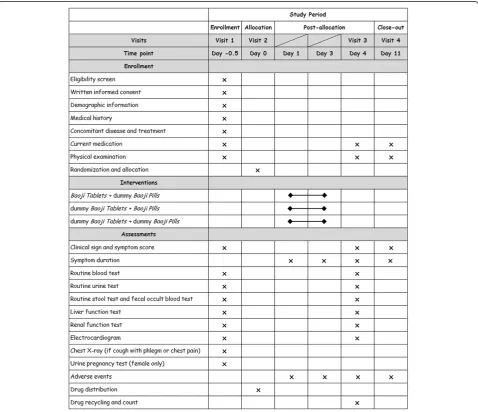
Patients are administered dummy Baoji Tablets 0.9 g and dummyBaoji Pills3.7 g three times daily for 3 days. All groups receive health education for the common cold, such as the recommendation to increase rest and fluid intake. During the study, patients are visited four times by the investigators. The time points for the visits are 0.5 days before baseline, at baseline, 4 days post baseline and 11 days post baseline. The follow-up visits last for one week after the treatment. Details of study visits and contents can be found in Figure 2.
Outcome measurements
Primary outcomes
The primary outcome of this study will be the duration of all symptoms, which is defined as the number of hours from baseline to the time when the patient feels
not sick at all. This can be acquired from the patient diary, in which each patient records any changes in symptoms.
Secondary outcomes
[image:5.595.59.538.305.717.2]Secondary outcomes include duration of primary and secondary symptoms, changes in primary and secondary symptom scores and cumulative symptom score at day 4, as well as the evaluation of treatment efficacy. In this trial, the symptom score system and treatment efficacy evaluation system follow theGuidelines for Clinical Re-search of New Chinese Medicine [14]. In the symptom score system, the primary and secondary symptoms are given graded scores. The cumulative symptom score is the sum of all symptom scores. In addition, TCM signs will also be assessed (Figure 3). The treatment efficacy evaluation system uses the percentage of symptom score
reduction (PSSR). The PSSR for a patient after treatment is calculated according to the following formula:
PSSR¼ Symptom score at day 0Symptom score at day 0−Symptom score at day 4
100%
The symptom improvement will be classified as full re-covery (PSSR≥90%), good recovery (90% > PSSR≥70%), modest recovery (70% > PSSR≥30%) and no recovery (PSSR < 30%).
Safety outcomes
Safety outcomes include results of a routine blood test, routine urine test, routine stool test, fecal occult blood test, liver function test, renal function test and electro-cardiogram. These biological indicators are monitored both before and after treatment. A urine pregnancy test must be done before recruiting a female patient of child-bearing age.
Data management
In our study, all data are entered electronically using Or-acle Clinical Remote Data Capture. Original study forms
will be kept on file at the participating sites for a period of 3 years after completion of the study. At the end of the trial, the investigators, data managers and statisti-cians will perform a blind review and confirm the data-base before processing the data. Only the principal investigator will have access to the final trial data set. All patients’ personal information is classified and is used only in this study.
Adverse event reporting
Adverse events will be recorded in detail using medical terminology throughout the study. Severe adverse events must be reported to both the institutional review board and the principal investigator within 24 hours. If there is a medical emergency, the unblinding procedures will be initiated by the principal investigator.
Sample size calculation and statistical analysis
[image:6.595.56.540.89.447.2]to be 7 days with a standard deviation of 4 days [15]. To demonstrate a reduction in the duration of all symptoms by 2 days, which is defined as clinically relevant, the sample size needs to be 85 cases for each group. Consid-ering the potential loss of patients, the number of partic-ipants recruited must be 96 per group. Therefore, a total of 288 patients will be recruited in this trial.
The statistical analysis for this study will be performed by an independent professional statistician using PEMS 3.1 in a separate location. An intent-to-treat analysis for the patients, who have received treatment at least once, will be carried out. Missing data will be adjusted using the last observation carried forward method. The per-protocol analysis will be restricted to participants who strictly follow the protocol and complete the study. The safety analysis will be conducted only for randomized subjects who have completed at least one study visit. Pearson’s chi-square test or Fisher’s exact test will be performed on categorical variables, Student’s t-test on continuous normally distributed variables and the Wil-coxon rank sum test on non-normal variables. Due to the multicenter design, the Cochran–Mantel–Haenszel test stratified by clinical centers and analysis of covari-ance adjusted for clinical center and baseline will be used in this study. The statistical significance level will be set at P< 0.05 and 95% confidence interval will be calculated.
Discussion
To date, there are still no effective therapeutic options available to treat the common cold. It seems that a vac-cine may be a good solution. However, vacvac-cines only work on certain viruses. Besides, since diverse viral sero-types cause the common cold, vaccine preparation is very difficult. Therefore, recent studies have mainly fo-cused on symptomatic management. TCM is widely used in China to treat the common cold and many stud-ies have shown that a TCM formulation might be better in reducing symptoms than a placebo [16-19]. However, the quality of many of these reported studies is of great concern [20]. A number of high-quality clinical trials are needed before any Chinese herbal preparation can be recommended for the common cold [21]. For this rea-son, the study protocol was designed according to the Consolidated Standards of Reporting Trials statement [22]. Quality controllers will pay regular visits to each center, recheck CRFs and monitor the research data throughout the trial. Moreover, investigators in different centers are all required to follow the standard operating procedures. To our knowledge, previous studies have only focused on wind-cold syndrome and wind-heat syn-drome. Therefore, this will be the first multicenter, double-blind, double-dummy, randomized and placebo-controlled trial designed to treat CCSDS in an adult
population from China. It will establish the basis for a scientific and objective assessment of the efficacy and safety of Baoji Tablets for treating CCSDS, and provide evidence for a phase III clinical trial.
Trial status
This trial is currently recruiting participants.
Abbreviations
CCSDS:common cold with summer-heat and dampness syndrome; CFDA: China food and drug administration; CRF: case report form; PEMS: Package for encyclopaedia medical statistics; PSSR: percentage of symptom score reduction; TCM: traditional Chinese medicine.
Competing interests
The authors declare that they have no competing interests. Neither the funding agency nor any outside organization has a role in study design or manuscript preparation.
Authors’contributions
R-ZF, J-QL and BM contributed to the design and development of the study protocol. R-ZF prepared the initial draft of the manuscript. J-QL, AKJ and JDM contributed to and revised the manuscript. BM was the general supervisor for this research. All authors critically reviewed the content and approved the final version.
Acknowledgements
The study is financially supported by Wanglaoji Pharmaceutical Co Ltd, Guangzhou, China. This funding source had no role in the design of this study and does not have any responsibility for analyses, interpretation of the data or the decision to submit results, other than to provide test drugs.
Author details
1
Department of Integrated Traditional and Western Medicine, West China Hospital of Sichuan University, 37 Guoxue Lane, Chengdu 610041, Sichuan Province, People’s Republic of China.2Department of Emergency Medicine, Carolinas Medical Center, 1000 Blythe Blvd, Charlotte, NC 28203, USA. 3
Department of Emergency Medicine, University of North Carolina Hospitals, 170 Manning Drive, Chapel Hill, NC 27514, USA.
Received: 1 September 2013 Accepted: 5 December 2013 Published: 21 December 2013
References
1. Herlov-Nielsen H, Permin H:Common cold–risk factors, transmission and treatment.Ugeskr Laeger2001,163:5643–5646.
2. Arroll B:Common cold.Am Fam Physician2011,84:1390–1391. 3. Worrall G:Common cold.Can Fam Physician2011,57:1289–1290. 4. Turner RB:The common cold.InGoldman's Cecil Medicine.24th edition. Edited
by Goldman L, Schafer AI. Philadelphia: Saunders Elsevier; 2011:2089–2090. 5. Treanor JJ:Adenovirus Diseases.InGoldman's Cecil Medicine.24th edition. Edited
by Goldman L, Schafer AI. Philadelphia: Saunders Elsevier; 2011:2100–2101. 6. Romero JR:Enteroviruses.InGoldman's Cecil Medicine.24th edition. Edited
by Goldman L, Schafer AI. Philadelphia: Saunders Elsevier; 2011:2140–2143. 7. Woodwell DA, Cherry DK:National Ambulatory Medical Care Survey: 2002
summary.Adv Data2004,346:1–44.
8. McCaig LF, Burt CW:National hospital ambulatory medical care survey: emergency department summary.Adv Data2004,2002:1–34.
9. Fendrick AM, Monto AS, Nightengale B, Sarnes M:The economic burden of non-influenza-related viral respiratory tract infection in the United States.Arch Intern Med2003,163:487–494.
10. Simasek M, Blandino DA:Treatment of the common cold.Am Fam Physician
2007,75:515–520.
11. Commission SP:Pharmacopoeia of the People's Republic of China.9th edition. Beijing: China Medical Science Press; 2010.
13. Jackson GG, Dowling HF, Muldoon RL:Acute respiratory diseases of viral etiology. VII. Present concepts of the common cold.Am J Public Health Nations Health1962,52:940–945.
14. Zhen XY:Guidelines for Clinical Research of New Chinese Medicine.Beijing: China Medical Science Press; 2002.
15. Audera C, Patulny RV, Sander BH, Douglas RM:Mega-dose vitamin C in treatment of the common cold: a randomised controlled trial.Med J Aust
2001,175:359–362.
16. Wang L, Zhang RM, Liu GY, Wei BL, Wang Y, Cai HY, Li FS, Xu YL, Zheng SP, Wang G:Chinese herbs in treatment of influenza: a randomized, double-blind, placebo-controlled trial.Respir Med2010,104:1362–1369. 17. Wong W, Lam CL, Fong DY:Treatment effectiveness of two Chinese
herbal medicine formulae in upper respiratory tract infections–a randomized double-blind placebo-controlled trial.Fam Pract2012,
29:643–652.
18. Chang J, Zhang Y, Mao B, Wang L, Li TQ, Zhang RM:A double-blind, randomized controlled trial of Chaige Qingre Granule in treating acute upper respiratory tract infection of wind heat syndrome.Zhong Xi Yi Jie He Xue Bao2007,5:141–146.
19. Chang J, Dong SJ, She B, Zhang RM, Meng MB, Xu YL, Wan LL, Shi KH, Pan JH, Mao B:Treatment of common cold patients with the shi-cha capsule: a multicenter, double-blind, randomized, placebo-controlled, dose-escalation trial.Evid Based Complement Alternat Med2012,2012:254571.
20. Zhong YQ, Fu JJ, Liu XM, Diao X, Mao B, Fan T, Yang HM, Liu GJ, Zhang WB:
The reporting quality, scientific rigor, and ethics of randomized placebo-controlled trials of traditional Chinese medicine compound formulations and the differences between Chinese and non-Chinese trials.Curr Ther Res Clin E2010,71:30–49.
21. Wu T, Zhang J, Qiu Y, Xie L, Liu GJ:Chinese medicinal herbs for the common cold.Cochrane Database Systematic Reviews2007,1, CD004782. 22. Moher D, Schulz KF, Altman D:The CONSORT Statement: revised
recommendations for improving the quality of reports of parallel-group randomized trials 2001.Explore (NY)2005,1:40–45.
doi:10.1186/1745-6215-14-440
Cite this article as:Fenget al.:The efficacy and safety ofBaoji Tablets for treating common cold with summer-heat and dampness syndrome:
study protocol for a randomized controlled trial.Trials201314:440.
Submit your next manuscript to BioMed Central and take full advantage of:
• Convenient online submission
• Thorough peer review
• No space constraints or color figure charges
• Immediate publication on acceptance
• Inclusion in PubMed, CAS, Scopus and Google Scholar
• Research which is freely available for redistribution