ISSN 2250-3153
An Effect of Forging Process Parameters on Filling the
Job Weight: An Industrial Case Study
Mahendra G. Rathi*, Nilesh A. Jakhade**
* HOD (Workshop), Government College of Engineering, Aurangabad,
Maharashtra, India.
**
PG Student, Dept. of Mechanical Engineering, Government College of Engineering, Aurangabad, Maharashtra, India.
Abstract- Since the defects causes high rejection rates, it is important to move any production process in the direction of eliminating all imperfections as a part of an effective continuous improvement program. Forging process is no exception to this. In present study, the various forging defects that occur in the components during closed-die hot forging process are investigated initially. The investigation is done with the help of Quality Assurance department in a forging industry. During investigation, the various defects that causes high rejection rates are identified and unfilling defect which has major contribution in high rejection rate is selected for study purpose. The fish-bone diagram is used to explore the possible causes of unfilling defect, through a brainstorming session. It is observed that the three process parameters having major responsibility to fill the job weight. These parameters are- billet weight, heating temperature, and heating time. The best combination of these process parameters must be followed during the production process in order to reduce the rejection rate due to unfilling forging defect. To get the best parameter combination, DOE technique (like Taguchi method) is the most powerful approach. But before going to use Taguchi method, it is very much necessary to determine the effect of selected process parameters on output. Therefore, the objective of this paper is to present the effect/influence of selected process parameters on filling the job weight. For this purpose, OVAT analysis is used here. Engineers and Scientists often perform OVAT experiments, which consists of varying only one factor or variable at a time with keeping others constant.
Index Terms- Unfilling, Fish-bone diagram, Process Parameters, OVAT analysis.
I. INTRODUCTION
orging is defined as a metal working process in which the useful shape of work piece is obtained in solid state by compressive forces applied through the use of dies and tools. Forging process is accomplished by hammering or pressing the metal. It is one of the oldest known metalworking processes with its origin about some thousands of years back. Traditionally, forging was performed by a smith using hammer and anvil. Using hammer and anvil is a crude form of forging. In modern times, industrial forging is done either with presses or with hammers powered by compressed air, electricity, hydraulics or steam. Forging process produces parts of superior mechanical properties with minimum waste of material. In this process, the starting material has a relatively simple geometry; this material is
plastically deformed in one or more operations into a product of relatively complex configuration. Some examples of shapes obtained now-a-days by forging process are- Crane hook, connecting rod of an IC engine, spanner, gear blanks, crown wheel, pinion etc.
Though forging process gives superior quality product compared to other manufacturing processes, there are some defects that are lightly to come if a proper care is not taken in forging process design. Defects can be defined as the imperfections that exceed certain limits. There are many imperfections that can be considered as being defects, ranging from those traceable to the starting materials to those caused by one of the forging processes or by post forging operations. In forging process, defects like unfilling, mismatch, scale pits, surface cracking, fold and lap, improper grain flow etc. are responsible for high rejection rates. In this study, unfilling forging defect is focused. Unfilling defect can be defined as some section of die cavity not completely filled by the flowing metal, or metal does not fill the recesses of the die cavity completely during the forging process. It causes due to improper design of the forging die, die wear, improper use of forging techniques, less raw material, poor heating of raw material inside the furnace, etc. It can be avoided by proper die design, using proper raw material and proper heating of billets inside the furnace to get the desired forgeability of raw material. The effect of unfilling defect is that the job dimensions cannot be filled; ultimately the required final job weight cannot be filled completely as per the requirements of company standards. Due to presence of this defect, there will be insufficient material stock on forged component for subsequent machining operations, hence the job gets rejected. In order to increase the product quality and to reduce the rejection rate due to defects, the design activities need to systematically consider various designs and process related parameters and finally come out with the best parameters combination for better process performance.
II. METHODOLOGY
ISSN 2250-3153
designing experiments involving the testing of factors or causes, one at a time instead of all simultaneously. It involves:
Moving one input variable, keeping others constant at their baseline (nominal) values, then,
Returning the variable to its nominal value, and repeating for each of the other inputs in the same way. OVAT is frequently preferred by modelers because of practical reasons. In case of model failure under OVAT analysis, the modeler immediately knows which is the input factor responsible for the failure. Despite of all criticisms, some researchers have articulated a role for OVAT and showed they can be more effective under certain conditions as number of runs is limited, primary goal is to attain improvements in the system, and experimental error is not large compared to factor effects, which must be additive and independent of each other.
III. INPUT DATA COLLECTION AND PROBLEM
IDENTIFICATION
During the investigation that done with the help of QA department, in a forging industry, it is clear from the monthly rejection report (Table 1) for the month of December 2013, company has manufactured 14 types of gear blanks. In the total production of 12945 numbers, 787 numbers got rejected. It means the plant has a rejection rate of 6.08% in that month. This much rejection rate cannot be tolerated by the company, this lead to undergo detail study in the company about the defects that caused this much rejection rate and the remedial actions suitable for that to reduce the rejection rate. From the information of Table 1, two charts are plotted. Chart 1 shows that Part No. 2876 has maximum rejection and Chart 2 shows that ‘Unfilling’ defect has major contribution in rejection of part No. 2876. Therefore, Part No. 2876 is selected here for study purpose and trying to attack on unfilling defect in that product.
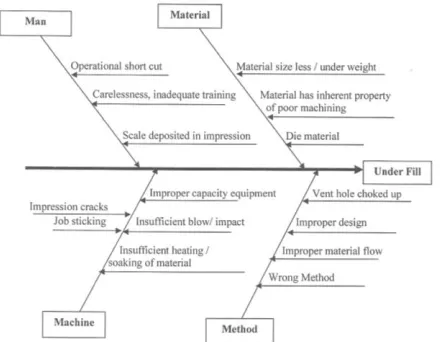
Figure 1 shows fish-bone diagram that used during brainstorming session for unfilling forging defect. During the brainstorming session, it is observed that the three process parameters (billet weight, heating temperature of furnace, and heating/soaking time of raw material/billet inside the furnace) having major responsibility to fill the die cavity. Therefore, these three process parameters are selected here for trial purpose. As per the Process Standard of company, the ranges of three process parameters (which are selected for trial purpose), for the Part No. 2876 are- Billet Weight: 6.25 Kg +/- 0.05 Kg, Heating Temperature of furnace: 1200 0C +/- 50 0C, and Heating/Soaking Time for billets inside the furnace: 60 min. +/- 10 min.
[image:2.612.316.580.75.596.2]Figure 1: Fish-bone diagram for unfilling (underfilling) forging defect
Table 1: Monthly Rejection Report (Dec. 2013)
Chart 1: Part number wise rejected Qty.
Chart 2: Defect wise rejected Qty. for Part No. 2876
IV. EXPERIMENTAL DETAILS
[image:2.612.41.261.580.751.2]ISSN 2250-3153
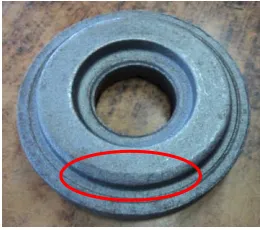
[image:3.612.307.491.140.509.2]There are three input process parameters selected with their three levels. Details of parameters and their levels used in this study are as shown in Table- 2. Unfilling defect is as shown in Photographs- 1 and 2. It is very difficult to predict the occurrence of this defect at a particular place on a job, but this defect directly affects the required final job weight. So, the selected output for this study is required final job weight. As per the Company standard, the required final job weight for Part No. 2876 is 5.50 Kg +/- 0.05 Kg.
Table 2 : Process Parameters with their Levels
A Billet Wt. (in Kg) 6.20
(A1) 6.25 (A2)
6.30 (A3)
B Heating Temp. (in 0C) 1150 (B1)
1200 (B2)
1250 (B3)
C Heating Time (in min.) 50 (C1)
60 (C2)
70 (C3)
Photograph 1: Unfilling defect at front side of job
Photograph 2: Unfilling defect at back side of job
B. Design of Experiments:
The design of experiment is carried out by OVAT methodology. Table 3 shows the layout of experiments to be carried out according to OVAT analysis. Total 9 trials to be conducted. In first 3 trials, billet weight is varied, while heating temperature and time are kept constant at middle level of limits. For rest of the trials, heating temperature and time are varied respectively one-by-one with keeping remaining parameters constant at middle level of limits.
C. Experimental Set-up:
A Series of experiments are conducted to evaluate the influence of process parameters on job weight. The trials are carried out with 2 Ton Pneumatic Hammer. Electronic weighing machine is used for weight measurement. The experiments are conducted by keeping all other parameters constant. The constant parameters
are air-fuel ratio (6:1) to furnace burner, type of furnace oil (cbfs), air pressure (75 psi) to hammer, type of hammer, die wear within limit, skilled operator, etc. Photograph 3 shows
hammering operation with 2-Ton hammer during
experimentation and photograph 4 shows electronic weighing machine to be used for weight measurement purpose.
Table 3 : Layout of experiments
Trial No.
Parameters Combination
A B C
1 6.20 1200 60
2 6.25 1200 60
3 6.30 1200 60
4 6.25 1150 60
5 6.25 1200 60
6 6.25 1250 60
7 6.25 1200 50
8 6.25 1200 60
9 6.25 1200 70
Photograph 3: Hammering Operation
[image:3.612.36.283.158.385.2] [image:3.612.35.165.418.533.2]ISSN 2250-3153
V. RESULTS AND DISCUSSION
[image:4.612.313.575.184.371.2]After the conduction of trials, the results for job weight are collected and they are analyzed by means of OVAT analysis using Minitab 14 software. Table 4 shows the results of trials and discussion for OVAT analysis is as follows:
Table 4: Results of Experiments
Trial No.
Parameters
Combination Job wt.
A B C
1 6.20 1200 60 5.38
2 6.25 1200 60 5.45
3 6.30 1200 60 5.49
4 6.25 1150 60 5.43
5 6.25 1200 60 5.45
6 6.25 1250 60 5.40
7 6.25 1200 50 5.46
8 6.25 1200 60 5.45
9 6.25 1200 70 5.42
[image:4.612.33.278.486.725.2]1) OVAT analysis of Billet weight:
Table 5: Results for Billet weight analysis
Trial
No. Billet wt. Result
1 6.20 5.38
2 6.25 5.45
3 6.30 5.49
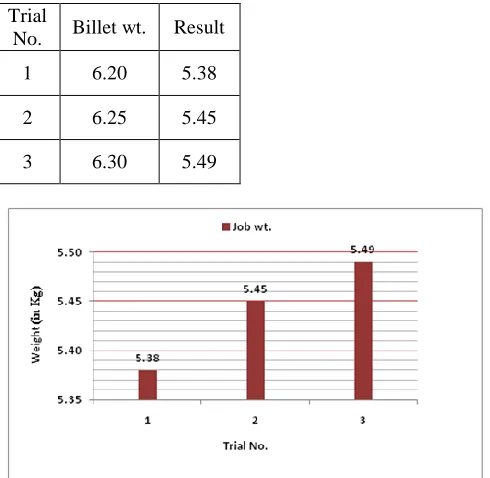
Chart 3: Trend chart of billet weight analysis
The selected levels of billet weight are 6.20, 6.25,and 6.30 Kg. Heating temperature and time are kept constant at middle level of limits and trials are taken. From table 5 and chart 3, it is observed that, in Trial No. 1, as billet weight is at lower side of limits, there is heating loss. Due to this, there is material loss and resulted into unfilled job. In Trial No. 2, billet weight is increased by 0.05 Kg as compared to trial No. 1, so there is compensation of heating loss. Therefore, there is optimum job weight. In Trial No. 3, as billet weight is at higher side of limits there is minimum heating loss, hence there is no unfilling of job.
Billet wt
Jo
b
W
t
6.30 6.28
6.26 6.24
6.22 6.20
5.50
5.48
5.46
5.44
5.42
5.40
5.38
Scatterplot of Job Wt vs Billet wt
Graph 1: Scatterplot of job wt.-vs-billet weight
From graph 1, it is clear that, as billet weight increases, the job weight also increases. Hence, billet weight is influencing factor on job weight.
2) OVAT analysis of Heating Temperature:
Table 6: Results for Heating Temperature analysis
Trial
No. Temp. Result
4 1150 5.43
5 1200 5.45
[image:4.612.290.545.492.745.2]ISSN 2250-3153
Chart 4: Trend chart of heating temperature analysis
The selected levels of heating temperature are 1150, 1200, and 1250 0C. Billet weight and heating time are kept constant at middle level of limits and trials are taken. From table 6, chart 4 and graph 2, it is observed that, in Trial No. 4, as heating temperature is at lower side of limits, there is improper material flow, resulted in unfilled job. In Trial No. 5, heating temperature is increased by 50 0C as compared to trial No. 4, so there is proper material flow, resulted into optimum job weight. In Trial No. 6, as heating temperature is at higher side of limits, there are more scale losses. So material loss is more, resulted into unfilled job. Hence, heating temperature is influencing factor on job weight.
Temp
Jo
b
W
t
1250 1225
1200 1175
1150 5.45
5.44
5.43
5.42
5.41
5.40
Scatterplot of Job Wt vs Temp
Graph 2: Scatterplot of job wt.-vs-heating temperature
[image:5.612.312.578.396.560.2]3) OVAT analysis of Heating Time:
Table 7: Results for Heating Time analysis
Trial
No. Time Result
7 50 5.46
8 60 5.45
9 70 5.42
Chart 5: Trend chart of heating time analysis
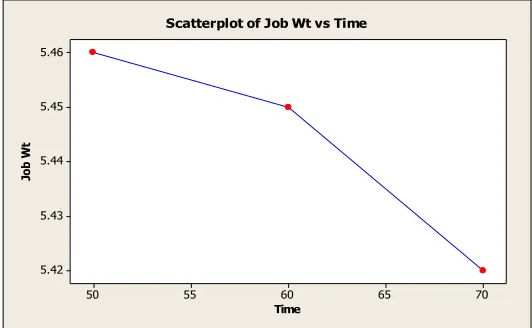
The selected levels of heating time are 50, 60, and 70 min. Billet weight and heating temperature are kept constant at middle level of limits and trials are taken. From table 7 and chart 5, it is observed that, in Trial No. 7, as heating time is at lower side of limits, there is less heating loss, resulted into no unfilling of job. In Trial No. 8, heating time increased by 10 min. as compared to trial No. 7, but as billet weight is at middle level of limits, still there is optimum job weight. In Trial No. 9, as heating time is at higher side of limits, again there are more scale losses, so material loss is more, resulted into unfilled job. From graph 3, it is clear that, as heating time increases, there are more scale losses so material loss is more, therefore job weight get decreased resulting into unfilling of job weight. Hence, heating time is influencing factor on job weight.
Time
Jo
b
W
t
70 65
60 55
50 5.46
5.45
5.44
5.43
5.42
Scatterplot of Job Wt vs Time
Graph 3: Scatterplot of job wt.-vs-heating time
VI. CONCLUSION
Following conclusions are drawn from this study:
Less billet weight resulted into unfilled job. As well as due to high heating temperature and time, there is excessive scale loss, resulted into unfilled job.
Due to high heating temperature and time, there will be improper microstructure and hardness of job.
Low heating temperature and time resulted into forging rupture and improper microstructure of job.
ISSN 2250-3153
calculations, scale loss below 4% of sum of net weight, flash weight, and slug weight of job is preferable in box type oil fired furnace. Heating loss is more when the heating temperature and duration of heating the billets is more.
Heating temperature 1200 0C to 1250 0C would be better at 6.30 Kg billet weight with 50 min. heating time.
Hence, the selection of process parameters with their levels is proper and they are having the influence on filling the job weight.
In order to get the best combination of these parameters, the optimization is necessary by using the DOE technique (like Taguchi method).
ACKNOWLEDGMENT
Authors would like to thank the Management of ‘Bombay Forgings Ltd.’, E14/51, M.I.D.C. Industrial area Chikalthana, Aurangabad, Maharashtra, India for their Technical support and Experimental assistance throughout the work. Authors also thank to Mr. Ayas Hashmi for his continuous support and guidance throughout the work.
REFERENCES
[1] Taylan Altan, Gracious Ngaile, Gangshu Shen- “Cold and Hot Forging- Fundamentals and Applications”, Handbook by ASM International- February 2005
[2] H. James Henning- “Defects in Hot Forging”- May/June 2007 [3] Course Material by Arkey Technical Training and Research Institute,
Pune, Maharashtra, India- “Defect analysis and Productivity improvement in forging industries”- October 2007
[4] Aju Pius Thottungal, Sijo. M.T, “Controlling Measures to Reduce Rejection Rate due to Forging Defects”, International Journal of Scientific and Research Publications, Vol.3, Issue 3, March 2013. [5] Christy Mathew, Justin Koshy, Dr. Deviprasad Varma, “Study of
Forging Defects in Integral Axle Arms”, International Journal of Engineering and Innovative Technology (IJEIT), Vol.2, Issue 7, January 2013.
[6] Martin Tanco, Elisabeth Viles, Lourdes Pozueta, “Are All Designs of Experiments Approaches Suitable for Your Company?”, Proceedings of the World Congress on Engineering 2008, Vol.II, WCE 2008, July 2 - 4, 2008, London, U.K.
AUTHORS
First Author – Mahendra G. Rathi, HOD (Workshop),
Government College of Engineering, Aurangabad, Maharashtra, India. [email protected], +91- 9049504930
Second Author – Nilesh A. Jakhade, PG Student, Dept. of
Mechanical Engineering, Government College of Engineering, Aurangabad, Maharashtra, India.