Public Health Theses School of Public Health
Summer 8-7-2018
Parent-mediated Support of Social
Communication Among Toddlers with Autism: A
Systematic Review and Direct Observation of
Parent-child Interaction
Danielle M. MooreFollow this and additional works at:https://scholarworks.gsu.edu/iph_theses
This Thesis is brought to you for free and open access by the School of Public Health at ScholarWorks @ Georgia State University. It has been accepted for inclusion in Public Health Theses by an authorized administrator of ScholarWorks @ Georgia State University. For more information, please contact
Recommended Citation
Moore, Danielle M., "Parent-mediated Support of Social Communication Among Toddlers with Autism: A Systematic Review and Direct Observation of Parent-child Interaction." Thesis, Georgia State University, 2018.
Parent-Mediated Support of Social Communication among Toddlers with Autism: A Systematic Review and Direct Observation of Parent-Child Interaction
by
Danielle Michaele Moore, Bachelor of Arts in Journalism
A Thesis Submitted to the School of Public Health Graduate Faculty at Georgia State University in Partial Fulfillment
of the
Requirements for the Degree MASTER OF PUBLIC HEALTH
APPROVAL PAGE
Parent-Mediated Support of Social Communication among Toddlers with Autism: A Systematic Review and Direct Observation of Parent-Child Interaction
by
Danielle Michaele Moore
Approved:
Dr. Kathleen Marie Baggett__ Committee Chair
Dr. Brian Barger_________ Committee Member
Acknowledgments
I would like to express my gratitude to my mentor for the past two years, Dr. Kathleen Baggett, for her unending support and encouragement on this project. You have given me invaluable opportunities that have challenged me and made me better in more ways than I can count. I would also like to thank Dr. Brian Barger for providing not only expert guidance on this project, but also much-needed humor and kindness along the way.
Thank you to my friends and family - for cheering me on to the finish line, and for believing in me whenever self-doubt threatened my goals.
To my parents - who have supported my dreams when they felt distant, and encouraged their fulfillment even when the distance took me far from home.
Author’s Statement Page
In presenting this thesis as a partial fulfillment of the requirements for an advanced degree from Georgia State University, I agree that the Library of the University shall make it available for inspection and circulation in accordance with its regulations governing materials of this type. I agree that permission to quote from, to copy from, or to publish this thesis may be granted by the author or, in his/her absence, by the professor under whose direction it was written, or in his/her absence, by the Associate Dean, School of Public Health. Such quoting, copying, or publishing must be solely for scholarly purposes and will not involve potential financial gain. It is understood that any copying from or publication of this dissertation which involves potential financial gain will not be allowed without written permission of the author.
TABLE OF CONTENTS
ACKNOWLEDGMENTS ...03
LIST OF TABLES………...06
LIST OF FIGURES………...07
ABSTRACT………...08
INTRODUCTION 1.1 Background……….………... 09
1.2 Public Health Burden and Conceptual Underpinning of ASD……...………09
1.3 Parent-Mediated Early Interventions……….….13
1.4 Research-to-Practice Gaps and Needs………16
SYSTEMATIC LITERATURE REVIEW 2.1 Search Procedures for Study Identification………...……….17
2.2 Observation Measures of Parent Support of Toddler Social Communication.…...…...…23
2.3 Implications for Use of Progress Monitoring Measures for Community EI Providers...23
2.5 Study Purpose and Research Questions...25
METHOD 3.1 Participants……….….27
3.2 IPCI-2 Measure……….………..27
3.3 Procedures …...29
3.4 Statistical Analysis...30
RESULTS 4.1 Descriptive Statistics of Demographic Sample and Study Variables……….….…...31
4.2 Correlational Analyses……….………...33
4.3 Analyses of Variance (ANOVA)...36
DISCUSSION AND CONCLUSION 5.1 Discussion of Research Questions...39
5.2 Contributions to Current Research...41
5.3 Study Limitations and Implications for Future Research...41
5.4 Conclusions……….…………...…...………..……....42
REFERENCES...44
APPENDICES Appendix A Variable Definitions for Systematic Review……….59
Appendix B Systematic Review Study Categories………....60
Appendix C IPCI-2 Variable Definitions………..63
List of Tables
Table 4.1 Demographic Profile of Sample
Table 4.2 Univariate Analysis of IPCI-2 Scores by Overall Caregivers, Mothers, and Fathers
Table 4.3 Correlation Coefficients Among Parent Support and Child Engagement Variables
Table 4.4 Relative Low, Medium, and High Overall Caregiver Facilitators and Child
Engagement Outcomes
Table 4.5 Relative Low, Medium, and High Overall Caregiver Facilitators and Composite Child
List of Figures
Figure 2.1 Flow diagram displaying decision-making criteria across the literature search and
ABSTRACT
INTRODUCTION: Autism spectrum disorder (ASD) is a neurodevelopmental disorder affecting 1 in 59 children in the United States (Centers for Disease Control and Prevention [CDC], 2018). Parent-mediated early interventions, which aim to support parent facilitation of toddler social communication, are a major of focus of research (Green et al., 2017). Systematic review of the literature revealed that, out of 27 studies of parent-mediated interventions to improve toddler social communication outcomes, only seven (25.9%) used a measure designed to assess both parent and child behavior during observed parent-child interaction. Measures reported in this literature are of limited relevance for community early childhood practitioners due to high level of training and burden required for administration and scoring. To address this limitation, secondary coding and analysis of parent-child interaction video data from a recently published study (Schertz, Odom, Baggett, & Sideris, 2017) was conducted. Using a practical and psychometrically sound indicator of parent-child interaction, the aim was to provide an empirical example of how results of an indicator of parent-child interaction could be applied by
practitioners via a data-based approach for monitoring progress of parent support of toddler social behavior among dyads participating in community parent-mediated intervention services. Analyses were conducted to examine parent support behaviors in relation to the general outcome of child social behavior toward their parents and address the following research questions: What is the mean, median, range, and standard deviation of parent positive support behavior and child social behavior in a sample of toddlers with ASD? Is parent positive support behavior
significantly and positively related to child social behavior? Do children whose parents engage in high levels of support behavior demonstrate more positive social behavior in contrast to children whose parents engage in low levels of support behavior?
METHOD Direct observation of parent-child interaction was conducted using the Indicator of Parent Child Interaction-2 (IPCI-2), within a sample of parents and toddlers from a randomized controlled trial of a parent-mediated early behavioral intervention focused on improving
outcomes for toddlers with ASD (Schertz et al., 2017). Videos were coded from 10-minute parent-child free-play sessions recorded in the family homes. Two independent coders
established interobserver agreement at 92.5%. Descriptive statistics were provided of caregiver support behavior (facilitator) and child engagement with parents.Toquantify the strength of the relationship between parent and child behavior, correlation, and bivariate regression analyses were conducted between caregiver facilitators and child engagement.
RESULTS: Caregivers overall obtained a mean facilitator score of 217.9 (SD= 59.8, range=285) and mean child engagement score of 126.37 (SD= 40.0, range= 190). Overall caregiver facilitator and overall child engagement variables showed highly significant strong correlations, r=.747, p<.0001. Overall engagement behavior of children differed significantly depending upon whether their caregivers engaged in low, medium, or high levels facilitator behaviors, F (2, 128) = 47.72, p < .0001.
DISCUSSION: This study highlights the relevance of practical application of a practitioner measure to assess parent-child interaction. Results demonstrate that an applied observation measure, with high interobserver agreement, can be use used to capture targeted parent behaviors key to promoting social communication in toddlers with ASD.
CHAPTER 1: INTRODUCTION
Autism spectrum disorder (ASD) is a neurodevelopmental disorder that affects an
estimated 1 in 59 children in the United States (Centers for Disease Control and Prevention
[CDC], 2018). The disorder manifests across diverse ethnic and socioeconomic backgrounds and
is diagnosed 4 times more often in boys than in girls (Centers for Disease Control and Prevention
[CDC], 2018). Social communication deficits, including impairments in reciprocal social
interaction, and repetitive interests are core to the disorder. Symptoms of ASD appear during the
first 3 years and can be reliably diagnosed by 18-24 months of age through a comprehensive
evaluation that includes neurologic examinations, clinical observation, developmental
assessments, and caregiver report (American Psychiatric Association, 2013).However, social
developmental risk indicators for later ASD diagnosis can be reliably identifiedas early as 6-14
months of age (Estes, Zwaigenbaum, et al., 2015; Landa et al., 2013; Ozonoff et al., 2010).
Prominent examples of social indicators include deficits in shared positive affect, directed
vocalizations, gaze, social engagement, and joint attention (Bolton, Golding, Emond, & Steer,
2012; Rogers & Talbott, 2016).
Public Health Burden
As children age, developmental difficulties become more pronounced and the need for
specialized care, treatment, and therapeutic service increase in number and cost. With a total
estimate of approximately 850,000 children under the age of 17 living with ASD (Buescher et
al., 2014) and ongoing evidence of rising incidence, the associated economic cost to society and
families is substantial. Estimated annual economic cost of caring for an individual child with
ASD, including healthcare, therapy, family-coordinated services, special education, and
collective economic cost estimates for direct medical, non-medical, and productivity loss
involved with caring for a person with ASD are forecasted to reach $461 billion by 2025 in the
United States (Leigh & Du, 2015). Burden continues to increase as children with ASD face life
challenges specific to social communication difficulties and the lack of ability to infer mental
states of others. By adolescence people with ASD are at higher risk for comorbid psychiatric
disorders. A meta-analysis found 40 percent of children and adolescents with ASD had elevated
levels of at least one social phobia or anxiety disorder, significantly higher than rates observed in
typically developing children (Van Steensel, Bögels, & Perrin, 2011). Human learning is
embedded in social experiences (Vygotsky, 1934/1986)and therefore measuring the progress of
children with ASD in their interactions with others is important to early intervention. Yet, the
challenges children with ASD face are grounded in difficulties responding to and initiating social
interactions.
Social communication Deficits of ASD
Children with ASD display deficits that fall under specific social communication
constructs, such as shared positive affect and joint attention. Shared positive affect is defined as
shared social smiling, laughing, and the exchange of positive emotional expressions. During the
first year of life, children typically display the earliest forms of these communicative acts toward
their caregivers during face-to-face interactions (Bakeman & Adamson, 1984). However,
children with ASD show deficits in shared positive affective behaviors such as social smiling and
gaze after 6 months (Ozonoff et al. 2010). In addition, children exhibit deficits in more advanced
triadic forms of communication such as joint attention. Joint attention is defined as the ability to
share focus and coordinate gaze or interest between another person and an object for the purpose
attention is an important early precursor to social communication development with cascading
effects on later cognitive and social development (Mundy, 2017; Siller & Sigman, 2008).
Outcomes in 20 year longitudinal examinations of adults with ASD show that responding to
joint-attention at 3.5 years predicted adult social functioning and independence (Gillespie-Lynch
et al., 2012) emphasizing the importance of targeting support of joint attention in early
childhood. Moreover, without early intervention, absence of joint attention and shared positive
affective behaviors continue to be a problem and communication deficits compound over time to
include repetitive behavior patterns, verbal language delays, lack of social smiling and shared
enjoyment, poor eye-contact, delayed symbolic and functional play skills, and limited response
to one’s name (Boyd et al., 2010; Murza, 2016).
Conceptual Underpinnings of ASD
Theory of Mind (ToM) is a prominent framework for conceptualizing social
communication deficits observed in ASD (Baron-Cohen, Leslie & Frith, 1985; Premack and
Woodruff, 1978). ToM describes the cognitive ability to infer the mental states, intentions, and
emotions of others. These aspects of ToM are commonly referred to in social cognitive research
as referential processes which are critical to advancing along the continuum toward a more
mature social cognition known as mentalizing. Mentalizing integrates information that a child has gathered based on memories of where another person has directed their attention in the past
and allows them to apply this information to common experiences (Mundy, 2016). This capacity
for perspective-taking emerges by 5 years of age in typically developing children and continues
to mature as children become more skilled in learning to predict the thoughts and feelings of
others through more complex social interactions (Astington & Dack, 2008). The capacity to
between joint attention skills and mentalizing (Mundy, 2016). However, young children with
ASD lack the ability to interpret the speech, actions, and intentions of others during early
development.
Further research indicates that specific forms of joint attention, responding and initiating,
may involve activation of different areas of the brain. fMRI research has shown that typical
infants following someone’s gaze toward an object (responding to joint attention) resulted in
activation of the left dorsal prefrontal cortex (Grossman & Johnson, 2010). Joint attention
initiation, such as attempting to direct someone else’s attention toward an object, is found to
activate the overlapping regions within the ventral striatum and involves the cohesion of the
frontal-central lobe. Physiological research indicates that children with ASD may experience low
connectivity within the default cortices (Kuhn-Popp, Kristen, Paulus, Meinhardt, & Sodian, et
al., 2016; Mundy, 2017; Schilbach et al., 2010). Further evidence suggests that the default
network of the brain is active when individuals imagine the perspective of others and involve
skills that enable the individual to retrieve information from past experiences in order to
construct mental simulations (Mundy, 2016). Several studies have linked the default region of
the brain to the function of spontaneous social behavior and use of imagination indicating that
poor communication development may be associated with weak connectivity among the nodes
within the default network cortices (Kennedy & Courchesne, 2008; Weng et al., 2010).
These developmental delays in ToM and referential mental processing are core
characteristics of ASD with differences observable through measures of language-learning and
social communication, including reduced frequency of joint attention and symbolic play –
abilities which are foundational to social communication development (Charman et al., 2000).
self-relevant, and meaningful experiences that build capacities for joint attention and shared
engagement in order to take advantage of early brain plasticity as cortical connections become
established (Bauman, 2000; Mundy, 2017; Pierce et al., 2016). During this early period, the
brain undergoes immense structural change as neural activity is refined making early
intervention of fundamental importance to improving life-long outcomes (Pierce, Courchesne, &
Bacon, 2016).
Parent-Mediated Early Interventions
Parent-mediated early interventions for toddlers with autism focus on engaging parents in
intervention to support their child’s social communication development. In the past five years, a
growing body of evidence has demonstrated that parent-mediated interventions can substantially
improve social communication of toddlers with autism (Green et al., 2017; Siller et al., 2013;
Schertz et al., 2017). Mediated learning theories postulate that development is modifiable from
within the context of the parent-child relationship (Feuerstein, 1980). Responsive and sensitive
parent support behaviors are an example of parent-mediation of child directed learning
(Feuerstein, Klein, & Tannenbaum, 1991; Schreibman et al., 2015). Responsive behaviors
support joint attention skills by engaging the child’s intrinsic interests. Responsive
parent-mediated behaviors include following the child’s lead, imitating, expanding on the child’s
interest, commenting, and recognizing communicative symbols such as eye gaze and emotions
(Kasari et al., 2010; Shire, Gulsrud, Kasari, 2016). Parent-mediation of pre-verbal social
communication also involves support of shared positive affective behaviors such as social
smiling, laughing, using a warm tone, affirming comments, and affectionate touch (Baggett et
al., 2011; Steiner, 2011; Vernon, Koegel, Dauterman, & Stolen, 2012). However, effective
for the most under-resourced parents (Hoffman, Sweeney, Hodge, Lopez-Wagner, & Looney,
2009; Stuart & McGrew, 2009).
When parents attempt to engage their children with autism are repeatedly ignored,
parents may develop patterns of problematic interaction in which they either disengage or
become excessively directive with their children neither of which lead to positive parent-child
interaction (Siller & Sigman, 2002). Extensive research has shown the effects of autism
diagnosis on early parenting. Studies have shown parents of children with ASD experience high
rates of parental grief after the diagnosis, stress, depression, and marital challenges due to
caregiving demands and lack of skills to facilitate social communication competencies in
preverbal children with autism. (Hartley, Barker, Seltzer, Floyd, Greenberg, et al. 2010; Ingersoll
& Hambrick, 2011; Stuart & McGrew, 2009). These challenges can be especially difficult for
parents with low-social support systems and those who lack access to specialized training and
resources that can meet the needs of a child with ASD (Boyd, 2002; Ingersoll & Hambrick,
2011; Siller & Sigman, 2002). Parents who are poor and experience associated stressors are
particularly vulnerable to higher risk interactions with their children in general (Stuart &
McGrew, 2009; Vig & Kaminer, 2002) and have been demonstrated to be less responsive to their
children. Because parent-child relationships can suffer and compound social communication
challenges these stressors are important to consider at the start of intervention. Limited
parent-mediation and low responsivity can lead to delays across all developmental domains for young
children (Landa.
Because strong parent-mediation and responsiveness are crucial for supporting child
social communication competencies of children with autism, (Brown & Woods, 2016; Morales et
parent-child relationship serves as a vehicle for creating embedded learning opportunities for
children to internalize positive affective interactions that are associated with facilitating joint
attention (Kasari et al., 2012; Kasari, Sigman, Mundy, & Yiriya, 1990). Parent-mediated
interventions teach parents responsive and affective mediation skills for interacting with their
children in routine activities at home that support self-efficacious, socially valid, and sustainable
learning for both parents and children and have proven effects (Schreibman et al., 2015). For
example, results from a 2013 review of parent-mediated early interventions for children with
ASDs summarized proximal indicators of improved parent-child interaction such as shared
attention as well as distal indicators of decreased autism severity and increased language
comprehension (Oono et al., 2013). Outcomes of subsequent studies of parent-mediated
interventions demonstrate significant increases in toddler joint attention, (Schertz et al., 2013;
Schertz et al., 2017) interactive play, gaze shift, shared positive affect, as well as gains in verbal
communication (Green et al., 2015; Kasari et al., 2008; Kasari et al., 2014; Wetherby et al.,
2014).
In addition to predicting long-term gains in child social outcomes (Estes et al., 2015;
Kasari et al. 2012), early intervention can help reduce the financial strain families face years
following a diagnosis. Early intervention targeting social communication prior to age 2 is
associated with reduced financial burden to families seeking services (MacDonald,
Parry-Cruwys, Dupere & Ahearn, 2014; Zwaigenbaum et al., 2015) and the most recent findings show
that families who begin very early intervention use fewer cumulative intervention services
overall (e.g. physical therapy, speech therapy) resulting in savings of about $19,000 per child per
year (Cidav et al., 2017). Children who receive early parent-mediated social communication
social communication outcomes and less severe autism symptoms two years after treatment
(Estes et al., 2015; Green et al., 2017; Johnson & Meyers, 2007; Kasari et al., 2008; Wetherby &
Woods, 2006; Zwaigenbaum et al., 2015). Accordingly, the American Academy of Pediatrics
recommends that families begin intensive intervention as early as possible following a positive
risk assessment or ASD diagnosis between the ages of 2 to 3 years of age (Anderson, Liang, &
Lord, 2014;Pierce et al., 2016; Rogers & Talbott, 2016).
Research-to-Practice Gaps and Needs
While there is strong and growing evidence of the effectiveness of parent-mediated
interventions for improving social communication of toddlers with autism, there are still
substantial challenges to moving these researcher-implemented interventions into community
practice. Community implementers need data-based indicators to show whether their
interventions are having the intended effects of increasing parent supports that facilitate
preverbal social communication of very young children (Baggett & Carta, 2010).
It is not clear to what extent the existing experimental literature on parent-mediated
interventions include examples of parent-child interaction measures that practitioners could use
to monitor the progress of interventions focused on promoting the key parent support behaviors
demonstrated to strengthen child social communication competencies. There are no systematic
reviews of the use of parent-child interaction measures within parent-mediated intervention
studies for children younger than 3. Furthermore, best practices for applied interventionists
recommend using parent-child interaction progress-monitoring measures to determine whether or
not interventions are effective at improving toddler social communication outcomes through
parent-child relationships (Greenwood, et al., 2011; Baggett et al., 2011). To address this need, a
was conducted. In particular, measures of parent-child interaction were examined within this
literature. The purpose of this review was to address whether the literature provides community
early interventionists with examples of progress-monitoring measures that can be used to
monitor whether parent-mediated interventions are increasing parent support behavior as
intended to promote toddler social communication. Specifically, parent-child interaction
measures within this literature are described and summarized in the following chapter.
CHAPTER 2: SYSTEMATIC LITERATURE REVIEW
The objectives of this systematic review were to: (1) Identify and describe methodology
of published experimental and quasi-experimental studies of parent-mediated intervention
focused on social communication promotion among children with ASD younger than 36 months
of age; (2) Quantify and describe approaches to measuring progress of parent support of their
children’s social communication behavioral within studies of parent-mediated intervention; (3)
Evaluate the current status of this literature to inform community level early childhood
personnel, who are primarily comprised of bachelor’s level and lay personnel, to monitor the
progress of parent support of social communication among dyads participating in
parent-mediated intervention.
In order to systematically identify studies that focused on parent-mediated interventions
for promoting social communication among children under 36 months with ASD, several
procedural steps were taken. First, search terms were identified using relevant key words in order
to conduct the electronic database and subsequent ancestral searches of relevant studies
determined. Finally, a systematic review of the included literature was conducted to address the
above study objectives. These steps are detailed in the following sections.
Search Procedures for Study Identification
Search Terms. Key words were extracted from prominent published studies and reviews
to generate preliminary terms for searching major electronic databases, including the following:
Elton B. Stephens Company (EBSCO), Web of Science, and ProQuest, a multi-disciplinary,
full-text database that includes dissertations, theses, primary source material, and scholarly content.
Search terms included the following: AB (autis* OR "pervasive developmental" OR asperger*)
AND AB (toddler OR infant) AND AB intervention AND AB (parent OR early). Upon
completion of searches, references of identified studies were examined for the purpose of
identifying relevant studies that were not captured in the original electronic search.
Inclusion and Exclusion Criteria. For inclusion, studies met each of the following
criteria: (1) an experimental or quasi-experimental design was employed to examine effects of
parent-mediated interventions to promote social communication among toddlers; (2) The
majority of study participants were younger than 36 months of age and met diagnostic criteria for
ASD. Mode age was used if available. Mean age was used if mode age could not be determined.
Studies that were not available in English, not published in a peer-reviewed journal, or published
before year 2000 were excluded.
Review Procedures for Study Inclusion. 1,426 titles generated from combined
electronic searches of EBSCOhost, Proquest, and Web of Science were coded by two
independent reviewers as “relevant” or ‘irrelevant” relative to inclusion criteria. 171 titles coded
as “relevant” via consensus progressed to the next level of review. This process was repeated
inclusion criteria. Finally, published reports of manuscripts were reviewed relative to each of the
inclusion criteria and those studies. After methodology review of the remaining 56 studies, 29
studies (51.8%) were excluded due to failure to meet all inclusion criteria. Of these, five studies
(8.9%) failed to meet design criteria, nine studies (16.4%) contained subjects with average age >
36 months, six studies (10.9%) were not peer-reviewed, and six studies (10.9%) failed to use or
mention a reliable or valid ASD screening or diagnostic tool, three studies (5.4%) were excluded
for lacking a parent-mediated intervention focus. Twenty-seven studies, which met all inclusion
criteria, comprised the final set of studies for systematic review. See Appendix D PRISMA
checklist. Twenty percent of these studies were randomly selected for independent review of
inclusion criteria. Inter-coder agreement of inclusion status as “met” or “unmet” was calculated
using the formula: [𝑛𝑢𝑚𝑏𝑒𝑟 𝑜𝑓 𝑎𝑔𝑟𝑒𝑒𝑚𝑒𝑛𝑡𝑠 ÷ (𝑛𝑢𝑚𝑏𝑒𝑟 𝑜𝑓 𝑎𝑔𝑟𝑒𝑒𝑚𝑒𝑛𝑡𝑠 +
𝑛𝑢𝑚𝑏𝑒𝑟 𝑜𝑓𝑑𝑖𝑠𝑎𝑔𝑟𝑒𝑒𝑚𝑒𝑛𝑡𝑠) × 100]. Inter-coder agreement that studies met criteria for
Fig. 1 Flow diagram displaying decision-making criteria across the literature search and study
selection.
Systematic Review Categories
The 27 studies, which met criteria for inclusion in the systematic review, were coded
according to the following methodological characteristics: study design, ASD inclusion method,
sample characteristics, and observation measures of parent support of toddler social
communication. Categories of study design included randomized controlled trials, single-subject,
and quasi-experimental designs. Sample characteristics included child gender, caregiver Studies identified from search engines: (n = 1,426)
[EBSCOhost = 675; Web of Science = 590; ProQuest = 161]
Potentially relevant publications (n = 171)
Publications screened for methodological criteria (n = 56)
Publications excluded after review of titles/abstracts (n = 115)
Parent-mediated intervention studies included in final review (n = 27)
Publications excluded due to not meeting methodological criteria (n
[image:21.612.55.577.175.525.2]education, maternal age, employment, household income, race or ethnicity, and native-language
if reported. Categories of ASD inclusion method included the use of a gold-standard diagnostic
measure, the Autism Diagnostic Observation Schedule (ADOS) or Autism Diagnostic
Observation Schedule-2 (ADOS-2) (Falkmer, Anderson, Falkmer, & Horlin, 2013; Lord, Rutter,
DeLavore, & Risi, 2008), a screener tool, another standardized measure, referral through
regional intervention programs that required positive diagnostic screens for ASD such as Part C
regional intervention programs, or a combination of any of these items. Observation measures of
parent support were coded according to whether the study reported observed child behavior only
and did not measure parent behavior, used separate observational measures of parent support and
toddler behavior, or used a single observational parent-child interaction measure for both parent
and child behavior. See Appendix A for definitions of review categories.
Reliability Coding. After initial systematic review and coding of studies according to the
above criteria, an independent reviewer randomly selected 20% of studies and coded them
according to four review criteria (intervention design, participant age, category of ASD
identification, and social communication outcomes). Inter-rater agreement was calculated using
the formula: [𝑛𝑢𝑚𝑏𝑒𝑟 𝑜𝑓 𝑎𝑔𝑟𝑒𝑒𝑚𝑒𝑛𝑡𝑠 ÷ (𝑛𝑢𝑚𝑏𝑒𝑟 𝑜𝑓 𝑎𝑔𝑟𝑒𝑒𝑚𝑒𝑛𝑡𝑠 +
𝑛𝑢𝑚𝑏𝑒𝑟 𝑜𝑓𝑑𝑖𝑠𝑎𝑔𝑟𝑒𝑒𝑚𝑒𝑛𝑡𝑠) × 100]. Inter-coder agreement was 100%.
Categories of study design. Systematic review revealed that among the 27 studies,
55.6% (n=15) employed a randomized controlled trial design, 40.7% (n=11) used a single
subject experimental design, and 3.7% (n=1) used a quasi-experimental design.See Appendix B
for a table of individual study characteristics.
Sample characteristics. Sample characteristics of study participants were as follows.
children made up the entire sample in 29.6% (n=8) studies. Caregiver education level was
reported in 77.8% (n=21) of studies. Only 18.5% of studies (n=5) reported a majority with at
most a high school education but no college degree. A sample majority with at least some
college or a college degree was reported in 29.6% of studies (n=8). A majority sample with a
college degree or post-graduate degree was reported in 29.6% of studies (n=8). A few studies
22.2% (n=6) did not report education level. Maternal age was reported in only (37.0%) studies
(n=10). One study reported a majority of mothers who were younger than 30 years (Schertz &
Odom, 2007). There were six studies (22.2%) that listed information regarding current
employment of which 3.7% (n=1) included a majority unemployed sample. Household income
was reported in only 14.8% of studies (n=4). An entire sample majority with income levels
greater than $60,000 was reported in 7.4% (n=2) studies. One study reported a split majority
between $41,000-$60,000 and greater than $60,000 (Schertz et al., 2017). Only 3.7% of the
studies (n=1) reported a plurality below $40,000 (Kasari et al, 2014). Finally, a majority white
demographic sample was reported in 55.6% studies (n=15) and 25.9% (n=7) reported a
non-white majority. There were five studies (18.5%) that did not report race or ethnicity.
Surprisingly, 14.8% studies (n=4) reported information on native-spoken language and 3.7%
(n=1) reported a split majority of both English and Spanish native-speakers. See Appendix B for
table of individual study characteristics.
ASD Inclusion Method. Of the studies in this review, 70.3% (n=19) used a
gold-standard measure, the Autism Diagnostic Observation Schedule, to determine study inclusion
(ADOS; Lord et al., 1999). In 10.7% of studies (n=3) another standardized measure was used as
intervention programs that required positive diagnostic screens for ASD was used. Finally, 7.4%
of studies (n=2) screeners in addition to standardized measures for study inclusion.
Observation measures of parent support behavior of toddler social communication.
Ten studies (37.0%) reported data on observed child behavior only and did not measure parent
behavior. Ten studies (37.0%) reported on parent support of toddler social communication using
separate observation measures of parent support and toddler behavior. Only, seven studies
(25.9%) used an instrument designed to measure both parent and child behavior during observed
parent-child interaction. For more detail on measures used, see Appendix B for table of
individual study characteristics.
Implications for use of progress monitoring measures for community EI service
providers. This review found very few practical observation measures of parent support
behavior used in the current literature that could be used by community practitioners to assess
social communication within parent-mediated interventions of young children with ASD. Of the
17 total studies that reported on some quality of parent support behavior in addition to toddler
behavior, 10 used separate observational methods to do so. This finding is troublesome because
requiring community practitioners to train and learn to code using two separate observational
measures can be highly burdensome and expensive. Many measures incorporate complicated
coding schemes that may be laborious and require specialized training beyond what many early
intervention practitioners possess. Furthermore, the majority of the measures used to code parent
support behavior and child behavior, either in tandem or separately, were adapted from previous
studies or coding schemes and not readily accessible or realistic for use within community
practice. Many measures include extensive observation periods that are not practical for repeated
especially important for single-subject study designs where continuous assessment is necessary
in order to monitor small changes. Finally, few observational measures that assess parent-child
interaction account for more than one construct and do not capture the universal qualities
necessary for interventions to adequately inform practitioners as to the quality and progress of
parent-child interaction throughout intervention.
The findings of this review underscore the scarcity and need for practical measures for
use in parent-mediated intervention studies that focus on the sensitive and responsive parent
behaviors that promote social communication and joint attention development in toddlers under
36 months with ASD. If interventions that focus on promoting crucial social communication
skills through parent-mediation do not measure the positive parent support behaviors that
promote these child outcomes, then it is impossible for practitioners to understand how well
interventions are working and whether or not to modify the intervention or increase intensity to
enhance parent learning (Walker, Carta, Greenwood & Buzhardt, 2008). Furthermore, at the
community level, measures must be feasible for frequent use by applied professionals in the field
of child development.
While brief practitioner tools relevant for monitoring parent support behavior based on
direct observation of parent-child interaction were not found in the studies of parent-mediated
interventions examined in the literature review, examples of such measures exist. An example of
one measure that captures both parent and child interaction behaviors is the Indicator of Parent
Child Interaction (IPCI-2; Baggett et al., 2011). The IPCI-2 (1) focuses on parent behaviors
identified in the literature to promote social communication outcomes of infants and toddlers, (2)
is designed to focus on everyday activities in the home or child-care setting, (3) can be
practitioners including para-professionals, nurses, Part C Early Intervention staff, Early Head
Start staff, and social workers (Baggett & Carta, 2006; Carta et al., 2010, Oono et al., 2013;
Zwaigenbaum et al., 2015). It has been used in studies of high risk infants and in
population-based studies of universal interventions to promote early parent support behavior (Barr et al.,
2014; Davis, Baggett, & Feil et al., 2018, Hackworth et al., 2017) in accordance with
recommendations that address the need for interventions designed for the natural environment
(American Academy of Pediatrics, 2016; Division for Early Childhood, 2014; National Research
Council, 2001; Gould et al., 2011; Reichow, Boyd, Barton, & Odom, 2016; Siller et al., 2014;
Wetherby & Woods, 2006). The Indicator of Parent Child Interaction is an evidence-based
measure created to monitor the growth and risk behaviors indicative of varying levels of
responsive support in order to provide a practical and quality assessment of parent-child
interaction in order to inform and guide intervention (Carta et al., 2010). Most importantly the
IPCI-2 was created so that measures of intervention progress can be easily transferred to
community settings. Considering the strength of parent-mediated interventions and lack of
progress monitoring measures across parent-mediated studies, the IPCI-2 may serve as a
practical measure for capturing important parent support behaviors known to promote child
social behaviors.
Study Purpose and Research Questions
To examine parent-child interaction within a sample of toddlers who met criteria for
inclusion in a parent-mediated study of autism, a secondary analysis and descriptive study was
conducted using the Indicator of Parent Child Interaction-2 (IPCI-2), within a sample of parents
parent-mediated early behavioral intervention focused on improving outcomes for toddlers with ASD
(Schertz et al., 2017).
The IPCI-2 was used to examine parent-child interaction videos for degrees of parent
positive support behaviors as well as toddler social behaviors in order to assess the relationship
between these domains and the relationship between varying degrees of positive parent support
and child social communication behavior. Research questions include the following: (1) What is
the mean, median, range, and standard deviation of parent positive support behavior and child
social behavior in a sample of toddlers with ASD? (2) Is parent positive support behavior
significantly and positively related to child social behavior? (3) Do children whose parents
engage in high levels of support behavior demonstrate more positive social behavior in contrast
to children whose parents engage in low levels of support behavior?
It was hypothesized that parent positive support behaviors (overall caregiver facilitators
and individual variables acceptance/warmth, descriptive language, follows lead, and
maintains/extends) will be significantly and positively correlated with overall child engagement
as well as individual variables positive social feedback, follow through, and sustained
engagement. It was also hypothesized that mean levels of child engagement behavior will differ
significantly among levels of positive parent support behaviors (overall low, medium, and high
caregiver facilitators) as has been demonstrated for other high-risk samples of parents and
CHAPTER 3: METHOD
Participants
Toddlers aged 16-30 months and their parents were recruited for the JAML study from
both rural and urban areas in North Carolina, Kansas/Missouri, and Indiana. Researchers
recruited participants from diagnostic centers, speech clinics, Part C providers, and university
research databases. In order to be eligible for this study, children met the following criteria 1)
age below 30 months at evaluation, 2) scores above the cut-off for ASD as measured by the
Toddler Module of the Autism Diagnostic Observation Scale-II (ADOS-T; Lord et al, 2012), 3)
and no greater than three instances of initiating or responding to joint-attention during a
10-minute free play activity with parents at home (Schertz et al., 2017). Toddlers born premature,
failure to thrive, or who possessed other developmental disabilities were excluded. There were
144 participants that met inclusion criteria for the JAML study. Of these participants, videos of
parent-child interaction were obtained for 131 dyads for whom complete video data was
available. Demographic data, including child gender and caregiver role, were also obtained for
secondary analysis. Sample characteristics for this analysis are displayed in Table 1. For detailed
information about the full sample, see Schertz et al., 2017.
Measures
The IPCI-2 is a general outcome measure that assesses both parent and child behavior
based on direct observation of parent-child free play (IPCI-2; Baggett et al., 2011). For the
purpose of this study, parent positive support behaviors (caregiver facilitator behaviors) were
examined. These include acceptance/warmth, descriptive language, follows lead, and maintains
extends. Acceptance/warmth involves sensitive responding behaviors such as use of gentle
connect objects and actions or nouns and adjectives. Follows lead involves noticing and
commenting on a child’s interest or joining in the activity. Maintains and Extends is categorized
as following a child’s lead in addition to introducing a theme or activity that extends the interest
of the child. A summary variable was also created by adding all four caregiver facilitator
variables to create an overall caregiver facilitator variable. Child engagement behaviors include
positive feedback, sustained engagement, and follow through. Positive feedback involves
affectionate touch, words, smiling, and social signals directed at the caregiver. Sustained
engagement is categorized as social or non-social engagement for at least more than half of the
interval. Follows through involves responsive gestures or vocalizations toward the caregiver as a
result of attempts from the caregiver to engage the child. A composite child variable, follow
through and positive social feedback, was created to isolate the two primarily social-oriented
child variables, while excluding the sustained engagement variable. The composite was created
because sustained engagement can be exhibited through both through non-social and social
behavior. A summary variable (overall child engagement) was created to represent all three child
variables. See definitions of caregiver and child items in Appendix C. Psychometrics of the
IPCI-2 are reported in multiple studies, demonstrating adequate inter-rater agreement, test-retest
reliability, concurrent validity, and predictive validity for children 2-42 months of age and their
caregivers (Baggett et al., 2006; Baggett et al., 2011; Barr et al., 2014; Hackworth et al. 2017).
Specifically, one recent study showed the measure is sensitive to differences in at-risk
populations of parents and children with 0.5 SD increase in caregiver facilitator support and
child engagement (n=287 observations) pre-post across seven intervention sessions (Barr et al.,
2014). The most recent randomized controlled trial (n=900 observations) showed inter-rater
treatment group for this study showed greater improvement in use of descriptive language (ES =
0.77; 95% CI 0.35, 1.20) and maintaining their child’s interest (ES = 0.52;95% CI 0.05, 0.98)
compared to standard. (Hackworth et al. 2017).
The IPCI-2 is scored as follows. For each 10-minute recorded parent-child interaction
free play video, IPCI-2 items are coded within 30 second intervals as present or absent (1 or 0
respectively). A summary score is calculated for each behavior as the sum total across all
intervals.
Coding. Prior to the secondary analysis study, two coders were trained and certified as
IPCI-2 coders by an expert coder. Training processes consisted of reviewing the IPCI-2
operational definitions and procedures, observing video examples and non-examples of parent
and child behavior items, and coding practice. Certification required that coders met
interobserver agreement criterion of 80%, calculated by dividing the total number of agreements
by the total number of agreements + disagreements. After initial coding, 25% (n=33) videos
were randomly selected for review by an independent coder to document interobserver
agreement. Inter-observer agreement was calculated by dividing agreement on a behavior
occurring in an interval by agreement plus disagreement and multiplying by 100. Mean
inter-observer agreement was high at 92.51%.
Procedure
For this descriptive study, secondary data coding and analysis was conducted using
parent-child interaction videos obtained from a study of toddlers with autism and their parents
who were recruited to participate in a parent-mediated intervention, the Joint Attention Mediated
Learning (JAML) program aimed at improving toddler social communication (Schertz, Odom,
Video recording procedures were conducted in three visits during pre-assessment for later
coding. Each video administration was 10 minutes in length. All assessment activities were
recorded in the family home by trained research assistants. Institutional Review Board approval
was obtained to view parent-child interaction videos from the JAML study (Schertz et al., 2017).
Analysis
The data analysis for this study was generated using SAS University Edition software.
Copyright © 2017 SAS Institute Inc. SAS and all other SAS Institute Inc. product or service
names are registered trademarks or trademarks of SAS Institute Inc., Cary, NC, USA.
Descriptive statistics including mean, standard deviation, median, and range of seven behavior
variables and two summary variables were generated for behaviors within each domain of
interest: caregiver facilitators and child engagement. Descriptive statistics were also included to
summarize distributions of study variables among caregiver role and child gender.
To determine if caregiver facilitator behaviors were significantly and positively related to
child engagement behaviors, correlation coefficients were included to describe positive and
negative linear relationships between each variable (e.g. overall caregiver facilitator and domain
outcomes and overall child engagement and domain outcomes).
To investigate whether children whose parents engage in high levels of support behavior
demonstrate more positive social behavior in contrast to children whose parents engage in low
levels of support behavior, a tertile split was conducted using PROC RANK to divide overall
caregiver support into three groups. The one-way analysis of variance (ANOVA) was usedto
examine differences in mean, standard deviation, and generate p-values among levels of overall
caregiver facilitator levels and overall child engagement. Due to heterogeneity of variances, the
mean, standard deviation, and generate p-values among levels of overall caregiver facilitator and
the composite child follow through and child positive social feedback outcome variable.
CHAPTER 4: RESULTS
Demographics
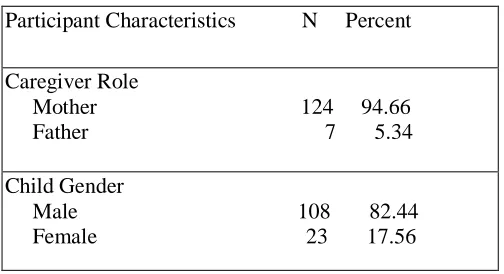
The study sample included 133 total caregiver-child dyads. The child sample was
majority male (n = 108) comprising 82.44% of the sample. There were 23 female children
(17.56%). The majority of caregivers, n=124 (94.66%), were mothers. There were seven father
caregivers in the sample (5.34%). For detailed information about the full sample, see Schertz et
[image:32.612.75.327.436.573.2]al., 2017.
Table 1
Demographic Profile of Sample
Participant Characteristics N Percent
Caregiver Role
Mother 124 94.66 Father 7 5.34
Child Gender
Male 108 82.44 Female 23 17.56
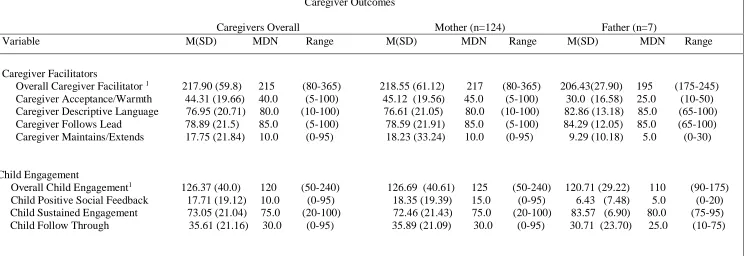
Research Question 1: What is the mean, median, range, and standard deviation of parent
support behavior and child social behavior? Descriptive statistics for IPCI domain and item
Table 2
Univariate Analysis of IPCI-2 Scores by Overall Caregivers, Mothers, and Fathers
Note. 1Sum, variable percent
Caregiver Outcomes
Caregivers Overall Mother (n=124) Father (n=7)
Variable M(SD) MDN Range M(SD) MDN Range M(SD) MDN Range
Caregiver Facilitators
Overall Caregiver Facilitator 1 217.90 (59.8) 215 (80-365) 218.55 (61.12) 217 (80-365) 206.43(27.90) 195 (175-245)
Caregiver Acceptance/Warmth 44.31 (19.66) 40.0 (5-100) 45.12 (19.56) 45.0 (5-100) 30.0 (16.58) 25.0 (10-50) Caregiver Descriptive Language 76.95 (20.71) 80.0 (10-100) 76.61 (21.05) 80.0 (10-100) 82.86 (13.18) 85.0 (65-100)
Caregiver Follows Lead 78.89 (21.5) 85.0 (5-100) 78.59 (21.91) 85.0 (5-100) 84.29 (12.05) 85.0 (65-100) Caregiver Maintains/Extends 17.75 (21.84) 10.0 (0-95) 18.23 (33.24) 10.0 (0-95) 9.29 (10.18) 5.0 (0-30)
Child Engagement
Overall Child Engagement1 126.37 (40.0) 120 (50-240) 126.69 (40.61) 125 (50-240) 120.71 (29.22) 110 (90-175)
Child Positive Social Feedback 17.71 (19.12) 10.0 (0-95) 18.35 (19.39) 15.0 (0-95) 6.43 (7.48) 5.0 (0-20) Child Sustained Engagement 73.05 (21.04) 75.0 (20-100) 72.46 (21.43) 75.0 (20-100) 83.57 (6.90) 80.0 (75-95) Child Follow Through 35.61 (21.16) 30.0 (0-95) 35.89 (21.09) 30.0 (0-95) 30.71 (23.70) 25.0 (10-75)
IPCI item and domain scores for mothers and fathers are nearly indistinguishable with
the exception of higher scores for mothers on Maintaining and Extending and Acceptance and
Warmth. See Discussion section regarding cautions for difference interpretation. On average,
caregivers overall obtained an IPCI Facilitator score of 217.9 (SD= 59.8, range=285). Mean IPCI
scores within the facilitator domain are as follows: acceptance and warmth was 44.31 (SD=
19.66, range=95); descriptive language was 76.95 (SD= 20.71, range= 90); follows lead was
78.89 (SD= 21.5. range= 95); maintains and extends was 17.75 (SD= 21.84, range= 95).
For caregivers overall, the average IPCI Child Engagement domain score was 126.37
(SD= 40.0, range= 190). Mean IPCI scores within the child engagement domain are as follows:
child positive social feedback was 17.71 (SD= 19.12, range= 95); child sustained engagement
was 73.05 (SD= 21.04, range= 80); child follow through was 35.61 (SD= 21.16, range= 95).
Correlational Analyses
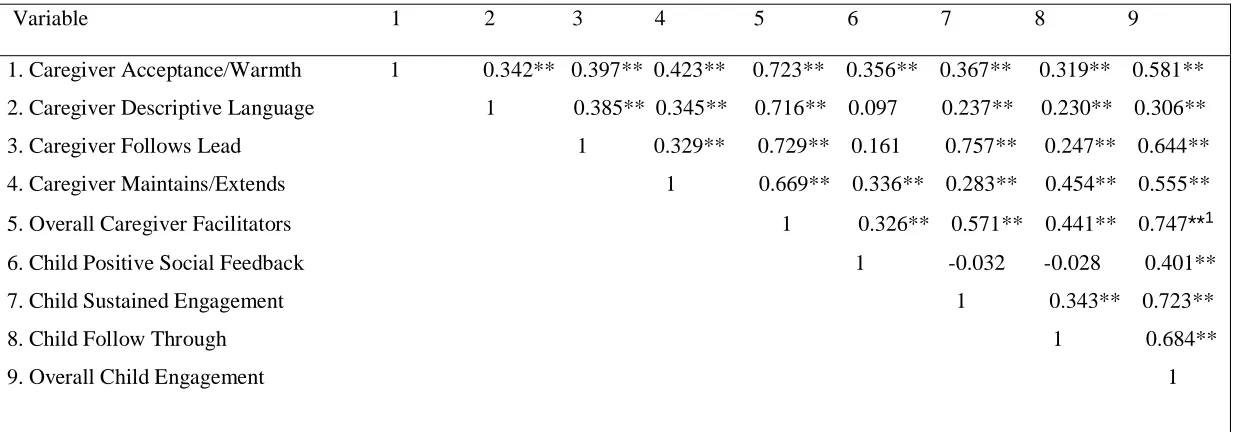
Research Question 2 Is parent positive support behavior significantly and positively related
to child social behavior? Spearman correlation coefficients showing associations between all
caregiver and child domain variables and Pearson correlation coefficients showing associations
between overall caregiver facilitators and overall child engagement variables are presented in
Table 3
Correlation Coefficients Among Caregiver Facilitator and Child Engagement Variables (n=131)
Variable 1 2 3 4 5 6 7 8 9
1. Caregiver Acceptance/Warmth 1 0.342** 0.397** 0.423** 0.723** 0.356** 0.367** 0.319** 0.581**
2. Caregiver Descriptive Language 1 0.385** 0.345** 0.716** 0.097 0.237** 0.230** 0.306**
3. Caregiver Follows Lead 1 0.329** 0.729** 0.161 0.757** 0.247** 0.644**
4. Caregiver Maintains/Extends 1 0.669** 0.336** 0.283** 0.454** 0.555**
5. Overall Caregiver Facilitators 1 0.326** 0.571** 0.441** 0.747**1
6. Child Positive Social Feedback 1 -0.032 -0.028 0.401**
7. Child Sustained Engagement 1 0.343** 0.723**
8. Child Follow Through 1 0.684**
9. Overall Child Engagement 1
Correlation between overall caregiver facilitators and overall child engagement was
strong and highly significant, r= .747, p<.0001. Significant strong, moderate, and weak
correlations between item level IPCI caregiver facilitator and child engagement domain variables
in order of strength of association were as follows: caregiver follows lead and child sustained
engagement showed the strongest significant correlation, rs=0.757, p < .0001.
Significant moderate correlations between caregiver facilitator and child engagement
variables were as follows: caregiver maintains/extends and child follow through, rs=0.454, p <
.0001, caregiver acceptance and warmth and child sustained engagement, rs=.367, p < .0001,
caregiver acceptance/warmth and child positive social feedback, rs=.356, p < .0001, caregiver
maintains and extends and child positive feedback, rs=0.336, p< .0001, caregiver acceptance and
warmth and child follow through, rs=.319, p=.0002.
Significant weak correlations between caregiver facilitator and child engagement
variables were as follows: caregiver maintains extends and child sustained engagement, rs=
0.283, p=.001, caregiver follows lead and child follow through, rs=0.247, p=.005, caregiver
descriptive language and child sustained engagement, rs=0.237, p=.007, caregiver descriptive
language and child follow through, rs=0.230, p < .008.
Non-significant associations were as follows: caregiver follows lead and child positive
social feedback, rs=0.161, p=.066, caregiver descriptive language and child positive social
feedback rs=0.097, p=.270.
Analyses of Variance
Research Question 3: Do children whose parents engage in high levels of support behavior
(e.g. total caregiver facilitators who show acceptance and warmth, follow their child’s lead,
use descriptive language, and maintain and extend their child’s attention) demonstrate
more positive social behavior (e.g. positive social feedback, follow through, and sustained
engagement or total child engagement) in contrast to children whose parents engage in low
[image:37.612.79.570.474.569.2]levels of support behaviors? Results from the one-way analysis of variance test indicated there were significant differences between overall child engagement at Bonferroni adjusted alpha levels of < .02 (.05/3) for low, medium, and high levels of overall caregiver facilitators, F (2, 128) = 47.72, p < .0001. Results from the analysis of relative low, medium, and high parent support and overall child engagement are displayed in Table 7.
Table 4
Relative Low, Medium, and High Overall Caregiver Facilitators and Child Engagement Outcomes
Note. a One-way Analysis of Variance test, Bonferroni adjusted alpha levels of < .02, *p-value<.05
**p-value <.01
Overall Child Engagement (%)
Variable N=131 Mean SD P Value
Overall Caregiver Facilitator <.0001**a
Post hoc pairwise comparisons using the Tukey HSD test indicated that mean child engagement for low overall caregiver facilitators (M = 95.47, SD = 30.04), medium overall caregiver facilitators (M = 124.11, SD = 27.37), and high (M = 159.65, SD = 33.95) significantly differed between all groups. Independent t-tests revealed that mean overall child engagement for low overall caregiver facilitators was significantly lower than for medium overall caregiver facilitators t (86) = 4.68; p = .0001) with a large effect size (d = 0.997). Mean overall child engagement was also significantly lower for low overall caregiver facilitators than for high overall caregiver facilitators t (84) = (-9.28); p = .0001 with a very large effect size (d = 2.003). Similarly, the mean overall child engagement for medium overall caregiver facilitators was significantly lower than high overall caregiver facilitators t (86) = (-5.42), p =.0001. Cohen’s D effect size between groups was 1.15.
A second bivariate analysis was used to evaluate differences in a composite score of child positive feedback and child follow through among low, medium, and high parent support
[image:38.612.63.587.562.652.2]behavior classes. Results from this analysis can be found in Table 8.
Table 5
Relative Low, Medium, and High Overall Caregiver Facilitators and Composite Child Positive Social Feedback and Child Follow Through
Note. aWelch’s One-way Analysis of Variance test for unequal variances and normal distributions,
Bonferroni adjusted alpha levels of < .02, *p-value<.05 **p-value<.01
Composite Child Positive Social Feedback and Child Follow Through (%)
Variable N=131 Mean SD P Value
Overall Caregiver Facilitator <.0001**a
The Welch’s one-way analysis of variance test for normal distributions and heterogeneity of variance was conducted with Bonferroni adjusted alpha levels of < .02. Results of Welch’s
ANOVA indicated that the three groups significantly differed significantly, F (2, 82.19) = 25.71,
p = <.0001. Post hoc pairwise comparisons using the Tukey HSD test indicated that the mean child composite scores for low overall caregiver facilitator (M = 36.51, SD=17.85) medium overall caregiver facilitators (M = 49.22, SD = 22.31) and overall high caregiver facilitators (M
= 74.42, SD = 29.73) all differed significantly between groups. Results from independent
samples t-tests using Satterthwaite approximation indicated that mean child composite scores for
low overall caregiver facilitators were significantly lower compared to medium overall caregiver
facilitators, t (86) = (-2.94), p =.004 with a medium effect size between groups (d = 0.629). Mean child composite scores for low overall caregiver facilitators were significantly lower
compared to high overall caregiver facilitators, t (68.79) = (-7.17), p = .0001 with a very large effect size between groups (d = 1.546). Finally, there was a significantly lower mean child composite score for medium overall caregiver facilitators compared to high overall caregiver
CHAPTER 5: DISCUSSION
Parent-mediated interventions in young children with autism are well established as an
evidence-based guideline. Proper measurement tools of parent support behaviors are critical to
assessing effectiveness of interventions of parent-mediated support of child social outcomes. It
was initially suspected that progress-monitoring measures of both parent support and child
social/behavioral outcomes would be infrequently used in the published literature, which
systematic review confirmed. Furthermore, direct observation of parent-child interactions using
the IPCI-2 tool confirmed that this particular measure is efficient, validated, easily learned, and
potentially invaluable in quantifying parent support behaviors and child social behaviors in
children with ASD.
As exhibited in our systematic review, there is no current standard practice regarding
parent and child monitoring in the field of ASD. Although parent-mediation was theorized as the
mechanism for promoting child social outcomes in all of the studies included in the systematic
review, only 25.9% (n=7) used a measure of both parent and child behavior to assess directly
observed behavior during parent-child interaction. Of concern, measures that were used to assess
both parent and child behavior based on direct observation of parent-child interaction tended to
fall into one of two categories. Some were very narrow in focus. For example, two studies
focused primarily on shared parent-child positive affect such as smiling, laughing, and elevated
playful tone (Brian et al, 2017; Vernon et al., 2012) which warranted reliance on supplementary,
separate parent measures to account for additional support behaviors (as cited in Brian et al,
2017). The others involved complex coding schemes, and high levels of training, which are not
consistent with recommendations for routine measurement in early intervention (Greenwood,
Direct observation of a sample of toddlers with ASD and their caregivers using the
IPCI-2 progress-monitoring measure yielded easily quantifiable and interpretable parent support
behavior and child social behavior outcomes with high reliability between two independent
coders (92.5%) and significant associations between observed parent behavior and child social
communication (Baggett et al., 2011; Schertz et al., 2017). Descriptive analysis of IPCI caregiver
and child behaviors were similar for mothers and fathers. Although mothers engaged in higher
levels of Maintaining and Extending and Acceptance and Warmth behavior as compared to
fathers, this should be interpreted with caution given that this difference was due to five dyads
that were univariate outliers.
Correlational analysis supported the study hypothesis that IPCI caregiver facilitator
variables would positively correlate with child engagement behavior. Interestingly, caregiver
maintains and extends, a behavior built upon following a child’s lead, was significantly
associated with positive social feedback. This finding suggests that children, whose caregivers
provide high level support in maintaining their children’s interest, have patterns of higher
affective engagement with their parents. Analysis of variance and post-hoc comparison tests
provided support for the second hypothesis that mean levels of child engagement behavior would
differ significantly among levels of overall caregiver facilitator behaviors. Children whose
caregivers engaged in higher levels of support (low versus medium versus high), engaged in
significantly higher levels of overall engagement behaviors, as well as composite child follow
through and positive social feedback behaviors, with large effects. This particular difference
was interesting given that child follow through and child positive social feedback require social
engagement, whereas sustained engagement – the child variable excluded from this composite –
Contributions to Current Research
This study provided the first systematic review of the early parent-mediated intervention
literature. The results from this review supported recommendations from several other studies
addressing the need for measures of parent-child interaction that are sensitive to the key proximal
indicators of positive parent support behavior and child outcomes to further the understanding of
how various intervention components effect change (Brown & Woods, 2016; Oono &
McConachie, 2013). It also highlighted the lack of practical, general progress monitors in use in
the current early intervention literature. However, this study fills this gap by showing how the
IPCI-2 can be used by lay practitioners working to measure progress in toddler social
communication through parent-mediated intervention. This measure may be used by community
interventionists to examine several areas of inquiry including information about whether
coaching strategies are working as intended to increase levels of parent-responsivity as well as
general mediating effects of parent behavior on child outcomes. This study showed that
variations in levels of parent support (low, medium, high) predict levels of total child
engagement behaviors as well as composite child follow through and positive social feedback.
Parent-child interaction progress measures like the IPCI can be used to inform coaches about
behaviors that parents are using more or less actively. This data-based information can be used to
help coaches make decisions about when to modify coaching to provide more targeted support to
parents.
Study Limitations and Implications for Future Research
This study was limited to descriptive analysis of video data of caregiver-child interaction.
Future efforts should focus on evaluating the effects of intervention on change in caregiver-child
results of this study. One example would be to include variables in analysis that may impact
parent facilitator scores such as child autism diagnostic scores, parent stress indices,
income-levels, and native-language in order to explore how these variables may describe variations in
parent support, as indicated by the IPCI, before the start of the intervention. This may be used to
guide decisions about coaching strategies and intensity of intervention in response to specific
associations with low facilitator scores before intervention begins. Another, example, would be
to consider outliers as a focus of inquiry as they may provide valuable information in regard to
causes of variation within specific caregiver-child dyads. These cases may warrant follow-up
work to explore as a phenomenon of interest. Furthermore, research should also investigate the
use of the IPCI to measure specific changes in caregiver-child interaction at several times points
pre- and post-intervention within randomized samples of toddlers with ASD. Future community
interventions should ensure parent responsive behaviors are appropriately measured as
recommended by using a parent-child interaction measure, such as the IPCI-2, that can be
administered in short routine assessments to evaluate the progress of interventions and make
quick decisions regarding treatment (Division for Early Childhood, 2014; Greenwood, Carta, &
McConnell, 2011; Odom et al., 2016). Finally, if early ASD intervention studies exhibited more
uniformity through use of a validated and reliable parent-child interaction measures, research
would benefit from the ability to more accurately synthesize results from parent support within
parent-mediated interventions.
Conclusion
Evaluating parent support behavior within the parent-child relationship in early
intervention is critical because evidence shows responsive and sensitive caregiving leads to