ISSN 2250-3153
www.ijsrp.org
Decision Support System for Rapid Prototyping Process
Selection
Vikram Shende*, Dr. Prafulla Kulkarni**
* Department of Production Engineering, K. K. Wagh Institute of Engineering Education, Pune Nasik, India
**
Principal, Gokhale Education Society’s College of Engineering, Nasik, India
Abstract- This paper presents a methodology for decision support system for rapid prototyping process selection. Experimentation recommends the methodology for RP process selection which is divided into three stages. First stage is to identify part requirements in terms of quality, cost and time. Second stage is generating feasible alternative processes and attributes data collection based on benchmarking. Attributes considered for evaluation are the most significant those will affect the selection of RP process. Third stage is to evaluate the data by decision making Method such as Graph Theory and Matrix Approach and TOPSIS method.
Index Terms- RP Process Selection, Graph Theory and Matrix Approach, AHP, TOPSIS, Decision Methods
I. INTRODUCTION
he competition in world market is rising tremendously day-by-day. Now, it is crucial for products to reach market as early as possible before competitors. New technology is required - compress time to market the products. Rapid Prototyping is a promising time compression technique. Rapid Prototyping technologies are energy efficient, less material wastage and can process complex shapes without tooling.
Rapid prototyping is widely used in the automotive, aerospace, medical, and consumer products industries. Rapid prototyping and manufacturing prototypes are increasingly used in the development of new products, spanning conceptual design, functional prototypes, and tooling.
There are a large number of R.P. Technologies available in the market and continuously new advancement in technologies as well as their materials are making selection problem more complex. However, it is really difficult for users with RP experience to select a suitable process because there are so many RP systems worldwide, and the best selection depends on many attributes. Furthermore, each system has its own strengths, defects, applications, utilities and limitations. It is a complex problem that cannot be solved readily using conventional statistical techniques alone. Selection of an appropriate process requires a sound understanding of the interactions between the part quality, part properties, part cost, build envelope, build time (speed) and other concerns. [3]
Since the selection of the appropriate technology addresses different process and cost attributes, it is a decision problem with many objectives implying many quantitative and qualitative factors that can be studied. So main problem with technology selection are:
i. Multiple alternatives are available. ii. Wide application areas of RP parts.
iii. Various quantitative and qualitative attributes data. iv. Expert judgment.
II. METHODOLOGY II. 1 Previous Work Study
Marcello Bragalia, Alberto Petroni [1], proposes a methodology that is based on Analytic Hierarchy Process. Data have been drawn from a survey of twenty-one end-users (consisting of both firms and service bureaus) of twenty different types of RP Machines. The methodology has proved to be an effective tactical tool for selecting the technology that best fits the end-user’s needs.
P.C. Smith, A. E. W. Rennie [2], studied all the processes, machine specifications, materials available in particular region and database for selector tool was developed. Relationship database was constructed detailing the types of machines available from various producers, the different types of technologies each machine used, available materials for each machine and based on this database selector tool was developed.
ISSN 2250-3153
www.ijsrp.org Rao and Padmanabhan [3], by using Diagraph method and Matrix approach, ‘rapid prototyping process selection index’ is proposed to evaluate and rank the RP processes for producing a given part. It defines desirable attributes of a rapid prototyping system as process selection criteria. The interrelations between the selection criteria in terms of their relative importance are modeled in diagraph and matrix style and evaluated with permanent function.
Nagahanumaiah, K. Subburaj, B. Ravi [4], presents a computer aided rapid tooling process selection and manufacturability evaluation methodology. Analyze customer tooling requirement and pair wise comparison of attributes by AHP. Then selection of Rapid tooling process based on process capability mapping in quality function deployment (QFD) against a set of tooling requirements. Then the effect of each process variable of the selected RP process is mapped and prioritized to identify critical process parameters.
D.T.Pham, R.S.Gault [5], presented an overview of the RP technologies and further process strengths and weaknesses are detailed. Flowcharting logical technique is used for selection of RP process based on requirement of part.
Market needs a decision support system which is simple but able to manage complexity and technique should be scientific. To increase use of RP process and for proper process selection, a decision support system needs to be developed keeping in view the end use of part.
2.2 Methodology:
Step 1: Part requirements are divided into basic three categories:
a) Quality attributes – Accuracy, Surface Finish, Strength, Heat Resistance and Percentage Elongation. b) Cost – RP Part Cost
c) Time requirement – Build Time
Step 2: Data collection of RP processes for attributes relevant to part requirements data –
a) Benchmark part fabrication through selected RP processes – SLA, SLS, 3DP and FDM. b) Measurements of part against parameter - quality, cost and build time.
Step 3: Apply decision making methods - Graph Theory and Matrix Approach, TOPSIS, for analyzing the data and for selection of RP process.
III. RAPID PROTOTYPING PROCESS SELECTION 1. Prototype part requirements identification
[image:2.612.31.523.486.564.2]Proto part for design verification purpose, requirements were identified from three users. One is Prototype part service bureau which produces parts based on order received (A), Actual User of the part (B), and third one is RP process Machine manufacturer (C). Based on part requirement user rating obtained on scale of 1 to 10 and data is tabulated in table 1.
TABLE I
RP DESIGN VERIFICATION PROTO PART REQUIREMENTS
User Accuracy (A) Surface Finish (R)
Tensile
Strength (S) Elongation (E)
Part Cost (C)
Build Time (T) Heat Deflection Temperature
(HR)
A 7 7 6 6 5 5 4
B 7 7 7 6 5 5 3
C 8 7 6 6 6 5 4
2. RP Process attributes data collection
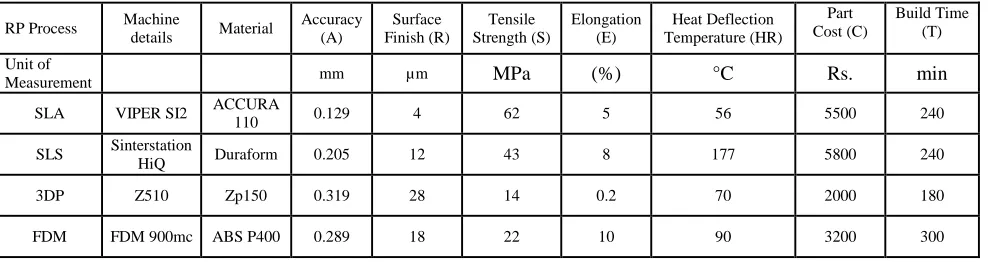
The fabrication of the geometric benchmark part done on four widely used RP processes, which are the liquid-based Steriolithography (SLA), Fused Deposition Modeling (FDM) and powder-based Selective Laser Sintering (SLS) and 3 Dimensional Printing Machine. The RP process was set to achieve required geometric accuracy as part to be used for design verification.
ISSN 2250-3153
[image:3.612.30.524.78.209.2]www.ijsrp.org TABLE 2
RP PROCESS BENCHMARK PART ATTRIBUTE VALUES RP Process Machine
details Material
Accuracy (A)
Surface Finish (R)
Tensile Strength (S)
Elongation (E)
Heat Deflection Temperature (HR)
Part Cost (C)
Build Time (T) Unit of
Measurement mm µm MPa (%) °C Rs. min
SLA VIPER SI2 ACCURA 110 0.129 4 62 5 56 5500 240
SLS Sinterstation
HiQ Duraform 0.205 12 43 8 177 5800 240
3DP Z510 Zp150 0.319 28 14 0.2 70 2000 180
FDM FDM 900mc ABS P400 0.289 18 22 10 90 3200 300
3. Decision Making methods
Decision makers frequently face the problem of assessing a wide range of alternative options and selecting one based on a set of conflicting criteria. In decision making environment, need is for simple, systematic, logical and scientific method to guide decision makers in considering a number of selection criteria and their interrelations.
Graph Theory and Matrix Approach
Graph Theory and Matrix Approach, Multiple Attribute Decision Making (MADM) method require both intra- and inter-attribute comparisons and involve explicit tradeoffs that are appropriate for the problem considered.
Table 2 data values normalized for non-beneficiary attribute Value = / where in - Lowest Value of Measure, – Measured value of ith alternative and for beneficiary attribute = / where in - Measured value of ith alternative, – Highest value of jth alternative.
Secondly attributes are compared pair wise for their importance and relative importance decision matrix prepared.
[image:3.612.36.431.395.464.2]RP Process selection attribute function which is Permanent of attribute matrix evaluated with MATLAB and RPSI for each process obtained and arranged in descending order of RP process selection index. The RP process having the highest value of RP process selection index is the best suitable process.
TABLE 3
RP PROCESS BENCHMARK PART ATTRIBUTE VALUES
RP Process (A) (R) (S) (E) (C) (T) (HR)
SLA 1.000 1.000 1.000 0.500 0.273 0.510 0.316
SLS 0.627 0.333 0.694 0.800 0.259 0.510 1.000
3DP 0.403 0.143 0.226 0.020 1.000 1.000 0.395
FDM 0.444 0.222 0.355 1.000 0.500 0.432 0.508
D =
Attributes (A) (R) (S) (E) (C) (T) (HR) (A) 0.500 0.600 0.600 0.700 0.700 0.800 (R) 0.500 0.600 0.600 0.700 0.700 0.800 (S) 0.400 0.400 0.500 0.600 0.600 0.700 (E) 0.400 0.400 0.500 0.600 0.600 0.700 (R) 0.300 0.300 0.400 0.400 0.500 0.600 (T) 0.300 0.300 0.400 0.400 0.500 0.600 (HR) 0.200 0.200 0.300 0.300 0.400 0.400
TABLE 4
RPSI FOR DESIGN VERIFICATION PROTO PART (CAR TAIL LAMP HOUSING) RP Process RPSI
ISSN 2250-3153
www.ijsrp.org
TOPSIS Method
This method is based on the concept that the chosen alternative should have the shortest Euclidean distance from the ideal solution, and the farthest from the negative ideal solution.
Step1: In this method Table 2 values are normalized by and the normalized decision matrix obtained as mentioned in Table 5.
[∑ ]
Step 2: decide the relative importance (i.e. weights) of different attributes with respect to the objective. A set of weights (for j=1, 2… M) such that ∑ = 1. These weights are obtained by Analytic Hierarchy Process (AHP) method and are as mentioned below.
Step 3: Obtain the weighted normalized matrix . This is done by the multiplication of each element of the column of the matrix with its associated weight . Hence, the elements of the weighted normalized matrix are expressed as:
Step 4: Obtain the ideal (best) and negative ideal (worst) solutions in this step. The ideal (best) and negative ideal (worst) solutions can be expressed as:
∑
∑
= . . .
∑
∑
= . . .
Where J = (j = 1,2,…,M) / j is associated with beneficial attributes, and
J’ = (j = 1,2,…,M) / j is associated with non-beneficial attributes.
[image:4.612.99.496.191.261.2]indicates the ideal (best) value of the considered attribute among the values of the attributes for different alternatives. In case of beneficial attributes it indicates the higher value of the attribute. In case of non-beneficial attributes it indicates the lower value of the attribute and vice versa for .
TABLE 5
NORMALISED RP PROCESS ATTRIBUTES
RP Process (A) (R) (S) (E) (C) (T) (HR)
SLA 0.260 0.112 0.777 0.364 0.634 0.523 0.257
SLS 0.415 0.337 0.539 0.582 0.669 0.523 0.812
3DP 0.646 0.786 0.175 0.015 0.173 0.267 0.321
[image:4.612.192.409.458.547.2] [image:4.612.78.483.665.766.2]FDM 0.586 0.505 0.276 0.727 0.346 0.617 0.413
TABLE 6
Weights by AHP Method
RP Process (A) (R) (S) (E) (C) (T) (HR)
0.2570 0.1990 0.1701 0.1395 0.1099 0.0586 0.0658
TABLE 6 MATRIX
RP Process (A) (R) (S) (E) (C) (T) (HR)
ISSN 2250-3153
www.ijsrp.org
Step5: The separation of each alternative from the ideal one is given by the Euclidean distance in the following equations.
√ ∑ , √ ∑ , i=1,2,….,N
Step6: The relative closeness of a particular alternative to the ideal solution, Pi, can be expressed as below-
A set of alternatives are arranged in descending order , according to the value of Pi indicating the most preferred and least preferred feasible solutions. Pi may also be called the overall or composite performance score of alternative Ai.
3.3 Comparison of Results:
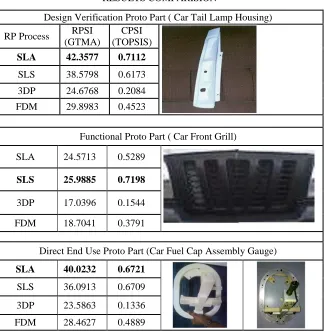
[image:5.612.43.368.414.745.2]As mentioned in below table RP Process Selection Index by Graph Theory and Matrix Approach and Composite Performance Selection Index by TOPSIS method, process ranking achieved is same. Same Calculations repeated for other applications like functional proto, Direct End use proto part and results are tabulated as below.
TABLE 7
CPSI FOR DESIGN VERIFICATION PROTO PART (CAR TAIL LAMP HOUSING) RP Process
SLA 0.0819 0.2017 0.7112
SLS 0.0939 0.1516 0.6173 3DP 0.2218 0.0584 0.2084
FDM 0.1479 0.1221 0.4523
TABLE 8
RESULTS COMPARISION
Design Verification Proto Part ( Car Tail Lamp Housing)
RP Process RPSI (GTMA)
CPSI (TOPSIS) SLA 42.3577 0.7112
SLS 38.5798 0.6173 3DP 24.6768 0.2084 FDM 29.8983 0.4523
Functional Proto Part ( Car Front Grill)
SLA 24.5713 0.5289
SLS 25.9885 0.7198
3DP 17.0396 0.1544
FDM 18.7041 0.3791
Direct End Use Proto Part (Car Fuel Cap Assembly Gauge)
SLA 40.0232 0.6721
SLS 36.0913 0.6709
ISSN 2250-3153
www.ijsrp.org IV. CONCLUSION
i. Decision making methods helps in systematic and analytical manner to address every element of selection - complexity due to interrelation of attributes, wide range of RP alternatives available, variety of RP prototype application areas, expertise requirement in process selection.
ii. Qualitative and subjective judgments by different peoples can be included in the priority setting.
iii. Proposed approach forms a basis for database creation for network RP processes, database creation based on variety of alternatives and evaluating part requirements for best suitable RP process.
iv. This study demonstrates potential benefits of using structured approach to the selection of alternative rapid prototyping processes. The methodology described in this study can provide guidance not only for RP process selection but also for other areas of Decision making in manufacturing areas.
APPENDIX Nil
ACKNOWLEDGMENT
I would like to take this opportunity to express my deep sense of gratitude to my beloved project guide Dr. Prafulla Kulkarni. He encouraged me throughout my academic program and was supporting me in all challenging situations.
REFERENCES
[1] Dr. Marcello Bragalia, Dr. Alberto Petroni, A Management Support Technique for the selection of RapidPrototyping Technologies, Journal of Industrial Technologies; Vol.15, No. 14, pp.2-6,1999
[2] P.C. Smith, A. E. W. Rennie Development of an additive layer manufacturing (ALM) selection Tool for direct manufacture of product, Lancaster Product Development Unit, Lancaster University, Lancaster, LA1 4YR, UK, Sep 2008 , pp.507-518.
[3] R.Venkata Rao, K.K. Padmanabhan, Rapid Prototyping Process selection using graph theory and matrix approach, ELSEVIER Journal of Materials Processing Technology 194 (2007) 81-88
[4] Nagahanumaiah, K. Subburaj, B.Ravi, Computer aided rapid tooling process selection and manufacturability evaluation for injection mold development, Journal Science Direct, 2008 , pp.262-276.
[5] D.T.Pham, R.S.Gault, A Comparison of rapid prototyping technologies, International Journal of Machine Tools & Manufacture 38 (1998), pp.1257-1287 AUTHORS
First Author – Vikram Shende, M.E (Industrial Engineering), and [email protected]