Citation:
Munyangeyo, T (2009) Enhancing learner engagement in e-learning provision.
Assessment,
Teaching and Learning Journal, 7. 10 - 13. ISSN 1756-8781
Link to Leeds Beckett Repository record:
http://eprints.leedsbeckett.ac.uk/1164/
Document Version:
Article
The aim of the Leeds Beckett Repository is to provide open access to our research, as required by
funder policies and permitted by publishers and copyright law.
The Leeds Beckett repository holds a wide range of publications, each of which has been
checked for copyright and the relevant embargo period has been applied by the Research Services
team.
We operate on a standard take-down policy.
If you are the author or publisher of an output
and you would like it removed from the repository, please
contact us
and we will investigate on a
case-by-case basis.
ALT JOURNAL NUMBER 7: WINTER 2009
10
that reflection as it relates to our own teaching practice is profoundly part of the foundation of
purposeful learning. Questioning our routine allows us to ask ourselves what really does and does not work when we seek to meet learners’ needs. Reflecting on what we do leads to the evaluation of the effectiveness of our teaching practice, the re-examination of our teaching approaches from the perspective of the learner and basing our professional decisions upon feedback from learners and/or colleagues.
By examining the current e-learning provision in languages at Leeds Metropolitan University, this study aims to investigate teachers’ perceptions and students’ attitudes and preferences towards good practice in e-learning. This article reflects on the results of a survey of the Languages Subject Group’s e-learning activities and delivery, which was conducted from November 2008 to April 2009. The survey sought to enhance the understanding of good practice in e-learning provision and barriers that might hinder the effective delivery of web-based learning materials, from both the learner’s and the teacher’s point of view. Although preferences, in this respect, may change over time, making any step to understand the determinants of learners’ engagement in e-learning could challenge some assumptions on the effectiveness of teaching and learning approaches.
Improving the learner’s engagement
The assumption that teachers’ own preferred learning styles tend to affect the ways in which they teach has been highlighted by numerous pedagogical critics (Kain, 2003; Moore, 2004; Schuh, 2004). In Differentiated instructional strategies: one size doesn’t fit all, Gregory and Chapman (2007) eloquently assert that this one-size-fits-all model is currently outmoded alongside new approaches that recognise individual differences. Other researchers (Brown, 2003; Hart, 2003; Pillay, 2002; Weimer, 2002) argue that 21st-century curricula challenge traditional teacher-centred methodologies “to meet the increasingly diverse needs of students and make the required increases in achievement gains […]. With teacher educators, problems occur when teaching styles conflict with students’ learning styles, often resulting in limited learning or no learning” (Brown, 2003).
assumption that uploading them onto e-learning platforms would be good practice in embedding information technology into independent learning practice. Although some designers and advocates of e-learning platforms state that “effective and engaging e-learning materials can go a long way to meeting the accessibility needs of different learners [and offer] many distinct advantages over traditional paper based resources” (JISC, 2009), a simplistic display of information on the platforms seems to turn online sources into traditional printouts. This survey seeks to examine the teachers’ and learners’ perceptions of the current e-learning approaches in languages and explore new strategies that would foster curriculum developments to enhance the learner’s engagement.
Methodology
ALT JOURNAL NUMBER 7: WINTER 2009
11
learner and teacher perceptions of the
e-learning provision in languages
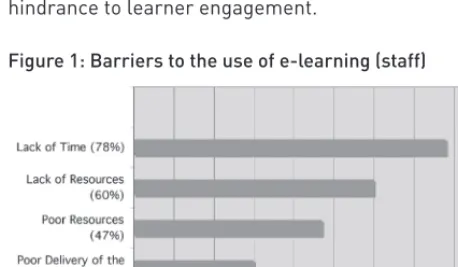
While both students and staff recognised in this survey that there is a need to create a variety of engaging e-learning resources to widen subject knowledge and enhance language skills development, there were discrepancies between learner and teacher perceptions of barriers to the effective use of e-learning. 78% of teachers believed that neither poor delivery nor poor resources are the key factors that undermine effective e-learning provision. Instead, they felt that efforts to implement e-learning strategies in Languages were hampered by the lack of availability of technology enhanced learning materials, and above all by lack of time (which may be related) (Figure1). Furthermore, only 30% of teachers perceived poor delivery of computer-assisted learning resources to be the major barrier. However, as the lowest percentage (45%) of student responses cited poor resources as barriers to the use of e-learning, it would seem that students believe that the institutional e-learning platform is actually full of valuable
materials (Figure 2). 88% of students believed that the delivery methods in fact constituted the greatest hindrance to learner engagement.
Overall, students are keen to access e-learning materials that accommodate individuality. Some of them expressed their concerns that the current e-learning provision doesn’t give them “access to native speaker” fluency in the form of a forum. Others said it does not “offer the flexibility to navigate around the site” and “does not enhance the development of all major language skills”, such as reading, listening, speaking and writing.
Nevertheless, many learners were generally most positive about using e-learning resources where, in some language modules, they accessed interactive resources that widened their subject knowledge and provided them with alternative examples or explanations to those from classroom settings. They felt that this provided continuous formative assessment opportunities, allowed them to test their progress and enhanced their engagement. In this respect Weimer (2002) is right when he writes that “if students are engaged, involved and connected with a course, they are motivated to work harder in that course”. If many students feel that variety is key to enhance interest in learning, any web-based learning strategy that does not foster this variety is not e-learning but rather e-teaching. While e-learning relates to enhancing the active participation of students in content knowledge building and skills development (Rosenberg, 2001), e-teaching denotes displaying electronic materials with limited engaging and collaborative activities. In this respect, although there are some critics like Harris (2008) who prefer e-teaching over e-learning when he states that “e-learning lowers the bar for teaching by assuming that students teach themselves”, students who took part in the survey considered e-teaching to be an approach that turned electronic platforms into libraries which learners could turn to whenever they needed missed or extra handouts.
[image:3.637.51.280.478.611.2]Another discrepancy that was highlighted by the survey is that the highest score (68%) of teachers’ perceptions of the best way of supporting students off-campus was given to “uploading teaching materials onto the e-learning platform as a good method of e-learning delivery”. Only 38% cited “using forums” as the best method of e-learning delivery, and yet student
[image:3.637.50.264.611.732.2]Figure 1: Barriers to the use of e-learning (staff)
ALT JOURNAL NUMBER 7: WINTER 2009
12
can replace a classroom”, there is a consensus among students that “nothing can replace the teacher”, because they believe that “the classroom interaction leads to in-depth study”. When students were asked to determine the form of e-learning that they valued most, mixed mode e-learning scored high to the detriment of web-dependent e-learning. This approach ensures that e-learning delivery is not overly dependent on technology, yet sufficient to match students’ expectations by catering to their skills level and ability in all key language areas.
Conclusion
It seems clear from this survey that the learner-centred approach in e-learning has to be developed further in Languages before any discrepancy between learner and teacher perceptions of good practice can completely disappear. There is a need for a more standardised modular structure, the development of multi-levelled tasks to meet the learners’ mixed ability needs and a well-established e-learning strategy that reflects pedagogical approaches in planning and delivery of e-learning.
ALT JOURNAL NUMBER 7: WINTER 2009
13
bibliography
Atherton, J. S. (2009) Learning and Teaching: Reflection and Reflective Practice. Available at: http:// www.learningandteaching.info/learning/reflecti.htm
[Accessed 3 October 2009].
Brown, K. L. (2003) From teacher-centered to learner-centered curriculum: Improving learning in diverse classrooms. Education 124(1), 49–54. Available at: http://www.questia.com/ googleScholar.qst;jsessionid=KL1Vfycxngsknc3 TdPBzGksL2SGd1k2llQvlmVVBHk1vMz2Sx2sZ!-563477853!2042080103?docId=5002018664 [Accessed 2 October 2009].
Costello, P.J.M. (2003) Action research. London: continuum.
Gregory, G. & Chapman, C. (2007) Differentiated instructional strategies: one size doesn’t fit all. London: Corwin Press.
Harris, J.M. (2008) Why we need better e-teaching, not more e-learning. MedBiquitous E-Learning Discourse. Available at: http://meld.medbiq.org/divergent_ views/better_eteaching_harris.htm
[Accessed May 2009].
Hart, I. (2003) The Outsider’s Gaze: A Learner-Centred Approach to Language-Teaching Materials. Educational Media International. Available at: http:// www. tandf.co.uk/journals [Accessed 2 October 2009]. Joint Information Systems Committee (JISC) (2009) Creation of Learning Materials. Available at: http:// www.techdis.ac.uk/index.php?p=9_7 [Accessed 2 October 2009].
Kain, D. J. (2003) Teacher-Centered versus Student-Centered: Balancing Constraint and Theory in the Composition Classroom. Pedagogy 3 (1), 104-108. Moore, A. (2004) The good teacher: dominant discourses in teaching and teacher education. Oxon: Routledge. Pillay, H. (2002) Understanding learner-centredness: does it consider the diverse needs of individuals? Studies in Continuing Education 24(1), 93-102. Rosenberg, M. J. (2001) E-learning: Strategies for delivering knowledge in the digital age. New York:
Schuh, K.L. (2004) Learner-centered principles in teacher-centered practices? Teaching and Teacher Education 20(8), 833-846.
Tomal, D.R. (2003) Action research for educators. Lanham: Scarecrow Press.
Weimer, M. (2002) Learner-centered teaching: five key changes to practice. San Francisco: Jossey-Bass.
Dr Théophile Munyangeyo
Senior Lecturer in French Studies
Research Ethics Co-ordinator for Languages and English Language Teaching