ANALYSIS OF AGRO- PROCESSING INDUSTRIES PROBLEMS:
A CASE STUDY CHITTOOR DISTRICT, ANDHRA PRADESH
Dr. G. Nagaraja,
Associate Professor
Dept. of Economics, Andhra University Visakhapatnam-530003, Andhra Pradesh, India
ABSTRACT
The Agro-Processing industry in India plays a vital role in the national
economicdevelopment and has potential to meet the local needs and export requirements. Some
estimates suggest that in developed countries, up to 14.00 % of the total work force is engaged in
agro-processing sector directly or indirectly. However, in India, only about 3 % of the work force finds employment in this sector revealing it’s under developed state and vast untapped
potential for employment. Ithelps in processing agricultural products such as field crops, tree
crops, livestock andfisheries and converting them to edible and other usable forms. Thus,
transformationof agriculture through creating forward and backward linkages with industry has
beenemerging as an important option to overcome the increasing challenges of
creatingemployment opportunities for increasing labourforce and sustaining the livelihood
ofhouseholds in rural areas. Agro-industries confined in both organized as well as un-organized
segments were facing variety of problems. The present study attempted to examine the problems
of agro processing units i.e., problems raw materials, financial, marketing and others etc.
Key Words: Agro Processing units, Financial, Market, Raw materials,
Introduction
Most important point in the agro-processing is that asizeable portion of raw material
processed in them being rural based it has a very highemployment potential with significantly
and different agricultural outputs,which are more suitable for processing. On the other hand,
development of theseindustries would relax wage goods constraints to economic growth by
enhancing thesupply of their products. In this context there is a need for improving the capacity
ofthe agro-industries to harness backward linkages with agriculture and allied activitiesin order
to efficiently convert part of the output to value added products acceptable tothe domestic and
international markets. This would generate employmentopportunities for different types of skills
through food processing, packaging, gradingand distribution. At the same time this will transfer a
size margin to farmers throughmarket linkages. Considering the importance of agro-processing
industries in the developmentperspectives of overall rural development in general and realizing
the expected role ofexpanding this sector for achieving increasing employment opportunities and
income level to overcome the emerging challenges of unemployment and poverty in ruralareas of
the State. Agro processing industries are facing many problems i.e, raw materials, finance
,marketing and others.
Review of Literature
Agribusiness as a concept was first used by J.Davis and R.Goldberg in 1957. According
to them, agribusiness is the sum total of all operations involved in the manufacture and
distribution of farm supplies, production activities of the farm, and the storage, processing and
distribution of farm commodities and items made from them.1For them, Agribusiness involves
those individuals and organizations engaged in the production, processing, transport, storage,
financing, regulation and marketing of the world’s food and fiber supplies. In short, according to
Jemes E.Austin,2 agribusiness is a seed to consumer system composed of series of closely related
activities that together enable agricultural produce to flow from the farm to the market place. For
Fedar Ernest, agribusiness is the extension of capitalism into agriculture of underdeveloped
countries.3It stands for modernization of agriculture in capitalist style. In view of this, in India,
the term agro-industry is often used in a broad sense. The National Council of Applied Economic
Research4 had defined agro-industries as those, which use either agricultural raw materials or
make things that farmers need for agricultural purposes. According to S.K.Gupta5, the
concept of agro-industries is confined only to those industries that are engaged in the processing
which produce inputs for agriculture such as fertilizers and farm implements. Ajit Prasad
Jain6 has defined agro-industry as one which carry out the processing of farm produce and which
provides inputs for the developments of agriculture. He holds that development of agriculture in
modern times in marked by the growth of agro-industries which on the one hand provide
machine and material needed for achieving higher agricultural yields and on the other process
farm produce into the finished and semi-finished goods.
Planning Commission of India had set forth the following criteria for distinguishing the
agro-industries.7The industries which satisfy the criteria are those which (1) encourage greater
input in to agriculture, (2) lead to better processing and conversion of agricultural commodities,
(3) ensure high returns on processed goods and (4) increase agricultural production. Obviously
planning commission has included under agro-industries not only those industries which are
concerned with the processing of agricultural products but also such industries which are
involved in the production of farm inputs and farm implements.i
M.P.Kaushal8 has defined agro-industries in a more comprehensive sense as (1)
industries directly based on production of agricultural commodities including forestry, (2)
industries based on agricultural wastes, (3) industries based on agricultural by products, (4) water
harvesting technology as water is one of the most important source of agricultural production and
(5) small scale and industrial structures supporting the purchase, manufactures and repairs of
agricultural implements.
Methodology
The study has been based on primary data, the study purports to analyse the problems
encountered by the Agro Processing industries in Chittoor district. The study covers 120 small
and medium Agro processing units because the size and conditions under which they operate
varies from the unit to unit. The data is collected through canvassing questionnaires to the
Objective of the Study
The main objectives of the present study is to identify the problems encountered by the
Agro Processing industries and to offer some feasible suggestions for toning up of the
performance of Agro Processing industries in Chittoor district.
Source of the Data
The present study is mainly based on primary data. The Primary data was collected from
the sample units by way of field study. Schedules specially designed for the purpose were filled
in through personnel interviews and information given by the respondents was also recorded,
analysed and drawn interferences.
RESULTS AND DISCUSSION
Major problems relating to raw materials faced by Agro-Processing Industries as a whole
industries high market price of raw materials, irregular availability of raw materials of shortage
of raw materials these problems are faced by 61.54 per cent, 52.14 per cent and 35.89 per cent of
the total entrepreneurs respectively other raw materials related problems reported by units
included poor quality of raw material (18.8 per cent) protagonist policy of government favouring
farmers (13.68 per cent) lake of storage facility (14.53 per cent) and competition among units to
by raw material (9.40 per cent). High market price of raw material is one of the most serious
problems relating to raw materials for 62.82 per cent of the units in rice mills, 80 per cent of
units in coconut oil mills, 53.33 per cent of the units in curry powder processing units, 55.50 per
cent of the units milk processing industries.
Table 1: Distribution of Units on the basis of Problems relating to raw materials
Industry
High Market Price of Raw Materials
Irregular availability of raw materials
Non availability /shortage of raw material
Poor quality of raw materials
Lack of Storage facilities
Competition among units to by raw materials
Rice Mills 22 (62.85) 27 (77.14) 16 (45.71) 5 (14.29) 7 (20.00)
0 35
Milk Processing’s 12 (60) 7 (35) 3 (15) 7 (35)
0 5
(25) 20
Fruit and Vegetable Processing 7 (28) 13 (52) 6 (24)
0 8
(32)
0 25
Curry Powder Processing 14 (56) 13 (52) 14 (56) 9 (36)
0 0 25
Coconut Oil Mill Processing 12 (80) 14 (93.33) 12 (80) 10 (66.33) 1 (6.66) 1 (6.66) 15
Total 67
(55.83) 74 (61.66) 51 (42.5) 33 (27.5) 9 (7.5) 6 (5) 120
Source: Survey Data
Figures in Parentheses are percentage share.
Irregulars availability of raw material is another raw material related problem for 77.14%
of the units in rice mills, 63.6% of the units in fruit and vegetables processing industry. 80% of
the units are coconut oil mills, 53.33% of the units in curry powder manufacture industry and
45.71% the units in rice mills reputed shortage of raw materials is another raw material related
problem.Poor quality of raw material is another raw material related problem faced by most of
the units in coconut oil mills 66.67% and lock and storage facilities is a raw materials related
problem for 33.33% of the units in curry powder manufacturing industry.Competition among
units to by raw material is one of the most serious raw material related problem for most of the
units in coconut mills 60% of the units in this industry face this problems.
Financial Problems:
Financial problems relate to shortage of capital to build up fixed assets, for modernization
and technological up gradation, and shortage of working capital. During the survey, many units
in each industry reported facing both of these financial problems. Therefore, percentage share of
units facing each problem may not aggregate to 100 per cent, but may be less than or more than
100%(Table 2).
Industry Total Units Lack of Finance
Lack of Working Capital
Rice Mills 35 12
(34.29)
15 (42.85)
Milk Processing’s 20 6
(30)
8 (4)
Fruit and Vegetable Processing
25 14
(56)
12 (48)
Curry Powder Processing
25 12
(48)
09 (36) Coconut Oil Mill
Processing
15 6
(40)
7 (46.66)
Total 120 48 (40) 51 (42.5)
Source: Survey Data
Figures in Parentheses are percentage share
Lack of Finance:
It is observed in table 2. shows that 40% of agro-processing industrial units as a whole
have reported facing financial problems. They reported that they lack finance for expansion and
modernisation of the units/for technological up gradation. Industry wise analyses shows that
34.29 % of rice mills, 56% fruit and vegetables, 48% curry powder processing, 40 % coconut oil
mill processing and 30% milk processing units face this problem Sri Jyothi Currypowder in
Madanapalli, Ragu Modern rice mill in Chittoor, St. Mary’s oil Industries in Pileru reported that
financial constraints limit their sale promotion activities and advertising campaigns which
determine their marketing success.
Lack of Working Capital:
42.5 % of units in Agro-Processing Industries as a whole face this problem. Industry wise
analysis reveals that 42.85 % of the rice mills, 46.66 % coconut oil mills and 36 per cent of curry
powder manufacturing Units 4% milk processing and 48% of fruits and vegetable processing
units have reported lake of adequate capital as one of the financial problems affecting this
operation of the unitsKalapataru coconut oil mill, Tirupati, observed the lake of adequate
working capital adversely affected their capacity of Sri Balaji rice mill adequate stock of raw
Modern rice mill in Chittoor, Sri Jyothi Currypowder in Madanapalli, Kalapataru coconut oil
mill, Tirupati observed that lack of adequate working capital adversely affected their capacity to
maintain adequate stock of raw materials and finished products and thus, affect regular
functioning of the units.
Marketing Problems of Sample Agro-Processing Industry
Marking problems relate to competition cost of production sales demand brand
acceptability, mass media expenditure etc. Distributions of units on the basis of marketing
problem they face are given table 3.
Competition
The most important marketing problem common to all sample Agro-Processing Industrial
units face competition from other units within the same industry from large scale units from
multinational companies and also from other units which produce substitute for Agro-Processing
Industrial units as a whole suffer from this problem (Table 3). The proportion of units facing this
problem various from 77.14 % in rice mills of 28% fruit and vegetable processing and curry
powder processing 52 %. However table shows that this problem is series in the rice mills 77.14
%, coconut oil mills 60 %, milk processing 70%, fruit and vegetables 28%.
High Cost Production:
Table 3 shows that 60.83% of Agro-Processing Industry unit as a whole have reported it
as the second most serious marketing problem. This problem is found to be several in case of
many industries namely rice mills 68.57%, milk processing 70%, fruit and vegetable processing
48%, curry powder processing 52%, coconut oil mill 66.66%. 40% of Agro-Processing Industrial
units as a whole have reported facing financial problems.Industry wise analyse shows that
34.29% of rice mills, 30 per cent milk processing, 48 per cent curry powder manufactory, 56% of
Credit Sale:
The third most important marketing problem controlled by Agro-Processing Industries is
credit sale of the product; Industrial Units are competition to sell their product to retailer on
credit. Credit sales require industries to keep on producing without realizing the sale proceeds
with in a reasonable period of time. This long with others factors market most of the industrial
units impossible either to devote themselves entirely to production activities or to finding out
alternative outlets of market, or to the task of improving the quality of their products and raising
their productivity (Table 3). 53.33% of the total agro-processing industrial units as a whole
have reported it to be the next important marketing problem. This problem is severe in industries
like milk processing 80%, rice mills 71.42%, curry powder processing 56 per cent, fruit and
vegetable processing 28 %, and coconut oil mill processing 13.33 %. Stiff competition, desire to
expand sales volume and profit have been reported as reasons attributable to this problem.
Beside these factors, Ragu Modern rice mill in Chittoor, Sri Jyothi Curry powder in Madanapalli,
Kalapataru coconut oil mill, Tirupati have reported that fear of loss of market share and fear of
bad debt are some other reasons for resorting to credit sale by the units.
Lack of Brand Goodwill:
Another marketing problem which the units have reported to be facing is the lack of
brand goodwill. It implies that their product brand have not received much public acceptance
(Table.3). 39.16 % of agro processing industries as a whole are facing this problem. This
problem has been reported by 42.85% of rice mills, 60 % milk processing, 40% curry powder
processing, 33.33% coconut oil mill processing and 20% fruit and vegetable processing. The
units have attributed it to inadequate publicity through mass media. 37.5% of agro-processing
units have reported that inadequate publicity through mass as a marketing problem. Sri Jyothi
Curry powder in Madanapalli, Tirumal milk processing unit in Chittoor, St. Mary’s oil Industries
in Pileru reported that they are reluctant to have media exposure because of lack of finance and
Inadequate Publicity through Mass Media:
Mass media exposure is an essential ingredient for the smooth growth of an industry. It
helps entrepreneurs to plan their activities in accordance with market trends, introduce goods to
suit consumers’ tastes and get consumers informed of their product through advertising (Table
3). 37.5% of agro-processing industrial units as a whole have reported inadequate publicity
through mass media as a marketing problem. This problem is faced by 45.71 % of rice mills,
60% of milk processing’s, 40 % of curry powder processing, 26.66 % of coconut oil
processing, 12% of fruit and vegetable processing units. Sri Jyothi Curry powder manufacturing
in madanapalli opined that effective marketing of curry powder products depend on wide sale
promotion activities, advertising campaigns and product differentiation which require huge
finance. Small units in this industry lack adequate finance for this purpose and therefore, have no
media exposure and have very marketing strategies.
Other Problems:
Distribution of units on the basis of others problems affecting operation Agro-Processing
Industry is an excess of revenues from total sales over associated expenses for an industry. A
good rate of profitability is necessary for smooth running and growth of an industry. However an
important problem affecting the operation of Agro-Processing Industry units is low level of
Table 3: Distribution of Units by Market Problems
Industry
Total Units
Competition High
Cost of Product Credit sale Lack of Brand Goodwill Inadequate Publicity through mass Media Lack of Differentiated Product Low Demand Heavy Taxes Lack of Storage facilities
Rice Mills 35 27
(77.14) 24 (68.57) 25 (71.42) 15 (42.85) 16 (45.71) 09 (25.71) 2 (5.71) 4 (11.42) 0 Milk Processing’s
20 14
(70) 14 (70) 16 (80) 12 (60) 12 (60)
0 0 0 0
Fruit and Vegetable Processing
25 7
(28) 12 (48) 7 (28) 5 (20) 3 (12)
0 0 16
(64)
0
Curry Powder Processing
25 13
(52) 13 (52) 14 (56) 10 (40) 10 (40) 5 (20)
0 5
(20)
0
Coconut Oil Mill
Processing
15 9
(60) 10 (66.66) 2 (13.33) 5 (33.33) 4 (26.66)
0 4
(26.66)
0 0
Total 120 70
(58.33) 73 (60.83 64 53.33) 47 (39.16) 45 (37.5) 14 (11.66) 6 (5) 15 (12.5) 0
Source: Survey Data
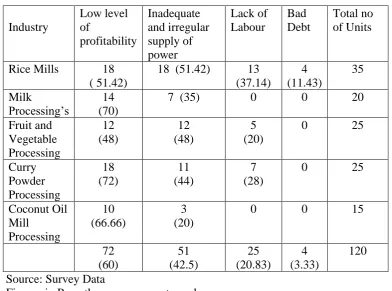
Table: 4 Distributions of Units on the Basis of Other Problems Industry Low level of profitability Inadequate and irregular supply of power Lack of Labour Bad Debt Total no of Units
Rice Mills 18
( 51.42)
18 (51.42) 13
(37.14) 4 (11.43) 35 Milk Processing’s 14 (70)
7 (35) 0 0 20
Fruit and Vegetable Processing 12 (48) 12 (48) 5 (20)
0 25
Curry Powder Processing 18 (72) 11 (44) 7 (28)
0 25
Coconut Oil Mill Processing 10 (66.66) 3 (20)
0 0 15
72 (60) 51 (42.5) 25 (20.83) 4 (3.33) 120
Source: Survey Data
[image:11.595.105.492.108.384.2]Figures in Parentheses are percentage share
Table 4 shows that the 6% of the total Agro-Processing Industry units have reported
if to be a major problem. The proportion of units having low level of profit various from
66.66% in coconut oil mills to 72% in curry powder processing, 70% of milk processing
units, 48 % fruits and vegetable 5%, 51.42% in rice mills. This problem is attributed to high
cost of production stiff competition and inability of the units to change price of the product
proportionate of change in prices of inputs.
Inadequate and Irregular supply of power:
42.5%of the total Agro-Processing Industry units have reported the inadequate and
irregular supply of power affect their operation (Table 4). Agro-Processing Units which are
located in remote areas, face this problem seriously 51.42% of Rice mills 48% of fruits and
vegetable, 44% of curry powder processing units, 35% of milk processing units, 20% of
coconut oil mill processing units. Lake of regular supply of power adversely affects the
existing capacity utilization regulating in low level of production on the one hand and an
increase in cost of production on the others. Therefore an assured regards supply of power is
the other hand 20.83 % of the Agro-Processing Industry units in there Industry namely 37.14
% of rice mills, 20% of fruits and vegetables, 28% of Curry powder processing have reported
that lake of labours affected their operate.
Bad debt:
Bad debt is the amount which the customers fail to pay to the processing units or there
which appear irrecoverable. In preparing accounts they are treated as loss. Bad debt arils due
to the practice of credit sale of the products by Agro-Processing Industry units and is
regarded as a cost of maintain receivables. Table 4 shows that 3.33% of Agro-Processing
Industry units as a whole face this problem and reported it adversely affected their motivation
to continue production. This consist 11.43% of rice mills, 8% Curry powder manufacturing
units.
Suggestions for Policy Recommendation
1. It was found that capacity utilization in Agro processing industries as a whole is low.
This is caused by irregular availability and shortage of raw materials and inadequate
and irregular supply of power. To solve this problems agriculture raw material
products must be increased considerably by earlier mention strategies.
2. Assured supply of raw material in adequate quantity could also be done though
motivating farmers for undertaking diversification in their farming system by using
available land under the cultivation of particular raw material as required by industrial
units located in particular areas.
3. Only a few units in the sample are found going for international accepted quality
management system certificate. Therefore in order to make Agro-processing units
competitive domestically and internationally. ISO Certificate units must be made
mandatory.
4. In the case of rice mill Civil Supplies Corporation production paddy from farmers
supply it to the processes get them processes and distributions the rice through civil
supplies Corporation outlets. This arrangements has eliminated intermediaries
5. The facility of cold storage should be made available in clusters of villages so as to
retain the quality of most perceivable farm based raw material for a substantial period
of time.
6. The rate of value added tax imposed by the State Government was very high which
increasing per unit cost of production and making products highly competitive against
the similar goods arriving from other states of the country even in domestic markets
leave aside the export markets. In this context it was suggested either to reduce the
rates of VAT or the similar amount claimed as VAT should be refunded to the
industry as loan on subsidized rates of interest.
7. Emerging marketing problems can be solved though establishment of procurement
centers among the clusters of villages, ensuring fair measurement of crops while
selling to different agencies from the part of the Government.
8. The State Government should ensure regularity in supply of power in industrial areas.
9. The contribution of technological progress to the growth of performance of Agro
Processing industries as a whole negative. To solve this problem advanced
processing technology should be adopted in this sector.
10. The State Government should introduced policies for providing subsidisedfinancial
incentives in the form of capital subsidy cum loan at starting of theunits especially in
industrially backward districts.
11. Lack of brand goodwill and inadequately publicity of the products are marketing
problems faced by relatively small units in agro processing sector particularly food
processing units. This units are unable to have media exposure due to huge cost
involved it. In order to expose their products to the greater public and to explain the
products relative merits over others with the aim of expanding market for their
products, District Industrial Centre association with associations of processing units
should organize agro processing industries trade fairs in important cities in the state.
Conclusion
The development of agro based industries can help to realise the various linkages or
inter-relationships between industry and agriculture. Agro processing industries brings
immense benefits to the people to the economy and speed up industrialization process. If the
to realise the essential goal of rural development of generating employment opportunities on
a large scale for the weaker sections of the rural society.However it has a significant place in
Chittoor District in relation to agriculture production. Therefore, it has great scope for
development in the district. Hence it must be promoted extensively, existing units in this
sector are found facing many problems which affect their operation. In this context the
recommendation are much help to the policy makers of the state who are engaged in framing
Agro Processing Industrial policies.
Reference:
1. Ajit Prasad Jain, “Agro-Industries in India”, Khadigramodyog, June-July, 1995,
P.461.
2. Bandarla, Amarnath. 1992. Problems of agro-based industries. Khadi Gram Udyog 35
(5):183-187.
3. Chatterjee, Anjana. 1992. Entrepreneurship development programme and
self-employment. Yojana. 36 (16): 12-15.
4. Ernest Feder, “Agri-Business in Underdeveloped Agriculture”, Economic and
Political Weekly, Vol.11, No.29, July 1976, P.1056.
5. Government of India, Planning Commission, Fourth Five Year Plan-A Draft Outline,
New Delhi, 1966, P.241.
6. Gupta,. S.K, “ Development of Agro-Industries: Problems and Prospects”, Deep and
Beep Publications, New Delhi, 1993, P.5.
7. Prof. M.L. Subramanian; The Dna Of Agri-Finance In India; Scholedge International
Journal of Business Policy & Governance; Oct 2014, Vol. 1 Issue 1, p36-49.
8. Jairath, M. S. 1996. Agro-processing and infrastructure development in hilly area: A
Case study of fruit and vegetables processing. Indian Journal of Agri. Marketing. 10
(2): 28-46.
9. J.Davis and R.Goldberg, A Conception of Agro-Business, Harward University,
Boston, 1957.
10. JemesE.Austin, Agribusiness in Latin America, Pracger Publishers, New York, 1983,
11. Malliswari, M. N (1996). “Mango processing in Andhra Pradesh. Potentials,
infrastructure and constraints. Indian Journal Agri. Marketing 10 (2): 19.
12. RamaswamiA.S, “Rationale of Agro-Industrial Integration in India”,
Khadigramodyog, Vol. 15, September 1969, P.817.
13. Philip, Morrey D; Trend Analysis Of The Inclusive Growth Orientation Among
Developing Countries; Scholedge International Journal of Multidisciplinary & Allied
Studies; Mar2015, Vol. 2 Issue 3, p30-34.
14. Singh, Anil and Partap.1987. Diagnosis and treating industrial sickness. Yojana. 31
(12) : 12-13.
15. Venkaiah. V, “Impact of Agro-Based Industries on Rural Economy”, Himalaya
Publishing House, Bombay, 1987, P.22.