0095-1137/09/$08.00⫹0 doi:10.1128/JCM.00267-09
Copyright © 2009, American Society for Microbiology. All Rights Reserved.
Improved Multiple-Locus Variable-Number Tandem-Repeat Assay for
Staphylococcus aureus
Genotyping, Providing a Highly Informative
Technique Together with Strong Phylogenetic Value
䌤
†
Christine Pourcel,
1* Katia Hormigos,
1Lucie Onteniente,
1Olga Sakwinska,
2Ruud H. Deurenberg,
3and Gilles Vergnaud
1,4Universite´ Paris-Sud 11, CNRS, UMR8621, Institut de Ge´ne´tique et Microbiologie, 91405 Orsay, France1; Department of
Fundamental Microbiology, University of Lausanne, 1015 Lausanne, Switzerland2; Department of Medical Microbiology,
Maastricht University Medical Center, P.O. Box 5800, 6202 AZ Maastricht, The Netherlands3;
and DGA/MRIS, Mission pour la Recherche et l’Innovation Scientifique, 92221 Bagneux, France4
Received 6 February 2009/Returned for modification 23 April 2009/Accepted 19 August 2009
We describe an improvedmultiple-locusvariable-numbertandem-repeat (VNTR)analysis (MLVA) scheme for genotyping Staphylococcus aureus. We compare its performance to those ofmultilocus sequencetyping (MLST) andspatyping in a survey of 309 strains. This collection includes 87 epidemic methicillin-resistantS. aureus(MRSA) strains of the Harmony collection, 75 clinical strains representing the major MLST clonal complexes (CCs) (50 methicillin-sensitiveS. aureus[MSSA] and 25 MRSA), 135 nasal carriage strains (133 MSSA and 2 MRSA), and 13 publishedS. aureusgenome sequences. The results show excellent concordance between the techniques’ results and demonstrate that the discriminatory power of MLVA is higher than those of both MLST andspatyping. Two hundred forty-two genotypes are discriminated with 14 VNTR loci (diversity index, 0.9965; 95% confidence interval, 0.9947 to 0.9984). Using a cutoff value of 45%, 21 clusters are observed, corresponding to the CCs previously defined by MLST. The variability of the different tandem repeats allows epidemiological studies, as well as follow-up of the evolution of CCs and the identification of potential ancestors. The 14 loci can conveniently be analyzed in two steps, based upon a first-line simplified assay comprising a subset of 10 loci (panel 1) and a second subset of 4 loci (panel 2) that provides higher resolution when needed. In conclusion, the MLVA scheme proposed here, in combination with available on-line geno-typing databases (including http://mlva.u-psud.fr/), multiplexing, and automatic sizing, can provide a basis for almost-real-time large-scale population monitoring ofS. aureus.
Staphylococcus aureus is a pathogen of worldwide clinical significance. For this reason, it is the subject of intensive in-vestigations in terms of virulence and drug resistance pheno-types and, also, population genetics. Although the latter is not of significant use for short-term patient care, it is essential for understanding the emergence and spread of new phenotypes. For instance, it was initially considered most likely that methi-cillin (metimethi-cillin)-resistant variants were appearing only rarely through the acquisition of a mobile DNA region designated staphylococcal cassette chromosomemec(SCCmec) and that these variants were spreading efficiently worldwide (34). How-ever, the most recent population genetics investigations sug-gested instead that SCCmecwas acquired hundreds of times independently worldwide and that, as a rule, the geographic spread of these resistant strains was limited (28, 36). This knowledge could be produced in the past 10 years due to sequence-based approaches, mainly multilocus sequencet yp-ing (MLST) analysis, in which approximately 3 kb of codyp-ing genome sequence (or 1/1,000 of the whole genome) are
scanned for polymorphism. MLST has allowed the creation of shared and high-quality databases which can be easily queried over the Internet, and this has proved to be highly valuable (7). However, as the sequences used in MLST schemes evolve slowly and are highly conserved, the resolution provided by MLST is too low for the investigation of recent evolution and, above all, for short-term epidemiological studies. The sequenc-ing of much larger portions of the genome to increase resolu-tion can only be used in dedicated research projects analyzing a limited number of strains (28). Presently, pulsed-field gel electrophoresis (PFGE) remains the most discriminatory tech-nique for S. aureus typing, but it allows the constitution of shared databases only at the national level and is not appro-priate for population studies (1, 35). There is, consequently, still a need for a technology as discriminatory as PFGE and as portable as MLST at a low cost.
Tandemly repeated sequences provide a very valuable source of polymorphism.Multilocusvariable-numbert
andem-repeat (VNTR) analysis (MLVA) is now used in genotyping several bacterial species (26, 48). MLVA typing relies upon a basic and widespread methodology, the measurement of the length of DNA fragments. It is not a “pattern”-producing method, even when run on agarose gels. The genotype, in the form of a string of numbers corresponding to the number of repeats at each locus, is highly portable and can be readily incorporated in large databases (13).
* Corresponding author. Mailing address: Baˆtiment 400, Labora-toire GPMS, Institut de Ge´ne´tique et Microbiologie, Universite´ Paris Sud, 91405 Orsay cedex, France. Phone: 33 1 69 15 30 01. Fax: 33 1 69 15 66 78. E-mail: [email protected].
† Supplemental material for this article may be found at http://jcm .asm.org/.
䌤Published ahead of print on 26 August 2009.
3121
on May 16, 2020 by guest
http://jcm.asm.org/
VNTRs were proposed years ago to genotypeS. aureus iso-lates, first with a tandem repeat (TR) adjacent to the coagulase gene coa (12) and later with a single TR present in the S. aureus protein A (spa) gene (9). Subsequently, new TRs present in individual genes were analyzed simultaneously to produce patterns, or “fingerprints” (8, 37). A second level of TR-associated polymorphisms due to repeat unit variations was exploited by sequencing TR alleles. Thespagene, provid-ing a high level of information, is most frequently used. It allows the relatively correct assignment of isolates to MLST-defined clonal complexes (CCs) (17, 22, 41), with some occa-sional exceptions. The resulting data have a limited phyloge-netic value (28). In order to increase the discriminatory power and phylogenetic content, an assay called double-locus s e-quence typing (DLST) in which a second TR locus (clfB) is included has recently been developed (23).
MLVA stricto sensu, in which a repeat copy number is deduced for each locus, was first applied toS. aureus genotyp-ing by Hardy et al., usgenotyp-ing seven members of a class of repeated elements called staphylococcal interspersed repeat units (SIRUs) (15, 16). Eleven additional TRs were later identified, and different combinations were used to improve the assay (11). Ikawaty et al. recently described an MLVA scheme with six SIRUs (20) that showed a higher discriminatory power than MLST andspatyping. However, the clustering only identified three large clusters of MLVA types and the correlation with MLST CCs was partial. In a recent work, Schouls et al. con-firmed that MLVA with as few as eight VNTRs provided clustering similar to that ofspatyping and PFGE, but they did not demonstrate agreement between MLST complexes and MLVA complexes with their assay (40).
Although MLVA appears to have the potential to provide a technique for short-term epidemiological studies that is fast and reliable in comparison to other techniques, there is still no consensus on the set of VNTR markers to be used for an efficient genotyping protocol and, more generally, for the po-tential use of MLVA forS. aureustyping. Different TRs vary at different rates, and homoplasy levels at individual VNTRs may be high. Due to intraspecies genetic variability in S. aureus, some primer combinations fail to amplify a significant fraction of the strains. The loci and primers to be used need to be carefully selected. In the present study, we have investigated new VNTRs, as well as previously described ones, and we propose an MLVA genotyping scheme, the MLVA-14 assay, made up of two complementary panels totaling 14 markers, which provides an easy and highly informative genotyping as-say with a strong phylogenetic content. For this purpose, we analyzed three diverseS. aureusstrain collections which were previously characterized in detail with both MLST and spa
typing.
MATERIALS AND METHODS
Strains.Eighty-seven strains from the Harmony collection (1) were provided
by Alex van Belkum. Twenty-five methicillin-resistantS. aureus(MRSA) carriage
strains were isolated in the Maastricht University Medical Center (MUMC) in The Netherlands between 2002 and 2006 and comprise five strains each from
MLST CC5, CC8, CC22, CC30, and CC45 (29). Fifty methicillin-sensitiveS.
aureus(MSSA) nasal carriage strains were isolated from patients attending their general practitioner in The Netherlands during 2005 and comprise five strains each from MLST CC5, CC7, CC8, CC12, CC15, CC22, CC25, CC30, CC45, and
CC51 (6). These 75 strains were previouslyspatyped (30).
One hundred thirty-five nasal carriage strains, two of which were MRSA, were isolated from newly employed hospital personnel during their first medical checkup at a tertiary care hospital in Lausanne, Switzerland, and have been
genotyped using MLST,spatyping, amplified fragment-length polymorphism,
and DLST (39). Reference strain Mu50 was purchased from the Centre de Ressources Biologiques de l’Institut Pasteur (CRBIP). The Ridom nomenclature
was used to describe the organization of thesparepeats (17).
MLVA.Oligonucleotide primers targeting the 5⬘and 3⬘flanking regions of the selected loci and matching the sequenced genomes of strains COL, MRSA476, MW2, N315, NCTC8325, JH1, JH9, Newman, USA300 (FPR3757), and USA300 (TCH1516) were used for amplification. Some mismatches existed with the genomes of strains MRSA252 and RF122. DNA was extracted by using a DNeasy tissue kit (Qiagen) after treatment of bacteria with lysostaphin (Sigma) at a
concentration of 1 mg/ml. PCRs were performed in 15-l volumes containing 2
ng DNA, 1⫻PCR buffer, 1.5 mM MgCl2,1 UTaqDNA polymerase (Qiagen,
Courtaboeuf, France), 200M of each deoxynucleoside triphosphate, and 0.3
M of each flanking primer (Eurogentec, Angers, France). Amplification was
performed with a PTC 200 thermocycler (Bio-Rad, Marnes-la-Coquette, France) using the following conditions: initial denaturation cycle for 5 min at 94°C, 35 cycles of denaturation for 30 s at 94°C, annealing for 30 s at various temperatures (indicated in Table 1), and elongation for 45 s at 72°C plus a final elongation step for 10 min at 72°C. Three microliters of PCR products was separated in a 2% agarose gel (Eurogentec, Angers, France). Electrophoresis was performed in
20-cm-long gels made in 0.5⫻Tris-borate-EDTA buffer (Sigma), run at 8 V/cm.
In each run, the PCR product from reference strain Mu50 was included at least once. The 100-bp DNA size marker was from MBI Fermentas (Euromedex,
Souffelweyersheim, France). The gels were stained after the run in 0.5g/ml
ethidium bromide for 15 to 30 min and then rinsed with water and photographed
under UV illumination (Vilber-Lourmat, Marne la Valle´e, France). To prevent
carryover contamination, the different steps of the procedure were performed in separate rooms with dedicated materials.
In the first phase of the study, the size of the amplicons was measured with the assistance of BioNumerics 5.1 (Applied-Maths, Sint-Martens-Latem, Belgium), and the number of repeats was deduced using the Mu50 genome sequence as a reference. Thereafter, the size of the amplicons was directly estimated by eye before import and conversion into a character data set in BioNumerics.
Nomenclature and description of MLVA profiles. The repeat lengths and numbers of repeat units in the different sequenced genomes were determined by using the Microorganisms Tandem Repeats Database (http://minisatellites.u
-psud.fr) (4, 13, 25). For each locus, the size of the PCR product,S, in the first
sequenced genome (as predicted by in silico analysis of reference strain Mu50
with the primer pair used here), the size of the repeat unit,U, and the
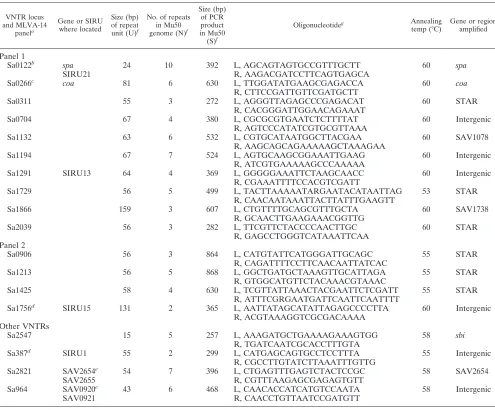
corre-sponding number of repeat units,N, are indicated in Table 1. Amplification of
DNA from reference strain Mu50 produced amplicons of the expected size. The
exact copy number for each allele was calculated as follows:Swas subtracted
from the estimated allele size, and the result was divided byU, added toN, and
rounded up to the nearest integer that was distant by less than 0.2. Alleles which could not be rounded up following this rule were double-checked and eventually sequenced to confirm the existence of intermediate alleles (0.5) and to establish the reason for this intermediate size (which may result from small deletions in the flanking sequence).
The polymorphism index of individual or combined VNTR loci was calculated using the Hunter-Gaston diversity index (19), an application of Simpson’s index of diversity (43). Confidence intervals (CI) were calculated as described by Grundmann et al. (14). The results of using the MLVA-14 assay, with 14 VNTRs in two panels, to genotype a strain are expressed as its allelic profile,
correspond-ing to the number of repeats at each VNTR in the order Sa0122 (spa), Sa0266
(coa), Sa0311, Sa0704, Sa1132, Sa1194, Sa1291 (SIRU13), Sa1729, Sa1866, and
Sa2039 (panel 1) and Sa0906, Sa1213, Sa1425, and Sa1756 (SIRU15) (panel 2) (Table 1). The genotype of Mu50, deduced from its genomic sequence, is 10 6 3 4 6 7 4 5 3 3 (panel 1) 3 5 4 2 (panel 2). The categorical coefficient (also called Hamming’s distance) and the unweighted pair group method with arithmetic mean clustering method were run within BioNumerics. A cutoff value of 45% similarity was applied to define clusters. It corresponds to differences at a max-imum of 3 VNTRs out of 14. This is still empirical since there is no precise knowledge about the VNTR evolutionary mechanism and speed, but it seems to correctly define clusters when compared to those defined by other genotyping methods. The minimum spanning tree was produced in BioNumerics, allowing the creation of missing links. The circle size is proportional to the number of isolates. A logarithmic scale was used when drawing branches.
The MLVA profiles and allele size ranges are available for comparison in the
MLVAbank for Bacterial Genotyping (http://mlva.u-psud.fr/ [Staphylococcus
au-reusdatabase]).
on May 16, 2020 by guest
http://jcm.asm.org/
RESULTS
Selection of a VNTR panel.In a preliminary study performed in 2003, 14 VNTRs were selected by comparing the available se-quenced genomes of strains Mu50, N315, MRSA252, NCTC8325, MW2, and MSSA476 using the strain comparison tool developed by Denoeud and Vergnaud (4) and available at http://minisatellites.u-psud.fr/ (Microorganism Tandem Re-peats database and Strain Comparison pages) (Table 1). They were tested on a collection from the Pasteur Institute given to us by Nevine El Sohl and previously typed by PFGE. These initial results showed that MLVA could efficiently cluster strains with similar pulsotypes (31). We then investigated the informativeness and potential use of additional VNTRs de-scribed in other studies. Most of the published primers did not
[image:3.585.44.539.79.489.2]perfectly match the genome of the strains analyzed or they were predicted by in silico analysis of thirteen sequenced ge-nomes to amplify more than one locus. This is the case, for instance, for thesdrlocus in which the three highly informative TRs present in genessdrC,sdrD, andsdrEcould not be am-plified independently. In addition to thespalocus (SIRU21), only SIRU01, SIRU13, and SIRU15 (15) and SAV920 and SAV1078 (10) were retained and tested on a larger collection of strains (data not shown). For SAV920 and SIRU01, lack of amplification was observed in about 10% of strains, and there-fore, these markers were not kept for a first-line MLVA scheme. The selected set of loci comprises 14 VNTRs that are present in all of the sequenced genomes, 6 of which correspond toS. aureusrepeat (STAR) elements (Sa0311, Sa0906, Sa1213, TABLE 1. VNTRs used in this study
VNTR locus and MLVA-14
panela
Gene or SIRU where located
Size (bp) of repeat
unit (U)f
No. of repeats in Mu50
genome (N)f
Size (bp) of PCR product in Mu50
(S)f
Oligonucleotideg Annealing
temp (°C)
Gene or region amplified
Panel 1
Sa0122b spa 24 10 392 L, AGCAGTAGTGCCGTTTGCTT 60 spa
SIRU21 R, AAGACGATCCTTCAGTGAGCA
Sa0266c coa 81 6 630 L, TTGGATATGAAGCGAGACCA 60 coa
R, CTTCCGATTGTTCGATGCTT
Sa0311 55 3 272 L, AGGGTTAGAGCCCGAGACAT 60 STAR
R, CACGGGATTGGAACAGAAAT
Sa0704 67 4 380 L, CGCGCGTGAATCTCTTTTAT 60 Intergenic
R, AGTCCCATATCGTGCGTTAAA
Sa1132 63 6 532 L, CGTGCATAATGGCTTACGAA 60 SAV1078
R, AAGCAGCAGAAAAAGCTAAAGAA
Sa1194 67 7 524 L, AGTGCAAGCGGAAATTGAAG 60 Intergenic
R, ATCGTGAAAAAGCCCAAAAA
Sa1291 SIRU13 64 4 369 L, GGGGGAAATTCTAAGCAACC 60 Intergenic
R, CGAAATTTTCCACGTCGATT
Sa1729 56 5 499 L, TACTTAAAAATARGAATACATAATTAG 53 STAR
R, CAACAATAAATTACTTATTTGAAGTT
Sa1866 159 3 607 L, CTGTTTTGCAGCGTTTGCTA 60 SAV1738
R, GCAACTTGAAGAAACGGTTG
Sa2039 56 3 282 L, TTCGTTCTACCCCAACTTGC 60 STAR
R, GAGCCTGGGTCATAAATTCAA Panel 2
Sa0906 56 3 864 L, CATGTATTCATGGGATTGCAGC 55 STAR
R, CAGATTTTCCTTCAACAATTATCAC
Sa1213 56 5 868 L, GGCTGATGCTAAAGTTGCATTAGA 55 STAR
R, GTGGCATGTTCTACAAACGTAAAC
Sa1425 58 4 630 L, TCGTTATTAAACTACGAATTCTCGATT 55 STAR
R, ATTTCGRGAATGATTCAATTCAATTTT
Sa1756d SIRU15 131 2 365 L, AATTATAGCATATTAGAGCCCCTTA 60 Intergenic
R, ACGTAAAGGTCGCGACAAAA Other VNTRs
Sa2547 15 5 257 L, AAAGATGCTGAAAAGAAAGTGG 58 sbi
R, TGATCAATCGCACCTTTGTA
Sa387d SIRU1 55 2 299 L, CATGAGCAGTGCCTCCTTTA 55 Intergenic
R, CGCCTTGTATCTTAAATTTGTTG
Sa2821 SAV2654e 54 7 396 L, CTGAGTTTGAGTCTACTCCGC 58 SAV2654
SAV2655 R, CGTTTAAGAGCGAGAGTGTT
Sa964 SAV0920e 43 6 468 L, CAACACCATCATGTCCAATA 58 Intergenic
SAV0921 R, CAACCTGTTAATCCGATGTT
a
Locus tags indicate the genomic localization in strain Mu50 (GenBank accession number AP009324) in kilobases.
b
Primers are different from those in references 42 and 15.
c
Primers are different from those in reference 37.
d
SIRU1 and SIRU15 primers are those described in reference 15.
e
Locus tag is from reference 10.
f
U,N, andSwere used to calculate the exact copy number of each allele as described in Materials and Methods.
g
L, left; R, right.
on May 16, 2020 by guest
http://jcm.asm.org/
Sa1425, Sa1729, and Sa1866), a family of intergenic elements whose copy numbers vary from 13 to 21 in individual strains (3). The VNTR set contains four additional intergenic TRs (Sa1756 [SIRU15], Sa0704, Sa1194, and Sa1291 [SIRU13]) and four TRs located inside the coding regions of thespa,coa, SAV1078, and SAV1738 genes (corresponding to Sa0122, Sa0266, Sa1132, and Sa1866, respectively). The MLVA scheme was run with individual PCRs and agarose gel electrophoresis of amplicons in this study, as shown in Fig. 1 for a subset of VNTRs. The size of the amplicons can be easily estimated by eye on agarose gels. For markers Sa0906 and Sa1213, the absence of amplification was frequently observed when using primers localized about 20 bp on each side of the TRs. There-fore, primers inside the two genes flanking the STAR element were selected, allowing correct amplification in all the strains. A large number of alleles could be obtained for Sa0906, re-flecting the complexity of the locus as confirmed by examina-tion of the sequence (see “The structure of Sa0906” below).
This MLVA assay is perfectly reproducible, as attested by the repeated use of Mu50 DNA as control, which always gave the same result. In addition, the stability of the VNTRs in cultured bacteria is demonstrated by the use of different batches of Mu50 DNA and by the fact that the observed am-plicon sizes are identical to those predicted by the genome sequence.
Comparison of MLVA, MLST, andspa typing in 300 iso-lates.To assess the informativeness of MLVA compared to that of MLST andspatyping, we genotyped three complemen-tary and well-referenced strain collections previously analyzed by these two techniques and belonging to the major MLST CCs. Overall, the efficiency of PCR amplification was excellent. Only in three instances could no amplification be obtained, which may be due to the absence or the mutation of the target of one of the primers: Sa0311 failed to amplify two MLST sequence type 398 (ST398) samples from nasal carriage, and
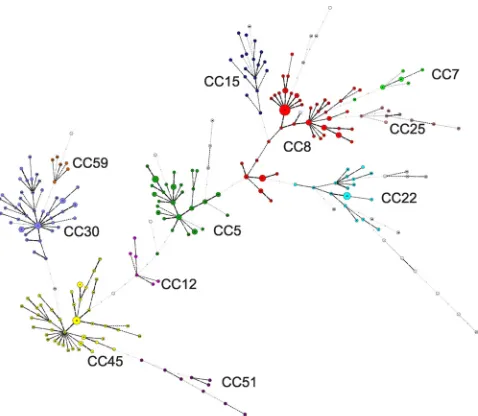
Sa1291 failed to amplify the ST8 sample NL33. The data were used to perform a clustering analysis based upon the categor-ical distance coefficient and unweighted pair group method with arithmetic mean clustering method. With a cutoff value of 45%, 21 clusters were defined, two of which corresponded to a single isolate (2 strains of nasal carriage, Laus167 of ST50 and Laus325 of ST78) (see dendrogram in Fig. S1 in the supple-mental material). These clusters correspond to CCs defined by MLST and byspatyping together with the algorithm Based Upon Repeat Pattern. Figure 2 shows a minimum spanning tree which produces a more condensed representation of the clustering and suggests relationships between the clusters. An almost perfect correlation between the results of the different techniques was observed, with the exception of a few isolates which did not cluster by MLVA with strains of the same ST or
spatype. Strain NL33,spatyped as t701 that is associated with CC8, is grouped with CC7, and Laus356, ST45 andspatype t1081, is grouped with CC12, both with long branches. In general, a much higher diversity was found with MLVA than with MLST, particularly inside the major CCs, due to polymor-phism at one or several VNTRs (Fig. 3). For example, the groups of 19 ST8 and t008 isolates, 16 ST5 and t002 isolates, and 18 ST30 and t012 isolates were each resolved into 12 MLVA genotypes. Thirteen ST45 t015 isolates were resolved into seven MLVA genotypes (44). The diversity index of the MLVA-14 assay is 0.9965 (95% CI, 0.9947 to 0.9984) (243 genotypes). In comparison, the diversity index of the MLST assay with the same isolates (52 different STs) is 0.9314 (95% CI, 0.9198 to 0.9431) and the diversity of thespaassay (127spa
types) is 0.9802 (95% CI, 0.9755 to 0.9849).
In order to test whether the complete set of 14 VNTRs was necessary to get a good resolution, clustering was performed with different combinations of markers, and we found that very satisfying clustering was already obtained with 10 VNTRs (panel 1), excluding those occasionally showing very small al-FIG. 1. Polymorphism of six VNTRs in 12 isolates (lanes numbered 1 to 12) as shown by agarose gel electrophoresis of PCR products. PCR was performed on two groups of 6 unrelated isolates, and the products are migrated next to the DNA size marker (the sizes in base pairs are shown on the left side of the first panel).
on May 16, 2020 by guest
http://jcm.asm.org/
[image:4.585.102.485.68.288.2]leles (Sa0906, Sa1123, Sa1425, and Sa1756). The only incon-sistency observed with panel 1 is the clustering of an ST121 (CC51) isolate with CC45 strains. Therefore, we propose to use panel 1 to assign the isolates to a cluster and four addi-tional markers (panel 2) for more informativeness. Panel 1 discriminates 215 genotypes with a diversity index of 0.9946 (95% CI, 0.9925 to 0.9967).
The structure of Sa0906.As explained above, VNTR Sa0906 is a TR present in a STAR element, which shows a complex organization requiring the use of primers in the flanking cod-ing regions for efficient PCR amplification (SAV0834 and SAV0835) (Fig. 4). A large number of alleles was observed, and in order to better assess their nature, these alleles were sequenced. The basic organization of a STAR element is a group of three sequences, or “boxes,” in the order B, C, A that
are 46 bp, 57 bp, and 97 bp long, respectively (24). Box C can be tandemly repeated (Fig. 4, cat1). The shortest allele, corre-sponding to a basic structure, was observed in only four isolates from the present collection of strains (NL33 and a group of nasal carriage isolates, Laus253, Laus369, and Laus292), all localized in out-group positions. In isolates of CC45, the pres-ence of a 21-bp duplication (Fig. 4, cat2) was observed and different alleles were seen to possess one to four C sequences. CC5 and CC8 isolates had an identical structure, with an in-sertion within the box C repeats of the STAR element and variations in copy number on both sides (Fig. 4, cat3). In several other CCs (and in strain RF122), it seemed that a deletion had removed part of this insertion (Fig. 4, cat4). An artificial convention is proposed so that all the different alleles and deletion combinations can be coded as in the case of an ordinary TR variation (described in the support website at http://minisatellites.u-psud.fr/MLVAnet/index.php?&largeur -1680).
DISCUSSION
[image:5.585.44.283.67.275.2]MLVA. We demonstrate in this study that the results of MLVA genotyping of S. aureus are highly informative and congruent with those of two other widely used techniques, FIG. 2. Minimum spanning tree representation of the MLVA
clus-tering. The MLVA data for 311 isolates, including 10 reference strains, was analyzed in BioNumerics. Each circle represents a genotype, and the size is proportional to the number of isolates. Isolates in the main MLST CCs are indicated by the different colors.
[image:5.585.89.491.535.696.2]FIG. 3. Minimum spanning tree representation of the MLVA clustering of isolates belonging to CC8 and CC45. The size of each circle is proportional to the number of isolates.Spatypes are indicated inside circles and by using different colors. The dark circle means that more than onespatype is present. The color codes for CC8 and CC45 are independent.
FIG. 4. Organization of the STAR element containing the Sa0906 VNTR. The diagram is drawn from the sequencing of PCR products from isolates of different CCs. Arrows represent PCR primers; the light gray bars represent sequence (“box”) A, the dark gray bars box B, and the open bars box C. The black bars represent inserted sequences. Cat, category.
on May 16, 2020 by guest
http://jcm.asm.org/
MLST andspatyping. MLVA provided better resolution and was more congruent with the results of MLST than with those of spa typing. VNTRs were previously used to genotype S. aureusin a method calledmultilocusvariable-number tandem-repeatfingerprinting (MLVF) to reflect the fact that the data are not interpreted in terms of repeat copy number at each locus but simply used to compare multiple banding patterns as is done with PFGE (21, 27, 38, 45). The discriminatory power of MLVF is similar to that of PFGE, but the profiles are not easily comparable between laboratories and this precludes the constitution of international databases. The reproducibility of MLVF might be also limited by the performance of 10-plex PCRs. Other PCR-based genotyping techniques, such as re-petitive sequence-based PCR, are satisfactory for determining strain relatedness, but their informativeness is low and the data are not suitable for population studies (47). Although MLVA is a gel-based method (using either traditional gels or sophis-ticated capillary electrophoresis equipment), it relies on coding the results as a string of numbers. This, in contrast to all fingerprinting methods, including PFGE and MLVF, makes the resulting profiles highly reproducible and portable, like MLST andspatyping.
In the present MLVA scheme, markers which could be eas-ily analyzed using agarose gel electrophoresis were favored (i.e., with a size difference between two alleles that is greater than 5% of the amplicon size across the whole allele size range). As such, the assay can be performed in a laboratory equipped with simple molecular biology equipment. In addi-tion, preliminary experiments showed that the assay can be easily adapted to capillary electrophoresis. For instance, six
markers could be analyzed simultaneously on a Beckman CEQ8000 apparatus in a multiplex PCR, using three fluoro-phores and selecting VNTRs according to the allele size range (see Fig. S2 in the supplemental material). Further develop-ment of this procedure should allow the analysis of the com-plete set of markers in two to three PCRs.
In addition to informativeness and portability, the cost issue is also very important when choosing a genotyping technique, particularly when thousands of isolates need to be investigated. Based on the cost of consumables only, the cost of in-house MLST typing for one sample (seven PCR amplifications and seven sequencing reactions) was estimated to be $30, with an initial start-up cost of $100,000 to $300,000 for equipment. When sequencing is performed outside the laboratory, it amounts at the very least to $50 per strain for sequencing costs alone. The cost for consumables alone for MLVA with 14 VNTRs amounts to $10 per strain whether the analysis is done with agarose gels or capillary electrophoresis, although the later requires a considerably higher start-up investment and expensive maintenance, whereas the former requires more hands-on time.
Population structure.In recent years, MLST has provided a clear view of theS. aureus population and its evolution, with the definition of a number of well-defined CCs that are evolv-ing, largely independently from each other, to such an extent that some authors suggest giving species status to each CC (46).
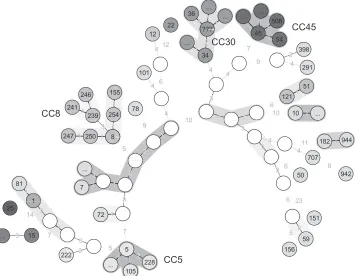
[image:6.585.117.475.72.348.2]The collection of strains analyzed here covers the two groups or clades identified by MLST analysis (2, 18). This is illustrated in Fig. 5, using a minimum spanning tree representation and FIG. 5. Minimum spanning tree representation of the MLST clustering, performed using the MLST sequence data. Missing links (empty circles) and logarithmic branch length parameters were used.
on May 16, 2020 by guest
http://jcm.asm.org/
allowing the prediction of missing links. The phylogenetic re-lationships observed by using MLVA data also separate the isolates into two main groups (Fig. 2). The two clades are not as sharply defined as those found by using MLST data, but the main relationships between CCs are similar using either MLVA or MLST. MLVA clearly allows the identification of CCs and the emergence of new families, as shown here with ST239 emerging from ST8, for example (33).
In the nasal carriage isolates, the clustering produced by MLVA is very similar to that identified by eBURST analysis of MLST data (39). In this previous work, ST942 and ST707 were grouped by DLST, although, when grouped by MLST, they differed by more than two mutations. This was also the case for ST291 and ST398. The MLVA-14 assay, which investigates 14 loci throughout the genome, also groups these isolates, sug-gesting a closely related origin of at least some part of their genome. Theirspatypes are compatible with a recent common origin. In the previous study mentioned above, amplified frag-ment-length polymorphism analysis placed Laus356, an ST45 isolate with a spa type characteristic for CC45, with a long branch next to the main CC45 cluster. By MLVA, this isolate is positioned with a long branch near the CC12 cluster.
Among the 14 selected VNTRs, 6 are present in STAR elements. The polymorphism of box C in STAR elements is used in a typing protocol based on RFLP and PCR (32) and contributes significantly to the present MLVA-14 assay. Addi-tional polymorphism is provided by different rearrangements, including the insertion or deletion of sequences which can be further described upon sequencing. In particular, marker Sa0906 shows at least four structures which appear to be of phylogenetic value. Indeed, MLVA clustering places certain strains in an ancestral position to specific clusters, for example, NL33, a CC8 isolate from The Netherlands.
Antibiotic resistance.In the present collection, strains be-longing to CC7, CC15, and CC25 were all MSSA, whereas both MSSA and MRSA isolates were found intermixed in all the other clusters. CC8 and CC5 isolates are mainly MRSA, as previously observed. This is in agreement with the CCs ob-served in typical MRSA and MSSA lineages worldwide (re-viewed in reference 5).
CC45. We describe in CC45 an unusual polymorphism at locus Sa0906, as well as in loci Sa1213 and Sa1425, with no or only a fraction of one repeat (data not shown). In addition, this CC also possesses only one copy of the repeat for loci Sa1132, Sa1291, Sa2039, and Sa1756 (SIRU15). Among these VNTRs, only locus Sa1132 is within a hypothetical protein-coding gene. In addition, CC45 displays the highest level ofspa polymor-phism, apparently through loss of motifs, whereas the other VNTRs show relatively less diversity (44). Therefore, we be-lieve that in this CC, there is for some reason an important level of recombination leading to deletion. We are presently exploring the basis for this phenomenon. At the moment, there is no complete sequenced genome available for a CC45 strain.
Conclusion. There is a need to expand investigations of pathogenic bacterial populations on a worldwide scale. The currently available data come from very few countries (36), and the main typing method (MLST) has an insufficient discrimi-natory power for epidemiological and shorter-term evolution-ary studies, which is well exemplified by the study of Nubel et al. (28). Single-nucleotide polymorphism typing might provide
an interesting alternative to MLST. However, in a highly clonal species likeS. aureus, the use of single-nucleotide polymor-phisms is an inherently biased approach which will fail to explore CCs not previously identified by other means. For epidemiological studies, MLVA entails costs and time invest-ment similar to those ofspatyping while providing consider-ably higher resolution. MLVA appears to be adapted to large-scale investigations and, in addition, might give some insight into the effects of DNA plasticity and recombination through the analysis of the TR mechanism of instability. In contrast to MLVF, in which VNTRs are used to produce a pattern, MLVA investigates each locus independently. The MLVA-14 assay described here, comprising 10 loci in panel 1 and 4 loci in panel 2, is highly discriminatory, cost efficient, reproducible, and portable. The assay can be used in automated or more manual protocols, as is best adapted to local conditions. If necessary, additional VNTRs described in the literature (Table 1) could be added by taking advantage of the numerous avail-able genome sequences to design new primer sets avail-able to amplify most if not all strains. In addition to the present col-lection of strains, the MLVA-14 assay has been applied to about 300 isolates from French patients with cystic fibrosis, allowing a follow-up during chronic infection (H. Vu Thien, K. Hormigos, G. Corbineau, B. Fauroux, H. Carvol, D. Moissenet, G. Vergnaud, and C. Pourcel, unpublished data).
ACKNOWLEDGMENTS
We are grateful to Alex van Belkum and Rene´ te Witt for the generous provision of the Harmony strain collection.
This work was supported by CNRS, Universite´ Paris-Sud, and the Association Vaincre la Mucoviscidose.
REFERENCES
1.Cookson, B. D., D. A. Robinson, A. B. Monk, S. Murchan, A. Deplano, R. de Ryck, M. J. Struelens, C. Scheel, V. Fussing, S. Salmenlinna, J. Vuopio-Varkila, C. Cuny, W. Witte, P. T. Tassios, N. J. Legakis, W. van Leeuwen, A. van Belkum, A. Vindel, J. Garaizar, S. Haeggman, B. Olsson-Liljequist, U. Ransjo, M. Muller-Premru, W. Hryniewicz, A. Rossney, B. O’Connell, B. D. Short, J. Thomas, S. O’Hanlon, and M. C. Enright.2007. Evaluation of molecular typing methods in characterizing a European collection of
epi-demic methicillin-resistantStaphylococcus aureusstrains: the HARMONY
collection. J. Clin. Microbiol.45:1830–1837.
2.Cooper, J. E., and E. J. Feil.2006. The phylogeny ofStaphylococcus aureus—
which genes make the best intra-species markers? Microbiology152:1297–
1305.
3.Cramton, S. E., N. F. Schnell, F. Go¨tz, and R. Bru¨ckner.2000. Identification
of a new repetitive element inStaphylococcus aureus. Infect. Immun.68:
2344–2348.
4.Denoeud, F., and G. Vergnaud.2004. Identification of polymorphic tandem repeats by direct comparison of genome sequence from different bacterial
strains: a Web-based resource. BMC Bioinform.5:4.
5.Deurenberg, R. H., and E. E. Stobberingh.2008. The evolution of Staphy-lococcus aureus. Infect. Genet. Evol.8:747–763.
6.Donker, G. A., R. H. Deurenberg, C. Driessen, S. Sebastian, S. Nys, and E. E. Stobberingh.2009. The population structure ofStaphylococcus aureusamong general practice patients from The Netherlands. Clin. Microbiol. Infect.
15:137–143.
7.Enright, M. C., N. P. Day, C. E. Davies, S. J. Peacock, and B. G. Spratt.2000. Multilocus sequence typing for characterization of methicillin-resistant and
methicillin-susceptible clones ofStaphylococcus aureus. J. Clin. Microbiol.
38:1008–1015.
8.Francois, P., A. Huyghe, Y. Charbonnier, M. Bento, S. Herzig, I. Topolski, B. Fleury, D. Lew, P. Vaudaux, S. Harbarth, W. van Leeuwen, A. van Belkum, D. S. Blanc, D. Pittet, and J. Schrenzel.2005. Use of an automated multiple-locus, variable-number tandem repeat-based method for rapid and
high-throughput genotyping ofStaphylococcus aureusisolates. J. Clin. Microbiol.
43:3346–3355.
9.Frenay, H. M., A. E. Bunschoten, L. M. Schouls, W. J. van Leeuwen, C. M. Vandenbroucke-Grauls, J. Verhoef, and F. R. Mooi.1996. Molecular typing
of methicillin-resistantStaphylococcus aureuson the basis of protein A gene
polymorphism. Eur. J. Clin. Microbiol. Infect. Dis.15:60–64.
on May 16, 2020 by guest
http://jcm.asm.org/
10.Gilbert, F. B., A. Fromageau, L. Gelineau, and B. Poutrel.2006.
Differen-tiation of bovineStaphylococcus aureusisolates by use of polymorphic
tan-dem repeat typing. Vet. Microbiol.117:297–303.
11.Gilbert, F. B., A. Fromageau, J. Lamoureux, and B. Poutrel.2006.
Evalua-tion of tandem repeats for MLVA typing ofStreptococcus uberisisolated
from bovine mastitis. BMC Vet. Res.2:33.
12.Goh, S. H., S. K. Byrne, J. L. Zhang, and A. W. Chow.1992. Molecular typing ofStaphylococcus aureuson the basis of coagulase gene polymorphisms.
J. Clin. Microbiol.30:1642–1645.
13.Grissa, I., P. Bouchon, C. Pourcel, and G. Vergnaud.2008. On-line resources for bacterial micro-evolution studies using MLVA or CRISPR typing.
Bio-chimie90:660–668.
14.Grundmann, H., S. Hori, and G. Tanner. 2001. Determining confidence intervals when measuring genetic diversity and the discriminatory abilities of
typing methods for microorganisms. J. Clin. Microbiol.39:4190–4192.
15.Hardy, K. J., B. A. Oppenheim, S. Gossain, F. Gao, and P. M. Hawkey.2006. Use of variations in staphylococcal interspersed repeat units for molecular
typing of methicillin-resistantStaphylococcus aureusstrains. J. Clin.
Micro-biol.44:271–273.
16.Hardy, K. J., D. W. Ussery, B. A. Oppenheim, and P. M. Hawkey.2004. Distribution and characterization of staphylococcal interspersed repeat units
(SIRUs) and potential use for strain differentiation. Microbiology150:4045–
4052.
17.Harmsen, D., H. Claus, W. Witte, J. Rothganger, H. Claus, D. Turnwald, and U. Vogel.2003. Typing of methicillin-resistantStaphylococcus aureusin a
university hospital setting by using novel software forsparepeat
determina-tion and database management. J. Clin. Microbiol.41:5442–5448.
18.Holden, M. T., E. J. Feil, J. A. Lindsay, S. J. Peacock, N. P. Day, M. C. Enright, T. J. Foster, C. E. Moore, L. Hurst, R. Atkin, A. Barron, N. Bason, S. D. Bentley, C. Chillingworth, T. Chillingworth, C. Churcher, L. Clark, C. Corton, A. Cronin, J. Doggett, L. Dowd, T. Feltwell, Z. Hance, B. Harris, H. Hauser, S. Holroyd, K. Jagels, K. D. James, N. Lennard, A. Line, R. Mayes, S. Moule, K. Mungall, D. Ormond, M. A. Quail, E. Rabbinowitsch, K. Rutherford, M. Sanders, S. Sharp, M. Simmonds, K. Stevens, S. Whitehead, B. G. Barrell, B. G. Spratt, and J. Parkhill.2004. Complete genomes of two
clinicalStaphylococcus aureusstrains: evidence for the rapid evolution of
virulence and drug resistance. Proc. Natl. Acad. Sci. USA101:9786–9791.
19.Hunter, P. R., and M. A. Gaston.1988. Numerical index of the discrimina-tory ability of typing systems: an application of Simpson’s index of diversity.
J. Clin. Microbiol.26:2465–2466.
20.Ikawaty, R., R. J. Willems, A. T. Box, J. Verhoef, and A. C. Fluit.2008. Novel multiple-locus variable-number tandem-repeat analysis method for rapid
molecular typing of humanStaphylococcus aureus. J. Clin. Microbiol.46:
3147–3151.
21.Karynski, M., A. J. Sabat, J. Empel, and W. Hryniewicz.2008. Molecular
surveillance of methicillin-resistantStaphylococcus aureusby multiple-locus
variable number tandem repeat fingerprinting (formerly multiple-locus vari-able number tandem repeat analysis) and spa typing in a hierarchic
ap-proach. Diagn. Microbiol. Infect. Dis.62:255–262.
22.Koreen, L., S. V. Ramaswamy, E. A. Graviss, S. Naidich, J. M. Musser, and B. N. Kreiswirth.2004.spatyping method for discriminating among Staph-ylococcus aureusisolates: implications for use of a single marker to detect
genetic micro- and macrovariation. J. Clin. Microbiol.42:792–799.
23.Kuhn, G., P. Francioli, and D. S. Blanc.2007. Double-locus sequence typing
usingclfBandspa, a fast and simple method for epidemiological typing of
methicillin-resistantStaphylococcus aureus. J. Clin. Microbiol.45:54–62.
24.Kuroda, M., T. Ohta, I. Uchiyama, T. Baba, H. Yuzawa, I. Kobayashi, L. Cui, A. Oguchi, K. Aoki, Y. Nagai, J. Lian, T. Ito, M. Kanamori, H. Matsumaru, A. Maruyama, H. Murakami, A. Hosoyama, Y. Mizutani-Ui, N. K. Taka-hashi, T. Sawano, R. Inoue, C. Kaito, K. Sekimizu, H. Hirakawa, S. Kuhara, S. Goto, J. Yabuzaki, M. Kanehisa, A. Yamashita, K. Oshima, K. Furuya, C. Yoshino, T. Shiba, M. Hattori, N. Ogasawara, H. Hayashi, and K. Hira-matsu.2001. Whole genome sequencing of methicillin-resistant Staphylococ-cus aureus. Lancet357:1225–1240.
25.Le Fle`che, P., Y. Hauck, L. Onteniente, A. Prieur, F. Denoeud, V. Ramisse, P. Sylvestre, G. Benson, F. Ramisse, and G. Vergnaud.2001. A tandem repeats database for bacterial genomes: application to the genotyping of
Yersinia pestisandBacillus anthracis. BMC Microbiol.1:2.
26.Lindstedt, B. A.2005. Multiple-locus variable number tandem repeats
anal-ysis for genetic fingerprinting of pathogenic bacteria. Electrophoresis26:
2567–2582.
27.Melles, D. C., L. Schouls, P. Francois, S. Herzig, H. A. Verbrugh, A. van Belkum, and J. Schrenzel.2009. High-throughput typing ofStaphylococcus aureusby amplified fragment length polymorphism (AFLP) or multi-locus variable number of tandem repeat analysis (MLVA) reveals consistent strain
relatedness. Eur. J. Clin. Microbiol. Infect. Dis.28:39–45.
28.Nubel, U., P. Roumagnac, M. Feldkamp, J. H. Song, K. S. Ko, Y. C. Huang, G. Coombs, M. Ip, H. Westh, R. Skov, M. J. Struelens, R. V. Goering, B.
Strommenger, A. Weller, W. Witte, and M. Achtman.2008. Frequent
emer-gence and limited geographic dispersal of methicillin-resistant
Staphylococ-cus aureus. Proc. Natl. Acad. Sci. USA105:14130–14135.
29.Nulens, E., E. E. Stobberingh, E. Smeets, H. van Dessel, M. A. Welling, S. Sebastian, F. H. van Tiel, P. S. Beisser, and R. H. Deurenberg.2009. Genetic
diversity of methicillin-resistantStaphylococcus aureusin a tertiary hospital
in The Netherlands between 2002 and 2006. Eur. J. Clin. Microbiol. Infect.
Dis.28:631–639.
30.Nulens, E., E. E. Stobberingh, H. van Dessel, S. Sebastian, F. H. van Tiel, P. S. Beisser, and R. H. Deurenberg.2008. Molecular characterization of
Staphylococcus aureusbloodstream isolates collected in a Dutch university
hospital between 1999 and 2006. J. Clin. Microbiol.46:2438–2441.
31.Onteniente, L.2004. A study of polymorphism associated with tandem
re-peats for the genotyping ofPseudomonas aeruginosa andStaphylococcus
aureus. Ph.D. thesis. Universite´ Evry Val d’Essonne, France.
32.Quelle, L. S., A. Corso, M. Galas, and D. O. Sordelli.2003. STAR gene restriction profile analysis in epidemiological typing of methicillin-resistant
Staphylococcus aureus: description of the new method and comparison with other polymerase chain reaction (PCR)-based methods. Diagn. Microbiol.
Infect. Dis.47:455–464.
33.Robinson, D. A., and M. C. Enright. 2004. Evolution ofStaphylococcus aureusby large chromosomal replacements. J. Bacteriol.186:1060–1064. 34.Robinson, D. A., and M. C. Enright.2003. Evolutionary models of the
emergence of methicillin-resistant Staphylococcus aureus. Antimicrob.
Agents Chemother.47:3926–3934.
35.Ross, T. L., W. G. Merz, M. Farkosh, and K. C. Carroll.2005. Comparison of an automated repetitive sequence-based PCR microbial typing system to pulsed-field gel electrophoresis for analysis of outbreaks of methicillin-resis-tantStaphylococcus aureus. J. Clin. Microbiol.43:5642–5647.
36.Ruimy, R., A. Maiga, L. Armand-Lefevre, I. Maiga, A. Diallo, A. K. Kou-mare, K. Ouattara, S. SouKou-mare, K. Gaillard, J. C. Lucet, A. Andremont, and E. J. Feil.2008. The carriage population ofStaphylococcus aureusfrom Mali is composed of a combination of pandemic clones and the divergent
Panton-Valentine leukocidin-positive genotype ST152. J. Bacteriol.190:3962–3968.
37.Sabat, A., J. Krzyszton-Russjan, W. Strzalka, R. Filipek, K. Kosowska, W. Hryniewicz, J. Travis, and J. Potempa.2003. New method for typing Staph-ylococcus aureusstrains: multiple-locus variable-number tandem repeat anal-ysis of polymorphism and genetic relationships of clinical isolates. J. Clin.
Microbiol.41:1801–1804.
38.Sabat, A., N. Malachowa, J. Miedzobrodzki, and W. Hryniewicz.2006.
Com-parison of PCR-based methods for typingStaphylococcus aureusisolates.
J. Clin. Microbiol.44:3804–3807.
39.Sakwinska, O., G. Kuhn, C. Balmelli, P. Francioli, M. Giddey, V. Perreten, A. Riesen, F. Zysset, D. S. Blanc, and P. Moreillon.2009. Genetic diversity
and ecological success ofStaphylococcus aureusstrains colonizing humans.
Appl. Environ. Microbiol.75:175–183.
40.Schouls, L. M., E. C. Spalburg, M. van Luit, X. W. Huijsdens, G. N. Pluister, M. G. van Santen-Verheuvel, H. G. van der Heide, H. Grundmann, M. E. Heck, and A. J. de Neeling.2009. Multiple-locus variable number tandem
repeat analysis ofStaphylococcus aureus: comparison with pulsed-field gel
electrophoresis and spa-typing. PLoS ONE4:e5082.
41.Shopsin, B., M. Gomez, S. O. Montgomery, D. H. Smith, M. Waddington, D. E. Dodge, D. A. Bost, M. Riehman, S. Naidich, and B. N. Kreiswirth.1999. Evaluation of protein A gene polymorphic region DNA sequencing for
typing ofStaphylococcus aureusstrains. J. Clin. Microbiol.37:3556–3563.
42.Shopsin, B., M. Gomez, M. Waddington, M. Riehman, and B. N. Kreiswirth.
2000. Use of coagulase gene (coa) repeat region nucleotide sequences for
typing of methicillin-resistantStaphylococcus aureusstrains. J. Clin.
Micro-biol.38:3453–3456.
43.Simpson, E. H.1949. Measurement of diversity. Nature163:688. 44.Strommenger, B., C. Kettlitz, T. Weniger, D. Harmsen, A. W. Friedrich, and
W. Witte.2006. Assignment ofStaphylococcus isolates to groups byspa
typing, SmaI macrorestriction analysis, and multilocus sequence typing.
J. Clin. Microbiol.44:2533–2540.
45.Tenover, F. C., R. R. Vaughn, L. K. McDougal, G. E. Fosheim, and J. E. McGowan, Jr.2007. Multiple-locus variable-number tandem-repeat assay
analysis of methicillin-resistantStaphylococcus aureusstrains. J. Clin.
Micro-biol.45:2215–2219.
46.Turner, K. M., and E. J. Feil.2007. The secret life of the multilocus sequence
type. Int. J. Antimicrob. Agents29:129–135.
47.van der Zee, A., H. Verbakel, J. C. van Zon, I. Frenay, A. van Belkum, M. Peeters, A. Buiting, and A. Bergmans.1999. Molecular genotyping of Staph-ylococcus aureusstrains: comparison of repetitive element sequence-based PCR with various typing methods and isolation of a novel epidemicity
marker. J. Clin. Microbiol.37:342–349.
48.Vergnaud, G., and C. Pourcel. 2009. Multiple locus variable number of
tandem repeats analysis. Methods Mol. Biol.551:141–158.