2019 International Conference on Artificial Intelligence and Computing Science (ICAICS 2019) ISBN: 978-1-60595-615-2
Research and Application of Clothing Recommendation System
Combining Explicit Data and Implicit Data
Ming ZHU, Qian WANG and Hong-tao ZHANG
School of Computer, Donghua University, Shanghai 201620, China
Keywords: Explicit data and implicit data, Clothing recommendation, K-means clustering.
Abstract. Apparel recommendation algorithms are widely used to solve the problem of clothing information overload and satisfying users' personalized wear requirements. The recommendation algorithm usually adopts a single data type. This paper proposes a recommendation algorithm that combines user explicit data with implicit data. Explicit data in this article uses users preference color, style data, implicit data uses user purchase records, browsing record data, calculated by two data types and feature vectors, obtain user-score high-dimensional matrix, PCA dimensionality reduction for high-dimensional matrix to obtain user scoring feature matrix use the optimized Pearson user similarity algorithm to get a list of recommendations after the Top-N sorting algorithm. The experimental results show that the F1 value of Explicit CF is 0.284, and the F1 value of Implicit CF is 0.265. The F1 value of the proposed algorithm proposed in this paper is 0.321.
Introduction
In recent years, clothing sales accounted for the first place in the proportion of online shopping merchandise sales, consumer online shopping behavior generated a large amount of explicit data and implicit data. Using explicit data and implicit data, researchers can fully exploit the user's preferences and characteristics, and combine the recommended algorithms in the computer field to recommend suitable clothing for users. Compared with the recommendation algorithm using only one data type, the recommendation algorithm combining explicit data and implicit data combines two user data types with clothing feature attributes, and optimizes the classic collaborative filtering algorithm user model, so that The recommendation accuracy rate is improved, and the result is more suitable for the user's personalized wear requirements, which provides a new idea for the recommendation algorithm research.
The classical collaborative filtering recommendation algorithm usually includes a user model, an item model and a recommendation algorithm[1], and the user model data is divided into explicit data
and implicit data according to the data type. Xiao Wenqiang[2] only based on the implicit data of user purchase records, using the distribution of implicit data to establish a user-item matrix and optimize user similarity. The method is easy to collect data, but the amount of purchase record data is small. The matrix isvery sparse; Chen Junhong[3] establishes a “user-tag-clothing” three-dimensional
relationship based on user search records, and combines the TF-IDF algorithm to calculate interest levels for recommendation. The explicit data preprocessing in this recommendation algorithm relies on natural Language processing, the label system needs to be continuously improved, and the system stability is weak; Hu Juliang[4] scores the user-clothing attribute “0-1 Judgment Matrix” according to
the browsing history and purchase record, and calculates the weight of each attribute value and the user - Apparel interest rate, recommending high-interest clothing for users. This method applies two kinds of implicit data and multiple clothing attributes, but the purchase record and browsing record do not set the weight coefficient, and the two kinds of data may have data. Noise; Li Yuanbo[5] uses the
This paper proposes a clothing recommendation algorithm combining explicit data and implicit data, obtaining explicit data (by color, style, etc.) and implicit data (such as browsing records, purchase records, etc.) of new users and old users, and establishing The scoring matrix of the target user. The matrix will be the service that the user cares about the explicit data such as color, style combined with the implicit data such as browsing records and purchase records used by the classic recommendation algorithm, which enhances the influence of the user in the recommendation process, and is conducive to recommending the user's current personalization demand for clothing, the recommendation results have a strong pertinence and timeliness. At the same time, the system clusters the color of the clothing, performs PCA dimensionality reduction on the scoring matrix, and utilizes the optimized Pearson similarity algorithm calculates similar users and recommends the top N pieces of clothing through Top-N.
Related Work
Experts in the field of clothing believe that color and style are two important factors of clothing, color and style have different fashion trends every year. The explicit data in this paper mainly adopts the color and style of the user's favorite clothing; the classic collaborative filtering recommendation algorithm usually Using browser records or purchase records, these two kinds of data have been widely recognized by researchers. The implicit data in this paper mainly uses browsing records and purchase records.
In the field of computer system, according to whether the user clearly expresses the preference for the item, the user data information is divided into explicit data and implicit data; in the field of software development knowledge theory, Liu Qingjing[6] consider user information from the perspective of complexity Can be divided into explicit knowledge and tacit knowledge. At the same time, Nonaka[7] believe that the distinction between tacit knowledge and explicit knowledge is that tacit knowledge has the subjectivity of knowledge producers, while explicit knowledge has objectivity. Explicit knowledge with objectivity is the core of computer algorithm recommendation. The data obtained after subjective tacit knowledge explicitization is the basis of recommendation system personalization. The traditional recommendation algorithm uses only one data type. The data type can only reflect one user's explicit or tacit knowledge. The user model is not accurate enough, and the recommendation accuracy rate needs to be improved. The color and style adopted in this system are explicit data tacit knowledge. Purchase records and browsing records are implicit data explicit knowledge. The two data types are combined to fully exploit the user's explicit knowledge and tacit knowledge. Extracting user characteristics and comprehensively portraying the user's image is conducive to recommending users from both the subjective and objective perspectives, Making the recommendation system more intelligent and personalized.
System Structure
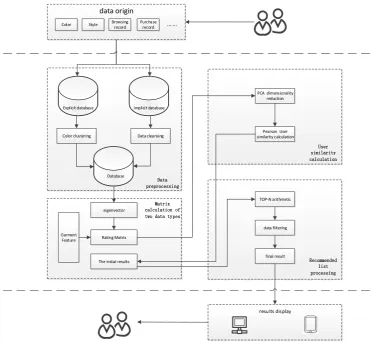
recommendation list. Finally, through the front-end page to the target user, the recommended system architecture diagram is shown in Figure 1.
Color clustering
Explicit database Implicit database
eigenvector
PCA dimensionality reduction
Rating Matrix Garment
Feature
Pearson User similarity calculation
The initial results
TOP-N arithmetic
data filtering
final result
Data preprocessing
data origin
results display
Color Style Browsing record Purchase record ……
User similarity calculation
Recommended list processing
Data cleansing
Database
[image:3.595.112.492.102.444.2]Matrix calculation of two data types
Figure 1. Recommended system architecture diagram.
Data Preprocessing
(1) Color similarity calculation
1) Construct HSV color space model
In this system, explicit data mainly uses clothing color and style. There are many kinds of clothing colors, and it is difficult for the user to choose the favorite color. Therefore, the system calculates the similarity of the clothing color and clusters into 6 colors for the user to select. Before the similarity calculation, researcher first need to build a
Color space model. Shen Minmin[8] summarized 99 popular fashion colors, and the system used these 99 popular colors as the color basis. Because the color summarized by the experts in the field of clothing is usually expressed in Pantone, Pantone cannot be directly applied to the computer system. Therefore, this study first obtained the RGB of the above 99 colors through the Pantone color card electronic version. Since RGB does not reflect the brightness, purity, and hue in color, these three are important elements in the color design of clothing, so the color is distributed on the three-dimensional model according to the RGB to HSV formula.
2) Color K-means clustering
To the user character, choose the colour selection range that oneself like from 99 kinds of popularity colour is too big. Therefore, this paper proposes to classify colors through unsupervised K-means clustering algorithm in machine learning, and get 6 kinds of representatives. Sexual clothing colors are available for users to choose from.
Establish a three-dimensional color data set {(R1, G1, B1), (R2, G2, B2)...(Rn, Gn, Bn)}, initial
clustering center {(h1, s1, v1), (h2, s2, v2)...(h6,s6,v6)}, converts the RGB color model into an HSV
coordinates is to divide these data elements into six data classes. Next, the iterative operation is performed by converting the new cluster center until the two cluster centers and the J values are equal, and the obtained cluster center is obtained[9]. The specific algorithm is Algorithm 1.
Algorithm 1 Color similarity calculation and color clustering algorithm
Input: {(R1,G1,B1),(R2,G2,B2)... ...(Rn,Gn,Bn)},{(h1,s1,v1),(h2,s2,v2)... ...(h6,s6,v6)}
Output: {(HH1,SS1,VV1),(HH2,SS2,VV2)... ...(HH6,SS6,VV6)}
For(i=0; i<n; i++) max=max(Ri,Gi,Bi)
min=min(Ri,Gi,Bi)
if (Ri= max) Then H i = (Gi-Bi)/(max-min)
else if (Gi= max) Then H i = 2 + (Bi-Ri)/(max-min)
else if (Bi= max) Then H i = 4 + (Ri-Gi)/(max-min)
else if (min= max) Then H i = 0
Hi = Hi * 60
if (Hi < 0) Then Hi = Hi + 360
Vi=max(Ri,Gi,Bi)
Si=(max-min)/max // RGB - HSV
For(i=1;i< n; i++) For(j=0;j<6;j++)
Lij=[(H i-hj)2+(Si-sj)2+(Vi-vj)2]-2
J=J1j+J2j+J3j...+Jnj //Minimum path sum
Jmin=J1j+J2j+J3j...+Jnj //The final cluster center
return {(HH1,SS1,VV1),(HH2,SS2,VV2)... ...(HH6,SS6,VV6)} //Returns the final cluster center
(2) Implicit data data cleaning
In this system, the implicit number mainly uses the user's behavior data, including browsing records, purchase records. This part of the data is affected by the seller's discount activities, home page recommendation, etc. For the clothing recommendation system, there is data noise. Researchers can use DataWrangler[11] and other software to clean and rearrange the data.
Matrix Calculation of Two Data Types
The clothing recommendation system combining explicit data and implicit data collects explicit data and implicit data of the user, and generates a user-item scoring matrix through the feature vector. The explicit data scoring calculation method takes color as an example. If the user selects red, then all the color subclass scores that match the color red are the ratio of the color weight to the total weight of the explicit data. The implicit data score calculation method takes the purchase record as an example. If the user purchases the item, the value of the purchase record subclass score of the item is the ratio of the purchase record weight to the implicit data total weight value. The total score t is the sum of the product of the explicit data and the explicit data coefficient and the product of the implicit data and the implicit data coefficient, and the explicit data coefficient and the implicit data coefficient are added to one.
In this paper, X is used to represent the score of explicit data, Y is used to represent the score of implicit data, and T is the total score. α represents the data coefficient, Xn represents the nth subclass
explicit data score, Yn represents the nth subclass implicit data score, and wn represents the nth
subclass weight, the specific algorithm such as algorithm 2 .
Algorithm 2 Matrix scoring algorithm combining explicit data with implicit data
Input: Y1,Y2,X1,X2,α,set Y1{Y1R1.1,Y1R1.2,... ...Y1Rm.n},set Y2{Y2R1.1,Y2R1.2,... ...Y2Rm.n,String
Output: T For each i[0,m] For each j[0,n]
If (Y1Ri,j=1) Then ai,j←1
Else if (Y1Ri,j=0) Then ai,j←0 //set Y2 in a similar way
YRi,j←
2 1 1 Y Y Y +
× ai,j+
2 1 2 Y Y Y + ×bi,j
For each i[0,m] For each j[0,n]
If (f(Y1Ri,j)=StringX1) Then ci,j←1
Else if ((f(Y1Ri,j)=0) Then ci,j←0 //StringX2 in a similar way
XRi,j←
2 1 1 X X X +
× ci,j+
2 1 2 X X X + ×di,j
Ti,j=α×YRi,j+(1-α)×XRi,j
Return T
User Similarity Calculation
(1) PCA algorithm dimensionality reduction
In this system, as the number of users and clothing continues to increase, the user scoring matrix dimension is too high, each time the recommended calculation amount is large, and the system efficiency is low, so the pca algorithm needs to be used for matrix dimension reduction. First find the sample meanm, the covariance s is calculated from the mean, and the eigenvalue of the covariance is, the feature vector ise And then calculate the projection of each dimension aik. among
them,=(1,2,...,n), 12...n
, e (e1,e2,...,en)
=
[6]. Finally, a dimensionally reduced projection
matrix is obtained, which is the main component of the sample space and arranged according to the principal components from large to small.
n x m n i i
= = 1 (1) T m i i i m x mx S
= − − = 1 ) )( ( (2) ) (x m e aik k i
−
= (3)
(2) Pearson user similarity optimization
As a user-based recommendation system, this system needs to calculate the user similarity. The commonly used similarity calculation methods are cosine similarity, Pearson similarity and modified cosine similarity[11-12], because the cosine similarity lacks the user frequency division scale problem, and the Pearson similarity experimental effect is compared with the modified cosine similarity experiment. The effect is more ideal. The system uses Pearson similarity to calculate user similarity. However, if the two users have fewer common scoring items, their user similarity will be high. In order to reduce the impact of this phenomenon on the recommendation system, the system optimizes the Pearson similarity algorithm and introduces users' common scores. coefficient. u1 is the target
user, un is the other user, I is the total number of items graded, r1 is the target user's score, and rm is the
score of other users, wi For the common scoring coefficient,I1avg is the average score of all items by u1,
Iiavg is the average score of all items by ui, and Psim is the optimized similarity. The specific algorithm
Algorithm 3 Pearson user similarity optimization
Input: u1, {u2,u3,u4... ...un}, {I1,I2,I3... ...Im},r1, {r2,r3,r4... ..rm}
Output: u
For each i[2,n]
− −− −
=
2 2
1 1
1 1
) ( )
(
) )( (
i i
i i i
r u r
u
r u r u sim
//Pearson similarity computing
| |
| |
1 i i i
I I
I W=
//Coefficient of common score
If(Iu1≥Iiavg) Then w=wi
Else Then w=0 Psim= w ×sim i
Return psim
Recommended List Processing
After the similarity is calculated by the user similarity calculation, the system uses the sorting method commonly used in the top-n recommendation to push the top 10 recommendation results to the user in the form of a recommendation list. In the recommended list, there may be garments that the user has purchased or garments of the same color as the garments that the user has already purchased, and the system needs to filter such garments.
Experimental Verification and Evaluation
Experimental Design
The female consumers of Chinese clothing online shopping are mainly concentrated in college students and staff (19-35 years old). In this experiment, 50 female college students are used as experimental subjects, and the coats are classified as targets. The subjects are collected for nearly 30 days in Taobao. The clothing category browsing record and the purchase record are used as experimental implicit data. The user prefers color and style as explicit data, and the explicit data and implicit data communication constitute a data set. By comparing various recommendation algorithm evaluation indicators[5,10], this paper decides to verify the algorithm from three aspects: recall rate,
accuracy rate and f1 value.
Experimental Results
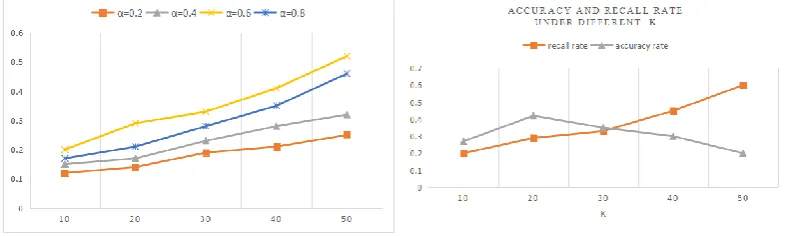
[image:6.595.99.500.643.761.2]First, the accuracy is used as the criterion to determine the best data coefficient α = 0.6 (Figure 2).In the experiment, k refers to the number of clothing in the clothing list recommended by the user after the recommendation algorithm. When K=20, the accuracy rate is the highest; as the number of recommendations increases, the recall rate continues to increase (Figure 3).
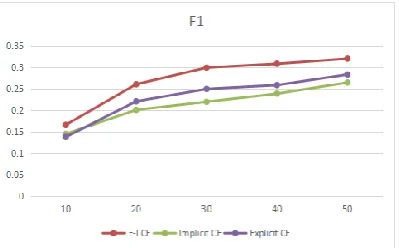
In this experiment, based on the F1 value, the clothing recommendation algorithm (IE CF) combining explicit data and implicit data and the clothing recommendation algorithm (Implicit CF) using the browsing record, and the clothing recommendation algorithm (Explicit CF) using the user score. Compare them (Figure 5).The clothing recommendation algorithm combined with explicit data and implicit data proposed in this paper has higher F1 value than the former two algorithms by 3.7% and 5.6% respectively.
Figure 4. Comparison of F1 values of the three recommended algorithms.
Conclusion
(1) According to the characteristics of the clothing field, this paper studies a K-means color clustering method applied to the clothing system, which clusters the complex and diverse clothing colors into a representative small number of color sets that the system really needs.
(2) This paper starts with explicit data and implicit data, and studies a user matrix scoring method that fully depicts the user image. This method can be used to add multiple data types to the recommendation system, and more comprehensively mine user information, providing a new idea for the recommendation algorithm research.
(3) This paper optimizes the Pearson user similarity calculation method to solve the problem of high similarity of users with less common scores, and greatly improves the accuracy of the recommendation algorithm.
Acknowledgment
This research is supported by the Dongguan professional town innovation service platform construction project, Dongguan Humen garment collaborative innovation center, and the Guangdong provincial cooperation innovation and platform environment construction special funds (Grant No. 2014B090908004).
References
[1] Liu Hui, Guo Mengmeng, Pan Weiqiang. A review of personalized recommendation systems [J]. Journal of Changzhou University (Natural Science Edition), 2017, 29 (03): 51-59.
[2] Xiao Wenqiang, Yao Shijun, Wu Shanming. An improved top-N collaborative filtering recommendation algorithm [J]. Journal of Computer Applications, 2018(1).
[3] Chen Junhong, Liu Yumei. Research on the recommendation model of business women's clothing based on label [J]. Journal of Zhejiang Textile and Apparel Technology College, 2017, 16(04): 68-72.
[5] Li Yuanbo, Cao Yu. Collaborative Filtering Recommendation Algorithm Based on PCA Dimension Reduction [J]. Computer Technology and Development, 2016, 26(02): 26-30.
[6] Liu Qingjing. Research on the role of explicit knowledge and tacit knowledge in software process improvement [d]. South China University of Technology, 2011.
[7] Nonaka. I., Takeuchi. H., The Knowledge-Creating Company [M]. New York: Oxford University Press, 1995.
[8] Shen Minmin. Research on clothing color consultation system based on wearing factors [d]. Suzhou University, 2009.
[9] Cong Si'an, Wang Xingxing. A review of K-means algorithm research [J]. Electronic Technology and Software Engineering, 2018 (17): 155-156.
[10]Wang Anqi, Liu Wei, Fu Xiaodong, Liu Lijun, Huang Qingsong. Judgment Optimization Model for Personalized Apparel Recommendations [J]. Computer Engineering and Applications, 2018, 54(11): 204-210+229.
[11]Arora G., Kumar A., Devre G.S., et al. Movie recommendation system based on users’ similarity [J]. International Journal of Computer Science and Mobile Computing, 2014, 3(4): 765-770.