2019 International Conference on Computer Science, Communications and Big Data (CSCBD 2019) ISBN: 978-1-60595-626-8
Security Enhancements of the Surveillance Data Exchange
Protocol “ASTERIX”
Marián JANČÍK
1,*, Johannes DE HAAN
2and Petr JONÁŠ
31,2Eurocontrol, Rue de la Fusée 96,1130 Brussels, Belgium
3Department of Air Transport, Faculty of Transportation Sciences,
Czech Technical University in Prague
*Corresponding author
Keywords: Asterix protocol, Cyber Security, Radar, Surveillance.
Abstract. The surveillance information are key data for all air navigation service providers which are responsible for the safety of the air passengers and the efficiency of Air Traffic Management system. In this paper, we have focused on the analysis of a protocol used to carry the surveillance information from the sensor to the ATC centre as well as amongst variety of ATM applications inside the ATC centre. As the original ASTERIX protocol has been developed without any security mechanism, it constitutes a major vulnerability. This deficiency has been acknowledged by the AMG (ASTERIX management group) which is seeking a remedy. In this article we describe a proposal to implement the security features into the protocol.
Introduction
ASTERIX (short for “All Purpose Structured Eurocontrol Surveillance Information Exchange”) is a de-facto standard protocol defining the low level (“down to the bit”) implementation of a data format for exchanging surveillance-related information amongst ATM (Air Traffic Management) applications.[1]
It was designed as Presentation and Application protocol (layers 5 and 6 of ISO/OSI Reference Model) for communication media with limited bandwidth. This is why it follows rules that enable it to transmit all the information needed, with the smallest data load possible.
The first version of ASTERIX was approved by Radar Systems Specialist Panel (RSSP) at their 15th Meeting held on 1-4 July 1986. Nowadays it has been adopted by the world users’ community as the de-facto standard in this domain.[2] EUROCONTROL (European Organisation for the Safety of Air Navigation) is also developing a reference ASTERIX library called E-ARCO (EUROCONTROL’s Asterix Codec), which will be made available to the community free of charge. ASTERIX is an extensible format with a number of different data categories, each of which deals with one particular kind of information.[3] These include target reports from surveillance sensors such as radars as well as processed information such as aircraft tracks and various system status messages.[4]
The structure of ASTERIX data block, which is basically the payload of the underlying TCP/IP protocol, can be defined as shown on Fig. 1:
Figure 1. ASTERIX Data Block.
Table 1. ASTERIX Data Categories.
Data Categories Application
000 – 127 Standard Civil and Military Applications 128 – 240 Special Civil and Military Applications 241 – 255 Civil and Military Non-Standard Application
ASTERIX protocol is very efficient but absolutely lacks any safety or security (e.g. encryption) mechanisms.
Current Status
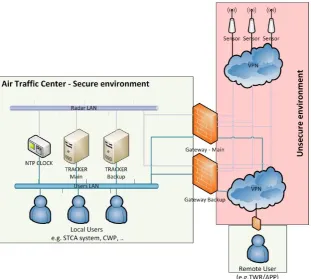
The protocol itself is not implicitly secure. In fact there already exists a proof of concept work to exploit it. A custom software program called “MITMAST” (Man in the middle ASTERIX) which is using ARP Poisoning technique between two hosts is capable of manipulating the ASTERIX data.[5] Despite the lack of any security feature, every air navigation service provider, the main consumer of the surveillance data, must ensure the data transported by the ASTRIX protocol are delivered securely from the sensor to the ATM centre.[6]
Besides that the ATM cyber-security in the European Union (EU) is also mandated by EU law, i.e.: -“Commission Implementing Regulation (EU) 2017/373 - of 1 March 2017 - laying down common requirements for providers of air traffic management/air navigation services and other air traffic management network functions and their oversight”,
-“Directive 2016/1148/EU of the European Parliament and of the Council of 6 July 2016 concerning measures for a high common level of security of network and information systems across the Union”.
[image:2.595.143.455.446.725.2]Additionally, the security at the network level is continuously being scrutinised by the hackers and cybercriminals. The SSL/TLS protocol suffered during the last years several serious vulnerabilities, therefore, to put the security just in this protocol it is not enough.
Requirements
Usually, there are six main security services provided by secure communication systems: Confidentiality, Authentication, Integrity, Non-repudiation, Availability and Authorization.[8] However, for the implementation of the security elements into the ASTERIX protocol only the following main requirements have been selected.
Authentication
Integrity
Confidentiality Authentication
It must be possible to ensure that the data are coming from the expected source, e.g. a sensor. We also must ensure that the request for the data is coming from a legitimate user e.g. STCA (Short Term Conflict Alert) application.
A possible solution is to sign the data.
Integrity
The protocol shall ensure that no-one can tamper with the date once they are sent. The solution which are being considered are encryption or hashing.
Confidentiality
The protocol shall also ensure the delivery of the data over non-secure connections. This can be achieved by encryption of the sensitive data.
Non-repudiation is considered as unnecessary in the exchange of surveillance data, due to the extremely short validity of the data. For example, the classical radar delivers the position of the aircraft every 4-12 seconds, and the modern non rotating sensors deliver the data at even higher frequency.[9] Even if the report is missed, in couple of seconds a new one will arrive.
Availability is difficult to achieve at the protocol level and besides the all ATM systems are designed and manufactured as redundant at multiple levels.
Authorization is at this time not essential. The current design of the ATM system is such that the surveillance information are provided almost directly from the producer (e.g. radar) to the consumer (e.g. SDPS - surveillance data processing systems). This allows relatively easy way to permit/deny the access to data (e.g. from the military radar).
Additional requirements which has to be considered are backward compatibility with current version of ASTERIX and compatibility with the SWIM (System Wide Information Management) systems.
Solutions
Non ASTERIX Wrapper
Figure 3. Data structure of “Non ASTERIX wrapper”.
The idea of having a wrapper around of ASTERIX data block would probably allow a quicker implementation, however with a significant risk that different manufacturers would implement incompatible wrappers.
Special ASTERIX Category
Figure 4. Data structure of Special ASTERIX category
Similar to the wrapper this solution would also encapsulate the ASTERIX data block. The difference is that it would be standardised by AMG which would minimise the risk of incompatibility.
ASTERIX Category 000 is a primary candidate to be this special category.
PKI (public key infrastructure) is suggested for the signing, emitting and maintaining certificates and revocations lists. EUROCONTROL will in the near future start to operate the Root Certification Authority for all SWIM systems and applications. Thus using PKI is a preferred choice, however other solutions e.g. symmetric key encryption might be used as well.
Conclusion
The surveillance sensors and the surveillance network are fundamental for the safety of air transportation and consequently they are part of the critical infrastructure of every country.[11] Therefore we must make every effort to guarantee the maximum availability and security. ASTERIX protocol is very efficient but lacks any safety or security mechanisms. That is why the users have to move to another link layer to obtain a security level, which might be insufficient, considering the criticality of the carried information.
EUROCONTROL, as the lead designer of the protocol, must address the growing concerns about the security flaws.[12]
In this paper we cover the current status and we identify the main security requirements.
Our proposed mitigation against the vulnerability is to implement a special ASTERIX category which would encapsulate the transported ASTERIX categories, comparable to encapsulation principal of the data through different layer of TCP/IP protocol.
Last but not least, we highlight the need for the backward compatibility to ensure seamless cooperation with the existing systems.
References
[1] EUROCONTROL Specification for Surveillance Data Exchange - Part 1, Edition: 2.4, Brussels 2016, Reference nr: EUROCONTROL-SPEC-0149, ISBN: 978-2-87497-028-3.
[4] Dzunda, Milan; Kotianova, Natalia; Pulis, Pavel; et al.: Selected Aspects of the Windmill Construction Impact on Air Traffic Safety. Conference: International Conference on Power, Energy Engineering and Management (PEEM) Location: Bangkok, Thailand, Date: January 24-25, 2016, Pages: 290-294.
[5] Casanovas, Eduardo & Exequiel Buchaillot, Tomas & Baigorria, Facundo. (2016). Vulnerability of Radar Protocol and Proposed Mitigation. Journal of ICT Standardization. 4. 65-86. 10.13052/jicts2245-800X.414.
[6] Dzunda, M.; Csefalvay, Z.; Kotianova, N.: Target Localization by Method of Intersections of the Ellipses Using Two UWB Radar Systems. Conference: International Conference on Advanced Educational Technology and Information Engineering (AETIE) Location: Beijing, Peoples R China Date: May 17-18, 2015, Pages: 697-706.
[7] Jancik, Marian, Simon Holoda, Milan Dzunda, and Branislav Kandera. “Current Status of Cyber Security in the Surveillance Data Processing Systems in Europe.” In 2018 XIII International Scientific Conference - New Trends in Aviation Development (NTAD), 59–63. Kosice: IEEE, 2018. https://doi.org/10.1109/NTAD.2018.8551678 , Electronic ISBN: 978-1-5386-7918-0.
[8] Dzunda, Milan; Kotianova, Natalia: Selected Aspects of Applying Communication Technology to Air Transportation. International Conference on Computer Science and Information Engineering (CSIE) Location: Bangkok, Thailand, Date: June 28-29, 2015, Pages: 1-7.
[9] Dzunda, M., Kotianova, N., Holota, K., et al.: Use of Passive Surveillance Systems in Aviation. Activities in Navigation: Marine Navigation and Safety of Sea Transportation, Published: 2015, Pages: 249-253.
[10] Johannes DE Haan, Eurocontrol Internal Document, “ASTERIX Security Implementation Options”, Date: NOV-22-2018, Brussels.
[11] Dzunda, M.; Cekanova, D.; Cobirka, L.; et al.: Protection Against High-Frequency Radiation of Aviation Electronic Support Systems Used in Air Transport. Transnav-International Journal on Marine Navigation And Safety Of Sea Transportation Volume: 12, Issue: 1, March 2018, Pages: 183-186.