Security Analysis and Improvements of a Three-Party
Password-Based Key Exchange Protocol
Hang Tu
1, Han Shen
2, Debiao He
2, Jianhua Chen
31School of Computer, Wuhan University, Wuhan, China
2,3School of Mathematics and Statistics, Wuhan University, Wuhan, China e-mail: [email protected]
http://dx.doi.org/10.5755/j01.itc.43.1.5322
Abstract. Recently Xie et al. [Q. Xie, N. Dong, X. Tan. D. Wong, G. Wang. Improvement of a three-party password-based key exchange protocol with formal verification. Information Technology and Control, 2013, Vol. 42, No. 3, 231-237] proposed an efficient three-party password-based key exchange protocol and used a formal verification tool to verify its security. In this paper, we demonstrate that their protocol is vulnerable to the off-line password guessing attack and the key compromise impersonation attack. The analysis shows that their protocol is not secure for practical applications. To overcome weaknesses in Xie et al.’s protocol, we also propose an improved 3PAKE protocol. Analysis shows that our protocol not only overcomes those weaknesses, but also has better performance. Therefore, our protocol is more suitable for practical applications.
Keywords: Key exchange protocol; Three-party; Password guessing attack; Key compromise impersonation attack; Denning-Sacco attack.
1. Introduction
The concept of the two-party password-based authenticated key exchange (2PAKE) protocol was first proposed by Bellovin and Merritt [1]. In such protocols, two parties could authenticate each other and generate a session key for future communications through a password shared between them. To ensure secure communication in the peer-to-peer system, a different password should be shared in each pair of communication parties. Then every party of the system has to maintain 𝑘 −1 passwords if there are 𝑘 parties in the system. Therefore, 2PAKE is not suitable for the large-scale peer-to-peer system. To solve the problems, many three-party password-based authenti-cated key exchange (3PAKE) protocols [2-12] were proposed during the last few years.
Lu and Cao [2] proposed an efficient 3PAKE protocol to improve performance in previous proto-cols. However, many researchers [3-8] demonstrated that Lu and Cao’s protocol is vulnerable to the off-line password guessing attack and the man-in-the-middle attack. To overcome those weaknesses, Huang [9] proposed a new 3PAKE protocol. However, Yoon and Yoo [10] pointed out that Huang’s protocol is vulnerable to the undetectable on-line password guessing attack and the off-line password guessing
attack. In 2011, Lou and Huang [11] used elliptic curve cryptography to construct a new 3PAKE protocol for resource-constrained devices. Although their protocol has better performance, Xie et al. [12] found that their protocol is vulnerable to the off-line password guessing attack and the partition attack. Xie et al. also proposed an improved 3PAKE protocol to overcome weaknesses in Lou and Huang’s protocol. Unfortunately, in this paper, we will demonstrate that Xie et al.’s 3PAKE protocol is vulnerable to the off-line password guessing attack and the key compromise impersonation attack. To overcome weaknesses in Xie et al.’s protocol, we also propose an improved 3PAKE protocol.
2. Review of Xie et al.’s 3PAKE protocol
In this section, we will give a brief review of Xie et al.’s 3PAKE protocol. For convenience, some notations are defined as follows.
•𝑞,𝑛: two large prime number; •𝐹𝑞: a finite field;
•𝐸(𝐹𝑞): an elliptic curve over 𝐹𝑞;
•𝐺: a cyclic additive group over 𝐸(𝐹𝑞) with order 𝑛; •𝑃: a generator of 𝐺;
•𝑇𝑇: the trusted server; •𝐴,𝐵: two users;
•𝑝𝑤𝐴: the password shared between 𝐴 and 𝑇𝑇; •𝑝𝑤𝐵: the password shared between 𝐵 and 𝑇𝑇; •𝑑: the secret key of 𝑇𝑇;
•𝐹: the public key of 𝑇𝑇, where 𝐹=𝑑𝑃;
•𝐻(⋅) : a secure hash function, where 𝐻(⋅): {0,1}∗→ 𝐺;
•ℎ(⋅) : a secure hash function, where ℎ(⋅): {0,1}∗→ 𝑍
𝑛∗;
•∥: the string concatenation operation; •⊕: the exclusive OR operation;
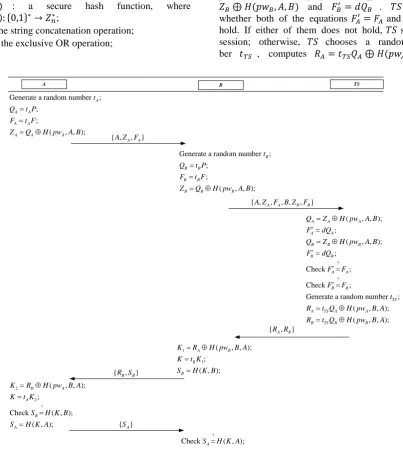
The trusted server (𝑇𝑇) chooses a large prime number 𝑞, an elliptic curve 𝐸(𝐹𝑞) defined over a finite field 𝐹𝑞, a cyclic group of points 𝐺 over 𝐸(𝐹𝑞), a generator 𝑃 of 𝐺 and a secure hash function 𝐻(⋅), where 𝐻(⋅): {0,1}∗→ 𝐺. 𝑇𝑇 also generates a random number 𝑑 as his secret key and computes his public key 𝐹=𝑑𝑃. Let 𝑝𝑤𝐴/𝑝𝑤𝐵 be the password shared between the user 𝐴/𝐵 and 𝑇𝑇. As shown in Fig. 1, the detail of Xie et al.’s 3PAKE protocol is described as follows.
1) 𝐴 chooses a random number 𝑡𝐴, computes 𝑄𝐴=𝑡𝐴𝑃, 𝐹𝐴=𝑡𝐴𝐹 and 𝑍𝐴=𝑄𝐴⊕ 𝐻(𝑝𝑤𝐴,𝐴,𝐵).
Then 𝐴 sends the message {𝐴,𝑍𝐴,𝐹𝐴} to 𝐵.
2) Upon receiving {𝐴,𝑍𝐴,𝐹𝐴}, 𝐵 chooses a random number 𝑡𝐵 , computes 𝑄𝐵 =𝑡𝐵𝑃 , 𝐹𝐵=𝑡𝐵𝐹 and 𝑍𝐵 =𝑄𝐵⊕ 𝐻(𝑝𝑤𝐵,𝐴,𝐵). Then 𝐵 sends the message
{𝐴,𝑍𝐴,𝐹𝐴,𝐵,𝑍𝐵,𝐹𝐵} to 𝑇𝑇.
3) Upon receiving {𝐴,𝑍𝐴,𝐹𝐴,𝐵,𝑍𝐵,𝐹𝐵}, 𝑇𝑇 com-putes 𝑄𝐴=𝑍𝐴⊕ 𝐻(𝑝𝑤𝐴,𝐴,𝐵) , 𝐹𝐴′=𝑑𝑄𝐴 , 𝑄𝐵= 𝑍𝐵⊕ 𝐻(𝑝𝑤𝐵,𝐴,𝐵) and 𝐹𝐵′ =𝑑𝑄𝐵 . 𝑇𝑇 checks
whether both of the equations 𝐹𝐴′=𝐹𝐴 and 𝐹𝐵′=𝐹𝐵 hold. If either of them does not hold, 𝑇𝑇 stops the session; otherwise, 𝑇𝑇 chooses a random num- ber 𝑡𝑇𝑆 , computes 𝑅𝐴=𝑡𝑇𝑆𝑄𝐴⊕ 𝐻(𝑝𝑤𝐴,𝐵,𝐴) ,
TS A
Generate a random number ;
; ; ( , , ); A A A A A
A A A
t
Q t P
F t F
Z Q H pw A B
= = = ⊕
B
{ ,A ZA,FA}
? ? ( , , ); ; ( , , ); ; Check ; Check ;
Generate a random number ;
( , , );
( , , );
A A A A A B B B B B
A A
B B
TS A TS A A B TS B B
Q Z H pw A B
F dQ
Q Z H pw A B
F dQ
F F
F F
t
R t Q H pw B A
R t Q H pw B A
= ⊕ ′ = = ⊕ ′ = ′ = ′ = = ⊕ = ⊕
{ ,A ZA,F B ZA, , B,FB} Generate a random number ;
; ; ( , , ); B B B B B
B B B
t
Q t P
F t F
Z Q H pw A B
= = = ⊕
{R RA, B}
1 1 ( , , ); ; ( , ); A B B B
K R H pw B A
K t K
S H K B
= ⊕ =
=
{R SB, B}
2
2 ?
( , , );
;
Check ( , );
( , );
B A A
B A
K R H pw B A
K t K
S H K B
S H K A
= ⊕ =
=
= {SA}
?
Check ( , );SA=H K A
𝑅𝐵=𝑡𝑇𝑆𝑄𝐵⊕ 𝐻(𝑝𝑤𝐵,𝐵,𝐴) and sends the message
{𝑅𝐴,𝑅𝐵} to 𝐵. {𝑅𝐴,𝑅𝐵}
4) Upon receiving {𝑅𝐴,𝑅𝐵}, 𝐵 computes 𝐾1= 𝑅𝐴⊕ 𝐻(𝑝𝑤𝐵,𝐵,𝐴), 𝐾=𝑡𝐵𝐾1 and 𝑇𝐵=𝐻(𝐾,𝐵).
Then 𝐵 sends the message {𝑅𝐵,𝑇𝐵} to 𝐴.
5) Upon receiving {𝑅𝐵,𝑇𝐵}, 𝐴 computes 𝐾2= 𝑅𝐵⊕ 𝐻(𝑝𝑤𝐴,𝐵,𝐴), 𝐾=𝑡𝐴𝐾2 and checks whether
the equation 𝑇𝐵 =𝐻(𝐾,𝐵) holds. If it does not hold, 𝐴 stops the session; otherwise, 𝐴 computes 𝑇𝐴= 𝐻(𝐾,𝐴) and sends the message {𝑇𝐴} to 𝐵.
6) Upon receiving {𝑇𝐴}, 𝐵 checks whether the equation 𝑇𝐴=𝐻(𝐾,𝐴) holds. If it does not hold, 𝐵 stops the session; otherwise, 𝐴 and 𝐵 generates the session key 𝐾=𝑡𝐴𝑡𝐵𝑡𝑇𝑆𝑃.
3. Security analysis of Xie et al.’s 3PAKE
protocol
Xie et al. claimed that their 3PAKE protocol could withstand various attacks. In this section, we will show their protocol is vulnerable to two kinds of attack in different subsections.
3.1. Off-line password guessing attack
For password-based protocols, the password guessing attack is very dangerous, since many users would like to choose simple and easy-to-remember password for their convenience. According to Ding and Horster’s work, there are three kinds of password guessing attacks [13], i.e. the detectable on-line password guessing attack, the undetectable password guessing attack and off-line password guessing attack. The off-line password guessing attack is more dangerous than the other two attacks since there is no participation of the user or the server. Xie et al. claimed that their protocol could withstand the off-line password guessing attack. However, in this subsection, we will show that an adversary
A
could get the user’s password through the off-line password guessing attack. Let the equation of the elliptic curve 𝐸(𝐹𝑞) be 𝑦2=𝑥3+𝑎𝑥+𝑏 , where 𝑎,𝑏 ∈ 𝐹𝑞 and4𝑎3+ 27𝑏2≠0 mod 𝑞. The detail of the attack is
described as follows.
1)
A
intercepts the mesage{𝐴,𝑍𝐴,𝐹𝐴} sent by 𝐴, where 𝑄𝐴 =𝑡𝐴𝑃, 𝐹𝐴=𝑡𝐴𝐹 and 𝑍𝐴=𝑄𝐴⊕ 𝐻(𝑝𝑤𝐴, 𝐴,𝐵).2)
A
chooses a possible password 𝑝𝑤𝐴′ from a dictionary 𝐷 and computes 𝑍𝐴=𝑄𝐴⊕ 𝐻(𝑝𝑤𝐴′,𝐴,𝐵).3)
A
checks whether the point 𝑄𝐴′ is a point on 𝐸(𝐹𝑞) by checking if the equation 𝑦𝑄2𝐴′ =𝑥𝑄𝐴′
3 𝑎𝑥 𝑄𝐴′ +
𝑏 mod 𝑞 holds, where 𝑥𝑄
𝐴′ and 𝑦𝑄𝐴′ are the 𝑥
-coordinate and the 𝑦-coordinate of 𝑄𝐴′ respectively. If 𝑄𝐴′ is a point on 𝐸(𝐹𝑞),
A
finds the correctpassword; otherwise,
A
repeats 2) and 3) until the correct password is found.Since ℎ(⋅) is a secure hash function, we could get that the computational result 𝑄𝐴′ =𝑍𝐴⊕ 𝐻(𝑝𝑤𝐴′,𝐴,𝐵) is a random number pair
(
x
QA′,
y
QA′)
if𝑝𝑤𝐴′ is not the correct password. Let 𝑛 be the order of
the group 𝐺. Then the probability that the point
(
,
)
A A
Q Q
x
′y
′ lies on 𝐸(𝐹𝑞) is no larger than 2𝑛 [14].
Therefore, the adversary could find the correct password 𝑝𝑤𝐴′ using the above-described attack with a
probability of �1−1
𝑛� |𝐷|−1
≈1−2(|𝐷𝑛|−1)≈1 since the size of the dictionary 𝐷 could be ignored compared with the order of 𝐺. Therefore, we could conclude that Xie et al.’s 3PAKE protocol is vulnerable to the off-line password guessing attack.
3.2. Key compromise impersonation attack
As a key exchange protocol, the 3PAKE protocol should provide the known-key security, the perfect forward secrecy, the key compromise impersonation resilience, the unknown key share resilience and the no key control. However, we find that Xie et al.’s 3PAKE protocol cannot provide the key compromise impersonation resilience, i.e. it is vulnerable to the key compromise impersonation attack. In the 3PAKE protocol, the key compromise impersonation resilience means that any adversary
A
cannot impersonate another user 𝐵 or the trusted server 𝑇𝑇 to the user 𝐴 when he gets 𝐴’s password. Suppose thatA
gets 𝐴’s password 𝑝𝑤𝐴, then he could impersonate 𝐵 and 𝑇𝑇 to 𝐴 through the following steps.1) 𝐴 chooses a random number
t
A , computes 𝑄𝐴=𝑡𝐴𝑃, 𝐹𝐴=𝑡𝐴𝐹 and 𝑍𝐴=𝑄𝐴⊕ 𝐻(𝑝𝑤𝐴,𝐴,𝐵).Then 𝐴 sends the message {𝐴,𝑍𝐴,𝐹𝐴} to 𝐵.
2)
A
intercepts the message {𝐴,𝑍𝐴,𝐹𝐴} and computes 𝑄𝐴=𝑍𝐴⊕ 𝐻(𝑝𝑤𝐴,𝐴,𝐵).3)
A
chooses two random numberst t
B,
TS andcomputes 𝑄𝐵=𝑡𝐵𝑃 , 𝑅𝐴=𝑡𝑇𝑆𝑄𝐴 , 𝑅𝐵=𝑡𝑇𝑆𝑄𝐵⊕ 𝐻(𝑝𝑤𝐴,𝐵,𝐴), 𝐾1=𝑅𝐴, 𝐾=𝑡𝐵𝐾1 and 𝑇𝐵=𝐻(𝐾,𝐵).
Then
A
sends the message {𝑅𝐵,𝑇𝐵} to 𝐴.4) Upon receiving {𝑅𝐵,𝑇𝐵} , 𝐴 computes 𝐾2=𝑅𝐵⊕ 𝐻(𝑝𝑤𝐴,𝐵,𝐴) , 𝐾=𝑡𝐴𝐾2 and checks
whether the equation 𝑇𝐵=𝐻(𝐾,𝐵) holds. It is easy to see that the equation holds. Then 𝐴 computes 𝑇𝐴= 𝐻(𝐾,𝐴) and sends the message {𝑇𝐴} to 𝐵.
4. Our improved 3PAKE protocol
To overcome weaknesses in Xie et al.’s 3PAKE protocol, we proposed an improved 3PAKE protocol in this section.
The trusted server (𝑇𝑇) chooses a large prime number 𝑞, an elliptic curve 𝐸(𝐹𝑞) defined over a finite field 𝐹𝑞, a cyclic group of points 𝐺 over 𝐸(𝐹𝑞), a generator 𝑃 of 𝐺 and a secure hash functions ℎ(⋅), where ℎ(⋅): {0, 1}∗→ 𝑍𝑛∗. 𝑇𝑇 also generates a random
number
d
as his secret key and computes his public key 𝐹=𝑑𝑃. Let 𝑝𝑤𝐴/𝑝𝑤𝐵 be the password shared between the user 𝐴/𝐵 and 𝑇𝑇. As shown in Fig. 2, the detail of our improved 3PAKE protocol is described as follows.1) 𝐴 chooses a random number 𝑡𝐴, computes 𝑄𝐴=𝑡𝐴𝑃, 𝐹𝐴=𝑡𝐴𝐹 and 𝑍𝐴=ℎ(𝑝𝑤𝐴,𝐴,𝐵,𝑄𝐴,𝐹𝐴).
Then 𝐴 sends the message {𝐴,𝑄𝐴,𝑍𝐴} to 𝐵.
2) Upon receiving {𝐴,𝑍𝐴,𝐹𝐴}, 𝐵 chooses a random number 𝑡𝐵 , computes 𝑄𝐵 =𝑡𝐵𝑃 , 𝐹𝐵=𝑡𝐵𝐹 and 𝑍𝐵 =ℎ(𝑝𝑤𝐵,𝐴,𝐵,𝑄𝐵,𝐹𝐵). Then 𝐵 sends the message
{𝐴,𝑄𝐴,𝑍𝐴,𝐵,𝑄𝐵,𝑍𝐵} to 𝑇𝑇.
3) Upon receiving {𝐴,𝑄𝐴,𝐹𝐴,𝐵,𝑍𝐵,𝐹𝐵} , 𝑇𝑇 computes 𝐹𝐴′=𝑑𝑄𝐴 , and 𝐹𝐵′ =𝑑𝑄𝐵 . 𝑇𝑇 checks
whether both of the equations
𝑍𝐴=ℎ(𝑝𝑤𝐴,𝐴,𝐵,𝑄𝐴,𝐹𝐴′) and
𝑍𝐵 =ℎ(𝑝𝑤𝐵,𝐴,𝐵,𝑄𝐵,𝐹𝐵′) hold. If either of them does
not hold, 𝑇𝑇 stops the session; otherwise, 𝑇𝑇 computes 𝑅𝐴=ℎ(𝑝𝑤𝐴,𝐴,𝐵,𝑄𝐴,𝐹𝐴′,𝑄𝐵) , 𝑅𝐵= ℎ(𝑝𝑤𝐵,𝐴,𝐵,𝑄𝐵,𝐹𝐵′,𝑄𝐴) and sends the message
{
R R
A,
B}
to 𝐵.4) Upon receiving {𝑅𝐴,𝑅𝐵}, 𝐵 checks whether the equation 𝑅𝐵=ℎ(𝑝𝑤𝐵,𝐴,𝐵,𝑄𝐵,𝐹𝐵′,𝑄𝐴) holds. If it does not hold, 𝐵 stops the session; otherwise, 𝐵 computes 𝐾=𝑡𝐵𝑄𝐴=𝑡𝐴𝑡𝐵𝑃 and 𝑇𝐵=ℎ(𝐾,𝐵). Then 𝐵 sends the message {𝑅𝐴,𝑄𝐵,𝑇𝐵} to 𝐴.
5) Upon receiving {𝑅𝐴,𝑄𝐵,𝑇𝐵}, 𝐴 checks whether the equation 𝑅𝐴=ℎ(𝑝𝑤𝐴,𝐴,𝐵,𝑄𝐴,𝐹𝐴,𝑄𝐵) holds. If it does not hold, 𝐴 stops the session; otherwise, 𝐴 computes 𝐾 =𝑡𝐴𝑄𝐵=𝑡𝐴𝑡𝐵𝑃 and checks whether the equation 𝑇𝐵 =ℎ(𝐾,𝐵) holds. If it does not hold, 𝐴 stops the session; otherwise, 𝐴 computes 𝑇𝐴=ℎ(𝐾,𝐴) and sends the message {𝑇𝐴} to 𝐵.
6) Upon receiving {𝑇𝐴}, 𝐵 checks whether the equation 𝑇𝐴=ℎ(𝐾,𝐴) holds. If it does not hold, 𝐵 stops the session; otherwise, 𝐴 and 𝐵 generate the session key 𝐾=𝑡𝐴𝑡𝐵𝑃.
5. Security analysis
In this section, we will analyze the security of our 3PAKE protocol. We will show that our protocol could provide perfect forward secrecy and mutual
TS A
Generate a random number ;
;
;
( , , , , );
A A A
A A
A A A A
t
Q t P
F t F
Z h pw A B Q F
= = =
B
{ ,A Q ZA, A}
?
?
;
;
Check ( , , , , );
Check ( , , , , );
( , , , , , );
( , , , , , );
A A B B
A A A A
B B B B A A A A B B B B B A
F dQ
F dQ
Z h pw A B Q F
Z h pw A B Q F
R h pw A B Q F Q
R h pw A B Q F Q
′ = ′ =
′ =
′ =
′ =
′ =
{ ,A Q ZA, A, ,B Q ZB, B} Generate a random number ;
;
;
( , , , , );
B B B
B B
B B B B
t
Q t P
F t F
Z h pw A B Q F
= = =
{R RA, B}
?
Check ( , , , , , );
;
( , );
B B B B A B A A B
B
R h pw A B Q F Q
K t Q t t P
S h K B
= = =
=
{R Q SA, B, B}
?
?
Check ( , , , , , );
;
Check ( , );
( , );
A A A A B A B A B
B A
R h pw A B Q F Q
K t Q t t P
S h K B
S h K A
= = =
=
= {SA}
?
Figure 2. Our improved 3PAKE protocol
authentication. We will also show that our protocol could withstand the password guessing, the key compromise impersonation attack, the man-in-the-middle attack, the replay attack, the Denning-Sacco attack, the impersonation attack and the server spoofing attack.
5.1. Perfect forward secrecy
Suppose an adversary
A
could get 𝐴’s password 𝑝𝑤𝐴, 𝐵’s password 𝑝𝑤𝐵 and 𝑇𝑇’s secret key 𝑑. Wealso assume that
A
could intercept the message{𝐴,𝑄𝐴,𝑍𝐴}, {𝐴,𝑄𝐴,𝑍𝐴,𝐵,𝑄𝐵,𝑍𝐵}, {𝑅𝐴,𝑅𝐵}, {𝑅𝐴,𝑄𝐵,
𝑇𝐵} and {𝑇𝐴} transmitted among 𝐴, 𝐵 and 𝑇𝑇, where
𝑄𝐴=𝑡𝐴𝑃, 𝐹𝐴=𝑡𝐴𝐹, 𝑍𝐴=ℎ(𝑝𝑤𝐴,𝐴,𝐵,𝑄𝐴,𝐹𝐴),
𝑄𝐵=𝑡𝐵𝑃, 𝐹𝐵=𝑡𝐵𝐹, 𝑍𝐵=ℎ (𝑝𝑤𝐵,𝐴,𝐵,𝑄𝐵,𝐹𝐵),
𝑅𝐴=ℎ(𝑝𝑤𝐴,𝐴,𝐵,𝑄𝐴,𝐹𝐴,𝑄𝐵), 𝑅𝐵=ℎ(𝑝𝑤𝐵,𝐴,𝐵,𝑄𝐵,
𝐹𝐵,𝑄𝐴), 𝐾=𝑡𝐴𝑡𝐵𝑃, 𝑇𝐴=ℎ(𝐾,𝐴) and 𝑇𝐵=ℎ(𝐾,𝐵).
A
could compute 𝐹𝐴 and 𝐹𝐵 from 𝑄𝐴 and 𝑄𝐵 . However, he cannot compute 𝐾=𝑡𝐴𝑡𝐵𝑃 from 𝑄𝐴 and 𝑄𝐵 since he will face the computationalDiffie-Hellman problem. Therefore, our 3PAKE protocol could provide perfect forward secrecy.
5.2. Mutual authentication
Without 𝐴/𝐵’s password 𝑝𝑤𝐴/𝑝𝑤𝐵, any adversary cannot generate a legal 𝑍𝐴=ℎ(𝑝𝑤𝐴,𝐴,𝐵,𝑄𝐴,𝐹𝐴)/ 𝑍𝐵=ℎ (𝑝𝑤𝐵,𝐴,𝐵,𝑄𝐵,𝐹𝐵) . Then 𝑇𝑇 could
authenticate 𝐴/𝐵 by checking the correctness of 𝑍𝐴/𝑍𝐵. Without 𝐴/𝐵’s password 𝑝𝑤𝐴/𝑝𝑤𝐵 and 𝑇𝑇’s
secret key 𝑑, any adversary cannot generate a legal 𝑅𝐴=ℎ(𝑝𝑤𝐴,𝐴,𝐵,𝑄𝐴,𝐹𝐴,𝑄𝐵)/𝑅𝐵=ℎ(𝑝𝑤𝐵,𝐴,𝐵,𝑄𝐵,
𝐹𝐵,𝑄𝐴). Then 𝐴/𝐵 could authenticate 𝑇𝑇 by checking
the correctness of 𝑅𝐴/𝑅𝐵. Besides, 𝐴 and 𝐵 could authenticate each other by checking correctness of 𝑇𝐵 and 𝑇𝐴 separately. Therefore, our 3PAKE protocol could provide mutual authentication among 𝐴, 𝐵 and 𝑇𝑇.
5.3. Password guessing attack
It is easy to withstand the detectable on-line password guessing attack and the undetectable password guessing attack by limiting the login time in some period. Then we just need to show that our protocol could withstand the off-line password guessing attack. The information of 𝐴’s password is included in 𝑍𝐴 and 𝑅𝐴, where 𝑍𝐴=ℎ(𝑝𝑤𝐴,𝐴,𝐵,𝑄𝐴, 𝐹𝐴) and 𝑅𝐴=ℎ(𝑝𝑤𝐴,𝐴,𝐵,𝑄𝐴,𝐹𝐴′,𝑄𝐵) .
A
couldguess a password 𝑝𝑤𝐴′ from a dictionary. However, he cannot verify its correctness since he cannot compute 𝐹𝐴 without 𝑇𝑇’s secret key. Then
A
cannot get 𝐴’spassword through the off-line password guessing attack. Through a similar method, we could show that
A
cannot get 𝐵’s password through the off-line password guessing attack. Therefore, our protocol could withstand the password guessing attack.5.4. Key compromise impersonation attack
Suppose an adversary
A
could get 𝐴’s password 𝑝𝑤𝐴 and intercept the message {𝐴,𝑄𝐴,𝑍𝐴} sent by 𝐴,where 𝑄𝐴=𝑡𝐴𝑃, 𝐹𝐴=𝑡𝐴𝐹 and 𝑍𝐴=ℎ(𝑝𝑤𝐴,𝐴,𝐵, 𝑄𝐴,𝐹𝐴). To impersonate 𝐵 and 𝑇𝑇 to 𝐴,
A
has togenerate a legal message {𝑅𝐴,𝑄𝐵,𝑇𝐵}, where 𝑅𝐴= ℎ(𝑝𝑤𝐴,𝐴,𝐵,𝑄𝐴,𝐹𝐴′,𝑄𝐵) , 𝑄𝐵=𝑡𝐵𝑃 , 𝐾=𝑡𝐵𝑄𝐴=
𝑡𝐴𝑡𝐵𝑃 and 𝑇𝐵=ℎ(𝐾,𝐵) . However,
A
cannotcompute correct 𝑅𝐴 since he cannot compute 𝐹𝐴 without 𝑇𝑇 ’s secret key. Therefore,
A
cannot impersonate 𝐵 and 𝑇𝑇 to 𝐴 and our protocol could withstand the key compromise impersonation attack.5.5. Man-in-the-middle attack
From the above description, we know that our 3PAKE protocol could provide mutual authentication among 𝐴, 𝐵 and 𝑇𝑇. Therefore, our 3PAKE protocol could withstand the main-in-the-middle attack.
5.6. Replay attack
Suppose that an adversary could intercept the message {𝐴,𝑄𝐴,𝑍𝐴} and replay it to 𝐵 , where 𝑄𝐴=𝑡𝐴𝑃, 𝐹𝐴=𝑡𝐴𝐹 and 𝑍𝐴=ℎ(𝑝𝑤𝐴,𝐴,𝐵,𝑄𝐴,𝐹𝐴).
However, he cannot generate a legal message {𝑇𝐴} since he does not know 𝑡𝐴, where 𝑇𝐴=ℎ(𝐾,𝐴) and 𝐾=𝑡𝐴𝑄𝐵. Then 𝐵 could disclose the attack by
checking the correctness of 𝑇𝐴. Through a similar method, we could show that 𝐴 and 𝑇𝑇 also could detect the replay attack. Therefore, our 3PAKE protocol could withstand the replay attack.
5.7. Denning-Sacco attack
Suppose that an adversary
A
could get the session key 𝐾=𝑡𝐴𝑡𝐵𝑃 and intercepts the message{𝐴,𝑄𝐴,𝑍𝐴}, {𝐴,𝑄𝐴,𝑍𝐴,𝐵,𝑄𝐵,𝑍𝐵}, {𝑅𝐴,𝑅𝐵}, {𝑅𝐴,𝑄𝐵,
𝑇𝐵} and {𝑇𝐴} transmitted among 𝐴, 𝐵 and 𝑇𝑇, where
𝑄𝐴=𝑡𝐴𝑃, 𝐹𝐴=𝑡𝐴𝐹, 𝑍𝐴=ℎ(𝑝𝑤𝐴,𝐴,𝐵,𝑄𝐴,𝐹𝐴),
𝑄𝐵=𝑡𝐵𝑃, 𝐹𝐵=𝑡𝐵𝐹, 𝑇𝐴=ℎ(𝐾,𝐴), 𝑇𝐵=ℎ(𝐾,𝐵),
𝑍𝐵=ℎ (𝑝𝑤𝐵,𝐴,𝐵,𝑄𝐵,𝐹𝐵). 𝑅𝐴=ℎ(𝑝𝑤𝐴,𝐴,𝐵,𝑄𝐴,𝐹𝐴,
𝑄𝐵), 𝑅𝐵=ℎ(𝑝𝑤𝐵,𝐴,𝐵,𝑄𝐵, 𝐹𝐵,𝑄𝐴). However, he
still cannot get 𝐹𝐴 and 𝐹𝐵 since he does not possess 𝑇𝑇’s secret key 𝑑. Then he cannot get 𝐴/𝐵’s password 𝑝𝑤𝐴/𝑝𝑤𝐵. Therefore, our 3PAKE protocol could
withstand the Denning-Sacco attack.
5.8. Impersonation attack
To impersonate 𝐴 to 𝐵 and 𝑇𝑇, the adversary
A
has to generate a legal message {𝐴,𝑄𝐴,𝑍𝐴}, where 𝑍𝐴=ℎ(𝑝𝑤𝐴,𝐴,𝐵,𝑄𝐴,𝐹𝐴), 𝑄𝐴=𝑡𝐴𝑃, and 𝐹𝐴=𝑡𝐴𝐹.A
could generate a random number 𝑡𝐴 and compute 𝑄𝐴=𝑡𝐴𝑃, 𝐹𝐴=𝑡𝐴𝐹. However, he cannot computepassword 𝑝𝑤𝐴. Arguing analogously, we could show that
A
cannot impersonate 𝐵 to 𝐴 and 𝑇𝑇. Therefore, our 3PAKE protocol could withstand the impersonation attack.5.9. Server spoofing attack
To impersonate 𝑇𝑇 to 𝐴, the adversary
A
has to generate a legal message 𝑅𝐴=ℎ(𝑝𝑤𝐴,𝐴,𝐵,𝑄𝐴,𝐹𝐴, 𝑄𝐵) when he receives the message {𝐴,𝑄𝐴,𝑍𝐴}, where𝑍𝐴=ℎ(𝑝𝑤𝐴,𝐴,𝐵,𝑄𝐴,𝐹𝐴), 𝑄𝐴=𝑡𝐴𝑃, and 𝐹𝐴=𝑡𝐴𝐹.
However, he cannot compute 𝐹𝐴 from 𝑄𝐴 since he does not 𝑇𝑇’s secret key 𝑑. Then
A
cannot generate 𝑅𝐴 and impersonate 𝑇𝑇 to 𝐴. Using a similar method,we can show that
A
cannot impersonate 𝑇𝑇 to 𝐵. Therefore, our 3PAKE protocol could withstand the server spoofing attack.6. Performance analysis
In this section, we will analyze the computational cost and communicational cost of our 3PAKE protocol. We also compare the performance of our protocol with Lou and Huang’s 3PAKE protocol [11] and Xie et al.’s 3PAKE protocol [12]. For convenience, some notations are defined as follows.
•𝑇𝑆𝑀: the running time of a scalar multiplication operation;
•𝑇𝑀𝐻: the running time of a map-to-point hash function operation;
•𝑇𝐻: the time of executing a general hash function operation;
It is well known that the running time of a scalar multiplication operation is more time-consuming than other operations. Many implementations of those operations have been reported. In Scott et al.’s [15], a supersingular curve or non-supersingular curve 𝐸(𝐹𝑞) over a finite field 𝐹𝑞 is chosen, where the length of big number 𝑞 and the order of 𝐸(𝐹𝑞) is 512bits and 160 bits, respectively. They evaluate the running time using a Pentium IV processor with 512MB RAMS. Besides, the machine under Windows XP offers a maximum clock speed of 3 GHz. The implement results are listed in Table 1 [15].
Table 1. Running time of different operations
𝑇𝑆𝑀 𝑇𝑀𝐻 𝑇𝐻
1.17𝑚𝑠 ≈1.00𝑚𝑠 ≈0.01𝑚s
In Table 2, we list comparisons among, our 3PAKE protocol, Lou and Huang’s 3PAKE protocol [11] and Xie et al.’s 3PAKE protocol [12] in terms of computational cost, where the execution times are measured using Table 1. Our 3PAKE protocol has better performance than Lou and Huang’s 3PAKE protocol at the trusted server side. Lou and Huang’s
3PAKE protocol has better performance at the user side. Lou and Huang’s 3PAKE protocol is vulnerable to the off-line password guessing attack and the partition attack. Xie et al.’s 3PAKE protocol cannot withstand the off-line password guessing attack and the key compromise impersonation attack. Analysis shows that our 3PAKE protocol could overcome weaknesses and has better performance than Xie et al.’s 3PAKE protocol. Therefore, we can conclude that our protocol is more suitable for practical applications.
Table 2. Comparison of computational costs
𝐴 𝐵 𝑇𝑇
Lou and Huang’s 3PAKE protocol [11]
3𝑇𝑆𝑀+ 3𝑇𝐻
≈3.54𝑚𝑠 3≈𝑇𝑆𝑀3.54+ 3𝑚𝑠𝑇𝐻 4≈𝑇𝑆𝑀4.71+ 3𝑚𝑠𝑇𝐻
Xie et al.’s 3PAKE protocol [12]
3𝑇𝑆𝑀+ 4𝑇𝑀𝐻
≈7.51𝑚𝑠 3𝑇≈𝑆𝑀7.51+ 4𝑚𝑠𝑇𝑀𝐻 4𝑇≈𝑆𝑀8.68+ 4𝑚𝑠𝑇𝑀𝐻
Our 3PAKE protocol
3𝑇𝑆𝑀+ 4𝑇𝐻
≈3.55𝑚𝑠 3≈𝑇𝑆𝑀3.55+ 4𝑚𝑠𝑇𝐻 2≈𝑇𝑆𝑀2.38+ 4𝑚𝑠𝑇𝐻
7. Conclusion
In this paper, we give some analysis about the security of the Xie et al.’s 3PAKE protocol. We point out that their protocol is vulnerable to dangerous attacks. To overcome those weaknesses, we also propose an improved 3PAKE protocol. Analysis shows that our improved protocol not only overcomes those weaknesses, but also has better performance. Therefore, our protocol is more suitable for practical applications.
References
[1] S. M. Bellovin, M. Merritt. Encrypted key exchange: password based protocols secure against dictionary attacks. In: Proceedings of IEEE Symposium on Research in Security and Privacy, 1992, pp. 72–84. [2] R. X. Lu, Z. F. Cao. Simple three-party key exchange
protocol. Computers and Security, 2007, Vol. 26, 94−97.
[3] H. Guo, Z. J. Li, Y. Mu, X. Y. Zhang. Cryptanalysis of simple three-party key exchange protocol.
Computers and Security, 2008, Vol. 27, 16-21. [4] Y. F. Chang. A practical three-party key exchange
protocol with round efficiency. International Journal of Innovative Computing, Information and Control, 2008, Vol. 4, 953-960.
[5] H. R. Chung, W. C. Ku. Three weaknesses in a simple three-party key exchange protocol. Information Sciences, 2008, Vol. 178, 220-229.
[6] R. C. W. Phan, W. C. Yau, B. M. Goi. Cryptanalysis of simple three-party key exchange protocol (S-3PAKE). Information Sciences, 2008, Vol. 178, 2849-2856.
simple three-party key exchange protocol. IEEE Communication Letters, 2009, Vol. 13, 205-207. [8] H. S. Kim, J. Y. Choi. Enhanced password-based
simple three-party key exchange protocol.
Computers and Electrical Engineering, 2009, Vol. 35, 107-114.
[9] H. F. Huang. A simple three-party password-based key exchange protocol. International Journal of Communication Systems, 2009, Vol. 22, 857-862. [10] E. J. Yoon, K. Y. Yoo. Cryptanalysis of a simple
three-party password-based key exchange protocol.
International Journal of Communication Systems, 2011, Vol. 24, 532-542.
[11] D. C. Lou, H. F. Huang. Efficient three-party password-based key exchange scheme. International Journal of Communication Systems, 2011, Vol. 24, 504-512.
[12] Q. Xie, N. Dong, X. Tan. D. S. Wong, G. Wang. Improvement of a three-party password-based key exchange protocol with formal verification.
Information Technology and Control, 2013, Vol. 42, No. 3, 231-237.
[13] Y. Ding, P. Horster. Undetectable on-line password guessing attacks. ACM Operating Systems Review, 1995, Vol. 29, No. 4, 77-86.
[14] D. He, S. Wu. Security flaws in a smart card based authentication scheme for multi-server environment.
Wireless Personal Communications, 2013, Vol. 70, No. 1, 323-329.
[15] M. Scott, N. Costigan, W. Abdulwahab. Implemen-ting cryptographic pairings on smartcards. In:
Cryptographic Hardware and Embedded Systems – CHES 2006, LNCS, 2006, Vol. 4249, pp. 134–147.