Open Access
Study protocol
Effectiveness of focused structural massage and relaxation massage
for chronic low back pain: protocol for a randomized controlled trial
Daniel C Cherkin*
1, Karen J Sherman
1, Janet Kahn
2, Janet H Erro
1,
Richard A Deyo
3, Sebastien J Haneuse
1and Andrea J Cook
1Address: 1Group Health Research Institute, Seattle, USA, 2College of Medicine, University of Vermont, Burlington, USA and 3School of Medicine,
Oregon Health and Science University, Portland, USA
Email: Daniel C Cherkin* - [email protected]; Karen J Sherman - [email protected]; Janet Kahn - [email protected];
Janet H Erro - [email protected]; Richard A Deyo - [email protected]; Sebastien J Haneuse - [email protected]; Andrea J Cook - [email protected] * Corresponding author
Abstract
Background: Chronic back pain is a major public health problem and the primary reason patients seek massage treatment. Despite the growing use of massage for chronic low back pain, there have been few studies of its effectiveness. This trial will be the first evaluation of the effectiveness of relaxation massage for chronic back pain and the first large trial of a focused structural form of massage for this condition.
Methods and Design: A total of 399 participants (133 in each of three arms) between the ages of 20 and 65 years of age who have low back pain lasting at least 3 months will be recruited from an integrated health care delivery system. They will be randomized to one of two types of massage ("focused structural massage" or "relaxation massage"), or continued usual medical care. Ten massage treatments will be provided over 10 weeks. The primary outcomes, standard measures of dysfunction and bothersomeness of low back pain, will be assessed at baseline and after 10, 26, and 52 weeks by telephone interviewers masked to treatment assignment. General health status, satisfaction with back care, days of back-related disability, perceived stress, and use and costs of healthcare services for back pain will also be measured. Outcomes across assigned treatment groups will be compared using generalized estimating equations, accounting for participant correlation and adjusted for baseline value, age, and sex. For both primary outcome measures, this trial will have at least 85% power to detect the presence of a minimal clinically significant difference among the three treatment groups and 91% power for pairwise comparisons. Secondary analyses will compare the proportions of participants in each group that improve by a clinically meaningful amount.
Conclusion: Results of this trial will help clarify the value of two types of massage therapy for chronic low back pain.
Trial registration: Clinical Trials.gov NCT 00371384.
Published: 20 October 2009
Trials 2009, 10:96 doi:10.1186/1745-6215-10-96
Received: 1 September 2009 Accepted: 20 October 2009
This article is available from: http://www.trialsjournal.com/content/10/1/96
© 2009 Cherkin et al; licensee BioMed Central Ltd.
Background
Massage has become one of the most popular comple-mentary and alternative medical (CAM) therapies for back pain, the condition for which CAM therapies are most commonly used [1]. Furthermore, back and neck pain are the most common reasons for which massage care is sought, representing more than one third [2] of the more than 100 million annual visits to massage therapists [3]. As currently practiced in the U.S., massage incorporates a variety of soft-tissue techniques and sometimes includes techniques aimed at changing how patients perceive and use their bodies in daily activities. Virtually all massage schools teach basic Swedish massage techniques aimed at relaxation, but few offer substantial training in techniques for treating chronic musculoskeletal pain as part of the basic training program. Only a minority of massage ther-apists take continuing education courses in these tech-niques.
Prior to 2000, there were no published trials evaluating the effectiveness of any types of massage for back pain. By the time the current study was proposed (October, 2004), one medium-sized randomized clinical trial (RCT) (78 massage subjects) [4] and two small RCTs (12 and 25 massage subjects) [5,6] found back-pain focused massage effective for subacute and chronic back pain at the end of treatment. The only trial that measured long-term out-comes found that the benefits of massage were still evi-dent 9-10 months after completion of therapy [4]. In contrast, there have been no published evaluations of the effectiveness of relaxation massage for back pain, despite its being the most widely available type of massage in the United States.
If relaxation massage were found to be an effective treat-ment for chronic back pain, it might provide a valuable non-pharmacologic alternative to commonly prescribed muscle relaxants, which are of questionable benefit for chronic back pain and which have significant side effects and risk of habituation [7,8]. However, if relaxation mas-sage is not effective, patients with chronic back pain wish-ing to try massage should be directed to the minority of massage therapists adequately trained in therapeutic mas-sage techniques, and masmas-sage schools would do well to include such training in their basic programs.
The primary aim of this study is to determine if Relaxation Massage, employing Swedish massage techniques, is an effective treatment for chronic low back pain in terms of
reduced pain and improved function. We hypothesize that
Relaxation Massage will be more effective than continued usual care alone.
Our secondary aims are:
a) To determine if Focused Structural Massage, employing neuromuscular and myofascial techniques, is more effective than Relaxation Massage. We hypoth-esize that Focused Structural Massage will be more effective than Relaxation Massage.
b) To explore the ability of pre-treatment psychosocial and clinical characteristics to predict which patients will benefit most from each type of massage.
Methods and Design
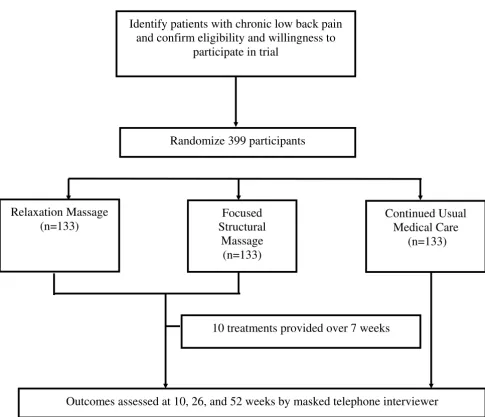
OverviewWe will recruit health plan patients who have sought med-ical care for chronic low back pain. Eligible participants will be randomized equally to one of three groups (Figure 1): Relaxation Massage (RM), Focused Structural Massage (FSM) or continued usual care (UC). Participants in the two massage arms will receive 10 treatments over a 10-week period. The massage treatments will be provided by licensed massage therapists with experience in both RM and FSM and who will receive special training in imple-mentation of the treatment protocols. To minimize disap-pointment (and possibly losses to follow-up), participants assigned to UC will receive $50. All partici-pants will retain access to the health care services to which they are entitled by their insurance coverage.
Participants will be followed for a one-year period follow-ing randomization and primary and secondary outcomes will be assessed by telephone interviewers masked to treatment assignment after 10, 26, and 52 weeks. The pri-mary outcomes will be dysfunction due to back pain and bothersomeness of back pain. Secondary outcomes will include general health status, satisfaction with back care, days of restricted activity, perceived stress, and use and costs of back-related health care for the year following ran-domization.
Bias will be minimized by a clinical protocol designed to offer maximum possible masking in a study of a physical procedure such as massage. Participants in the two mas-sage groups will know only that they will receive one of two methods of massage for treating back pain and that it isn't known which method is more effective. Furthermore, outcomes data will be collected by telephone interviewers masked to treatment assignment.
treat-ment but not the other. In addition, we will determine which specific FSM treatments emphasized by massage therapists' (as recorded on the visit treatment forms) are associated with the best treatment outcomes.
Study population
This study will focus on patients between 20 and 65 years of age with non-radicular chronic low back pain of mechanical origin (as opposed to infectious, neoplastic, or inflammatory causes). There are many causes of low back pain, but in most cases, the precise pathoanatomic diagnosis is unattainable because of the weak association among symptoms, pathoanatomic changes, and imaging results.
Inclusion and exclusion criteria
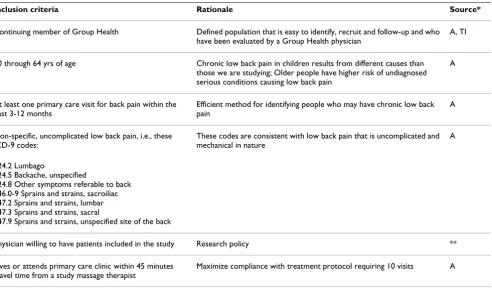
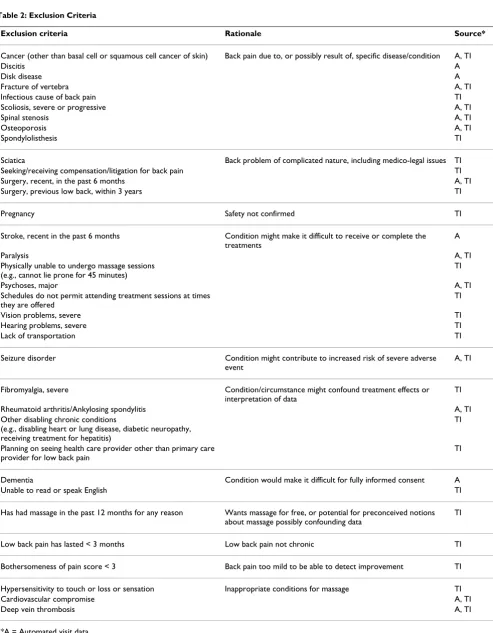
[image:3.612.64.549.81.498.2]Health plan members between 20 and 65 years of age with ICD-9 diagnoses indicative of non-specific low back pain will be eligible for the study if their pain has lasted at least three months, they rate their low back pain at least 3 on a 0 to 10 back pain bothersomeness scale, and give informed consent (Tables 1 and 2). Reasons for exclusion will be identified from two sources: 1) automated data on ICD-9 diagnoses recorded during all visits over the previ-ous year made by health plan members identified with low back pain-compatible ICD-9 diagnoses, and 2) tele-phone eligibility interviews. Members found to have any of the following will be excluded: structural or neurologic causes or potential causes of low back pain (i.e., sciatica, Study Design
Figure 1
Study Design. Recruitment, randomization to treatment, and outcomes assessment.
Randomize 399 participants
Identify patients with chronic low back pain
and confirm eligibility and willingness to
participate in trial
Relaxation Massage
(n=133)
Continued Usual
Medical Care
(n=133)
Outcomes assessed at 10, 26, and 52 weeks by masked telephone interviewer
10 treatments provided over 7 weeks
Focused
Structural
underlying systemic or visceral disease, pregnancy, spond-ylolisthesis, spinal stenosis, cancer or unexplained weight loss, recent vertebral fracture); inappropriate candidate for massage (e.g., the chronic conditions identified in Tables 1 and 2); characteristics complicating the interpre-tation of findings (i.e., involved with litigation or com-pensation claim for back pain, evidence of severe or progressive neurologic deficits, back surgery within the prior three years, planning to seek other treatment for back pain); or characteristics related to ability to complete the study protocol (i.e., unable to speak or read English, plans to move out of town).
Because sciatica is subjective we will ask patients about radiating pain, any association with numbness or tingling, whether it radiates below the knee, whether it is worse with coughing or sneezing, and whether the leg pain is worse than the back pain. These responses are combined to make a decision whether or not sciatica is likely. To minimize the likelihood of including persons who have strongly preconceived notions about specific massage treatments or who wish to participate in this trial only to obtain free massage treatments that they were planning to pay for anyway, we will exclude potential participants who have received massage for any reason within the past 12 months. Finally, we will require that participants be willing to visit one of the study massage therapists during
the 10-week treatment period and to respond to the 3 fol-low-up questionnaires.
Recruitment procedures
[image:4.612.65.557.99.393.2]Group Health members with in-plan visits resulting in diagnoses of non-specific low back pain will be identified from automated visit data. Those with diagnosis codes during the prior year that correspond to the exclusion cri-teria will be excluded. Primary care physicians will be pro-vided with a description of the study and given an opportunity to ask that their patients not be invited to par-ticipate. Three months after their back pain visits, poten-tial participants will be mailed brochures describing the study and key eligibility requirements and inviting partic-ipation. The brochure will contain a tear-out pre-paid postcard on which persons interested in the study can write their names and contact information and mail back to our study staff. An interviewer will then phone the members to answer questions and determine eligibility using a computer program to guide the members through a series of screening questions. The screening process ends with documentation in a database of either eligibility or ineligibility. If eligible, the study staff guides the patient through the consent and HIPAA processes and then mails prospective participants who remain interested two signed copies of the combined consent/HIPAA form. The prospective participant will then be asked to sign and
Table 1: Inclusion Criteria
Inclusion criteria Rationale Source*
Continuing member of Group Health Defined population that is easy to identify, recruit and follow-up and who have been evaluated by a Group Health physician
A, TI
20 through 64 yrs of age Chronic low back pain in children results from different causes than those we are studying; Older people have higher risk of undiagnosed serious conditions causing low back pain
A
At least one primary care visit for back pain within the past 3-12 months
Efficient method for identifying people who may have chronic low back pain
A
Non-specific, uncomplicated low back pain, i.e., these ICD-9 codes:
These codes are consistent with low back pain that is uncomplicated and mechanical in nature
A
724.2 Lumbago
724.5 Backache, unspecified
724.8 Other symptoms referable to back 846.0-9 Sprains and strains, sacroiliac 847.2 Sprains and strains, lumbar 847.3 Sprains and strains, sacral
847.9 Sprains and strains, unspecified site of the back
Physician willing to have patients included in the study Research policy **
Lives or attends primary care clinic within 45 minutes travel time from a study massage therapist
Maximize compliance with treatment protocol requiring 10 visits A
*A = Automated visit data; TI = Telephone interview
Table 2: Exclusion Criteria
Exclusion criteria Rationale Source*
Cancer (other than basal cell or squamous cell cancer of skin) Back pain due to, or possibly result of, specific disease/condition A, TI
Discitis A
Disk disease A
Fracture of vertebra A, TI
Infectious cause of back pain TI
Scoliosis, severe or progressive A, TI
Spinal stenosis A, TI
Osteoporosis A, TI
Spondylolisthesis TI
Sciatica Back problem of complicated nature, including medico-legal issues TI Seeking/receiving compensation/litigation for back pain TI
Surgery, recent, in the past 6 months A, TI
Surgery, previous low back, within 3 years TI
Pregnancy Safety not confirmed TI
Stroke, recent in the past 6 months Condition might make it difficult to receive or complete the treatments
A
Paralysis A, TI
Physically unable to undergo massage sessions (e.g., cannot lie prone for 45 minutes)
TI
Psychoses, major A, TI
Schedules do not permit attending treatment sessions at times they are offered
TI
Vision problems, severe TI
Hearing problems, severe TI
Lack of transportation TI
Seizure disorder Condition might contribute to increased risk of severe adverse event
A, TI
Fibromyalgia, severe Condition/circumstance might confound treatment effects or interpretation of data
TI
Rheumatoid arthritis/Ankylosing spondylitis A, TI
Other disabling chronic conditions
(e.g., disabling heart or lung disease, diabetic neuropathy, receiving treatment for hepatitis)
TI
Planning on seeing health care provider other than primary care provider for low back pain
TI
Dementia Condition would make it difficult for fully informed consent A
Unable to read or speak English TI
Has had massage in the past 12 months for any reason Wants massage for free, or potential for preconceived notions about massage possibly confounding data
TI
Low back pain has lasted < 3 months Low back pain not chronic TI
Bothersomeness of pain score < 3 Back pain too mild to be able to detect improvement TI
Hypersensitivity to touch or loss or sensation Inappropriate conditions for massage TI
Cardiovascular compromise A, TI
Deep vein thrombosis A, TI
return one copy of each form to the study staff in a pre-paid return envelope. Upon receipt of the signed form, a Research Specialist (RS) will contact the potential partici-pant to administer the baseline questionnaire using a computer-assisted telephone interviewing program. Those still willing to participate will be randomized to one of the three treatment arms.
If necessary, we will supplement recruitment by recruiting members who have had recurrent visits for low back pain at any time over the past few years or by placing advertise-ments in the health plan's quarterly magazine.
Randomization to treatment groups
After administering the baseline questionnaire, the RS will use an ACCESS database to randomize one third of the participants to usual care and two-thirds to a massage intervention. The RS will ask the participants randomized to a massage treatment about their preference for geo-graphic location of a therapist. The RS will then identify a therapist in the chosen location and enter that therapist's study identification code into the ACCESS database pro-gram that will use a pre-propro-grammed computer-generated sequence of blocked random numbers for each therapist to assign the participant, with equal probability, to FSM or RM treatment. Thus, using this two-stage randomization procedure, roughly one-third of all participants will be randomized to each of the three arms. This will also ensure that each massage therapist sees approximately equal numbers of participants in each of the two massage groups. The one-third of participants randomized to the control group will be mailed checks for $50. The randomi-zation database will be built to ensure that treatment allo-cation cannot be viewed prior to randomization and cannot be changed after randomization.
Participants randomized to the control group will be thanked for their willingness to participate, reminded of the importance of completing the follow-up interviews, and told they will be mailed checks for $50 in 4 to 6 weeks. Shortly after randomization to massage, the RS will call the massage therapist to provide the participant's con-tact information and to specify which type of massage the participant is to receive. The RS will also give the massage therapist a date by which the first appointment needs to be scheduled for that participant. Participants rand-omized to a massage treatment will be telephoned within 48 hours by the chosen massage therapist to set up the ini-tial appointment. The massage therapist will call the research assistant to confirm that the first appointment has been made. The massage therapist will provide partic-ipants directions to the therapist's office. The massage therapist will schedule the nine subsequent visits with the participant.
Study Treatments
Participants will be randomized to one of three groups: RM, FSM or UC. The RM and FSM treatment protocols will maximize the distinction between the types of relaxation massage and focused structural massage employed by licensed practitioners but preserve the massage therapists' belief that they are providing potentially helpful treat-ment by allowing them enough latitude to tailor their treatments to each patient. The massage therapists will carefully document the treatments they actually provide using specially-designed treatment visit forms color-coded and customized for each type of massage. The ther-apists will provide treatments to participants in both the groups in their offices. Both massage treatment protocols will prescribe 10 visits over 10 weeks, with each follow-up visit lasting one hour. The first visit will be 75 to 90 min-utes to allow for a full assessment as well as a treatment lasting 50 to 60 minutes.
In addition to providing the massage, therapists may pre-scribe self-care exercises from a pre-defined list of seven suggestions, which are designed to enhance the effects of the hands-on treatment. Six of these suggestions are com-mon to both types of massage (see below). Massage ther-apists will demonstrate each self-care suggestion they make and ask the participant to practice the suggestion. In addition, participants will be provided a standardized handout describing and illustrating each suggestion.
Relaxation Massage
In this arm, the massage therapist will give a series of 10 full body massages intended to ease low back pain and improve function by inducing a generalized sense of relax-ation.
a) Six distinct techniques will be permitted:
i) Effleurage (gliding)
ii) Petrissage (kneading)
iii) Friction (circular only)
iv) Vibration
v) Rocking and jostling
vi) Holding
i) Head/neck: 5-15 minutes
ii) Back and buttocks: 7-20 minutes
iii) Back of legs: 3-8 minutes
iv) Feet: 2-8 minutes
v) Arms: 5-8 minutes
vi) Hands: 3-8 minutes
vii) Front and sides of legs: 2-10 minutes
viii) Chest and abdomen: 5-15 minutes
c) Self-care suggestions: Following each treatment ses-sion, therapists may choose up to 3 suggestions for participants from the following list:
i) Resting Position to Ease the Lower Back
ii) Stretch for Before Getting Out of Bed
iii) Cat-Cow Stretch
iv) Lateral Bend
v) Walking to Help the Lower Back
vi) Golf Ball Roll to Stretch the Plantar Fascia
vii) Conscious Relaxation exercises on a compact disc (unique to the RM treatment protocol)
These self-care suggestions could vary from week to week.
Focused Structural Massage
In this arm, the massage therapist will give a series of 10 massages intended to identify and alleviate musculoskel-etal contributors to participants' low back pain.
a) Techniques Allowed: A wide range of therapeutic massage techniques will be allowed at the therapists' discretion. However, Swedish massage techniques, which are in prominent use in the RM protocol, can only be used to warm/prepare the tissue or to serve as transition strokes. Specific techniques that are permit-ted include the following:
i) Postural and palpatory assessment of tissues before, during and after massage.
i) Swedish massage - ONLY to warm and prepare the tissues or to serve as transition strokes
ii) Cross fiber and longitudinal friction massage -believed to break-up adhesions, address fibrosis, and/or increase local circulation in ischemic tis-sues.
iii) Myofascial Techniques including
(1) Muscle stripping - continuous strokes within the muscle bellies with the goal of sepa-rating adherent fascicles, improving circula-tion, identifying contraction modules, and elongating tissues.
(2) Myofascial release techniques: including direct and indirect, active and passive applica-tions, skin rolling techniques, broad, horizon-tal and longitudinal plane techniques, pin and stretch (fascia and/or muscle specific) and fas-cial unwinding.
iv) Neuromuscular Techniques
(1) Sustained compression (ischemic compres-sion) - used to work on active and latent trigger points or tender tissues. Tissues may be placed in neutral, stretched, or slackened position to access the irritable area.
(2) Trigger point therapy
(3) MET (Muscle energy techniques):
(a) post-isometric relaxation
(b) concentric and eccentric contraction based resistives
(c) reciprocal inhibition
(4) Origin insertion approximation technique and stretch applied at muscle attachments
(5) PRT (positional release techniques):
(a) functional technique
(b) facilitated positional release
(c) strain counterstrain
(d) orthobionomy
(7) Lymphatic techniques for relief of swelling, congestion and edema found in involved tissues
(8) Craniosacral Techniques that are part of a bio-mechanical approach - working with the bones, ligaments, muscles, and fascia of the craniosacral system. Energetic Craniosacral techniques are not allowed.
b) Areas of the body that can be treated - The FSM is expected to vary from one client to another and one session to another, as it is to be used in response to tis-sue abnormalities, postural habits, and other muscu-loskeletal impairments that may be contributing to the participant's low back pain. Any area of the body may be treated so long as it is within the scope of prac-tice for Massage Therapists in the State of Washington. It is not assumed, however, that this will necessarily result in full-body massages.
c) Self-care suggestions: Therapists may recommend up to 3 exercises for participants following each treat-ment session from the following list:
i) Resting Position to Ease the Lower Back
ii) Stretch for Before Getting Out of Bed
iii) Cat-Cow Stretch
iv) Lateral Bend
v) Walking to Help the Lower Back
vi) Golf Ball Roll to Stretch the Plantar Fascia
vii) Psoas Stretch (unique to the FSM treatment protocol)
Massage therapists
All massage treatments will be performed by licensed massage therapists who have at least 5 years experience, are comfortable strictly following both treatment proto-cols, and are trained and experienced in the techniques permitted in both the RM and FSM treatment protocols. Approximately 25 massage therapists in the Puget Sound region of western Washington will be recruited from within the network of alternative providers contracted to provide services to Group Health members. This will ensure that the therapists have already met minimum qualifications (e.g., massage training and licensure, mal-practice insurance coverage, accessible and adequate treat-ment facilities). Participating massage therapists will need to agree to strictly adhere to the treatment protocols, be comfortable providing either massage treatment to any of
the study participants, and to complete the training pro-gram for the study.
Training and monitoring of massage therapists
The massage therapists will attend 1.5 day training pro-gram with co-investigators Sherman and Kahn, and con-sultant Diana Thompson, an experienced massage therapist who is a national leader in developing standards of care for the profession. This training will include a thor-ough discussion of the protocol and instruction in using terms consistently when they record the findings of their assessments and the treatments they provide on the treat-ment visit forms. There will also be hands-on training ses-sions to ensure that study massage therapists are comfortable with following both of the protocols and with the types of questions they might be asked by partic-ipants about the protocols. The therapists will also prac-tice completing the treatment forms correctly and giving self-care suggestions. The training sessions will include "dress rehearsals" for both of the treatment styles using mock participants.
Assessment of outcomes
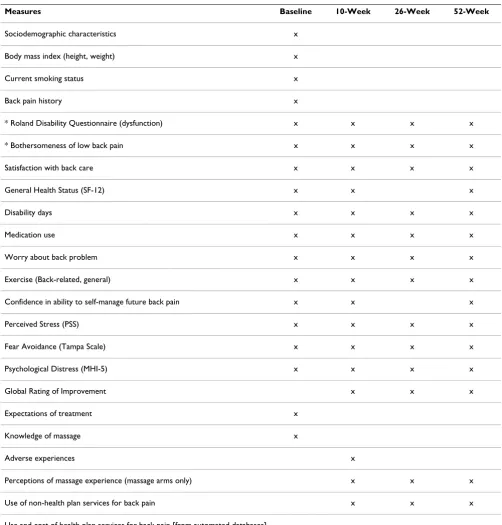
A core set of recommended outcome measures [9] cover-ing five important domains will be assessed: back-related dysfunction, pain, general health status, disability and patient satisfaction. The primary effectiveness outcomes are pain and dysfunction assessed at the 10-week tele-phone interview. Relative effectiveness will be determined by comparing changes from baseline to follow-up among the three treatments arms. Table 3 summarizes the catego-ries of questions included in the baseline and follow-up questionnaires.
Primary measures of effectiveness
The modified Roland-Morris Disability Questionnaire will be used to measure back-related patient dysfunction [9,10]. This instrument, which asks 23 yes/no questions and takes approximately five minutes to complete, is scored by summing up the number of "yes" responses. It has been found to be reliable, valid and sensitive to clini-cal changes [10-12] and is well suited for telephone administration. This is the single most important out-come of the study.
highly correlated with measures of function and other outcome measures [10].
Both primary outcomes will be measured at baseline and during the 10, 26 and 52 week follow-up interviews. The trial's primary endpoint will be the 10 week follow-up, immediately after completion of the 10 massage
treat-ments. All interviews will be conducted using computer-assisted telephone interviews (CATI)
Secondary outcome measures
[image:9.612.54.556.97.622.2]General health status will be measured using the well-vali-dated SF- 12 [13] that has been recommended for use in
Table 3: Content of baseline and follow-up questionnaires
Measures Baseline 10-Week 26-Week 52-Week
Sociodemographic characteristics x
Body mass index (height, weight) x
Current smoking status x
Back pain history x
* Roland Disability Questionnaire (dysfunction) x x x x
* Bothersomeness of low back pain x x x x
Satisfaction with back care x x x x
General Health Status (SF-12) x x x
Disability days x x x x
Medication use x x x x
Worry about back problem x x x x
Exercise (Back-related, general) x x x x
Confidence in ability to self-manage future back pain x x x
Perceived Stress (PSS) x x x x
Fear Avoidance (Tampa Scale) x x x x
Psychological Distress (MHI-5) x x x x
Global Rating of Improvement x x x
Expectations of treatment x
Knowledge of massage x
Adverse experiences x
Perceptions of massage experience (massage arms only) x x x
Use of non-health plan services for back pain x x x
Use and cost of health plan services for back pain [from automated databases]
studies of back pain [14]. We will calculate the SF-12 physical and mental health summary scores.
Days of restricted activity due to back problems, a surrogate for disability, will be measured with a back-pain specific modification of 3 National Health Interview Survey ques-tions about the number of half-days spent in bed, home from work or school, or cutting down on usual activities due to illness or injury during the past week [15].
Patient global rating of improvement will be measured by asking participants to provide a global rating of improve-ment in their back-related dysfunction on a seven point scale ranging from "completely gone" to "much worse". Satisfaction with information given about the cause of the back problem, treatments received, and overall care will be measured using three separate questions, each using a 5-point Likert scale (ranging from very satisfied to very dissatisfied).
We will include the following psychosocial measures:
Psychological distress will be measured with the 5-item Mental Health Index of the SF-36 [16]. This scale, which assesses general mental health, including depression, anx-iety, behavioral-emotional control, and general positive affect, is brief and reliable and has shown good agreement with more comprehensive measures of mental health [17].
Perceived stress will be measured with the 10-item version of the Perceived Stress Scale [18], the most widely used self-report measure of psychological stress. The Perceived Stress Scale is a state measure that usually asks about stress experienced over the last month, and is influenced by fac-tors that vary such as daily hassles, life events, appraisals and coping resources [19]. Thus, the PSS should be sensi-tive to changes in life stress due to the massage interven-tion.
Fear avoidance will be measured with the Tampa Scale for Kinesiophobia [20] that measures back pain patients' fears of movement, exercise and serious underlying dis-ease. We will use the 10-item version that retains accepta-ble internal consistency (alpha = 0.76), is easier and quicker to administer and has proved sensitive in detect-ing intervention effects in clinical trials [21]. Typical items (rated on a "strongly agree" to "strongly disagree" Likert scale) are: "I'm afraid that I might injure myself if I exer-cise;" and "My body is telling me I have something dan-gerously wrong."
Measures of health care resource use
Participants' use of health care for back pain during the year following randomization will be measured using
automated utilization data, interview data on out-of-plan utilization, and records for each visit to the study massage therapists. The automated utilization data will provide information about all provider visits and hospitalizations at health plan facilities or paid for by the health plan. Vis-its for back pain can be identified by the diagnoses listed for every visit and hospitalization. Imaging studies of the lower back can also be identified by specific procedure codes.
Visits to non-study massage therapists and providers not covered by the health plan will be estimated from the interview data for the time period since the previous inter-view, i.e., the 10-week interview will request information about out-of-plan utilization since participants were ran-domized to study treatment, the 26-week interview will ask about the previous 16 weeks, etc. These data will per-mit determination of the percentage of participants in each treatment group who had any visits for low back pain during and following the intervention period, as well as calculation of the mean number of visits. Current use of medications of all types used for low back pain will be captured in the follow-up interviews.
Costs of back-related care will be estimated by assigning dollar values to each service. Costs of specific services (e.g., visits, imaging studies, medications) will be deter-mined using data from Group Health's cost management information system which defines cost based on standard relative value units (RVUs) assigned to actual department RVUs produced. Costs of the massage interventions will be distinguished from the costs of all other back pain-related services to permit separate comparisons among the treatment groups of the costs of the interventions themselves, of the non-intervention back care costs incurred during the 10-week treatment period, and of the total back pain-related costs incurred over the 42 week period between completion of the study interventions and the end of the 52 week follow-up period.
Data Collection and Management
We will implement procedures to ensure that randomiza-tion is proceeding as planned, recruitment is on track, clinic data collection forms are accurately entered into databases, the computer assisted telephone interviewing (CATI) system is storing data correctly, and data can be accurately transferred and retrieved as needed. We will develop a relational database to track information on every stage of recruitment, randomization, treatment process, and outcomes assessment so we can report patient flow automatically and in an integrated fashion using standard, automated reports. To ensure accurate transfer of information, we will use electronic methods to routinely transfer data from the CATI database to the rela-tional database. All data system processes will be thor-oughly tested prior to the start of recruitment.
The CATI programs will contain range and logic checks. Appropriate information collected on the massage treat-ment visit forms will be entered into a computer database that also contains range and logic checks. Data will be examined for completeness using computer programs developed specifically for that purpose. In addition, we will test all analytic programs to ensure that the analyses are accurate. Procedures to protect the confidentiality and integrity of the databases and paper systems will be reviewed by the biostatistician prior to patient recruit-ment and periodically during the study.
To maintain the confidentiality of patient-related infor-mation in the database, unique participant study numbers will be used to identify patient outcomes and treatment data. The password security system will assign appropriate levels of computer privileges to different groups of data-base users. This will ensure that all masked personnel remain masked to treatment group.
Computer files with patient names will be password pro-tected with access restricted to staff using this information to recruit patients, obtain follow-up data, and interact with any patients reporting adverse events. We will pre-test the procedure for sending the randomization infor-mation to the massage therapist and regularly audit treat-ment visit forms to ensure that participants being treated by massage therapists receive the treatment to which they were assigned and that the protocol is being correctly fol-lowed. During the treatment phase of the trial, we will continually monitor the massage therapists and provide focused booster training as needed. The massage thera-pists will mail copies of Visit Forms (identified only by study ID number and patient initials) to the research team after each participant has completed treatment. After being audited to ensure adherence to the protocol, charts will have initials removed, and again stored in locked fil-ing cabinets accessible only to study personnel. Finally, all
analysis data files will be password protected. Full data backup procedures will be performed nightly.
Protection of human subjects and assessment of safety Protection of human subjects
This study protocol was approved by the Institutional Review Board of Group Health Cooperative.
Data Safety Monitoring Body
Given the favorable safety profile from previous studies of massage coupled with the small numbers of adverse events reported in the literature, this trial will be moni-tored for safety by an independent Data Safety Monitoring Body (DSMB) comprised of a biostatistician, primary care physician and massage therapist. The DSMB's job will be to evaluate the adverse experience data we will provide them on a regular basis to protect the safety of the study participants. Based on the observed adverse effects of the treatments under study, the DSMB will make recommen-dations on a regular basis to the P.I. and the Office of Clin-ical and Regulatory Affairs at the National Center for Complementary and Alternative Medicine (NCCAM) regarding continuation, termination, or other modifica-tions of the trial.
Adverse Events
Participants will be asked about adverse experiences at each massage visit and during the 10-week telephone interviews. We will define an adverse experience as any unfavorable and unintended sign, symptom or disease temporally associated with the use of the massage treat-ments that could reasonably be related to the treattreat-ments. Because massage has relatively short-term physiological effects, we will not report adverse events that first manifest more than one week after a participant's final treatment (or more than 10 weeks after randomization for the usual care control group). If a participant develops a Serious Adverse Experience (i.e., any adverse event occurring dur-ing treatment that results in any of the followdur-ing out-comes: death, a life-threatening adverse event, inpatient hospitalization or prolongation of existing hospitaliza-tion, a persistent or significant disability/incapacity, or cancer) during the 10 weeks after randomization, it will be promptly (within 7 days) reported to the chair of the Data Safety Monitoring Body. If the Adverse Experience is, at least possibly, due to massage, it will also be promptly reported to the Group Health IRB and to NCCAM's Office of Clinical and Regulatory Affairs. In addition, we will summarize all adverse experiences in the trial in our rou-tine reports to our DSMB and IRB.
Stopping rules
serious adverse events in one or more of the treatment arms. In this case, the DSMB could decide to terminate one of the arms of the trial or the entire trial.
We are not proposing to perform an interim analysis for efficacy and therefore have established no formal stop-ping rules. Even if the two massage treatments reduce pain and dysfunction (the primary outcomes of this trial) more than usual care, we do not consider this an important enough reason to end the trial early. Previous trials of massage have been plagued by small sample sizes and we think it is important that this study be large enough and long enough to clearly evaluate the effectiveness of mas-sage.
Statistical Issues
Sample size and the detectable difference
Because patient function (or dysfunction) is generally considered the more consequential of our two primary outcome measures, we want to ensure that our sample size estimates provide adequate power to detect a clini-cally significant difference of 2.0 points between groups on the Roland Disability scale [10]. To obtain outcomes data for 120 subjects per group, assuming a 10% loss to follow-up rate, we would need to randomize 133 partici-pants. Our target sample size of 399 randomized individ-uals (133 per group) was computed using assumptions described below.
To protect against multiple comparisons, we will use Fisher's protected least significant difference approach which has been shown to have desirable properties when there are three groups [23]. This approach makes pair-wise comparisons between the three treatment groups only if the overall F-test is significant. The power of the overall analysis depends on how the means from the three treatment groups differ. We therefore assumed that the FSM group would be one Roland point superior to the RM group, which would, in turn, be one Roland point better than the UC group (giving a difference of 2 points between the FSM and UC groups).
Our estimates of the standard deviations of our primary outcome measures (adjusted for pre-randomization base-line values) derive from analyses of covariance of 8-week follow-up data from 92 study participants in our pilot study evaluating acupuncture for chronic low back pain: Roland SD = 4.65 and Bothersomeness SD = 2.71. Com-parable standard deviation estimates at the end of the 10-week treatment period for 83 participants in our pilot study of CAM therapies for chronic low back pain, were 12%-15% lower. Thus, the standard deviation estimates we used for calculating statistical power in the proposed trial are probably conservative, likely underestimating actual power.
With 120 respondents per group (using two-sided signifi-cance level of 0.05) the omnibus F-test for the Roland scale will have 85% power for detecting a statistically sig-nificant difference among the three treatment means. If this omnibus test is statistically significant, as appears likely given our previous studies of FSM and those of oth-ers, we will address each Specific Aim of the study by com-paring specified pairs of means, as discussed below. We will have 91% power to detect a pairwise difference of 2.0 Roland units.
For our other primary outcome measure, symptom both-ersomeness, we want to be able to detect a minimal clini-cally important difference of 1.5 points on the 0 to 10 scale [10]. With data for 120 participants per group we will have over 99% power for detecting a minimal clini-cally significant difference among the three treatment means (assuming they are equally spaced and with 1.5 points between the extremes). In pairwise comparisons we will have 99% power to detect a 1.5-point difference on the Bothersomeness scale.
The power calculations are based on simple comparisons of the follow-up scores at a single point in time (ten weeks after randomization) with adjustment for baseline values using analysis of covariance. We also plan to adjust for other baseline characteristics (e.g., age, gender, and base-line covariates found predictive of 10-week outcomes). Inclusion of such baseline covariates can also improve precision of the variance estimate and therefore increase power.
Statistical Analysis
The primary statistical analyses will directly address Aim 1 (to determine if RM is an effective treatment for chronic low back pain) and Aim 2 (to determine if FSM is more effective than RM). A separate analysis will address the third aim, to explore the ability of psychosocial, and clin-ical baseline characteristics of patients to predict which of them will benefit most from each type of massage and which components of each treatment are associated with superior outcomes. These analyses are described below.
We will use an intent-to-treat approach for all analyses, i.e., individuals will be analyzed by the group to which they were randomized, regardless of participation in any treatment sessions. This minimizes biases that often occur when participants not receiving assigned treatments are excluded from analyses. We will use a standard linear regression mean model (ANCOVA) of the form:
where Y(t) is the response at follow-up time t, Baseline is
the pre-randomization value of the outcome measure, Trt
includes dummy variables for the full relaxation massage and focused structural massage groups, Time is a series of dummy variables indicating the follow-up times, and z is a vector of covariates representing other variables being adjusted for. (Note that α1, α2, α3, and α4 are vectors.) The referent group in this model is the usual care group at the first follow-up time. The models will be fitted using Gen-eralized Estimating Equations (GEE) to take into account possible correlation within individuals over time [24]. GEE protects against misspecification of the correlation within a participant's scores over time. Such analyses can incorporate data for every time point at which a patient completes a follow-up interview. However, it is important to first assess whether there is differential dropout by either assigned treatment or symptom or function level. If differential dropout occurs, we will use the method of Lit-tle to rectify possible biases that could occur [25].
Both primary outcomes (function and symptoms) will be tested at the 0.05-level, because they address separate sci-entific questions. Analyses of both outcomes will be reported, imposing a more stringent requirement than simply reporting a sole significant outcome. Arguments against adjusting for multiple comparisons in this situa-tion have been made by Rothman) and others [26-28].
If we find a significant overall difference, we will localize the difference among the three groups using pairwise comparisons in accordance with our specific aims. For Aim 1, we will compare the RM group with the UC group. For Aim 2, we will compare the RM group with the FSM group. We will also compare the FSM group and the UC group, although this is not included as a specific aim.
We will consider interactions of treatment and the base-line value that would indicate the effect of treatment depends on status at baseline. We will also test for signif-icant interactions of treatment with other variables (e.g., age, race, gender, and pain below the knee but not meet-ing criteria for sciatica) to determine if treatment differ-ences are modified by these variables. To explore whether baseline characteristics predict which treatment performs better (Aim 3), we will examine our main outcome meas-ures separately by subgroups using both tabular and graphical methods. We will begin with simple exploratory data analysis approaches, because we have no initial hypotheses about which characteristics will predict treat-ment success. Exploratory analysis will examine the uni-variate relationships between potential baseline predictor variables and outcomes of the treatments. We may also use more sophisticated statistical methods (e.g., latent class analysis) to identify individuals with different pat-terns of baseline characteristics that respond differently to the treatments.
We will also analyze secondary outcomes for Aims 1 and 2, including costs of back care, general health status (SF-36), depression, perceived stress, fear avoidance, disabil-ity days, and satisfaction with care. An analysis of costs may entail a transformation (e.g., log cost) but can be modeled using linear regression without a baseline value for costs since they will be unknown. We will adjust for age and other factors that may affect costs. We recognize that we will have low statistical power to detect even mod-erate cost differences among the groups. For binary out-comes (e.g., medication use) we will use logistic regression. Despite the multiplicity of analyses, we will focus our main analyses on treatment effects on each of the five outcome domains recommended for studies of back pain [8].
We are interested in the effect of individual massage ther-apists on the outcomes. Because each massage therapist will deliver both RM and FSM treatments, we can compare treatment effects within each massage therapist. While dif-ferences would have to be extremely large to detect a sig-nificant difference for a particular therapist, we may be able to determine whether there is significant variation across massage therapists that cannot be explained by ran-dom variation.
Finally, we will conduct exploratory analyses using the treatment log data to examine relationships among underlying conditions, treatments used and treatment outcomes. For the FSM treatment group, we will describe the frequency with which each specific technique was used and the relationship between the underlying condi-tion and the technique(s) selected, using chi-square tests. We will then examine the relationship between the under-lying condition and the likelihood of a good outcome and whether this relationship is affected by the specific treat-ment(s) employed. For these analyses we will use stand-ard multivariate techniques (e.g., analysis of covariance, logistic regression, GEE). For the RM group, which follows a relatively fixed treatment protocol, we will only examine the relationship between the underlying condition and treatment outcomes.
Competing interests
The authors declare that they have no competing interests.
Authors' contributions
Publish with BioMed Central and every scientist can read your work free of charge
"BioMed Central will be the most significant development for disseminating the results of biomedical researc h in our lifetime."
Sir Paul Nurse, Cancer Research UK
Your research papers will be:
available free of charge to the entire biomedical community
peer reviewed and published immediately upon acceptance
cited in PubMed and archived on PubMed Central
yours — you keep the copyright
Submit your manuscript here:
http://www.biomedcentral.com/info/publishing_adv.asp
BioMedcentral
the manuscript. All authors read and approved the final manuscript.
Acknowledgements
We are particularly grateful to the educators from the Massage Therapy Research Consortium who designed the two massage treatment protocols: Lou Benson, Founder and Director, The Bodywork Education Project, Cambridge, MA; Elaine Calenda, Boulder College of Massage Therapy, Boulder, CO; John Katomski, Swedish Institute, New York, NY; Martha Menard, Charlotttesville, VA; and Dawn Schmidt, Four Winds Massage, Education, Consulting and Spiritual Practices, Edmonds, WA. We are also grateful for the assistance of our NCCAM Project Officer, Dr. Partap Kha-lsa.
This trial was funded by the National Institute of Health's National Center for Complementary and Alternative Medicine (NCCAM) (R01 AT 001927). The study was reviewed and approved by NCCAM's Office of Clinical and Regulatory Affairs before being funded. Beyond providing funding, NCCAM has not participated in the research activities of this project.
References
1. Wolsko PM, Eisenberg DM, Davis RB, Kessler R, Phillips RS: Pat-terns and perceptions of care for treatment of back and neck pain: results of a national survey. Spine 2003, 28:292-7. 2. Cherkin DC, Deyo RA, Sherman KJ, Hart LG, Street JH, Hrbek A,
Davis R, Cramer E, Milliman B, Booker J, Mootz R, Barassi J, Kahn JR, Kaptchuk TJ, Eisenberg DM: Characteristics of visits to licensed acupuncturists, chiropractors, massage therapists, and naturopathic physicians. J Am Board Fam Pract 2002, 15:463-72. 3. Eisenberg DM, David RB, Ettner SL, Appel S, Wilkey S, Rompay MV,
Kessler RC: Trends in alternative medicine use in the United States, 1990-1997: Results of a follow-up national survey. JAMA 1998, 280:1569-75.
4. Cherkin DC, Eisenberg D, Sherman KJ, Barlow W, Kaptchuk TJ, Street J, Deyo RA: Randomized trial comparing traditional Chinese medical acupuncture, therapeutic massage, and self-care education for chronic low back pain. Arch Intern Med
2001, 161:1081-8.
5. Hernandez-Reif M, Field T, Krasnegor J, Theakston H: Lower back pain is reduced and range of motion increased after massage therapy. Int J Neurosci 2001, 106:131-45.
6. Preyde M: Effectiveness of massage therapy for subacute low-back pain: A randomized controlled trial. CMAJ 2000, 162:1815-20.
7. Schnitzer TJ, Ferraro A, Hunsche E, Kong SX: A comprehensive review of clinical trials on the efficacy and safety of drugs for the treatment of low back pain. J Pain Symptom Manage 2004, 28:72-95.
8. van Tulder MW, Touray T, Furlan AD, Solway S, Bouter LM, Cochrane Back Review Group: Muscle relaxants for nonspecific low back pain: a systematic review within the framework of the Cochrane collaboration. Spine 2003, 28:1978-92.
9. Bombardier C: Outcome assessments in the evaluation treat-ment of spinal disorders: summary and general recommen-dations. Spine 2000, 25:3100-3.
10. Patrick DL, Deyo RA, Atlas SJ, Singer DE, Chapin A, Keller RB: Assessing health-related quality of life in patients with sciat-ica. Spine 1995, 20:1899-1909.
11. Deyo R, Battie M, Beurskens AJHM, Bombardier C, Croft P, Koes B, Malmivaara A, Roland M, Von Korff M, Waddell G: Outcome meas-ures for low back pain research: A proposal for standardized ise. Spine 1998, 23:2003-13.
12. Roland M, Fairbank J: The Roland-Morris Disability Question-naire and the Oswestry Disability QuestionQuestion-naire. Spine 2000, 25:3115-24.
13. Ware JE, Kosinski M, Keller SD: A 12-Item Short-Form Health Survey: Construction of scale and preliminary tests of relia-bility and validity. Med Care 1996, 34:220-223.
14. Luo X, Lynn George M, Kakouras I, Edwards CL, Pietrobon R, Rich-ardson W, Hey L: Reliability, validity, and responsiveness of the
short form 12-item survey (SF-12)in patients with back pain. Spine 2003, 28:1739-45.
15. Riess PW: Current estimates from the national health inter-view survey: United States, 1984. Hyattsville, MD: National Center for Health Statistics. DHHS publication PHS; 1986:86-1584. Vital and health statistics; series 10; no. 156
16. Ware JE Jr, Sherbourne CD: The MOS 36-item short-form health survey (SF-36). I. Conceptual framework and item selection. Med Care 1992, 30:473-83.
17. Ware J, Kosinski M, Keller SK: SF-36 physical and mental health summary scales: A user's manual. The Health Institute, Boston; 1998.
18. Cohen S, Williamson G: Perceived stress in a probability sample of the United States. In The social psychology of health. Claremont Symposium on applied social psychology Edited by: Spacapan S, Oskamp S. Newbury Park, CA: Sage; 1988.
19. Cohen S, Kamarck T, Mermelstein R: A global measure of per-ceived stress. J Health Soc Behav 1983, 24:385-96.
20. Vlaeyen JW, Kole-Snijders AM, Boeren RG, van Eek H: Fear of movement/(re)injury in chronic low back pain and its rela-tion to behavioral performance. Pain 1995, 62:363-72. 21. Von Korff M, Moore JE, Lorig K, Cherkin DC, Saunders K, González
VM, Laurent D, Rutter C, Comite F: A randomized trial of a lay person-led self-management group intervention for back pain patients in primary care. Spine 1998, 23:2608-2615. 22. Altman DG, Schulz KF, Moher D, Egger M, Davidoff F, Elbourne D,
Gøtzsche PC, Lang T, CONSORT GROUP (Consolidated Standards of Reporting Trials): The revised CONSORT statement for reporting randomized trials explanation and elaboration. Ann Intern Med 2001, 134:663-94.
23. Levin JR, Serlin RC, Seaman MA: A Controlled, Powerful Multi-ple-Comparison Strategy for Several Situations. Psychological Bulletin 1994, 115:153-159.
24. Zeger SL, Liang KY: Longitudinal data analysis for discrete and continuous outcomes. Biometrics 1986, 42:121-30.
25. Little RJA: Modeling the drop-out mechanism in repeated-measures studies. J Am Stat Assoc 1995, 90:1112-1121.
26. Rothman KJ: No adjustments are needed for multiple compar-isons. Epidemiol 1990, 1:43-6.
27. Rothman KJ, Greenland S: Modern Epidemiology 2nd edition. Lippin-cott-Raven, Philadelphia; 1998.
28. Savitz DA, Olshan AF: Multiple comparisons and related issues in the interpretation of epidemiologic data. Am J Epidemiol