IMAGE RESTORATION BASED ON UNSYMMETRIC
FUZZY SWITCHED STEERING KERNEL
1 R. PRABHU, 2 Lt. Dr. S. SANTHOSH BABOO
1
Research Scholar, Department of Computer Science, Bharathair University Coimbatore, India.
2
Associate Professor, P.G. & Research Dept Computer Science, D.G. Vishnav College Chennai, India.
E-mail: [email protected], [email protected]
ABSTRACT
The Digital image restoration is one of the image processing techniques that deals with the methods used to recover an original image from a degraded image. The proposed work is done for high density impulse noise which is affected by gaussian blur and is solved by using fuzzy filtering techniques for denoising and a Noise Suppressed Steering Kernel for deblurring which is a hybrid method. In the previous work the outputs suffering with spurious edges in the case of denoising. The above disadvantages of the steering kernel are overcome by using median filters. The presence of spurious edges on iterative process gets added up and becomes stronger if not removed. Hence it can be eliminated by using median filters at the end of the each iteration, since this method is an iterative process. A noise suppressed steering kernel NSSK is used in the proposed method.
Keywords: Image restoration, Fuzzy filter, Steering kernel, Noise suppressed steering kernel.
1. INTRODUCTION
In the field of image processing digital image restoration is one of the processes to recover an original image which is degraded. Blur and noise are the two common problems that exist in digital imaging. It happens during important camera setting that strongly affects these two issues. If the exposure time is fixed, a large aperture will increase the signal to noise ratio, mean while reducing the depth of field and thus increasing the out-of-focus blur, which eliminates high-frequency components of the image. On the other hand, a small aperture will alleviate the blur but increase the noise level. Noise can also be suppressed by using longer exposure time but of course, this may cause motion blur that is even more difficult to remove. At the same time, limited accuracy of auto-focus systems and low light condition may add extra blur and noise into the image. So in real applications, such as consumer digital imaging, it is very common to record weakly blurred and relatively noisy images.In digital image restoration regression is one of the process of recovering original image which is affected by
noise or blur. The image can be recovered by using denoising and deblurring techniques. Basically regression has two techniques .The first one is parametric regression which is based on some specific model for the underlying original data and analyses and estimates based on those parameters. The second one is non-parametric regression which is based on data itself instead of assuming a specific model for the original data. There are lots and lots of methods are used for denoising and debluring.
second section illustrates on fuzzy techniques for denoising and the third section illustrates steering kernel for image deblurring. The fourth section illustrates the Noise Suppressed Steering Kernel and the last section gives the result and analysis.
2. LITERATURE REVIEW
The digital image restoration is challenging in the field of computer science and its application. The ultimate aim of image restoration is to bring a better result when an image is degraded. Image degradation is happened in so many reasons, it happens due to miss focus of camera, camera settings, environmental changes etc. In order to rectify this issue lots and lots of methods are proposed for bringing better results. AtoniBuades et al [1] proposed a measure called noise for evaluation and comparison of denoising methods. Initially the above said noise measure is computed and analyzed for local smoothing filters and then a new algorithm called “Non-Local means” is proposed as the result of non-local averaging of the pixels of an image. Bart Goossens et al [2] improved the NL means algorithm and extended to reduction of colored or correlated noise which resulted in better denoising compared with wavelet based techniques. Haichao Zhang et al [3] presented Non Local Kernel Regression model using structural and similarity properties in images. The properties are non-local self-similarity and local structural regularity. The model can be applied in denoising, deblurring and also reconstruction of both images and videos. [4]
The conjunctive deblurring algorithm (CODA) was able to handle large blur. In CODA the temporal kernel is computed by using the large steps restored by the deterministic filter. Therefore if the image structures are dominated by narrow edges, CODA cannot produce an accurate blur kernel and it can be applied to other Basyian Estimation based problems, such as image denoising, unsampling, matting and impainting. [5] Jian-FengCai states how to recover a motion blurred image due to camera shake by using a regularization- based approach to remove motion blurring form the image by regularizing the sparsity of both the original image and the motion blur kernel under tight wavelet frame system. This method was not able to deal with nonuniform motion blurring, including
image blurring caused by camera rotation and partial image blurring caused by fast moving objects in the scene. [6] HuiJi and Kang Wang proposed a robust image deblurring with an inaccurate blur kernel method can either be used to deblur images when only the blur kernel of low quality is available or can be used to deblur images blurred by complex blurring processes such as spatially varying motion blurring.
3. IMAGE DENOISING USING FUZZY TECHNIQUE
This is one of the machine learning concepts. The machine learning concept is divided into two categories namely artificial neural network and fuzzy logic. In artificial neural network the input and output must be declared and trained based on the application. The fuzzy logic technique is used to certain application based on which the user fix some criteria. Fuzzy logic represents a powerful approach to decision making. Since the concept of fuzzy logic was formulated in 1965 by Zadeh, many researchers have been carried out on its application in the various areas of digital image processing such as image quality assessment, edge detection, image segmentation, etc.
In fuzzy technique there is a membership function which will decide the criteria. There are three types of membership function applied in the proposed work. The first function is named as small negative, second function is negative and third function is large negative. This is known as tramp type membership function. These function come under trapezoidal membership function .This is applied based on the rule which is created to the input image.
figure 1.0. The next membership function takes the pixel value from 4 to 6, when the noise fall in this pixel it will consider as negative shown in the figure 1.1. When the noise fall on the pixel value from 6 to 9 it is named as large negative shown in the figure 1.2.
3.1 Rule generation
In the proposed work we have generated four rules.
a. When f0 is small negative and f255 is negative the system generate mean for the corresponding pixel.
b. When f0 is large negative and f255 is small negative the system generate standard deviation.
c. When f0 is negative the system generates median operation.
[image:3.595.82.508.95.768.2]d. When f255 is positive the system generates mean operation.
Figure 1.0 Fuzzy System
[image:3.595.317.508.159.247.2]Figure 1.1 F0 membership function
[image:3.595.320.473.180.457.2]Figure 1.2 F255 membership function
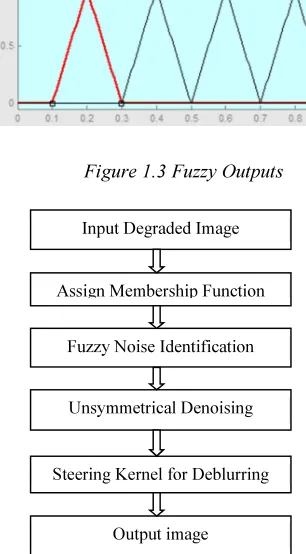
Figure 1.3 Fuzzy Outputs
Figure1.4: Overview of the proposed method
In the figure 1.3 shows the overview of the proposed method.
Step 1: First get an input degraded image is
taken for the process.
Step 2: Assigning fuzzy membership function
for degraded image.
Step 3: Noise identification using fuzzy rules.
Step 4: Unsymmetrical denoising based on fuzzy
output.
Step 5: Next use Steering kernel for Deblurring
the image.
Step 6: Finally the original image is recovered
by using a Noise Suppressed Steering kernel.
Input Degraded Image
Assign Membership Function
Unsymmetrical Denoising Fuzzy Noise Identification
Steering Kernel for Deblurring
[image:3.595.92.287.254.611.2]
Input Noisy Image
0 ≤
Pij ≤ 255
Select 3x3 windows with center element Pij as processing pixel
All pixels 0’s or 255’s
No change in the selected 3x3
window
Processing pixel is replaced by mean
filtering
Compute F0 and F255
Std deviation Median Mean
Fuzzy Rules
[image:4.595.146.451.162.682.2]Denoised image
Figure 1.5: Flow chart of fuzzy denoising
The above flowchart describes the functionality of image denoising using fuzzy technique. First the input image of
3x3
windows is taken with the center
element Pij
pixel is replaced by mean filtering. Now compute f0 and f255 by using fuzzy filtering. Now fuzzy rules are applied based on pixel values. Based on pixel value fuzzy will decide to
calculate standard deviation, mean and median. Finally the image is denoised using fuzzy filtering technique.
[image:5.595.195.478.204.656.2]4. NOISE SUPPRESSED STEERING KERNEL
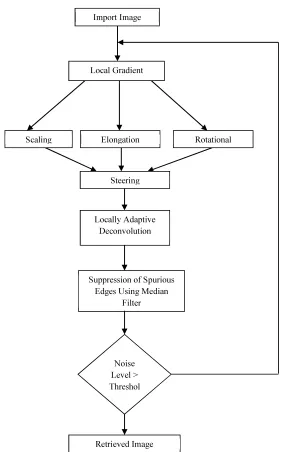
Figure 1.6: Flowchart of Noise Suppressed Steering Kernel
The traditional process of steering kernel regression technique is a non parametric approach of regression which involves directly on the data itself instead of depending on any specific model. The above method outputs
spurious edges when noise is high. The presence of spurious edges on iterative process gets added up and becomes stronger if not removed. Hence it can be eliminated by using median filters at the
Suppression of Spurious Edges Using Median
Filter Steering
Locally Adaptive Deconvolution
Noise Level > Threshol
Retrieved Image Import Image
Scaling Elongation Rotational
end of all iteration. This method has the following steps.
1. Importing image
2. Formulating image and local gradient. 3. Parametric analysis
4. Steering matrix formation 5. Application of steering kernel 6. Suppression of spurious edges 7. Thersholding
4.1. Importing Image:
The image needed to be edge detected is chosen from the database of images. All the initial process of making the image ready for further processing is to be performed. The initial process includes enhancing quality, cropping the image, resizing the image, etc,
4.2. Formulating image and local Gradient: An image gradient is a directional change in the intensity or color in an image. Image gradients may be used to extract information from images. Gradient is one of the important parameters used for image processing. The gradient of the image is given by using the formula
g ∂g∂x∗ x ∂g∂y∗ y
Where, பப୶ is the gradient in x direction,
ப
ப୷is the gradient in y direction.
After calculating the image gradient, local gradients are to be found. Local gradient are used to formulate the various parameters of the image.
4.3. Parametric analysis:
Gradient of an image can be used to analyze various parameters such as scaling parameters, Rotational parameter and elongation parameter. Scaling parameters provide information on sizes of the image. Rotational parameters are one associated with defining on what angle the image is been located or rotated. Elongation parameter is those which imply how the image has been elongated.
4.4 .Steering matrix formation:
A new approach of de-blurring is carried out using steering kernels regression technique. Steering kernels regression is carried out using steering matrix. Steering kernel regression is a non parametric regression
technique. It involves non linear combination of data i.e. the data not only depends on sample location and density but also on the radiometric properties. This method adapts the regression kernel locally so that the kernels arrange themselves along the features instead of arranging across them. Features include edges. The processes behind steering kernel regression are given below. The measured data of steering kernel is represented as,m୧ rd୧
α୧wherei 1 … p
Where
r (di)= regression function acting on pixel coordinates,
αi = zero mean noise values distributed identically and
p= total number of pixels.
The steering kernel is mathematically represented as
SKy୪ y୧ det CV୪ expy୪
y୧CV୪y୪ y୧
Where,
yi = center pixel where steering kernel (SK) window is located,
yl= locally selected pixel within SK window, CVl=Covariance matrix with window around yl.
4.5. Noise suppresses multi computing
steering kernel
The final noise suppresses multi computing kernel is obtained from the steering kernel using the formula,
k SK sF ⊗ SK Where,
k= noise suppresses multi computing kernel, SK = Steering kernel,
s = degree of sharpening, F = Laplacian filtering ⊗ = convolution operator.
4.6. Suppression of spurious edges:
4.7. Thresholding:
After the spurious edges are being removed the output image is subjected to a process of thresholding. The output values are being compared with one defined value which is the threshold value such that the output image values are compared with this defined value. If the appropriate threshold condition is not met the whole process will repeat from the initial stage of taking gradient. If it is met the obtained output is the final de-blurred output.
5. RESULT AND ANALYSIS
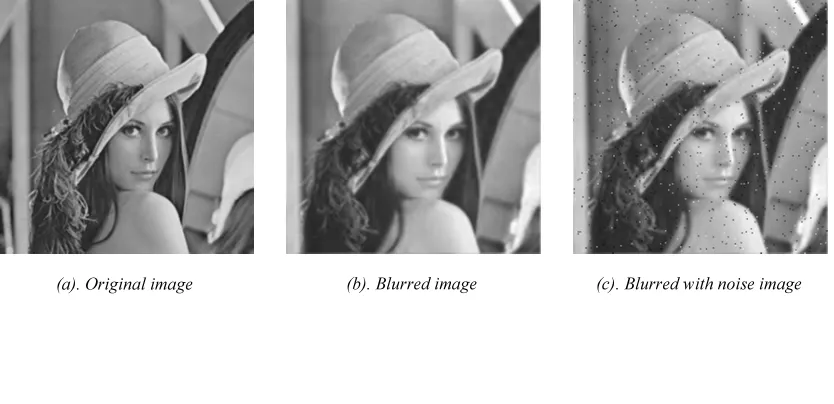
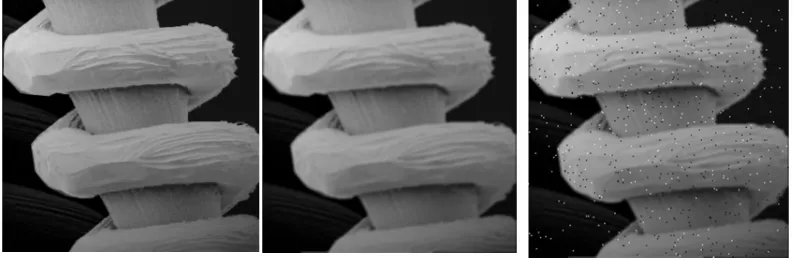
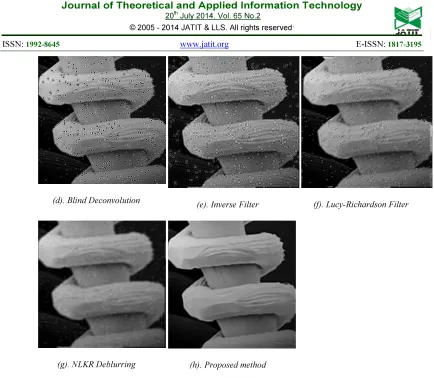
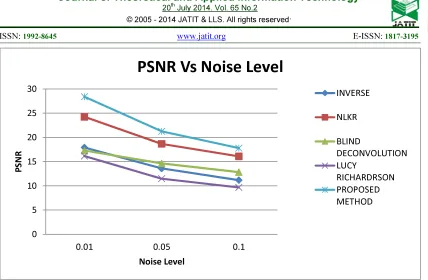
The proposed fuzzy denoising with noise suppressed steering kernel deblurring and other existing algorithms in the literature are implemented and the results are shown in figure 1.7 anf 1.8. It has been explicitly proven that the image applied with proposed algorithm is denoised and deblurred with better clarity. The comparative analysis is done based on Gaussian blur level as shown in the Table-1. Statistically the improvement of the proposed method is proved with the help of graph plotted with PSNR against the noise level as shown in the figure 1,7.
In the figure 1.7 a standard Lena image is taken as an input image and in the first step a blur is applied in the figure 1.7. (b) Then addition of noise is added. In the next step a blind deconvolution is applied shown in the figure 1.7. (d) It shows better result from blind deconvolution. Next an inverse filtering is applied shown in the figure 1.7. (e), it shows better result when comparing previous methods.
[image:7.595.92.509.521.723.2]For implementation latest version of MAT LAB is used. For the purpose of analyzing the proposed method, the latest version of MATLAB called MATLAB 2013 is used, and its performance can be measured in terms of CPU time by means of virtual cores. The CPU uses multi threading to perform multiple operations. However, Intel CPU with hyper threading contributes the appearance of a computer with multi cores. It uses 2 GB RAM memories and a half of the core is being utilized for using tools such as the Windows Task Manager. Data are computed with the help of the Pentium processor, thus increasing the performance without any congestion in the data bus.
Figure 1.7 Results for noise corrupted lena image (a) Original image (b) Blurred image (c) Blurred with noise image (d) Blind Deconvolution (e) Inverse Filter (f) Lucy-Richardson Filter (g) NLKR Deblurring (h) Proposed method
Figure 1.8 Results for noise corrupted rope image (a) Original image (b) Blurred image (c) Blurred with noise image (d)
Blind Deconvolution (e) Inverse Filter (f) Lucy-Richardson Filter (g) NLKR Deblurring (h) Proposed method
(a). Original image (b). Blurred image (c). Blurred with noise image
(d). Blind Deconvolution (e). Inverse Filter (f).Lucy-Richardson Filter
(d). Blind Deconvolution (e). Inverse Filter (f). Lucy-Richardson Filter
[image:9.595.86.520.71.449.2](g). NLKR Deblurring (h). Proposed method
Table I: Comparison of PSNR Values Of Different Algorithms for Image at Different Noise Densities COMPARISON, Gaussian blur level (lambda=3,sigma=8)
IMAGE
NAME NOISE
RANGE
BLIND
DECONVOLUTION INVERSE
LUCY
RICHARDRSON NLKR
PROPOSED METHOD
Lena 0.01 17.27 17.92 16.15 24.24 28.39
0.05 14.63 13.59 11.47 18.66 21.26
0.1 12.82 11.16 9.66 16.08 17.78
Einstein 0.01 17.21 16.96 18.17 21.99 24.3
0.05 15.31 13.5 12.71 18.37 19.49
0.1 14.52 11.09 10.88 15.88 17.2
Rope 0.01 17.07 17.82 16.05 24.27 26.83
0.05 14.37 13.42 11.28 18.48 23.33
0 5 10 15 20 25 30
0.01 0.05 0.1
P
S
N
R
Noise Level
PSNR Vs Noise Level
INVERSE
NLKR
BLIND
DECONVOLUTION LUCY
[image:10.595.89.517.79.359.2]RICHARDRSON PROPOSED METHOD
Fig 1.9 PSNR DB Vs Noise Density %
CONCLUSION
In this paper, A Noise Suppressed Steering kernel is used for deblurring and fuzzy filtering is used for denoising. This method is used in applications when the image is affected by combination of impulse noise and gaussian blur .The Experiments show that the proposed approach can efficiently restore images distorted by impulse noise and Gaussian blur .The proposed method is compared with other algorithms and able to produce better results. Compared with other state of the art adaptive sharpening methods, it handles both Denoising and sharpening tasks simultaneously very well. Since it is an iterative process the only issue is time complexity, because fuzzy filtering takes some time for decision making of noise detection. Even it takes time and produce better results than other methods and the system is able to produce good results is minimum configuration. The proposed method is demonstrated by experimental results which exhibit significant improvement over several other methods.
REFERENCES
[1] Antoni Buades, Bartomeu Coll, “A non-local algorithm for image denoising” SIAM REVIEW _c 2010 Society for Industrial and Applied Mathematics Vol. 52, No. 1, pp. 113–147.
[2] Bart Goossens, Hiêp Luong, Aleksandra Pižurica And Wilfried Philips,”An Improved Non-Local Denoising Algorithm”,
[3] Haichao Zhang, IEEE, Jianchao Yang, Yanning Zhang, “Image and Video Restorations via Non Local Kernel Regression” IEEE TRANSACTIONS ON CYBERNETICS, VOL. 43, NO.3, JUNE, 2013, 1035.
[4] Thomas S. Huang,” Non local kernel regression”, IEEE TRANSACTIONS ON IMAGE PROCESSING, VOL. 21, NO.1, JANUARY 2012, page 115 -129.
[5] Jian-FengCai , “Framelet-Based Blind Motion Deblurring from a Single
Image”,IEEE TRANSACTIONS ON
[6] HuiJi and Kang Wang,” Robust Image Deblurring With an Inaccurate Blur Kernel “
IEEE TRANSACTIONS ON IMAGE
PROCESSING, VOL. 21, NO. 4, APRIL 2012, page 1624 – 1634.
[7] De Moraes R.M. “An Analysis Of The Fuzzy Expert Systems Architecture For Multispectral Image Classification Using Mathematical Morphology Operators”, International Journal of Computational Cognition, Vol. 2, No. 2, pp. 35–69, June 2004.
[8]Maja Tamerinac-Ott, Olaf Ronnegerger,” Multiview Deblurring for 3-D Image from Light-Sheet-Based Fluoresence microscopy”
IEEE TRANSACTIONS ON IMAGE
PROCESSING, VOL. 21, NO. 4, APRIL 2012.
[9]F. Soroubek and J. Flusser, “Multichannel blind iterative image restoration, “IEEE Trans. Image process. vol.12 no.9, pp. 1094-1106, Sep, 2003.
[10] Mohammad Rostami, Oleg Michilovich and Zhou Wang,” Image Deblurring using derivative compressed sensing for optical
imaging Application”,IEEE
TRANSACTIONS ON IMAGE
PROCESSING, VOL.21, NO. 7, JULY 2012.
[11]Abdul Rehman, Zhou Wang,” Reduced-Reference Image Quality Assesment By Structural Similarity Estimation”, IEEE
TRANSACTIONS ON IMAGE
PROCESSING, VOL.21, NO. 8, JULY 2012.
[12]Chao Wang,Lifeng Sun,peng Cui, jainwei Zang and Shiqiang yang,” Analyzing Image deblurring through three paradigms ”, IEEE
TRANSACTIONS ON IMAGE
PROCESSING, VOL.21, NO. 1, JULY 2012.
[13]P. Venkatesan, Dr. S.K. Srivatsa,” Statistical Complexion-Based filtering for removal of impulse noise in color image”, Journal of Theoretical and Applied Information Technology, vol.59 No.3 ISSN: 1992-8645, E-ISSN: 1817-3195.
[14]S.Awate and R. Whitaker, “Unsupervised, Information-Theoretic, Adaptive Image Filtering for Image Restoration,” IEEE Trans. Pattern Analysis and Machine Intelligence, vol. 28, no. 3, pp. 364-376, Mar. 2006.
[15] A. Buades, B. Coll, and J.-M. Morel, “A Review of Image Denoising Algorithms, with a New One,” Multiscale Modeling and Simulation, vol. 4, no. 2, pp. 490-530, 2005.
[16]Haichao Zhang, Jianchao Yang, “Image and Video restoration via Nollocal kernel Regression”,IEEE TRANSACTIONS ON CYBERNETICS, VOL. 43, NO. 3, JUNE 2013.
[17] Andrews. H.C. and B.R. Hunt, Digital Image Restoration, Englewood Cliffs,NJ: Pretice-Hall,1977.