ScholarWorks @ Georgia State University
ScholarWorks @ Georgia State University
Art and Design Theses Ernest G. Welch School of Art and Design
Spring 8-11-2011
Parts of the Sum
Parts of the Sum
Andrew Cho
Georgia State University
Follow this and additional works at: https://scholarworks.gsu.edu/art_design_theses Part of the Art and Design Commons
Recommended Citation Recommended Citation
Cho, Andrew, "Parts of the Sum." Thesis, Georgia State University, 2011. https://scholarworks.gsu.edu/art_design_theses/89
This Thesis is brought to you for free and open access by the Ernest G. Welch School of Art and Design at ScholarWorks @ Georgia State University. It has been accepted for inclusion in Art and Design Theses by an authorized administrator of ScholarWorks @ Georgia State University. For more information, please contact
by
ANDREW CHO
Under the Direction of Mark Burleson
ABSTRACT
Parts of the Sum is an installation of ceramic, wood, and drawn components which examines
the symbiosis of individual and cultural identity: a recursive relationship which engenders unceasing
di-versity. The installation uses patterns and rule-based compositions as vehicles to address the
develop-ment of complexity from compounded simplicity as it relates to personality. An immersive
meta-network that emulates the complexity underlying identity, Parts of the Sum ultimately relies on the
ac-tive participation and inclusion of the viewer for completion.
by
ANDREW CHO
A Thesis Submitted in Partial Fulfillment of the Requirements for the Degree of
Master of Fine Arts
in the College of Arts and Sciences
Georgia State University
Copyright by Andrew Cho
by
ANDREW CHO
Committee Chair: Mark Burleson
Committee: Craig Drennan
Christina West
Electronic Version Approved:
Office of Graduate Studies
College of Arts and Sciences
Georgia State University
DEDICATION
To my parents, for all the sacrifices and the sweat which made all this possible. And most
ACKNOWLEDGEMENTS
I’d like to thank….
Christina West and Mark Burleson, for the unparalleled freedom they’ve allowed me and their
trust that I would make the most of it.
Craig Drennen, for keeping me on my toes by finding fresh and innovative ways of kicking me in
the conceptual shins.
Kelly O’Brien, Brian McClean, Stephanie Busing, and James and Emily Vanderpool, for all the
ri-diculous, off topic conversations which later turned out to be strangely relevant.
Nimer Aleck, for helping me keep pace these last three years.
All my professors, past and present, for their patience and enthusiasm.
TABLE OF CONTENTS
ACKNOWLEDGEMENTS ... v
LIST OF FIGURES ... vii
1 INTRODUCTION ... 1
2 PARTS OF THE SUM ... 2
3 CONCLUSION ... 22
LIST OF FIGURES
Fig.1 Mark Lombardi – Chicago Outfit the Satellite Regimes ... 4
Fig.2 Connectome 1 with detail ... 6
Fig.3 Connectome 2 with detail ... 7
Fig.4 Roger Hiorns - Seizure ... 8
Fig.5 Olafur Elaisson – The Weather Project ... 8
Fig.6 Yoshihiro Suda – Palais de Tokyo, Paris 2004... 10
Fig.7 Mark Dion - Roundup ... 10
Fig.8 Nodes ... 13
Fig.9 Node detail ... 14
Fig.10 Gregory Schneider – Die Familie Schneider ... 18
Fig.11 Parts of the Sum ... 20
1 INTRODUCTION
Personality is a thing of near limitless permutation. No two people are the same, and no person
is quite the same from day to day. As multiple individuals interact, they create groups whose qualities
are dependent upon the individuals within. A peculiar feedback loop results where cultures influence
the character of their people who influence the character of their culture: a fabric of evolving recursion.
Parts of the Sum is a mixed media installation of drawings and sculptures which is intended to
model this phenomenon. The drawings speak directly to the more abstract aspects of the concept. Each
was created from randomized data points which are subjected to a pre-determined, inflexible set of
rules carried to their fullest extent. The sculptural pieces counterbalance the drawings, engaging the
viewer in a more conceptually approachable manner manner. The drawings and the sculptures address
the same concept, but approach it from two different directions to provide diverse viewpoints of a large,
multifaceted issue. The installation is incomplete without the intellectual and physical inclusion of the
viewer. Therefore, the configuration, material, and aesthetic are all designed to foster a sense of kinship
2 PARTS OF THE SUM
This installation began as a small drawing in 2008. The instructor, Paul Rodecker, created a class
called “Time Intensive Drawing,” in which he pushed his students to develop their drawings to the point
of compositional collapse. His goal for the class, as he stated, was to have everyone leave with at least
one drawing that took over a hundred hours. The guidelines forced the students to develop strategies
which would keep interest fresh enough to let the drawing continuously develop regardless of the
intensive commitment. Not wishing to be subject to the familiar caprices of my own fancy, I felt that I
had to adopt a new drawing style to comply with the project assignment.
The drawing was not started with any particular concept or endpoint in mind. Instead, it was to
be a process-based piece which would result only in something radically different from the
representational style with which I had become comfortable. From Sol Lewitt’s “Sentences on
Conceptual Art,” I borrowed the following points and made them the framework of the drawing:
2. Rational judgments repeat rational judgments. 3. Irrational judgments lead to new experience.
5. Irrational thoughts should be followed absolutely and logically.
6. If the artist changes his mind midway through the execution of the piece, he compromises the result and repeats past results.
29. The process is mechanical and should not be tampered with. It should run its course.
I resolved to use only dots and lines and to base the entire composition on a set of rules, such that the
work would compose and complete itself. My only function was to provide the labor. It seemed to be a
strategy that could keep me working for a hundred hours while mollifying my appetite for details.
The rules were awkward things, based primarily upon color interaction and the results of
previous rules, but the drawing nevertheless progressed, swelling in scale until eight more sheets of
paper were necessary. As the work went on, my relationship with the dots themselves began to change.
empathize with dots which slipped through the cracks, as if they were cheated of a birthright by my
negligence. Less and less time was spent with pen to paper. It was instead given to scouring the page in
an attempt to give every dot its due. I developed an emotional involvement with what was meant to be
an abstract exercise, imbuing each dot with sentiment and viewing the whole page as a community
whose relationships I was arduously mapping.
One hundred and ninety-two hours later I had an enormous page filled with
nonrepresentational connections which I called Pairs of Seven. In the process of drawing it, I stumbled
upon an analogy between rule-based dot-and-line drawings and social dynamic. The emphasis of the
drawing was clearly upon “connection,” but the extent of the abstraction allowed that relationship to
function equally well on multiple levels.
At their most superficial, they were dots on a page connected to one another by thin colored
lines which formed a large, rule based system. On the second level, they are individual elements
interacting with one another in a consistent and logical manner. Mark Lombardi’s drawings (fig. 1)
delineate the complex dynamic between multinational corporations, heads of state, and average
citizens through clear and comprehensive graphic depiction of their interactions. I saw Pairs of Seven as
filling the same function, albeit with arbitrariness supplanting actual events as the foundation of the
configuration: a map of an imaginary city. The third level took much more time to reveal itself.
Subsequent series examined the notion of a cohesive, functioning entity split into its constituent
elements. Each series revolved around this central concept, but manifested itself differently in aesthetic.
Fig. 1
The style resembles astrological maps, and there is a conceptual unity between the two. Both start with
randomized data points, inasmuch as the layout of the stars is dependent upon factors beyond the
scope, control, and understanding of early astronomers. Logic was imposed upon a scattered dataset,
form was wrested from formlessness, and a drawing was pulled down from the sky.
Each culture would interpret the same drawing uniquely; some seeing a large bear, others a
coffin followed by mourners, still others a drinking gourd, but each would make that translation from
randomized data into cohesive object. However, the profusion of points in the sky led to constellations
that were unique to a culture as some stars were variously brought into the spotlight and others pushed
memorable and comprehensible set. This set was then subjected to a set of logic, unique to the culture,
which influenced the perception of the nonrepresentational “drawing,” altering the very perception of
the heavens. A vast collection of twinkling points of lights is simultaneously an inky field populated by
heroes, beasts, and monsters.
The Connectome drawings (figs. 2-3) evolved from this line of thinking. The title is
neurobiological in origin, and refers to the comprehensive “roadmap” of neural pathways in the brain.
The theory of the connectome hypothesizes that what matters more than the number of neurons is the
nature of their connections and interactions with one another. Wiring the same set of neurons in
different sequences would therefore create a different type of thinking-machine (Lichtman 351). The
theory not only speaks directly to personality and individuality, but is further relevant in its focus upon
the connective elements in describing the composition of a system whose proper functioning arises
from compounded simplicity.
Each drawing was composed of two colors of ink dots which, again, were connected by a series
of lines. The quality, number, and color of the lines were dependent upon size, color, and relative
positions of the dots, but the rules governing each drawing differed. Therefore, each drawing evolved
into a composition which was simultaneously the direct product of easily understood directives yet
impossible to predict at the outset.
However, this modus operandi is extremely cold and mechanical, belying the complexity and, at
times, irrationality which characterize human behavior. What was missing was a human element which
could differentiate the final composition from the product of a computer program supplied with the
same dataset and rules. Embracing irrationality and with a nod to the aphorism, “To err is human,” I
kept track of every mistake in the drawings which had resulted from my own carelessness. These
Fig.2
obviated legal, logical connections. Each of these errors was highlighted as a gold point and, at the end
of the ruleset, one final rule connected all of the gold points with a heavy gold line.
The rules, the mechanical aspect of the drawings, were thus vehicles for teasing out the human
element, the mistakes. The golden constellation was dependent upon the initial set of rules for its
con-figuration, but it itself represented the contribution of a fallible participant. From this added element,
the third level of the analogy grew. Each Connectome was a modeling of a fictitious social unit, with dots
representing individuals and lines representing their interactions. Each set of rules, then, is
analogous to the culture of the unit, the common understanding which shape acceptable behavior.
Different cultures bring different individuals together in different ways. But what about the gold
constellation? The “identity” of the culture is manifests itself as the final composition. What is here
instead is a unique individual emerging from particular circumstances. If I were to start with the same
initial conditions and rules and begin the drawing again, the very nature of error would force a new gold
constellation at the end. Like identical twins born and raised together who nevertheless develop
individual each time. The golden elements are, in essence, nonfigurative portraiture of an individual who
is a product both of their particular culture and personal idiosyncrasies.
This was the third level of the analogy and the most intricate. As if increasing the power on a
microscope, the scale has become successively more focused as the levels change: from abstract general
principle of relationships to large scale communal interaction to the individual’s relationship to the
community. However, the final level contains within itself the germ of the second, with the result that
the two are recursively dependent. Put another way, the Connectome drawings are portraits which are
explicitly reliant upon the framework of culture. However, as discovered in Pairs of Seven, the shape of a
culture is dependent upon the qualities of all the constituent individuals. Each is at the heart of the
other.
From a practical point of view, this statement is so obvious as to almost be assumed. Cultures
are products of their people and people are influenced by their cultures. By speech, a good ol’ boy from
Dixie can be distinguished from a native Californian, and they are both quite distinct from someone
raised in Australia. Each of these three are simultaneously contributors to and consequences of their
Fig.4
means to address it visually. I had unintentionally come back to Lewitt’s “Sentences on Conceptual Art”
and proven for myself the first dictum, the one at which I had initially scoffed: “1. Conceptual artists are
mystics rather than rationalists. They leap to conclusions that logic cannot reach.”
The relationship between individual and culture is the most delicate aspect of this concept, but
also the most interesting and potentially rich. The works as a whole, then, needed to reinforce the
notion of recursion and the most obvious solution was to present them as installation in which all the
pieces were parts of a much larger, all-encompassing network. It was also imperative that the
installation not be viewed as merely an aesthetic or conceptual exercise, but as a distillation of an
ubiquitous social phenomenon. The viewer needed to feel themselves a kinship with the work and a
part of the network in order to apply the concept of the installation more broadly. All decisions from this
point on needed to facilitate the viewer’s immersion in the work, both emotionally and physically.
The function of an installation is primarily to alter the viewer’s perception or experience of a
space. However, I feel it necessary to differentiate between two separate approaches to this goal. The
first exists within a space, but is bound by it. This creates a pocket of something unusual which is
couched in the everyday world. Roger Hiorns’ Seizure (fig.4), in which he coated the entire surface of a
condemned London flat with copper sulfate crystals, has this effect. Upon entering the space, the viewer
is confronted with an uninterrupted texture of twinkling blue crystalline growth in a space which is still
recognizable as a domestic setting. For all the otherworldliness that such a radical transformation brings,
it is cloistered from the world outside; the crystals stop at the door. This is even more dramatically
illustrated in Olafur Elaisson’s The Weather Project (fig.5), in which through thousands of bulbs, mirrors,
and mist, the artist creates the illusion of the Sun itself levitating in the middle of the Tate. The effect
impact of the work stopped at the walls. Viewers left with the impression of something wonderful which
had happened in that particular room.
In constrast to these works, and an excellent illustration of the second approach to installation,
are the miniature carvings of Yoshihiro Suda (fig.6). After learning which gallery will be showing his
work, he selects flora native to the region and meticulously carves the flower or seedling out of wood.
After finishing and painting them as true-to-life as possible, he installs them in unassuming corners and
cracks of the gallery space. The pristine white cube is gently subverted by delicate green shoots.
Given a large space, one can fill it either by using a large object which commands as much
attention as possible, such as Elaisson’s sun, or one can manipulate the space itself to assist the function
of the work. Suda’s plants are small and easily overlooked, but because of that they turn the emptiness
of the gallery to their advantage. The negative space is charged with potential for every nook, no matter
how insignificant, has the potential to interrupted by a sprout. Their inconspicuousness implies a certain
omnipresence.
This type of installation changes the psychological rather than the physiological experience of
the space through its intimate collaboration with the architecture and its continuous awareness of what
is left unsaid. Mark Dion’s Roundup (fig.7) was a meticulous cultivation of the viewer’s awareness of the
exhibition space, in this case, the Museum of Chicago. Having shut down the museum for a weekend,
Dion and volunteers scoured it for any arthropods which lived in the building, which were then
catalogued and photographed. With the photographs on display in the museum in which they were
caught alongside the safari-esque garb of an amateur entomologist, the viewer is made intensely aware
of the normally invisible elements which surround them at that particular moment.
If the “art” is water, then the approach of Elaisson and Hiorns is a vessel; it contains the art and
gives it shape, but the work does not extend beyond the walls. On the other hand, Suda and Dion’s work
acts more like a sponge in that holds it water, but could not properly be said to contain it. It is rather
infused by it, and the implication remains that the water can continue to exist as easily outside the
sponge. Suda and Dion make site-specific work, but the issue that they address, the unseen potential in
a space, is applicable to any and all buildings and the concept can seamlessly carry over into the viewer’s
work, home, or favorite coffee shop. Their approach is concerned less with the object in the room than
the potential of the space itself. By tapping in to that potential, the impact of the work is not limited by
current location.
Traditional gallery display is a refined system of segregation of an art object from the world.
Confronted with paintings in frames and sculptures on pedestals, there is an explicit delineation of
domain. The old metaphor of painting as a window implies an impassable albeit invisible barrier
between the viewer and object, the exact opposite effect required by Part s of the Sum. By constructing
personal identification with an object. If the viewer feels that the work is not “Other,” it removes a
hurdle in the path to union with the installation. The work occupies volume and functions with a
Minimalist “theatricality.” Michael Fried used this term in his essay Art and Objecthood to describe work
which:
is concerned with the actual circumstances in which the beholder encounters literalist *aka Minimalist+ work….Whereas in previous art, “what is to be had from the work is located strictly within [it],” the experience of literalist art is of an object in a situation – one that, by definition, includes the beholder.
It is the need for that sort of presence which dictated the scale of the sculptural components of Parts of
the Sum. Seeking to replicate the feeling of standing in a crowd, the sculptures exist at the human scale
to engender sympathy between viewer and object. Theatricality brings the concept off the gallery wall
and into the realm of bodies and three-dimensions. It cultivates an atmosphere of permeation rather
than presentation. As a living entity rather than a displayed specimen, the work is more readily
associated with the world outside of the installation.
The Nodes (figs. 8, 9), as the sculptures are called, were designed to fulfill this physical
relationship with the viewer, but also to present a more approachable and engaging aspect of the
concept than the abstract Connectomes. Contemporary art in general, and conceptual and abstract art
in particular, draw criticism for their lack of accessibility. Without a solid background in Modern art, and
perhaps even an artist statement in hand for good measure, a viewer can easily miss the meaning
behind a piece, dismissing it as a compositional exercise or conceptual navel gazing. In addition to
providing the element of Theatricality, the Nodes addressed the central concept of the installation from
Fig.8
Few if any psychological forces are stronger than the human tendency to seek, and when
necessary, create faces in what we see. The famous Jesus-in-a-grilled cheese sandwich or the Face on
Mars illustrate how certain visual cues trigger an area of the brain which causes it to register the visual
stimulus as “face” rather than “object.” This process is so strong that, once seen, it becomes all but
impossible to “un-see” the face in the object (Svoboda). Our reaction to a human countenance is
immediate and fosters a unique emotional connection with an otherwise inanimate object. The Nodes
featured representational imagery to promote this relationship, but also made explicit the unity
between the dots in the Connectomes and the concrete examples from the world outside which they
Fig.9
The imagery started as candid snapshots of pedestrians in downtown Atlanta. From there, the
image was cropped and hand-drawn onto the ceramic forms with a china paint based reductive drawing
technique (fig. 9). Early on a decision had to be made as to whether to use photographic transfers or to
adapt the image into a drawing. Photographs would have the advantage of being far quicker, allowing
for a greater volume of output and maximizing the presence of Nodes in the installation. More Nodes
would also approximate the density inherent in the Connectomes. However, the inclusion of
photographs would bring the baggage inherent in photography to the work.
Photographic manipulation, from the earliest examples of multiple exposure-based “ghost
photography” through surrealist darkroom manipulation up until the ubiquity of Photoshop-altered
images today, has done little to tarnish the aura of factuality which surrounds the photographic image. A
second, to make this image possible. As such, it is incredibly specific to the time and place in which it
was taken. Such specificity is an impediment if the need is for an open ended image to which anyone
can respond, since it is associated with a particular “memory” which none but the photographer would
have. A strategy for stripping this baggage from the imagery was necessary.
In his book Understanding Comics, Scott McCloud addresses the way in which comics, as system
of simplified visual representation, trigger an empathetic reaction with the viewer:
When two people interact, they usually look directly at one another, seeing their partner’s features in vivid detail. Each one also sustains a constant awareness of his or her own face, but this mind-picture is not nearly so vivid; just a sketchy arrangement, a sense of shape, a sense of general placement. Something as simple and basic as a cartoon. Thus, when you look at a photo or a realistic drawing of a face, you see it as the face of another. But when you enter the world of a cartoon, you see yourself. (McCloud 35, 36)
McCloud’s focus here is on creating a sense of identity between image and viewer. In his scheme, the
cartoon image must overcome the massive psychological hurdle between Other and Self. Parts of the
Sum did not need to have such a complete relationship with the viewer’s sense of self, but it did need to
land somewhere between Other and Self in order to be more universally approachable. McCloud’s
argument implied abstraction was a route for fostering this effect.
Abstraction’s primary tool is simplification, distilling a complex composition into its essential
units. The drawings on the Nodes are not a far departure from the source photographs in terms of
representational imagery, but having been drawn, they are bereft of that veneer of “truth” which
accompanies unaltered photography. The drawings are created rather than captured, which removes
them a step from the source object, bringing them closer towards the idea of the object. The farther
along one goes on the path towards absolute abstraction, the more that is pared away from the source
image. An absence of given information allows the individual viewer to mentally supplement the image,
Put another way, a photograph of a girl walking is indelibly associated with the fact that a
particular girl was walking in a particular place and the moment was captured by the camera. The
photograph is inextricable from that one particular girl and place. A drawing, however, is understood to
be a created object which does not necessarily have a basis in reality. It therefore moves one step from
“that girl on that street” towards the abstract idea of “any girl on any street.” Once the image makes the
shift towards the indefinite, it functions more like a skeleton key in the minds of the viewers and can
trigger a more idiosyncratic, and therefore personal, reaction to “girl on street.” The imagery on the
Nodes are drawings specifically to tread that fine line between eyewitness actuality and subjective
receptivity.
Street photography carries with it a sense of setting, that is, time and place, but especially with
the accessibility of digital technology it seem instantaneous and effortless. The facility of a point and
shoot camera leads to the strategy of take 40 photographs, choose the best one, and discard the rest.
The individual photographic image is largely devalued through an overabundance of supply. Drawings,
on the other hand, are unique objects which are imbued with a sense of the time inherent in their
creation. The concept of value resulting from labor and virtuosity, as set forth by Glen Adamson in his
essay The Spectacle of the Everyday, separates the drawings on the Nodes from their photographic
counterparts and adds a level of engagement that would otherwise be absent. Freehand drawings on
the Nodes lent them an intensity of focus and detail which complimented the single-mindedness of Pairs
of Seven and the Connectome series.
The Nodes were always meant to function as counterpoints to the Connectome drawings,
supplementing the limitations of abstraction with concrete images. The imagery was inched slightly
towards abstraction in order to divest it of its photographic specificity and in this translation, moved
they might function more fully as sympathetic cues, while maintaining a level of realism which rooted
them in the world of objects rather than ideas.
The feedback loop between individual and culture creates, in a sense, complex networks nestled
one inside the other. The presentation of Parts of the Sum was designed to mimic this web of
interconnections. Each of the individual pieces, on the wall or freestanding, needed be visually linked
with continuous lines that shot across the gallery floor and encircled individual elements, as if the
individual pieces were points within the Connectome series. The gallery space was to be used as a
three-dimensional canvas for the meta-network.
Most viewers are quite willing to project depth into two-dimensional objects. It is the
foundation of the pictorial legacy of “window into a space.” Illusory depth is assumed and
two-dimensional artwork is treated as if it had two-and-a-half dimensions. The lines of the meta-network sit
in that same half-dimension point. The lines rest superficially on the forms and, at the correct angles,
align as if projected onto the pieces. If the meta-network seemingly occupies a dimension removed from
the work, that is, if it is seen to be interacting but fundamentally separate, it facilitates a reading of the
meta-network as something distinct from the object. If the meta-network permeates the space rather
than being bound by it, then it leaves open the possibility that it extends through the gallery walls into
the world beyond.
In 2004, Gregory Schneider opened Die Familie Schneider, an installation that occupied two
neighboring homes in a London residential district (fig.10). Viewers were given a set of keys and entered
the first home, where they found people showering, sleeping, washing dishes, and the clutter of a poorly
kept house on any given day. Upon entering the second home, they again found people showering,
sleeping, washing dishes, and clutter, but the details were so faithfully reproduced as to be almost
indistinguishable. The “inhabitants” of the two homes were identical twins, executing identical tasks in
Fig.10
the walls were replicated as closely as possible. What began as an eerie, voyeuristic intrusion into a
domestic space became an unnerving existential exercise.
Die Familie is conceptually distant from Parts of a Sum, but the results which it is trying to
achieve and the means by which it effects them are surprisingly similar. In Die Familie, the viewers are
confronted by a nonspecific family engaged in mundane activities, sinister overtones aside. Upon
entering the second house, they are again confronted by the same situation in a space which they know
to be physically distinct from the first. A strange unity is set up between separate locations. Schneider is
guaranteed this reaction from the viewer’s exposure to the first house; he can be absolutely certain that
everyone will have the foundation set for a déjà vu experience. However, he also chooses to compose
the houses in fairly neutral, almost average circumstances. There is no outlandish décor, nor bizarre
activity which would distinguish the houses from what might be going on in any other home in the
neighborhood. The characters in the houses are not even interacting, leaving the relationship between
the “residents” open to interpretation.
The effect of this is that there is an unseen relationship between the two homes by virtue of
the street, even in the nation. By limiting identifiers in their person and behavior, even stripping their
relationships down to their coexistence in a house, Schneider transforms the “residents” archetypes
which the viewer is free to approach on his or her own terms. It is for the same reason that the node
drawings were stripped of the “baggage” of photography.
Schneider’s installation goes a step farther than Suda’s carved plants in its scale. While Suda
works within a single building, cultivating the impression that the work extends beyond, Schneider
bridges two distinctly separate structures which are superficially similar to dozens surrounding them.
The work is encompassed not by a structure, but by a neighborhood. Because of the ambiguity of the
“residents,” their apparent (albeit sinister) normalcy, and the aesthetic similarity of every house on the
residential street, the significance of the installation is to a social unit rather than a space. For Parts of
the Sum to be effective, it needed to be composed in a way which fostered a similar social relevance.
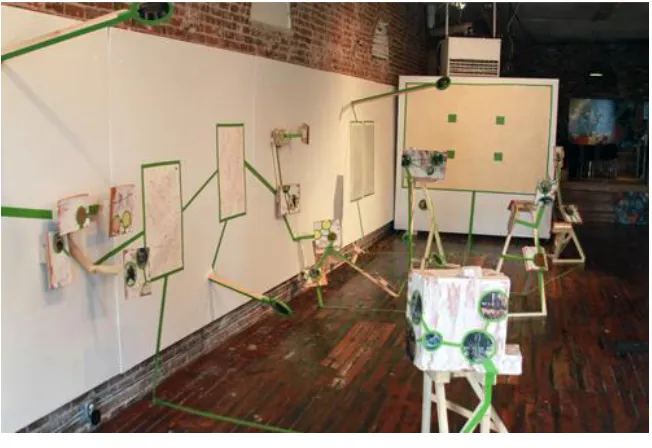
To assist the impression that the work extended beyond the confines of the gallery space, materials
were chosen to make the work seem a part of the architecture of the gallery and the surrounding
buildings (Fig.11). Originally a horse stable and converted into a nontraditional exhibition space, the
gallery had rough, unfinished brick walls and original hardwood floors in a state of mild disrepair. With
this in mind, the materials of the Nodes were chosen for their relationship to the aesthetics of the
location. Rough, untreated lumber and overfired red earthenware basted with white slip echoed the
Fig. 11
The work was installed such that the Nodes were largely clustered around Pairs of Seven in the
back of the room. Standing in the midst of them, one is surrounded by snatches of images on three sides
and a large-scale drawing in front. In the center of all these, the meta-network lines come together to
form an empty circle on the ground (fig.12), just large enough for an individual to stand in. This circle
represents the most crucial aspect of the exhibition, for it is here that the individual literally enters the
work and is explicitly made a component of the exhibition.
The primary objective of the installation was to design a work that was ambiguous enough to be
approachable, but not so open ended as to be incomprehensible or irrelevant to the viewer. The viewer
is an integral part of the concept and the installation was designed to reflect that. The recursive
relationship between individual and culture, as depicted in the Connectome series, relies on a certain
amount of subjectivity for the individual to emerge. The same back-and-forth, conversational
Fig.12
viewer may choose to create a narrative from the disparate-though-connected imagery, or perhaps
search for commonalities in their modes of dress or bearing; the precise nature of the relationship is
dependent upon the viewer, but each requires that active participation. As with any work of art (or
communication in general), the role of viewer is based on reciprocity rather than passivity. The circle on
3 CONCLUSION
For many years, I was depressed by the thought of how time would eclipse everything around us.
A history text on the 19th century contains a few thousand names: a few thousand whose deeds shone
more brightly than their contemporaries. The farther back you look, the dimmer recollection becomes. I
don’t even know my great-grandfather’s name, and his life has a greater import to my own than many of
the names I do remember. It was paramount to me that my actions somehow survive the slow appetite
of obscurity.
But somewhere along the course of years this changed. I can’t point to any gigantic catalyst which
changed everything, but I can point to a list of little ones. Dragons of Eden by Carl Sagan was one of
these. In it, he laid forth what was, to me at least, a revolutionary way of looking at knowledge.
In short it ran thus:
In the earliest forms of life, all information was stored genetically. In the nucleus of a
single-celled organism were all the directions it needed to eat, eliminate waste, and reproduce. Life was
simple and so were the creatures. As they began to develop, grow in complexity, more data was needed
to regulate not only their behavior, but also their bodily systems. They had new tissues and organs
which allowed them to interact with the outside world in ever more complex ways. And so instructions
had to be drawn up which controlled the internal and external affairs of the animal.
But there is an upper limit to the practicality of storing knowledge genetically, not the
least of which is the increased risk of mutation which is essentially information corruption. An
extragenetic information storage unit was needed to harbor all the new data and slowly the brain came
into being. Unlike the genome, the brain is plastic and allows greater flexibility and adaptive behaviors.
Creatures become gregarious, socially complex, with ever more complicated physiological structures, all
But there is an upper limit to the practicality of storing knowledge cerebrally. Another
storage unit is necessary. And into the light stepped visual language. Knowledge was no longer subject
to the ravages of forgetfulness. Being extrasomatic, writing freed knowledge from the confines of the
body. Information could be communicated horizontally with the same efficiency as before, but with
equal ease it could now be passed vertically, from generation to generation. (Sagan 41-49, 216-17)
In Sagan’s viewpoint, visual language is not simply a technology, but a step in human evolution.
Because of it, I can study the discoveries of people across the planet as easily as if they were told to me
personally. I can take their research and build on it, revise it, and put it back into circulation to be
snatched up by others. And I can look across the vistas and treat the work of long-dead scholars as if
they had been created the night before.
To study, to tease meaning out of raw data, and to leave a record of your discoveries for others
to find is to further human evolution. We are in the unique position of guiding the direction of our own
development and it is not a course set by a privileged few. It is an epic collaboration between every
member of the family of humankind which is enriched by every addition, regardless of size. We are each
actively crafting our places in the world, changing who we are as individuals, and building our culture.
Parts of the Sum is an attempt to address this phenomenon, and my own humble contribution to the
collective enterprise that is culture. I present it to reaffirm my place in the world: my own point in the
4 REFERENCES
Adamson, Glen. “The Spectacle of the Everyday,” in Out of the Ordinary: Spectacular Craft. By Laurie Britton-Newell. London: Victoria and Albert Museum, 2007.
Fried, Michael. “Art and Objecthood.” ArtForum 5 (1967): 12-23.
LeWitt, Sol. "Sentences on Conceptual Art." 0-9, 1969. Reprinted in: Art-Language, May 1969.
Lichtman, J; Sanes, J (2008). "Ome sweet ome: what can the genome tell us about the connectome?". Current Opinion in Neurobiology 18 (2008): 346–53.
McCloud, Scott. Understanding comics : the invisible art. New York: HarperPerennial, 1994.
Sagan, Carl. The dragons of Eden : speculations on the evolution of human intelligence. New York: Ballantine Books, 1978.