Recycled Pulsars
Thesis by
Bryan Anthony Jacoby
In Partial Fulfillment of the Requirements
for the Degree of
Doctor of Philosophy
California Institute of Technology
Pasadena, California
2005
c
2005
Bryan Anthony Jacoby
Acknowledgements
I would like to thank some of the many people who have influenced and contributed to me
and this work. Those who have my gratitude are too many to thank here, but I will do
my best. But first, I would like to acknowledge the generous financial support of the NSF
Graduate Research Fellowship Program and the NRAO GBT Student Support Program
that made this work possible.
My mother has always encouraged my curiosity and supported my interest in science,
even when it involved sacrifice on her part. I hope that I will be as good a parent.
Alex Wolszczan, along with Stuart Anderson and Brian Cadwell, introduced me to the
fascinating world of pulsars and radio instrumentation as an undergraduate at Penn State.
I am lucky to have had Stuart as a willing mentor for the past decade.
I am grateful to my advisor, Shri Kularni, for providing the direction and resources for
this research, and for his insights which continue to amaze me. Matthew Bailes has served
as unofficial co-advisor and treated me like a member of his group from the beginning; I
have learned much from him.
I have had the privilege of learning from several other exceptional astronomers. My time
with Don Backer has been a true highlight, both personally and educationally. Marten van
Kerkwijk, Deepto Chakrabarty, and Dale Frail have been generous and patient as well.
The members of the Swinburne pulsar group (past and present), namely Steve Ord,
Aidan Hotan, Haydon Knight, Willem van Straten, Russell Edwards, and Craig West, have
become not only valued colleagues but also very good friends. Along with the many other
people I have had the good fortune of knowing at Swinburne, Parkes, and Green Bank, they
have made my long stints away from home much more pleasant as well as productive. I have
spent less time observing at Palomar but it is one of my favorite places, largely because of
the exceptional people who work there.
past several years that it is hopeless to try to thank them all. I have shared an interest
in neutron stars with David Kaplan, Adam Chandler, and Rick Jenet, and fear that I
have learned more from them than I managed to teach in return. Brian Cameron, a recent
addition to the team, has been a pleasure to work with; I greatly appreciated his willingness
to help with observing and other responsibilities in the stressful late stages of writing this
thesis. Edo Berger has kindly helped me several times with data analysis. I also thank
Jon Sievers, Pat Udomprasert, Cathy Slesnick, Melissa Enoch, Josh Eisner, George Becker,
and Stuartt Corder for being accommodating and enjoyable office mates. My classmates
Mike Santos and Matt Hunt are great friends and are two of the most interesting people
I know. Mike, along with Rob Simcoe and Micol Christopher, helped to provide an outlet
for me through their hard work captaining the Cataclysmic Variables, our department
soccer team. Thanks to people here in Robinson would be incomplete without mentioning
our crack team of systems administrators, Patrick Shopbell, Cheryl Southard, and Anu
Mahabal, without whom very little would get done around here. John Yamasaki’s work
on pulsar instrumentation was critical to my research and I have missed him since he left
Caltech.
This thesis is dedicated to my wonderful wife Megan, whose love and support have
Abstract
We present the results of a large-area survey for millisecond pulsars (MSPs) at moderately
high galactic latitudes with the 64 m Parkes radio telescope, along with follow-up timing and
optical studies of the newly-discovered pulsars and several others. Major results include the
first precise measurement of the mass of a fully recycled pulsar and measurement of orbital
period decay in a double neutron star binary system allowing a test of general relativity
along with improved measurements of the neutron star masses.
In a survey of ∼4,150 square degrees, we discovered 26 previously unknown pulsars, including 7 “recycled” millisecond or binary pulsars. Several of these recycled pulsars are
particularly interesting: PSR J1528−3146 is in a circular orbit with a companion of at
least 0.94M⊙; it is a member of the recently recognized class of intermediate mass binary
pulsar (IMBP) systems with massive white dwarf companions. We have detected optical
counterparts for this and one other IMBP system; taken together with optical detections
and non-detections of several similar systems, our results indicate that the characteristic
age τc =P/2 ˙P consistently overestimates the time since the end of mass accretion in these
recycled systems. This result implies that the pulsar spin period at the end of the
accre-tion phase is not dramatically shorter than the observed period as is generally assumed.
PSR J1600−3053 is among the best high-precision timing pulsars known and should be
very useful as part of an ensemble of pulsars used to detect very low frequency gravitational
waves. PSR J1738+0333 has an optical counterpart which, although not yet well-studied,
has already allowed a preliminary measurement of the system’s mass ratio. The most
signif-icant discovery of this survey is PSR J1909−3744, a 2.95 ms pulsar in an extremely circular
1.5 d orbit with a low-mass white dwarf companion. Though this system is a fairly typical
low-mass binary pulsar (LMBP) system, it has several exceptional qualities: an extremely
narrow pulse profile and stable rotation have enabled the most precise long-term timing
the pulse timing data which has allowed the most precise measurement of the mass of a
millisecond pulsar: mp = (1.438 ± 0.024)M⊙. Our accurate parallax distance
measure-ment, dπ = (1.14+0−0..0807) kpc, combined with the mass of the optically-detected companion,
mc = (0.2038 ± 0.0022)M⊙, will provide an important calibration for white dwarf models
relevant to other LMBP companions.
We have measured the decay of the binary period of the double neutron star system
PSR B2127+11C in the globular cluster M15. This has allowed an improved measurement of
the mass of the pulsar,mp= (1.3584±0.0097)M⊙, and companion,mc = (1.3544±0.0097)M⊙,
as well as a test of general relativity at the 3% level. We find that the proper motions of
this pulsar as well as PSR B2127+11A and PSR B2127+11B are consistent with each other
and with one published measurement of the cluster proper motion.
We have discovered three binary millisecond pulsars in the globular cluster M62 using
the 100-m Green Bank Telescope (GBT). These pulsars are the first objects discovered with
the GBT.
We briefly describe a wide-bandwidth coherent dedispersion backend used for some of
Contents
Acknowledgements iii
Abstract v
1 Introduction 1
2 A Large-Area Survey for Radio Pulsars at High Galactic Latitudes 5
2.1 Introduction . . . 6
2.2 Observations and Analysis . . . 7
2.3 Detected Pulsars . . . 10
2.4 Implications for Sub-Millisecond Pulsars . . . 26
2.5 Conclusions . . . 29
3 Discovery of Six Recycled Pulsars in a High Galactic Latitude Survey 31 3.1 Introduction . . . 32
3.2 A High Latitude Pulsar Survey . . . 32
3.3 Discovery and Timing of Six Recycled Pulsars . . . 33
3.3.1 PSR J1528−3146: Massive Companion . . . 35
3.3.2 PSR J1600−3053: High Timing Precision LMBP . . . 35
3.3.3 PSR J1738+0333: Short Binary Period LMBP . . . 35
3.3.4 PSR J1741+13: LMBP with Strong Scintillation . . . 39
3.3.5 PSR J1933−6211: LMBP or IMBP? . . . 39
3.3.6 PSR J2010−1323: Isolated MSP . . . 41
4.2 Pulse Timing . . . 45
4.2.1 Shapiro Delay . . . 49
4.2.2 Distance . . . 50
4.3 Optical Observations of the White Dwarf Companion . . . 50
4.4 Conclusions . . . 52
5 The Mass of a Millisecond Pulsar 55 5.1 Introduction . . . 56
5.2 Observations and Pulse Timing . . . 57
5.2.1 Shapiro Delay and Component Masses . . . 58
5.2.2 Distance and Kinematic Effects . . . 58
5.3 Conclusions . . . 63
6 Optical Detection of Two Intermediate Mass Binary Pulsar Companions 65 6.1 Introduction . . . 66
6.2 Observations . . . 67
6.3 Discussion and Conclusions . . . 70
7 Measurement of Orbital Decay in the Double Neutron Star Binary PSR B2127+11C 73 7.1 Introduction . . . 74
7.2 Observations and Analysis . . . 74
7.3 Discussion . . . 75
7.3.1 Post-Keplerian Observables for M15C . . . 75
7.3.2 Kinematic Effects on Pulse Timing . . . 79
7.3.3 Component Masses of M15C and a Test of General Relativity . . . . 80
7.3.4 Proper Motion of M15 . . . 80
7.3.5 Intrinsic Spin Period Derivatives . . . 83
A Pulsars in M62 85
B A Wide-Bandwidth Coherent Dedispersion Backend for High-Precision
List of Figures
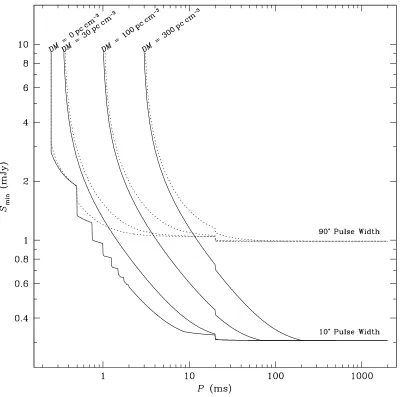
2.1 Survey sensitivity. . . 9
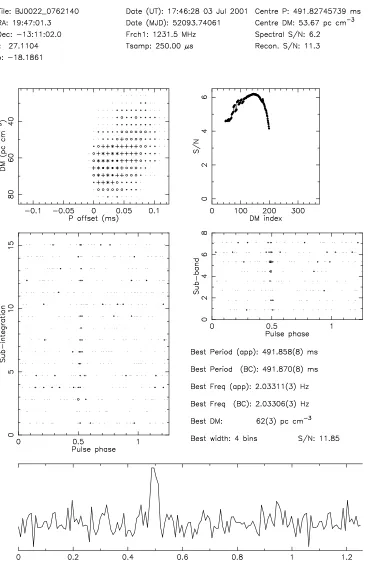
2.2 Example millisecond pulsar candidate. . . 11
2.3 Example slow pulsar candidate. . . 12
2.4 Pulse profiles of 19 new slow pulsars. . . 15
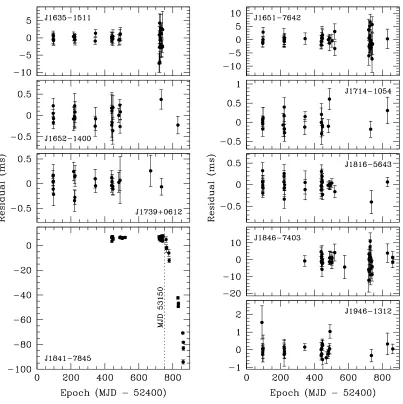
2.5 Timing residuals for 10 new slow pulsars. . . 16
2.6 Timing residuals for 9 new slow pulsars. . . 17
2.7 Spin period – magnetic field strength diagram. . . 19
2.8 Spin period distribution of pulsars in survey region. . . 23
2.9 Dispersion measure distribution of pulsars in survey region. . . 24
2.10 Galactic distribution of pulsars. . . 25
2.11 Neutron star mass, radius, and spin period. . . 27
2.12 Minimum detectable spin period vs. spin period for 36 MSPs. . . 30
3.1 Average pulse profiles of six recycled pulsars at 1.4 GHz . . . 34
3.2 Timing residuals of five recycled pulsars . . . 38
3.3 Radial velocity curve of PSR J1738+0333 companion . . . 40
4.1 Average pulse profile of PSR J1909−3744 . . . 46
4.2 Timing residuals of PSR J1909−3744 . . . 48
4.3 Optical image of PSR J1909−3744 companion . . . 51
4.4 Optical spectrum of PSR J1909−3744 companion . . . 53
5.1 High-precision timing residuals for PSR J1909−3744. . . 60
5.2 Companion mass – orbital inclination diagram for PSR J1909−3744. . . 61
5.3 Mass – mass diagram for PSR J1909−3744. . . 62
6.2 Massive white dwarf cooling — theory and observation . . . 72
7.1 Average pulse profiles for three pulsars in M15 . . . 77
7.2 Timing residuals for three pulsars in M15 . . . 78
7.3 M15C mass-mass diagram . . . 81
7.4 Proper motion of M15 . . . 82
B.1 Dispersed pulse profile. . . 88
B.2 Block diagram of coherent dedispersion backend . . . 90
B.3 Fast Flexible Digitizer II . . . 91
List of Tables
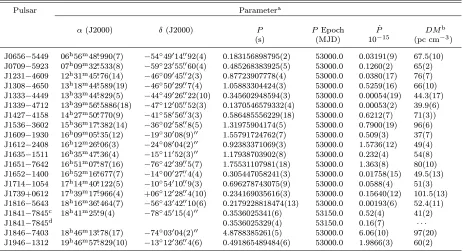
2.1 Timing model parameters for 19 new slow pulsars . . . 13
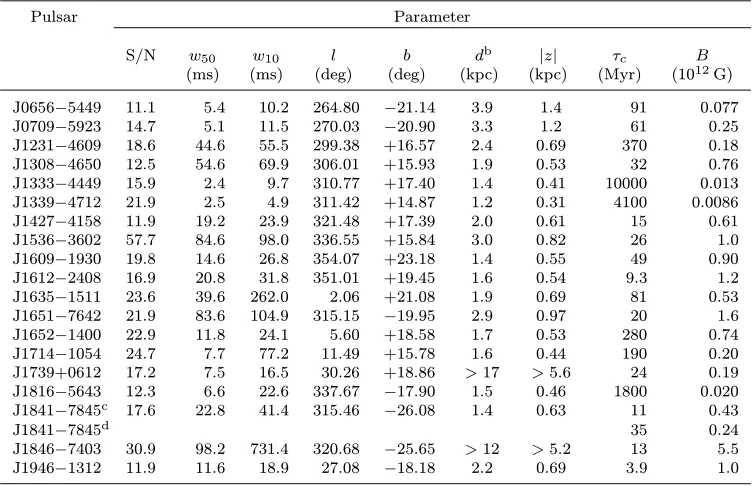
2.2 Derived parameters for 19 new slow pulsars . . . 14
2.3 Previously known pulsars detected by survey . . . 20
2.3 Previously known pulsars detected by survey . . . 21
2.4 Undetected previously known pulsars in survey region . . . 22
3.1 Pulsar Parameters for J1528−3146, J1600−3053, and J1738+0333 . . . 36
3.2 Pulsar Parameters for J1741+13, J1933−6211, and J2010−1323 . . . 37
4.1 Parameters of the PSR J1909−3744 system . . . 47
5.1 Improved parameters of the PSR J1909−3744 system . . . 59
6.1 Parameters of six target massive white dwarf binary systems . . . 69
6.2 Observations of massive white dwarf binary systems . . . 69
Chapter 1
Introduction
The story of the study of pulsars begins in 1054 A.D., when Chinese astronomers observed
the appearance of a bright object in the sky, the Crab supernova. We now know that
su-pernovae like the Crab are the death cries of massive stars. Nearly 900 years later, Baade &
Zwicky (1934) hypothesized that a very compact, dense remnant — a dead star composed
almost entirely of neutrons — could be produced in a supernova explosion. However, it
was assumed that these small neutron stars would not emit enough thermal radiation to
be detected by optical telescopes. In 1967, Jocelyn Bell was observing interplanetary
scin-tillation of celestial radio sources and found periodic bursts of radio noise unlike anything
that had ever been seen before. These pulses, repeating every 1.3 s and visible each day
in the same part of the sky, turned out to be the pulsar PSR B1919+21 (Hewish et al.,
1968), a spinning, highly-magnetized neutron star sending out beams of radio waves along
its magnetic axis. When these beams sweep past the earth, we see the pulsar blink on and
then off, much like a rotating lighthouse beacon. Soon thereafter, Staelin & Reifenstein
(1968) discovered a pulsar spinning 30 times per second at the heart of the Crab supernova
remnant.
The discovery of the first binary pulsar, PSR B1913+16 (Hulse & Taylor, 1975), and of
the first millisecond pulsar (MSP), PSR B1937+21 (Backer et al., 1982), ushered in the era
of recycled pulsars and high-precision timing. After a neutron star is born, it gradually slows
and eventually ceases to shine. In some circumstances, the neutron star can be recycled
and begin a new life by accreting matter and angular momentum from a binary companion,
spinning the neutron star up to fantastic rates. To the chagrin of many pulsar astronomers,
after over twenty years of searching for more MSPs, PSR B1937+21 is still the most rapidly
mass of the sun packed into an object the size of a small city, a magnetic field 108 times stronger than that of the earth, and spinning faster than the blades of a kitchen blender or
the crankshaft of a Formula 1 race car engine, are among the most exotic objects known
in the universe. Well over 100 recycled pulsars are known today (out of over 1,500 pulsars
total) — many in globular star clusters.
With incredible rotational stability rivaling that of atomic clocks, recycled pulsars
pro-vide ideal laboratories for a variety of physical experiments. Binary pulsars with massive
companions can be used to test theories of gravity (Taylor & Weisberg, 1989; Stairs et al.,
2002), and by timing the most stable MSPs, it will be possible to constrain or possibly
even detect low-frequency gravitational waves emitted by massive black hole binary
sys-tems (Jaffe & Backer, 2003; Lomen et al., 2003). The ability to conduct these ultra-precise
experiments with stars scattered across the galaxy with precision far exceeding almost every
other type of astronomical observation comes from the technique of pulsar timing. Briefly,
the arrival times of pulses obtained from a given set of observations are compared with a
model or mathematical description of the expected pulsar behavior, and in turn, used to
improve our knowledge of the model parameters. The power of this technique comes from
the ability to count exactly how many rotations of the pulsar have taken place between
one observation and the next over a long period of time, leading to very small fractional
uncertainties in the model parameters (see Bell, 1998 for a detailed overview). A large
part of the motivation for present and future pulsar search efforts is finding objects that
will improve the quality of these timing experiments, or allow completely new experiments
as in the case of the recently-discovered double pulsar system (Burgay et al., 2003; Lyne
et al., 2004). Another primary motivation is the detection of an object spinning
substan-tially faster than PSR B1937+21, whose very existence would provide direct constraints to
theoretical models describing the mass – radius relation of nuclear matter (Fig. 2.11).
Motivated by these considerations, we have surveyed a large area of the sky at
moder-ately high galactic latitudes for pulsars (Chapter 2). This effort resulted in the discovery of 7
recycled pulsars (Chapters 3 and 4), including one remarkable object which has allowed the
first precise measurement of the mass of an MSP (Chapter 5). We have completed a series
of optical observations of pulsars with massive white dwarf binary companions (Chapter 6),
one of which was discovered in the pulsar survey. Through long-term timing observations
verified that general relativity provides a correct description of gravity at the 3% level,
improved upon the previous mass measurements of the pulsar and its companion, and
ver-ified the proper motion of M15 (Chapter 7). We have discovered three binary MSPs in the
globular cluster M62 (Appendix A) as part of a study of globular cluster pulsars which is
still in progress. Finally, we describe the design of an observing system used for some of
Chapter 2
A Large-Area Survey for Radio
Pulsars at High Galactic Latitudes
†
B. A. Jacobya, M. Bailesb, S. Ordb, H. Knightb,c, A. Hotanb,c, R. T. Edwardsc,
and S. R. Kulkarnia
aDepartment of Astronomy, California Institute of Technology, MS 105-24, Pasadena, CA 91125;
[email protected], [email protected], [email protected].
bCentre for Astrophysics and Supercomputing, Swinburne University of Technology, P.O. Box 218,
Hawthorn, VIC 31122, Australia; [email protected], [email protected], [email protected].
cAustralia Telescope National Facility, CSIRO, P.O. Box 76, Epping, NSW 1710, Australia;
Abstract
We have completed a survey for pulsars at high galactic latitudes with the 64-m Parkes radio
telescope. Observing with the 13-beam multibeam receiver at a frequency of 1374 MHz, we
covered ∼4,150 square degrees in the region −100◦ ≤ l ≤ 50◦, 15◦ ≤ |b| ≤ 30◦ with 7,232 pointings of 265 s each. The signal from each beam was processed by a 96−channel×
3 MHz×2−polarization filterbank, with the detected power in the two polarizations of each
frequency channel summed and digitized with 1-bit resolution every 125µs, giving good sensitivity to millisecond pulsars with low or moderate dispersion measure. The resulting
2.4 TB data set was processed using standard pulsar search techniques with the workstation
cluster at the Swinburne Centre for Astrophysics and Supercomputing. This survey resulted
†Part of a manuscript in preparation for publication in
in the discovery of 26 new pulsars including 7 binary or millisecond “recycled” pulsars, and
re-detected 36 previously known pulsars. We describe the survey methodology and results,
and present timing solutions for the 19 newly discovered slow pulsars.
2.1
Introduction
Since the discovery of the first radio pulsar (Hewish et al., 1968), a great deal of effort in
radio astronomy has been expended searching for pulsars, with about 1,500 pulsars known
today. Until the late 1990s, most pulsars surveys focused on the region of sky near the plane
of our galaxy since that is where the density of pulsars is highest. Also, early surveys usually
were conducted at frequencies around 400 MHz because of pulsars’ steep radio spectra, and
because the larger beam produced by a given telescope at lower frequencies allowed for more
rapid coverage of the sky, or conversely, longer integration on a given point in the sky, given
a region of sky to cover and a fixed allocation of observing time.
However, there are clear advantages to searching for pulsars at higher frequencies. Most
notably, dispersion and scattering are mitigated, allowing for better time resolution and
sensitivity to pulsars with large dispersion measures (DMs). Also, the galactic synchrotron background has a steep spectrum and contributes little to the total system temperature
at higher frequencies. The final disadvantage of high-frequency surveys, namely the slow
sky coverage resulting from a small telescope beam, has been overcome by the innovative
13-beam multibeam receiver package at the Parkes radio telescope (Staveley-Smith et al.,
1996) and 13 accompanying analog filterbanks which provide a combined beam area on the
sky about 25% larger than the 70-cm system used in the Parkes Southern Pulsar Survey
(Manchester et al., 1996). The Parkes Multibeam Pulsar Survey covering ∼1,500 square degrees within 5◦ of the galactic plane has used this system to great effect, roughly doubling the number of pulsars known before this survey began (Manchester et al., 2001; Hobbs et al.,
2004).
While pulsars descend from short-lived massive stars which are born and die in the
galactic disk, older pulsars have had time to migrate to moderate to high galactic latitudes.
Millisecond pulsars (MSPs) which spin roughly a hundred times or more each second are
in this older group, having lived a life as a “normal” pulsar, then later being “recycled” to
objects which promise to reveal the neutron star equation of state: discovering ever faster
spinning pulsars constrains the size of neutron stars, and measuring effects predicted by
Einstein’s general relativity allows us to determine their masses. Although the density of
pulsars is less at high galactic latitudes than in the plane of the galaxy, a shallow survey of
this relatively neglected part of the sky provides an efficient means for discovering recycled
pulsars, as demonstrated by the Swinburne Intermediate Latitude Pulsar Survey in a region
between 5◦and 15◦from the galactic plane (Edwards & Bailes, 2001b; Edwards et al., 2001). Here, we describe the results of a 21-cm multibeam survey for pulsars at higher galactic
latitudes between 15◦ and 30◦ from the galactic plane.
2.2
Observations and Analysis
Between 2001 January and 2002 December, we observed roughly 4,150 square degrees in the
region−100◦ ≤l≤50◦, 15◦ ≤ |b| ≤30◦ in 7,232 individual pointings of 265 s with the 64-m Parkes radio telescope at a frequency of 1374 MHz. Using the 13-beam multibeam receiver
system, the signal from each beam was processed by a 96 MHz×2 filterbank, the powers
from each polarization pair summed, and the result 1-bit sampled at 125µs intervals. The resulting 94,016 survey beams comprising 2.4 TB in total were written to 98 DLT tapes
for later analysis. The observing and data processing procedures were virtually identical
to those described by Edwards et al. (2001). Our observing hardware and methodology
were identical to the Parkes Multibeam Pulsar Survey, except that our integration time per
pointing was shorter (265 s compared to 2,100 s) and our sampling interval was half as long
(125µs compared to 250µs).
The minimum detectable fluxSmin for a radio periodicity search can be calculated by a
modified form of the radiometer equation,
Smin =
α β (Trec+Tsky)
G(2 ∆ν tint)1/2
δ
1−δ
1/2
, (2.1)
where α is the threshold signal-to-noise ratio (S/N), β ≈1.5 is an efficiency factor taking account of losses such as quantization error, G is the telescope gain, ∆ν is the observed bandwidth,tint is the integration time, Trec and Tsky are the receiver and sky contributions
signal, including contributions from the sample period, dispersion smearing, finite DM
search step size, and scattering. Figure 2.1 shows representative sensitivity curves for this
survey. In our calculations, we have assumed that the pulsar signal contains (2δ)−1 equally significant harmonics in the frequency domain.
Our large data set was analyzed with the cluster of 64 Compaq Alpha workstations at
Swinburne University of Technology’s Centre for Astrophysics and Supercomputing. The
filterbank data from each survey beam were padded with 32 empty channels with
appro-priate frequency spacing so that dispersion was a linear function of channel number in this
128-channel space. First, each channel was searched for strong, narrow-band radio
fre-quency interference (RFI), and affected channels were masked. We then used the “tree”
dedispersion algorithm (Taylor, 1974) to break the 128 channels into 16 sub-bands, each
dedispersed at a range of differentDMs. This sub-band data could then be efficiently dedis-persed and summed to form one of 374 trial DMs up to a maximum 562.5 pc cm−3. Once
the sub-bandDM reached twice the diagonalDM of 17 pc cm−3(when roughly one sample period of smearing occurs within an individual channel), adjacent samples were summed
(thereby doubling the diagonal DM) and the process repeated until the maximum search
DM was reached.
The periodicity search used an adaptation of the search software from the Parkes
South-ern Pulsar Survey (Manchester et al., 1996) and followed standard pulsar search procedures.
Briefly, the Fourier transform was computed for a given trial DM and searched for har-monically related patterns with a fundamental frequency greater than 1/12 Hz, summing
up to 16 harmonics of a given frequency. The large list of possible candidates in the
three-dimensional space of repetition frequency, number of harmonics summed, and DM was consolidated into a list of the best 99 suspects from each survey beam. Each of these was
then subjected to a time-domain optimization in spin period (P) andDM. For each beam, the 48 most promising suspects from this optimization were saved for further scrutiny.
Candidate pulsars were selected from 1.2 million search suspects using a variety of fixed
and adaptive filters, and finally, by human examination. Typically, the roughly 45,000
suspects from a given tape were considered together. Filters were constructed to eliminate
known interference frequencies and to enforce criteria to eliminate other low-quality suspects
spurious short-period signals found in our data. Finally, adaptive filters were used to allow
signals that appeared at nearly the same period separated by many telescope beam widths
many times on one tape. These automated parameter-based filters and screens allowed us
to cull the suspect list to fewer than 10,000, each of which was then given much more human
attention than would have been possible for the full set of suspects. Diagnostic information
for two example candidate pulsars which were eventually confirmed is shown in Figures 2.2
and 2.3. Plausible pulsar candidates were re-observed, with the observation time depending
on the strength of the candidate.
We note that in the case of one extremely convincing MSP candidate — later confirmed
as PSR J1741+13 — it took four re-observations before it appeared again. This experience
highlights the important role played by scintillation in pulsar surveys. Many other
candi-dates which were not as convincing or interesting as this one were, of course, not afforded
four confirmation attempts, and there are doubtless other pulsars in the survey region which
were not visible at the time of the survey observation. We have no doubt that re-observing
regions which have previously been surveyed will yield new discoveries, even when a new
observing capability or strategy is not brought to bear.
2.3
Detected Pulsars
In addition to the seven recycled pulsars described in Chapters 3 and 4, this survey
dis-covered 19 new slow pulsars. After confirmation, we began a roughly monthly timing
pro-gram to determine phase-connected timing solutions for all slow pulsars using the Parkes
512×0.5 MHz×2 filterbank in conjunction with the center beam of the multibeam receiver centered on 1390 MHz. Following standard pulse timing procedures, folded profiles were
cross-correlated with a template profile to determine times of arrival (TOAs). We used
the standard pulsar timing package tempo1, along with the Jet Propulsion Laboratory’s DE405 ephemeris for all timing analysis. TOA uncertainties for each pulsar were scaled
to achieve reduced χ2 ≃ 1 in order to improve the estimation of parameter uncertainties. Timing solutions for these pulsars are given in Table 2.1 and derived parameters are given
in Table 2.2. Average pulse profiles are shown in Figure 3.1, and timing residuals relative
to the models in Table 2.1 are shown in Figures 2.5 and 2.6.
Table 2.1. Timing model parameters for 19 new slow pulsars
Pulsar Parametera
α(J2000) δ(J2000) P P Epoch P˙ DMb
(s) (MJD) 10−15 (pc cm−3)
J0656−5449 06h56m48s.990(7) −54◦49′14.′′92(4) 0.183156898795(2) 53000.0 0.03191(9) 67.5(10)
J0709−5923 07h09m32s.533(8) −59◦23′55.′′60(4) 0.485268383925(5) 53000.0 0.1260(2) 65(2)
J1231−4609 12h31m45s.76(14) −46◦09′45.′′2(3) 0.87723907778(4) 53000.0 0.0380(17) 76(7)
J1308−4650 13h18m44s.589(19) −46◦50′29.′′7(4) 1.05883304424(3) 53000.0 0.5259(16) 66(10)
J1333−4449 13h33m44s.829(5) −44◦49′26.′′22(10) 0.345602948594(3) 53000.0 0.00054(19) 44.3(17)
J1339−4712 13h39m56s.5886(18) −47◦12′05.′′52(3) 0.1370546579332(4) 53000.0 0.00053(2) 39.9(6)
J1427−4158 14h27m50s.770(9) −41◦58′56.′′3(3) 0.586485556229(18) 53000.0 0.6212(7) 71(3))
J1536−3602 15h36m17s.382(14) −36◦02′58.′′8(5) 1.31975904174(5) 53000.0 0.7900(19) 96(6)
J1609−1930 16h09m05s.35(12) −19◦30′08(9)′′ 1.55791724762(7) 53000.0 0.509(3) 37(7)
J1612−2408 16h12m26s.06(3) −24◦08′04(2)′′ 0.92383371069(3) 53000.0 1.5736(12) 49(4)
J1635−1511 16h35m47s.36(4) −15◦11′52(3)′′ 1.17938703902(8) 53000.0 0.232(4) 54(8)
J1651−7642 16h51m07s.87(16) −76◦42′39.′′5(7) 1.75531107981(18) 53000.0 1.363(8) 80(10)
J1652−1400 16h52m16s.677(7) −14◦00′27.′′4(4) 0.305447058241(3) 53000.0 0.01758(15) 49.5(13)
J1714−1054 17h14m40s.122(5) −10◦54′10.′′9(3) 0.696278743075(9) 53000.0 0.0588(4) 51(3)
J1739+0612 17h39m17s.966(4) +06◦12′28.′′4(10) 0.234169035616(3) 53000.0 0.15640(12) 101.5(13)
J1816−5643 18h16m36s.464(7) −56◦43′42.′′10(6) 0.2179228818474(13) 53000.0 0.00193(6) 52.4(11)
J1841−7845c 18h41m25s.9(4) −78◦45′15(4)′′ 0.3536025341(6) 53150.0 0.52(4) 41(2)
J1841−7845d 0.3536025329(4) 53150.0 0.16(7) · · ·
J1846−7403 18h46m13s.78(17) −74◦03′04(2)′′ 4.8788385261(5) 53000.0 6.06(10) 97(20)
J1946−1312 19h46m57s.829(10) −13◦12′36.′′4(6) 0.491865489484(6) 53000.0 1.9866(3) 60(2)
aFigures in parenthesis are uncertainties in the last digit quoted. Uncertainties are calculated from twice the formal error
produced bytempo.
bDM determined from discovery or confirmation observation across 288 MHz wide observing band at 1374 MHz cParameters obtained from fit to data prior to timing event around MJD 53150
Table 2.2. Derived parameters for 19 new slow pulsars
Pulsar Parameter
S/N w50 w10 l b db |z| τc B
(ms) (ms) (deg) (deg) (kpc) (kpc) (Myr) (1012G)
J0656−5449 11.1 5.4 10.2 264.80 −21.14 3.9 1.4 91 0.077 J0709−5923 14.7 5.1 11.5 270.03 −20.90 3.3 1.2 61 0.25 J1231−4609 18.6 44.6 55.5 299.38 +16.57 2.4 0.69 370 0.18 J1308−4650 12.5 54.6 69.9 306.01 +15.93 1.9 0.53 32 0.76 J1333−4449 15.9 2.4 9.7 310.77 +17.40 1.4 0.41 10000 0.013 J1339−4712 21.9 2.5 4.9 311.42 +14.87 1.2 0.31 4100 0.0086 J1427−4158 11.9 19.2 23.9 321.48 +17.39 2.0 0.61 15 0.61 J1536−3602 57.7 84.6 98.0 336.55 +15.84 3.0 0.82 26 1.0 J1609−1930 19.8 14.6 26.8 354.07 +23.18 1.4 0.55 49 0.90 J1612−2408 16.9 20.8 31.8 351.01 +19.45 1.6 0.54 9.3 1.2 J1635−1511 23.6 39.6 262.0 2.06 +21.08 1.9 0.69 81 0.53 J1651−7642 21.9 83.6 104.9 315.15 −19.95 2.9 0.97 20 1.6 J1652−1400 22.9 11.8 24.1 5.60 +18.58 1.7 0.53 280 0.74 J1714−1054 24.7 7.7 77.2 11.49 +15.78 1.6 0.44 190 0.20 J1739+0612 17.2 7.5 16.5 30.26 +18.86 >17 >5.6 24 0.19 J1816−5643 12.3 6.6 22.6 337.67 −17.90 1.5 0.46 1800 0.020 J1841−7845c 17.6 22.8 41.4 315.46 −26.08 1.4 0.63 11 0.43
J1841−7845d 35 0.24
J1846−7403 30.9 98.2 731.4 320.68 −25.65 >12 >5.2 13 5.5 J1946−1312 11.9 11.6 18.9 27.08 −18.18 2.2 0.69 3.9 1.0
The timing behavior of these objects is typical of slow pulsars, with the possible
ex-ception of PSR J1841−7845. As shown in Figure 2.6, a timing solution which appeared
to be valid for nearly a year fails to predict the pulsar phase for recent observations. This
timing event, occurring near MJD 53150, does not resemble classical glitch behavior seen in
much younger pulsars in which a sudden decrease inP is accompanied by an increase in the spin-down rate, ˙P (Shemar & Lyne, 1996). The residuals qualitatively resemble a so-called “slow glitch” as observed in PSR J1825−0935 (Zou et al., 2004) and the fractional change
in spin period (−3×10⁻³) is of similar magnitude; however, our post-event timing solution
for J1841−7845 suggests that ˙P has decreased to roughly 30% of its pre-event value. We are therefore skeptical that our timing solution is correct for this object, and include it here
only as an aid to others who may want to observe this object. Our timing data for this
object are sparse; unfortunately several other observations are unusable due to RFI.
Three of these slow pulsars (J1333−4449; J1339−4712; and J1816−5643) have relatively
long characteristic ages (τc = P/2 ˙P > 109yr) and weak inferred surface dipole magnetic
fields (Bsurf = 3.2×10¹⁹Gs−1/2
p
PP˙ ≈1010G) compared to other slow pulsars. In Figure 2.7, we plotBsurf vs. P for known pulsars with measured ˙P and indicate the objects found
in this survey. These three objects fall in the transition region inP – Bsurf space between
the predominantly isolated slow pulsars and the recycled pulsars found most often in binary
systems.
In addition to the 26 pulsars discovered in this survey, 36 previously known pulsars were
detected (Tab. 2.3). Of the 28 previously known pulsars we failed to detect (Tab. 2.4),
Figure 2.7: Spin period – magnetic field strength diagram. The dashed line shows the equi-librium spin-up line resulting from Eddington accretion. Dotted lines indicate characteristic ages of 104 and 1010 years. Small points mark isolated objects, filled circles show pulsars in binary systems. Red symbols indicate objects in globular clusters. Blue open circles mark pulsars discovered in this survey, except for J1741+13 (P = 3.75 ms; see Chapter 3) and J1841−7845 (P = 354 ms) for which we do not yet have secure measurements of ˙P and hence Bsurf. Where possible, ˙P has been corrected for the apparent acceleration induced
Table 2.3. Previously known pulsars detected by survey
Pulsar Parametera
P DM S1400b l b S/Nc
(s) (pc cm−3) (mJy) (deg) (deg)
J0711−6830 0.0055 18.4 3.4(5) 279.60 −23.27 14.4 J1034−3224 1.1506 50.8 4.7 272.12 +22.13 87.5 B1114−41 0.9432 40.5 3 284.52 +18.08 93.1 J1141−3107 0.5384 30.8 · · · 285.82 +29.41 19.2 J1141−3322 0.2915 46.5 1 286.66 +27.29 76.1 J1159−7910 0.5251 59.2 · · · 300.48 −16.54 31.4 B1237−41 0.5122 44.1 · · · 300.76 +21.42 36.0 J1320−3512 0.4585 16.4 · · · 309.62 +27.31 63.7 B1325−43 0.5327 42.0 2 309.95 +18.43 74.9 J1335−3642 0.3992 41.7 · · · 312.79 +25.34 11.1 J1418−3921 1.0968 60.5 1.4 320.90 +20.47 18.4 B1552−23 0.5326 51.9 0.9(1) 348.52 +22.50 33.5 B1552−31 0.5181 73.0 1.4(4) 342.78 +16.76 64.6 B1600−27 0.7783 46.2 1.7(3) 347.20 +18.77 76.9 J1603−2531 0.2831 53.8 · · · 348.45 +19.99 225.2 B1620−09 1.2764 68.2 0.6(1) 5.38 +27.18 34.4 B1620−26d 0.0111 62.9 2.0(3) 351.05 +15.96 22.2
J1643−1224 0.0046 62.4 3.3(1) 5.75 +21.22 62.9 B1641−68 1.7856 43.0 2 321.91 −14.82 28.1 B1642−03 0.3877 35.7 21.0(6) 14.19 +26.06 443.3 B1701−75 1.1910 37.0 · · · 316.75 −20.21 29.9 J1713+0747e 0.0046 16.0 3 28.83 +25.21 10.1
Table 2.3
Pulsar Parametera
P DM S1400b l b S/Nc
(s) (pc cm−3) (mJy) (deg) (deg)
B2003−08 0.5809 32.4 2.8(7) 34.17 −20.31 122.7 B2043−04 1.5469 35.8 1.7(5) 42.74 −27.40 50.6
aParameter values except for detected S/N obtained from
http://www.atnf.csiro.au/research/pulsar/psrcat/
bFigures in parenthesis are uncertainty in the last digit quoted, where
known
cFor pulsars detected in multiple survey beams, S/N of strongest detection dIn the globular cluster M4
eDiscovered at sub-harmonic of actual spin frequency
The fraction of binary and recycled pulsars discovered in this survey (7 out of 26 new
pulsars) is significantly higher than that of the pulsar population as a whole, demonstrating
the efficacy of a shallow, high-frequency survey away from the galactic plane for finding
MSPs. Figure 2.8 shows the period distribution of newly-discovered pulsars with previously
known pulsars in the survey region, excluding those in globular clusters. The distribution of
new pulsar periods is clearly weighted toward short periods relative to the previously known
pulsars even though MSPs are thought to have slightly steeper spectra than slow pulsars
(Toscano et al., 1998), suggesting that the improved effective time resolution afforded by
observing at high frequency is a significant advantage compared with the sensitivity of the
Parkes Southern Pulsar Survey at 436 MHz (Manchester et al., 1996). TheDM distribution of newly discovered pulsars is similar to that of the previously known pulsars (Fig. 2.9).
Figure 2.10 shows the galactic distribution of newly discovered pulsars. It is curious that
while most of the new pulsars are in the northern side of the galaxy, the distribution of new
pulsars in the south is relatively isotropic in the survey region while in the north, it falls
off markedly with increasing distance from the galactic plane. We note that a significant
part of our survey region, and in fact, three of our newly discovered pulsars are visible with
the 305-m Arecibo telescope, further supporting the claim that re-surveying the sky can be
Table 2.4. Undetected previously known pulsars in survey region
Pulsar Parametera
P DM S1400b l b
(s) (pc cm−3) (mJy) (deg) (deg)
B0559−57 2.2614 30.0 · · · 266.56 −29.33 B0904−74 0.5496 51.1 · · · 289.81 −18.31 B0909−71 1.3629 54.3 · · · 287.80 −16.24 B1010−23 2.5179 22.5 · · · 262.20 +26.39 J1047−3032 0.3303 52.5 0.18 273.57 +25.14 B1056−78 1.3474 51.0 · · · 297.64 −17.56 B1118−79 2.2806 27.4 · · · 298.77 −17.48 J1455−3330 0.0080 13.6 1.2(1) 330.80 +22.57 B1607−13 1.0184 49.1 · · · 359.51 +26.95 B1612−29 2.4776 44.8 · · · 347.46 +15.06 J1650−1654 1.7496 43.2 1.6 2.93 +17.23 B1648−17 0.9734 33.5 0.3(1) 2.89 +16.88 B1657−13 0.6410 60.4 · · · 7.58 +17.59 J1720+2150 1.6157 41.1 · · · 44.03 +29.36 B1732−02 0.8394 65.0 · · · 21.98 +15.92 J1752+2359 0.4091 36.0 · · · 49.17 +23.06 J1756+18 0.7440 77.0 · · · 43.82 +20.21 J1813+1822 0.3364 60.8 · · · 45.62 +16.39 B1851−79 1.2792 39.0 · · · 314.39 −27.05 J1910−5959Ac 0.0033 33.7 0.22 336.59 −25.73
J1910−5959Bc 0.0084 33.3 0.06 336.56 −25.62
J1910−5959Cc 0.0053 33.2 0.30 336.53 −25.66
J1910−5959Dc 0.0090 33.3 0.07 336.56 −25.62
J1910−5959Ec 0.0046 33.3 0.09 336.56 −25.62
J1940−2403 1.8553 63.3 · · · 15.91 −21.01 J1947−4215 1.7981 35.0 · · · 357.25 −27.71 B1946−25 0.9576 23.1 0.4(1) 15.33 −23.39 J2005−0020 2.2797 35.9 0.4 41.40 −16.64
aParameter values obtained from http://www.atnf.csiro.au/research/pulsar/psrcat/ bFigures in parenthesis are uncertainty in the last digit quoted, where
known.
2.4
Implications for Sub-Millisecond Pulsars
It is curious that the fastest spinning neutron star known, PSR B1937+21 withP = 1.56 ms, was the first millisecond pulsar discovered (Backer et al., 1982). This exceptional object was
discovered in a targeted search and until fairly recently, few large-area pulsar surveys were
sensitive to pulsars with spin periods of order a millisecond. It is interesting to ask whether
the lack of observed pulsars with periods faster than that of B1937+21 can be explained
by observational selection effects, or if it requires these putative “sub-millisecond” pulsars
to be an extremely rare population.
If pulsars with spin periods shorter than 1.56 ms do not exist, it may be simply because
the recycling process — the mechanism by which a low-mass star evolves off the main
sequence and donates mass and angular momentum to its neutron star companion — does
not efficiently produce such rapidly rotating objects, or once produced, their rotation quickly
slows because of gravitational wave emission (Bildsten, 2003). However, it may be that the
minimum spin period of neutron stars is imposed by centripetal acceleration, with the stars
breaking apart when the rotational speed at the equator exceeds the gravitational escape
speed.
This question has important implications for the equation of state of dense matter which
relates the mass and radius of neutron stars. Figure 2.11 shows the mass-radius relationship
for a number of possible neutron star equations of state (EOSs), as well as the relationship
between breakup spin period and radius for several relevant values of neutron star mass.
Given the observed spin period and mass distribution of radio pulsars, the constraints on
the EOS are not very strong: if PSR B1937+21 has the same mass as PSR J1909−3744,
its radius can still be as large as 16 km. Progress on this front is most likely to come from
constraints on the minimum neutron spin period, either from discovery of faster-rotating
pulsars or a better understanding of the underlying population.
Through a detailed analysis of the known pulsar population, Cordes & Chernoff (1997)
found that the most likely minimum period of the underlying period distribution is not much
less than that of PSR B1937+21, but that at the 95% confidence level, spin periods as short
as 1 ms could not be ruled out, and at the 99% confidence level, extended as low as 0.65 ms.
More recently, spin periods for 11 neutron stars obtained through X-ray observations whose
Figure 2.11: Neutron star mass, radius, and spin period. Top: mass vs. radius for a variety of possible equations of state, from Lattimer & Prakash (2001). Bottom: minimum (breakup) spin period vs. radius for example neutron stars of mass 1.25M⊙ (slow pulsar
J0737−3039B, Lyne et al., 2004), 1.44M⊙(millisecond pulsar J1909−3744, Chapter 5), and
used to infer a minimum spin period of 1.3 ms to 95% confidence, assuming a uniform
distribution down to a cutoff period (Chakrabarty et al., 2003), and through application of
a similar analysis to the radio pulsar population, McLaughlin et al. (2004) find a minimum
spin period of 1.2 ms at 95% confidence. As an exercise, we have attempted a simple
analysis of the millisecond radio pulsar population which includes the results of several
pulsar surveys in roughly the last decade. We consider the known population of pulsars with
P <10 ms, and ask the following question: if each of these pulsars could be made to spin faster without changing any of its other parameters (e.g., duty cycle,DM, and luminosity), what is the shortest spin period at which the discovery survey could still have detected it?
We consider only pulsars found in modern surveys with good sensitivity to MSPs, excluding
any objects found in targeted searches (globular clusters, known steep spectrum objects,
γ-ray sources, etc.), or those for which we cannot reliably estimate parameters impacting detection sensitivity. This approach to understanding the underlying population of pulsars
has the attractive feature that it takes selection effects very naturally into account; however,
it is simplistic and assumes a homogeneity in the population that is far from assured. We
have also neglected the increasing difficulty posed by a given orbital acceleration as the
pulsar period decreases. Furthermore, very short period pulsars may preferentially exist
in short-period binary systems (Burderi et al., 2001), and the computational power and
techniques to efficiently detect such systems has only recently become available (Ransom,
2001).
In Figure 2.12, we plot this minimum detection period Pmin, calculated by Equation
2.1, and taking into account subtleties such as the size of the DM steps and number of harmonics summed in the search against the actual spin period of 36 millisecond pulsar. Of
these, we find that 20 could have been detected at spin periods shorter than 1.56 ms. Taken
at face value, this implies that pulsars with spin periods between 0.30 ms (the smallestPmin
value resulting from this analysis) and 1.56 ms must be about 50 times less common per
octave than pulsars with periods between 1.56 ms and 10 ms. However, we also find that
fully one fourth of the pulsars we consider should not have been detected at all by the
surveys that discovered them! This result is explained by interstellar scintillation, which
can cause a pulsar’s observed flux to deviate widely from the average value which we have
used where possible in our calculations. Taken together with the likelihood that formal
(Edwards et al., 2001), we believe this analysis cautions against excluding the possibility of
pulsars with periods shorter than 1.56 ms based on the sensitivities of pulsar surveys to date.
However, it does appear that very short period pulsars, if they exist, are uncommon and
are likely to be found only through intensive search efforts with very high time resolution.
2.5
Conclusions
We have completed a survey for pulsars covering 10% of the sky with the 21-cm multibeam
receiver system at the 64-m Parkes radio telescope. This survey was very successful,
discov-ering 7 new recycled pulsars (described in detail in Chapters 3 and 4) and 19 slow pulsars,
and re-detecting 36 previously known pulsars in the survey region.
Taken together with the previous Swinburne Intermediate Latitude Survey which
dis-covered 69 new pulsars including 8 recycled pulsars, we now have a consistent census of the
pulsar population over∼7,100 square degrees between 5◦ and 30◦ from the galactic plane, which will be very valuable for modeling the underlying population.
We thank W. van Straten for help with survey observations, and the Parkes Multibeam
Pulsar Survey collaboration for making the data acquisition hardware and software used for
this survey available to the community. BAJ and SRK thank NSF and NASA for supporting
their research. The Parkes telescope is part of the Australia Telescope which is funded by
Figure 2.12: Minimum detectable spin period vs. spin period for 36 MSPs. The minimum spin period at which a given millisecond pulsar could have been detected given the sensitivity of the discovery survey and pulsar’s DM and pulse shape is plotted against observed spin period. Open circles show pulsars discovered in surveys with the 21-cm Parkes Multibeam system (This work; Manchester et al., 2001; Hobbs et al., 2004), filled circles are pulsars from the Parkes 70 cm pulsar survey (Manchester et al., 1996; Lyne et al., 1998), filled triangles are pulsars from Arecibo 430 MHz surveys (Camilo et al., 1993; Nice et al., 1993; Foster et al., 1995; Nice et al., 1995; Camilo et al., 1996; Ray et al., 1996; Lommen et al., 2000), and filled squares are from the Jodrell Bank 600 MHz survey (Nicastro et al., 1995). Blue circles indicate pulsars discovered in this survey, described fully in Chapters 3 and 4. In calculating Pmin, average flux densities have been used where available; otherwise,
the calculation was based on the discovery signal-to-noise ratio. The horizontal dotted line indicates the period of the fastest spinning known pulsar, PSR B1937+21. Pulsars above the slanted dashedPmin =P line should not have been detected in the discovery survey, but
could have been detected at the plotted value ofPmin; pulsars above the solid horizontal line
Chapter 3
Discovery of Six Recycled Pulsars
in a High Galactic Latitude
Survey
†
B. A. Jacobya, M. Bailesb, S. Ordb, H. Knightb,c, A. Hotanb,c, and
M. H. van Kerkwijkd
aDepartment of Astronomy, California Institute of Technology, MS 105-24, Pasadena, CA 91125;
[email protected], [email protected], [email protected].
bCentre for Astrophysics and Supercomputing, Swinburne University of Technology, P.O. Box 218,
Hawthorn, VIC 31122, Australia; [email protected], [email protected], [email protected].
cAustralia Telescope National Facility, CSIRO, P.O. Box 76, Epping, NSW 1710, Australia.
dDepartment of Astronomy and Astrophysics, University of Toronto, 60 St. George Street, Toronto, ON
M5S 3H8, Canada; [email protected].
Abstract
We present six recycled pulsars discovered during a 21-cm survey of approximately 4,150
deg2 between 15◦ and 30◦ from the galactic plane using the Parkes radio telescope. One
new pulsar, PSR J1528−3146, has a relatively long spin period and a massive white dwarf
companion. The five remaining pulsars have short spin periods (P <10 ms); four of these have white dwarf binary companions and one is isolated.
†Part of a manuscript in preparation for publication in
3.1
Introduction
Because most pulsars are thought to descend from massive stars in the disk of the galaxy,
the bulk of pulsar search efforts have historically been concentrated near the galactic plane.
However, the distribution of detectable recycled pulsars is expected to be relatively isotropic
because compared to young pulsars, they have had a longer lifetime to migrate away from
their birthplace in the galactic disk and their shorter periods strongly limit the distance
to which they can be detected in the electron-rich galactic plane. These facts, combined
with the relative insensitivity to dispersion and lower sky temperatures afforded by
high-frequency observations, suggested that a 21 cm survey for pulsars away from the galactic
plane would be extremely productive. The success of the Swinburne Intermediate Latitude
Pulsar Survey demonstrated the validity of this approach, discovering eight recycled
pul-sars in ∼3,000 deg2 at galactic latitudes between 5◦ and 15◦ (Edwards & Bailes, 2001a,b;
Edwards et al., 2001).
3.2
A High Latitude Pulsar Survey
We carried out a pulsar search using the 13-beam multibeam receiver on the 64 m Parkes
radio telescope from January 2001 to December 2002. This survey covered ∼4,150 deg2 in
the region −100◦ < l < 50◦, 15◦ < |b| < 30◦. Relatively short 265 s integrations gave a sensitivity which is well-matched to the expected scale height and luminosity distribution
of the pulsar population and allowed us to complete the 7,232 survey pointings in about
four weeks of observing. The signals from each beam were processed and digitized by
a 2×96×3 MHz filterbank operating at a center sky frequency of 1374 MHz and
one-bit sampled every 125µs, providing good sensitivity to fast pulsars with low to moderate dispersion measures. This observing methodology is identical to that employed for the
Swinburne Intermediate Latitude and differs from that of the Parkes Multibeam Pulsar
Survey (Manchester et al., 2001) only in sampling period (125µs vs. 250µs) and integration time (265 s vs. 2100 s).
The resulting 2.4 TB of data were searched for pulsar-like signals using standard
tech-niques with the 64 Compaq Alpha workstations at the Swinburne Centre for Astrophysics
and Supercomputing, resulting in the discovery of 26 new pulsars (Chapter 2). Of these 26
inter-esting millisecond pulsar and has been reported elsewhere (Jacoby et al., 2003, see Chapter
4). The other six are described here.
3.3
Discovery and Timing of Six Recycled Pulsars
These six objects belong to the class of recycled pulsars with relatively weak magnetic
fields and small spindown rates. Five are “millisecond” pulsars (MSPs) with spin periods
well under 10 ms; the sixth has a longer spin period, but is still clearly recycled due to its
large characteristic age (τc). One of the MSPs is isolated; the other pulsars are in binary
systems with white dwarf companions. Average pulse profiles of the six pulsars are shown
in Figure 3.1.
We have begun a systematic timing program at Parkes for these and other pulsars
discovered in this survey, primarily using the 2×512×0.5 MHz filterbank at 1390 MHz with occasional observations using the 2×256×0.125 MHz filterbank at 660 MHz to determine the dispersion measure (DM).
We followed standard pulsar timing procedures: folded pulse profiles from individual
observations were cross-correlated with a high signal-to-noise template profile to determine
an average pulse time of arrival (TOA) corrected to UTC(NIST). The standard pulsar
timing packagetempo1, along with the Jet Propulsion Laboratory’s DE405 ephemeris, was used for all timing analysis. TOA uncertainties for each pulsar were multiplied by a factor
between 1.12 and 1.65 to achieve reducedχ2≃1. Two of the new pulsars, PSR 1738+0333 and PSR J1933−6211, have very small orbital eccentricities (e), giving rise to a strong covariance between the time of periastron (T0) and longitude of periastron (ω) in these
systems. For these pulsars, we have used the ELL1 binary model which replacesω,T0, and
ewith the time of ascending node (Tasc) and the Laplace-Lagrange parameters esinω and
ecosω (Lange et al., 2001). We have used the DD model (Damour & Deruelle, 1985, 1986) for PSR J1528−3146 and PSR J1600−3053.
We have not yet obtained a phase-connected timing solution for the binary MSP PSR J1741+13.
For this object, orbital parameters were obtained by fitting a model to observed spin periods
obtained from multiple observations with the 96-channel survey filterbank. As our current
knowledge of its position is limited by the telescope beam size, the name of this pulsar may
change when its position is determined more precisely.
Astrometric, spin, binary, and derived parameters for all pulsars are given in Tables 3.1
and 3.2. Timing residuals for the five pulsars with timing solutions are shown in Figure 3.2.
3.3.1 PSR J1528−3146: Massive Companion
PSR J1528−3146 has the longest spin period (P = 60.8 ms) of the six new pulsars reported here. The minimum companion mass (obtained from the mass function by assuming an
edge-on orbit and a pulsar mass of 1.35 M⊙) is 0.94 M⊙; the system’s circular orbit suggests that
the companion must be a CO or ONeMg white dwarf. Only a handful of such intermediate
mass binary pulsar (IMBP) systems are known (Edwards & Bailes, 2001b; Camilo et al.,
2001). Of all low-eccentricity binary pulsars, this object has the second highest minimum
companion mass and fifth highest projected orbital velocity. The orbital parameters of
PSR J1528−3146 are broadly similar to those of PSR J1157−5112, the low-eccentricity
binary pulsar with the most massive white dwarf companion (Edwards & Bailes, 2001a).
We have detected a potential blue optical counterpart at the pulsar timing position (Chapter
6).
3.3.2 PSR J1600−3053: High Timing Precision LMBP
Our timing results obtained with the Parkes filterbank for this 3.6 ms pulsar have a weighted
RMS residual of only 1.55µs over three years. However, observations with the Caltech-Parkes-Swinburne Recorder II (CPSR2; see Appendix B and Bailes, 2003), a wide-bandwidth
coherent dedispersion backend at Parkes, reveal a very narrow profile component which
al-lows for extremely precise temporal localization of the pulsar signal. Initial results with
CPSR2 suggest the potential for substantially improved timing precision and will be
re-ported in a future paper. This pulsar will be an important part of pulsar timing array
experiments aimed at detecting low-frequency gravitational waves emitted by coalescing
supermassive black hole binaries (Jaffe & Backer, 2003).
3.3.3 PSR J1738+0333: Short Binary Period LMBP
Only one white dwarf binary in the galactic disk has an orbital period shorter than that of
Table 3.1. Pulsar Parameters for J1528−3146, J1600−3053, and J1738+0333
Parametera J1528−3146 J1600−3053 J1738+0333
Right ascension,αJ2000. . . 15h28m34.s9542(2) 16h00m51s.90392(2) 17h38m53s.96317(5)
Declination,δJ2000. . . −31◦46′06′′.836(8) −30◦53′49′′.325(2) +03◦33′10′′.839(2)
Proper motion inα,µα(mas yr−1) . . . · · · -0.91(51) 5.6(17)
Proper motion inδ,µδ(mas yr−1) . . . · · · -4.0(15) 4(4)
Pulse period,P (ms) . . . 60.82223035146(1) 3.59792845222642(6) 5.8500957646929(6) Reference epoch (MJD) . . . 52500.0 52500.0 52500.0 Period derivative, ˙P (10−20) . . . . 24.9(1) 0.9479(4) 2.409(4)
Dispersion measure,DM(pc cm−3) . . . . 18.163(6) 52.333(1) 33.778(9)
Binary model . . . DD DD ELL1 Binary period,Pb(d) . . . 3.180345754(3) 14.348457554(4) 0.3547907344(4)
Projected semimajor axis,asini(lt-s) . . 11.452324(5) 8.8016571(4) 0.343430(2) Orbital eccentricity,e. . . 0.000213(1) 0.00017371(8) · · ·
Longitude of periastron,ω(deg) . . . 296.83635±0.2 181.768043±0.03 · · ·
Time of periastron,T0. . . 52502.4013744±0.002 52506.3711244±0.001 · · · esinω(×10−6) . . . . · · · · · · -0.009(8000) ecosω(×10−6) . . . . · · · · · · 4(9)
Time of ascending node,Tasc(MJD) . . . . · · · 52500.1938656(2)
Weighted RMS timing residual (µs) . . . 11.1 1.55 3.99 Derived Parameters
Orbital eccentricity,e. . . · · · 0.000004(90) Longitude of periastron,ω(deg) . . . · · · 359.8793±98 Time of periastron,T0 (MJD) . . . · · · 52500.5485374±0.1
Minimum companion massmcmin(M⊙) 0.94 0.20 0.09
Galactic longitude,l(deg) . . . 337.94 344.09 27.72 Galactic latitude,b(deg) . . . 20.22 16.45 17.74
DM-derived distance,d(kpc)b. . . . 0.80 1.53 1.41
Distance from Galactic plane,|z|(kpc) . 0.28 0.43 0.43 Transverse velocity,v⊥(km s−1)c. . . · · · 30+16−15 44(23)
Surface magnetic field,Bsurf (108G) . . . . 39.3 1.8d 3.7d
Characteristic age,τc(Gyr) . . . 3.9 6.2d 4.0d
Pulse FWHM,w50(ms) . . . 0.59 0.079 0.43
Pulse width at 10% peak,w10(ms) . . . 1.29 0.41 1.44
Discovery S/N . . . 28.0 16.7 13.3
aFigures in parenthesis are uncertainties in the last digit quoted. Uncertainties are calculated from twice the formal
error produced bytempo.
bFrom the model of Cordes & Lazio (2002)
cStated uncertainty in transverse velocity is based only on uncertainty in proper motion; the distance is taken as
exact.
Table 3.2. Pulsar Parameters for J1741+13, J1933−6211, and J2010−1323
Parametera J1741+13 J1933−6211 J2010−1323
Right ascension,αJ2000. . . 17h41m37s±1m 19h33m32s.4272(3) 20h10m45s.9196(2)
Declination,δJ2000. . . +13◦54′41′′±14′ −62◦11′46′′.881(4) −13◦23′56.′′027(6)
Pulse period,P (ms) . . . 3.7471544(6) 3.3543431438847(1) 5.223271015190(1) Reference epoch (MJD) . . . · · · 53000.0 52500.0 Period derivative, ˙P (10−20) . . . . · · · 0.37(1) 0.482(7)
Dispersion measure,DM(pc cm−3) . . . . 24.0(3) 11.499(7) 22.160(2)
Binary model . . . · · · ELL1 · · ·
Binary period,Pb(d) . . . 16.335(2) 12.81940650(4) · · ·
Projected semimajor axis,asini(lt-s) . . 11.03(6) 12.281575(3) · · · esinω(×10−6) . . . . · · · 1.1(4) · · · ecosω(×10−6) . . . . · · · -0.55(50) · · ·
Time of ascending node,Tasc(MJD) . . . . 52846.22(1) 53000.4951005(5) · · ·
Weighted RMS timing residual (µs) . . . · · · 6.06 4.25 Derived Parameters
Orbital eccentricity,e. . . · · · 0.0000013(4) · · ·
Longitude of periastron,ω(deg) . . . · · · 115.93036±22 · · ·
Time of periastron,T0 (MJD) . . . · · · 53004.6233183±0.8 · · ·
Minimum companion massmcmin(M⊙) 0.24 0.32 · · ·
Galactic longitude,l(deg) . . . 37.94 334.43 29.45 Galactic latitude,b(deg) . . . 21.64 -28.63 -23.54
DM-derived distance,d(kpc)b. . . . 0.91 0.52 1.02
Distance from Galactic plane,|z|(kpc) . 0.34 0.25 0.41 Surface magnetic field,Bsurf (108G) . . . . · · · 1.2 1.6
Characteristic age,τc(Gyr) . . . · · · 15 17
Pulse FWHM,w50(ms) . . . 0.16 0.36 0.28
Pulse width at 10% peak,w10(ms) . . . 0.32 1.03 0.44
Discovery S/N . . . 10.7 22.9 12.4
aFigures in parenthesis are uncertainties in the last digit quoted. Uncertainties are calculated from twice
the formal error produced bytempo.
suitable for high precision timing experiments, particular using the 305 m Arecibo telescope.
We found a faint blue object (V ≈21) at the pulsar’s position in the digitized sky survey plates; subsequent imaging and spectroscopy show that it is a DA white dwarf withTeff ≈
8500 K. On the night of 3 July 2003, we obtained five spectra of this counterpart spanning
about half of the system’s orbit with the Echellette Spectrograph and Imager (Sheinis et al.,
2002) on the 10 m Keck II telescope. The spectra were reduced using standard techniques
with the makee2 package. Radial velocities were obtained by cross correlation of the observed spectra with a template; these radial velocities were corrected to the barycentric
frame in both time and velocity. Even with this preliminary effort, the orbital motion is
clearly detected (Fig. 3.3). The amplitude of the companion’s radial velocity variations is
181±27 km s−1, and the systemic radial velocity is 30±21 km s−1. This implies a mass ratio of 8.6±1.6 for the system. Both the radial and transverse velocities of the system are relatively small, giving a 3-D velocity of 42±26 km s−1, neglecting the uncertainty in the distance to the system.
3.3.4 PSR J1741+13: LMBP with Strong Scintillation
This 3.7 ms LMBP scintillates very strongly at 1.4 GHz, frequently making it undetectable in
reasonable integration times at Parkes. In fact, four attempts were required to confirm this
pulsar candidate. This strong scintillation likely explains why this pulsar was not discovered
in previous Arecibo surveys and suggests that multiple survey observations over a given area
of sky may be a worthwhile strategy. We have not yet obtained a phase-connected timing
solution for this pulsar.
3.3.5 PSR J1933−6211: LMBP or IMBP?
This short period pulsar’s companion has a minimum mass of 0.32M⊙— somewhat higher
than the typical LMBP. The only other pulsars with companions of at least 0.3M⊙ and spin periods shorter than 10 ms are PSR J2019+2425 (Nice et al., 1993) with a much longer
orbital period, and PSR J1757−5322 (Edwards & Bailes, 2001b) and PSR J1435−6100
(Camilo et al., 2001) with substantially more compact orbits.
Figure 3.3: Radial velocity of PSR J1738+0333 companion as a function of orbital phase. The curve represents the best-fit model, holdingTascandPbfixed at the values derived from
3.3.6 PSR J2010−1323: Isolated MSP
This 5.2 ms pulsar is the only isolated MSP found in this survey. Approximately one-fourth
of recycled pulsars not associated with globular clusters are isolated.
We thank R. Edwards for invaluable help with pulsar search software, and D. Fox for
taking the Keck observations. BAJ thanks NSF and NASA for supporting his research. The
Parkes telescope is part of the Australia Telescope which is funded by the Commonwealth
of Australia for operation as a National Facility managed by CSIRO. Some of the data
pre-sented herein were obtained at the W.M. Keck Observatory, which is operated as a scientific
partnership among the California Institute of Technology, the University of California, and
the National Aeronautics and Space Administration. The Observatory was made possible