Polling based Mobile Data Gathering and weightage based
Data Storage Algorithm for Wireless Sensor Networks
Palani. U1, Alamelumangai. V2, Alamelu Nachiappan3
1
Research Scholar, Department of Electronics and Instrumentation Engineering, Annamalai University, Chidambaram.
2
Professor, Department of Electronics and Instrumentation Engineering, Annamalai University, Chidambaram.
3
Professor, Department of Electrical and Electronics Engineering, Pondicherry Engineering College, Puducherry. India
Abstract
In this paper, polling based mobile data gathering and the priority based data storage algorithm for wireless sensor networks (WSN) is proposed. Initially, the centralized algorithm places the polling points (PPs) on the shortest path. These polling points (PP) buffer locally aggregated data and upload the data to the mobile data collector when it arrives. Then, priority based data storage module is processed where the data is classified as high and low priority based on the deadline and urgency. The high priority data is buffered near the polling points. When there is overload of data at the mobile data collector, the lower priority of data will be dropped. By simulation results, it has been shown that the proposed algorithm minimizes the data losses and reduces energy consumption.
1. Introduction
Wireless Sensor Networks (WSNs) is a self-organized, distributed, sensing and data propagation networks formed by a large number of sensor nodes. Nodes are resource constrained tiny autonomous devices. It is used for sensing, data processing and communicating components environmentally distributed to sense environmental conditions in their immediate surroundings. Batteries are used as an energy resource. Sensor nodes generate data and operate in a multi-hop fashion to relay data from other nodes. It has a task to perform systematic collection of data and transmit gathered data to a distant base station (BS). [1] [2]. WSNs undertake intensive data collection during the sensing period right from the beginning. The limited energy storage of tiny sensors in a WSN harshly restricts transmitting the acquired data, which in turn disturbs the connectivity of the network due to premature death of several sensors [4]. As data collection becomes an issue in WSN, data aggregation
technique is required to reduce the energy consumption [5].
Sink mobility in WSNs provides energy conservation by balancing energy consumption of each sensor node and reduces latency during data collection. It can also reduce the possibility of “routing hotspots” caused by fixed sinks due to the nearby heavy data flow [6, 7, 8].
Mobile sinks face some challenging issues like seamless data collection and energy conservation. The frequent variation of the sink location causes loss of data reports from the sensor nodes as the existing path become invalid on moving the sink. Communication paths or routing trees should be exhaustively rebuilt to overcome this. The frequent updates of the routing tree results in large energy consumption and significant delays for restarting communication [9]. As the sinks collect data from the nodes within a certain range, a protocol should have policies for sleeping and waking up the sensor nodes to save energy [9].
This paper proposes a polling-based mobile data gathering and priority based data storage (PMDGPDS) algorithm for WSN.
2. Related Works
Miao Zhao et al [10] have proposed a three-layer framework for mobile data collection in wireless sensor networks, which includes the sensor layer, cluster head layer, and mobile collector layer. The framework employs distributed load balanced clustering and dual data uploading, which was referred to as LBC-DDU. The objective was to achieve good scalability, long network lifetime and low data collection latency. At the sensor layer, a distributed load balanced clustering (LBC) algorithm was used for sensors to self-organize themselves into clusters. The algorithm generates multiple cluster
heads in each cluster to balance the work load and facilitate dual data uploading. At the cluster head layer, the inter-cluster transmission range was carefully chosen to guarantee the connectivity among the clusters. Multiple cluster heads within a cluster cooperate with each other to perform energy-saving inter-cluster communications.
Arun K. Kumar et al [11] have proposed a model of mobile data collection that reduces the data latency significantly. In a wireless sensor network, battery power was a limited resource on the sensor nodes. Hence, the amount of power consumption by the nodes determines the node and network lifetime. One way to reduce power consumed was to use a special mobile data collector (MDC) for data gathering, instead of multi-hop data transmission to the sink. The MDC collects the data from the nodes and transfers it to the sink. Using a combination of a new touring strategy based on clustering and a data collection mechanism based on wireless communication, the delay can be reduced significantly without compromising on the advantages of MDC based approach.
Songtao Guo et al [12] have proposed a framework of joint Wireless Energy Replenishment and anchor-point based Mobile Data Gathering in WSNs by considering various sources of energy consumption and time-varying nature of energy replenishment. The anchor point selection strategy and the sequence to visit the anchor points was determined. The WerMDG problem was formulated into a network utility maximization problem which was constrained by flow, energy balance, link and battery capacity and the bounded sojourn time of the mobile collector. Furthermore, a distributed algorithm was used that composed of cross-layer data control, scheduling and routing sub algorithms for each sensor node and sojourn time allocation sub algorithm for the mobile collector at different anchor points.
Shuai et al [13] have proposed a data collection scheme, called the Maximum Amount Shortest Path (MASP) that increases network throughput as well as conserves energy by optimizing the assignment of sensor nodes. MASP was formulated as an integer linear programming problem and then solved with the help of a genetic algorithm. A two-phase communication protocol based on zone partition was designed to implement the MASP scheme. Moreover, a practical distributed approximate algorithm was developed to solve the MASP problem.
3. Proposed Solution 3.1 Overview
This paper proposes a polling-based mobile data gathering and priority based data storage algorithms for WSN.
In polling-based mobile data gathering, a subset of sensors will be selected as polling points that buffer locally aggregated data and upload the data to the mobile collector when it arrives. It uses the centralized algorithm [15] that places the pooling points (PPs) on the shortest path trees rooted at the sensors closest to the data sink.
In Priority based data Storage, data is classified as high and low priority based on the deadline and urgency. The high priority data is buffered near the polling points. When there is overload of data at the mobile data collector, the lower priority of data will be dropped [14].
3.2 Selection of Polling Points (PP)
Among the sensor nodes, to find the optimal polling points (PP) the relay routing paths and the tour of the mobile collector are considered. If the mobile collector is available then the data collection is partitioned in two ways [15]:
First: - The sensors which are selected as PPs are efficiently distributed and are close to the data sink. Second: - The number of PPs are smallest under the constraint of the relay hop bound.
Considering these factors the shortest path tree based data collection algorithm (SPT-DCA) with its pseudo code listed is given in Algorithm 1. This algorithm will iteratively choose the PP among the sensors on a shortest path tree (SPT) depending upon the sensor which is near to the root that can connect the remote sensors on the tree.
SPT-DCA will build a SPT which covers every sensor in the network. Let us consider the sensor network as a graph G(V,E), where V=S represents all the sensors in the network, and E is the set of edges connecting any two neighboring sensors. For the single SPT the operation of algorithm is as given below.
Consider SPT denoted by with and .
Algorithm 1: SPT-DCA
Input: A sensor network G(V,E), the relay hop
bound d, and the static data sink π.
Output: A set of PPs P
Construct SPTs for G that cover all the vertices in V ; Step 1: For each SPT , when is not empty find the farthest leaf vertex v on ; Step 2: If v is not a PP then assign parent(v) to u and assign u to v.
Step 3: If u is not the root of then Update by removing all the child vertices of u and the pertinent edges.
Step 4: If u is the root of then all the sensors on are affiliated with and is set to be empty. Step 5: If v is a PP then
Remove v from current if d = 1 Assign parent(v) to w and w to v if d ≠ 1 Step 6: If w is not the root of then remove the subtree rooted at w from . Corresponding sensors on the removed subtree are affiliated with v on the geometric tree . If w is the root of then sensors on that are not selected as PPs are affiliated with v on the geometric tree .
Find an approximate shortest tour U visiting π and all the PPs in P;
3.3 Priority based Distributed Data Storage (PDDS)
The set of PPs denoted by {SPP} in buffer area is considered as a distributed storage system to store the sensing data for the WSN. Thus we can consider that each node i knows its distance to the sink DS(i) and to
the neighbor nodes DN(i). Thus all sensor nodes used
to forward their packets towards nodes in {SPP} at any time. The data packets are classified as high and low priority based on the deadline and urgency. The goal of PDDS is to achieve the following
Dropping of packets in {SPP} should be minimized.
If dropping of packets is unavoidable, those with lower priorities should be dropped first.
To facilitate mobile mules to collect data, packets with higher priorities should be stored in PPs with high buffer size which are closer to the sink [14].
Each u
{SPP}, Let Pu denote the packet at u,Pr(Pu) denote the priority of Pu.
BSu denote the buffer space
of u.
Then PDDS has to satisfy the following properties:
P1. For each node v
{SPP}, such that BSu > BSv and DS(u) < DS(v), thenPr(Pu) > Pr(Pv)
P2. For each node v
{SPP}, such that BSu < BSv and DS(u) > DS(v), thenPr(Pu) < Pr(Pv)
The properties P1 and P2 imply that nodes which are closer to the sink and having high buffer space should contain high priority packet and vice versa.
For each node u
{SPP},Let MaxPost(u) be the packet with maximum priority of all neighbors v of u such that BSu >
BSv and DS(u) < DS(v).
Let MinPre(u) be the packet with minimum priority of all neighbors v of u such that BSu < BSv and DS(u) > DS(v).
Let MaxEqual(u) be the packet with maximum priority of all neighbors v of u such that
BSu =BSv and DS(u) =DS(v).
Let MinEqual(u) be the packet with minimum priority of all neighbors v of u such that
BSu =BSv and DS(u) =DS(v).
Based on the properties P1 and P2 and the above category of packets, the following packet exchange rules are designed.
R1. When Pr(MaxPost(u)) > Pr(u), then node u exchanges packet with MaxPost(u)
R2. When Pr(u) > Pr(MinPre(u)), then node u exchanges packet with MinPre(u)
R3 a. When Pr(MaxEqual(u)) > Pr(MinPre(u)), then these two packets are exchanged
R3.b When Pr(MaxPost(u)) >
Pr(MinEqual(u)), then these two packets are exchanged
The above rules are triggered when a node changes its packet or when its neighbors change their packets. The steps involves in PDDS are given in Algorithm2.
Algorithm-2
1. If a packet Pu arrives at the node u
{SPP},2. Check the priority of packet Pr(Pu)
3. If P1 or P2 is violated at u, then
Exchange the packet as per rules R1, R2 and R3. Else
Store the packet at u End if
4. Simulation Results 4.1 Simulation Parameters
We use NS-2 [17] to simulate our proposed Priority Based Distributed Scheduling (PBDS) protocol. We compare the Adaptive Data Gathering (ADG) [16] algorithm with our proposed PMDGPDS algorithm. The performance evaluated mainly according to the parameters. average packet delivery ratio, average end-to-end delay and packet drop.
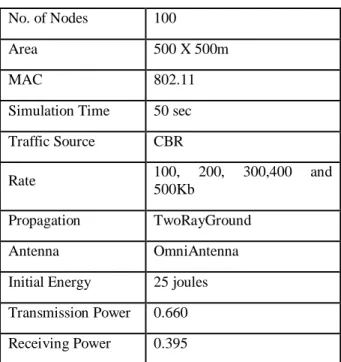
The simulation settings and parameters are summarized in table 1
No. of Nodes 100
Area 500 X 500m
MAC 802.11
Simulation Time 50 sec Traffic Source CBR
Rate 100, 200, 300,400 and 500Kb
Propagation TwoRayGround Antenna OmniAntenna Initial Energy 25 joules Transmission Power 0.660 Receiving Power 0.395
Table 1: Simulation parameters
4.2 Results & Analysis
The simulation results are presented in the next section. R ate Vs D elay 0 2 4 6 8 100 200 300 400 500 R a te (K b) D e la y (S e c ) P MDG P DS A DG
Fig 1: Rate Vs Delay R ate Vs D eliveryR atio
0 0.5 1 100 200 300 400 500 R a te (K b) D e lR a ti o P MDG P DS A DG
Fig 2: Rate Vs Delivery Ratio R ate Vs P ac ket D rop
0 500 1000 1500 2000 100 200 300 400 500 R a te (K b) P k ts P MDG P DS A DG
Fig 3: Rate Vs Drop R ate Vs E nerg y C ons umption
16 18 20 22 24 100 200 300 400 500 R a te (K b) E n e rg y (J ) P MDG P DS A DG
Fig 4: Rate Vs Energy
Figures 1 to 4 show the results of delay, delivery ratio, packet drop and energy consumption by varying the rate from100Kb to 500Kb for the CBR traffic in PMDGPDS and ADG protocols. When comparing the performance of the two protocols, we infer that PMDGPDS outperforms ADG by 19% in
terms of delay, 18% in terms of delivery ratio, 51% in terms of packet drop, and 5% in terms of energy consumption
5. Conclusion
In this paper mobile data gathering in WSN is processed. The priority based data storage module is processed where the data is categorized as high and low priority based on the deadline and urgency. Moreover, when there is overload of data at the mobile data collector, the lower priority of data will be dropped. Then the data exchange policy is processed and it is used in order to avoid dropping of higher priority data, then the data can be exchanged between two mobile data collectors. At lastdistributed scheduling algorithm is used to schedule the time slots according to which thedata collector could gather the maximal amount of data within a limited period
References
[1] Mohammad Hossein Anisi, Abdul Hanan Abdullah, Shukor Abd Razak, “Energy-Efficient Data Collection in Wireless Sensor Networks”, Wireless Sensor Network, 2011, 3, pp.329-333. [2] T. T. Truong, K. N. Brown and C. J. Sreenan, "Using Mobile Sinks in Wireless Sensor Networks to Improve Building Emergency Response", Mobile & Internet Systems Laboratory and Cork Constraint Computation Centre, Department of Computer Science, University College Cork, Ireland (2010).
[3] Leonidas Tzevelekas and Ioannis Stavrakakis. "Sink mobility schemes for data extraction in large scale WSNs under single or zero hop data forwarding." Wireless Conference (EW), 2010 European. IEEE, 2010.
[4] Junzhao Du, Hui Liu, Longfei Shangguan, Luo Mai, Kai Wang and Shucong Li, "Rendezvous Data Collection Using a Mobile Element in Heterogeneous Sensor Networks." International Journal of Distributed Sensor Networks, 2012. [5] Mohammad Hossein Anisi1, Abdul Hanan Abdullah, and Shukor Abd Razak, “Efficient Data Aggregation in Wireless Sensor Networks”, International Conference on Future Information Technology, Singapore, IPCSIT, 2011,vol.13. [6] Zhou Sha, Jia-Liang Lu, Xu Li, Min-You Wu, “An Anti-Detection Moving Strategy for Mobile Sink”, in the proceedings of IEEE, Globecom, 2010.
[7] Long Cheng, Yimin Chen, Canfeng Chen and Jian Ma, “Query-Based Data Collection in Wireless Sensor Networks with Mobile Sinks”, In Proceedings of the International Conference on Wireless Communications and Mobile Computing: Connecting the World Wirelessly, pp. 1157-1162, ACM, 2009.
[8] Athanasios Kinalis, Sotiris Nikoletseas, Dimitra Patroumpa and Jose Rolim, “Biased Sink Mobility with Adaptive Stop Times for Low Latency Data Collection in Sensor Networks”, Information Fusion, Volume 15, January 2014, Pages 56–63. [9] Taisoo Park, Daeyoung Kim, Seonghun Jang, Seong-eun Yoo, and Yohhan Lee, “Energy Efficient and Seamless Data Collection with Mobile Sinks in Massive Sensor Networks”, Parallel & Distributed Processing, IPDPS, IEEE International Symposium, Rome, 2009.
[10] Miao Zhao, Yuanyuan Yang, Fellow and Cong Wang, “Mobile Data Gathering with Load Balanced Clustering and Dual Data Uploading in Wireless Sensor Networks”, IEEE Transactions on Mobile Computing, 2013.
[11] Arun K. Kumar, Krishna M. Sivalingam and Adithya Kumar, “On reducing delay in mobile data collection based wireless sensor networks”, Wireless Networks, No.19, pp.285–299, 2013.
[12] Songtao Guo, Cong Wang and Yuanyuan Yang, “Joint Mobile Data Gathering and Energy Provisioning in Wireless Rechargeable Sensor Networks”, IEEE Transactions on Mobile Computing, 2013.
[13] Shuai Gao, Hongke Zhang and Sajal K. Das, “Efficient Data Collection in Wireless Sensor Networks with Path-Constrained Mobile Sinks”, IEEE Transactions on mobile computing, vol. 10, No. 5, APRIL 2011.
[14] Yu-Chee Tseng, Fang-Jing Wu, Wan-Ting Lai, "Opportunistic data collection for disconnected wireless sensor networks by mobile mules, Ad Hoc Networks, pp.1150–1164, 2013
[15]. Miao Zhao and Yuanyuan Yang, “Bounded Relay Hop Mobile Data Gathering in Wireless Sensor Networks”, 2009 IEEE
[16] Yongxuan Lai, Jinshan Xie, Ziyu Lin, Tian Wang and Minghong Liao, "Adaptive Data Gathering in Mobile Sensor Networks Using Speedy Mobile Elements", Sensors 2015
[17] Network Simulator: