ISSN(Online): 2320-9801
ISSN (Print): 2320-9798
I
nternational
J
ournal of
I
nnovative
R
esearch in
C
omputer
and
C
ommunication
E
ngineering
(An ISO 3297: 2007 Certified Organization)
Vol. 4, Issue 3, March 2016
Review on Image Segmentation
X.Arockia Stella1, Dr.N.Sujatha 2
Research Scholar, PG & Research Department of Computer Science, Raja Doraisingam Govt. Arts College,
Sivagangai, TamilNadu, India 1
Assistant Professor, PG & Research Department of Computer Science, Raja Doraisingam Govt. Arts College,
Sivagangai, TamilNadu, India2
ABSTRACT: Image segmentation is the crucial stride to investigate images and separate information from them. It is the field generally scrutinized and still offers different difficulties for the scientists. This paper attempts to put light on the fundamental standards on the techniques used to portion an image. This paper focuses on the thought behind the fundamental routines utilized. Image segmentation can be extensively ordered as semi-intuitive methodology and completely programmed approach and the calculations created lies in both of this methodologies. Image division is an urgent stride as it straightforwardly impacts the general accomplishment to comprehend the image.
KEYWORDS: Segmentation Methods, Image, Pixon, Cluster, Graph-cut, Hybrid Methods.
I. INTRODUCTION
An image is fundamentally a two dimensional function of spatial directions, f(x, y), and ampitude of this capacity at a given direction gives the power estimation of the image. The image can be communicated as the result of elements of enlightenment and reflection.
f(x,y) = i(x,y) . r(x,y) where i(x,y) is the capacity of force and r(x,y) is the capacity of reflectivity.
Digital image processing is utilization of different calculations on the image to enhance the nature of the image by evacuating clamor and other undesirable pixels furthermore to acquire more data on the image.
Among the different image preparing strategies image segmentation is extremely pivotal stride to examine the given image. This paper primarily concentrates on this strategy, the different techniques took after and few calculations that are broadly utilized. An endeavor is made to give the examination on these systems by taking test images. The images are worked utilizing Matlab programming.
ISSN(Online): 2320-9801
ISSN (Print): 2320-9798
I
nternational
J
ournal of
I
nnovative
R
esearch in
C
omputer
and
C
ommunication
E
ngineering
(An ISO 3297: 2007 Certified Organization)
Vol. 4, Issue 3, March 2016
II. IMAGE SEGMENTATION
Image segmentation is a mid-level preparing procedure used to break down the image and can be characterized as a handling method used to arrange or bunch a image into a few disjoint parts by gathering the pixels to frame a district of homogeneity in view of the pixel attributes like dark level, shading, composition, power and different components. The fundamental motivation behind the segmentation procedure is to get more data in the area of enthusiasm for a image which helps in annotation of the article scene. [1]. Image segmentation goes for space autonomous segment of the image into an arrangement of outwardly unmistakable and homogeneous areas as for specific properties. [2]. The principle objective of segmentation is to plainly separate the item and the foundation in a image.
In the event that R speaks to a image, then the image segmentation is basically segmentation of R into subregions R1,R2… ..Rn , such th
and is governed by following set of rules:
a) Ri is a connected set, i=1,2,…..n.
b) Ri∩ Rj = Ø for all i and j, i ≠ j
c) Q(Ri) = True for i= 1,2,…n.
d) Q(Ri U Rj) = False for adjoint regions, Ri and Rj
Where Q(Rk) is a logical predicate [3]. The rules described above mentions about continuity, one-to-one relationship,
homogeneity and non-repeatability of the pixels after segmentation respectively.
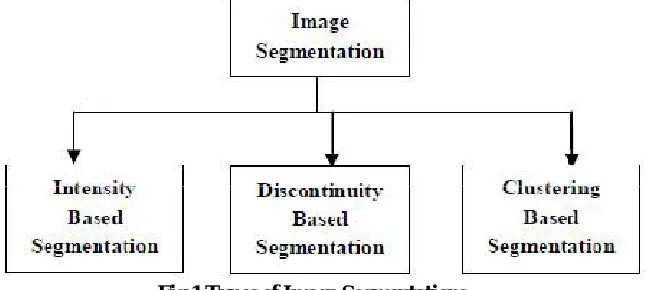
There are many knowledge based approaches to segment an image and can be listed as
Intensity based methods
Discontinuity based methods
Clustering methods
2.1. Intensity Based Segmentation
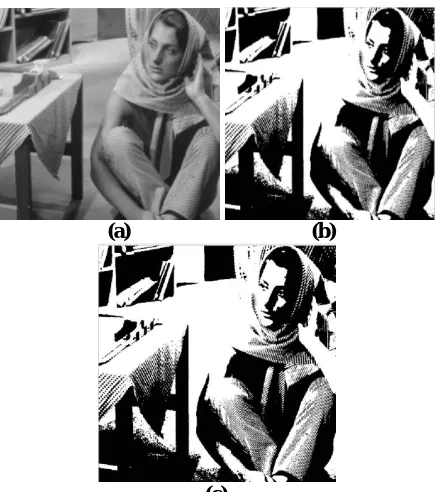
One of the least difficult ways to deal with portion a image depends on the power levels and is called as edge based methodology. Edge based methods characterizes the image into two classes and takes a shot at the propose that pixels fitting in with certain scope of force qualities speaks to one class and whatever remains of the pixels in the image speaks to alternate class. Thresholding can be executed either all inclusive or privately. Worldwide comparing so as to thresholding recognizes protest and foundation pixels with limit esteem picked and utilize double segment to portion the image. The pixels that breeze through the edge test are considered as item pixel and are allocated the twofold esteem "1" and different pixels are doled out double esteem "0" and regarded as foundation pixels. The edge based division systems are modest, computationally quick and can be utilized as a part of constant applications with help of specific equipment [4].
where g(x,y) is the output image; i(x,y) is the input image and t is the threshold value.
Neighborhood thresholding is likewise called as versatile thresholding. In this system the limit esteem changes over the image contingent upon the neighborhood normal for the subdivided areas in the image. The calculation took after for versatile thresholding can be expressed by and large as:
1. Separate the picture into subimage.
2. Select a nearby limit for sub image reckoned.
ISSN(Online): 2320-9801
ISSN (Print): 2320-9798
I
nternational
J
ournal of
I
nnovative
R
esearch in
C
omputer
and
C
ommunication
E
ngineering
(An ISO 3297: 2007 Certified Organization)
Vol. 4, Issue 3, March 2016
4. Consider all sub images exclusively and pick comparing limit values. 5. Stop division while all the sub images are processed.
Advantage:
1. Computationally affordable
2. Fast and more straightforward to execute
3. Can work continuously applications [4].
Disadvantage:
1. Neglects the spatial data of the image.
2. Highly commotion delicate.
3. Selection of limit quality is vital and regularly brings about over or under division.
4. May lead to pseudo edges or missing edges. [5].
(a) (b)
(c)
Figure 2: (a) Original Image, (b) Multi-thresholding, (c) Otsu’s thresholding
2.2. Discontinuity Based Methods
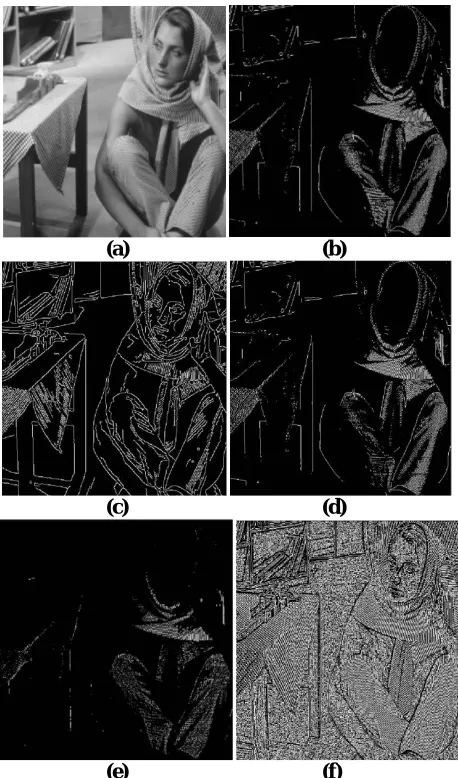
These systems depend on the rule of force varieties among the pixels. On the off chance that the image comprises two or more protests limits exists and henceforth can be connected to fragment the image. The limits of the items lead to arrangement of edges. The noteworthy unexpected changes in the power levels among neighboring pixels in certain bearing are termed as edges and bring about the brokenness in the pixels. Edge location essentially includes the accompanying steps: smoothing the image, edge identification and edge restriction. [6].
A suitable smoothing channel is connected on test image to expel the clamor from the image to make it suitable for division. At that point the „possible‟ edges are assembled together to check for candidature lastly the „true‟ edges are
found by confining the edge „candidates‟. There are four diverse edge sorts that might be available in the image (a)
stage edge (b) slope edge (c) edge and (d) incline edge and are appeared in the fig correspondingly. [7].
Edges are generally found by applying veils over the image. The slope or the zero intersection procedures are utilized to discover the edges in the given image. The convolution operation between the veil and the image decides the edge set for the image.
ISSN(Online): 2320-9801
ISSN (Print): 2320-9798
I
nternational
J
ournal of
I
nnovative
R
esearch in
C
omputer
and
C
ommunication
E
ngineering
(An ISO 3297: 2007 Certified Organization)
Vol. 4, Issue 3, March 2016
A. First order derivative operators:
There are two systems for first request subordinate edge identification. 1) One of the techniques is assessing the angles produced along two orthogonal bearings. 2) The second approach is using an arrangement of discrete edge formats with diverse introductions. The main subordinate administrator utilizes slope system to discover the edges by utilizing the greatest and least estimation of the angle. The inclination is a measure of progress in a capacity.
Direction of gradient is given by
α is measured with respect to x axis.
The operators used in this category are Robert’s operator, Prewitt’s operator and Sobel’s operator.
B. Second Order Derivative operators:
These administrators take a shot at zero intersection discovery of the second subordinate of the angle. It identifies the neighborhood maxima in inclination values and regards them as edges. The Laplacian operator is utilized with the second subordinate administrator. The Laplacian operator for any capacity f(x, y) is given by
Where,
ISSN(Online): 2320-9801
ISSN (Print): 2320-9798
I
nternational
J
ournal of
I
nnovative
R
esearch in
C
omputer
and
C
ommunication
E
ngineering
(An ISO 3297: 2007 Certified Organization)
Vol. 4, Issue 3, March 2016
(a) (b)
(c) (d)
(e) (f)
Figure 3: (a) Original Image, (b) Sobel Operator, (c) Canny Operator, (d) Prewitt Operator, (e) Roberts Opertaor, (f) Log Operator
Advantage:
1. Second request administrators give solid results.
2. Useful in figuring the quantity of distinctive articles present in the given image.
Disadvantage:
1. No single administrator can fit for all assortments of images and the computational multifaceted nature increments with the extent of administrator.
2. Many a times the edges acquired are not ceaseless. 3.
2.3. Clustering Based Methods:
ISSN(Online): 2320-9801
ISSN (Print): 2320-9798
I
nternational
J
ournal of
I
nnovative
R
esearch in
C
omputer
and
C
ommunication
E
ngineering
(An ISO 3297: 2007 Certified Organization)
Vol. 4, Issue 3, March 2016
A. Agglomerative clustering: This is a various leveled approach and begins calling so as to gather every information point a different group, and after those consolidations the proper groups into single clusteres. The key stride for various leveled calculations is to register the separation. This procedure can be schematized utilizing dendograms. The consequence of this strategy is that it results in a few segments. The uniqueness grid is utilized to choose which groups are to be blended; the littlest section gives the information focuses that are slightest disparate and thus are the undoubtedly possibility to be consolidated. Calculation: Agglomerative Hierarchical grouping [13].
1. Select the greatest comparability esteem from the data likeness grid and its session is Si,Sj and join and frame its piece Si,j.
2. Form a grid with Si,j.
3. Find the cell estimation of grid as Similarity(Si,j, Sk) = min { comparability (Si,Sk), Similarity(Sj,Sk)} 4. Repeat stage 2 until single group in lattice cell.
B. Partitional clustering: These calculations works by indicating the quantity of gatherings at first and meeting them iteratively. The partitional grouping isolates the information focuses into clusteres such that the aggregate separation of information focuses to their particular group focuses is insignificant. A calculation to accomplish this is called K-means grouping. The partitional grouping results in one single segment of the image.
(a) (b)
(c)
Figure 4: (a) Original Image, (b) Fuzzy C-means clustering, (c) K-means clustering Advantage:
1. Clustering calculations use a wide range of elements of images such as splendor (pixel force) and geometric
data (pixel area), however a calculation's viability is exceptionally reliant on the kind of article and the element utilized.
2. This raises equivocalness among the decision of elements to acquire better results for given image and henceforth restrain the speculation of a grouping calculation.
Disadvantage:
1. In hierarchal system if once the union/split is done, it can never be fixed. This inflexibility can be constraint for some situation and can be valuable in different as it prompts littler calculation costs by not stressing over a combinatorial number of distinctive decisions
ISSN(Online): 2320-9801
ISSN (Print): 2320-9798
I
nternational
J
ournal of
I
nnovative
R
esearch in
C
omputer
and
C
ommunication
E
ngineering
(An ISO 3297: 2007 Certified Organization)
Vol. 4, Issue 3, March 2016
Image segmentation is a procedure of separating an image into its constituent homogeneous locales to concentrate information from the characteristics of the image. Therefore, a great segmentation ought to bring about areas in which the image components ought to have uniform properties regarding brilliance, shading or composition and so forth. Despite the fact that the image is to be distributed into districts, the significant changes inside of the locales ought to be recognizable outwardly. The estimation of nature of segmentation is that the components of the same area ought to be comparative and ought to have clear contrast between components of alternate areas. The segmentation procedure can be isolated into different class in light of the parameter chose for segmentation such as pixel force, homogeneity, irregularity, group information, topology and so forth. Every methodology has its own particular favorable circumstances and inconveniences. The outcome got utilizing one methodology may not be the same as contrasted and other methodology. Routines that are specific to specific applications can regularly accomplish better execution and this choice of a proper way to deal with a segmentation issue can be a troublesome situation. Essentially the segmentation can be semi-intuitive or completely programmed. The algorithms created for segmentation lies in both of this classification. With the real trouble of poorly postured nature of segmentation it is difficult to get single response for segmentation of given image as the understanding fluctuates from individual methodologies.
Sometimes manual association to portion the image might be blunder inclined (for instance, if there should be an occurrence of seed determination) while the completely mechanized methodology can give mistake yield and at times intelligent techniques can be relentless and tedious. So a solitary way to deal with section all assortments of images might be down to earth unachievable. The former information on the image can give better results and gives client the decision to choose appropriate technique to portion the image.
IV.EXPERIMENTAL RESULT
Table1.1 performance of PSNR value for various segmentation methods using image
V. CONCLUSION
In the control of computer vision, image handling is a rapidly moving field. Its development has been filled by innovative advances in computerized imaging, PC processors and mass capacity gadgets. In this paper, different methods of image segmentation has been examined, a diagram of all related image segmentation parameters has been introduced in this paper. PSNR value has been measured on various segmentation methods using image which is tabulated here. Otsu’s thersholding is better than other segmentation methods. Otsu’s thersholding image has been enhanced.
REFERENCES
[1] Dr. (Mrs.) G.Padmavathi, Dr.(Mrs.) P.Subashini and Mrs.A.Sumi “Empirical Evaluation of Suitable Segmentation Algorithms for IR Images”, IJCSI International Journal of Computer Science Issues, Vol. 7, Issue 4, No 2, July 2010.
[2] X. Munoz, J. Freixenet, X. Cuf_ı, J. Mart, “Strategies for image segmentation combining region and boundary information”, Pattern Recognition
S. No Image Type PSNR
1 Multi thresholding 17.1785
2 Otsu’sthresholding 12.6575
3 Sobel Operator 13.8960
4 Canny Operator 56.0925
5 Prewitt Operator 60.004
6 Roberts Operator 57.025
7 Log Operator 56.025
8 Fuzzy 55.025
ISSN(Online): 2320-9801
ISSN (Print): 2320-9798
I
nternational
J
ournal of
I
nnovative
R
esearch in
C
omputer
and
C
ommunication
E
ngineering
(An ISO 3297: 2007 Certified Organization)
Vol. 4, Issue 3, March 2016
Letters 24, page no 375–392, 2003.
[3] R.C. Gonzalez and R.E. Woods, “Digital Image Processing”, third edition, PHI publication, 2008. [4] S. Nagabhushana, “Computer Vision and Image Processing”, New Age International Publishers, 2005.
[5] Tranos Zuva, Oludayo O. Olugbara, Sunday O. Ojo and Seleman M. Ngwira “Image Segmentation, Available Techniques, Developments and Open Issues”, Canadian Journal on Image Processing and Computer Vision Vol. 2, No. 3, March 2011.
[6] Ravi S and A M Khan, “Operators Used in Edge Detection: A Case Study”, International Journal of Applied Engineering Research, ISSN 0973-4562 vol. 7 No 11, 2012.
[7] N. Senthilkumaran and R. Rajesh, “Edge Detection Techniques for Image Segmentation – A Survey of Soft Computing Approaches”, International Journal of Recent Trends in Engineering, Vol. 1, No. 2, May 2009.