Session Clocking and Hijacking Attack Detect
and Defence Strategies on WSN Network
Amar Shinde1, Sandip Khote2, Prof. Anupkumar Bongale3
Student, Department of Computer Engineering, DYPCOE Pune, Savitribai Phule Pune University, Pune. India1,2
Prof., Department of Computer Engineering, DYPCOE Pune, Savitribai Phule Pune University, Pune. India3
ABSTRACT: Remote ridiculing assaults are anything but difficult to dispatch and can altogether effect the execution
of systems. In spite of the fact that the character of a hub can be confirmed through cryptographic verification, traditional security methodologies are not generally alluring in view of their overhead prerequisites. In this paper, we propose to utilize spatial data, a physical property connected with every hub, difficult to distort, and not dependent on cryptography, as the premise for (1) distinguishing mocking assaults; (2) deciding the quantity of assailants when different enemies taking on the appearance of a same hub character; and (3) confining various foes. We propose to utilize the spatial relationship of got sign quality (RSS) acquired from remote hubs to distinguish the ridiculing assaults. We then detail the issue of deciding the quantity of aggressors as a multi-class identification issue. Group based systems are created to decide the quantity of aggressors. At the point when the preparation information is accessible, we investigate utilizing Support Vector Machines (SVM) strategy to promote enhance the exactness of deciding the quantity of assailants. Also, we added to a coordinated identification and restriction framework that can confine the positions of numerous assailants. We assessed our strategies through two testbeds utilizing both a 802.11 (WiFi) system and a 802.15.4 (ZigBee) system in two genuine office structures. Our exploratory results demonstrate that our proposed techniques can accomplish more than 90% Hit Rate and Precision while deciding the quantity of aggressors. Our confinement results utilizing an agent set of calculations give solid confirmation of high exactness of restricting different enemies.
KEYWORDS: Wireless network security, Spoofing attack, Attack detection, Localization
I. INTRODUCTION
parodying assaults and additionally decide the quantity of foes utilizing group investigation strategies grounded on RSS-based spatial connections among ordinary gadgets and enemies; and IDOL: an incorporated location and confinement framework that can both recognize assaults and in addition discover he positions of numerous enemies notwithstanding when the foes fluctuate their transmission power levels. The Partitioning around Medoids (PAM) group examination technique is utilized to perform assault location. We figure the issue of deciding the quantity of assailants as a multi-class location issue. We encourage added to a component called SILENCE for testing Silhouette Plot and System Evolution with least separation of groups, to enhance the exactness of deciding the quantity of assailants. Also, when the preparation information is accessible, we propose to utilize Support Vector Machines (SVM) technique to advance enhance the precision of deciding the quantity of assailants. The way that remote channel reaction de-relates quickly in space, a channel-based verification plan was proposed to segregate between transmitters at various areas, and in this way to distinguish mocking assaults in remote systems concentrated on extracting so as to build fingerprints of 802.11b WLAN NICs radiometric marks, for example, recurrence extent, stage blunders, and I/Q root counterbalance, to guard against character assaults. Nonetheless, there is extra overhead connected with remote channel reaction and radiometric signature extraction in remote systems. In WSN system presented a security layer that utilized fashion safe connections in light of the parcel movement, including MAC grouping number and activity example, to identify parodying assaults. The MAC grouping number has likewise been utilized as a part of performs of parodying discovery. Both the succession number and the activity example can be controlled by a foe the length of the foe takes in the movement design under ordinary conditions. The hub's "spatial mark", including Received Signal Strength Indicator (RSSI) and Link Quality Indicator (LQI) to verify messages in remote systems. In any case, none of these methodologies are fit for deciding the quantity of assailants when there are different foes teaming up to utilize the same character to dispatch pernicious assaults. Further, they don't be able to restrict the positions of the foes after assault recognition.
II. LITERATURE SURVEY
1) Supporting Anonymous Location Queries in Mobile Environments with Privacy grid
AUTHORS: B. Bamba, L. Liu, P. Pesti, and T. Wang
This paper presents Privacy Grid - a structure for supporting unknown area based questions in versatile data conveyance frameworks. The Privacy Grid system offers three one of a kind abilities. In the first place, it gives an area security insurance inclination profile model, called area P3P, which permits portable clients to expressly characterize their favored area protection prerequisites as far as both area concealing measures (e.g., area k-obscurity and area l-differences) and area administration quality measures (e.g., most extreme spatial determination and greatest worldly determination). Second, it gives quick and viable area shrouding calculations for area k-secrecy and area l-assorted qualities in a portable domain. We create dynamic base up and best down lattice shrouding calculations with the objective of making high anonymization progress rate and effectiveness regarding both time unpredictability and upkeep cost. A half and half approach that precisely consolidates the qualities of both base up and best down shrouding ways to deal with further diminish the normal anonymization time is likewise created. Last however not the slightest, Privacy Grid joins transient shrouding into the area shrouding procedure to further build the achievement rate of area anonymization. We likewise talk about Privacy Grid components for supporting unknown area questions. Exploratory assessment demonstrates that the Privacy Grid methodology can give near ideal area k-namelessness as characterized by per client area P3P without presenting huge execution punishments.
2) On the Value of a Random Minimum Weight Steiner Tree
AUTHORS: B. Bollobas, D. Gamarnik, O. Riordan, and B. Sudakov
Consider a complete chart on n vertices with edge weights picked haphazardly and freely from an exponential circulation with parameter 1. Fix k vertices and consider the base weight Steiner tree which contains these vertices. We demonstrate that with high likelihood the heaviness of this tree is (1 + o(1))(k − 1)(log n − log k)/n when k = o(n) and n→∞. 1.
3) Random Key Predistribution Schemes for Sensor Networks
Key foundation in sensor systems is a testing issue on the grounds that uneven key cryptosystems are unacceptable for use in asset obliged sensor hubs, furthermore in light of the fact that the hubs could be physically bargained by an enemy. We display three new instruments for key foundation utilizing the structure of pre-disseminating an arbitrary arrangement of keys to every hub. To start with, in the q-composite keys plan, we exchange off the improbability of an expansive scale system assault keeping in mind the end goal to fundamentally reinforce arbitrary key redistribution's quality against littler scale assaults. Second, in the multipath-support plan, we demonstrate to reinforce the security between any two hubs by utilizing the security of different connections. At long last, we introduce the irregular pairwise keys plan, which consummately safeguards the mystery of whatever is left of the system when any hub is caught, furthermore empowers hub to-hub confirmation and majority based renouncement.
4) Enhancing Base Station Security in Wireless Sensor Networks,
AUTHORS: J. Deng, R. Han, and S. Mishra
Remote sensor organizes that are conveyed in applications, for example, front line observing and home sentry frameworks face intense security concerns, including listening stealthily, fabrication of sensor information, disavowal of administration assaults, and the physical trade off of sensor hubs. Sensor systems are frequently composed progressively, with a base station serving as a passage for gathering information from a multi-jump system of asset compelled sensor hubs. Earlier work that has concentrated on securing the steering between sensor hubs has expected that the base station is adequately capable to shield itself against security dangers. This paper considers techniques for securing the sensor system against an assortment of dangers that can prompt the disappointment of the base station, which speaks to a main issue of disappointment. To start with, multipath directing to various destination base stations is examined as a procedure to give resistance against individual base station assaults and/or bargain. Second, perplexity of location and distinguishing proof fields in parcel headers through hashing capacities is investigated as a system to mask the area of the base station from busybodies. Third, movement of the base station in the system topology is concentrated on as a method for upgrading strength and alleviating the extent of harm.
5) Intrusion Tolerance and Anti- Traffic Analysis Strategies for Wireless Sensor Networks
AUTHORS: J. Deng, R. Han, and S. Mishra
Remote sensor systems face intense security worries in applications, for example, combat zone checking. A main issue of disappointment in a sensor system is the base station, which goes about as a gathering purpose of sensor information. In this paper, we research two assaults that can prompt detachment or disappointment of the base station. In one arrangement of assaults, the base station is disengaged by blocking correspondence between sensor hubs and the base station, e.g. by DOS assaults. In the second assault, the area of the base station is derived by investigating information movement towards the base station, which can prompt sticking and/or revelation and decimation of the base station. To protect against these assaults, two secure procedures are proposed. In the first place, secure multi-way steering to numerous destination base stations is intended to give interruption resilience against seclusion of a base station. Second, hostile to activity examination systems are proposed to mask the area of the base station from busybodies. An execution assessment is accommodated a reenacted sensor system, and in addition estimations of cryptographic overhead on genuine sensor hubs.
III. EXISTING SYSTEM AND PRPOSED SYSTEM APPROACH
1. Ingress/Egress Filtering:
2. Ingress – An ISP disallows accepting from its stub associated systems parcels whose source address does not have a place with the comparing stub system address space
3. Egress – A switch or a firewall which is the door of a stub system sift through any bundle whose source address does not fit in with the system address space.
DISADVANTAGES OF EXISTING SYSTEM:
2. Not self-defensive
3. Effective only when implemented by large number of networks 4. Deployment is costly
5. Incentive for an ISP is very low
PRPOSED SYSTEM:
1.The proposed System utilized Inter area Packet channels (IDPFs) design, a framework that can be developed exclusively taking into account the privately traded BGP upgrades.
2. Each hub just chooses and spreads to neighbors in view of two arrangements of steering approaches. They are Import and Export Routing strategies.
3. The IDPFs utilizes a doable way from source hub to the destination hub, and a parcel can reach to the destination through one of its upstream neighbors.
4. The preparing information is accessible; we investigate utilizing Support Vector Machines (SVM) technique to advance enhance the exactness of deciding the quantity of aggressors.
5. In confinement results utilizing an agent set of calculations give solid confirmation of high precision of limiting various enemies.
6. The Cluster Based remote Sensor Network information got signal quality (RSS) based spatial connection of system Strategy.
7. A physical property connected with every remote gadget that is difficult to distort and not dependent on cryptography as the premise for identifying caricaturing assaults in remote systems.
ADVANTAGES OF PROPOSED SYSTEM:
1. Damage Reduction under SPM Defense is high 2. Client Traffic
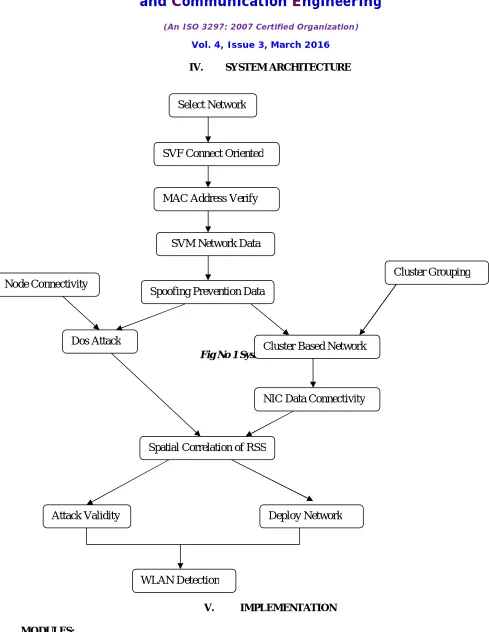
IV. SYSTEM ARCHITECTURE
Fig No 1 System Architecture
V. IMPLEMENTATION
MODULES:
I. Blind & Non-Blind Spoofing II. Man in the Middle Attack
Select Network
SVF Connect Oriented
MAC Address Verify
SVM Network Data
Spoofing Prevention Data
Dos Attack Cluster Based Network
NIC Data Connectivity
Spatial Correlation of RSS
Cluster Grouping Node Connectivity
Attack Validity Deploy Network
III. Constructing Routing Table IV. Finding Feasible path
V. Constructing Inter-Domain Packet Filters VI. Receiving the valid packets
I. Blind & Non-Blind Spoofing:
1. Spoofing detection is to devise strategies that use the uniqueness of spatial information.
2. In location directly as the attackers’ positions are unknown network RSS, a property closely correlated with location in physical space and is readily available in the wireless networks.
3. The RSS readings at the same physical location are similar, whereas the RSS readings at different locations in physical space are distinctive.
4. The number of attackers when there are multiple adversaries masquerading as the same identity.
II. Man in the Middle Attack:
1. Localization is based on the assumption that all measurements gathered received signal strength (RSS) are from a single station and, based on this assumption, the localization algorithm matches a point in the measurement space with a point in the physical space.
2. The spoofing attack, the victim and the attacker are using the same ID to transmit data packets, and the RSS readings of that ID is the mixture readings measured from each individual node.
3. RSS-based spatial correlation to find out the distance in signal space and further detect the presence of spoofing attackers in physical space.
III. Constructing Routing Table:
1. The channel frequency response is sensitive to each multipath. An impulse in the time domain is a constant in the frequency domain, and thus a change to a single path may change the entire multiple tone link of Network.
2. In wireless networks classes that provide automatic reconfiguration of APs, adjusting power levels and channel assignments to optimize coverage while minimizing contention between neighbors.
3. The RSS readings over time from the same physical location will belong to the same cluster points in the n-dimensional signal space.
IV. Finding feasible path (Attack Computation):
1. Converting the large dataset into medium format for the computation purpose.
2. In this medium the rows consists of http request and columns consists of time for a particular user (IP address).
3. Received Signal Strength Indicator Formula,
4. The RSS stream of a node identity may be mixed with RSS readings of both the original node as well as spoofing nodes from different physical locations.
V. Constructing Inter-Domain Packet Filters:
2. The minimum distance between two clusters is large indicating that the clusters are from different physical locations.
3. The minimum distance between the returned clusters to make sure the clusters are produced by attackers instead of RSS variations and outliers.
VI. Receiving different Transmission Power:
1. The transmission power levels when performing spoofing attacks so that the localization system cannot estimate its location accurately.
2. The CDF of localization error of RADAR-Gridded and ABP when adversaries using different transmission power levels.
3. In detection mechanisms are highly effective in both detecting the presence of attacks with detection rates over 98% and determining the number of network.
VI. RESULT OF ATTACK DETECTION
A. Impact of Threshold:
The limits of test insights characterize the basic area for the noteworthiness testing. Properly setting an edge t empowers the assault locator to be powerful to false recognitions. Figures demonstrate the Cumulative Distribution Function of Dm in sign space under both typical conditions and also with ridiculing assaults. We watched that the bend of Dm moved incredibly to the directly under ridiculing assaults. Along these lines, when Dm > t, we can proclaim the vicinity of a caricaturing assault.
Fig-2: Different transmission power. [7]
B. Impact of Distance between the Spoofing Node and the original node:
VII. CONCLUSION
In this work, we proposed to use got signal quality (RSS) based spatial relationship, a physical property associated with each remote contraption that is hard to distort and not reliant on cryptography as the reason for recognizing satirizing ambushes in remote frameworks. We gave theoretical examination of using the spatial association of RSS obtained from remote center points for attack recognizable proof. We decided the test estimation considering the gathering examination of RSS readings. Our system can perceive the region of strikes and what's more choose the amount of foes, criticizing the same center point character, with the objective that we can confine any number of attackers and get rid of them. Choosing the amount of enemies is a particularly troublesome issue. We made SILENCE, a part that uses the base partition testing despite bundle examination to achieve better exactness of choosing the amount of aggressors than various methods under concentrate, for instance, Silhouette Plot and System Evolution, that usage bunch examination alone. Also, when the arrangement data is open, we researched using Support Vector Machines (SVM) based part to help upgrade the precision of choosing the amount of attackers present in the system. To acknowledge our strategy, we drove tests two testbeds through both a 802.11network (WiFi) and a 802.15.4 (ZigBee) framework in two bona fide office building circumstances. We found that our acknowledgment segments are exceedingly fruitful in both recognizing the region of attacks with distinguishing proof rates more than 98% and choosing the amount of foes, finishing more than 90% hit rates and precision at the same time when using SILENCE and SVM-based instrument. Further, in perspective of the amount of aggressors managed by our instruments, our planned disclosure and control structure can limit any number of foes despite when attackers using different transmission power levels. The execution of limiting adversaries achieves near results as those under normal conditions, in this way, giving strong confirmation of the ampleness of our system in recognizing remote ridiculing strikes, choosing the amount of attackers and binding foes.
REFERENCES
[1] J. Bellardo and S. Savage, “802.11 denial-of-service attacks: Real vulnerabilities and practical solutions,” in Proceedings of the USENIX Security Symposium, 2003, pp. 15 – 28.
[2] F. Ferreri, M. Bernaschi, and L. Valcamonici, “Access points vulnerabilities to dos attacks in 802.11 networks,” in Proceedings of the IEEE Wireless Communications and Networking Conference, 2004.
[3] D. Faria and D. Cheriton, “Detecting identity-based attacks in wireless networks using signalprints,” in Proceedings of the ACM Workshop on Wireless Security (WiSe), September 2006.
[4] Q. Li and W. Trappe, “Relationship-based detection of spoofing-related anomalous traffic in ad hoc networks,” in Proc. IEEE SECON, 2006. [5] B. Wu, J. Wu, E. Fernandez, and S. Magliveras, “Secure and efficient key management in mobile ad hoc networks,” in Proc. IEEE IPDPS, 2005. [6] A. Wool, “Lightweight key management for ieee 802.11 wireless lans with key refresh and host revocation,” ACM/Springer Wireless Networks, vol. 11, no. 6, pp. 677–686, 2005.
[7] Y. Sheng, K. Tan, G. Chen, D. Kotz, and A. Campbell, “Detecting 802.11 MAC layer spoofing using received signal strength,” in Proc. IEEE INFOCOM, April 2008.
[8] J. Yang, Y. Chen, and W. Trappe, “Detecting spoofing attacks in mobile wireless environments,” in Proc. IEEE SECON, 2009. [9] Y. Chen, W. Trappe, and R. P. Martin, “Detecting and localizing wirelss spoofing attacks,” in Proc. IEEE SECON, May 2007.
[10] M. bohge and W. Trappe, “An authentication framework for hierarchical ad hoc sensor networks,” in Proceedings of the ACM Workshop on Wireless Security (WiSe), 2003, pp. 79–87.
[11] L. Xiao, L. J. Greenstein, N. B. Mandayam, and W. Trappe, “Fingerprints in the ether: using the physical layer for wireless authentication,” in Proceedings of the IEEE International Conference on Communications (ICC), June 2007, pp. 4646–4651.
[12] V. Brik, S. Banerjee, M. Gruteser, and S. Oh, “Wireless device identification with radiometric signatures,” in Proceedings of the 14th ACM international conference on Mobile computing and networking, 2008, pp. 116–127.
[13] F. Guo and T. Chiueh, “Sequence number-based mac address spoof detection,” in Recent Advances in Intrusion Detection, 2006, pp. 309–329. [14] L. Sang and A. Arora, “Spatial signatures for lightweight security in wireless sensor networks,” in The 27th Conference on Computer Communications, INFOCOM 2008., 2008, pp. 2137–2145.
[15] P. Bahl and V. N. Padmanabhan, “RADAR: An in-building RF-based user location and tracking system,” in Proc. IEEE INFOCOM, 2000. [16] E. Elnahrawy, X. Li, and R. P. Martin, “The limits of localization using signal strength: A comparative study,” in Proc. IEEE SECON, Oct. 2004.
[17] Y. Chen, J. Francisco, W. Trappe, and R. P. Martin, “A practical approach to landmark deployment for indoor localization,” in Proc. IEEE SECON, September 2006.
[18] J. Yang and Y. Chen, “A theoretical analysis of wireless localization using RF-based fingerprint matching,” in Proceedings of the Fourth International Workshop on System Management Techniques, Processes, and Services (SMTPS), April 2008.