EFFLUENT DECOLORIZATION TECHNOLOGIES FOR THE PULP AND PAPER INDUSTRY
T, W, Joyce and W. H. P e t k e
Department of Wood and Paper S c i e n c e North Carolina S t a t e University
Raleigh, North Carolina 27650
The work upon which this p u b l i c a t i o n is based was supported w i t h funds from Water Resources Research I n s t i t u t e o f The U n i v e r d i t y o f North Carolina as a u t h o r i z e d by t h e Water Research and Development A c t of 1978.
ACKNOWLEDGMENTS
We thank M s . J a n e t Lucas f o r h e r p a t i e n c e and t h e s k i l l f u l p r e p a r a t i o n o f t h e manuscript.
One of u s (TWJ) i s a p p r e c i a t i v e t o h i s g r a d u a t e s t u d e n t s , S a l e s h L a t h i a , Bob Schmidt, J e f f Brown, Brown Belt, A 1 B e s h i r e , Alton Campbell, J a n e t
Campbell, Liz G e r r a r d
,
and B. Vasudevan, who have s t u d i e d v a r i o u s a s p e c t s o ft h e c o l o r problem.
We also thank Mike S k l a r e w i t z f o r a s s i s t a n c e i n t h e p r e p a r a t i o n o f t h e s e c t i o n concerning t h e Rapson-Reeve P r o c e s s ,
DISCLAIMER STATEMENT
C o n t e n t s of t h i s p u b l i c a t i o n do not n e c e s s a r i l y r e f l e c t t h e views and p o l i c i 6 s of t h e Water Resources Research I n s t i t u t e of The U n i v e r s i t y o f North C a r o l i n a , n o r does mention o f t r a d e names o r commercial p r o d u c t s c o n s t i t u t e t h e i r
endorsement o r recommendation f o r use by t h e S t a t e o r t h e I n s t i t u t e .
ABSTRACT
The d i s c h a r g e of c o l o r from pulp and paper m i l l s is a s e r i o u s a e s t h e t i c problem. Recently, t h e c o l o r - c a u s i n g o r g a n i c compounds have a l s o been
i m p l i c a t e d i n t h e appearance o f a l g a l blooms i n t h e Chowan R i v e r , North C a r o l i n a .
The pulp and paper i n d u s t r y has long sponsored r e s e a r c h t o f i n d c o s t - e f f e c t i v e means t o remove c o l o r from i t s e f f l u e n t s . Although many c o l o r removal t e c h n o l o g i e s have been proposed, none i s widely accepted.
T h i s r e p o r t is a c o m p i l a t i o n of t h e r e s e a r c h l i t e r a t u r e , p r i m a r i l y s i n c e
TABLE OF CONTENTS
Page
...
ABSTRACT v
...
LIST OF TABLES
..viii
...
LIST OF FIGURES i x I N T R O D U C T I O N m * . ~ ~ ~ ~ w ~ ~ ~ e * * * ~ ~ ~ e ~ ~ ~ * ~ * * * ~ * ~ ~ ~ m * * * ~ ~ ~ ~ ~ ~ ~ ~ ~ ~ ~ ~ ~ ~ ~ ~ ~ ~ l G e n e r a l Background. . .
1...
The Manufacture of Paper 5...
The Nature of Color 19...
COLOR REMOVAL TECHNOLOGIES 27. . .
I n t r o d u c t i o n 27...
E f f l u e n t Treatment 27...
Color Removal by Secondary Treatment 27...
The MyCoR Process. 28. . .
Metal I o n s * 3 l. . .
Enzyme P r e t r e a t m e n t 40...
Resin S e p a r a t i o n and I o n Exchange 42. . .
Aluminium Oxide 47 Adsorption on Wood...
47Membrane Processes
...
50I r r a d i a t i o n
...
* . * . . * * . * * e * 0 * * * m * . * * * * e * * * 0 * 0 * * * 0 * 0 5 6...
E l e c t r o l y t i c Processes...
57A c t i v a t e d Carbon
...
e * m * e . * * 0 0 * * . 0 * * * m * 0 * 0 * * 0 m 6 0 Land Treatment...
63...
Amine P r o c e s s e s 66 Ozone. . .
. . 6 6 P r o c e s s M o d i f i c a t i o n s...
69.
Oxygen Pulping and Anthraquinone. . . o . . .
69Bleach P l a n t M o d i f i c a t i o n s
...
73. . .
Oxygen Bleaching 73 C h l o r i n e Dioxide...
76...
Hypochlorite 77 Peroxide...
80Ozone
...
81Gas-Phase Bleaching
...
82Displacement Bleaching
. . .
84The Rapson-Reeve Closed Bleach P l a n t
...
86LIST OF TABLES
PAGE Economic Importance o f Some Major Pulp Mills
i n North Carolina..o...O~~~...o~m...~mOom~...~.e..o.2 pulp and Paper M i l l s i n North CarolinaO...3
Typical White Liquor
...
Typical Black Liquor Composition (Pine K r a f t ) . 13
...
M i l l s i n North C a r o l i n a U t i l i z i n g Pulp Bleaching d 6 Approximate Color Concentrations i n Various Waste
Streams from Bleached K r a f t Pulp Production...2~ Costs o f D e c o l o r i z a t i o n A l t e r n a t i v e s f o r t h e F i r s t C a u s t i c E x t r a c t i o n Stage ESfluent...91
Costs of' D e c o l o r i z a t i o n A l t e r n a t i v e s f o r t h e T o t a l Mill Effl~ent~...~~~..~...~~...~...~2
LIST OF FIGURES
Page
1
.
Flow Chart of t h e Manufacture o f Paper ...e.ee... ..62
.
P o r t i o n o f L i g n i n polymer...^ Conventional Bleach Plant... ...ee...eee.. . I 4K r a f t Recovery System ...e.ee...a..ee.e..e~e.ae.... 18
Some Proposed Chromophoric S t r u c t u r e s
...
22...
Sources of P o l l u t a n t s i n Bleached Kraft M i l l . ..25 D e s t r u c t i o n o f C h l o r i n a t e d Compounds by t h e MyCoR P r o c e s s
. .
-30 MyCoR Process...
32 Mini-Lime P r o c e s s . . . e . . e a e . e e e e . e e e . . e . . e e e . . e . e ..33Chemical Reactions i n t h e Lime P r e c i p i t a t i o n Process..
...
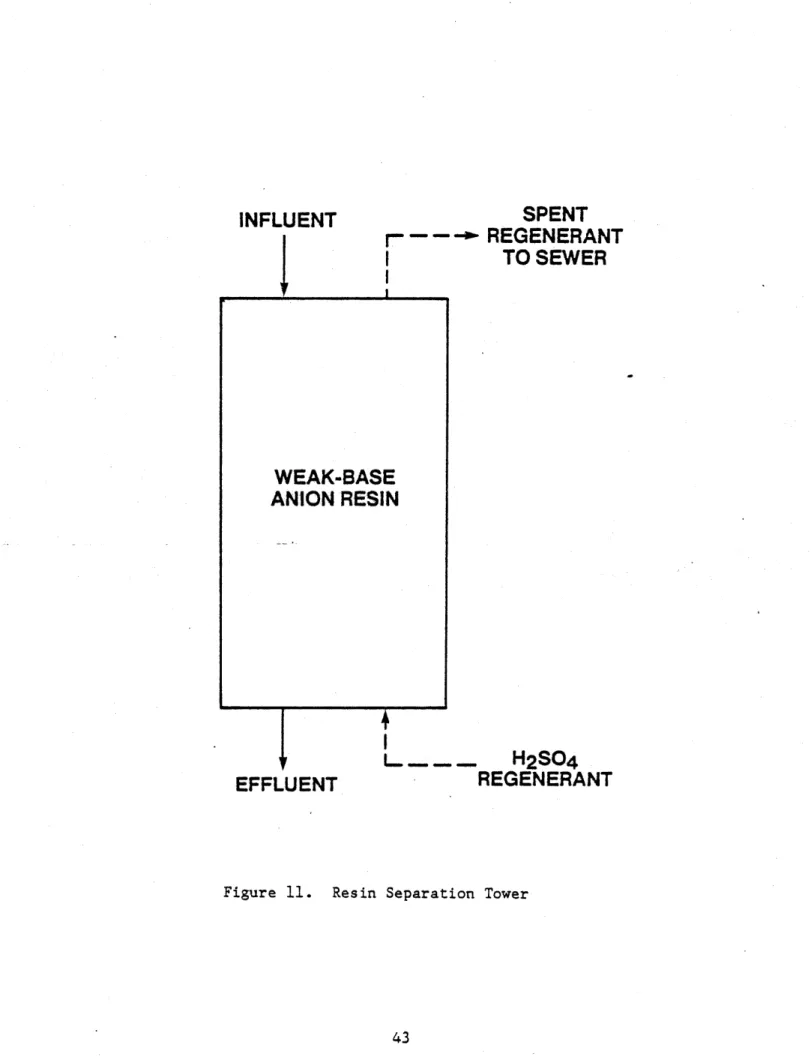
36Resin S e p a r a t i o n Tower
.
e e e e e e e e e ~ ~ e e e a e e e e e e e e e e m e e e e a ~ e ~ ~ ~ ~ 4 3...
Resin Adsorption Treatment of Bleach P l a n t E f f l u e n t 46 Activated Alumina P r o c e s s Scheme . . . e . . a e e e e e . e . e a e 48
...
14. Activated Alumina Adsorption P l a n t 49
...
.
15 P r i n c i p l e s of Membrane S e p a r a t i o n ..*.51
...
16. U l t r a f i l t r a t i o n Module ..52
...
U l t r a f i l t r a t i o n Treatment System 55
E l e c t r o l y t i c Treatment Processes e e e e e e e e e a e a ~ m e e e e e e e e e ~ ~ e a e 5 8
...
Production o f Metal Ion Coagulant by E l e c t r o l y t i c Means 59
Activated Carbon System ~ ~ e e e a e e e e e e e e e e e e ~ e a a e e e e ~ e e e e e e e a a e 6 ~
...
Rapid I n f i l t r a t i o n System 64
Ozone D e c o l o r i z a t i o n System
.
e . e e e e e e e e e * e e e e e e e * e e e e ~ e ~ e e e e a 6 ~...
Oxygen Bleach P l a n t 74
...
...
25.
E f f e c t o f C102 S u b s t i t u t i o n on Color Discharge 79...
.
26 Gas Phase C h l o r i n a t o r 83
...
27
.
Displacement Bleach P l a n t 85...
28.
The Closed-Cycle M i l l Bleach P l a n t F i l t r a t e Recovery 88...
SUMMARY
The d i s c h a r g e of c o l o r from pulp and p a p e r m i l l s h a s l o n g been t h o u g h t t o be a n u i s a n c e i n t h a t t h e brownish e f f l u e n t from mills is c o n s i d e r e d p o l l u t e d by t h e pub1j.c. More r e c e n t l y , t h e r e is some e v i d e n c e t o s u p p o r t t h e
c o n t e n t i o n t h a t p u l p and paper m i l l e f f l u e n t s are i n v o l v e d i n blue-green algae blooms. A t p r e s e n t , t h e r e a r e no U.S. governmental r e s t r i c t i o n s on t h e
d i s c h a r g e o f c o l o r .
T h i s r e p o r t is a review o f t h e r e s e a r c h l i t e r a t u r e c o n c e r n i n g c o l o r removal t e c h n o l o g i e s f o r t h e pulp and p a p e r i n d u s t r y . The l i t e r a t u r e s i n c e 1975 is emphasized s i n c e s e v e r a l reviews o f c o l o r removal t e c h n o l o g i e s p r i o r t o t h a t time a r e a v a i l a b l e .
A t t h i s p o i n t , no one s p e c i f i c c o l o r removal technology h a s been i d e n t i f i e d a 3 t h e moat c o s t e f f e c t i v e . I n f a c t , t h e r e a r e no m i l l s i n t h e U. S. which have i n s t a l l e d a c o l o r removal technology f o r f u l l - t i m e s e r v i c e . There a r e no t e c h n o l o g i e s which would n o t have an e x t r e m e l y a d v e r s e economic
impact on t h e m i l l i n v o l v e d .
The pulp and paper i n d u s t r y h a s l o n g i n v e s t i g a t e d c o l o r removal
t e c h n o l o g i e s . Research i n t o t h e s e t e c h n o l o g i e s c o n t i n u e s and new p r o c e s s e s a r e proposed each y e a r . However, t h e y have a 1 1 been found t o have s e r i o u s t e c h n i c a l (on a f u l l - s c a l e b a s i s ) o r economic problems.
It would a p p e a r t h a t oxygen-based b l e a c h p l a n t s hold t h e most promise f o r c o l o r removal. A s u b s t a n t i a l p o r t i o n o f t h e t o t a l c o l o r from a pulp m i l l
Not a l l t e c h n o l o g i e s can be a p p l i e d t o a l l m i l l s . I n t e r f e r e n c e s w i t h pulp and paper p r o d u c t i o n schemes, i n s u f f i c i e n t s p a c e , o r p r o c e s s
i n c o m p a t i b i l i t i e s a l l may p r e c l u d e a c c e p t a b i l i t y of a s p e c i f i c technology. It would a p p e a r t h a t c o l o r removal t e c h n o l o g i e s c o s t on t h e order o f $10-
INTRODUCTION
G e n e r a l Background
The p u l p a n d ' p a p e r i n d u s t r y is t h e n a t i o n ' s t h i r d l a r g e s t i n d u s t r i a l consumer o f w a t e r (The K l i n e Guide t o t h e Paper I n d u s t r y , 1980). An e s t i m a t e d two t r i l l i o n g a l l o n s o f wastewater a r e d i s c h a r g e d a n n u a l l y by t h e p u l p and paper i n d u s t r y , much o f which is h i g h l y c o l o r e d . T h i s c o l o r is mainly
a t t r i b u t a b l e t o l i g n i n d e g r a d a t i o n p r o d u c t s formed d u r i n g v a r i o u s p u l p i n g and b l e a c h i n g o p e r a t i o n s and is r e l a t e d t o t h e c o l o r i n s t r e a m s which comes from decaying v e g e t a t i o n (Christman and Ghassemi, 1966).
The p u l p and paper i n d u s t r y is one o f t h e l a r g e s t b u s i n e s s e s i n North C a r o l i n a . S e v e r a l o f t h e l a r g e r mills i n North C a r o l i n a are shown i n T a b l e 1 w i t h t h e number o f employees and a n n u a l p a y r o l l . I n a d d i t i o n t o t h o s e p e r s o n s employed d i r e c t l y by t h e paper companies, many o t h e r s are needed f o r s e r v i c e s and, i n p a r t i c u l a r , t o s u p p l y pulpwood t o t h e mills. A complete l i s t i n g o f paper manufacturing f a c i l i t i e s i n North C a r o l i n a is p r e s e n t e d i n T a b l e 2.
S i n c e t h e advent o f environmental l e g i s l a t i o n , wastewater t r e a t m e n t h a s r e f e r r e d p r i m a r i l y t o BOD and suspended s o l i d s removal. Color was n o t t h o u g h t t o b e a major problem, b e i n g c l a s s i f i e d as a nonconventional p o l l u t a n t . There a r e s t i l l no f e d e r a l r e g u l a t i o n s c o n c e r n i n g c o l o r d i s c h a r g e , b u t some s t a t e s and Canadian p r o v i n c e s have e s t a b l i s h e d p e r m i s s i b l e l i m i t s o f c o l o r d i s c h a r g e f o r a few select p u l p m i l l s . The r e a s o n s f o r c o l o r r e g u l a t i o n s a t t h e s e l o c a t i o n s are s a i d t o be p r o t e c t i o n o f f i s h e r i e s o r f o r a e s t h e t i c
Table 1 . Economic Importance o f Some Major P u l p Mills i n North Carolina
Location Owner
Riegelwood F e d e r a l Paper Roanoke Rapids Champion
N e w Bern Weyerhaeuser
Canton Champion
Number of Annual
T a b l e 2. P u l p a n d P a p e r H i l l s i n N o r t h C a r o l i n a
P u l p i n g
P r o c e s s P r o d u c t i o n ( t o n s / d a y ) L o c a t i o n
C a n t o n
Owner P r o d u c t s
K r a f t 1 , 5 4 0
Champion P a p e r s E n v e l o p e , T a b l e t , O f f s e t , Bond, Mimeo, D u p l i c a t o r , P o s t e r , M i l k C a r t o n ,
S a n i t a r y Food C o n t a i n e r
C h a r l o t t e C a r o l i n a P a p e r Board Corp.
P l a i n a n d B e n d i n g C h i p , Vat L i n e d , W h i t e Wood, P u r e W h i t e , B e n d i n g News, M i s t Grey,
B l e a c h e d H a n i l l a L i n e d Box B o a r d s
Conway
G o l d s b o r o
1.umberton
Max t o n
Moncure
New B e r n
P a t t e r s o n
G e o r g i a - P a o i f i c Cor p
.
D e f i b e r a t e d Wood
De f i b e r a t e d Uood
C o t t o n L i n t e r
H a r d b o a r d
R o o f i n g F e l t , A s p h a l t S a t u r a t e d F e l t s , P r e p a r e d R o o f i n g
C e l o t e x Corp.
Alpha C e l l u l o s e Corp.
L e g g e t t &
P l a t t I n c .
W e y e r h a e u s e r Co.
Custom Made C o t t o n L i n t e r P u l p s
C e l l u l o s e Wadding f o r P a c k i n g a n d C u s h i o n i n g
D e f i b e r a t e d Wood
Medium D e n s i t y F i b e r b o a r d
W e y e r h a e u s e r Co. K r a f t B l e a c h e d tlardwood a n d S o f t w o o d P u l p
C e l l u P r o d u u t s Co.
C r e p e d C e l l u l o s e Wadding a n d F a c i a l T i s s u e , T w i s t i n g P a p e r s
P i s g a h F o r e s t O l i n Corp. H o d i f i e d K r a f t B l e a c h e d F l a x
Plymouth
T a b l e 2. Pulp and P a p e r Mills i n North C a r o l i n a ( c o n t g d )
Weyerhaeuser Co. K r a f t NSSC
Weyerhaeuser Co. NP
.
R i e g e lwood F e d e r a l Paper K r a f t Board Co. I n c .
Roanoke Rapids Champion Packaging
l l a l i f a x Paper Board Co. I n c .
R o a r i n g R i v e r A b i t i b i - P r i c e Corp.
Rockingham J e r r y L. Goodwin I n c .
Kra f t
D e f i b e r a t e d
wood
K r a f t L i n e r b o a r d , NSSC C o r r u g a t i n g Medium, Milk C a r t o n Board, P o l y e t h y l e n e Coated Board
795 F l n e P r i n t i n g and W r i t i n g P a p e r s
Coated and Uncoated Bleaahed Board, Food Board, F o l d i n g C a r t o n Boxboard, F o i l L a m i n a t i n g ,
Coated Cover, Coated B r i s t o l
1,025 Bleached Hardwood and Softwood Market P u l p s
K r a f t Bag, ~ s ~ h a - l t i n ~ , Laminating, and O t h e r C o n v e r t i n g , Wrapping, Waxing P a p e r s ,
L i n e r b o a r d
P l a i n Chip, P a s t e d Chip, White L i n e d Chip, News
Board, Book and S p e c i a l t y L i n i n g , Ream and Rotary C u t t i n g
E x t e r i o r Hardboard S i d i n g
Meat and P o u l t r y Pads
c o n v e n t i o n a l b i o l o g i c a l t r e a t m e n t systems c a n n o t remove c o l o r .
Even though t h e r e a r e no w e l l - e s t a b l i s h e d c o l o r d i s c h a r g e r e g u l a t i o n s , t h e i n d u s t r y i t s e l f h a s a t t e m p t e d t o a d d r e s s t h e c o l o r problem f o r many
y e a r s . P r e v i o u s reviews o f t h e c o l o r problem have been p r e p a r e d by G i l l e s p i e and Berger ( 1 9 7 1 ) , T y l e r and F i t z g e r a l d ( 1 9 7 2 ) , Gehm ( 1 9 7 3 ) , Timpe, e t a 1
( 1973)
,
G a l l a y ( 1973),
Vincent ( 1973),
Gellman and Berger ( 1974), and Rush and Shannon (1976).It i s t h e purpose o f t h i s document t o review s t a t e - o f - t h e - a r t o f c o l o r removal t e c h n o l o g i e s and t o assemble i n f o r m a t i o n c o n c e r n i n g t h e c o l o r problem which h a s r e c e n t l y been p u b l i s h e d .
The Manufacture o f Paper
The manufacture o f p a p e r from t r e e s o r o t h e r woody p l a n t s first r e q u i r e s t h e d e s t r u c t i o n o f t h e n a t u r a l l y o c c u r r i n g f i b e r - t o - f i b e r s t r u c t u r e s . A
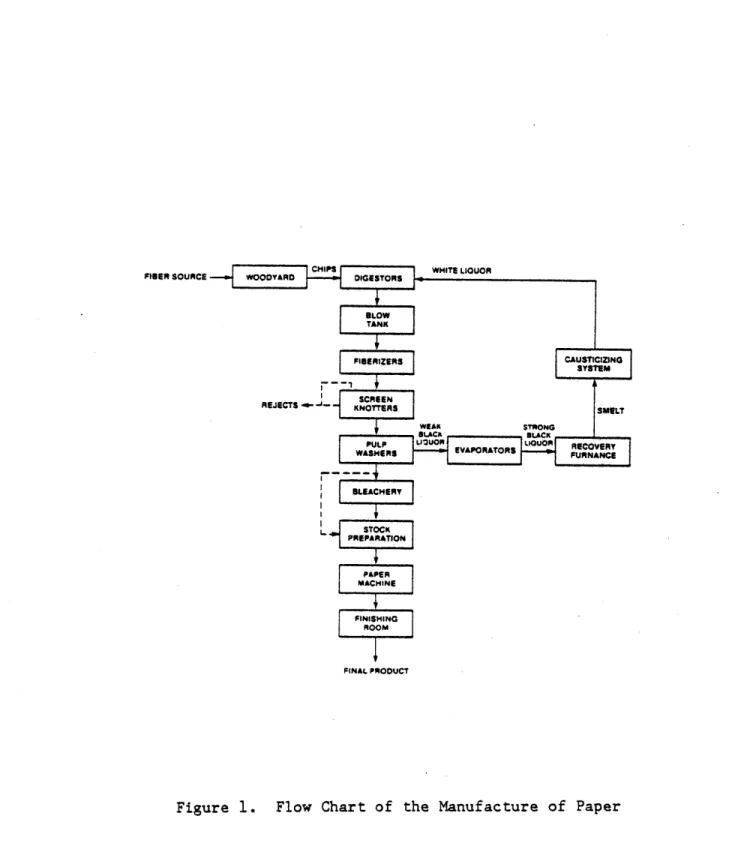
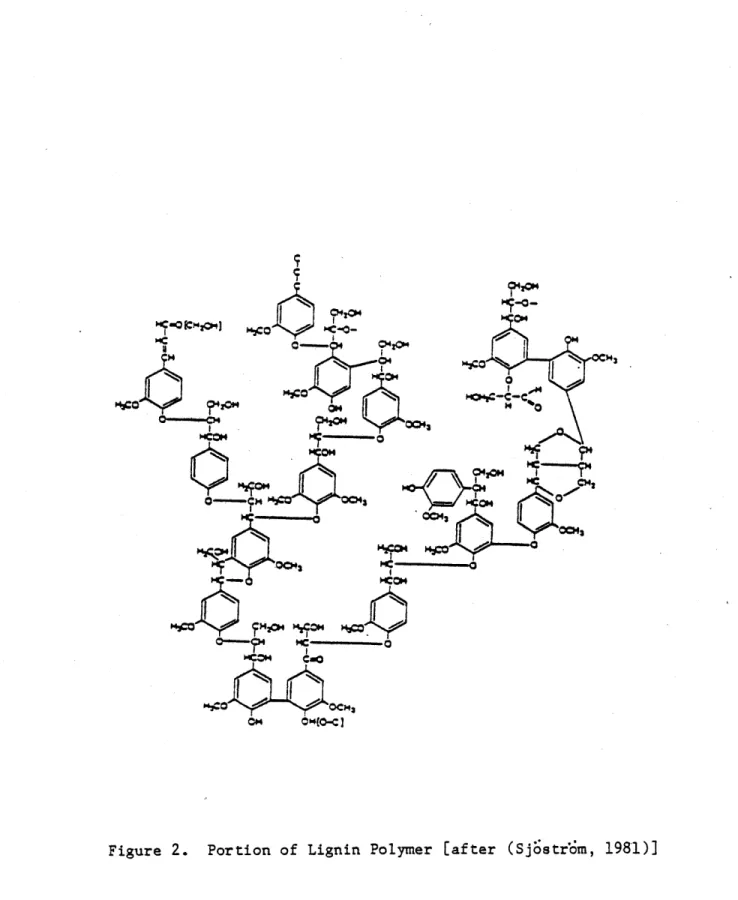
f l o w s h e e t f o r t h e manufacture o f paper i s p r e s e n t e d i n F i g u r e 1. These well- d e f i n e d , r i g i d s t r u c t u r e s c o n s i s t o f t h e papermaking f i b e r s h e l d t o g e t h e r i n o r g a n i z e d p a t t e r n s by l i g n i n ; l i g n i n i s t h e cement which bonds t h e f i b e r s t o g e t h e r and i m p a r t s s t r u c t u r a l r i g i d i t y t o t h e p l a n t . A proposed s t r u c t u r e o f l i g n i n i s p r e s e n t e d i n F i g u r e 2 . Complete f i b e r s e p a r a t i o n is e s s e n t i a l t o
t h e f o r m a t i o n of a good paper sheet. T h i s can be accomplished by e i t h e r
p h y s i c a l o r chemical means, o r a combination o f both. P h y s i c a l p u l p i n g p r o c e s s e s do n o t a c t u a l l y remove t h e l i g n i n from t h e wood f i b e r . The l i g n i n remaining i n a s s o c i a t i o n w i t h t h e f i b e r s i n h i b i t s f i b e r - t o - f i b e r bonding; t h i s r e s u l t s i n a weak s h e e t . Chemical p u l p i n g p r o c e s s e s d o , however, d i s s o l v e t h e l i g n i n by making i t s o l u b l e i n aqueous s o l u t i o n s . The i n c r e a s e d a v a i l a b i l i t y of f i b e r s u r f a c e f o r bonding due t o t h e absence o f l i g n i n r e s u l t s i n a
FIBER SOURCE WOODV4RD wnm uouon
i FINAL PRODUCT
BLOW
TAN# I
I
CAUStlCIaNO
S Y l M M
L
A
Figure 1. Flow Chart of the Manufacture of Paper
+
REJECTS +A-
S m N G
SMWT
The most common p u l p i n g p r o c e s s i n u s e today i s t h e k r a f t , o r s u l f a t e , process. T h i s p r o c e s s is by f a r t h e most common, a c c o u n t i n g f o r some 95% o f t h e t o t a l pulp produced (Bureau of t h e Census, 1979). The p r i n c i p a l p u l p i n g chemicals used i n t h i s p r o c e s s a r e sodium hydroxide (NaOH) and sodium s u l f i d e
(Na2S). P u l p s made from t h e k r a f t p r o c e s s a r e c h a r a c t e r i z e d by t h e i r e x c e l l e n t s t r e n g t h p r o p e r t i e s ; k r a f t means " s t r o n g w i n German. O t h e r advantages o f t h e k r a f t p u l p i n g p r o c e s s i n c l u d e t h e a b i l i t y t o r e c o v e r and r e c y c l e p u l p i n g chemicals and t h e a b i l i t y t o pulp v i r t u a l l y any f i b e r s o u r c e , even t h o s e c o n t a i n i n g a h i g h percentage o f r e s i n o u s compounds, The
-
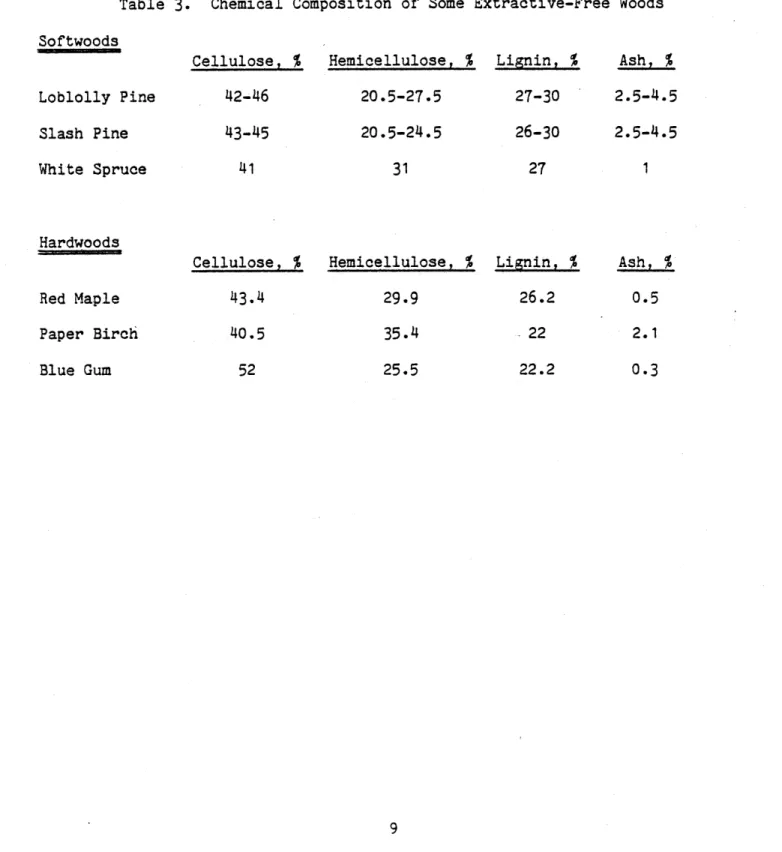
d i f f e r e n c e s i n composition between hardwood and softwood s p e c i e s ( T a b l e 3 )
c r e a t e problems f o r o t h e r p u l p i n g p r o c e s s e s . T h i s h a s g i v e n rise t o t h e dominance o f k r a f t m i l l s i n t h e South, where softwood8 a v a i l a b l e f o r p u l p i n g a r e abundant.
F i b e r is o b t a i n e d f o r t h e p u l p m i l l i n t h e form of l o g s of various sizes and a l s o a s c h i p s . The f i r s t s t e p i n c o n v e r t i n g t h e f i b e r s o u r c e i n t o p a p e r o c c u r s i n t h e wood room. Long l o g s a r e reduced t o a s i z e more e a s i l y handled
by c u t t i n g them on a s l a s h e r deck. Logs s t i l l t o o l a r g e f o r t h e ensuing equipment must be f u r t h e r reduced u s i n g a l o g s p l i t t e r o r o t h e r s i m i l a r equipment. The l o g s a r e then s e n t t o a debarking p r o c e s s which removes most of t h e d i r t and b a r k from them. E i t h e r wet o r d r y debarking p r o c e s s e s may be used. With more and more m i l l s u t i l i z i n g bark a s a f u e l , d r y debarking i s becoming t h e more common method. Dry debarking does n o t add m o i s t u r e t o t h e bark which r e d u c e s i t s f u e l v a l u e ; i t a l s o r e d u c e s t h e q u a n t i t y of wastewater which must be t r e a t e d . The debarked l o g s a r e then s e n t t o t h e c h i p p e r s where
Table 3. Chemical Composition of Some Extractive-Free Woods Softwoods
P
Cellulose, % Hemicellulose, % Lignin, % Ash, %
Loblolly Pine 42-46 20.5-27.5 27-30 2.5-4.5
Slash Pine 43-45 20
.
5-24.
5 26-30 2.5-4.5White Spruce 41 31 27 1
Hardwoods
P
Cellulose, % Hemicellulose, % L i m i n , % Ash, %
Red Maple 43.4
Paper Birch 40.5
Chips a r e s c r e e n e d t o i n s u r e a uniform s i z e and a r e t h e n charged i n t o t h e
d i g e s t e r . S c r e e n i n g a l l o w s a more c o n s i s t e n t pulp q u a l i t y t o be r e a l i z e d from t h e cooking p r o c e s s . Oversized c h i p s removed by t h e s c r e e n s a r e s e n t t o a r e c h i p p e r and a r e s u b s e q u e n t l y r e t u r n e d t o t h e s c r e e n s . Undersized c h i p s and f i n e s removed by t h e s c r e e n s can be u t i l i z e d as a f u e l a l o n g w i t h t h e bark.
The cooking c y c l e can be c a r r i e d o u t i n e i t h e r continuous o r b a t c h
d i g e s t e r s . A s t h e name i m p l i e s , t h e b a t c h d i g e s t e r pulps a s p e c i f i c amount o f c h i p s and t h e n d i s c h a r g e s them b e f o r e b e i n g recharged. The c o n t i n u o u s
d i g e s t e r o p e r a t e s under c o n d i t i o n s o f c o n t i n u o u s flow. The c h i p s are placed
i n t h e d i g e s t e r a l o n g w i t h t h e d e s i r e d amount o f cooking chemicals r e f e r r e d t o a s "white l i q u o r n (see Table 4 f o r t y p i c a l w h i t e l i q u o r c o m p o s i t i o n ) . T h i s mixture can be h e a t e d e i t h e r d i r e c t l y o r i n d i r e c t l y w i t h steam. The steam
flow is r e g u l a t e d such t h a t a p r e - s p e c i f i e d time-temperature curve f o r the cook is followed; the shape o f t h e c u r v e is determined by t h e d e s i r e d pulp q u a l i t i e s . A p r e s s u r e r e l i e f is used on t h e d i g e s t e r s t o p r o v i d e f o r t h e d i s c h a r g e of non-condensible g a s e s and t h e r e c o v e r y of t u r p e n t i n e . Once t h e
maximum t e m p e r a t u r e i s a t t a i n e d , i t i s h e l d c o n s t a n t for t h e remainder of t h e cook. The pulp is f i n a l l y d i s c h a r g e d from t h e d i g e s t e r a f t e r t h e a p p r o p r i a t e cooking time h a s e l a p s e d ; t h i s is r e f e r r e d t o a s "blowing t h e d i g e s t e r
."
The pulp is n e x t s c r e e n e d t o remove any o v e r s i z e o r undercooked c o n s t i t u e n t s , such a s knots. These r e j e c t s can be re-introduced i n t o t h e d i g e s t e r f o r f u r t h e r cooking, r e f i n e d and r e s c r e e n e d , o r d i s p o s e d of a s f u e l o r r e f u s e . The a c c e p t e d pulp, along -&th t h e black l i q u o r from t h e cook, is
t h e n s e n t t o t h e brown s t o c k washers.
The brown s t o c k washers a r e used t o s e p a r a t e a s much of t h e b l a c k l i q u o r
Table 4 .
Chemical NaOH
Typical White Liquor Composition
g / l as Na30 g / l of Chemical
-
30% s u l f i d i t y
39 g / l Active Alkali as [ N ~ ~ S ]
33 g / l Effective Alkali as [ N ~ ~ S ]
A l l [ ] Expressed as NaZO
[ Na2S
I
/ [ NaOH ] + [ Na2S ][NaOH]
+
CNa2S]l i q u o r . The b l a c k l i q u o r i s composed o f t h e s p e n t and r e s i d u a l cooking chemicals and t h e d i s s o l v e d s o l i d s removed from t h e c h i p s d u r i n g cooking. A
t y p i c a l b l a c k l i q u o r composition is p r e s e n t e d i n Table 5. Washing i s n e c e s s a r y t o r e c o v e r t h e cooking chemicals and t o c l e a n t h e pulp. A
c o u n t e r c u r r e n t w a t e r flow, u t i l i z i n g a s e r i e s o f vacuum o r p r e s s u r e w a s h e r s , i s u s u a l l y employed. The recovered b l a c k l i q u o r is s e n t t o t h e r e c o v e r y
system w h i l e t h e c l e a n pulp proceeds t o e i t h e r t h e bleach p l a n t o r d i r e c t l y t o t h e paper m i l l .
Bleaching i s used as an e x t e n s i o n o f t h e cooking s t a g e t o f u r t h e r b r i g h t e n t h e pulp by removing more l i g n i n and o t h e r c o l o r i n g bodies. The r e s u l t i n g product i s a w h i t e pulp. A chemical o x i d a n t is used f o r this
I
purpose. The c o l o r e d compounds t o be removed from unbleached pulp must be c o n v e r t e d t o a w a t e r - s o l u b l e form; t h e y can t h e n b e e x t r a c t e d from the pulp. M u l t i p l e s t a g e b l e a c h i n g is n e c e s s a r y t o b l e a c h k r a f t pulps t o d e s i r e d - - - -
b r i g h t n e s s l e v e l s . Many d i f f e r e n t chemicals can be used i n t h e v a r i o u s b l e a c h i n g s t a g e s .
T a b l e 5. T y p i c a l Black Liquor Composition ( P i n e Kraft)
Component .
L i g n i n Hydroxy Acids
Formic Acid A c e t i c Acid E x t r a c t i v e s
Other
s a v i n g s . The p u l p i s f u r t h e r b r i g h t e n e d by t h e o x i d a t i o n and s u b s e q u e n t removal of t h e r e m a i n i n g l i g n i n . The f o u r t h and f i f t h s t a g e s a r e t h e same as t h e second and t h i r d . They a r e employed t o a c h i e v e a n i n c r e m e n t a l i n c r e a s e i n t h e pulp b r i g h t n e s s . A complete l i s t i n g o f m i l l s i n North C a r o l i n a which p r a c t i c e p u l p b l e a c h i n g i s p r e s e n t e d i n T a b l e 6.
The bleached a n d / o r unbleached f i b e r s t o be made i n t o paper are f u r t h e r t r e a t e d b e f o r e b e i n g made i n t o a s h e e t . To i m p a r t s t r e n g t h and d r a i n a g e p r o p e r t i e s t o t h e p u l p , a b e a t i n g o r r e f i n i n g p r o c e s s is used. T h i s p r o c e s s tears and r u p t u r e s t h e f i b e r s c a u s i n g f i b e r i z a t i o n which r e s u l t s i n b e t t e r bonding and a more d e n s e s h e e t . F i l l e r s s u c h as c l a y s , CaC03, t a l c , and Ti02 may be added t o improve s u c h c h a r a c t e r i s t i c s as o p a c i t y , smoothness, and b r i g h t n e s s . S i z i n g a g e n t s such as r o s i n s , waxes, o r s y n t h e t i c s a r e used t o i n h i b i t t h e p e n e t r a t i o n o f p a r t i c u l a r l i q u i d s t h r o u g h t h e f i n a l p r o d u c t . Other a d d i t i v e s such as d y e s , wet o r dry s t r e n g t h r e s i n s , and r e t e n t i o n a i d s may a l s o be used t o i m p a r t d e s i r e d q u a l i t i e s t o t h e p u l p o r t h e f i n i s h e d p r o d u c t . P o r t i o n s o f t h e s e a d d i t i v e s w i l l a p p e a r i n t h e wastewater t r e a t m e n t system due t o i n a d v e r t a n t l o s s from t h e paper machine.
The paper s h e e t is formed by d i s c h a r g i n g a stream o f pulp s l u r r y o n t o a moving wire. A f i b e r mat i s formed on t h e w i r e a s t h e water i s d r a i n e d o f f . T h i s mat l e a v e s t h e wire and is i n t r o d u c e d t o t h e p r e s s s e c t i o n where
T a b l e 6. MILLS I N NORTH CAROLINA UTILIZING PULP BLEACHING
L o c a t i o n
-
Owner D i g e s t e r g B l e a c h S e q u e n o e P r o d u c t i o n o f B l e a c h e d P u l p (T/D)Can t o n Champion 18 B a t c h PlnetC-E-H-E-D-H- a n d C-E-H-D-H P a p e r s HWD: C-E-11-E-D
New B e r n H e y e r h a e u a e r 8 B a t c h C-E-H-D-E-D 725
P i a g a h F o r e s t O l i n 1 3 Rotary C-E-H 300
Plymouth Weyerhaetrser 19 B a t c h C/D-E-D-E-D-D 1 C o n t i n u o u s 2:C-E-H-P a n d 1:C-E-H-E-D-P
Riege lwood F e d e r a l P a p e r 16 B a t c h 3:C-E-H-D-E-D and 2:C-E/H-D-E-D Board 1 C o n t i n u o u s
*
The l a r g e r o l l s o f p a p e r from t h e paper machine a r e u s u a l l y n o t s u i t a b l e f o r customer wants o r needs. These r o l l s a r e f u r t h e r p r o c e s s e d i n t o s u i t a b l e form f o r subsequent end u s e s by i n d i v i d u a l customers.
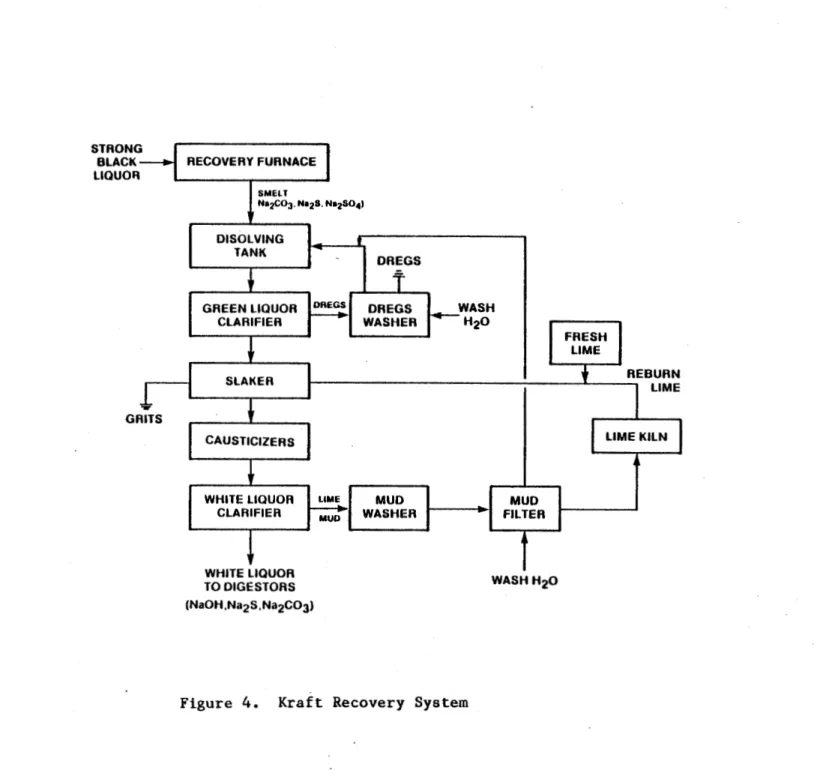
The r e c o v e r y system o f t h e k r a f t p r o c e s s ( F i g u r e 4 ) makes t h i s p r o c e s s an economically f e a s i b l e means o f p a p e r p r o d u c t i o n . The b l a c k l i q u o r recovered from t h e cooked pulp c o n t a i n s t h e s p e n t cooking c h e m i c a l s a l o n g w i t h t h e
compounds removed from t h e c h i p s . The l i q u o r removed from t h e b l e a c h i n g s t a g e c o n t a i n s o r g a n i c compounds t h a t c o u l d b e recovered o r u t i l i z e d f o r f u e l , b u t t h e c o r r o s i v e n e s s of' the c h l o r i d e s i n t h i s l i q u o r p r e s e n t s t o o many problems t o b e i n c l u d e d i n t h e r e c o v e r y system. For t h i s r e a s o n , t h e i n d u s t r y t r e n d is toward b l e a c h i n g w i t h oxygen, hydrogen p e r o x i d e o r o t h e r o x i d i z i n g r e a g e n t s which do n o t c o n t a i n c h l o r i d e s . These a l t e r n a t i v e b l e a c h i n g compounds a l l o w t h e r e c y c l e o f p o r t i o n s o f t h e b l e a c h i n g l i q u o r s . T h i s r e s u l t s i n a d e c r e a s e of t h e wastewater t o be t r e a t e d and an i n c r e a s e i n the q u a n t i t y o f chemicals r e c o v e r e d .
The black l i q u o r t o b e burned i n t h e r e c o v e r y f u r n a c e is t o o d i l u t e t o s u p p o r t combustion a s i t comes d i r e c t l y from t h e washers. M u l t i p l e e f f e c t e v a p o r a t o r s c o n c e n t r a t e t h e l i q u o r t o about 50055% d i s s o l v e d s o l i d s . However, t h i s is s t i l l n o t c o n c e n t r a t e d enough f o r t h e r e c o v e r y f u r n a c e s . D i r e c t o r i n d i r e c t c o n t a c t e v a p o r a t o r s f u r t h e r c o n c e n t r a t e t h e l i q u o r t o 60.65%
d i s s o l v e d s o l i d s . A t t h i s c o n c e n t r a t i o n , t h e b l a c k l i q u o r can be burned w i t h o u t auxiliary f u e l .
When d i r e c t c o n t a c t e v a p o r a t o r s a r e u s e d , a n o x i d a t i o n s t a g e f o r t h e b l a c k l i q u o r is employed. The o x i d a t i o n o f
c o n t a c t e v a p o r a t o r s d e c r e a s e s t h e amount o f atmosphere. T h i s r e s u l t s r e d u c t i o n of
DlSOLVlNG i
TANK -4
DREGS STRONG
BLACK ----+
I
GREEN LIQUOR DREGSPf,"
CLARIFIER WASHER
a
RECOVERY FURNACE
FRESH
LIQUOR w I
SMELT
Na2CO3. NQS. Nn2S04)
'I
GRITS
SLAKER
LlME KILN
0
I
t
REBURNt
WHITE LIQUOR LIME
CLARIFIER - Fl LTE R
I
*I
I
LlME
7
t
WHITE LIQUOR
TO DIGESTORS WASH Hz0
i n t h e amount of' make-up s u l f u r needed t o m a i n t a i n t h e d e s i r e d s u l f i d i t y l e v e l s i n t h e w h i t e l i q u o r .
Concentrated b l a c k l i q u o r i s i n j e c t e d i n t o t h e r e c o v e r y f u r n a c e and t h e o r g a n i c s a r e burned as a f u e l . The h e a t from t h e combustion r e d u c e s t h e s p e n t cooking chemicals and t h e y l e a v e t h e f u r n a c e as a s o l i d %nelttt. T h i s smelt is d i s s o l v e d i n t h e smelt t a n k and forms "green l i q u o r n .
C l a r i f i e d g r e e n l i q u o r i s s l a k e d w i t h lime and r e t a i n e d i n c a u s t i c i z i n g t a n k s . A f t e r c a u s t i c i z i n g , t h e "white l i q u o r 1 # is c l a r i f i e d . T h i s is t h e cooking l i q u o r used i n t h e k r a f t cooks. The s o l i d s removed from t h e w h i t e l i q u o r are washed, f i l t e r e d , and burned i n t h e lime k i l n . The lime r e s u l t i n g from t h i s p r o c e s s is r e c y c l e d t o t h e s l a k e r t o be mixed w i t h t h e g r e e n l i q u o r .
E f f l u e n t s , o r s p i l l s , from t h e m i l l which c a n n o t be r e c y c l e d o r r e c o v e r e d must be t r e a t e d . Bleach p l a n t and paper m i l l e f f l u e n t s p r o v i d e a l a r g e
p o r t i o n o f t h i s flow. Wastewater t r e a t m e n t f a c i l i t i e s d i f f e r g r e a t l y from
m i l l t o m i l l . Each m i l l h a s its own s p e c i a l problems and t h e f a c i l i t i e s are designed t o handle t h e s e on a c a s e by c a s e b a s i s . These d e s i g n s however, must a l s o be a b l e t o meet t h e e f f l u e n t g u i d e l i n e s e s t a b l i s h e d for each m i l l .
The Nature of Color
Color is a term which has several d i f f e r e n t meanings. A s i t pertains to
t h e pulp and paper i n d u s t r y , c o l o r is d e f i n e d as t h e a b s o r p t i o n o f l i g h t i n t h e v i s i b l e range. The v i s i b l e l i g h t range c o v e r s wavelengths o f 400-700 nanometers. One a d d i t i o n a l d i s t i n c t i o n must a l s o b e made. Color can be measured i n two forms, t r u e and a p p a r e n t c o l o r . True c o l o r is measured when any t u r b i d i t y p r e s e n t i n i t i a l l y has been removed from a sample. The
o b s e r v a t i o n of c o l o r p r i o r t o t h e removal o f t u r b i d i t y i s r e f e r r e d t o a s
a sample can c a u s e s c a t t e r i n g and r e f l e c t a n c e o f l i g h t . I n t h i s s i t u a t i o n , r e f l e c t a n c e can be mistaken f o r absorbance. T h i s w i l l c a u s e t h e r e p o r t of e r r o n e o u s l y h i g h c o l o r l e v e l s .
S e v e r a l d i f f e r e n t methods a r e a v a i l a b l e f o r t h e measurement o f c o l o r , These i n c l u d e v i s u a l comparison w i t h platinum-cobalt s t a n d a r d s ,
s p e c t r o p h o t o m e t r i c a n a l y s i s , and t r i s t i m u l u s f i l t e r methods, The N a t i o n a l Council o f t h e Paper I n d u s t r y f o r A i r and Stream Improvement, I n c . (1971) has developed a method o f c o l o r measurement s p e c i f i c a l l y f o r p u l p and paper
i n d u s t r y effluents. T h i s method i n v o l v e s a d j u s t i n g t h e pH o f t h e sample t o
7 . 6 u s i n g e i t h e r HC1 o r NaOH. The sample is t h e n f i l t e r e d through a 0.8 micron p o r o s i t y membrane f i l t e r t o remove t u r b i d i t y . It was found t h a t t h e 0.8 micron f i l t e r was small enough t o remove c o l l o i d a l p a r t i c l e s , b u t large enough not t o remove l i g n i n macromolecules. The c o l o r v a l u e s are o b t a i n e d by comparing s p e c t r o p h o t o m e t r i c r e a d i n g s of t h e samples t o t h o s e o f p l a t i n u m - c o b a l t s t a n d a r d s , The s p e c t r o p h o t o m e t r i c a n a l y s e s are c a r r i e d o u t a t 465
nanometers.
The c o l o r observed i n paper i n d u s t r y e f f l u e n t s i s pH dependent, A s t h e
pH i n c r e a s e s , t h e c o l o r v a l u e a l s o i n c r e a s e s f o r a g i v e n sample. T h i s is n o t a l i n e a r r e l a t i o n s h i p and v a r i e s depending on t h e s o u r c e o f t h e c o l o r .
Resonating double bonds a r e g e n e r a l l y h e l d t o be r e s p o n s i b l e f o r t h e c o l o r caused by o r g a n i c compounds. A s t h e pH i n c r e a s e s , t h e r e s u l t i n g chemical c o n f i g u r a t i o n s permit more resonance, t h e r e b y i n c r e a s i n g t h e c o l o r . T h i s is a l s o t h e r e a s o n i t is n e c e s s a r y t o t e s t f o r c o l o r a t a s p e c i f i c pH. To make meaningful comparisons of c o l o r measurements between m i l l s o r even between samples from t h e same m i l l , t h e t e s t s must have been made a t t h e same pH.
r e s p o n s i b l e f o r s e v e r a l o t h e r problems. The p h e n o l i c s which a r e a n i n t e g r a l p a r t of many color-causing compounds can pose a p o t e n t i a l t a s t e problem.
Algal o r b a c t e r i a l a c t i v i t y may i n c r e a s e due t o t h e a v a i l a b i l i t y of n u t r i e n t s bound t o t h e color-causing o r g a n i c compounds. The s i z e o f some of t h e c o l o r bodies can cause f o u l i n g o f ion-exchange r e s i n s . Other problems may i n c l u d e i n t e r f e r e n c e w i t h c o a g u l a t i o n a t w a t e r t r e a t m e n t p l a n t s , i n c r e a s e d c h l o r i n e demand, and c h e l a t i o n of metals. Light t r a n s m i t t a n c e may be reduced i n n a t u r a l w a t e r s , r e s u l t i n g i n decreased p r o d u c t i v i t y and i n t e r f e r e n c e w i t h c o l o r i m e t r i c a n a l y s e s done on t h e waters.
..
Recently, i t has been proposed ( P a e r l , 1982) t h a t a l g a l blooms ( R u e n z l e r , e t , a l , 1982, and Witherspoon and P e a r c e , 1982) a r e r e l a t e d t o t h e d i s c h a r g e of pulp and paper m i l l e f f l u e n t s i n t o t h e Chowan R i v e r , North C a r o l i n a . It was hypothesized t h a t t h e well-known metal c h e l a t i n g c a p a b i l i t y o f l i g n i n was
r e s p o n s i b l e f o r u p s e t t i n g t h e balance between green and blue-green a l g a e . E s s e n t i a l l y t h e same argument was made f o r t h e d i s t u r b a n c e o f t h e n a t u r a l balance between floc-forming and f i l a m e n t o u s b a c t e r i a i n waste t r e a t m e n t p l a n t s ( J o y c e , 1979). Filamentous b a c t e r i a and blue-green a l g a e have a high s u r f a c e t o volume r a t i o which p e r m i t s them t o more e f f e c t i v e l y c a p t u r e
n u t r i e n t s from s o l u t i o n .
L i d i n and i t s d e g r a d a t i o n p r o d u c t s a r e t h e major c o n t r i b u t o r s t o c o l o r i n m i l l e f f l u e n t s . Some of t h e c o l o r chromophores a r e shown i n F i g u r e 5. Lignin, a polymer of phenylpropane u n i t s , a c t s t o impart s t r u c t u r a l r i g i d i t y
t o i n d i v i d u a l f i b e r s and t o t h e p l a n t a s a whole. T h i s n e c e s s i t a t e s t h e removal o r breakdown of some o f t h i s l i g n i n t o provide t h e i n d i v i d u a l f i b e r s
r e s p o n s i b l e f o r n a t u r a l decay. The i n t r i c a t e s t r u c t u r e o f l i g n i n a l l o w s f o r c o n s i d e r a b l e double bond resonance, which c o r r e l a t e s t o t h e d a r k c o l o r of l i g n i n .
The q u a n t i t y o f c o l o r produced by each o p e r a t i o n i n a m i l l can be t r a c e d almost d i r e c t l y t o t h e amount o f l i g n i n r e l e a s e d d u r i n g t h a t o p e r a t i o n .
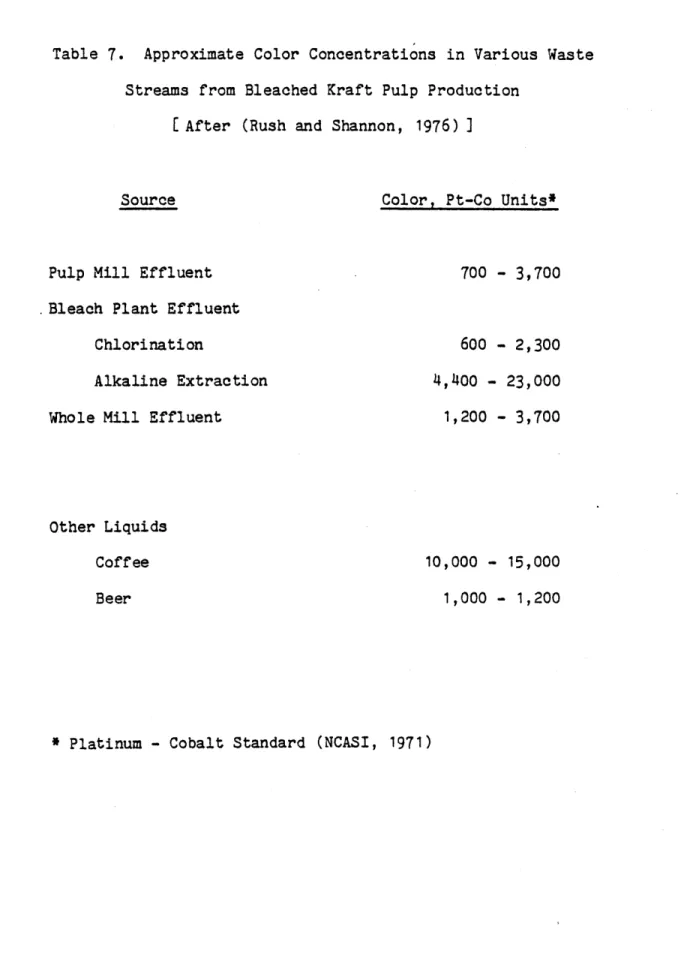
Approximate c o l o r c o n c e n t r a t i o n s i n s e v e r a l waste s t r e a m s a r e p r e s e n t e d i n
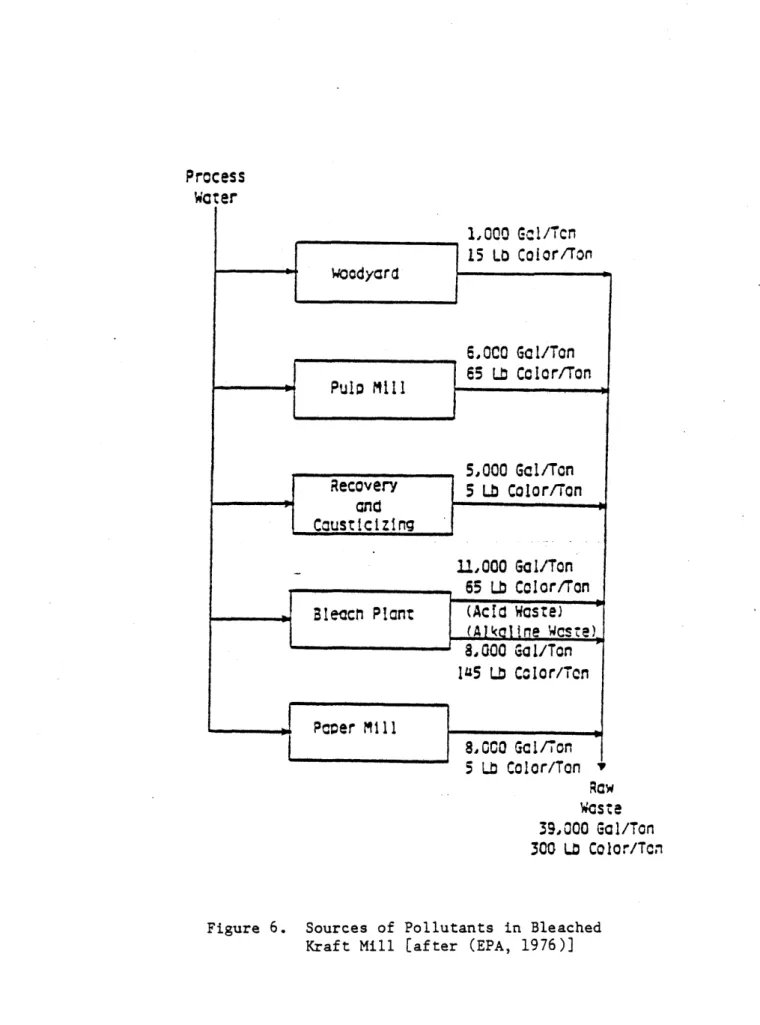
Table 7. However, t h e pulp m i l l , which r e l e a s e s t h e l a r g e s t amount of l i g n i n , is n o t r e s p o n s i b l e f o r t h e l a r g e s t p o r t i o n o f c o l o r i n t h e e f f l u e n t ( F i g u r e 6). T h i s is due t o t h e r e c o v e r y of t h e cooking chemicals. The c o l o r r e l e a s e d i n t h e pulping c y c l e is burned i n t h e recovery f u r n a c e t o r e c o v e r t h e
i n o r g a n i c chemicals used f o r pulping. T h e r e f o r e , most of t h e c o l o r r e l e a s e d d u r i n g pulping never r e a c h e s t h e f i n a l m i l l e f f l u e n t . The bleach p l a n t , which r e l e a s e s t h e next l a r g e s t amount of l i g n i n , s u b s e q u e n t l y becomes t h e major c o l o r source. These waste l i q u o r s cannot be t r e a t e d i n t h e same manner a s t h e pulping wastes. The c o r r o s i v e n e s s of t h e c h l o r i d e s u s u a l l y p r e s e n t i n
bleaching wastes p r o h i b i t s t h e burning o f t h e s e l i q u o r s . The bleach p l a n t can
b e r e s p o n s i b l e f o r more t h a n two-thirds of t h e t o t a l c o l o r load while c o n t r i b u t i n g l e s s than one-half of t h e e f f l u e n t volume.
The c o l o r b o d i e s a s s o c i a t e d with the bleach p l a n t are not p r e c i s e l y t h e same as t h o s e a s s o c i a t e d w i t h t h e pulp m i l l . There a r e g e n e r a l d i s t i n c t i o n s t h a t can be made between t h e chromophores of d i f f e r e n t l i q u o r s . Although t h e y a r e both mainly d e r i v a t i v e s o f l i g n i n , t h e a d d i t i o n a l chemical t r e a t m e n t s i n t h e bleach p l a n t cause f u r t h e r l i g n i n d e g r a d a t i o n and c r e a t e chemical
Table 7. Approximate Color Concentrations i n Various Waste Streams from Bleached K r a f t Pulp Production
[ A f t e r (Rush and Shannon, 1976) 1
Source Color, Pt-Co Units*
Pulp M i l l E f f l u e n t
. Bleach P l a n t E f f l u e n t C h l o r i n a t i o n
A l k a l i n e E x t r a c t i o n Whole M i l l E f f l u e n t
Other Liquids Coffee Beer
Process
8ecuver~ 5
lb
ColorfionGrid 4
C~ustlclzIm ,
-
11,000
GallTon
65 Lb CcIorflon
B
BIeucn
PIant:(Acid
Waste)t A M l lne W:e)
8,000
tal/Ton
*
IbS rh
CcIor/Tcn
P c ~ e r
nlll
.
b8 , GGO
Gci/tan
'5 Lb
Color/Ton
Figure 6. Sources of Pollutants in Bleached
COLOR REMOVAL TECHNOLOGIES I n t r o d u c t i o n
There a r e two g e n e r a l s t r a t e g i e s f o r t h e removal of c o l o r from t h e e f f l u e n t of a pulp and paper m i l l . The first i s t h e c o n v e n t i o n a l end-of-the- p i p e treatment. While t h i s s t r a t e g y u s u a l l y has t h e l e a s t impact on t h e mnaufacturing f a c i l i t i e s , i t is t y p i c a l l y t h e most expensive. A d d i t i o n a l l y , most of t h e t e c h n o l o g i e s which a r e i n t h i s c a t e g o r y merely c o n c e n t r a t e t h e c o l o r ; a. means o f chromophore d e s t r u c t i o n must u l t i m a t e l y be used. The second s t r a t e g y a t t e m p t s t o modify t h e manufacturing p r o c e s s s o t h a t l e s s c o l o r
bodies are produced o r s o t h a t t h e waste l i q u o r s may b e r e c y c l e d i n t e r n a l l y and be destroyed w i t h i n t h e process. Obviously, p r o c e s s m o d i f i c a t i o n s cannot be made i n a l l mills because o f l a c k o f f l e x i b i l i t y w i t h i n t h e m i l l o r a b a s i c i n c o m p a t i b i l i t y between t h e proposed p r o c e s s m o d i f i c a t i o n and t h e d e s i ~ e d end . product
E f f l u e n t Treatment
Color ,Removal by Secondary Treatment
The i n d u s t r y ' s c u r r e n t p r a c t i c e of c l a r i f i c a t i o n of t h e t o t a l m i l l
wastewater followed by b i o l o g i c a l t r e a t m e n t , commonly a e r a t e d lagoons o r a c t i v a t e d sludge u n i t s , can e l i m i n a t e c o n v e n t i o n a l p o l l u t a n t s such a s BOD and
COD a t e f f i c i e n c i e s o f up t o 95%. However, t h e s e b i o l o g i c a l systems a r e c a p a b l e of c o l o r r e d u c t i o n s of only 0-30% (Rush and Shannon, 1976, and Obiaga and Ganczarczyk, 1974). T h i s r e s i s t a n c e o f c o l o r bodies t o b i o l o g i c a l
t r e a t m e n t is l a r g e l y due t o t h e i n a b i l i t y of t h e m i c r o b i a l p o p u l a t i o n t o m e t a b o l i z e l i g n i n - d e r i v e d chromophores
.
Joyce, e t a 1 ( 1979 ) attempted t o m a n i p u l a t e t h e s l u d g e age i n an a c t i v a t e d s l u d g e r e a c t o r t o enhance c o l o rA d i r e c t approach t o improving t h e c o l o r r e d u c t i o n a b i l i t y o f b i o l o g i c a l processes has r e c e n t l y been r e p o r t e d (Dogherty, 1982). The Sybron Corp. has attempted t o augment t h e n a t u r a l m i c r o b i a l population of an a e r a t e d lagoon with a mutant s t r a i n of t h e bacterium, Pseudomonas aeruginosa. T h i s organism, mutated from normal i n h a b i t a n t s of t h e t r e a t m e n t system, is r e p o r t e d l y a b l e t o metabolize " c o l o r l i g n i n s , " and i t is claimed t o be a b l e t o remove 40% o f e f f l u e n t c o l o r and c o n s i d e r a b l e BOD5 i n l a b o r a t o r y s t u d i e s . M i l l - s c a l e e v a l u a t i o n is p r e s e n t l y being conducted a t a Canadian bleached kraft m i l l . The MyC6R Prqcess
White-rot wood decay f u n g i have a c t i v e l i g n i n o l y t i c systems t h a t w i l l degrade even h e a v i l y modified l i g n i n such as k r a f t l i g n i n and c h l o r i n a t e d l i g n i n . Thus, t h e s e f u n g i could conceivably be used i n wastewater t r e a t m e n t a p p l i c a t i o n s t o degrade lignin-derived chromophores produced d u r i n g t h e bleaching o f pulp. Exploratory experiments have demonstrated t h a t b l e a c h p l a n t e f f l u e n t s from t h e first a l k a l i e x t r a c t i o n s t a g e could be d e c o l o r i z e d w i t h t h e white-rot fungus, Phanerochaete chrysosporium Burds (Joyce, e t a l ,
1981, and Eaton, e t a l , 1982).
The U. S o F o r e s t Products Laboratory and North Carolina S t a t e U n i v e r s i t y a r e working t o develop and e v a l u a t e a c o l o r removal process based on ,P-.
chrysosporium. The process has been termed t h e FPL/NCSU MyCoR ( = c e l i a l &lor Removal) Process. Based on t h e r e s u l t s of a preliminary study with v a r i o u s
-
s t i r r e d fermentors and f i x e d f i l m r e a c t o r s , t h e r o t a t i n g b i o l o g i c a l c o n t a c t o r
(RBC) was chosen f o r bench s c a l e experiments because i t provides a l a r g e s u r f a c e a r e a f o r fungal c o n t a c t with both oxygen and t h e e f f l u e n t without e x c e s s i v e a g i t a t i o n , which is d e l e t e r i o u s t o l i g n i n degradation and
s u r f a c e a r e a p e r u n i t volume, low maintenance c o s t s , low energy r e q u i r e m e n t s , simple c o n s t r u c t i o n and o p e r a t i o n , and commercial a v a i l a b i l i t y .
The RBC MyCoR r e a c t o r may be o p e r a t e d e i t h e r a s a b a t c h r e a c t o r o r a s a c o n t i n o u s , plug-flow r e a c t o r (Campbell, 1983). Batch s t u d i e s allowed
monitoring o f c o l o r and pH changes as a f u n c t i o n o f time, providing a means o f s t u d y i n g t h e k i n e t i c s of chromophore d e s t r u c t i o n by d r a i n i n g e f f l u e n t from t h e
RBC a f t e r 24 hours and immediately r e f i l l i n g t h e r e a c t o r w i t h a f r e s h e f f l u e n t t o be d e c o l o r i z e d ; t h e e f f l u e n t c o n t a i n e d a l l n u t r i e n t s e x c e p t n i t r o g e n . The
rate of c o l o r removal i n c r e a s e d as t h e i n i t i a l c o l o r c o n c e n t r a t i o n was i n c r e a s e d u n t i l a maximum r a t e of chromophore d e s t r u c t i o n was reached a t a n i n i t a l c o l o r o f approximately 6,000 c o l o r u n i t s . Above 6,000 c o l o r u n i t s , t h e r a t e o f d e c o l o r i z a t i o n was independent o f t h e i n i t i a l c o l o r c o n c e n t r a t i o n . A t
t h i s s a t u r a t i o n p o i n t , t h e rate o f f u n g a l d e c o l o r i z a t i o n i n t h e RBC MyCoR
r e a c t o r was approximately 2,000 c o l o r u n i t s / l / d a y ( G e r r a r d , 1983).
S i n c e t h e a c t i v e l i f e s p a n o f t h e fungus i n t h e MyCoR r e a c t o r d e c r e a s e s
w i t h i n c r e a s i n g i n i t i a l e f f l u e n t c o l o r c o n c e n t r a t i o n , it was considered l i k e l y t h a t some low molecular weight compounds p r e s e n t i n t h e f i r s t e x t r a c t i o n s t a g e
(E$ e f f l u e n t and/or t h e f u n g a l d e g r a d a t i o n p r o d u c t s may be t o x i c t o t h e
fungus, e s p e c i a l l y t h o s e c h l o r i n a t e d o r g a n i c compounds known t o b e p r e s e n t i n t h e bleach p l a n t e f f l u e n t . To determine t h e f a t e of t h e s e low molecular
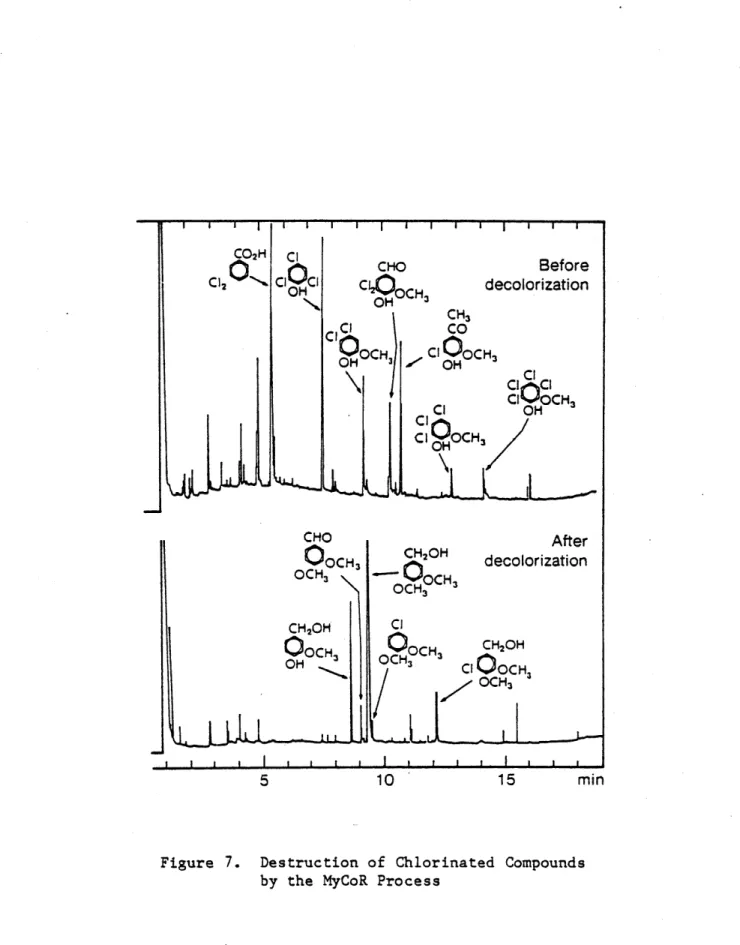
weight compounds i n t h e MyCoR r e a c t o r , t h e E l e f f l u e n t s b e f o r e and a f t e r MyCoR d e c o l o r i z a t i o n were e x t r a c t e d with chloroform a f t e r a d j u s t i n g t h e pH t o 2 . 5 .
The e x t r a c t s were s u b s e q u e n t l y examined by g a s chromatography/mass
Before decolorization
CHO
O O C H
OCH, \
After
CH20H decolorization
-
G c nOCH,
o C H ~ ~ ' CI Qocn,
were t h e dominant low molecular weight components i n t h e E l e f f l u e n t s . S u r p r i s i n g l y , t h e s e c h l o r i n a t e d phenols completely d i s a p p e a r e d a f t e r f u n g a l t r e a t m e n t , This f i n d i n g may be s i g n i f i c a n t , because most o f t h e i d e n t i f i e d c h l o r i n a t e d phenols a r e known t o be t o x i c t o a q u a t i c l i f e .
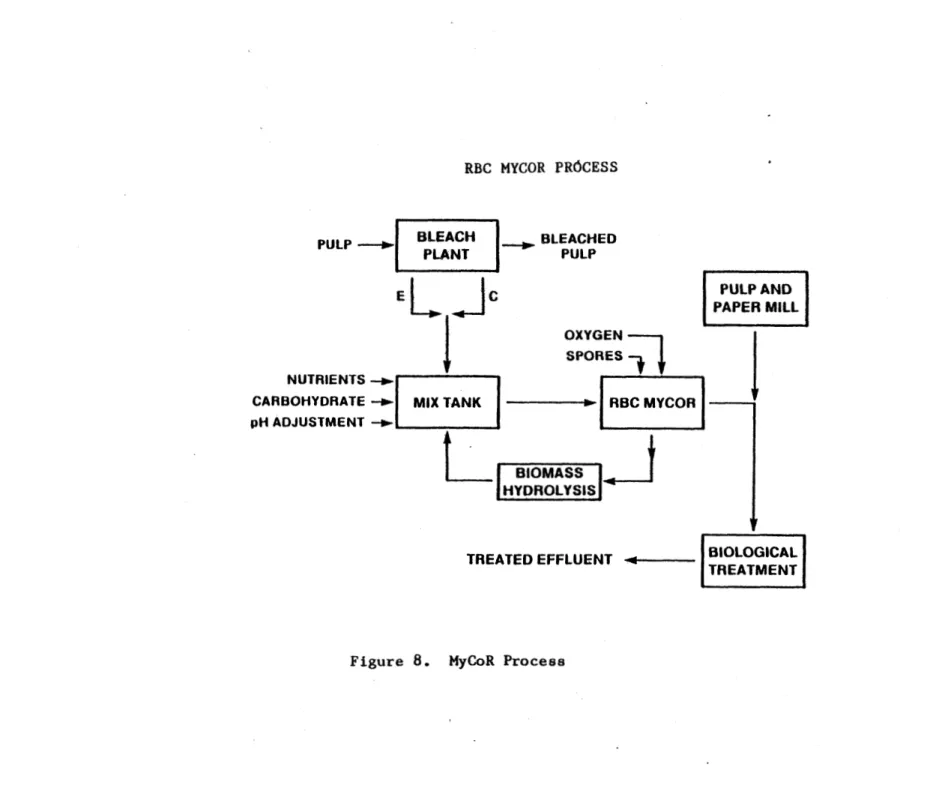
The suggested i n t e g r a t i o n o f t h e MyCoR P r o c e s s i n t o a p u l p and paper m i l l
is shown i n F i g u r e 8. Metal I o n s
One o f t h e more promising c o l o r removal p r o c e s s e s t h a t h a s been examined on a m i l l s c a l e is lime p r e c i p i t a t i o n ( F i g u r e 9). E a r l y s t u d i e s on removal of -
c o l o r from pulp and paper m i l l e f f l u e n t s u t i l i z e d t h e e x i s t i n g chemical t r e a t m e n t technology o f municipal w a t e r supply d e c o l o r i z a t i o n . S c r e e n i n g o f over t h i r t y metal i o n c o a g u l a n t s and a d s o r b a n t s demonstrated v a r y i n g degrees
o f e f f e c t i v e n e s s (Moggio, 1955)- Lack of recovery methods, o r o t h e r
t e c h n o l o g i c a l d i f f i c u l t i e s , such as c o r r o s i o n problems, prevented many from f u r t h e r c o n s i d e r a t i o n . Lime a d d i t i o n was considered t o have t h e g r e a t e s t p o t e n t i a l f o r a p p l i c a t i o n i n t h e i n d u s t r y . Among t h e f a c t o r s recognized a s f a v o r i n g use of lime were:
1. lime is comparatively low i n c o s t and is r e a d i l y a v a i l a b l e ( e s p e c i a l l y
i n t r e a t m e n t of k r a f t m i l l effluent, where l i m e i s produced as p a r t of t h e chemical recovery system, L e . , c a u s t i c i z i n g o f g r e e n l i q u o r ) ,
2, recovery methods a r e a l r e a d y well-developed, and,
3 . personnel a t k r a f t m i l l s have experience w i t h lime p r o d u c t i o n and recovery.
RBC MYCOR PRdCESS
BLEACH
-
BLEACHEDPULP
-1
PLANTI
PULPI
OXYGEN~-1
I
PULP AND
PAPER MILL
NUTRIENTS --,
3
+
CMWJOHYDRATE +
pH ADJUSTMENT
-+
TREATED EFFLUENT
-
I
BIOLOGICALTREATMENT
s t u d y , lime p r e c i p i t a t i o n has been one of t h e most widely i n v e s t i g a t e d c o l o r removal processes i n t h e pulp and paper i n d u s t r y . Although problems remain t o be solved ( L a t h i a and Joyce, 19781, i t is g e n e r a l l y considered t o be t h e most r e a d i l y a p p l i c a b l e of t h e v a r i o u s physical and chemical met hods s t u d i e d (Rush and Shannon, 1976).
The mechanism of l i m e p r e c i p i t a t i o n of c o l o r h a s been s t u d i e d ( B e n n e t t ,
e t a l , 1971). Color removal was found t o be a chemical r e a c t i o n i n which i n s o l u b l e calcium-organic salts formed, r a t h e r than a p h y s i c a l a d s o r p t i o n o r a b s o r p t i o n of c o l o r onto lime par$icles. The p r o c e s s was found t o be a
f u n c t i o n of two main f a c t o r s : the e n o l i c and phenolic hydroxyl c o n t e n t of' t h e e f f l u e n t and t h e molecular weight d i s t r i b u t i o n of t h e c o l o r bodies. The
r e a c t i o n e x h i b i t e d a pH dependence, r e q u i r i n g a pH of about 12 f o r complete i o n i z a t i o n of the phenolic hydroxyl groups which r e a c t w i t h t h e calcium ion.
E f f l u e n t s s t u d i e d were t h o s e from the c h l o r i n a t i o n and extraction stages o f t h e bleach p l a n t . The o r g a n i c s o l i d s of each e f f l u e n t were s u b j e c t e d t o elemental and f u n c t i o n a l group analyses and molecular weight determination. The s o l i d s i n t h e s p e n t l i q u o r s were mainly c h a r a c t e r i z e d a s a c i d i c c h l o r i n e - s u b s t i t u t e d l i g n i n o x i d a t i o n products of r e l a t i v e l y low molecular weight. Spectroscopic a n a l y s i s revealed very l i t t l e a r o m a t i c i t y . A t t e n t i o n was d i r e c t e d t o carboxyl, p h e n o l i c , and e n o l i c groups i n developing a t h e o r y t o e x p l a i n t h e mechanism of c o l o r removal by lime. Experiments were performed u t i l i z i n g s e l e c t i v e chemical blocking of s p e c i f i c f u n c t i o n a l groups, followed by lime a d d i t i o n . It was concluded t h a t f o r c h l o r i n a t i o n and e x t r a c t i o n s t a g e e f f l u e n t s , e n o l i c hydroxyl groups a r e most l i k e l y t h e predominant groups
involved i n p r e c i p i t a t i o n by lime.
o b t a i n e d from k r a f t p u l p i n g , p h e n o l i c hydroxyl groups appeared t o have t h e major r o l e i n t h e lime r e a c t i o n . S e l e c t i v e m o d i f i c a t i o n of f u n c t i o n a l groups was u t i l i z e d h e r e a l s o . Furthermore, t h e p h e n o l i c hydroxyl c o n t e n t of k r a f t l i g n i n was c o n s i d e r a b l y g r e a t e r t h a n i n s p e n t b l e a c h i n g l i q u o r s .
The scheme o u t l i n e d i n F i g u r e 10 r e p r e s e n t s t h e r e a c t i o n sequences proposed f o r c o l o r removal by l i m e o r o t h e r m e t a l i o n s . The f o r m a t i o n of keto-enols i n molecules c o n t a i n i n g chromophoric groups is shown, w i t h a l k a l i n e c o n d i t i o n s s h i f t i n g t h e e q u i l i b r i u m t o t h e e n o l i c form. A l k a l i is a l s o
r e q u i r e d f o r i o n i z a t i o n o f e n o l i c o r p h e n o l i c hydroxyls. The r e s u l t i n g a n i o n t h e n f o m s an i n s o l u b l e s a l t w i t h . c a l c i u m . It was noted t h a t , i n t h e s t u d y of lime p r e c i p i t a t i o n o f a c i d i c c h l o r i n a t i o n s t a g e c o l o r , it could n o t be
determined whether lime r e a c t e d w i t h o r i g i n a l f u n c t i o n a l groups o r w i t h ones produced by h y d r o l y s i s of c h l o r o - s u b s t i t u t e n t s by a l k a l i i n t h e l i m e
s o l u t i o n . Joyce and B e s h i r e ( 1 98 1 ) found t h a t softwood and hardwood e f f l u a n t s r e a c t e d d i f f e r e n t l y because t h e l i g n i n s were d i f f e r e n t
.
The a p p a r e n t i n f l u e n c e o f molecular weight on t h e lime d e c o l o r i z a t i o n p r o c e s s was seen when a t t e m p t s were made t o understand why approximately 15% o f t h e o r i g i n a l c o l o r could n o t be p r e c i p i t a t e d . T h i s problem was approached
b y t r e a t i n g l i q u o r from t h e c a u s t i c e x t r a c t i o n s t a g e w i t h l i m e and r e c o v e r i n g t h e p r e c i p i t a t e d and n o n - p r e c i p i t a t e d o r g a n i c s o l i d s by i o n exchange
t e c h n i q u e s . The compositions of t h e two f r a c t i o n s were s i m i l a r , each c o n t a i n i n g t h e f u n c t i o n a l groups t h a t had been e s t a b l i s h e d a s capable of producing i n s o l u b l e s a l t s with calcium. The average molecular weights, however, were s i g n i f i c a n t l y d i f f e r e n t
.
The v a l u e f o r s o l i d s whichp r e c i p i t a t e d was e s t i m a t e d t o be about 500, whereas i t was l e s s than one-half,
s u b s t a n t i a t e d t h e s e i m p l i c a t i o n s . It was determined t h a t lime w i l l
p r e c i p i t a t e almost a l l h i g h molecular weight c o l o r b o d i e s , i. e., t h o s e g r e a t e r than 5,000, p a r t i a l l y remove t h o s e from molecular weight 400 t o 5,000, b u t g e n e r a l l y cannot p r e c i p i t a t e s p e c i e s below molecular weight 400.
A b a s i c scheme is common t o a l l lime p r e c i p i t a t i o n p r o c e s s e s f o r c o l o r removal from pulp and paper m i l l e f f l u e n t s . E f f l u e n t and s l a k e d lime a r e mixed and s e n t t o a c l a r i f i c a t i o n b a s i n where t h e lime-organic s l u d g e
s e t t l e s . . The v a r i o u s p r o c e s s e s develped f o r l i m e t r e a t m e n t g e n e r a l l y d i f f e r a c c o r d i n g t o lime dosage, e f f l u e n t t y p e , and methods o f handling t h e lime-
o r g a n i c s l u d g e and d e c o l o r i z e d e f f l u e n t ,
P r o c e s s e s have been developed a l o n g two avenues, termed massive l i m e and minimum (9nini") lime processes. The first employs lime a p p l i c a t i o n r a t e s much g r e a t e r than t h a t r e q u i r e d f o r s t o i c h i o m e t r i c r e a c t i o n w i t h t h e c o l o r .
b o d i e s . I n e a r l y work, problems were encountered i n dewatering t h e lime- o r g a n i c s l u d g e when a minimum l i m e dose was used (Moggio, 19551, l e a d i n g t o f u r t h e r e x p e r i m e n t a t i o n w i t h g r e a t e r lime doses. I n l a b o r a t o r y t e s t s , l e v e l s of 10,000 t o 30,000 mg/L lime produced t h e most dense and most e a s i l y
dewatered s l u d g e because of t h e g r e a t e x c e s s of calcium hydroxide p a r t i c l e s
(Rush and Shannon, 1976). A one-year s t u d y by I n t e r n a t i o n a l Paper Company
e v a l u a t e d t h e i n c o r p o r a t i o n of a massive l i m e system f o r c o l o r removal a t a demonstration m i l l i n S p r i n g h i l l , La. (Wright, e t a l , 1974). The f a c i l i t y produced bleached k r a f t pulp a t about o n e - f i f t h of u s u a l f u l l s c a l e . A dosage
of t h e a l k a l i n e e x t r a c t i o n s t a g e and most of t h e unbleached decker e f f l u e n t could be t r e a t e d without exceeding t h e lime k i l n c a p a c i t y f o r lime p r o d u c t i o n i n t h e q u a n t i t y r e q u i r e d f o r c a u s t i c i z i n g . The t o t a l m i l l c o l o r l o a d was t h u s lowered by about 70%. F u r t h e r work w i t h t h i s p r o c e s s was not pursued,
however, due t o s e v e r a l s e r i o u s d i f f i c u l t i e s . Foaming i n c a u s t i c i z e r s and lime mud washers was a c o n s t a n t problem, and t h e white l i q u o r c o n c e n t r a t i o n was about 16% lower t h a n when produced i n t h e c o n v e n t i o n a l manner w i t h f r e s h lime. I m p l i c a t i o n s f o r f u l l s c a l e use i n c l u d e d requirements f o r a l a r g e r volume o f white l i q u o r f o r wood d i g e s t i o n and, consequently, i n c r e a s e d c a p a c i t y i n t h e chemical p r e p a r a t i o n and recovery systems.
There have been s e v e r a l v e r s i o n s o f t h e mini-lime p r o c e s s (Davis, 1971; Gould, 1973; S p m i l l , 1973); t h e s e have been a b l e t o overcome t h e problem of lime s l u d g e d e n a t e r i n g t o a l a r g e degree. Perhaps t h e most s u c c e s s f u l is t h e f u l l - s c a l e system o p e r a t e d by C o n t i n e n t a l Can Company a t Hodge, La. ( S p r u i l l ,
1973). This m i l l had been under p r e s s u r e from t h e s t a t e o f Louisiana t o lower t h e c o l o r i n wastewaters discharged i n t o a low flow stream. Most o f t h e 15
m i l l i o n g a l l o n s of wastewater produced p e r day by combined k r a f t and NSSC
boardmill e f f l u e n t s could be t r e a t e d . I n t h i s scheme, a s m a l l dose of a b o u t 1,000 mg/L lime is s l a k e d and mixed with waste l i q u o r . A f t e r primary
c l a r i f i c a t i o n , t h e d e c o l o r i z e d overflow i s s e n t t o a r e c a r b o n a t o r f o r removal of remaining d i s s o l v e d calcium. I n t h e r e c a r b o n a t o r , lime k i l n s t a c k g a s is i n t r o d u c e d a s a source of C02 which promotes t h e formation of i n s o l u b l e
calcium carbonate. After s e t t l i n g i n a c l a r i f i e r , t h e sludge is r o u t e d t o t h e