Efficient NNCF Image Denoising with Patch
Decomposition
Vishnu CC , Gopika Gopinath.
Student, Dept. of ECE., MCET, Desamangalam, Kerala, India
Assistant Professor, Dept. of ECE., MCET, Desamangalam, Kerala, India
ABSTRACT: Image denoising is one of the challenging procedure in modern technology. In this paper wavelet
denoising is applied in the decomposition section of the patching matching technique. Here, the noised image is divided into different patches and using nearest neighbour –based collaborative filtering(NNCF) the patch matching is done. For patch matching method the reference patches are taken from the noisy image itself, these type of matching is known by INT-CF, do to reference patches is taken from noisy image itself. After the patch matching section, image decomposition is done, here we use Targeted Image Denoising (TID) along with wavelet denoising for both decomposition and reconstruction of the image.by comparing with otherimage denoising methods our method gives better performance and better denoised image.
KEYWORDS: Patch matching NNCF, INT-CF, TID, wavelet
I. INTRODUCTION
There are many image denoising techniques are available in this modern century, most of the technique are patch based methods [1],[2],in this images are divided into multiple overlapping patches and each patch is denoised by the help of reference patches. The overall denoised performance is depend on how similar the reference patches are selected.Thereare mainly two way for the selection of reference patches, internal and external way. Internal way means reference patch is selected from the noisy image itself, external way means reference patch selected from the external source, sometimes it may be original image. Performance of the denoised output is depend on how similar the reference patches are to be underlying the clean patch. The reference patches are obtained from the query patches.
The main difficulty of the image denoising method is clean image is not known, so we use patch matching technique. As the name indicate patch matching means comparing each patches and better and most similar patches are selected. There are mainly two type of matching both internal and external matching, because both internal and external patches has their own advantages and disadvantages, so that we use both of the two.
The output from this patch matching scenario is used for decomposition process, at decomposition section we use Targeted Image Denoising [3], here TID is a external denoising algorithm that uses targeted database for denoising an image .the output from these TID denoising has performance limit.
In this paper we use wavelet denoising along with TID, Ie, output from the TID is again denoised with wavelet. Wavelet makes to recover better quality image while preserving the characteristics, we can see that PSNR value of our method has higher value than other methods.
II. RELATED WORK
First stage is the criterion for patch matching
d = d +α w(q, u)d ( )
Where d the distance between the patches q and j. αIs the normalization factors so that the weights sum to 1.w(q, u)Is the weight based on the closeness of patch q and patch u.d Is the corrected dissimilarity measure that is used to compare q and j
Next stage is finding the set of close neighbour .close neighbors are the patches that share the close similarities with noisy image. Ideally these patches are known as query image but in practical case this information cannot be used, so that we has to find out the set of close neighbours. The close neighbors are obtained from the INT-CF.The close neighbors of query patch selected from our noisy image itself.
Next stage is the choice of the weight in collaborative filtering, rating of neighbors are weighted by similarities of query patch. Here we use simple weighted scheme
W (q, u) = 1 if u is a close neighbour of q
0 otherwise
Ie, here we use 0-1 weight scheme for simplicity. That is weight is set to 1 if u is a close neighbour of q [5] other weighting schemes are also available such as Pearson correlation coefficient, or to learn the weights from the data [6]
There are many conventional decomposition and reconstruction techniques are available for patch matching methods. BM3D[7]is a transform domain denoising procedure, Another method is TID[8] it is the one of the best denoising methods, both internal and external patch matching are available, but the performance is higher obtained while using the internal patch matching method.
After the above stages we get the denoised image, but still it has the performance limit, and also we can improve the denoising level.
III.PROPOSED SYSTEM
As discussed in above sections, firstly the noised image is portioned into overlapping patches, and more efficient patch matching is carried out which is by using internal collaborative filtering. The reference patches obtained from this is known by also query pathes.these query patches are then done by decomposition and reconstruction. First we use TID[7] after that we use wavelet denoising. Wavelet makes it possible to recover better quality image from the noisy image, while keeping the characteristics remaining unchanged. One of the major advantage of the wavelet transform is the thresholding of small coefficient without affecting significant features of the image as the small coefficient are due to noise and large coefficient are due to important signal features.
There are mainly two technique is in the wavelet denoising soft and hard, for each wavelet coefficient if the amplitude is less than the threshold, then it will be set to zero, otherwise it will be kept unchanged(hard thresholding),or shrunk in the absolute value by an amount of the threshold( soft threshold).
Hard thresholding y= | | >
0 | | <
Soft thresholding y=sin( ) (| |− )
x=input image y=output signal T=threshold
T= 2 log( )
N=sample size
Figure:Image denoising
The above figure gives overall of our project. In decomposition and reconstruction section we use two technique, first we use TID then followed by wavelet denoising,and here we use discrete wavelet of daubechies8.The Daubechies wavelet, based on Ingrid wavelet, which are family of the orthogonal wavelet, which are characterized by maximal number of vanishing moments for some given support. Here we use Daubechies wavelet, which has highest number of vanishing moment.
IV.SIMULATIONRESULT
The simulation result involves firstly we divides the denoised image into multiple overlapping patches, after, that patch matching is carried out for getting better reference patches, by using this reference patches decomposition and reconstruction is carried out. So that we get patches, by aggregating these patches we get denoised image.
By comparing of two methods that is the comparison of TID and our method. By seeing this we can find out the result that our method is gives more efficient denoised output and the PSNR value of our method is better than the existing method.
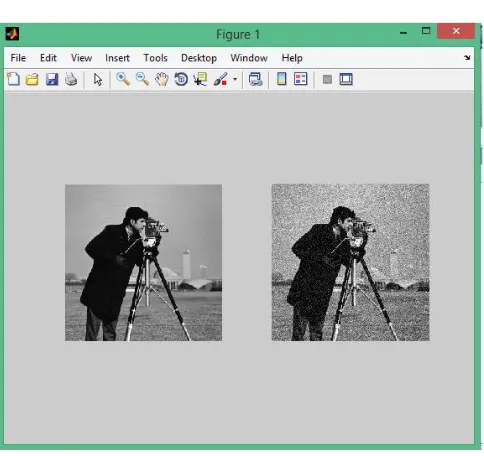
Figure1: sources image
The figure 1 shows a 256*256 image of both original and noised image, the noise is occurred during the acquisition time of the image. Here the noised image is known as source image itself
Figure 2: image patches
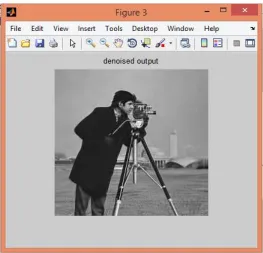
Figure 3: denoised output
Figure 3 shows the denoised output of our source image.which has the same size as the source image 256*256.by
finding the PSNR value we can see how similar the denoised image to orginal image.
Table 1: Comparison result
The table 1 shows the comparision between the existing method(TID) and with our efficient method(TID+WAVELET).from the table we can conclude that the PSNR value of our efficient method is high compare to to the existing method
V. CONCLUSION AND FUTURE WORK
In this paper, wavelet denoising is applied in the decomposition section of the patching matching technique. Here, the noised image is divided into different patches and using nearest neighbour –based collaborative filtering (NNCF) the patch matching is done. For patch matching method the reference patches are taken from the noisy image itself, these type of matching is known by INT-CF, do to reference patches is taken from noisy image itself. After the patch matching section, image decomposition is done, here we use Targeted Image Denoising (TID) along with wavelet
TID EFFICIENT(TID+WAVELET)
σ ∗255
NOISED DENOISED NOISED DENOISED
denoising for both decomposition and reconstruction of the image.by comparing with other image denoising methods our method gives better performance and better denoised image.
Further work can be extended the image denoising to video denoising, Ie, video can be denoised by optimizing the code of the image denoised one.
REFERENCES
1. A. Buades, B. Coll, and J. M. Morel, “A review of image denoising algorithms, with a new one,” Multiscale Modeling & Simulation, vol. 4, no. 2, pp. 490–530, 2005
2. C. Kervrann and J. Boulanger, “Local adaptivity to variable smoothness for exemplar-based image regularization and representation,” International Journal of Computer Vision, vol. 79, no. 1, pp. 45–69, 2008.
3. E. Luo, S. H. Chan, and T. Q. Nguyen, “Image denoising by targeted external databases,” in IEEE International Conference on Acoustics, Speech and Signal Processing (ICASSP), pp. 2450–2454,May 2014,.
4. G. Adomavicius and A. Tuzhilin, “Toward the next generation of recommender systems: A survey of the state-of-the-art and possible
extensions,” IEEE Transactions on Knowledge and Data Engineering, vol. 17, no. 6, pp. 734–749, June 2005S.
5. K. Goldberg, T. Roeder, D. Gupta, and C. Perkins, “Eigentaste: A constant time collaborative filtering algorithm,” Information Retrieval, vol. 4,
no. 2, pp. 133–151, July 2001.
6. R. M. Bell and Y. Koren, “Scalable collaborative filtering with jointly derived neighborhood interpolation weights,” in Seventh IEEE International Conference on Data Mining (ICDM 2007), pp. 43–52,October 2007.
7. K.Dabov,A.Foi,V.Katkovnik,andK.Egiazarian,“Imagedenoisingby sparse 3-d transform-domain collaborative filtering,” IEEE Transactions on
Image Processing, vol. 16, no. 8, pp. 2080–2095, August 2007.
8. “Adaptive image denoising by targeted databases,” IEEE Transactions on Image Processing, vol. 24, no. 7, pp. 2167–2181, July 2015
BIOGRAPHY
Vishnu ccis currently pursuing the M.Tech degree in Applied Electronics and Communication System from MCET