Array Dimension for Secret Sharing with Two
Levels QR Code Authentication
Priyanka Subhash Patil, Prof. Priya Parate
ME Student, Department of Computer Engineering, Rajiv Gandhi Institute of technology, Mumbai, India
Professor, Department of Computer Engineering, Rajiv Gandhi Institute of technology, Mumbai, India
ABSTRACT: In proposed QR code authentication two level storage is used, which help to verify original content in QR code. Our proposed work uses public and private storage level of document storage. In the public level same standard QR code storage level is explored; which can be readable to any QR code readable device. The private level is constructed by replacing the black modules by specific textured patterns. It consists of information encoded using q -ary code with an error correction capacity. Q-array code will increase the storage capacity of the QR code, but also to verify the original document from a copy. This authentication is due to the sensitivity of the used patterns to the print-and-scan process. The pattern recognition method that we use to read the second-level information can be used both in a private message sharing and in an authentication scenario.
KEYWORDS: QR code, two storage levels, private message, document authentication, pattern recognition, print-and-scan process.
I. INTRODUCTIONS
The use of QR codes is increasedbecause they are robust to the copying process, easy to read by any device and any user, they have a high encoding capacity enhanced by error correction facilities, they have a small size and are robust to geometrical distortions. However, those undeniable advantages also have their counterparts.
1) Information encoded in a QR code is accessible to every user easily, even if it is encoded. 2) It is difficult to classify original content from duplicate file content due to print and scan feature.
II. RELATED WORK OR LITERATURE SURVEY
SR NO PAPER NAME JOURNAL NAME AND
AUTHOR NAME
REFER POINTS
1. 2D BAR-CODES
FORAUTHENTICATION: A SECURITY APPROACH
Domaine Universitaire, 11 rue des Math´ematiques, BP 46 F-38042 St. Martin d’H`eres Cedex, France Signal Processing Conference 2012. Cl´eo Baras and Franc¸ois Cayre
1.
In this paper, consider
a
good authenticationsystem
using 2D-BCs from the
point of view of the
opponent.
2. ROBUST MESSAGE HIDING
FOR QR CODE
2014 Tenth International Conference on Intelligent Information Hiding and Multimedia Signal Processing Thach V. Bui
1.
It presented a robust
scheme
to
hide secretmessages
into QR code. Our scheme
is
secure
against
bit-changed attack and can
tolerate more errors than
usual. However, the length
ofsecret messages
is
smaller than the one using
existing schemes based on
bit algorithm.
3. UNSYNCHRONIZED 4D
BARCODES
CODING AND DECODING TIME-MULTIPLEXED 2D COLORCODES
Bauhaus-University Weimar Tobias Langlotz and Oliver Bimber.
1.
This Paper present a
novel technique for optical
data
transfer
between
public displays and mobile
devices
based
on
unsynchronized
4D
barcodes
4. DISTORTION MODELING
AND INVARIANT EXTRACTION FOR DIGITAL IMAGE PRINT-AND-SCAN PROCESS
International Symposium on Multimedia Information Processing (ISMIP 99), Taipei, Taiwan, Dec. 1999 Ching-Yung Lin and Shih-Fu Chang
1.
It proposes a model for
the
pixel
value
distortion, define the
RSC-based geometric
distortions, analyze the
change
of
DFT
coefficients
after
5. SECRET HIDING MECHANISM
USING QRBARCODE
2013 International Conference on Signal-Image Technology & Internet-Based Systems Pei-Yu Lin
1.
The
designed secrethiding
scheme can carry 24 to
9720 secret bits
into
a
cover QR code and
preserve the readability of
the QR code content based
on the capability of error
correction.
6. 2D COLOR BARCODES FOR
MOBILE PHONES
International Journal of Computer Science and Applications
M. QUERINI
1.
In this paper we have
proposed HCC2D, High
Capacity
Colored
2-Dimensional
7. PRINT AND SCAN’
RESILIENT DATA HIDING IN IMAGES
IEEE TRANSACTIONS ON INFORMATION
FORENSICS AND
SECURITY, VOL. 1, NO. 4, DECEMBER 2006
Kaushal Solanki,
1.
The robustness of the
methods is based on three
key components of our
approach
choice
of
embedding strategy based
on analytical.
III. EXISTING SYSTEM MECHANISM
Existing system basedon searching relational values between P&S unuseful patterns and related patterns. The storage capacity can be magnificentlyincreased by code alphabet q or by increasing the textured pattern size. Existing system results show a restoration of private information. It also highlights the possibility of using this QR code for document authentication.
Data stored in a QR code is can be easily readable to camera containing, although it is not plain text and therefore is only readable to authorized user ,likewise watch and read. It is impossible to classify an originally document in QR code from its copy due to their insensitivity to the Print and Scan process.
IV. PROPOSED SYSTEM MECHANISM
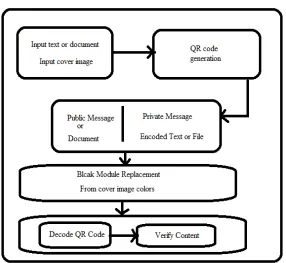
Proposed system uses two levels QR for data hiding. This 2LQR code has following levels 1. Public level.
2. Private level.
V. EXISTING ARCHITECTURE
Fig No 01 Existing System Architecture VI. PROPOSED SYSTEM ARCHITECTURE
VII. ALGORITHMS USED
The primary problem is to implement an efficient, robust, scalable, and easy to use authentication system. We present and analyze the authentication scheme that combines ownership factors (original content and authentication code) with knowledge factors. The method is based on smart card and optical challenge response solution in which a camera equipped mobile phone is used for the purpose of authentication. The security of the scheme is improved by using a type of knowledge-based authentication challenge to the user’s smart phone rather than a code displayed in clear text. This solution has high usability due to its ease of use, easy deployment and cost effectiveness.
VIII. CONTRIBUTION OR FUTURE SCOPE
Textured patterns are used are their sensitivity to hiding and reading original content in the QR Code., we use a pattern recognition method based on maximization of correlation values among printable and readable form of content or documentTwo level QR code generation uses.
IX. CONCLUSION
This 2LQR code can be used for secure privatedata sharing for authentication mechanism. The private level is created by replacing black modules with specific textured patterns. Image texture patterns are considered as black modules by QR code reader. So that the private level is hidden to QR code readers, we add the private level which does not affect in anyway the reading process of the public level. The proposed 2LQR code increases the storage capacity of the classical QR code due to its supplementary reading level.The storage capacity of the 2LQR code can be improved by increasing the number of textured patterns used or by decreasing the textured pattern size. All experiments show that even with a pattern size of 6×6 pixels and with an alphabet dimension q = 8, it is possible to obtain good pattern recognition results, and therefore a successful private message extraction. However, we are facing a trade-off between the pattern size, the alphabet dimensions and the quantity of stored information during the 2LQR code generation.
REFERENCES
[1] C. Baras and F. Cayre, “2D bar-codes for authentication: A securityapproach,” in Proc. 20th Eur. Signal Process. Conf. (EUSIPCO),Aug. 2012, pp. 1760–1766.
[2] T. V. Bui, N. K. Vu, T. T. P. Nguyen, I. Echizen, and T. D. Nguyen,“Robust message hiding for QR code,” in Proc. IEEE 10th Int. Conf.Intell.
Inf. Hiding Multimedia Signal Process. (IIH-MSP), Aug. 2014,pp. 520–523.
[3] T. Langlotz and O. Bimber, “Unsynchronized 4D barcodes,” in Proc.3rd Int. Symp., ISVC 2007, Lake Tahoe, NV, USA, Nov. 26–28, 2007,pp. 363–374.
[4] C.-Y. Lin and S.-F.Chang, “Distortion modeling and invariant extractionfor digital image print-and-scan process,” in Proc. Int. Symp. MultimediaInf. Process., 1999, pp. 1–10.
[5] P.-Y. Lin, Y.-H. Chen, E. J.-L. Lu, and P.-J. Chen, “Secret hidingmechanism using QR barcode,” in Proc. IEEE Int. Conf. Signal-ImageTechnol. Internet-Based Syst. (SITIS), Dec. 2013, pp. 22–25.
[6] M. Querini, A. Grillo, A. Lentini, and G. F. Italiano, “2D color barcodesfor mobile phones,” Int. J. Comput. Sci. Appl., vol. 8, no. 1, pp. 136– 155,2011.
[7] K. Solanki, U. Madhow, B. S. Manjunath, S. Chandrasekaran, andI. El-Khalil, “‘Print and scan’ resilient data hiding in images,”IEEE Trans. Inf. Forensics Security, vol. 1, no. 4, pp. 464–478,Dec. 2006.
[8] R. Villán, S. Voloshynovskiy, O. Koval, F. Deguillaume, and T. Pun,“Tamper-proofing of electronic and printed text documents via robusthashing and data-hiding,” in Proc. SPIE, vol. 6505, p. 65051T,Feb. 2007.