Plant Disease Detection using SVM Algorithm
and Neural Network Approach
Jasmeet Kaur, Er. Ramanpreet Kaur
Research Scholar, Dept. of CSE, CGCTC, Jhanjeri, Mohali, Punjab, India
Assistant Professor, Dept. of CSE, CGCTC, Jhanjeri, Mohali, Punjab, India
ABSTRACT: Plants have become an important source of energy, and are a fundamental piece in the puzzle to solve the problem of global warming. There are many types of diseases which are present in plants. To detect these diseases pattern are required to recognize them. A common approach in this case is the use of remote sensing techniques that explore multi and hyper spectral image captures. The methods that adopt this approach often employ digital image processing tools to achieve their goals. There are many types of pattern recognition algorithm which gives detection of disease with accuracy. In the existing work back propagation and principal component analysis are used to detect plant diseases. These algorithms are learned from training supervision in neural network. There is an issue of accuracy in these algorithms. These algorithms are able to detect diseases in plant but not in an accurate way. So to increase the accuracy for plant detection a new method will be proposed. In this method BP, PCA are combined with SVD to increase the accuracy of the detection.
KEYWORDS: Image Processing, Back Propagation, SVM, PCA, SVD.
I. INTRODUCTION
Image Processing is a procedure to change over an image into digital shape and play out a few operations to get an enhanced image and concentrate valuable information from it. It is most recent innovations and its applications in different parts of a business. Image Processing shapes center exploration zone inside designing and software engineering trains excessively [2]. There are two sorts of images which are analog and digital [6]. The images ought to be accessible in digitized structure is the most necessities for image processing of images, that is, arrays of limited length binary words. For digitization, most importantly the given Image is examined on a discrete grid and every specimen or pixel is quantized utilizing a limited number of bits. The digitized image is handled by a PC. To show a digital image, it is initially changed over into analog signal, which is scanned onto a presentation [8]. Back propagation gives an approach to train networks with any number of shrouded units organized in any number of layers. Indeed, the network does not need to be sorted out in layers - any pattern of availability that allows a halfway requesting of the hubs from input to output is permitted.
Networks that esteem this constraint are called feed forward networks; their association pattern shapes a coordinated non-cyclic graph. Once a network has been organized for a specific application, that network is adapted to be trained. At that point, the training, or learning, starts. Supervised and unsupervised are the two training for trained sets. It physically or by giving the craved outputs the inputs, Supervised training includes a system of furnishing the network with the fancied output. Unsupervised training is the place the network needs to make brains of the inputs without outside help or obstruction. The unlimited heft of networks use supervised training. Unsupervised training is utilized to play out some underlying portrayal on inputs. Its fame originates from three key properties [9]. In the first place, it is the optimal (regarding mean squared error) linear plan for compressing an arrangement of high dimensional vectors into an arrangement of lower dimensional vectors and afterward reproducing. Second, the model parameters can be figured specifically from the information. Third, pressure and decompression are straightforward operations to complete given the model parameters – they require just matrix increases.
capacity whose worth depends just on the separation from the cause. Sums of radial premise functions are ordinarily used to rough given functions. RBFs are additionally utilized as a part of bolster vector classification [11].
II. LITERATURE REVIEW
In [1] a study on various classification techniques that can be utilized for plant leaf diseases classification is done. This paper gives a diagram of various classification techniques utilized for plant leaf disease classification. The k-nearest-neighbor strategy is maybe the least difficult of all algorithms for predicting the class of a test illustration. A conspicuous hindrance of the k-NN strategy is the time complexity of making forecasts. Moreover, neural networks are tolerant to noisy inputs. Be that as it may, it is difficult to comprehend structure of algorithm in neural network. SVM was discovered focused with the best accessible machine learning algorithms in arranging high-dimensional information sets. In SVM computational complexity is decreased to quadratic enhancement issue and it's anything but difficult to control complexity of decision principle and frequency of error. Drawback of SVM is it's hard to decide optimal parameters when training information is not linearly divisible.
In [3] a philosophy for identifying plant diseases early and precisely, utilizing different image processing techniques and counterfeit neural network (ANN). The framework created here is for plant diseases acknowledgment, the advancement of good classification techniques and exact components is critical keeping in mind the end goal to run the framework continuously. In this way proposed approach which depends on Gabor channel for highlight extraction and ANN classifier for classification showed signs of improvement results and acknowledgment rate up to 91%. An ANN based classifier is embraced which utilizes the mix of shading and surface components to perceive and characterize distinctive plant diseases. The outcomes are empowering and guarantee the advancement of a decent machine vision framework in the zone of acknowledgment and classification of plant diseases.
In [4] a system to perceive the disease of two plants. This examination has been done on two grapes plants and two wheat plants to enhance exactness utilizing image processing techniques. Back propagation (BP) networks were utilized as the classifiers to distinguish grape diseases and wheat diseases, individually. The outcomes demonstrated that identification of the diseases could be successfully accomplished utilizing BP networks. While the magnitude of the element information were not decreased by utilizing principal component analysis (PCA), the optimal acknowledgment results for grape diseases were gotten as the fitting precision and the expectation exactness were both 100% and that for wheat diseases were acquired as the fitting exactness and the forecast exactness were both 100%. While the measurements of the element information were lessened by utilizing PCA, the optimal acknowledgment result for grape diseases was acquired as the fitting exactness was 100% and the forecast precision was 97.14%, and that for wheat diseases was gotten as the fitting exactness and the expectation precision were both 100%.
In [5] a system to distinguish diseases of plants utilizing image processing. This goes under automatic plant disease identification. There are number of colors for disease set apart as a dark spot and intensity for color segmentation. RGB image can be utilized for color segmentation. In this paper an examination of the result of CIELAB, HSI and YCbCr color space during the time spent disease spot identification is finished. Image smoothing is finished by middle channel. Otsu technique on color component to distinguish the disease spot can be connected for limit values. An algorithm which is autonomous of background plant sort, noise and disease spot color was produced and examinations were passed out on various "Monocot" and "Dicot" family plant leaves with both, noise free (white) and noisy background.
In [12] authors examined about the noisy image and connected Adaptive median filter to expel noise from the image and gives output as a filtered image. The evaluated Error and average error of the qualities put away in filtered image matrix have been ascertained with reference to the qualities put away in unique information matrix with the end goal of checking of appropriate noise expulsion. Presently information of every pixel has been changed over into binary number (8 bit) from decimal qualities. This procedure keeps on creating new information matrix with new distinctive arrangement of qualities. This information matrix has been taken as unique information matrix and spared in information bank. Presently for acknowledgment, another test image has been stepped as salt and pepper noise insertion, evacuation of noise utilizing adaptive median filter as specified before have been connected to get another test matrix.
generally supportive for the development of the crop, some of the time it contains poisons which may hurts some flying creatures moreover. The fundamental point of this paper is to gauge the effected territory of stem and base of the plant which is contaminated with disease. It results in low throughput. This paper gives different development techniques to the detection of plant diseases utilizing image processing. This will enhance throughput and identifies diseases automatically.
III. SUPPORT VECTOR MACHINES(SVM)
Based on statistical learning hypothesis, support vector machines (SVM) calculation has a strong mathematical hypothetical establishment and thorough hypothetical investigation, which has the advantage of hypothetical fulfillment, worldwide optimization, adaptability, and great generalization capacity. It is to a great extent tackled the past issues of picking machine learning model, over-fitting, non-linear, the scourge of dimensionality, local minimum points etc. It utilizes the structural danger minimization standard, which minimizes the observational danger; in the meantime effectively enhance generalization capacity of the calculation.
The calculation is to utilize genetic calculation to advance the SVM model parameters, the fundamental strides of it are as per the following:
a. Choose the underlying population of individuals haphazardly;
b. Evaluate the fitness of every individual in that population;
c. Select another generation of population from the past generation by utilizing selection operator;
d. Take the crossover and mutation operation on the present population, then take the evaluation, selection, crossover and mutation operation on the new breed, and proceed.
e. If the fitness capacity estimation of ideal individual is sufficiently expansive or the calculation have run numerous generations, and the ideal fitness estimation of the individual can't be changed clearly, then we get the ideal estimation of kernel capacity parameter , punishment component, and coldhearted loss capacity, and we can likewise get the ideal classifier by the preparation datum.
Keeping in mind the end goal to utilize a SVM to take care of a grouping or regression issue on data that is not linearly separable, we have to first pick a kernel and relevant parameters which you expect may outline non-linearly separable data into a feature space where it is linearly separable. This is a greater amount of a workmanship than a definite science and can be accomplished observationally - e.g. by trial and error. Sensible kernels to begin with are the Radial Basis, Polynomial and Sigmoidal kernels.
IV. PROPOSED TECHNIQUE
There are three types of algorithm which will be used in the proposed methods. These methods are:
A. Back-propagation Algorithm (BPA): Back-propagation provides a way to train networks with any number of hidden units arranged in any number of layers. In fact, the network does not have to be organized in layers. B. Principal Component Analysis (PCA): Principal Component Analysis is a mathematical Procedure that
makes use of orthogonal transformation to convert a set of observation of correlated variables and uncorrelated variables.
C. Singular Value Decomposition (SVD):
Singular Value Decomposition (SVD) is said to be a significant topic in linear algebra by many renowned mat hematicians. SVD is robust and reliable orthogonal matrix decomposition method. Due to SVD conceptual and stability reasons, it becomes more and more popular in signal processing area. SVD is an attractive algebraic transform for image processing. SVD has prominent properties in imaging. The main SVD properties that may be utilized in image processing. Although some SVD properties are fully utilized in image processing, others still needs more investigation and contributed to. A key property of SVD is its relation to the rank of a matrix and its ability to approximate matrices of a given rank. In first two algorithms BPA and PCA has less accuracy which is unable to detect accurate diseases in plants. But with the help of SVD we will enhanced the accuracy of the plant diseases so that it can be detected accurately.
Figure 1 Flow Chart
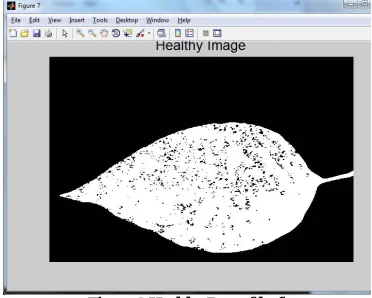
There are two data sets in which images are placed for comparison names as training data image and another one is train data image. After load both image we have to do extreme detection in which we match each and every position of image which we have to compare with training image. Then we generate descriptors which is a sparse feature representation that consists of both feature extraction and detection. We only use the feature extraction component. In the feature consistence resistance the points or descriptors which we find in the basic image with same dimensions similarly in another image, so we have to used consistence approach for matching between two images. In the scale angle point one image is placed at 90 angle another will place at different angle then their position of object in image will be same. After that some points are not clearly seen when we change their angles, so filtering process used to filter image or object in image. Then matching process start in which according to descriptors or key points found in basic or compare image. Using that it will match and give the result how many number of points will match in the final output. After that find the black pixel in the image because in the leaf or plant where is another color spot which is different from Green color that is shown in black color pixel after that it will show healthy or diseased image based on black pixel or spot image. Then result image is declared.
V. EXPERIMENTAL RESULTS
As shown in figure 2, the dataset is taken which contain multiple images and this dataset will be put into the folder named as training dataset. The second folder called train dataset contains some images. The images of the train folder will match with the images of the trained folder for the feature matching SIFT algorithm will be applied.
Figure 3 Diseased Part of leaf
As shown in figure 3, the images of the train folder will match with the images of the trained folder for the feature matching SIFT algorithm will be applied. In the figure, leaf whose features are matched will be extracted and in that leaf where are the diseases will be detected using enhanced SVM. The black background from the leaf will be extracted to know that how much portion of the leaf will be cut.
Figure 4 Area of Disease
As shown in figure 4, the SATURATION value of infected leaf will be calculated which helps to increase detected accuracy. In this figure the enhanced SVM algorithm will be applied which will separate the uninfected portion of the leaf. The enhanced SVM algorithm will separate the infected part of the leaf. The SVM shows the portion that how much part is infected which is 5.54 %
VI. CONCLUSION
REFERENCES
1. Savita N. Ghaiwat, Parul Arora, “Detection and Classification of Plant Leaf Diseases Using Image processing Techniques: A Review”, International Journal of Recent Advances in Engineering and Technology, ISSN(online) :2347-2812, Volume 2 Issues 3 2014
2. Prof. Sanjay B. Dhaygude and Mr.Nitin P.Kumbhar, “Agricultural plant Leaf Disease Detection Using Image Processing” International Journal of Advanced Research in Electrical,Electronics and Instrumentation Engineering Vol. 2, Issue , January 2013
3. Anand.H.Kulkarni and Ashwin Patil R. K, “Applying image processing technique to detect plant diseases”, International Journal of Modern Engineering Research (IJMER), Vol.2, Issue.5, Sep-Oct. 2012 pp-3661-3664 ISSN: 2249-6645 2012
4. Haiguang Wang, Guanlin Li, Zhanhong Ma, Xiaolong Li, “Image Recognition of Plant Diseases Based on Backpropagation Networks”, 5th International Congress on Image and Signal Processing (CISP 2012) 2012
5. Piyush Chaudhary Anand K. Chaudhari Dr. A. N. Cheeranand Sharda Godara “Color Transform Based Approach for Disease Spot Detection on Plant Leaf”, International Journal of Computer Science and Telecommunications [Volume 3, Issue 6, June 2012
6. Rani Pagariya and Mahip Bartere, “ Review paper on identification of plant diseases using image processing technique”, 2014
7. Jayamala K. Patil and Raj Kumar, “ Advance in image Processing for detection of plant disease”,Journal of Advanced Bioinformatics Applications and Research ISSN 0976-2604 Vol 2, Issue 2, June-2011, pp 135-141
8. Prof. Sanjay B. Dhaygude and Mr.Nitin P.Kumbhar, “ Agricultural Plant Leave detection using image Processing”, International Journal of Advanced Research in Electrical, Electronics and Instrumentation Engineering Vol. 2, Issue 1, January 2013
9. Yan K, Rahul Sukthankar , “pca-sift: a more distinctive representation for local image descriptors” Computer Vision and Pattern Recognition, 2004, CVPR 2004.,Proceedings of the 2004, IEEE Computer Society Conference on ,2004 pp.506-513.
10. Kim, D. G., T. F. Burks, J. Qin, and D. M. Bulanon, “Classification of grapefruit peeldiseases using color texture feature analysis”, International Journal on Agriculture and Biological Engineering, 2(3): 41-50, 2009
11. Arivazhagan, S., R. N. Shebiah, S. S. Nidhyanandhan, and L. Ganesan, “Classification ofcitrus and non-citrus fruits using texture features”, Computing Communication and Networking Technologies, ICCCNT-2010.
12. Quraishi, M.I.; Choudhury, J.P.; De, M., "Image recognition and processing using Artificial Neural Network," Recent Advances in Information Technology (RAIT), 2012 1st International Conference on , vol., no., pp.95,100, 15-17 March 2012
BIOGRAPHY
Jasmeet Kaur is a Research Scholar in the Computer Science Engineering Department, Chandigarh Group of Colleges Technical Campus, Jhanjeri, Mohali, Punjab. She is pursuing Masters in Technology (M Tech). Her research interests are Image Processing, Neural Networks etc.