University of Windsor University of Windsor
Scholarship at UWindsor
Scholarship at UWindsor
Electronic Theses and Dissertations Theses, Dissertations, and Major Papers
1-1-1979
Cueing and the encoding specificity principle in motor short-term
Cueing and the encoding specificity principle in motor short-term
memory.
memory.
Timothy Donald Lee
University of Windsor
Follow this and additional works at: https://scholar.uwindsor.ca/etd
Recommended Citation Recommended Citation
Lee, Timothy Donald, "Cueing and the encoding specificity principle in motor short-term memory." (1979). Electronic Theses and Dissertations. 6727.
https://scholar.uwindsor.ca/etd/6727
This online database contains the full-text of PhD dissertations and Masters’ theses of University of Windsor students from 1954 forward. These documents are made available for personal study and research purposes only, in accordance with the Canadian Copyright Act and the Creative Commons license—CC BY-NC-ND (Attribution, Non-Commercial, No Derivative Works). Under this license, works must always be attributed to the copyright holder (original author), cannot be used for any commercial purposes, and may not be altered. Any other use would require the permission of the copyright holder. Students may inquire about withdrawing their dissertation and/or thesis from this database. For additional inquiries, please contact the repository administrator via email
CUEING AND THE ENCODING SPECIFICITY PRINCIPLE
IN MOTOR SHORT-TERM MEMORY
by
TIMOTHY D. LEE
A Thesis
submitted to the Faculty of Graduate Studies through the Department of Psychology
in Partial Fulfillment of the Requirements for the Degree
of Master of Arts at the University of Windsor
Windsor, Ontario, Canada
UMI Number: EC54712
INFORMATION TO USERS
The quality of this reproduction is dependent upon the quality of the copy
submitted. Broken or indistinct print, colored or poor quality illustrations
and photographs, print bleed-through, substandard margins, and improper
alignment can adversely affect reproduction.
In the unlikely event that the author did not send a complete manuscript
and there are missing pages, these will be noted. Also, if unauthorized
copyright material had to be removed, a note will indicate the deletion.
UMI Microform E C 5 4 7 1 2 Copyright 2010 by ProQuest LLC
All rights reserved. This microform edition is protected against unauthorized copying under Title 17, United States Code.
ProQuest LLC
789 East Eisenhower Parkway P.O. Box 1346
r
'
^ ^ T l m o t h y D. Lee 1979
7 25 54 0
ABSTRACT
The present experiment examined motor short-term
memory for active and passive movement extents as a
function of cueing and as a function of the interaction
Between encoding and retrieval conditions.
Twenty-four right-handed female subjects were required
to retrieve information by reproducing the extent of an
encoded criterion movement either in the same mode of
execution as the criterion movement (Active-Active;
Passive-Passive) or in a different mode of execution
(Active-Passive; Passive-Active) in a linear positioning task.
The subjects were divided equally into three groups
according to the point at which information about the
reproduction movement mode of execution was made available
(cueing): (a) before the criterion movement, (b) immed
iately after the criterion movement but before a 15 sec
retention interval, and (c) after the retention interval,
immediately prior to the reproduction movement.
The results showed that there was no facilitory
effect of the point of cueing on retrieval performance.
However, when the criterion movement and the reproduction
movement modes of execution were the same performance
was better than when the modes of execution were different.
The results of the present experiment were discussed
as providing further support for the encoding specificity
principle in motor short-term memory. Adopting a recent
suggestion that active retrievals reflect recall and that
passive retrievals reflect recognition, a theoretical
concept for motor recognition failure also was discussed.
ACKNOWLEDGEMENT S
Sincere gratitude is expressed to Dr, T,T, Hirota .
for his supervision of this manuscript as well as the
initial interest he took in me and our subsequent research
endeavors.
Special thanks to Dr, J.L. Leavitt for his guidance
and for instilling in me the interest to undertake this
field of study.
Appreciation is also extended to Dr, A. Kobasigawa
for his assistance on this and previous works. A warm thanks
to my colleague Sandy Romanow for making the past two
years an enjoyable learning experience.
Most important is the sincere gratitude to my wife,
Barbara, for her devotion and encouragement and to my
parents for their continual support. This manuscript is
dedicated to these people.
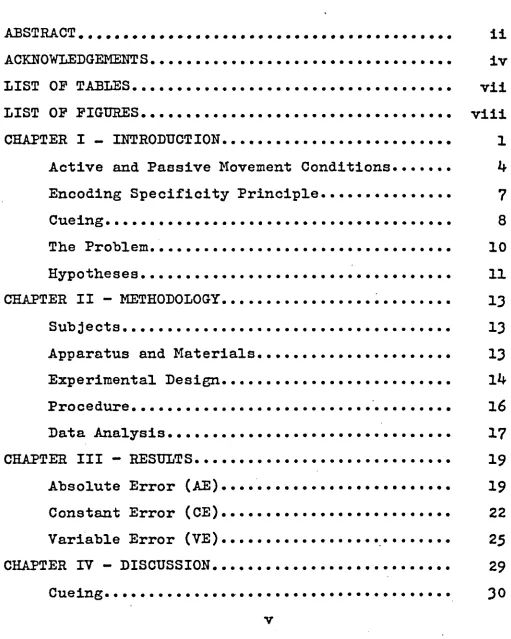
TABLE OP CONTENTS
ABSTRACT... ii
ACKNOWLEDGEMENT S i V LIST OP TABLES... vii
LIST OP FIGURES... viii
CHAPTER I - INTRODUCTION... 1
Active and Passive Movement Conditions... k Encoding Specificity Principle... 7
Cueing... 8
The Problem... 10
Hypotheses... 11
CHAPTER II - METHODOLOGY... 13
Subjects... 13
Apparatus and Materials... 13
Experimental Design... 14
Procedure... 16
Data Analysis... 17
CHAPTER III - RESULTS... 19
Absolute Error (AE)... 19
Constant Error (CE)... 22
Variable Error (VE)... 25
CHAPTER IV - DISCUSSION... 29
Cueing... 30
Encoding Specificity Principle... 32
Recognition and Recall... 34*
Motor Recognition and Recall... 35
CHAPTER V - CONCLUSIONS... 38
APPENDIX A — Presentation order of experimental conditions... 4*0 APPENDIX B — Instructions to subjects... 4*2 APPENDIX C — Mean error scores for each subject under criterion movement and repro duction movement interactions... 4*5 APPENDIX D — Post-hoc comparisons of significant ” main and interaction effects for cueing, criterion movement and reproduction movement conditions using Duncan’s procedure... 4*9 REFERENCES... 54*
LIST OP TABLES
TABLE PAGE
1 Analysis of Variance Summary Table for
Absolute Error B a t a ... 20
2 Analysis of Variance Summary Table for
Constant Error Bata ... 2b
3 Analysis of Variance Summary Table for
Variable Error B a t a ... 26
b Mean Absolute Error under Criterion
Movement and Reproduction Movement
Interactions... b6
5 Mean Constant Error under Criterion
Movement and Reproduction Movement
Interactions... by
6 Mean Variable Error under Criterion
Movement and Reproduction Movement
Interactions... bQ
7 Duncan's Analysis of the Main Effect of
Cueing for Absolute E r r o r ... 50
8 Duncan's Analysis of the Interaction Effect
between Criterion Movement and Reproduction Movement Modes of Execution for Absolute
Error ... 51
9 Duncan's Analysis of the Interaction Effect
between Cueing, Criterion Movement and Reproduction Movement Modes of Execution
for Constant E r r o r ... $2
10 Duncan's Analysis of the Interaction Effect
between Criterion Movement and Reproduction Movement Modes of Execution for Variable
Error... 53
LIST OP FIGURES
FIGURE PAGE
1 Mean absolute error as a function of the
point at which information about the reproduction movement mode of execution
is g i v e n ... 21
2 Mean absolute error for the interaction of
criterion movement and reproduction movement
modes of e x e c u t i o n ... 23
3 Mean variable error for interaction of
criterion movement and reproduction movement
CHAPTER I
INTRODUCTION
Extensive research during the past two decades has
been directed towards an understanding of the human
processing system for movement information. Using a linear
arm positioning task Adams and Dijkstra (1966) and Posner
(I967) provided initial evidence which suggested that
storage of movement information involves a process which
is different from the process of storing verbal as well
as non-verbal information.
The typical paradigm for examining motor short-term
memory involves the encoding of a movement to-be-remembered
or criterion movement followed either immediately or
after a short delay by the subject*s attempt to accurately
retrieve the criterion movement, called the reproduction
movement. Utilizing this paradigm investigators have
separately examined two stimulus cues or attributes which
provide movement information. One attribute which may be
used to retrieve a criterion movement is the end-location
or final stopping point of the movement to-be-remembered.
Another attribute is the extent of the movement or the
distance travelled. End-location is isolated as an attribute
and examined "by varying the starting location of the
reproduction movement and instructing the subject to
retrieve the final stopping position of the criterion
movement, rendering distance unreliable as an effective
attribute. Conversely, extent is isolated by varying the
starting location of the reproduction movement and instr
ucting the subject to retrieve the distance of the criterion
movement, thus end-location becomes an ineffective attribute.
Keele and Ells (1972) and later, Marteniuk and Roy
(1 9 7 2) were the first to isolate and investigate the
accuracy of utilizing end-location and extent attributes
in movement retrieval. Their results showed that a move
ment end-location attribute led to a more accurate retrieval
of the criterion movement than an extent attribute.
Laabs (1973) examined the retention characteristics
of these two movement attributes. The study involved a
comparison of retrieving end-location and extent attributes
after four retention conditions: immediate, 1 2 sec rest,
12 sec counting backwards, and 12 sec of spatial reasoning.
The results showed that for end-location, retrieval was
equally accurate for immediate and 12 sec rest conditions
and retrieval was less accurate when rehearsal was prevented
(counting backwards or spatial reasoning interpolated).
However, while retrieval using an extent attribute was
poorer with rest, accuracy did not deteriorate further
findings as evidence that an end-location attribute is
rehearsable as long as processing capacity is available
but that an extent attribute is not rehearsable, spontan
eously decaying over time.
In contrast, Marteniuk (1973) found that a movement
extent attribute was rehearsable and that a decrement in
performance occurred only after 10 sec of interpolated
activity. This contradictory finding was explained as
a difference in methodology. In the Laabs study the
criterion movement was "constrained11 (defined by the
experimenter) whereas Marteniuk employed a "preselected"
criterion movement (defined by the subject). Thus, when
a subject was allowed to define his own criterion, retrieval
accuracy was improved.
The general finding that preselected movements are
more accurately retrieved than constrained movements has
been demonstrated in studies where both extent and
end-location were reliable attributes for retrieval (Jones,
197^+5 Marteniuk, 1977)* only an end-location attribute was
reliable (Stelmach, Kelso, & Wallace, 1975)? and where
only an extent attribute was available for retrieval (Roy,
1978; Roy & Diewert, 1975, 1978).
Although the superior accuracy in retrieving pre
selected as opposed to constrained criterion movements
has been reliably demonstrated, the nature of this
.
see Kelso, Pruitt, & Goodman, 1979)* The present research,
was concerned only with constrained movement presentations
and research discussed henceforth will he limited to
results obtained from constrained paradigms.
Active and Passive Movement Conditions
Another issue which has received considerable
attention is the role that active and passive movements
play in the encoding of a memory trace. In a typical
constrained paradigm active movement requires a simple
subject-controlled action (of an experimenter defined
movement) whereas passive movement involves the guidance
of a subject's relaxed arm through the same criterion
movement by the experimenter. Following the appropriate
retention condition all subjects are required to actively
make the reproduction movement.
Marteniuk (1973) was the first researcher to examine
the encoding characteristics of actively versus passively
generated criterion movements. His results showed that
for both extent and end-location attributes, actively
producing the criterion movement resulted in superior
retrieval accuracy than passive production of the criterion
movement. Marteniuk attributed the difference between
active and passive movements as encoding to "varying
Marteniuk's findings have received only partial
support in the literature — being replicated only under
constrained conditions when an extent attribute was
available for retrieval, Stelmach, Kelso and Wallace
(1 9 7 5) examined end-location retrieval under active and
passive criterion movement conditions and found no diff
erences in retrieval accuracy. Studies which have examined
active and passive movements under conditions where both
movement end-location and extent were reliable attributes
for retrieval (Jones, 197^; Kelso, 1977a; Marteniuk, 1977)
have also failed to replicate Marteniuk's (1973) results.
The superiority in accuracy for retrieving active,
constrained criterion movements over passive, constrained
criterion movements has been successfully replicated for
extent as a codable attribute. Roy and Diewert (1978)
found that actively presented criterion movements were
retrieved more accurately than passively presented criterion
movements upon immediate retrieval. Furthermore, Roy
(1 9 7 8) demonstrated that after a 20 sec unfilled retention
interval this superiority was maintained. The investigators
(Roy & Diewert, 1978) attributed the significance of their
findings to an encoding process:
For a non-pre3elected movement since active movement
during the standard was necessary for accurate memory, it may be that information relevant to the execution of the movement (i.e. efferent or motor command
information and/or proprioceptive feedback information) during presentation of the standard is important in
The better retrieval accuracy for actively presented
movement information then, has been proposed to reflect
some qualitative difference in the encoding of the memory
trace — the memory trace being encoded to a stronger
memorial representation under active presentation. Other
researchers (Hall & Leavitt, 1977) interpreted the
phenomenon within the levels of processing framework
(Craik & Lockhart, 1972) and suggested that active move
ments represent more meaningful information, allowing
for more elaboration within a processing level compared
to passively presented movements.
Although the superior retrieval accuracy of active
criterion movements has been interpreted as reflecting
a better encoding of the memory trace, this conclusion
may be based upon a confounded experimental design, since
the typical research paradigm employs only active
reproduction movements. The procedure requires subjects,
having made the criterion movement passively and switched
to an active mode during retrieval, being compared to
subjects who produced both the criterion and reproduction
movements in the same mode of execution. In effect,
switching the mode of movement execution at the time of
retrieval prevents an appropriate examination of the
7 Encoding Specificity Principle
Recently, the question of how different conditions
at the time of output affect the subsequent retrieval
of an encoded item has received considerable attention
in the verbal literature. Thomson and Tulving (1970)
proposed the encoding specificity hypothesis (presently
known as the encoding specificity principle - Tulving &
Thomson, 1973) to explain the functional relationship
between encoding and retrieval conditions. The encoding
specificity principle maintains that the specific encoding
operations which are performed on an item determine which
conditions at retrieval will facilitate the most accurate
access to the memory trace. The more precisely the
conditions during output match the episodic memory trace
(conditions encoded with the to-be-remembered item) the
better the facilitation of retrieval. Widespread support
for the theory has been accumulated by numerous invest
igators (e.g. Pisher
&
Craik, 1977; Pellegrino & Salzberg,1975* Tulving & Watkins, 1975) 3n> the area of verbal
learning and memory.
The application of the encoding specificity principle
to research in the psychomotor area has come under very
recent examination. Lee and Hirota (1979) investigated
the encoding specificity principle in motor short-term
memory under conditions in which subjects were presented
8
were required to retrieve the extent of the movement
under active or passive conditions. For constrained
criterion movements the results showed that when the
modes of execution during encoding and retrieval were
the same (Active-Active; Passive-Passive) retrieval
accuracy for active and passive movements were equivalent.
These "same" conditions were significantly better than
when the mode of retrieval was different from the mode
of presentation (Active-Passive; Passive-Active), which
were themselves not significantly different. These findings
suggest that when retrieval operations satisfy the
conditions under which the criterion movement is encoded,
there is no advantage to active as opposed to passively
stored memory traces.
Nadeau and Lortie (1978) on the other hand provide
evidence that active movements provide for better retrieval
of extent information. In their study subjects were informed
of the mode of retrieval of passively presented movements
before the criterion movement. The results showed that
active retrievals were more accurate than passive
retrievals.
Cueing
Although the principle of encoding specificity asserts
that the degree to which conditions are matched at storage
theorists concede that the operations performed at encoding
are affected by the subject’s expectations of the conditions
to be encountered during retrieval (Flexser & Tulving,
1978; Lockhart, Craik, & Jacoby, 1976). If the subject
anticipates that the conditions at retrieval will not
match the stored episode, the subject may encode the
memory trace in such a manner that will best facilitate
retrieval according to the expectations of the conditions
to be encountered.
Indeed, evidence from two studies in the psychomotor
area suggest that humans are able to process information,
varying in accordance with an expectation of the conditions
to be encountered at retrieval. Although end-location
as a codable movement attribute has been reliably demon
strated to be a more accurate attribute for retrieval
than an extent attribute, instructions that alter the
expectations about the reproduction movement may reverse
the general trend. Hagman and Francis (1975) found that
when subjects were told before the criterion movement
that extent would be the only reliable attribute for
retrieval, extent was significantly better than
end-location in retrieving the encoded criterion movement.
An experiment by Wilberg and Hall (1976) required subjects
to either accurately retrieve the extent of the criterion
' < '■ ,iV.
movement, or to retrieve "just less" or "just more" than
1 . ; *
10 indicated that movement extent retrieval was better
when the instructions about the reproduction movement
were made available before as opposed to after the
criterion movement.
The Problem
The superior retrieval accuracy of movements which
have been presented actively as opposed to being
passively presented have been discussed as reflecting
a difference in either the quality or quantity of encoding.
While other lines of evidence have shown that superior
accuracy with active as opposed to passive reproduction
movements suggest that active/passive movement differences
are due to conditions available at retrieval, very recent
findings concur with the established research in the
verbal literature implying that the relationship between
conditions available at encoding and retrieval is the
critical variable.
The present research is designed to assess the
interaction of encoding and retrieval conditions on the
memory of movement information. Accuracy of retrieval
may be altered through cueing, by manipulating the point
at which information about the mode of retrieval is made
available to a subject (before presentation; after •
presentation but before a retention interval; or after
11
will provide an indication of the combined effects of
encoding, recoding (information transformation), and
retrieval on the processing of movement information.
Hypotheses
1. Cueing. Retrieval will be: (a) most accurate when
information of the mode of retrieval is made available
prior to the criterion movement, (b) less accurate
when the information is given after the criterion but
before the retention interval, and (c) least accurate
when the information is made available after the
retention interval.
2. Encoding. Conditions in which the criterion movement
is encoded actively will not differ in retrieval
accuracy from passively encoded criterion movements,
regardless of the point at which information about the
mode of retrieval is made available.
Retrieval. Conditions in which the reproduction movement
is made actively will not differ in retrieval accuracy
from passively retrieved movements, regardless of the
point at which information about the mode of retrieval
is made available.
4. Encoding Specificity Principle. Retrieval accuracy of
conditions in which both the criterion movement and
the reproduction movement are made in the same mode of
more accurate than the performance when retrieving
movements in which the reproduction movement is made
in a different mode than the criterion movement
(Active-Passive; Passive-Active)•
5* Cueing and the Encoding Specificity Principle,
(a) Movements in which the mode of criterion movement/
reproduction movement execution is the same will show
the most marked superiority over the different criterion
movement/reproduction movement execution conditions
when the information about the mode of retrieval is
available after the retention interval, (b) This
superiority will be decreased when the information is
provided after the criterion movement but before the
retention interval, (c) The two conditions will be
least different when information about the mode of
retrieval is made available prior to the criterion
13
CHAPTER II
METHODOLOGY
Subject8
Twenty-four right-handed females (3c age = 22.6 yrs,
SD = 5 #07 yrs) served as subjects. The subjects were
selected from two undergraduate psychology classes at the
University of Windsor and received credit towards their
mark in the course. All subjects were naive as to the
purposes of the experiment.
Apparatus and Materials
The linear slide apparatus consisted of an Ealing
Aluminum Optical Bench (cat. # 22-689*0, one meter in
length. The slide carriage was an Ealing Optical Carrier
(cat. # 22-*fl70) with dimensions of 10 cm across the
bench and 9 cm along the bench. A knob attached to a set
screw on one side of the carriage served as the subject’s
handle. On the experimenter’s side a meter rule attached
to the linear slide provided for measurements to the
nearest mm. All measurements were recorded from the
leading edge of the carriage. Near noiseless and
friction-less movements were made possible by the application of
Ik
The linear slide was placed upon a table approx
imately 76 cm in height. The slide was secured to the
table by the use of two C-clamps# The limits within
which the subject was able to move the carriage were
defined by the use of wooden blocks, constructed so
that the blocks rested on top of the slide and between
two Ealing carriers set as stops.
Vision was blocked by a visual shield, constructed
so as to allow free arm movements while preventing visual
feedback. The shield consisted of a vertical panel 79 cm
in height joined perpendicular at the bottom to a 56 cm
deep horizontal shelf. The horizontal shelf was 21 cm
above the surface of the table and provided space for
unrestricted lateral arm movement. Attached to the shelf,
directly in front of the subject and placed horizontally,
was a 2.5^ cm diameter Plexiglas rod mounted on two
vertical metal rods and served as an adjustable head and
chin rest. The entire shield was painted flat black.
An adjustable swivel stool served as the subject*s
seat. The experimenter was seated on the opposite side
of the table. A Hunter decade timer was used to time ..
retention intervals.
Experimental Design
The design of the present study was .a 3*2x2 factorial
15 subjects variable consisted of three points where
information about the mode of the reproduction movement
was made available to the subject (CUEING). The two within
subject variables were the mode in which the criterion
movement was executed (CRITERION MOVEMENT MODE of EXECUTION)
and the mode in which the reproduction movement was made
(REPRODUCTION MOVEMENT MODE of EXECUTION).
There were three CUEING groups of eight subjects
each. One group received information about the mode of
the reproduction movement prior to producing the criterion
movement (PRE-CM CUEING). A second group received infor-.
mation immediately following the criterion movement but
prior to a 15 sec unfilled retention interval (PRE-RI
CUEING). The final group received the information
immediately following the 15 sec retention interval,
just prior to the reproduction movement,(PRE-RM CUEING).
There were two levels of each of the two within
subject variables. The CRITERION MOVEMENT MODE of EXECUTION
was made either actively by the subject (ACT) or was
guided through the movement passively by the experimenter
(PASS). The REPRODUCTION MOVEMENT MODE of EXECUTION was
also made either actively or passively. Each subject was
tested on eight trials under each of the four criterion
movement/reproduction movement combinations (ACT-ACT;
16
Procedure
The experimental session began (in a room near the
test room) with a brief explanation of the task require
ments (see Appendix B for detailed instructions). The
experimenter and the subject then went to the test room
where the subject was seated with the saggital plane
of the body opposite the chin rest and the midpoint on
the linear slide. The height of the subject*s chair was
adjusted so that the extended arm was at approximately
right angles to the body's coronal plane.
The experimental session consisted of two phases:
a pretest and a test phase. During the pretest the subject
was given ten 50 cm passive movements during which the
subject was prompted to totally relax her arm. Then there
were 10 active movements during which the subject was
prompted to move at the same velocity as the passive
movements. The pretest concluded with four practice trials
at each of the criterion movement/reproduction movement
conditions.
During the test phase each trial (for all subjects)
consisted of a criterion movement, a 15 sec retention
interval and a reproduction movement. The criterion move
ment was 30 cm in length. Upon contacting the stop defining
the end-location of the criterion movement, the subject
was instructed to release the handle and place her hand
17 was then required to regrasp the handle and retrieve the
extent of the criterion movement. All movements were
made from right to left.
The only difference in instructions between the three
CUEIHG groups was the point at which the information
about the mode of retrieval was presented to the subject.
Each subject was handed a copy of the instructions and
asked to follow as the experimenter read the instructions
aloud.
Movement end-location as a codable attribute was
made unreliable for retrieval by varying the starting
location of the reproduction movement + 5 cm and ± 10 cm
from the starting location of the criterion movement.
Each of the four reproduction movement starting locations
occurred randomly eight times during the experimental
session. Each of the four criterion movement/reproduction
movement combinations also occurred randomly eight times.
Data Analysis
In accordance with a recent suggestion by Roy (1976)
and current practice in the literature, three dependent
measures were used: absolute error (AE), constant error
(CE), and variable error (VE). Adopting the interpretation
of these measures by Ho & Shea (1978), AE was considered
the measure of retrieval accuracy. CE was interpreted as
18
considered a measure of consistency or the variability
of each subject’s performance. The CE and VE measures
provided for a clearer interpretation of the results for
retrieval accuracy.
Each dependent measure was analyzed using a
three-way analysis of variance (ANOVA) with repeated measures
on the last two factors (Winer, 1971» case 1, p, 539)*
Post—hoc comparisons were performed using the Duncan’s
19
CHAPTER III
RESULTS
Three measures of reproduction performance are
reported in the present experiments absolute error,
constant error, and variable error.
Absolute Error (AE)
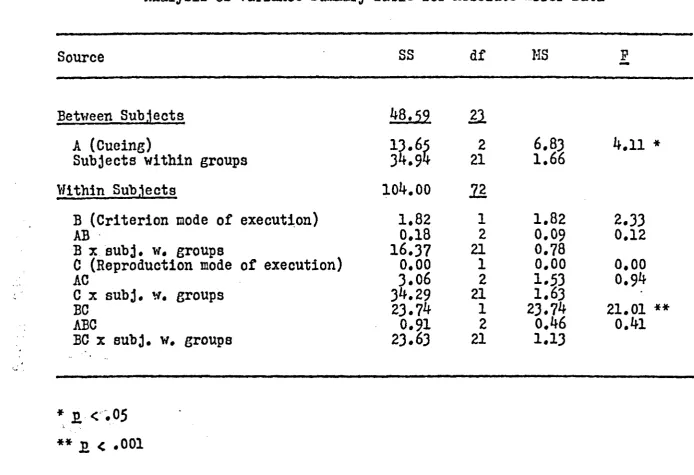
Analysis of variance for AE is summarized in Table
1. Main effects of cueing were significant, F(2,2l) =
if«ll9 p < *0 5, Main effects of criterion movement mode of
execution, F(l,21) = 2.33» P > *05> and reproduction movement
mode of execution, IT(l,2l) «* 0.00, p > .0 5,were not signif
icant. An interaction between criterion movement mode
of execution and reproduction movement mode of execution
was significant, F(l,21) « 21.01, £ < . 0 0 1 . All other
interactions failed to reach significance levels.
Post-hoc analysis using the Duncan’s New Multiple
Range procedure on the main effect of cueing showed that
the PRE-RI group (mean of **.27 cm) was significantly less
accurate than the PRE-CM and PRE-RM groups (means of 3.^1
cm and 3«5^ cm, respectively), which were not significantly
different themselves, (see Figure 1)
R ep ro du ced w ith pe rm is s io n of th e co py ri gh t o w n e r. Fu rthe r re production p ro h ib ite d w it ho ut p e rm is s io n . Table 1
Analysis of Variance Summary Table for Absolute Error Data
Source
SS
df
MS
F
Between Subjects
*8.59
H
A (Cueing)
13.65
2
6.83
4.11 *
Subjects within groups
34.94
21
1.66
Yfithin Subjects
104.00
21
B (Criterion mode of execution)
1.82
1
1.82
2.33
AB
0.18
2
0.09
0.12
B x subj. w. groups
16.37
21
0.78
C (Reproduction mode of execution)
0.00
1
0.00
0.00
AC
3.06
2
1.53
0.94
C x subj. w. groups
34.29
21
1.63
*BC
23.74
1
23.74
21.01 **
ABC
0.91
2
0.46
o.in
BC x subj. w. groups
23.63
21
1.13
* £ < *°5
* * £ < .001
ro
R ep ro du ced w ith pe rm is si o n of th e co py ri gh t o w ne r. Fu rthe r rep roduction p ro h ib it e d w ith o ut p e rm is s io n . £ o
4.5 r
4.0
1_ O i_ L. LU O 4-2
3.5
o
U)
A
<
C
§
‘ 3.0
0.0
KEY: PRE-CM - Cueing before
criterion movement
P R E - R I - Cueing before re ten tio n in te rv a l
P R E - R M - Cueing b e f o r e
re p ro du ctio n movement
PRE-CM
PRE-RI
PRE-RM
roexecution by reproduction movement mode of execution
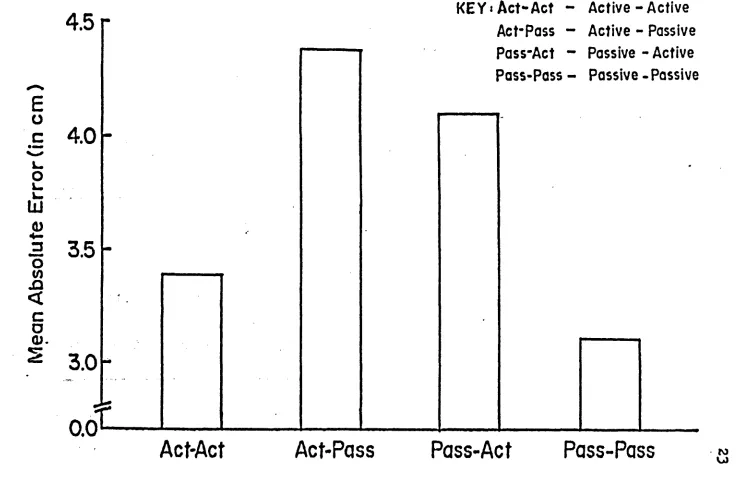
interaction revealed that when the criterion movement
was active, active retrieval was more accurate than
passive retrieval* However, when the criterion movement
was passive, active retrieval was less accurate than
passive retrieval* Each of the paired interactions in
which the modes of execution were the same (Active-Active
Passive-Passive) had significantly less mean absolute
error (3*39 cm and 3*10 cm, respectively) than each of
the different modes of execution.pairs (Active-Passive,
mean of 37 cm; Passive-Active, mean of ^*10 cm). The
Active-Active and the Passive-Passive conditions were
not significantly different. The difference between the
Active-Passive and the Passive-Active conditions also
failed to reach significance levels. (The interaction
effects may be seen in Figure 2)•
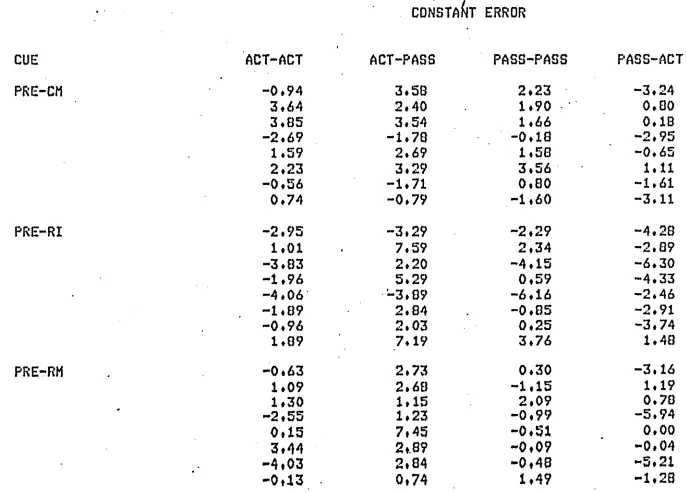
Constant Error (CE)
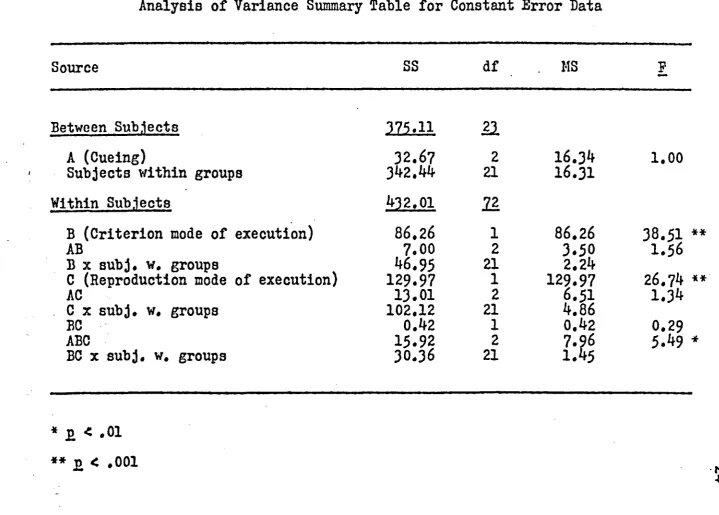
Analysis of variance for CE is summarized in Table
2. Main effects of criterion movement mode of execution,
F(l,2l) as 3 8 .51f E <*001, and reproduction movement mode
of execution, F(l,2l) = 26.7^» p <*001, were significant*
The main effect of cueing F(2,21) = 1.00, p > .05 was not
significant. An interaction between cueing, criterion
movement mode of execution, and reproduction movement
R ep ro du ced w ith pe rm is si o n of th e co py ri gh t o w ne r. Fu rthe r rep roduction p ro h ib it e d w ith o ut p e rm is s io n .
E
o.E
L.o
L. U (U <1>o
WSI
<
c
o 0).4.5 r
4.0
3
3.5
3.0
0.0
£
K E Y * A c t * A c t -
Act-Pass -
Pass-Act -
PassPass
-Active - -Active
Active - Passive
Passive - Active
Passive. Passive
Act-Act
Act-Pass
Pass-Act
Pass-Pass
toRe pro du ced w ith pe rm is s io n of th e co py ri gh t o w ne r. Fu rthe r re production p ro h ib it e d wi th ou t p e rm is s io n . Table 2
Analysis of Variance Summary Table for Constant Error Data
Source
SS
df
.
MS
1
Between Subjects
2Z5.U
22
A (Cueing)
32.67
2
16.34
1.00
Subjects within groups
342.4**
21
16.31
Within Subjects
**32.01
21
B (Criterion mode of execution)
86.26
1
86.26
38.51 *
AB
7.00
2
3.50
1.56
B x subj* w* groups
46.95
21
2.24
C (Reproduction mode of execution)
129.97
1
129.97
26.74 *
AC
13.01
2
6.51
1.34
C x subj* w* groups
102.12
21
4.86
EC
0.42
1
0.42
0.29
ABC
15.92
2
7.9
6
5.49 *
BC x subj. w. groups
30.36
21
1
M
* J) < .01
* * & < *001
-p-25 significant.
A Duncan's analysis revealed that for the main effect
of criterion movement mode of execution, active present
ations were overshot (mean of 0.97 cm) while passive
presentations were undershot (mean of -0.93 cm). Concerning
the reproduction movement mode of execution, active
retrievals were undershot (mean of —1.1^ cm) and passive
retrievals were overshot (mean of 1.19 cm). Post-hoc
analysis of the triple interaction between cueing,
criterion movement mode of execution, and reproduction
movement mode of execution is presented in Appendix D*
Variable Error (VE)
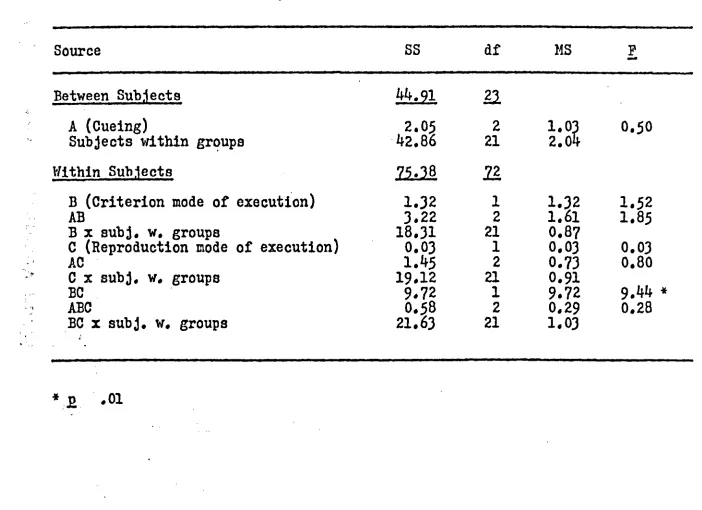
Analysis of variance for VE is summarized in Table
3. Main effects of cueing, F(2,21) = 0.50* P > « 0 5 * criterion
movement mode of execution, F(l,21) » 1.5 2, p > .0 5, and
reproduction movement mode of execution, F(l,21) ** 0.03,
P > *05, were not significant. An interaction between
criterion movement mode of execution and reproduction
movement mode of execution was significant, F(l,2l) = 9 . ^ *
p < . 0 1 . All other interactions failed to reach significance
levels.
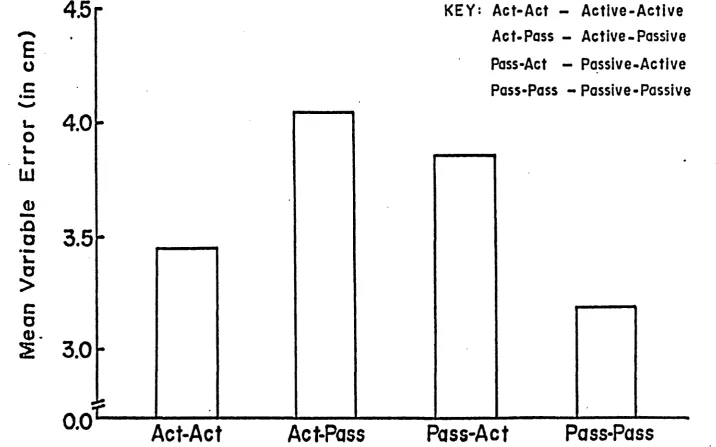
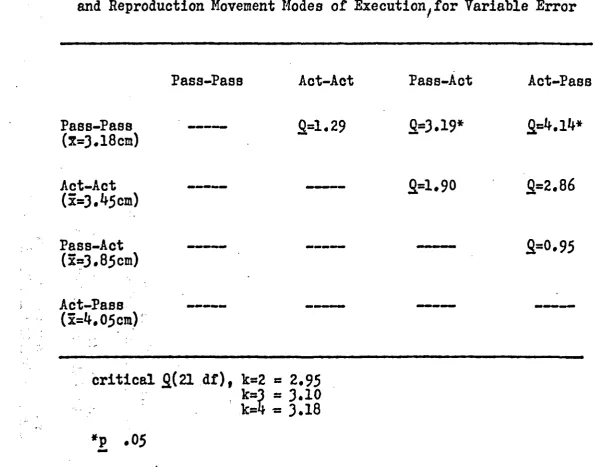
A Duncan's post-hoc analysis was performed on the
interaction between criterion movement mode of execution
and reproduction movement mode of execution. As illustrated
Re pr od uc ed w ith pe rm is s io n of the co p y ri g h t o w ne r. Furth er re production p ro h ib it e d w it h ou t p e rm is s io n .
Table 3
Analysis of Variance Summary Table for Variable Error Data
Source
SS
df
MS
F
Between Subjects
44.
?1
22
A (Cueing)
2.05
2
1.03
0.50
Subjects within groups
42.86
21
2.04
V/ithin Subjects
25.08
21
B (Criterion mode of execution)
1.32
1
1.32
1.52
AB
3.22
2
1.61
1.85
B x subj* w. groups
18.31
21
0.8?
C (Reproduction mode of execution)
0.03
1
0.03
0.03
AC
1.45
2
0.73
0.80
C x subj, w, groups
19.12
21
0.91
9.44 *
BC
9.72
1
9.72
ABC
0.58
2
0.29
0.28
BC x subj. w. groups
21.63
21
1.03
* £
.01
ro
R ep ro du ced w ith pe rm is s io n of th e co py ri gh t o w ne r. Furth er re production p ro h ib it e d w it ho ut p e rm is s io n .
E
o
U O u utii
O3
□• Mb
L. o
>
c
o 0)4.5
4.0
3.5
£ 3.0
0.0
11
KEY: A c t - A c t .
Act-Pass
Pass-Act
Pass-Pass
Act-Act
Act-Pass
Pass-Act
- A c t iv e - A c t iv e
- Active-Passive
- Passive-Active
- Passive-Passive
Pass-Pass
28 cm) was performed with significantly less variability
than the Passive-Active condition (mean of 3*85 cm) and
the Active-Passive condition (mean Of **.05 cm). Consist
ency in responding during the Active-Active condition
(mean of 3.^5 cm) was not significantly different from
any of the other conditions. The Active-Passive and
Passive-Active conditions also were not significantly
29
CHAPTER IV
DISCUSSION
Kany theories and paradigms commonly reported in
the verbal literature have been utilized by researchers
in the psychomotor area (e.g. Hall, 1978; Ho & Shea, 1978;
Leavitt, Lee, & Romanow, 1979; Hagill & Dowell, 1977)*
The present study adopted another concept from verbal
learning, the encoding specificity principle, to base
predictions about relationships between encoding and
retrieval operations in memory for movement information.
Previous research concerning the role of active and passive
movements have emphasized the importance of encoding on
memory without regard for the possible importance of the
effects of retrieval conditions. Indeed, the encoding
specificity principle would suggest that investigation of
the congruency between encoding and retrieval operations
would yield a more accurate account of the overall view
of memory and the processing of movement information.
Providing information about retrieval: conditions.
might be expected also to alter the way in which humans
encode or process encoded information. The functional
relationship between encoding and retrieval may be under
30
The results of the present study confirmed the
hypothesis hased upon the encoding specificity principle
for retrieval accuracy (i.e. AE) and partially confirmed
the prediction (only the Passive-Passive condition was
better than the ’’different" conditions) for performance
consistency (i.e. VE). The expected findings for the
effects of cueing were not obtained. Furthermore, the
predicted interaction between cueing and the encoding
specificity principle also was not supported.
The main effect for criterion movement mode of
execution (encoding hypothesis) and the main effect for
reproduction movement mode of execution (retrieval
hypothesis) observed for performance bias (i.e. CE) in
the present study was not expected. Indeed, previous
findings for performance biasing effects of active and
passive movements are highly inconsistent (c.f. Marteniuk,
1973; Nadeau & Lortie, 1978; Roy, 1978). The main effects
as well as the triple interaction observed for performance
bias have no clear theoretical basis and provide for no
meaningful comparisons at this time.
Cueing
The hypothesized effects of the point of cueing that
were expected in the present study were not obtained.
The failure of subjects to retrieve stored information
31 at retrieval is, however not without theoretical
importance*
Hall and Leavitt (1977) suggested that within a
certain level of processing there is elaboration of the
sensory consequences of a movement* If active and passive
movements are subject to elaboration then the facilitory
effects of cueing should have allowed the subject to
elaborate the encoded material to varying degrees
depending.upon the expected mode of movement execution
at retrieval and the point at which the cue was
presented* The results of the present study provide
no evidence to indicate that the point of cueing differ
entially affects directive and/or effective elaboration
of active and passive movements*
An experiment (published after the completion of
the present study) by Newell, Shapiro, and Carlton (1979)
provided subjects with cues about the mode of retrieval
in an experiment where visual and kinesthetic modalities
were manipulated at input and output* Similar to the
present study, Newell et al* provided information either
before the criterion movement presentation, after
presentation but before a 10 sec retention interval, and
after the retention interval. The results of the present
study were congruent with the Newell et al. findings:
there was no facilitory effect of the point of cueing*
32
(c.f. Hagman & Francis, 1975; Wilberg & Hall, 1976)
these results imply that prior knowledge of the conditions
under which the to-be-remembered movement will be retrieved
does not provide for any improvement in retrieval accuracy.
The most surprising result of the present study was
the poor retrieval accuracy of the group which received
information about the mode of retrieval immediately after
the criterion movement but before the retention interval.
Intuitively, it seems unlikely that the information
provided by the cue produced this finding. A more plausible
expanation would be that the verbal cue from the experi
menter served to divert attention from the information
provided by the movement. Considering that the cue was
presented to the subject immediately upon contact of the
stop defining the end of the criterion movement it is
possible that the presentation of the cue disrupted the
normal encoding and/or storage processes. The poor *■
retrieval accuracy of the group receiving the cue after
the criterion movement but before the retention interval
must be considered tentative however, with regards to the
Newell et al. (1979) study which showed that all three
cueing groups were equal in retrieval accuracy.
Encoding Specificity Principle
The results of the present study both support and
speci-ficity principle for active and passive movements. Lee
and Hirota (1979) found that retrieval accuracy of .
actively and passively constrained movement presentations
followed the predictions “based upon the encoding speci
ficity principle (Tulving & Thomson, 1973)* The present
study not only replicated these findings but also provided
partial support for the encoding specificity principle
for performance consistency as well. In addition, the
superiority of movement retrieval in the same mode of
execution as the criterion movement was maintained
regardless of the point at which information of the
retrieval mode was made available.
The applicability of the encoding specificity principle
may also be extended to research in other aspects of
psychomotor behavior. Investigation of the modality
effects of movement information typically employs a
research paradigm in which presentation of movement
information is in one modality (e.g. visual or kinesth
etic) and then retrieval is either in the same modality
(intramodal transfer) or the other modality (intermodal
transfer)• The consistent finding in the literature is
that intramodal transfer of movement information is
retrieved more accurately than intermodal transfer
(Diewert & Stelmach, 1977; Kelso & Frekany, 1978; Newell,
Shapiro, & Carlton, 1979)* Even though visual input
3k
other modalities (see Posner, Nissen, & Klein, 1976
for a review), researchers have concluded that "if vision
is to be useful it must be available for both presentation
and reproduction movements" (Kelso & Frekany, 1978, p.
1 5 k). Restated, these findings show that the conditions
at encoding (i.e. the modality of presentation) -must
be available at retrieval for optimal performance accuracy.
Wallace (1977) examined motor short-term memory
under conditions where the direction of movement retrieval
and the limb used to retrieve the criterion movement
were manipulated. Once again, the results showed that if
the encoded conditions were present at retrieval (i.e.
same limb or same direction) performance accuracy was
better than when the conditions at encoding were different
during retrieval.
Recognition and Recall
Support for the encoding specificity principle was
accumulated by Tulving and his associates on the basis
of experimental evidence involving two types of retrieval
operations for verbal material, recognition and recall.
Evidence prior to Tulving*s discoveries concerning the
differences between recognition and recall was best
expressed in terms of the dual-process hypothesis (Anderson
& Bower, 1972? Kintsch, 1970). In summary, the dual
35 assumes that recall Includes recognition as a
subprocess. You should remember that our previously described theory of recall includes the process of search (following pathways in LTM and finding items), and decision (deciding whether or not those items are appropriate to report;* The dual—process model accepts this sequence of events as a model for recall, and
further suggests that recognition corresponds to the decision process. That is, it suggests that recall includes search and recognition. The decision stage of recall is assumed to involve the same processes
as are involved in recognition, the processes described by signal detection theory. Thus, we see that recog nition is essentially recall with the search processes removed. (Klatsky, 1975* PP» 216-217)
The underlying assumption of the dual-process theory is
that recognition is necessarily equal or superior to
recall in proportion of presented items retrieved. Support
for the encoding specificity principle was obtained with
the discovery of recognition failure — the failure to
recognize items that had previously been recalled (Tulving
& Thomson, 1973)*
Motor Recognition and Recall
Retrieval of information involving the,processes
of recognition and recall has also been examined for motor
behavior (e.g. Newell & Chew, 197^» Schmidt, Christenson,
& Rogers, 1975? Williams, 1978). A recent study by Kelso
(1978) provided evidence suggesting that passive movements
in retrieval of movement information involves a recognition
component whereas active movements in retrieval reflect
recall. Kelso found that the removal of performance
in a linear positioning task resulted in a rapid decline
in retrieval accuracy of the active response mode group
in contrast to the relatively stable maintenance of
performance of the passive response mode group. The
superiority of the passive (recognition) over the active
(recall) group was discussed as being congruent'with
the dual-process hypothesis of verbal learning.
Adopting Kelso1s (1978) suggestion (passive retrieval
reflecting recognition; active retrieval reflecting
recall) the present findings concur with reports in
the verbal literature (e.g. Bartling & Thompson, 1977;
Rabinowitz, Mandler, & Barsalou, 1977; Tulving & Watkins,
1 9 7 7; Watkins & Tulving, 1975; Wiseman & Tulving, 1976)
concerning the cases where recognition is poorer than
recall (i.e. recognition failure). In the present
experiment appropriate examination of recognition failure
would be a comparison of the Active-Active condition
(i.e. recall of actively presented movements) and the
Active-Passive condition (i.e. recognition of actively
presented movements). The superior retrieval accuracy of
recall (i.e. in the Active-Active condition) over
recognition (i.e. in the Active-Passive condition)
observed in the present study may thus be considered
evidence for motor recognition failure. Caution concern
further evidence is accumulated in regards to active and
passive retrievals reflecting recall and recognition,
\
38
CHAPTER V
CONCLUSIONS
The study of human memory in previous years has
typically focused upon (among other processes) the
independent effects of encoding and retrieval operations.
Recently, Tulving (1979) criticized this approach and
suggested three central ideas which should he considered
when conducting research on human memory:
(a) the necessity of stipulating hoth encoding and retrieval conditions when describing data or making theoretical inferences from them; (b) the futility of trying to understand processes of remembering, either in general or in any specific situation, in terms of only the encoding or storage processes or only in terms of retrieval processes; and (c) the pivotal role played by phenomenon demonstrating
interactions between encoding and retrieval conditions in shaping theoretical ideas about memory (pp.
408-l*09)
The results of the present experiment and of a previous
study (Lee & Hirota, 1979) support Tulving*s suggestions, and
should be given careful consideration by researchers in
the area of motor memory. It is further suggested that
an appropriate examination of the relationship between
encoding and retrieval conditions involves the manipu
lation of variables that alter this relationship. The
present experiment found no evidence to suggest that cueing
in memory for movement extent. Future research, may he
focused upon such variables as attention, proactive and
retroactive interference, range effects, repetition
effects, organization, and developmental differences on
APPENDIX A
41
START*
Subject 1
Subject 2
Subject 3
Subject 4
Subject 5
Subject 6
Subject 7
Subject 8
PRE-CM Pass-Pass Act-Act Pass-Act Act-Pass Act-Act Pass-Pass Pass-Act Pass-Act Act-Act Pass-Pass Act-Act Act-Act Act-Pass Pass-Pass Pass-Act Act-Pass Act-Pass Pass-Pass Act-Act Act-Pass Pass-Pass Act-Pass Pass-Pass Act-Act Pass-Act Act-Pass Act-Act Pass-Act Act-Pass Pass-Act Pass-Act Pass-Pass GROUP PRE-RI Act-Act Pass-Pass Act-Act Act-Pass Act-Pass Act-Pass Pass-Act Pass-Act Act-Act Act-Pass Pass-Pass Act-Pass Act-Act Pass-Act Act-Act Pass-Act Pass—Act Pass-Act Pass-Pass Act-Act Act-Pass Pass-Act Pass-Pass Pass-Pass Pass-Act Act-Act Act-Pass Pass-Pass Act-Act Pass-Pass Act-Pass Pass-Pass PRE-RM Act-Act Pass-Pass Pass-Pass Act-Act Act-Act Pass-Pass Pass-Pass Pass-Act Pass-Pass Act-Act Pass-Aot Act-Pass Pass-Pass Act-Act Act-Act Pass-Pass Pass-Act Act-Act Act-Pass Act-Pass Pass-Pass Act-Aot Act-Pass Act-Pass Act-Pass Pass-Act Pas3-Act Pass-Act Pass-Act Pass-Act Act-Pass Act-Pass
* Trial at which subjects in each group began the presentation order of experimental conditions.
APPENDIX B
INSTRUCTIONS TO SUBJECTS
i+3
The present experiment will examine how well you
remember non-visual, movement information. The task
involves movement along a linear slide between two stops.
The experiment is divided into two phases. During the
pretest you will be acquainted with the apparatus and the
experimental conditions. In one condition you will grasp
the carriage handle with the thumb and index finger of
your right hand and actively move the apparatus from right
to left. This will be called active movement. In the other
condition^you will lightly place two fingertips on the
handle, totally relaxing your arm and hand, and the
carriage will be moved for you. This will be called passive
movement•
In the test phase one trial will consist of two move
ments. The first move, called the criterion movement will
require an active or a passive movement starting on your
right and moving left until a stop is contacted. Following
the criterion movement there will be a short delay during
which you are required to mentally rehearse the criterion
movement. Following the delay you will attempt to reproduce
the same distance as the criterion movement. The repro
duction movement will be made either actively or passively.
If the reproduction movement is passive, you will lightly
place two fingertips on the handle, the carriage will be
moved by me, and you must say stop when you think your