Genome-Wide Analysis of
mariner
-Like Transposable Elements in
Rice Reveals Complex Relationships With
Stowaway
Miniature
Inverted Repeat Transposable Elements (MITEs)
Ce´dric Feschotte,
1Lakshmi Swamy
2and Susan R. Wessler
Departments of Plant Biology and Genetics, The University of Georgia, Athens, Georgia 30602 Manuscript received September 26, 2002
Accepted for publication November 11, 2002
ABSTRACT
Stowawayis a superfamily of miniature inverted repeat transposable elements (MITEs) that is widespread and abundant in plant genomes. Like other MITEs, however, its origin and mode of amplification are poorly understood. Several lines of evidence point to plantmariner-like elements (MLEs) as the autonomous partners of the nonautonomousStowawayMITEs. To better understand this relationship, we have taken advantage of the nearly complete genome sequences of two rice subspecies to generate the first inventory of virtually all MLEs andStowawayfamilies coexisting in a single plant species. Thirty-four different MLEs were found to group into three major clades and 25 families. More than 22,000StowawayMITEs were identified and classified into 36 families. On the basis of detailed sequence comparisons, MLEs were confirmed to be the best candidate autonomous elements forStowawayMITEs. Surprisingly, however, sequence similarity between MLE andStowawayfamilies was restricted to the terminal inverted repeats (TIRs) and, in a few cases, to adjacent subterminal sequences. These data suggest a model whereby most of the StowawayMITEs in rice were cross-mobilized by MLE transposases encoded by distantly related elements.
T
c1/marineris a diverse and widespread superfamily Tc1/marinerelements were recently found to be wide-of eukaryotic class 2 transposable elements (re- spread in plants (reviewed inFeschotteet al.2002a). viewed inCapyet al.1998;Plasterket al.1999;Plas- The first reported plant members wereSoymar1, amari-terkandvan Luenen2002). One hallmark of the su- ner-like element (MLE) from soybean (JarvikandLark perfamily is insertion into the dinucleotide TA that is 1998) and Lemi1, a pogo-like element from Arabidopsis
duplicated upon insertion and flanks the element as a thaliana(FeschotteandMouche`s2000). Three addi-target site duplication (TSD). Tc1/marinerelements are tional rice MLEs were subsequently identified by data-relatively short (1.2–3.5 kb) and are simple in structure base searches, but none were characterized further with terminal inverted repeats (TIRs) and a single gene (Tarchiniet al. 2000;Shao and Tu2001; Turcotte encoding the transposase. A common model for the et al.2001;FeschotteandWessler 2002). These five transposition mechanism of Tc1/marinerelements has elements were used to derive plant-specific primers that emerged from the functional study of a limited number successfully amplified MLE transposase genes in PCR of animal transposases (Plasterk and van Luenen assays with DNA from a wide spectrum of flowering 2002). The N-terminal region of Tc1/marinertranspo- plant genomes (Feschotte and Wessler 2002). For sases contains DNA-binding domain(s) that bind spe- the majority of genomes assayed, multiple divergent lin-cifically to the TIRs (Plasterk et al. 1999; Lampe et eages of transposases were amplified from single species.
al.2001; Zhang et al. 2001). A C-terminal domain is Demonstration that MLEs are widespread and diverse characterized by an amino acid signature called the in plants provided support for the hypothesis that MLEs DDE/D motif consisting of two aspartic acid residues are the autonomous elements responsible for the origin and a glutamic acid residue (or a third D). This motif and spread of Stowaway, a large group of miniature is required for catalysis of both the DNA cleavage and inverted repeat transposable elements (MITEs;Bureau the strand transfer steps of the “cut and paste” transposi- andWessler1994). MITEs are structurally reminiscent tion reaction (reviewed inHartlet al.1997;Plasterk of class 2 nonautonomous elements with their small size
andvan Luenen2002). (⬍600 bp), lack of coding capacity, and TIRs (reviewed
in Feschotteet al. 2002b). However, their high copy number and structural homogeneity have served to
dis-1Corresponding author:Department of Plant Biology, University of
tinguish them from most of the previously described Georgia, Athens, GA 30602.
class 2 elements (Wessleret al.1995). MITEs were first E-mail: [email protected]
discovered in plants, where they are now recognized as
2Present address:Tri-Institutional MD/PhD Program, Weill Medical
College, Cornell University, New York, NY 10021. the predominant type of transposable element
ated with the noncoding regions of plant genes. This is with 22 considered full-length, as they contain a com-plete transposase coding region, TIRs, and TSD. Phylo-particularly evident in the cereals, including rice, maize,
barley, and wheat (Bennetzen2000;Feschotteet al. genetic analysis and other criteria, such as the presence or absence of introns, led to their grouping into 25 2002a; Goff et al. 2002; Yuet al. 2002). Vast amounts
of MITEs have also been discovered in many inverte- distinct families falling into three major clades. In addi-tion, up to 33,000StowawayMITEs were identified, with brate and vertebrate genomes (reviewed inFeschotte
et al.2002b). the high-copy-number elements grouping into at least 36 families. Surprisingly, none of the 25 MLE families Most of the tens of thousands of MITEs in plant
ge-nomes have been divided into two groups on the basis could be associated by simple internal deletion with any of the Stowaway families. Instead, sequence similarity of the similarity of their TIRs and TSDs: Tourist-like
MITEs and Stowaway-like MITEs (Wessler et al. 1995; betweenStowawayand MLE families was restricted to the TIRs and, in a few cases, to some adjacent subterminal Feschotteet al.2002b). ThatStowaway-like MITEs and
plant MLEs share similar terminal sequences (5⬘-CTC sequence. These data have led us to conclude that most of theStowawayMITEs in rice were probably cross-mobi-CCTCCRT-3⬘, where R stands for A or G) and target
site preference (TA) strongly suggested that Stowaway lized by MLE transposases encoded by distantly related elements.
MITEs were mobilizedin transby transposases encoded by MLEs (Turcotteet al.2001;Feschotteet al.2002b). A model was formulated that hypothesized thatStowaway
MATERIALS AND METHODS elements originated by internal deletion(s) from a
larger autonomous element (like previously described Semiautomated mining of full-length rice MLEs:A series of nonautonomous DNA elements) and were amplified to Perl scripts was written to automate the process of identifying and fetching full-length elements related to a particular trans-very high copy number by the transposase encoded by
posase. In a first step, the transposase amino acid sequence the autonomous element (Feschotteet al.2002b). The
is used as a query in a local WU-TBLASTN search (http:// diversity of Stowaway families observed in a single
ge-blast.wustl.edu) against a genomic database. The output file nome was explained by proposing that the families origi- is parsed and the significant hits (in this study,Evalues⬍10⫺5) nated as deletion derivatives of distinct lineages of MLEs are extracted from the database along with up to 10 kb of flanking DNA sequence. In a second step, the flanking se-(Feschotteet al.2002a,b). If this model is correct, one
quences are searched for the possible ends of the elements should encounterStowawayfamilies that have extensive
using a subroutine called MATCH-TIR. This program scans sequence similarity (i.e., not just in their termini) with
the 5⬘and 3⬘flanking regions of each hit with a 16-mer sliding MLEs present in the same genome. In addition, the window for the presence of a consensus motif corresponding diversity ofStowawayfamilies should correspond with a to the 5⬘and 3⬘ends of the element plus the expected target site duplications (user input). MATCH-TIR extracts 5⬘and 3⬘ similar diversity of MLEs in that same genome. Failure
hits (sequences with⬎80% similarity to the motif) along with to matchStowaway families with MLEs would indicate
50 nucleotides internal to the hits and produces pairwise align-that the model was incorrect or overly simplistic.
ments between 5⬘extended hits and the reverse complement Comparison of all of the MLEs andStowawayelements of 3⬘extended hits. The alignments are inspected visually and in a genome is possible only for Arabidopsis and rice for the best matching pairs (usually fewer than four mismatches in the first 22 nucleotides) are considered as the TIRs of the which entire genome sequences are available. Although
element. In this study, theOsmar1transposase sequence was remnants of MLE transposases are still recognizable in
used as the query in a WU-TBLASTN search against two data-the sequence of A. thaliana, no full-length MLEs are
bases. The first database containedⵑ360 Mb of bacterial arti-identifiable (ShaoandTu2001;FeschotteandWes- ficial chromosome (BAC)/P1-derived artificial chromosome sler2002; C.Feschotte, unpublished data). Further- (PAC) sequences fromOryza sativassp.japonicacv. Nipponbare (downloadable at http://rgp.dna.affrc.go.jp/cgi-bin/statusdb/ more, StowawayMITEs are relatively scarce in this
spe-seqcollab-assign.pl). The second database containedⵑ430 Mb cies (at least in the sequenced ecotype), with ⬍250
of contigs generated by whole-genome sequencing ofO. sativa copies organized into fewer than five families (Leet al.
ssp. indica cv. 9311 (downloadable at http://btn.genomics. 2000; C. Feschotte, unpublished data). In contrast, org.cn/rice/). The motif 5⬘-TACTCCCTCCAG-3⬘ and its re-previous searches of a limited amount of rice genomic verse complement were used for MATCH-TIR searches of the 5⬘ and 3⬘ ends of rice MLEs, respectively. Other searches sequence identified numerous families of Stowaway
were performed using WU-BLASTN against the two databases MITEs and full-length MLEs (Bureauet al.1996;Jiang
described above and a third database containing the whole-andWessler2001;ShaoandTu2001;Turcotteet al.
genome shotgun assembly ofO. sativassp.japonicacv. Nippon-2001; Feschotte and Wessler 2002). For these rea- bare produced by Syngenta (390 Mb; http://www.tmri.org). sons, the goal of this study was to characterize all MLE Compilation ofStowawayfamilies and copy number
deter-minations:Twenty-fourStowawayfamilies analyzed in this study andStowawayfamilies in rice and determine the extent
were previously published (from Stow-Os1-Os32;Bureauand of sequence relatedness between these two groups.
Wessler1994;Bureauet al.1996;JiangandWessler2001; A semiautomated computational approach was used
Turcotteet al.2001). These 24 families were compared to to identify and compare MLEs andStowawayMITEs in a collection of rice repeats identifiedde novoby the program the two draft genome sequences of rice (Goff et al. RECON inⵑ30 Mb of BAC/PAC sequences ofO. sativassp.
puted consensus sequences for the 24 previously recognized To compare MLE and Stowaway families, it was first Stowaway families and for four newly identified families (from necessary to obtain full-length MLEs including com-Stow-Os1-Os37; see Figure 3). An additional family (Stow-Os38)
plete ORFs and flanking TIRs and TSDs. The strategy was identified through BLASTN searches with the subterminal
employed is detailed inmaterials and methods. The regions ofOsmar4. Jerzy Jurka and A. Drazkiewicz (Repbase;
http://www.girinst.org) contributed 7 additional families (Stow- putative transposase sequence of Osmar1 was used as Os42-Os52). Copy numbers of Stowaway families were esti- the query in TBLASTN searches against two different mated for 360 Mb of BAC/PAC sequences from O. sativa databases. The first database contained ⵑ360 Mb of japonicaby two different methods and extrapolated to a
ge-BAC/PAC sequences generated fromO. sativassp.
ja-nome size of 430 Mb. In the first method, the database was
ponica(cv. Nipponbare) by the International Rice Ge-analyzed with RepeatMasker using the compilation of
Stow-awayconsensus described above. Crude values obtained from nome Sequencing Project (IRGSP). The second data-this search were refined by dividing the number of hits by two base was the draft genome sequence of O. sativa ssp. for queries with TIRs⬎45 bp (these sequences will produce indica(cv. 9311) recently released by the Beijing Geno-systematically two hits per position, one from each strand).
mics Institute (BGI;ⵑ420 Mb of shotgun sequence;Yu To correct for multiple hits due to interfamily similarity, we
et al.2002). After manual filtering of redundant hits, a combined families predicted to cross-hit (high level of
similar-ity in their TIRs) and considered the highest value obtained total of 39 sequences with significant similarity toOsmar1
for these families as the copy number of the combined fami- transposase were identified (Evalues⬍10⫺5). To define
lies. This method gave values corresponding to the upper the ends of the corresponding MLEs, 5 kb flanking each estimate in the range shown in Figure 3. The lower estimate
hit was searched for TIRs similar to those of previously was obtained by counting the number of hits produced in
identified rice MLEs and Stowaway MITEs. Elements BLASTN and FASTA searches using each consensus as a query
against the same database with default parameters. Each BAC with perfect or near perfect TIRs of⬎20 bp and large was counted as a hit if it contained a sequence matching⬎50% ORF(s) encoding the putative transposase were ex-of the length ex-of the query with at least 85% similarity. This tracted from the database along with 50 bp of flanking method gave a more conservative estimate partly because BAC/
genomic sequence and used as queries in BLASTN PAC sequences containing multiple family members produce a
searches against the IRGSP and BGI databases and the single hit.
Sequence and phylogenetic analyses:Rice MLEs were con- whole-genome shotgun assembly ofO. sativa japonicacv. ceptually translated in the six reading frames with MacVector Nipponbare produced by Syngenta (Goffet al.2002). (http://www.accelrys.com/products/macvector/). Transposase These BLASTN searches enabled us to isolate incom-open reading frames (ORFs) were assembled by removing
plete and/or noncoding copies and determine whether introns predicted with ⬎85% confidence by NetGene2
elements isolated fromjaponicaandindicawere present (http://www.cbs.dtu.dk) and/orFGENESH (http://genomic.
sanger.ac.uk/gf/gf.html). When necessary, frameshifts were at orthologous positions (for this study orthologous judiciously introduced according to nucleotide alignments MLEs are considered as the same insertion event). A of closely related elements. Putative initiation codons were list of all identified MLEs, their accession numbers, and predicted by NetStart (http://www.cbs.dtu.dk). The resulting
coordinates are available in a supplemental table (avail-transposase sequences were aligned with ClustalW using
de-able at http://www.genetics.org/supplemental). fault parameters in MacVector 7.0. Phylogenetic trees were
gen-erated with PAUP* version 4.0b8 (http://paup.csit.fsu.edu/) Twenty-two MLEs, ranging in size from 3167 to 11290 using the neighbor-joining and maximum parsimony methods bp, were classified as full length because they contained with default parameters and rooted with the distantly related ORF(s) corresponding to the transposase, had TIRs Soymar1 transposase from soybean. Sequence comparisons of
ranging from 20 to 36 bp (with fewer than four mis-OsmarandStowawayelements were carried out using the LFASTA
matches in most cases), and were flanked by a TA target and BLAST2 servers available at http://www.infobiogen.fr.
site duplication (Figures 1 and 2). Searches with Re-peatMasker and BLASTN revealed that other
transpos-RESULTS able elements had inserted into a few of the MLEs
(Fig-ure 1). For example, a 1795-bp Mutator-like element
Extracting MLEs from rice genomic sequence: Prior
was found inOsmar4whileOsmar7contained a 2708-bp analyses of small fractions of the rice genome identified
insertion consisting of aTourist-like MITE nested into a four MLEs and severalStowawayfamilies (Bureauet al.
solo LTR from the retrotransposonRIRE1. By excluding 1996;Maoet al.2000;Tarchiniet al.2000;Jiangand
secondary insertions in size determinations, full-length Wessler 2001; Shao and Tu 2001; Turcotte et al.
MLEs ranged from 3167 to 7072 bp. Ten additional 2001;FeschotteandWessler 2002). The amount of
MLEs appear to contain a full-length transposase gene rice sequences available in publicly accessible databases
and a substantial amount of subterminal sequence (see has increased dramatically since those studies and now
Figure 1). However, these elements were missing one encompasses nearly two complete genomes from two
or both termini due to either secondary mutations or
O. sativasubspecies:japonica(cv. Nipponbare) and
in-rearrangements after insertion (such as large deletions
dica(cv 93-11; seematerials and methodsfor details
or insertions) or gaps in the whole-genome sequence of the databases used in this analysis). This vast resource
assembly from the BGI. has been exploited to identify, classify, and compare
Phylogenetic analysis and classification ofOsmar
ele-MLEs and Stowaway MITEs coexisting within the rice
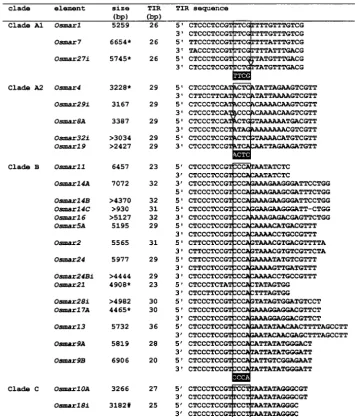
Figure 2.—Classification ofOsmars based on the TIR.Osmars are classi-fied into four clades (A1, A2, B, and C) on the basis of the sequence of a 4-bp motif in their TIR (boxed). This division is supported by the phyloge-netic analysis (see Figure 1). The di-agnostic consensus motifs are shown as white letters on a black back-ground. An asterisk indicates that the size ofOsmarwas calculated after re-moval of nested TE insertions (see Figure 1). The sign⬎is used for the size of incompleteOsmars, where only one terminus could be identified. The open triangle above the 5⬘TIR of Osmar8Aand the 3⬘TIR ofOsmar27i denotes an insertion of 5 and 2 bp, respectively, removed from the TIR sequence.
grouped into the same family when they shared⬎85% size from 432 to 505 residues with pairwise amino acid identities that varied from 36% (Osmar13 vs. Osmar26i) similarity over their entire length. Using these criteria,
25 different families of MLEs were distinguished (Fig- to 99% (Osmar5A vs. Osmar5Bi). The most conserved region is a central domain of ⵑ150 residues that is ures 1 and 2). Consistent with the nomenclature
intro-duced in animals, rice MLEs were designatedOsmar(for roughly delimited by the DD39D motif (see multiple alignment provided as supplemental data at http://
O.sativamariner) followed by the number of the family.
Members of the same family were further designated www.genetics.org/supplemental). This motif is charac-teristic of plant MLE transposases (ShaoandTu2001; by capital letters (for example,Osmar1AandOsmar1B;
see Figure 1). FeschotteandWessler 2002) and is found intact in
30 out of 34 putativeOsmarproteins. Phylogenetic trees A phylogenetic analysis of transposase sequences was
carried out to resolve evolutionary relationships among were generated from a multiple alignment of 34Osmar
transposases and the Soymar1 transposase using the rice MLE families. Conceptual translation and multiple
alignments of 34Osmartransposases revealed that most neighbor-joining and maximum parsimony methods. Both methods produced trees with very similar topology (27/34) are corrupted by substitutions and small
inser-tions/deletions (indels) that introduced premature that defined three major clades of Osmar transposase (A, B, and C in Figure 1). Clade A (10 families, 11 stop codons in the protein sequence. However, several
Osmars had intact ORFs and may encode active transpo- sequences) and clade B (13 families, 19 sequences) were more abundant and diverse than clade C (2 families, 4 sase (names underlined in Figure 1). After removal of
predicted introns (see below) and, where necessary, sequences) and can be further divided into subclades with strong bootstrap values (A1, A2, etc.; see Figure 1). introduction of frameshifts to restored ORFs, putative
Osmar transposase genes provides additional support approaches were used to compare the sequences in the terminal regions ofOsmars withStowawayfamilies. First, for the phylogenetic groupings. Four different introns
(called␣,,φ, and) were associated withOsmartrans- each rice MLE was used as a query in BLASTN searches against the three rice genomic databases (IRGSP, BGI, posases and result in genes with zero, one, or two
in-trons. When the distribution of these introns was super- and Syngenta). These searches revealed that Osmars were associated with few, if any, deletion derivatives (see imposed on the transposase phylogeny, each type of
intron was found to be specific to a clade or to a subclade supplemental table at http://www.genetics.org/supple-mental and Figure 4). Furthermore, these deleted cop-of transposases (Figure 1). That is, intron-␣ was
re-stricted to clade B, intron-to clade C, intron-φto sub- ies were heterogeneous in size (Figure 4) and were usually larger than Stowawayelements (280 bp–ⵑ2 kb clade A2, and intron-to subclade B1.
The phylogenetic organization ofOsmars is also sup- vs.94–350 bp forStowawayconsensus). Although a few MLE families, such asOsmar10, include a small homoge-ported by a comparison of their TIRs. For all Osmar
elements, the first 10 bp of the TIRs are well conserved neous group of short deletion derivatives (Figure 4), none of the derivatives have attained the high copy and match the consensus 5⬘-CTCCCTCCRT-3⬘(Figure
2). Adjacent to this motif is a 4-bp sequence that serves number that is a hallmark of MITE families.
In a second approach, eachStowaway consensus was to define a subset of Osmars.There is a striking
corre-spondence between these groupings and those defined used as a query in BLASTN searches against a database containing all full-length rice MLEs. These searches re-by the phylogenetic groupings of transposases (compare
groups in Figure 2 and phylogeny in Figure 1). Indeed, vealed that when significant sequence similarity existed, it was restricted to the terminal nucleotides (usually allOsmars in subclade A1 have a TTCG motif in their
TIRs while Osmars in subclade A2 display a consensus ⬍50 bp; see example of Osmar1and Stow-Os6, Figure 5). The most extensive matches were found between ACTC motif.Osmars clustered in clade B are
character-ized by a CCCA motif and those falling in clade C are Osmar4 and Stow-Os10b, Osmar13 and Stow-Os16, and
Osmar11andStow-Os49(Figure 5). characterized by TCCT. That each motif is diagnostic
of an Osmar transposase clade (or subclade) suggests Most of theStowawayfamilies can be assigned to one of the four majorOsmarclades on the basis of similarities coevolution between transposase and TIR sequences.
Classification ofStowawayMITEs and sequence rela- in their TIRs. In fact, 34 out of 36Stowawayconsensus
sequences display one of the four TIR motifs diagnostic
tionship with Osmars: Although numerous Stowaway
families were previously identified in rice, analysis of ofOsmarclades (compare Figures 2 and 3). For exam-ple, group B of StowawayandOsmarare characterized repeats was limited to a small fraction of the genomic
sequence (⬍50 Mb; Mao et al. 2000; Tarchini et al. by the same CCCA motif in the TIRs. Guided by these groupings, we generated consensus TIR sequences for 2000;JiangandWessler2001;Turcotteet al.2001).
For this reason, a more comprehensive search forStow- each major clade ofOsmarandStowawayin the form of pictograms (Figure 6). Comparison of the pictograms
awayMITEs was undertaken inⵑ360 Mb of BAC/PAC
sequence from the IRGSP. further revealed the similarities in the TIRs of corre-sponding clades ofOsmarandStowaway.
Searches were carried out with BLASTN and Re-peatMasker using a collection of previously character-izedStowawayelements (JiangandWessler2001;
Rep-DISCUSSION base Update, http://www.girinst.org) in addition to
elements identifiedde novoby RECON (BaoandEddy Several lines of evidence point to plant MLEs as the autonomous partners ofStowawayMITEs. In this study, 2002; N. Jiang, Z. Bao, S. Eddy and S. R. Wessler,
unpublished data). Depending on the stringency of we have taken the next step in testing this hypothesis by generating an inventory of virtually all MLEs and these searches (see materials and methods), a total
of 22,000–33,000 Stowaway elements are estimated to Stowaway families coexisting in a single genome and analyzing in detail their sequence relationships. populate the Nipponbare genome. Sequence
compari-sons led to the grouping of most of these elements into The first whole-genome picture of plant MLEs:A total of 39 MLE transposases and 22 potentially full-length 36 high-copy-number families (Figure 3). As withOsmar
families, members of the sameStowawayfamily share at MLEs were identified from the genomes of the two rice subspecies. On the basis of the phylogenetic analysis of least 85% similarity over their entire length. Stowaway
families are represented by consensus sequences that transposases, the intron/exon structure of the transpo-sase gene, and a comparison of terminal sequences, rice range in size from 96 to 312 bp with TIRs of 21 to 94
bp (Figure 3; consensus sequences were deposited in MLEs could be divided into 25 families that group into three major clades (Figures 1 and 2). These clades corre-Repbase Update, http://www.girinst.org).
With theOsmarandStowawayelements organized into spond to the three lineages of MLE transposases that were recently isolated by PCR using plant-specific MLE families, it was of interest to determine whether any
correspondence existed that would indicate a clear-cut primers and genomic DNA from a wide range of plant species (Feschotte and Wessler 2002; results not relationship between autonomous (Osmar) and
Figure3.—Classification ofStowaways based on the TIR. A consensus sequence was derived for each high-copy-numberStowaway family. Sources and methods of collecting these sequences are detailed inmaterials and methods. Stowawayfamilies were classified into four major clades on the basis of the same 4-bp motifs used to classifyOsmars (see Figure 2). Copy numbers were estimated using two methods, producing a lower and upper estimate for each family or a group of closely related families (see materials and methods).
major lineages of MLE transposases had diversified all appear to include families recently active in rice. This is reflected by the high level of sequence similarity prior to the divergence of the Poaceae family (ⵑ70
MYA) and have been maintained in the genomes of among members of severalOsmarfamilies and the pres-ence of copies with intact coding capacity (see Figure most extant grass species (Feschotte and Wessler
2002). The fact that the three MLE clades identified in 1 and examples in Figure 4). On the basis of these criteria, one of the most recently active MLE family rice correspond to these three major lineages indicates
that no other, more divergent, lineages are in rice. is Osmar5: the three full-length members are ⬎99.5% identical to each other and harbor intact transposase Thus, the rice genome is representative of the diversity
of MLE transposases in the grasses and as such should ORFs. It is therefore possible that one or more active MLEs may still reside in the rice genome.
serve as a suitable model for the evolutionary analysis
Figure 4.—Structure of some Osmarfamilies. Shown is the structure ofOsmar fami-lies representative of the three major clades of rice MLEs (clade A, Osmar8; clade B, Osmar5; and clade C, Osmar10). Each family in-cludes members of variable size that either contain or do not contain transposase se-quences (solid boxes). Aver-age percentAver-ages of pairwise similarity within and be-tween the two subsets of fam-ily members are shown. Hatched and dotted
frag-ments in Osm5m1 and
Osm5m2 represent portions that are unrelated to each other and to otherOsmar5 se-quences. Otherwise, small-er membsmall-ers resemble intsmall-er- inter-nal deletion derivatives of the larger members. Asterisks in-dicate the positions of prema-ture stop codons caused by nucleotide substitution or small indels in the transpo-sase sequence.
tion withinOsmarfamilies (see Figures 1, 2, and 4). Full- was obtained by combining data gathered from previous studies with those generated de novo by the program lengthOsmars harbor a single gene corresponding to the
putative transposase, which generally occupies a central RECON forⵑ30 Mb of rice sequences (seematerials and methods). Searches of ⵑ360 Mb of Nipponbare position in the element (but see Figure 2 for the few
exceptions) and has a similar size among rice MLEs. BAC/PAC sequences with this collection indicate that this genome contains from 22,000 to 33,000 Stowaway
Thus, most of the size variation among Osmars is due
to the variable length of the subterminal regions. These elements that group into 36 families (Figure 3). These values are in the range of those reported in previous regions do not display any obvious structural features,
such as direct or inverted motifs, like those of some studies (JiangandWessler2001;Turcotteet al.2001; Goffet al.2002;Yuet al.2002) and confirm that
Stow-other plant DNA transposons, including hAT or CACTA
superfamily members (KunzeandWeil2002). awayis one of the most abundant classes of interspersed repeats in rice, contributing up to ⵑ2% of the total In contrast to rice MLEs, there is a remarkable
conser-vation in the size of full-length MLEs described from a genomic DNA.
Like most previously described MITE families,
Stow-wide range of metazoan species. The dozens of elements
described from species as diverse as planarians, hydra, awayfamilies are characterized by relatively high num-bers of copies (for class 2 transposons) and a remarkable nematodes, insects, or humans vary in size from only
1.2 to 1.4 kb, despite extreme variation in sequence conservation in size (standard deviation from consensus size is typically⬍2% per family; data not shown). There (Robertson et al. 1998). Furthermore, MLE families
seem to be mainly represented by full-length copies in are, however, large variations in copy number among families, ranging from several dozen to a few thousand these species (Robertson et al. 1998). One notable
exception isHsmar1in humans, which is present in 200 (Figure 3). Interestingly, the most expansive families are also those with the longest TIRs (e.g.,Stow-Os1,
Stow-full-length copies (1.3 kb), but is responsible for the
spread of⬎2000 80-bp MITEs (Morgan1995). In rice, Os23, and Os-Stow46; see Figure 3). It is tempting to speculate that the palindromic structure of these
Stow-there is an overwhelming copy number excess of
Stow-awayMITEs over Osmars (22,000–33,000vs. ⬍40). To- aways may have contributed to their success.
The complex relationship ofOsmarandStowaway
ele-gether, these differences may reflect differences in the
cis- and trans-requirements of animal and plant MLE ments: Multiple alignments and phylogenetic analyses of hundreds of family members show that mostStowaway
transposases and/or their evolutionary dynamic.
A comprehensive inventory of Stowaway MITEs in families are made of multiple subfamilies of variable
age (not shown). This phylogenetic structure indicates
Figure 5.—Selected examples of pairwise quence comparisons between the terminal se-quences ofOsmarandStowawayelements. Examples ofOsmar-Stowawaymatches were selected to illustrate the range and extent of sequence similarity that can be found between the two groups. Significant similar-ities are usually restricted to the TIRs (Osmar1 vs. Stow-Os6and Osmar4 vs. Stow-Os10b) but, in a few cases, can be extended to the subterminal regions (Osmar13 vs. Stow-Os16andOsmar11 vs. Stow-Os49). TIRs are shown as arrows above Osmar sequences and belowStowaway.
that there have been multiple waves of amplification of a distinct group of MLE transposase. Thus, similarities of Osmar andStowaway in TIRs were used to connect of a limited number of Stowaway progenitors. Having
identified and characterizedStowaway and MLE fami- almost every Stowaway family with one of four distinct clades ofOsmartransposase (see Figure 6). Coevolution lies, we are now in a position to address two key
ques-tions: What are the enzymatic sources responsible for of TIR and transposase sequences is expected because transposase molecules recognize and bind specifically the bursts ofStowawaytransposition? How doStowaway
progenitors originate? to the TIRs during the transposition reaction of most class 2 transposons, including Tc1/mariner elements
Osmars as the transposase sources for Stowaway MITEs:
Comparison of Osmar and Stowaway sequences shows (Lampe et al. 2001; Zhang et al. 2001; Plasterk and van Luenen2002). Hence, changes in the transposase that similarity is primarily restricted to the first 20–30
bp of the elements (Figures 5 and 6). In some pairwise sequences are likely to be accompanied by changes in the TIR sequences and vice versa (Lampe et al. 2001; comparisons, significant similarities could be extended
to the subterminal regions, associating a givenStowaway Naumann and Reznikoff2002). The conservation of TIR sequences for different element families should family with an Osmar family (see Figure 5). However,
the level of similarity in these comparisons (⬍85%) is thus reflect the use of the same or a very similar source of transposase. For these reasons, we believe that the below the value of a typical intrafamily relationship.
Never-theless, these are the closest matches that can be estab- correspondence ofOsmarandStowawayTIRs is function-ally significant and supports the notion that different lished in the rice genome between a high-copy-number
Stowawayfamily and an element encoding a transposase. Stowawayfamilies have amplified by using distinct MLE transposases (Feschotteet al.2002a).
Therefore,Osmarelements are the best candidates as the
autonomous partners ofStowawayfamilies. Origin of Stowaway MITEs: Although evidence for a functional relationship between Stowaway MITEs and Our comparative analysis of the TIRs of Osmar and
Stowawayprovides further evidence for a functional rela- Osmartransposases is accumulating, there were very few cases of clear-cut sequence relationship between
Stow-tionship between these two groups of transposons. We
showed that Osmar and Stowaway families could be awayandOsmarelements (i.e., where the MITE resem-bles an internal deletion derivative of the larger ele-placed into corresponding groups on the basis of
to high copy numbers and represent a negligible frac- differential retention may explain someOsmar-Stowaway
situations, it cannot explain all of them. Among the tion of the 22,000–33,000 Stowaways present in rice.
dozens ofOsmarandStowawayfamilies described in this Thus, the origin of high-copy-numberStowawayfamilies
study, one would have expected to find at least a few remains enigmatic.
cases of direct association. After all, clear-cut relation-One possible explanation for this situation is the
dif-ships between large MITE families and full-length Tc1/ ferential retention of StowawayandOsmarelements in
marinertransposons were previously found in the Arabi-the rice genome over evolutionary time. Assuming that
dopsis and human genomes (e.g.,Morgan1995;Smit the loss of transposons is primarily a stochastic process
and Riggs 1996; Feschotte and Mouche`s 2000; re-(Hartlet al.1997), MITEs may simply have a greater
viewed inFeschotteet al.2002b). chance to persist because they outnumber their
autono-Instead of differential retention, we propose two, not mous partners. MITEs may also have a selective
advan-mutually exclusive, alternative hypotheses. First, some tage overOsmars, because their insertions are less likely
Stowaway families may not be derived fromOsmar, but than those of larger elements to be deleterious. While
may originatede novo following the fortuitous associa-tion and recogniassocia-tion of TIRs flanking unrelated seg-ments of DNA. The creation of a new DNA transposon by capture of flanking sequence has been reported for the P element in Drosophila (Tsubota and Huong 1991) and a similar scenario was proposed for the origin ofDs1elements in maize (MacRaeandClegg 1992). Support for this hypothesis comes from the fact that 13 high-copy-number Stowaway families are characterized by elements with long TIRs (48–94 bp; Figure 3), whereas there are noOsmars with TIRs longer than 36 bp (Figure 2). Long arrays of palindromic DNA are frequently encountered in eukaryotic genomes (e.g., Cavalier-Smith 1974;Deiningerand Schmid1976) and may provide the raw material for thede novoorigin of some MITE families.
De novoorigins are unlikely for otherStowawayfamilies that have extended regions of similarity with coexisting MLEs (Figure 5). These Stowaway families may have originated by internal deletion ofOsmars, but amplifica-tion to higher copy numbers could be a secondary event mediated by a transposase encoded by a distantly related element (see Figure 7). In this model, the origin and amplification of MITEs are considered as two different steps that may be separated by a long period of time. The more time elapsed between these two steps, the more difficult it will be to recognize the filiation between a MITE family and an autonomous element.
MITE amplification via cross-mobilization:Regardless of the origin of MITEs (de novoor ancient deletion deriva-tives), our results suggest that cross-mobilization is one
Figure7.—Model for the amplification of Stowaway MITEs. The first three steps of this model are based on the life cycle of MLEs pro-posed byHartlet al. (1997). An autonomous element, newly introduced in the ge-nome of a species by either vertical inheritance or hori-zontal transmission, first transposes at relatively high frequency (step 1). This may lead to a rapid increase in copy number if the double-strand gap left after excision is repaired using a locus containing the same transposon (for example, the homologous chromosome). Many newly synthesized transposons are internally deleted versions of the autonomous copy because of frequent interruption and/or slippage during gap repair (step 2). Copy numbers may increase until host defense mechanisms (homology-dependent silencing) and auto-regulatory processes (transposase titration, overproduction inhibition, etc.) act to repress transposition and stabilize copy numbers (Hartl et al. 1997;OkamotoandHirochika2001;Hannon2002;Plasterkandvan Luenen2002). Over time, both active and inactive copies are progressively degraded by point mutations (vertical inactivation) and are stochastically lost or fossilized in the genome (step 3). By chance, some of the decayed elements might preserve (or evolvede novo) sequences recognized by the transposase of a newly introduced autonomous element (step 4). The new autonomous element might be introduced from another species by horizontal transfer or genetic introgression, but it may also emerge “vertically” by diversifying evolution of a previously inactivated full-length element (as discussed byLampeet al. 2001). The newly expressed transposase will thus be able to mobilize its own family members and distantly related MITEs (step 4). We propose that sequence divergence between the MITE and its autonomous partner may favor the propagation of MITEs and allow their amplification to high copy numbers (step 5; see text for details).
of the major mechanisms operating in the rice genome scriptional level to repress the expression of the transpo-son gene product (Okamoto and Hirochika 2001; to amplify MITEs to high copy numbers. There are
previous examples of cross-mobilization of short DNA Feschotteet al. 2002a;Hannon 2002;Plasterk and van Luenen2002). All of these mechanisms are based transposons by distantly related autonomous elements.
In maize, Ds1 elements (ⵑ400 bp) have only the 5⬘ on recognition of nucleic acid sequence homology and triggered by multiple copies of the target sequence. As terminal 13 bp and the 3⬘terminal 26 bp in common
withAcelements, but they can be mobilized by theAc a result, there is usually an inverse correlation between the copy number of a transposable element family, the transposase (e.g., Shen et al. 1998). In Caenorhabditis
elegans, the nonautonomous Tc7 elements are mobilized expression levels of their gene products, and/or the transpositional activity of the family (e.g., Chandler
in vivoandin vitroby the Tc1 transposase, even though
Tc7 and Tc1 share only their 36 terminal nucleotides andWalbot1986;Chaboissieret al.1998;Hirochika
et al.2000). We speculate that a MITE lacking extensive (Rezsohazyet al. 1997). Interestingly, Tc7, like many
other MITE-like families in this species, has no parental sequence homology with an active autonomous ele-ment, but retaining the shortcis-sequences (TIRs) rec-autonomous copies recognizable in the C. elegans
ge-nome. For example, the MITE familiesCeleTc2,Cele11, ognized by the corresponding transposase, may be able to multiply without triggering homology-dependant and Cele12 all have Tc2-like TIRs while their internal
sequences have little similarity to each other or to other mechanisms of transposon silencing (see model in Fig-ure 7). This would ensFig-ure the maintenance of a high Tc2 sequences (Oosumi et al. 1996). To explain this
and related instances, the authors hypothesized that a level of transposase expression, which would allow MITE families to quickly spread and attain high copy numbers. single Tc family can cross-mobilize a variety of highly
divergent sequences (Oosumi et al. 1996). The cross- We are grateful to N. Jiang and Z. Bao for their help in the mining mobilization model also gains support from the recent and analysis ofStowawayfamilies and for sharing unpublished informa-tion. We also thank J. Jurka for providing access to data onStowaway
discovery that another rice MITE family,mPing, is
co-families prior to their publication in Repbase. We thank N. Jiang, mobilized in cell culture with a closely, but not directly
M. Osterlund, E. Pritham, and X. Zhang for critical reading of the related, autonomousPongelement (Jianget al.2003).
manuscript and helpful discussions. This work was supported by grants Interestingly,mPingelements areTourist-like MITEs, the from the National Science Foundation Plant Genome Initiative, the other principal MITE group in plants. Together with National Institutes of Health, and the University of Georgia Research
Foundation to S.R.W. our study of the Osmar-Stowaway relationships in rice,
these data converge toward a model where cross-mobili-zation plays a major role in the amplification of MITEs.
How could cross-mobilization contribute to MITE amplifica- LITERATURE CITED tion?Recent studies have shown that the activity of many
Bao, Z., andS. R. Eddy, 2002 Automatedde novoidentification of transposable element families is repressed by epigenetic repeat sequence families in sequenced genomes. Genome Res.
post-tran-Bennetzen, J. L., 2000 Transposable element contributions to plant Le, Q. H., S.Wright, Z.Yuand T.Bureau, 2000 Transposon diver-sity inArabidopsis thaliana. Proc. Natl. Acad. Sci. USA97:7376– gene and genome evolution. Plant Mol. Biol.42:251–269.
Bureau, T. E., and S. R.Wessler, 1994 Stowaway: a new family of 7381.
MacRae, A. F., and M. T. Clegg, 1992 Evolution ofAcandDs1
inverted-repeat elements associated with genes of both
monocoty-ledonous and dicotymonocoty-ledonous plants. Plant Cell6:907–916. elements in select grasses (Poaceae). Genetica86:55–66. Mao, L., T. C. Wood, Y. Yu, M. A. Budiman, J. Tomkinset al., 2000 Bureau, T. E., P. C.Ronaldand S. R.Wessler, 1996 A
computer-based systematic survey reveals the predominance of small in- Rice transposable elements: a survey of 73,000 sequence-tagged-connectors. Genome Res.10:982–990.
verted-repeat elements in wild-type rice genes. Proc. Natl. Acad.
Sci. USA93:8524–8529. Morgan, G. T., 1995 Identification in the human genome of mobile elements spread by DNA-mediated transposition. J. Mol. Biol. Capy, P., C. Bazin, D. HiguetandT. Langin, 1998 Dynamics and
Evolution of Transposable Elements. Springer-Verlag, Austin, TX. 254:1–5.
Naumann, T. A., andW. S. Reznikoff, 2002 Tn5 transposase with an Cavalier-Smith, T., 1974 Long palindromes in eukaryotic DNA.
Nature262:255–256. altered specificity for transposon ends. J. Bacteriol.184:233–240. Okamoto, H., andH. Hirochika, 2001 Silencing of transposable Chaboissier, M. C., A. BuchetonandD. J. Finnegan, 1998 Copy
number control of a transposable element, the I factor, a LINE- elements in plants. Trends Plant. Sci.6:527–534.
Oosumi, T., B. GarlickandW. R. Belknap, 1996 Identification of like element in Drosophila. Proc. Natl. Acad. Sci. USA95:11781–
11785. putative nonautonomous transposable elements associated with several transposon families inCaenorhabditis elegans.J. Mol. Evol. Chandler, V. L., andV. Walbot, 1986 DNA modification of a
maize transposable element correlates with loss of activity. Proc. 43:11–18.
Plasterk, R. H. A., andH. G. van Luenen, 2002 The Tc1/mariner
Natl. Acad. Sci. USA83:1767–1771.
Deininger, P. L., andC. W. Schmid, 1976 An electron microscope family of transposable elements, pp. 519–532 inMobile DNA II, edited by N. L.Craig, R.Craigie, M.Gellertand A. M. Lam-study of the DNA sequence organization of the human genome.
J. Mol. Biol.106:773–790. bowitz. American Society for Microbiology Press, Washington, DC.
Feschotte, C., andC. Mouche`s, 2000 Evidence that a family of
miniature inverted-repeat transposable elements (MITEs) from Plasterk, R. H. A., Z. Izsva´kandZ. Ivics, 1999 Resident aliens: the Tc1/marinersuperfamily of transposable elements. Trends theArabidopsis thalianagenome has arisen from apogo-like DNA
transposon. Mol. Biol. Evol.17:730–737. Genet.15:326–332.
Rezsohazy, R., H. G. A. M. van Luenen, R. M. DurbinandR. H. A. Feschotte, C., andS. R. Wessler, 2002 Mariner-like transposases
are widespread and diverse in flowering plants. Proc. Natl. Acad. Plasterk, 1997 Tc7, a Tc1-hitch hiking transposon in Caeno-rhabditis elegans.Nucleic Acids Res.25:4048–4054.
Sci. USA99:280–285.
Feschotte, C., N. JiangandS. R. Wessler, 2002a Plant transpos- Robertson, H. M., F. N. Soto-Adames, K. O. Walden, R. M. Avancini andD. J. Lampe, 1998 The mariner transposons of animals: able elements: where genetics meets genomics. Nat. Rev. Genet.
3:329–341. horizontally jumping genes, pp. 268–284 inHorizontal Gene Trans-fer, edited by M. Syvanenand C. I. Kido. Chapman & Hall, Feschotte, C., X. Zhang and S. Wessler, 2002b Miniature
in-verted-repeat transposable elements (MITEs) and their relation- London.
Shao, H., andZ. Tu, 2001 Expanding the diversity of theIS630-Tc1 -ship with established DNA transposons, pp. 1147–1158 inMobile
DNA II, edited by N. L.Craig, R.Craigie, M.Gellertand A. M. marinersuperfamily: discovery of a unique DD37E transposon and reclassification of the DD37D and DD39D transposons. Ge-Lambowitz. American Society for Microbiology Press,
Washing-ton, DC. netics159:1103–1115.
Shen, W. H., C. RamosandB. Hohn, 1998 Excision ofDs1from the Goff, S. A., D. Ricke, T. H. Lan, G. Presting, R. Wanget al., 2002
A draft sequence of the rice genome (Oryza sativaL. ssp.japonica). genome of maize streak virus in response to different transposase-encoding genes. Plant Mol. Biol.36:387–392.
Science296:92–100.
Hannon, G. J., 2002 RNA interference. Nature418:244–251. Smit, A. F. A., andA. D. Riggs, 1996 Tiggersand DNA transposon fossils in the human genome. Proc. Natl. Acad. Sci. USA93:
Hartl, D. L., A. R. LoheandE. R. Lozovskaya, 1997 Modern
thoughts on an ancyentmarinere: function, evolution, regulation. 1443–1448.
Tarchini, R., P. Biddle, R. Wineland, S. TingeyandA. Rafalski, Annu. Rev. Genet.31:337–358.
Hirochika, H., H. OkamotoandT. Kakutani, 2000 Silencing of 2000 The complete sequence of 340 kb of DNA around the rice adh1-adh2 region reveals interrupted colinearity with maize retrotransposons in Arabidopsis and reactivation by the ddm1
mutation. Plant Cell12:357–369. chromosome 4. Plant Cell12:381–391.
Tsubota, S. I., andD. V. Huong, 1991 Capture of flanking DNA by Jarvik, T., andK. G. Lark, 1998 Characterization of Soymar1, a
marinerelement in soybean. Genetics149:1569–1574. a P element inDrosophila melanogaster: creation of a transposable element. Proc. Natl. Acad. Sci. USA88:693–697.
Jiang, N., andS. R. Wessler, 2001 Insertion preference of maize
and rice miniature inverted repeat transposable elements as re- Turcotte, K., S.Srinivasanand T.Bureau, 2001 Survey of trans-posable elements from rice genomic sequences. Plant J.25:169– vealed by the analysis of nested elements. Plant Cell13:2553–
2564. 179.
Jiang, N., Z. Bao, X. Zhang, H. Hirochika, S. R. Eddyet al., 2003 Wessler, S. R., T. E.Bureau and S. E. White, 1995 LTR-retro-An active DNA transposon family in rice. Nature421:163–167. transposons and MITEs: important players in the evolution of Kunze, R., andC. F. Weil, 2002 The hAT and CACTA superfamilies plant genomes. Curr. Opin. Genet. Dev.5:814–821.
of plant transposons, pp. 565–610 inMobile DNA II, edited by Yu, J., S. Hu, J. Wang, G. K. Wong, S. Liet al., 2002 A draft sequence N. L.Craig, R.Craigie, M.Gellertand A. M. Lambowitz. of the rice genome (Oryza sativaL. ssp. indica). Science296:
American Society for Microbiology Press, Washington, DC. 79–92.
Lampe, D. J., K. K. WaldenandH. M. Robertson, 2001 Loss of Zhang, L., A. DawsonandD. J. Finnegan, 2001 DNA-binding activ-transposase-DNA interaction may underlie the divergence of mar- ity and subunit interaction of the mariner transposase. Nucleic iner family transposable elements and the ability of more than Acids. Res.29:3566–3575.
one mariner to occupy the same genome. Mol. Biol. Evol.18: