THE CONTROLLING ELEMENT IN SEX CHROMOSOME BEHAVIOR IN SCIARAl
HELEN V. CROUSE
Department of Botany, Columbia University, New York, New York Received May 23, 1960
ENETIC and cytological studies have been made on a number of species of Sciara (see
METZ
1938 for review). Common to all of these species is a series of unusual and remarkable cytological phenomena which involve the sex chromosome and which are related to the differentiation of sex in this genus. The first of these is encountered at the second meiotic division in the male, when, following the selective elimination of paternal homologues at the first spermato- cyte division, the maternally derived X chromosome undergoes equational non- disjunction. Thereby, instead of a haploid set of chromosomes, such as the egg transmits (three autosomes and one X),
the sperm nucleus comes to include two identical X’s and three autosomes. Although the sperm transmits two X chromo- somes to the zygote, in no cell of the developing embryo are both of them re- tained permanently: one is eliminated from the somatic nuclei of the females, both from the somatic nuclei of males, and one from the germ cells of each sex. This pattern of sex chromosome behavior constitutes a unique sex determining mechanism. All zygotes begin development under the influence of the same chromosome complement, three X’s and three pairs of autosomes. A differential between male and female is not established until anaphase of the seventh or eighth cleavageand then only in the somatic nuclei-at which time there is an elimination of one or of both paternal X’s in the production of female and male embryos, respectively (DuBOIS
1933). The germ line retains all three sex chro- mosomes until the germ cells have migrated to the definitive gonad site; then, in both sexes alike, one paternal X is eliminated. This elimination occurs not at anaphase but in resting cells at a stage when the chromosomes are in the form of fairly compact prochromosomes; one of the paternal X’s appears to migrate directly through the nuclear membrane into the cytoplasm and subsequently degenerates(BERRY
1941 ).
This series of interrelated and unusual phenomena demonstrates that the cells of the developing Sciara embryo can distinguish between sex chromosomes and autosomes, between maternal and paternal homologues. The nature of this “recognition” of chromosomes is not understood. One of the first questions to be answered, however, and one which is experimentally feasible, is whether a local-
1 The studies reported here were supported by grants G-6176 and G-9682 from the National Science Foundation. The studies on the Oak Ridge translocations were initiated in the Biology Division of the Oak Ridge National Laboratory during the tenure of a research participantship
ized segment on the sex chromosome, or the chromosome as a whole, is involved in the process.
With this question in mind, a number of reciprocal translocations between chromosome X and the autosomes have been obtained and a study made of their inheritance and their cytological behavior during spermatogenesis ( CROUSE
1943, 1960). The purpose of the present paper is to describe a new translocation in S . coprophila, designated “Oak Ridge Tl,” with which it has been possible to identify a proximal segment of heterochromatin on the X as the essential ele- ment controlling the unique behavior of this chromosome. The effects produced by the new translocation will be compared and contrasted to effects produced by a series of X translocations in the same species.
MA TER I A LS A N D M E T H O D S
The translocations were induced by X-ray irradiation (4000r) of sperm from monogenic strains of S. coprophila obtained originally from PROFESSOR
METZ’S
FIGURE 1 .-Diagram illustrating the history of chromosomes in monogenic S . coprophila
SEX D E T E R M I N A T I O N I N SCIARA 1431
laboratory. Use was made of the available sex-linked markers, Wavy (W) and swollen (sw) and of several autosomal dominants. In contrast to digenic species of Sciara, in which single families consist of both sons and daughters, the females in monogenic lines are either female producers or male producers. The in- heritance of sex of progeny is shown in Figure 1. Genetically there are two kinds of sex chromosomes, designated X and X’; females are either X’X (female producers) or XX (male producers)
,
and males are normally XX(XO
in soma). Wavy is a dominant marker on X’, and swollen is a recessive on X. In the earlier experiments ( CROUSE 1943) the translocations were detected by means of “linkage” of autosomal and sex-linked factors. Later a more useful criterion presented itself: the occurrence, among the progeny of females heterozygous for any one of the X translocations, of exceptional patroclinous sons or exceptional matroclinous daughters (see CROUSE 1960).Once an
X
translocation had been detected and the fact established that it was transmissible through both the male and female germ line, the positions of break- age on the chromosomes were determined by salivary gland chromosome analysis, and cytological studies were made on spermatogenesis in males receiving the translocation from their mother. It should be recalled from the introductory statement to this paper that, unlike oogenesis which is perfectly orthodox in Sciara, spermatogenesis is very unusual: each primary spermatocyte gives rise to only one sperm by virtue of the unequal nature of both meiotic divisions. At the first division there is no synapsis or crossing over, and at anaphase a directed segregation of homologues occurs as the paternally derived set of chromosomes is cast away in a bud. At the second division the maternal homologues divide equationally, but, as pointed out above, the two halves of the X fail to separate and both become included in the sperm nucleus. Their fate at the time of chromosome elimination in the embryo has already been described; the somatic and germ line chromosome eliminations are indicated on the diagram in Figure 1.For cytological study of spermatogenesis aceto-orcein squashes of Carnoy-fixed pupal testes were used chiefly, but these were supplemented by Feulgen-stained sections of comparable material preserved with a variety of fixatives, including Kahle, San Felice, and Gilson’s corrosive sublimate.
X is the essential controlling element in the extraordinary behavior of this chromosome.
RESULTS
T h e chromosomes in the translocation material: Shown on the diagram in Figure 2 are the important structural features of the X chromosome of S . coprophila as observed in the salivary gland nuclei. The 36 units of length assigned to it are based on the published maps (CROUSE 1943). There are 12 map sections, each with subdivisions A, B, and C. The photomicrograph in Figure 3 shows the entire salivary complement. The exact location of centromeres on these chromosomes cannot be determined by microscopic study because there is no chromocenter, and the centric regions are not characterized by any visible differential quality. By determining the positions of chromosome breakage in 18 different translocations and the metaphsae configuration for certain of these, it was possible to deduce that salivary element IV corresponds to the only V-shaped chromosome of the complement and that the proximal ends of the three remain- ing chromosomes are as indicated in Figure 3a ( CROUSE 1943 and unpublished). Moreover, it has been possible to localize fairly accurately the X centromere in map region 12C immediately adjacent to the large mass of heterochromatin which terminates this map section and which likewise constitutes the end of the chromosome. Of key significance in this localization were translocation “Oak Ridge T1” and a long paracentric inversion on the X. The paracentric nature of the inversion was established by cytological studies (unpublished) on oogenesis comparable to those made by CARSON on S. impatiens (CARSON 1946). I n addition to the centromere and terminal mass of heterochromatin, a third structural feature is indicated on the diagram, namely, three repeats located in map regions
2C, IOB, and 12B. These repeats are very short, each composed of a doublet and a singlet. Usually in smear preparations the interstitial one (10B) does not reveal itself through lateral synapsis (see Figure 3 ) . It is not that this repeat fails to undergo synapsis with the other two, but that in so doing the chromosome loop produced by the segment 10B-12B is so short that the chromosome breaks in this region or the lateral attachment is ruptured. All three repeats are laterally synapsed in the cell shown in Figure 4. Indicated by means of arrows on the diagram are the positions of breakage for each of the nine translocations under
2c 4c 6 A 66 98 OA Io6
I A I6
I
I
[,!T,
I
1
I
ORTIE MT1215 PTI MT993 PT2 ORT,
ORT26
SEX D E T E R M I N A T I b N I N S C I A R A 1433
FIGURE 3.-Photomicrograph of the normal salivary complement of S . coprophila. X 600.
study. The letters M, P, and OR designate Missouri, Pennsylvania, and Oak Ridge, respectively. Thus, “OR Ti” means the first of a series of X translocations obtained at the Oak Ridge Laboratory, etc.
The
spermatogenesis studies: The results of the cytological studies on sperma- togenesis are summarized in Table 1. In the second column of the table the autosome involved in each of the translocations is listed, together with the position of breakage according to the salivary maps. It will be noted that all of the trans- locations except M T1215 were simple, involving a single break on theX
and a single break on one of the autosomes. Even M T1215 was simple as regards the X breakage, and only two translocation chromosomes composed partially of X were formed by the rearrangement. Thus, in all nine cases the X was distributed between two rearracged chromosomes.IIf
3 a
4 a
I I C
\$
5
a
FIGURE 3a.-Outline drawing of the chromosomes shown in Figure 3. The proximal ends of
the rods are indicated by the letter c, the distal ends by f. IV is the V-shaped chromosome.
FIGURE +a.-Outline drawing of the chromosomes shown in Figure 4. The terminal hetero- chromatin of the X is stippled; the arrows indicate its position on the normal X and also on the translocation chromosome bearing the centromere of 11.
FIGURE 5a.-Outline drawing of chromosomes shown in Figure 5 .
some,” the original terminology applied by METZ. For all nine of the transloca- tions only one of the rearranged chromosomes underwent equational nondis- junction; the other chromosome underwent congression and equational division along with the autosomes. In seven of the nine cases the chromosome which dis- played behavior normally characteristic of the X, i.e., equational nondisjunction, could be identified (see fifth column of the table) ; in all except OR T1 it was the translocation chromosome composed of a distal autosomal segment and a proxi- mal segment of X including the X centromere and terminal heterochromatic mass.
S E X D E T E R M I N A T I O N IN SCIARA 1435
TABLE 1
Cytologicul studies of spermatogenesis
Translocation
M T993 M TI215 M T1232 P T1 P T2 OR T1 OR T7 OR T18 OR T26
Autosome and Shape of break position “precocious” chr.
11-18B rod
11-15C rod
I V 4 1 B and 5OA
111-25C rod
11-1 8B rod
11-16C rod
11-1 8C rod
IV-36B rod
I V 4 9 C rod
IV-37B rod
Shape of other translocation chromosonie Identification “precocious” cliromosonie rod V-shaped rod rod rod V-shaped J-shaped J-shaped J-shaped no Yes
For explanation see text.
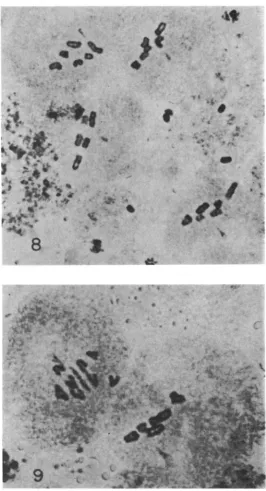
proximal segment of chromosome I1 attached to and ending in the X hetero- chromatin, the other composed of practically the entire X attached to a distal segment of chromosome I1 (see Figures 4,4a, 5, and 5a). The former chromosome, of course, should be a tiny rod at metaphase and possess the centromere obtained from 11; the latter should be a somewhat unequal V and possess the centromere obtained from the X.
That this is exactly what was found can be seen by studying the photo- micrographs shown in Figures 6, 8, and 9. By way of comparison the normal chromosome group at second metaphase is shown in Figure 7. The cells in this figure show very clearly a rod-shaped “precocious” chromosome at one pole and five chromosomes on the plate. Of the five, three are members of the regular complement and two are V-shaped “limited” chromosomes. The limited chromo- somes are supernumerary and occur only in the germ line; they are eliminated from the somatic nuclei of the embryo at the fifth or at the sixth cleavage
(Du BOIS 1933). In some species of Sciara limited chromosomes do not occur.
FIGURE $.-Photomicrograph of heterozygous OR T1 showing lateral synapsis of the three FIGURE 5.-Photomicrograph of heterozygous OR T1. In this nucleus the interstitial repeat is repeat regions. x 1500.
S E X D E T E R M I N A T I O N I N SCIARA 1437
I
7
?
J,
FIGURE 6.-Orcein squash of secondary spermatocytes of OR T1. Photomicrograph at 1500X.
Polar view of M 11; in the A I1 figure the tiny rod chromosome is dividing equationally (see text).
FIGURE 7 . S e c o n d a r y spermatocytes of PT I showing a chromosome complement which is
indistinguishable from that observed i n normal material a t this stage. Note the rod-like precocious chromosome and the two other rods on the equatorial plate (see text).
FIGURE & - S a m e testis as shown in Figure 6. Side views of M I1 in which precocious behavior
FIGURE 9 . 4 a m e testis as shown in Figures 6 and 8. Side view of M 11; A I1 figure shows
of tiny rod can be clearly seen. x 1500.
SEX DETERMINATION I N SCIARA 1439
which the heterochromatin from the
X
is not certain. Very often in orcein squashes of normal material, particularly in S. reynoldsi, the two chromatids of the precocious chromosome diverge distally as they go to the pole. Reasoning by analogy, then, one would be led to believe that the centromere of the tiny rod in the OR T1 spermatocytes actually backs into the pole and that the end of this translocation chromosome which is made up of the X heterochromatin actually leads the way. Whether this is indeed the case has not yet been determined from the sectioned material; it is hoped that with osmium fixation, better presentation of the spindle fibers will be obtained.The anaphase shown in Figure 6 is very interesting because the tiny rod has failed to exhibit precocity in this spermatocyte, and, instead, has clearly under- gone equational division. The fate of such cells subsequent to second anaphase is unknown. An estimate of the frequency with which this behavior occurs was made by careful study and tabulation of approximately 1000 spermatocytes at second metaphase and anaphase: in 940 cells the tiny rod clearly exhibited precocity; in eight cells it underwent equational division; and in 33 cells its behavior could not be determined. In the course of this careful tabulation no chromosome other than the tiny rod was ever found to exhibit precocity, even in those cells in which this rod underwent equational division.
By way of summary of the cytological studies on spermatogenesis, then, it can be stated that for each of the X translocations, only one of the rearranged chromosomes is transmitted in duplicate through the sperm: in every case except OR Ti it is the chromosome which is made up of a proximal segment of
X, including the X centromere and terminal heterochromatin. In OR Ti, where the heterochromatin and centromere have become separated from each other, it is the rearranged chromosome composed of the X heterochromatin and a proximal segment of
I1
which is transmitted in duplicate.H P P 0
5’
SPERMATOGONIA
“*
11
ELIMINATION
GERM
LINE
1111
nn
ln
/
c
ill SPERM
V’
n
/
FEMALE SOMA
-
n II AUTOSOME
INVOLVED
IN
TRANSLOCATION
U
OOGONIA
A
U
EGG
FROM
Q
PRODUCER
TRANSLOCATION
CHROMOSOME
WITH
1
X
CENTROMERE
n ULTRA
NSLOCATION
CHROMOSOME
WITH
AUTOSOMAL
SEX DETERMINATION I N SCIARA 1441
ELlMl N4lIO N
A
.
MALE
SOMA
\
’
GERM LINE1
ELMINATIONV
U
EGG FROM
9 PROWCER
;
TRANSLOCATION CHROMOSOME WITH X CENTROMERE!TRANSLOCATION CWIOMOSOME w m
AUTOSOMAL CENTROMERE
/
FIGURE 1 1.-Same as the diagram in Figure 10 except that it applies not to OR T1 but to the
other eight translocations.
males die because of the unbalanced complement in their somatic nuclei: for each of the translocations the complement is deficient for a segment of autosome and duplicated for a segment of X, the X duplication in the case of OR Ti com- prising all of the chromosome except the terminal mass of heterochromatin.
Inheritance of the translocations through the female: Meiosis in the Sciara female is perfectly orthodox and involves crossing over and the random assort- ment of homologues. Consequently, females heterozygous for a n X translocation would be expected to form two classes of euploid eggs. That this is the case has already been established for both the Missouri ( CROUSE 1943) and the Pennsyl- vania translocations (CROUSE 1960). It is true also of the Oak Ridge series (unpublished). In addition to the euploid eggs, aneuploid types arise through nondisjunction ( CROUSE 1960). Aside from the phenomenon of nondisjunction, the
X
translocations are inherited in a regular, orthodox manner.DISCUSSION
translocation studies show clearly that it is not the whole X chromosome which is involved in the elaborate series of interrelated cytological events but only a very localized region, namely, the terminal (proximal) mass of heterochromatin. This region controls both equational nondisjunction in the secondary spermato- cyte and chromosome elimination in the embryo; without it the sex chromosome behaves like an autosome, but with it the autosome behaves like X.
That the controlling region proves to be the heterochromatin which normally lies adjacent to the X centromere is, in the last analysis, probably not surprising. In view of the Sciara data one might have chosen the X centromere as the most plausible controlling element. First, the dramatic chromosome unorthodoxies in Sciara are clearly unrelated to the genic make-up of the chromosomes: a chromo- some which passes through the male germ line acquires an “imprint” which will result in behavior exactly opposite to the “imprint” conferred on the same chromosome by the female germ line. In other words, the “imprint” a chromo- some bears is unrelated to the genic constitution of the chromosome and is determined only by the sex of the germ line through which the chromosome has been inherited. Second, centric activity is obviously involved in equational non- disjunction, in chromosome elimination at anaphase (embryonic soma), and probably it is involved also in the prochromosome elimination from the germ cells at resting stage. That the controlling element on the X is not the centromere but an element which lies in the adjacent heterochromatin is in line with and gives support to the view advocated by NOVITSKI (1955) and by LINDSLEY and NOVITSKI
( 1958), that the kinetic activity of centromeres in Drosophila (as measured in anaphase bridge experiments) is to be attributed to the constitution of the heterochromatin immediately adjacent to the centromeres. That the hetero- chromatin of the Sciara X, upon translocation (OR T1) to the proximal segment of chromosome 11, can control the behavior of the rearranged chromosome is indeed very interesting. Not only is the centromere considerably removed (op- posite end of the rearranged chromosome) from the translocated heterochromatin, but it is a non-homologous centromere, the one derived from chromosome 11. This result supports the view advocated by LINDSLEY and NOVITSKI (1958), that the function of the centromere is constant from chromosome to chromosome.
S EX D E T E R M I N A T I d N IN SCIARA 1443
S U M M A R Y
Nine reciprocal translocations between chromosome X and the autosomes of S. coprophila have been studied in relation to their effects on spermatogenesis and chromosome elimination in the embryo. In every case one of the transloca- tion chromosomes displayed behavior typical of the autosomes at the second spermatocyte division; the other exhibited precocity and thus underwent equa- tional nondisjunction. The chromosome eliminated later from the embryonic soma and germ line was the translocation chromosome which had undergone equational nondisjunction during spermatogenesis. Precocity at the second spermatocyte division and elimination at the critical stages in the embryo were found to be under the control of the terminal heterochromatin which is located normally adjacent to the X centromere. When, by reciprocal translocation, this mass of heterochromatin comes to form the distal end of a rearranged chromo- some which bears the proximal segment of 11, it controls the behavior of this chromosome in spite of its wide separation from the centromere.
L I T E R A T U R E CI TED
BERRY, R. O., 194.1
CARSON, H. L., 1946
CROUSE, H. V., 1943
Chromosome behavior in the germ cells and development of the gonads of
The selective elimination of inversion dicentric chromatids during meiosis
Translocations in Sciara; their bearing on chromosome behavior and sex
The nature of the influence of X translocations on sex of progeny in Sciara coprophila.
Chromosome behavior during cleavage i n the eggs of Sciara coprophila
Localization of the genetic factors responsible for the
Chromosome behavior, inheritance, and sex determination in Sciara. Am.
Genetic measures of centromere activity in Drosophila melanogaster. J.
Sciara ocellaris. J. Morphol. 68: 547-583.
in the eggs of Sciara impatiens. Genetics 31 : 95-113.
determination. Missouri Univ. Research Bull. 379 : 1-75.
Chromosoma 11: 146-166.
1960
DuBors, A. M., 1933
LINDSLEY, D. L., and E. NOVITSKI, 1958
METZ, C. W., 1938
NOVITSKI, E., 1955
in relation to the problem of sex determination. Z. Zellforsch. 19: 595-614.
kinetic activity of X chromosomes of Drosophila melanogaster. Genetics 43 : 790-798.
Naturalist 72 : 485-520.