COGNITIVE ENGAGEMENT IN A COMPUTER-SUPPORTED COLLABORATIVE LEARNING ENVIRONMENT
NURBIHA A SHUKOR
COGNITIVE ENGAGEMENT IN A COMPUTER-SUPPORTED COLLABORATIVE LEARNING ENVIRONMENT
NURBIHA A SHUKOR
A thesis submitted to the fulfilment of the requirements for the award of the degree of Doctor of Philosophy (Educational Technology)
Faculty of Education Universiti Teknologi Malaysia
Al-Fatihah, A. Shukor A. Majid. Father, this is for you. For your patience, understanding and infinite love,
ACKNOWLEDGEMENT
My heartiest thanks to my supervisor, Assoc. Prof. Dr. Zaidatun Tasir; for all the guidance, patience, and care. Thank you for everything that you’ve put me through, making me realize that the world is not round and it takes two people to have things work.
A teacher, and a friend, Dr Henny van der Meijden who came all the way from the other part of the world, the Netherlands. Thank you for believing me and I am nothing but honoured to be one of your students.
Pictures can also never be put together without a mom in it. To my mother, Aminah Ma’arof, I believe for every of your du’a, you have me in it. I can never repay your thoughts and faith that you have in me. My big sister, dear brother, in-laws, thank you.
To Siti Khadijah Mohamed, you inspires me. Thanks to you. To my friends, dearest and close to my heart, Noor Dayana and Nabila, well things won’t be the same without both of you. Thank you for the moments that we had, for lending me your ears and hearts so that we are bonded to this wonderful relationship.
Also, to the rest of them which might be you. Thank you for making things work. For the tiniest thing that you have ever done for me, I appreciate them all. Only Allah knows it well.
Thank you Allah.
ABSTRACT
ABSTRAK
NEDERLANDSE SAMENVATTING
TABLE OF CONTENT
CHAPTER TITLE PAGE
DECLARATION ii
DEDICATION iii
ACKNOWLEDGEMENTS iv
ABSTRACT v
ABSTRAK vi
NEDERLANDSE SAMENVATTING vii
TABLE OF CONTENTS viii
LIST OF TABLES xiii
LIST OF FIGURES xv
LIST OF ABBREVIATIONS xvii
LIST OF APPENDICES xviii
1 INTRODUCTION 1
1.1 Introduction 1
1.2 Background of Problem 3
1.3 Problem Statement 12
1.4 Research Objectives 13
1.5 Research Questions 14
1.6 Theoretical Framework 14
1.7 Research Rationale 21
1.8 Relevance of Research 22
1.9 Scope and Limitation of Research 24
1.10 Operational Definition 25
2 LITERATURE REVIEW 30
2.1 Introduction 30
2.2 Online Learning 31
2.3 Students’ Engagement 35
2.4 Defining Cognitive Engagement 41
2.5 Investigating Cognitive Engagement in Online Learning
44
2.6 Collaborative Learning 48
2.7 Computer - supported Collaborative Learning, CSCL
55
2.8 Knowledge Construction, Cognitive Engagement and CSCL
69
2.9 Analyzing Students’ Cognitive Engagement in Online Learning
72
2.10 Preliminary Study on Students’ Cognitive Engagement in Online Learning
76
2.11 Evaluating Cognitive Engagement and Performances in Test
77
2.12 Summary 78
3 RESEARCH METHODOLOGY 80
3.1 Introduction 80
3.2 Research Design 80
3.3 Research Procedure 83
3.4 Samples and Population 86
3.5 Instrumentations 87
3.6 Pilot Testing 91
3.7 Summary 93
4 DATA ANALYSIS 94
4.1 Introduction 94
4.2 Quantitative and Qualitative Data Analysis
94
cognitive engagement in online learning
4.3.1 Coding scheme 4.3.2 Unit of analysis 4.3.3 Coding procedures 4.3.4 Inter-coder agreement 4.3.5 Alteration of coding scheme 4.3.6 Statistical analysis of students’
level of cognitive engagement in online learning
96 99 99 100 100 102
4.4 Analysis of the influence of CSCL environment to students’ level of cognitive engagement
102
4.5 Analysis of the influence of CSCL environment towards students’ academic performance in tests
103
4.6 Analysis of students’ attainment to the higher level of cognitive engagement in CSCL environment 4.5.1 Data mining procedures
106
4.7 Building performance predictive model based on students’ level of cognitive engagement in CSCL environment
107
4.8 Summary 109
5 DESIGN AND DEVELOPMENT OF
CSCL ENVIRONMENT
110
5.1 Introduction 110
5.2 Instructional Design
5.2.1 The Instructional System Development Model: Three-phase Development Model 5.2.1.1 Phase 1: Building
functional
110 111
Components (Pre Delivery)
5.2.1.2 Phase 2: Enhancement 5.2.1.3 Phase 3: Maintenance
132 133
5.3 Summary 133
6 RESULTS AND FINDINGS 134
6.1 Introduction 134
6.2 Respondents’ gender and group distribution
134
6.3 Students’ level of cognitive engagement in online learning
137
6.4 The influence of CSCL
environment towards students’ level of cognitive engagement in online learning
139
6.5 The influence of CSCL
environment towards students’ performance in test
143
6.6 Students’ attainment to the higher level of cognitive engagement in CSCL environment
149
6.7 The performance predictive model of students’ learning in a CSCL environment based on levels of cognitive engagement
162
6.8 Summary 168
7 DISCUSSIONS,
RECOMMENDATIONS AND CONCLUSIONS
169
7.1 Introduction 169
7.2 Discussions on Research Findings 169
7.2.1Students’ level of cognitive engagement in online learning
7.2.2 The influence of CSCL
environment towards students’ level of cognitive engagement in online learning
173
7.2.3 The influence of CSCL
environment towards students’ performance in test
178
7.2.4 Students’ attainment to the higher level of cognitive engagement in CSCL environment
181
7.2.5 The performance predictive model of students’ learning in CSCL environment based on levels of cognitive
engagement
185
7.3 Research Conclusions 187
7.4 Limitations of Research 189
7.5 Implication of Research 190
7.6 Future research recommendations 194
7.7 Summary 196
REFERENCES Appendices A - G
LIST OF TABLES
TABLE NO. TITLE PAGE
1.1 Socio-cultural theory and principles for CSCL environments (Bonk & Cunningham, 1998)
18
3.1 Instrumentations 88
4.1 The summary of quantitative and qualitative method being used
95
4.2 Social knowledge construction coding scheme (van der Meijden, 2005)
96
4.3 Grading system by Durm (1993) 103
4.4 Students’ category according to performance scores
104
4.5 Students’ final categorization 104
4.6 The interpretation of Cohen d value (effect size) adapted from Leech, Barrett and Morgan (2011)
106
4.7 Analysis of students’ attainment to the higher level of cognitive engagement in CSCL environment
106
4.8 Variables set for filtration in data mining 108
5.1 Functional components and CSCL principles 115
6.1 Samples cohort II group distribution 137
6.2 The distributions of cognitive contributions, affective, regulative and rest
138
6.3 Summary of descriptive statistics on students’ cognitive engagement in CSCL environment
140
6.4 Students’ pre and post performance test scores 143
6.5 Results for test of normality 146
6.6 The summary of paired-sample t-test for students’ performance in test
6.7 The effect size value for depending means 148
6.8 Power analysis results 149
6.9 Students’ attainment to the high-level of cognitive contributions in CSCL environment
149
6.10 Cross-tab presentation with respect to students’ performance and levels of cognitive engagement
150
6.11 (a) Number of students with H, HL and L level of cognitive engagement according to groups
160
(b) Number of scaffolding feedback received in groups
161
6.12 Raw data input for data mining 162
6.13 Summary of students’ pathway in CSCL environment
LIST OF FIGURES
FIGURE NO. TITLE PAGE
1.1 Research theoretical framework 15
3.1 The operational framework for investigating students’ cognitive engagement in CSCL environment
84
4.1 Data analysis and analysis procedures adapted from Hung and Zhang (2008)
107
5.1 The Three-phase Development Model by Sims and Jones (2003)
113
5.2 Main interface of CSCL environment 130
5.3 Functional component: CSCL task 130
5.4 Example of scaffolded instructions by ‘questioning’ technique
131
5.5 Example of scaffolded instructions by ‘verifying’ and ‘inviting clue contribution’ technique
131
6.1 Gender distribution in samples cohort I 135
6.2 Gender distribution in samples Set II 136
6.3 Students’ contribution in every task 141
6.4 The summary of students’ cognitive contributions in CSCL groups
142
6.5 Students’ category in pre and post tests 144
6.6 Students’ distribution in each performance category
145
6.7 Scatter plot for students’ pre test scores 146
6.8 Scatter plot for students’ post scores 147
6.10 Cognitive contributions for Task 2 154
Cognitive contributions for Task 3 154
6.11
6.12 Cognitive contributions for Task 4 155
6.13 Cognitive contributions for Task 5 156
6.14 Scaffolding feedback for CSCL groups in Task 1 157 6.15 Scaffolding feedback for CSCL groups in Task 2 157 6.16 Scaffolding feedback for CSCL groups in Task 3 158 6.17 Scaffolding feedback for CSCL groups in Task 4 159 6.18 Scaffolding feedback for CSCL groups in Task 5 159 6.19 Performance predictive model based on students’
cognitive engagement in CSCL environment using random tree algorithm
165
6.20 Performance predictive model based on students’ cognitive engagement in CSCL environment using random tree algorithm
166
LIST OF ABBREVIATIONS
CE - Cognitive engagement
CSCL - Computer-supported Collaborative Learning Environment
H - High-level of cognitive engagement HL - High-low level of cognitive
engagement
L - Low-level of cognitive engagement P1 - Poor performance during pretest W1 - Weak performance during pretest L-A1
M-A1
- Low-achiever during pretest Medium-achiever during pretest H-A1 - High-achiever during pretest
O1 - Outstanding performance during pretest
P2 - Poor performance during post test W2 - Weak performance during post test L-A2
M-A2
- Low-achiever during post test Medium-achiever during post test H-A2 - High-achiever during post test
LIST OF APPENDICES
APPENDIX TITLE PAGE
A Performance Tests 233
B Interview Protocol 244
C Validation of CSCL Environment and CSCL Tasks 248
D CSCL Problem-solving Tasks 253
E Validation of Performance Tests 255
F Website Evaluation Rubric 257
INTRODUCTION
1.1 Introduction
The current learning situation proves that surfing the internet (which is relatively considered ‘online’, will have the following benefits. It will: get people connected, share information (Kwisnek, 2005), make life more cost effective (Twigg, 2003), provide flexibility (O’Leary, 2005) and render distance is no longer a factor (Bonanno, 2005; Goldsmith, 2002). For some time, online learning has been a learning option, Whether or not online learning is efficient for training, distance learning, or in-class supporting teaching and learning systems (Cavanaugh, 2009; Kwisnek, 2005), it is apparently useful to support and enhance learning processes (O’Leary, 2005; Zhang et al., 2004). Therefore, the purpose of online learning should deploy the advantages of being online.
to proceed to investigate the process of learning, rather than determining the success of learning outcomes in particular (Dennen & Paulus, 2005; Sieber, 2005; Van der Meijden, 2005). For effective online learning, the ‘product’ of learning is now regarded as something that will be obtained at the end of learning. It is now the ‘process’ of learning that that appears to matter (Sieber, 2005).
The quality of online learning was regularly recognized through students’ satisfaction and perception towards their experiences in learning through this method (Ituma, 2011; Palmer & Holt, 2009), however, the transparency of this method remains an issue (Shank, 2010). It would be more well-founded if quality validation was made pedagogically throughout the online learning activity, such as investigating their cognitive engagement in an online learning environment. Cognitive engagement has been an area under discussion for authenticating students’ learning in traditional classrooms for quite some time until the present (Rotgans and Schmidt, 2011b; Helme and Clarke, 2001; Corno & Mandinach, 1983).
Various perspectives were chosen to evaluate cognitive engagement in online learning, such as taking the view of knowledge construction (Schellens et al., 2008; Van der Meijden, 2005; Flynn, 2004). Knowledge construction can vary from a low to a high level, where deep engagement is reached at the higher level. This occurs when students can finally manipulate the knowledge that they have and be able to come up with new concepts about same (Van Aalst, 2009). It involves a variety of cognitive processes (Van Aalst, 2009; Beers et al., 2005). As such, on-going research is being carried out to boost students’ levels of knowledge construction, and aim towards a higher level for harmonyin meaningful online learning (Schellens et al., 2008; Van der Meijden, 2005).
acquisition of knowledge and encourages their cognitive development accordingly (Nyikos and Hashimoto, 1997). In fact, Valcke et al (2009) found that students learning in a collaborative learning environment are able to reach a higher level of cognitive processing and metacognitive regulations. Researchers suggest that higher cognitive engagement in a collaborative learning environment is attributed to arguments, critiques and idea generations evolving through a series of discussions among group members during collaborative learning. This results in increased involvement of students’ thinking, which subsequently leads to higher cognitive engagement (McLoughlin and Luca, 2000).
1.2 Background of Problem
Despite the blessings of learning online, do the students actually learn while studying online? The quality of online learning remains questionable, particularly with regard to the effectiveness of online learning (Chen, Lambert & Guidry, 2010). The rapid growth of online learning triggers the need to have quality online programmes (Kim & Bonk, 2006). It is important to note that learning online is significantly more complex than in traditional settings. Sixty percent of the students in a study reported that online learning is more challenging than face-to-face learning (Kim, Liu & Bonk, 2005). As such, online learning should function as a way to learn new skills rather than simply being regarded as a luxury (Kwisnek, 2005). It requires students to be highly responsible for their learning (Nedelko, 2008; Sieber, 2005), as online learning is often learner-centred, active learning, independent learning, and requires a degree of self-motivation (Nedelko, 2008; Kerr et al., 2006).
level for knowledge to be shared in an online learning environment. Accordingly, Savery (2005) also mentioned that the absence of verbal communication in online learning environments can be unpleasant for both students and instructors who are unfamiliar with this scenario.
As such, successful online learning demands dynamic students with highly-developed dimensions of cognitive and communicative aspects (Bai, 2003). It is also important to note that online learning might bring about effects where students feel isolated due to the difficulty of building up close interaction between learners in online settings (Graff, 2006). Thus, it is important that students are indeed learning in online learning settings. This goal can be achieved through observation of students’ cognitive engagement in online discussions (Zhu, 2006).
1.2.1 Cognitive Engagement in Online Learning
Due to the complexity and diversity of learning online, students’ online learning processes should be monitored closely to ensure that learning, and indeed meaningful learning, does in fact occur. For learning to be truly meaningful, students need to be cognitively engaged (Solis, 2008). Cognitive engagement is an indication of the learning process taking place where students exert an amount of mental effort to become engaged with the learning material (Richardson & Newby, 2006; Walker, Greene and Mansell, 2006). Research explaining cognitive engagement in online learning is plentiful (see works by Wysocki (2007) and Zhu (2006)), as cognitive engagement is a prerequisite for students’ meaningful learning (Solis, 2008; Bai, 2003). It is also critical for the creation of new knowledge and understanding (Zhu, 2006).
participation (Sparkes, 2007), students’ control and relevance of schoolwork, and future aspirations and goals (Appleton et al., 2006). There are also few research works associating cognitive engagement with motivational constructs such as self-efficacy (Scott & Walczak, 2009; Walker, Greene & Mansell, 2006; Greene et al., 2004). Students will then assess themselves by answering surveys and questionnaires, such as the Student Engagement Instrument (Spanjers, 2007; Appleton et al., 2006), National Survey of Student Engagement (Chen, Lambert & Guidry, 2010) and Student Engagement Questionnaire (Coates, 2005).
However, due to the complexity of the online learning context, cognitive engagement seeks for an innovative method of evaluation where different ways of observing cognitive engagement in online learning are necessary. Beer, Clark and Jones (2010) argue that using such a method does not reflect the quality of engagement. Zhu (2006) further explains that it is almost impossible to observe cognitive engagement in an online learning environment but it can be understood from the richness of discussion messages. Regarding online learning context, Zhu (2006, p. 454) clarifies cognitive engagement as:
“.. attention to related readings and effort in analyzing and synthesizing readings demonstrated in discussion messages. Cognitive engagement, as defined, involves seeking, interpreting, analyzing, and summarizing information; critiquing and reasoning through various opinions and arguments; and making decisions. ”
knowledge construction in asynchronous or synchronous communication (Schellens et al., 2008; Beers et al., 2005; Van der Meijden, 2005; Veerman & Veldhuis-Diermanse, 2001; Gunawardena et al., 1997). The emerging trends indicated that previous researches utilized students’ written discourses to reflect their cognitive engagement in online learning. By collecting students’ online learning written discourses, they infer that:
“.. by externalising thinking processes, students make statements and counter statements, defend and challenge each other’s assumptions ..” (McLoughlin & Luca, 2000, p. 3).
By this proposition, investigating cognitive engagement through knowledge construction has gained the greatest attention. Several analyzing coding schemes have been developed to analyze students’ knowledge construction in online learning. However, previous studies found that students' level of cognitive engagement (or knowledge construction) were at the low-level (McLoughlin and Luca, 2000; Zhu, 2006; Schellens et al., 2008). For example, Zhu (2012) found that despite the variety of cultural backgrounds involved in the online discussion (Chinese and Flemish students), similar results were observed; that is, fewer messages that reached a high level of knowledge construction.
A low level of cognitive engagement signifies that students were only externalising their thinking processes using their existing knowledge, for example, by sharing and comparing information (Zhu, 2012). Learning at a low level of cognitive engagement is only beneficial to sustain the discussion and online interaction (Zhu, 2012). Constructing knowledge at a higher level is more important for students' learning, particularly online, because it ensures students are experiencing meaningful learning (Rahman et al., 2011). At the high-level of cognitive engagement, students externalise thoughts that involve arguments, justification, or decision making. Those are the attributes that help students to becritical thinkers and thereby able to construct new knowledge (McLoughlin and Luca, 2000).
construct new knowledge by arguing, justifying or asking and answering questions. A specific environment has to be designed to nurture these behaviours that enable the construction of new knowledge.
1.2.2 Knowledge Construction and Computer-supported Collaborative Learning
Knowledge construction develops in a collaborative learning environment where students communicate by sharing information in groups for solving given tasks (Dillenbourg & Fischer, 2007; Alavi & Dufner, 2005; Crook, 1998). Knowledge construction per se, is the vivid evidence of collaborative learning taking place (Alavi & Dufner, 2005; Veerman & Veldhuis-Diermanse, 2001; Crook, 1998), as students learning in a collaborative learning environment have to make their thoughts clear (Ding, 2009; van Boxtel, 2000).
With the growing usage of computers and technological affordances, computer-supported collaborative learning has become an emerging educational technology paradigm (Gros et al., 2005; Lipponen, 2002; Koschmann, 1996) that provides principles to design effective online learning environments. Originating from collaborative learning, computer-supported collaborative learning (CSCL) occurs where the processes of peer interaction, working in groups, sharing and distribution of knowledge are supported by technology (i.e computers) (Lipponen, 2002). CSCL highlights methods whereby technology-assisted collaborative learning increases interaction with peers and cooperativeness in group. The purpose of collaborative learning is to enable students to learn by working together to solve learning tasks (Gros, 2001; Kumar, 1996). This occurs where students are found to possess knowledge sharing behavior in a CSCL environment through the implemented peer-assisted learning (Auttawutikul & Natakuatoong, 2008).
construction in online learning indicated that, for some period, most of the students’ online discourses were information-sharing statements which fell into the lower degree of cognitive engagement (Ma, 2009; Schellens et al., 2008; Zhu, 2006; Schellens & Valcke, 2005; McLoughlin & Luca, 2000). There was no empirical remark that a higher order learning process such as construction of new knowledge and critical analysis of peer interaction had taken place in their discussions (Van der Meijden, 2005; Veerman & Veldhuis-Diermanse, 2001; McLoughlin & Luca, 2000).
Recent studies also reported that interaction in the CSCL environment is of high density (Leon et al., 2010; Rimor, Rosen & Naser, 2010; Lipponen et al., 2003). However, students tend to interact at the level of ‘rapid consensus’, where students tend to accept peers’ opinions not necessarily because they agree with each other, but merely to hasten the discussion (Rimor, Rosen & Naser, 2010). A great number of students also entered the collaborative learning space for the main purpose of downloading materials (Leon et al., 2010). Although messages were posted, the contents related to social regulations rather than task-related activities (Janssen et al., 2010). Stoney and Oliver (1999) previously noted that off-task activities usually signify that students are deviating from the programme. Also, even though students are highly motivated, they are found not to be reaching deep cognitive engagement (Blumenfeld, Kempler and Krajcik, 2006).
Another influencing factor is related to the structure of the collaborative tasks. Several studies reported that the collaborative tasks should be structured to initiate social interaction (Dixon, Dixon & Axmann, 2008; Van der Meijden, 2005; Blake & Rapanotti, 2001). Veerman and Veldhuis-Diermanse (2001) mentioned that a structured task is a task which is very complex, requiring students to regulate their activities in order to solve a given task. Dixon, Dixon and Axmann (2008) reported that discussion can cause confusion and that the collaborative exercises must be structured so that the students are aware of the expected interactions. Furthermore, most findings reported that interacting in the CSCL environment, mainly in asynchronous mode of communication, is time-consuming. This is due to the time that the students have to spend on reading, reflecting, and responding to the threaded discussion (Dixon, Dixon & Axmann, 2008). This is supported by Blake and Rapanotti (2001) who reported that the structured collaborative tasks will prepare students for a comfortable environment to work with (Blake & Rapanotti, 2001). Hence they will be more aware of the key centres of their activities (Lipponen et al., 2003).
This is equally agreed upon by Chung et al., (2008) who mentioned that simply positioning students in a group does not guarantee that their learning skills will improve. Dillenbourg and Fischer (2007) indicated that the success of collaborative learning is subject to productive interactions. They cited that interaction in a collaborative learning environment has to be designed (Dillenbourg & Fischer, 2007). Most CSCL environments that have been developed can function very well, but they are lacking in terms of the sociability of the environments (Kreijns & Kirschner, 2004). It is therefore important to design the CSCL environment in a way that triggers interactions, particularly towards achieving learning outcomes and considers constraints that may inhibit interactions. Strijbos, Martens and Jochems (2004) suggest six considerations to design interaction in a CSCL environment. These consider:
i. determining the type of learning objective to be achieved, ii. determining the expected interaction,
iii. selecting the task-type with respect to the learning objective and the expected interaction,
iv. determining whether structure is necessary with respect to the learning objective, expected interaction and the task-type,
v. determining the group size that suits the learning objectives, expected interaction, task-type and level of pre-structuring, and
vi. determining how a computer will be utilized to support learning and expected interaction.
1.2.3 Performance Predictive Model to illustrate students’ cognitive engagement in CSCL environment
Crook (1998) stated that the typical method of assessing the effectiveness of a collaborative learning environment is by assessing students’ learning outcomes in performance tests (post-performance test scores). Subsequently, research methodology emerged where researchers tended to investigate whether collaborative learning can predict better academic performances. Crook (1998) added that what ‘is lacking is how collaborative learning is ‘resourced’. This is true for the fact that the existing researches in collaborative learning tend to test on different influencing factors that enable collaborative learning to be successful. Dillenbourg (1999) pointed out that this is meaningless as there are too many variables involved and it all depends on the context of investigation.
In a case where collaborative learning is assessed to determine the quality of learning through students’ cognitive engagement, a performance predictive model is useful to illustrate such a case. Other than assessing students’ performance tests, by using a decision tree algorithm, researchers will be able to understand the processes that took place that finally point to the obtained results (Witten, Frank and Hall, 2011). From the performance predictive model, the researcher would be able to see the actual factors that caused certain specific outcomes. Different performance outcomes might be caused by different cognitive engagement behaviours, or it may be resourced from the same cognitive engagement behaviour.
students’ participation in online learning is plentiful, the students were found to be actively learning in an online learning environment and the density of interaction is high (Leon et al., 2010; Rimor, Rosen & Naser, 2010). However, it can not necessarily be concluded that students’ are indeed ‘learning’ because most of them result from social regulations rather than on-task discussions (Janssen et al., 2010). By analyzing the variables that include both cognitive engagement and students’ participation in online learning, a two-dimensional performance predictive model can be constructed which considers both qualitative and quantitative aspects of students’ learning online.
Research needs to be carried out to investigate how to increase students' level of cognitive engagement, particularly in online learning. Using a performance predictive model, researchers as well as educators will know which cognitive contribution is important for online learning success. In the future, educators will be able to encourage specific cognitive contributions (emerging from a performance predictive model) to enable students' better cognitive engagement, as well as their academic performances.
1.3 Problem Statement
Online learning has been cited as one of the emerging methods of learning possessing multiple learning approaches. Evaluation of online learning has been carried out in several ways and one of them evaluates students’ discourses in online learning to investigate their respective cognitive engagement (Zhu, 2006). Students’ cognitive engagement is vivid evidence of the learning process taken place. Through analysis of students’ discourse, students’ cognitive engagement can then be measured from a knowledge construction point of view (Rotgans & Schmidt, 2011a).
2000; Van der Meijden, 2005; Schellens et al., 2008). Interaction has been found to be of high density, but tends to focus on social regulations (Janssen et al., 2010). These are due to several influencing factors such as the use of communication mode, the structure of the collaborative tasks and lack of interactions. A properly designed CSCL environment is proposed to be able to enhance students' level of knowledge construction towards the higher degree and thus be able to address the aforementioned influencing factors.
Therefore, the purpose of this research is to first, analyse students’ levels of cognitive engagement without having to go through a systematic group learning activity. Next, this research developed an online CSCL environment with the aim of increasing students’ cognitive engagement, as well as their academic performances. Upon implementation, it is important to evaluate the effectiveness of the developed CSCL environment towards students’ academic performances. A performance predictive model is a useful illustration by which to provide the overall picture that leads us to the conclusion of the research. It will provide the interaction route that the students took to achieve specific levels of engagement and academic performances.
1.4 Research Objectives
The objectives of this research are, namely:
i. To analyze students’ level of cognitive engagement in online learning, ii. To develop a computer-supported collaborative learning environment, iii. To investigate the influence of CSCL environment on:
a. level of cognitive engagement, b. students’ performance in tests.
iv. To investigate students’ attainment of a higher level of cognitive engagement in the CSCL environment,
1.5 Research Questions
The research questions are, namely:
i. What are the students’ levels of cognitive engagement in online learning? ii. What are the influences of the CSCL environment in regard to:
a. levels of cognitive engagement? b. performance in tests?
iii. How do students reach higher levels of cognitive engagement in the CSCL environment?
iv. What is the performance predictive model of students’ cognitive engagement in a CSCL environment?
1.6 Theoretical Framework
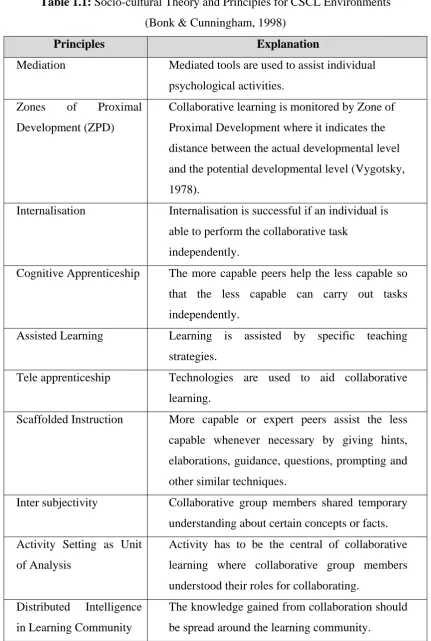
The theoretical framework of this research is presented in Figure 1.1. Initially, the term ‘cognitive engagement’ is made transparent for future reference. Prior analysis works have explained that computer-supported collaborative learning (CSCL) can support both co-construction of knowledge (Lipponen, 2002; Lehtinen et al., 1999) and greater social interaction (Lehtinen et al., 1999; Paavola et al., 2002). Thus, the CSCL environment is developed for the purpose of enhancing students’ cognitive engagement in online learning, which accords with the principles of CSCL by Bonk and Cunningham (1998) and the CSCL interaction principles of Jochems, Marten and Strijbos (2004).
“The implication of applying the 3PD model is that the original functional system will always be subject to change, and that
development environments need to schedule resources for the life-time of that course. The continual process of gathering and incorporating evaluation data caters for the sustainability of the course”.
Upon implementation of the CSCL environment, the data obtained from students’ server log files and students’ discussion scripts is analysed using an integrated analytical model. From these processes, this research hopes to ascertain the levels of students’ cognitive engagement in the CSCL environment, how students were cognitively engaged and how they performed in performance tests based on the construction of a performance predictive model. The following sub-topics will provide greater insight on each element of the proposed theoretical framework.
1.6.1 Cognitive Engagement in Online Learning
The definition of cognitive engagement is adapted from Zhu’s (Zhu, 2006) previous work. His definition of cognitive engagement relates to the students’ attention to discussion messages, which can be observed from behaviour seen in several postings (Zhu, 2006). According to Zhu (2006), students’ mental efforts can be translated into activities such as seeking, interpreting, analyzing and summarizing information, critiquing and reasoning through various opinions and arguments, and, finally, making decisions. The related activities are respectively the characteristics of collaborative co-construction of knowledge (Van der Meijden, 2005). Hence, cognitive engagement in this respect can also be understood as being students’ sustained mental efforts towards co-construction of knowledge while solving a given task.
context where observation is almost impossible to be carried out Students’ textual material being produced during discussions can serve as a representative of their mental activities and interactivity (Muirhead, 2000).
1.6.2 Computer-supported Collaborative Learning Environment
The proposed CSCL environment in this research integrates both CSCL principles (Bonk and Cunningham, 1998) and CSCL interaction design principles by Jochems, Marten and Strijbos (2004). The following discussions will provide detailed descriptions on how both principles are integrated to boost cognitive engagement in online learning.
1.6.2.1 CSCL principles based on Socio-cultural Theory
Socio-cultural theory views learning as a process that should occur in a social context (Jeon, 2000). The social context is the primary dimension in this theory, where Vygotsky (1978) asserts that a child’s development appears between people (social plane) (that is, the inter-psychological category) and between a child (individual plane) (that is, intra-psychological category). Nevertheless, individual learning remains applicable in this theory, but as a secondary dimension (Jeon, 2000).
Table 1.1: Socio-cultural Theory and Principles for CSCL Environments (Bonk & Cunningham, 1998)
Principles Explanation
Mediation Mediated tools are used to assist individual psychological activities.
Zones of Proximal Development (ZPD)
Collaborative learning is monitored by Zone of Proximal Development where it indicates the distance between the actual developmental level and the potential developmental level (Vygotsky, 1978).
Internalisation Internalisation is successful if an individual is able to perform the collaborative task
independently.
Cognitive Apprenticeship The more capable peers help the less capable so that the less capable can carry out tasks independently.
Assisted Learning Learning is assisted by specific teaching strategies.
Tele apprenticeship Technologies are used to aid collaborative learning.
Scaffolded Instruction More capable or expert peers assist the less capable whenever necessary by giving hints, elaborations, guidance, questions, prompting and other similar techniques.
Inter subjectivity Collaborative group members shared temporary understanding about certain concepts or facts. Activity Setting as Unit
of Analysis
Activity has to be the central of collaborative learning where collaborative group members understood their roles for collaborating.
Distributed Intelligence in Learning Community
1.6.2.2 The designing principles of CSCL environment for interaction
To tackle interaction issues that have previously been described, interaction in a CSCL environment has to be properly designed so that it triggers communication leading to knowledge sharing, and thus knowledge is constructed (Strijbos, Martens and Jochems, 2004). Veerman and Treasure-Jones (1999) quoted that for students to argue in a collaborative problem-solving environment, task characteristics and structured interaction play an interconnected role. Strijbos, Martens and Jochems (2004) proposed a process-oriented methodology for which the influence of interaction factors is composed of six designing steps. These are, namely:
i. learning objectives, ii. type of interaction iii. task-type
iv. level of pre-structuring, v. group size, and
vi. computer support.
For designing the CSCL environment to foster interaction, questions should be addressed with respect to the six designing steps which are discussed clearly in Chapter 5 (Strijbos, Jochems & Martens, 2004).
1.6.3 Three-phase Development Instructional Design Model
In relation to the instructional design, the model considers the following issues with respect to online learners, namely:
i. learners have the potential to advance and define their own essential knowledge base,
ii. the very uncertainty and lack of predictability of learning outcomes will be the key factors that add value to a learning community,
iii. emergent systems will provide the necessary triggers to enhance knowledge and understanding, and
iv. emergent learning will be one of the critical triggers by which individual creativity will be unleashed (Kays & Sims, 2006).
1.6.4 Integrated Analytical Model for Analyzing Students’ Cognitive Engagement in Online Learning
In this research, an integrated approach model is suggested to assess both aspects of students’ online learning. To investigate the quality of online learning, students’ cognitive engagement is assessed through their written messages in online discussions using the content analysis technique. A specific coding scheme by Van der Meijden (2005) is used to code the messages.
On the other hand, the data on students’ participation in online learning for quantitative assessment is retrieved from the available Learning Management System (LMS) databases (students’ server log files) and is further analyzed using the data mining technique.
1.6.5 Students' performance predictive model
A students' performance predictive model will illustrate the overall activities occurring within the CSCL environment. The model will be able to predict which cognitive attribute(s) is/are beneficial for students' attainment of a higher degree of cognitive engagement.
1.7 Research Rationale
The rapid and continuous growth of online learning provides the reason for conducting the present research. There are plenty of instructional designs, as well as pedagogical aspects, being incorporated within online learning websites. Evaluations of the effectiveness of developed websites are also studied. However, research on the pedagogical aspects, such as students’ cognitive engagement in the learning processes, will provide a greater insight into online learning. The relevance of cognitive engagement being narrowed down as the main scope of this research is due to several reasons.
Firstly, online learning is widely applied, but the quality of such learning context on students’ knowledge gains remain dubious. Although several efforts have been made to investigate students’ level of cognitive engagement in online learning, it was found that, for some time, students’ cognitive engagement remains at the low level. This scenario is worth researching, for online learning should be able to trigger students to achieve a higher level of cognitive engagement. Additionally, previous researches were also unable to fill the empty gap about the way in which students’ cognitive engagement in online learning can be related to their academic performances.
idea of using the CSCL approach to promote cognitive engagement in online learning is based on the premise that it might enable an increase in students’ academic performances and social skills by providing a set of guiding principles for learning and interacting.
1.8 Relevance of Research
The findings from this research are very useful to illustrate the current degree of students’ cognitive engagement in online learning settings. Upon recognising the degree of students’ cognitive engagement in online learning discussion, this research provides the framework for elevating the students’ lower degree of cognitive engagement in online learning context to the higher degree. The research would also examine varying impacts of a collaborative learning environment on students with differing levels of performance in tests.
1.8.1 Relevance of Research to Students
1.8.2 Relevance of Research to the Educators
As noted by Tu and Yen (2007), it is important to investigate individuals’ reactions towards the mediated environment. Thus, the findings of the research would suggest to academicians and educators the domains of collaborative learning that most affectstudents’ performances. It would be comprised of either the scaffolding instructions, the group composition or a result from other domains.
Also, educators will be able to ascertain important aspects that contributed to better cognitive engagement in online learning and thus enhance learning performances. It would be by way of either encouragingstudents to share information and elaborate on it, arguing on facts, asking and answering questions or due to other aspects. From the knowledge gained in this research, the educators can put in more emphasis to specific areas that can contribute to better cognitive engagement among the students.
Other than that, this research will explain the factors that either contribute to or might inhibit students’ cognitive engagement and learning performances in online learning. Thus, educators can benefit by proposing early planning, mediation or intervention to their students at hand.
1.8.3 Relevance of Research to Ministry of Higher Education, MOHE
1.8.4 Relevance of Research to Society
To a greater extent, the culture of building knowledge within a community, as is being applied in this research, will be able to produce valuable human resources. These resources will possess a variety of skills such as; being socially interactive, problem-solvers, and decision-makers, rather than simply being academically outshined.
1.9 Scope and Limitation of Research
This section provides information on the area being covered by this research. The limitations are also clearly stated to provide useful guidance for future research.
1.9.1 The Context
The research focuses on the students’ cognitive engagement in the online learning context, specifically through their online learning discussions under the influence of a collaborative learning environment. Cognitive engagement in this research’s context is reflected from students’ construction of knowledge in discussion messages while solving the given tasks.
1.9.2 The Samples
Samples in the present research are Malaysian undergraduate students who have basic computer skills, such as ability to operate Microsoft Word, PowerPoint, and Excel. The samples have also learned several computer subjects such as Basic Computer Programming and Digital Video and Animation. Simply said, they are computer literate, and thus, skills for learning online are not discussed but rather their cognitive engagement while completing the given task. However, limitations consisting of their differences in basic computer skills, as well as gender factors, are not being considered in this research.
1.10 Operational Definition
Following is a description of how different terminologies are used in the research.
1.10.1 Knowledge Construction
Van Aalst (2009, p. 11) defined knowledge construction as involving a variety of cognitive processes such as:
“.. explanation-seeking questions and problems, interpreting and evaluating new information, sharing, critiquing, and testing ideas at different levels and efforts to rise above current levels of explanation, including summarization, synthesis and the creation of new concepts”.
levels. Van der Meijden (2005) further explained that students’ knowledge construction can be categorized into low and high levels. A low level of knowledge construction generally does not involve students making significant cognitive efforts when elaborating facts or arguments. However, a high level of knowledge construction involves cognitive efforts of elaborating facts and arguments (Van der Meijden, 2005).
Students are cognitively engaged whenever knowledge is constructed through the variety of cognitive processes (for example, explanation-seeking questions and problems, interpreting and evaluating new information, sharing, critiquing, etc.). These cognitive processes are observed from students’ written messages and thus students are cognitively engaged from the emergence of these behaviours (Zhu, 2006).
1.10.2 Cognitive Engagement
The term ‘cognitive engagement’ in this research is defined by the employment of mental effort that students exert to solve a given task (Scott & Walczak, 2009; Blumenfeld, Kempler and Krajcik, 2006; Connell & Wellborn, 1991; Corno & Mandinach, 1983).
As in an online learning context, cognitive engagement is visible in this research through the perspective of Zhu (2006, p.454). He mentions that, in order to be cognitively engaged, students should be observed as being able to seek, interpret, analyze and summarize information. Other than that, they are able to critique and rationalise statements by giving opinions, arguments and making decisions.
i. asking comprehensive questions requiring explanations, ii. presenting answers with arguments or justification, iii. presenting new ideas with explanations,
iv. acceptance or rejection of others’ ideas with justification.
With respect to these behaviours, cognitive engagement is used interchangeably with knowledge construction on the understanding that when knowledge is constructed through provision of these behaviours in discussion messages, students are cognitively engaged in online learning (at low or high level).
1.10.3 Online Learning and Learning
For the purposes of this research, online learning is clearly defined as the platform of delivering instructions, learning and assessing through the web and hence utilizing various media and intra/internet resources to achieve the desired educational goals (Michigan Virtual University, 2005).
Learning, on the other hand is viewed as:
“.. a process, demonstrated through conversation, in which learners
reflect upon what they currently know and negotiate meaning and knowledge creation with others through conversation” (Dennen & Paulus, 2005, p. 97).
1.10.4 Collaborative Learning
Collaborative learning in this research entails the following properties:
i. a small group working together (Gol & Nafalski, 2007; Barkeley, Cross & Major, 2005; Smith & MacGregor, 1992),
ii. having specific learning activities or tasks (Barkeley, Cross & Major, 2005; Dillenbourg et al., 1996),
iii. knowledge being created upon collaboration (Dillenbourg & Fischer, 2007; Alavi & Dufner, 2005; Crook, 1998;Blumenfeld et al., 1996).
1.10.5 Computer-supported Collaborative Learning
Computer-supported collaborative learning (CSCL), as termed in this research, emerged from socio-cultural theory and socio-cognitive theory. The present research applies CSCL from the view of socio-cultural theory. It is a learning approach designed with the goal of putting students in a group to learn together to solve deliberate tasks in a computer-mediated environment (Lipponen, 2002). Each group member holds a role in order to accomplish the groups’ learning goal. The absence of one of the roles will cause the group to malfunction. This is one of the elements that differentiates collaborative learning from cooperative learning (Roschelle & Teasley, 1995).
1.10.6 Social Interaction
(1993) asserts that social interaction happens to be the fundamental principle of collaboration (Garrison, 1993). In this research, social interaction is defined according to Bornstein and Bruner (1989) as follows:
“Social interaction is the transmission of ideas, thoughts, emotions, knowledge, or processes between at least two people, where the learner and tutor interact with each other in a crucially patterned manner”.
Three main forms of interactions are: the student interaction, content interaction and teacher interaction (Moore, 1969). However, student-student interaction (peer interaction) will be the focus of this research. As indicated by Dillenbourg (1999), CSCL values all types of interactions, however, peer interaction should be emphasized as it is the type of interaction that results in collaborative knowledge building.
1.11 Summary
REFERENCES
Abdullah, S., Md Noor, N. & Aris, B. (2007). Pembangunan dan Penilaian Pembelajaran Menerusi Web bagi sub topik “Membina Laman Web” berasaskan pendekatan kolaboratif. 1st International Malaysian Educational Technology Convention, 735-743.
Andre, T. (1986). Problem Solving and Education. In Phye, G. D. and Andre, T. (Eds.) Cognitive Classroom Learning. (169-200). USA: Academic Press Inc.
Andresen, M.A. (2009). Asynchronous Discussion forums: success factors, outcomes, assessments, and limitations. Educational Technology & Society. 12(1), 249-257.
Anjewierden, A., Kollöffel, B., and Hulshof, C. (2007). Towards educational data
mining: Using data mining methods for automated chat analysis to understand
and support inquiry learning processes. In Proceedings of International
Workshop on Applying Data Mining in e- Learning (ADML 2007) as part of the 2nd European Conference on Technology Enhanced Learning (EC- TEL
2007), Crete, Greece.
Alavi, M. and Dufner, D. (2005). Technology-mediated collaborative learning: a research perspective. In S. R. Hiltz and R. Goldman (Eds.). Learning Together
Online: Research on Asynchronous Learning Networks,.(pp. 191–213). Mahwah, NJ: Lawrence Erlbaum Associates.
Allen, E., & Seaman, J. (2004). Entering the Mainstream: The Quality and Extent of Online Education in the United States, 2003 and 2004. Needham, Mass.: Sloan-Consortium, 2004.
Archambault, I., Janosz, M., Fallu, J., and Pagani, L. (2009). Student engagement and its relationship with early high school dropout. J. Adolesc. 32, 651–670.
Arend, B. (2009). Encouraging critical thinking in online threaded discussions. The Journal of Educators Online, 6 (1), 1-23.
Artino, A. R. (2010). Online or face-to-face learning? Exploring the personal factors that predict students’ choice of instructional format. Internet & Higher Education. 13, pp. 272-276.
Appleton, J. J., Christenson, S. L., Kim, D., & Reschly, A. L. (2006). Measuring cognitive and psychological engagement: Validation of the Student Engagement Instrument. Journal of School Psychology. 44, 427 – 445.
Auttawutikul S., Na–Songkla, J., & Natakuatoong, O. (2008). Developmentof a Knowledge Sharing Process using CSCL based on PAL Approach to Enhance
Knowledge Creation Behaviors of Graduate Students. E-Journal of Thailand Cyber University. 1(1).
Azizi Yahaya, Shahrin Hashim, Jamaludin Ramli, Yusof Boon, Abdul Rahim
Hamdan (2007). Menguasai Penyelidikan dalam Pendidikan Teori, Analisis & Interpretasi Data. Kuala Lumpur: PTS Professional Publishing Sdn. Bhd.
Bagnato, A.R. (1973). Teaching College Mathematics by Question-and-Answer.Educational Studies in Mathematics, 185-192.
Bai, H. (2003). SocialPresence and CognitiveEngagement in Online Learning Environments. In A. Rossett (Ed.), Proceedings of World Conference on E-Learning in Corporate, Government, Healthcare, and Higher Education 2003. (pp.1483-1486). VA: AACE.
Bandura, A. (1977). Social Learning Theory. New York: General Learning Press.
Barron , B. (2003). When smart groups fail. The Journal of the Learning Sciences, 12(3), 307-359.
Barkley, E. F., Cross, K.P. & Major, C. H. (2005). Collaborative learning techniques: A handbook for college faculty. San Francisco: Jossey-Bass.
Beach, D. (2008). Emerging ID models. Unpublished manuscript.
Beasley, N. & Smyth, K. (2004). Expected and Actual Student Use of an Online Learning Environment: A Critical Analysis. Electronic Journal on e-Learning, 2( 1), 43-50.
Beeland Jr., W. D. (2002). Student Engagement, Visual Learning and Technology: Can Interactive Whiteboards Help?. Action Research Exchange, Retrieved
September 13, 2009, from
http://chiron.valdosta.edu/are/Artmanscrpt/vol1no1/beeland_am.pdf
Beers, P. J., Boshuizen, H. P. A., Kirschner, P. A., & Gijselaers, W. H. (2005). Computer support for knowledge construction in collaborative learning environments. Computers in Human Behavior, 21, 623–643.
Beer, C. Clark, K., & Jones, D. (2010). Indicators of engagement. In C.H. Steel, M.J. Keppell, P. Gerbic & S. Housego (Eds.), Curriculum, technology & transformation for an unknown future. Proceedings ascilite Sydney 2010, 75-86.
Berry, R. G. (2006). Can Computer-Mediated Asynchronous Communication Improve Team Processes and Decision Making? Learning From the Management Literature. Journal of Business Communication, 43 (4). Pp. 344-366.
Betts, K. S. (2009). Lost in translation: Importance of effective communication in online education. Online Journal of Distance Education Administrators, 12(2).
Blumenfeld, C. P., Kempler, M. T., & Krajcik, S. J. (2006). Motivation and Cognitive Engagement in Learning Environements. In Sawyer, R. K (Ed.), Cambridge Handbook of Learning Sciences, pp 475-488.
Blumenfeld, P. C., Marx, R. W., Soloway, E. & Krajcik, J. (1996). Learning with peers: From small group cooperation to collaborative communities. Educational Researcher, 25(8), 37-40.
Bogdan, C. R. & Biklen, K. S. (2003). Qualitative Research for Education: An introduction to theories and methods. (4th edn), USA: Pearson Education Group.
Bonanno, K. (2005). Online Learning: The Good, The Bad, and The Ugly. Australian School Library Association XIX Biennial Conference – Meeting the challenge – April 2005.
Bonk, C. J. & Cunningham, D. J. (1998). Searching for learner-centered, constructivist, and sociocultural components of collaborative educational
learning tools. In C. J. Bonk & K. S. King (Eds.), Electronic collaborators: Learner-centered technologies for literacy, apprenticeship, and discourse (pp. 25-50). Mahwah, NJ: Erlbaum.
Borhan, L. (2005). The Development of children’s cognition through social interaction. Masalah Pendidikan 2005, 13-20.
Bornstein, M. H., & Bruner, J. S. (Eds.). (1989). Interaction in human development. Hillsdale, NJ: Lawrence Erlbaum Associates.
Bradford, G. & Wyatt, S. (2010). Online learning and student satisfaction: Academic standing, ethnicity and their influence on facilitated learning, engagement, and
information fluency. Internet & Higher Education, 13, 108-114.
Bromme, R. (2000). Beyond one's own Perspective - The Psychology of Cognitive Interdisciplinarity. In: Weingart, PeterStehr, Nico, eds. Practising Interdisciplinarity. Toronto, 115-133.
instruction: Essays in honor of Robert Glaser. (pp. 393-451). Hillsdale, NJ: Lawrence Erlbaum.
Burrows, Peter L. (2010). An examination of the relationship among affective, cognitive, behavioral, and academic factors of student engagement of 9th grade students. Thesis. University of Oregon.
Cameron, L. (2006). Teaching with Technology: Using Online Chat to Promote Effective In-Class Discussions. Paper presented at the Proceedings of the 23rd Annual ASCILITE Conference: Who’s learning? Whose technology?.3-6 December, 2006, Sydney.
Campbell, D. & Stanley, J. (1963). Experimental and quasi-experimental designs for
research. Chicago, IL: Rand-McNally.
Capozzoli, M., McSweeney, L., and Sinha, D. (1999). Beyond Kappa: A review of
interrater agreement measures. The Canadian Journal of Statistics, 27(1), 3 –
23.
Carini, R. M., Kuh, G. D. & Klein, S. P. (2006) Student engagement and student learning: Testing the linkages. Research in Higher Education, 47(1), pp. 1-31.
Carter, J. & Boyle, R. (2002). Teaching Delivery Issues- Lessons from Computer Science. Journal of Information Technology Education, 1(2), pp. 77-89.
Cavanaugh, C. (2009). Distance Education in Support of Expanded Learning Time in
Schools. Washington, DC: Center for American Progress. Scheduled for May
18 release at http://www.americanprogress.org/issues/domestic/education
Centre of Assessment and Evaluation of Student Learning. (2004). Why Test
Students?. Assessment Brief, 7.
Chen, P. D., Lambert, A. D., & Guidry, K. R. (2010). Engaging online learners: The impact of Web-based learning technology on student engagement. Computers & Education, 54(4), 1222-1232.
Chen, P. D., Guidry, K. R., & Lambert, A. D. (2009). Engaging online learners: A quantitative study of postsecondary student engagement in the online learning environment. Paper presented at the 2009 American Educational Research Association Annual Conference, San Diego, CA.
Cheung, S.W., Tan, C.S. & Hung, D. (2004). Investigating Problem Solving with Computer-supported Collaborative Learning. AARE International Education
Research Conference.
Chou, P. -N. & Chen, H. -H. (2008). Engagement in online collaborative learning: A case study using a web 2.0 tool. MERLOTJournal of Online Learning and Teaching, 4 (4), 574-582.
Chuah, C.K. (2007). Experience Redesign: A Conceptual Framework for Moving Teaching and Learning into a Flexible E-learning Environment. In Tsang, P. Kwan, R. and Fox, R (Eds.) Enhancing Learning through Technology.
Chung, W-T., Stump, G., Hilpert, J., Husman, J., Wonsik Kim & Ji Eun Lee. (2008). Addressing engineering educators’ concerns: Collaborative learning and achievement.38th AnnualFrontiers in Education Conference, 2008. FIE 2008.
Clark, D. R. (2004), Types of Evaluations in Instructional Design. Retrieved March
1, 2011 from
http://www.nwlink.com/~donclark/hrd/isd/types_of_evaluations.html
Coates, H. (2005). Leveraging Online Learning to Enhance Campus-based Student Engagement. EDUCAUSE Quarterly, vol. 1, pp. 66-68.
Cohen, J. (1988). Statistical power analysis for the behavioral sciences. Second Edition. Hillsdale, NJ: Lawrence Erlbaum Associates, Publishers.
(Ed.), Knowing, learning, and instruction: Essays in honor of Robert Glaser (pp. 453–494). Hillsdale, NJ: Lawrence Erlbaum Associates.
Connell, J. (1990). Context, self, and action: A motivational analysis of self-system processes across the life-span. In D. Cicchetti & M. Beeghly (Eds.), The self in transition: From infancy to childhood (pp. 61–67). Chicago: University of Chicago Press.
Connell, J.P. & Wellborn, J.G. (1991). Competence, autonomy, and relatedness: A motivational analysis of self-esteem processes. In M. Gunnar and L.A. Sroufe (eds.), Minnessota Symposium on Child Psychology. Chicago: University of
Chicago Press.
Cook, T. D. & Campbell, D. T. (1979). Quasi-experimentation: Design and analysis issues for field settings. Boston, MA: Houghton Mifflin Company.
Corno, L., & Mandinach, E. B. (1983). The Role of Cognitive Engagement in Classroom Learning and Motivation. Educational Psychology. 18(2), 88-108.
Cotton, D. & Yorke, J. (2006). Analyzing online discussions: What are the students learning? In Proceedings of the 23rd Annual Conference of the Australasian Society for Computers in Learning in Tertiary Education: “Who's learning? Whose technology?” December, 2006, Sydney, Australia.
Creswell, J. (2003). Research design: Qualitative, quantitative, and mixed methods approaches. Thousand Oaks, CA: Sage Publications.
Creswell, J. W. (2004). Educational Research: Planning, Conducting, and Evaluating Quantitative and Qualitative Research. USA: Sage Publication.
Crook, C.K. (1998) Young children as users of new technology. Computers and Education, 30, 237-247.
Curran, C. (2001). The Phenomenon of On-line Learning.European Journal of Education. 36 (2), pp. 113-132.
Dennen, V. P. & Paulus, T. M. (2005). Researching “collaborative knowledge building” in formal distance learning environments. Proceedings of CSCL 2005. Taipei:
International Society of the Learning Sciences.
de Jong, F., Veldhuis-Diermanse, E., & Lutgens, G. (2002). Computer-supported
collaborative learning in university and vocational education. In T.
Koschmann, R. Hall, & N. Miyake (Eds.) CSCL2: Carrying forward the
conversation. Mahwah, NJ: Lawrence Erlbaum, 111-128.
De Vaus, D.A. (2001). Research Design in Social Research, London: SAGE Publications.
Dick, W. & Cary, L. (1990). The Systematic Design of Instruction, Third Edition, Harper Collins.
Dillenbourg, P. (1999). What do you mean by "collaborative learning"? In P. Dillenbourg (Ed.), Collaborative learning: Cognitive and computational approaches. Amsterdam, NL: Pergamon, Elsevier Science, 1-16.
Dillenbourg, P., & Schneider, D.K. (1995). Collaborative learning and the internet. In Proceedings of the ICCAI 95 University of Geneva, Switzerland. http://tecfa.unige.ch/tecfa/research/CMC/colla/iccai95_20.html
Dillenbourg, P., Baker, M., Blaye, A. & O'Malley, C.(1996) The evolution of research on collaborative learning. In E. Spada & P. Reiman (Eds) Learning in Humans and Machine: Towards an interdisciplinary learning science. Oxford: Elsevier, 189-211.
Dillenbourg, P. & Fischer, F. (2007). Basics of Computer-Supported Collaborative Learning. Zeitschrift fur berufs-und Wirtschaftspadagogik. 21, 111-130.
Ding, N. (2009). Visualizing the sequential process of knowledge elaboration in computer-supportedcollaborative problem solving. Computers & Education, 52, 509-519.
Dixon, R., Dixon, K. & Axmann, M. (2008). Online student centred discussion: Creating a collaborative learning environment. In Hello! Where are you in the landscape of educational technology? Proceedings ascilite Melbourne 2008.http://ascilite.org.au/conferences/melbourne08/procs/dixon.pdf
Dringus, L.P. & Ellis, T. (2005). Using data mining as a strategy for assessing asynchronous discussion forums. Computers & Education, 45(1), 141 – 160.
Duffy, T., Korkmaz, A. Dennis, A., Bichelmeyer, B. Bunnage, J., Cakir, H. & Oncu, S. (2005). Engagement in Learning and student success: Findings from the CCNA2 course. Cisco Networking Academy Evaluation Project White Paper. Indiana University, Dec 2005. 1-13.
Earnshaw, R. (2007). Developing Quality Online Courses: A Three-phase Model Approach at Georgia Virtual School. Paper presented at 23rd Annual Conference on Distance Teaching and Learning, pp. 1-3.
Ellis, R., Goodyear, P., Prosser, M., & O’Hara, A. (2006). How and what university students learn through online and face-to-face discussion: conceptions, intentions and approaches. Journal of Computer Assisted Learning, 22(4), 244-25
Eskin and Ogan-Bekiroglu, H. (2009). Investigation of a pattern between students’ engagement and their science content knowledge: A case study., Eurasia Journal of Mathematics, Science & Technology Education,5 (1), pp. 63–70.
Farahiza, A. (2010). Blended Learning In Higher Education Institution In Malaysia. Regional Conference on Knowledge Integration in ICT, Putrajaya, 1 June 2010.
Finn, J. D. (1989). Withdrawing from school. Review of Educational Research, 59, 117-142.
Finn, J. D. (1993). School engagement and student at risk. Washington D.C.:
Fjermestad, J. Hiltz, R. S. & Zhang, Y. (2005). Effectiveness for students: Comparisons of ‘In-seat’ and ALN Courses. In Learning Together Online: Research on Asynchronous Learning Networks. USA.
Fleiss, J. L. (1981). Statistical methods for rates and proportions. 2nd ed. (New York: John Wiley) pp. 38–46.
Flowerday, T., & Schraw, G. (2003). Effect of choice on cognitive and affective engagement. Journal of Educational Research, 96, 207–215.
Flynn, T. (2003). Making Sense of Online Lerning: Frames, Rubrics, Tools & Coding
systems for analyzing asynchronous online discourse. AERA 2003, Chicago, pp. 1-37.
Flynn, T. (2004). Cognitive engagement in online discourse: A phenomenological study of knowledge construction in asynchronous dialogic community of practice. Doctoral Thesis. Pepperdine University.
Fredericks, J. A., Blumenfeld, P. C., & Paris, A. H. (2004). School engagement: Potential of the concept, state of the evidence. Review of Educational Research, 74, 59-109.
Garrison, D. R. (1993). Quality and Theory in Distance Education: Theoretical Consideration. In Keegan, D. (Ed.), Theoretical Principles of Distance Education, Routledge, New York: USA.
Garrison, D. R., & Anderson, T. (2003). E-learning in the 21st century: A framework for research and practice. London: RoutledgeFalmer.
Garrison, D. R., Anderson, T., & Archer, W. (2001). Critical thinking and computer conferencing: A model and tool to assess cognitive presence. American Journal of Distance Education, 15(1), 7-23.
Gerlach, J. M. (1994). Is this collaboration?. In Bosworth, K. and Hamilton, S. J. (Eds.), Collaborative Learning: Underlying Processes and Effective Techniques, New Directions for Teaching and Learning No. 59.
Ginns, P. & Ellis, R. (2007). Quality in blended learning: Exploring the relationships between on-line and face-to-face teaching and learning. Internet and Higher Education, 10, pp. 53-64.
Greer, T (2002). Critical Success Factors in Developimg, Implementing, and Teaching a Web Development Course. Journal of Information Systems Education, 13(1), 17-20.
Gress, C. L.Z., Fior, M., Allyson, F. H. & Ph