ABSTRACT
SHAFIEFARHOOD, ARYA. Core-Shell Redox Catalyst for Partial Oxidation of Methane with Active Lattice Oxygen. (Under the direction of Dr. Fanxing Li.)
Chemical looping processes offer more efficient, cost effective and environmentally friendly
routes for carbonaceous fuel conversion. This is achieved through a cyclic reaction and by
replacing the gaseous oxidants with the oxygen in the lattice of an oxygen carrier. Application
of chemical looping processes ranges from complete combustion (CLC) for energy production
to partial oxidation for reforming (CLR) or direct oxidation purposes. The effective
performance of these processes greatly depends on the performance of the oxygen carrier. As
a result, Rational design of active and selective oxygen carriers are of utmost importance.
Oxygen carriers are typically made out of two main parts: an oxygen reservoir (typically an
oxide of a transition metal) and an inert support phase to increase the mechanical properties of
the oxygen carrier. Therefore, the redox properties of the oxygen carriers can be tuned by both
changing their intrinsic properties and catalytic surface modification to enhance their kinetic
properties. This study focuses on development of more active and selective redox catalysts
though investigations on (i) using iron-based mixed oxides with tunable properties as oxygen
reservoirs, (ii) using mixed ionic-electronic conductive (MIEC) materials as support phases to
improve redox properties of iron-based redox catalysts, and (iii) catalytic surface modification
of redox catalysts to enhance their kinetic properties.
Oxygen carrying capacity and activity of the iron oxide-based oxygen carriers are proved to
be tuned by the addition of various concentrations of more readily reducible metals such as
demonstrated better spontaneous oxygen donation and better activities for methane oxidation.
The addition of compatible mixed ionic-electronic conductors, such as perovskites, proved to
improve the redox activity of the redox catalysts. These supports, which generally contain earth
or rare-earth metals, commonly have better selectivity toward syngas compared to iron oxide
due to the presence of more catalytically active sites on their surface.
The perovskite supported iron oxide is further engineered into a [email protected]
core-shell structure to exploit the high oxygen carrying capacity of iron oxide and the selective and
coke resistant surface of LSF. Results showed superior activity (up to 200 times) and selectivity
during a methane CLR process, when compared to iron oxide supported on inert materials
(Al2O3 and TiO2) and ionic conductors (YSZ). Slightly better activity, selectivity and coke
resistance are also observed compared to the composite sample with an identical LSF support.
The recyclability of the core-shell redox catalyst is also confirmed through long-term redox
experiments.
The core-shell redox catalyst undergoes four different reduction regions with noticeably
different product selectivities during the methane reduction half cycle. As confirmed by
transient pulse injection and isotopic exchange experiments, the underlying methane oxidation
mechanisms are different in the selective, and non-selective regions. Mars-van Krevlen
mechanism in which lattice oxygen converts surface activated species can be used to describe
the methane oxidation reaction throughout the reduction half cycle. Methane activation,
however, changes from forming loosely adsorbed activated species in the non-selective region
to dissociatively adsorbed species in the selective region. Oxygen anion diffusion through the
The effect of catalytic surface modification is studied on two different redox catalysts
(CaMnO3 and LaCeO3.5) as the core-shell samples already shows very high activity and
selectivity. Rh is used to enhance the redox properties of the redox catalysts. The presence of
rhodium enhances the methane activation kinetic on the surface. This leads to a faster and
higher oxygen removal from the redox catalysts. Rhodium is proved to reduce the CLR
operating condition by more than 300 °C. The Rh-promoted samples also showed good
© Copyright 2016 by Arya Shafiefarhood
Core-Shell Redox Catalyst for Partial Oxidation of Methane with Active Lattice Oxygen
by
Arya Shafiefarhood
A dissertation submitted to the Graduate Faculty of North Carolina State University
in partial fulfillment of the requirements for the degree of
Doctor of Philosophy
Chemical Engineering
Raleigh, North Carolina
2016
APPROVED BY:
_____________________________ ______________________________
Dr. Fanxing Li Dr. Gregory Parsons
Committee Chair
_____________________________ ______________________________
ii DEDICATION
To my mom, Farideh Memar-Esfahani, for all your love and sacrifices.
iii BIOGRAPHY
Arya Shafiefarhood was born in Tehran, Iran on July 3, 1987. Upon graduation from high
school in June 2005, he passed the national university entrance exam and attended college at
University of Tehran for chemical engineering. After graduation, he was offered honorary
admission to the Master’s program at the same school due to his remarkable credentials. Upon
finishing the Master’s program, Arya was accepted to North Carolina State University in the
department of chemical and biomolecular engineering in Fall 2011 to continue his graduate
studies toward Ph.D. He joined Dr. Fanxing Li’s research group in January 2012 to engage in
developing cleaner processes for fossil fuel conversion. He also took the opportunity to assist
in teaching graduate and undergraduate courses. During his Ph.D. program, Arya grew a
passion for volleyball and joined NC State mens volleyball club and attended The National
Collegiate ClubVolleyball Championship in 2015 (in which they ranked 6th) and 2016.
Following the completion of his Ph.D., Arya will be continuing his research in the same group
iv TABLE OF CONTENTS
LIST OF TABLES ... IX
LIST OF FIGURES ... XI
CHAPTER 1 Introduction ...1
1.1 Methane as an Energy Source ... 1
1.2 Current Technologies for Methane Conversion ... 2
1.2.1 Complete Oxidation/Combustion ... 2
1.2.2 Partial Oxidation ... 3
1.2.2.1 Methane Valorization ... 4
1.2.2.2 Methane reforming ... 6
1.3 Chemical Looping ... 7
1.3.1 Chemical Looping Combustion (CLC) ... 8
1.3.2 Chemical looping with Oxygen Uncoupling (CLOU) ... 10
1.3.3 Chemical Looping Reforming (CLR)... 11
1.3.4 Challenges for chemical looping processes ... 11
1.4 Oxygen Carriers/Redox Catalysts ... 12
1.4.1 Nickel-based Oxygen Carriers ... 13
1.4.2 Copper-based Oxygen Carriers ... 14
1.4.3 Iron-based Oxygen Carriers... 15
1.4.4 Manganese-based Oxygen Carriers ... 16
1.4.5 Cobalt-based Oxygen Carriers ... 17
1.4.6 Mixed Oxide Oxygen Carriers ... 18
v
1.5 Summary ... 20
REFERENCES ... 23
CHAPTER 2 Iron-Containing Mixed-Oxide Composites as Oxygen Carriers for Chemical Looping with Oxygen Uncoupling (CLOU)……….………...35
2.1 Abstract ... 35
2.2 Introduction ... 36
2.3 Experimental ... 39
2.3.1 Oxygen Carrier/Mixed Metal Oxide Selection and Preparation ... 39
2.3.2 Sample Characterization and Oxygen Donation/Uncoupling Experiments ...41
2.3.3 Interfacial Phase Diffusion Study ... 42
2.4 Results and Discussion ... 43
2.4.1 Effect of Cation Ratios on Oxygen Uncoupling Characteristics ... 43
2.4.1.1 Oxygen Carrier Phase Characterization ... 43
2.4.1.2 Uncoupling Properties of the Oxygen Carriers ... 44
2.4.2 Effect of Support Addition and Primary-Secondary Phase Interactions ... 47
2.4.2.1 Effect of Support Addition on Decomposition Behavior of Mixed Oxides ………..47
2.4.2.2 Interfacial Diffusion Study ... 51
2.4.2.3 Reducibility in Hydrogen and Methane ... 53
2.4.3 Redox Tests ... 55
2.4.3.1 Cyclic CLOU Studies ... 55
2.4.3.2 Cyclic Redox in Methane/Oxygen ... 56
vi
Acknowledgments ... 58
REFERENCES ... 59
CHAPTER 3 Fe2O3@LaxSr1-XFeO3 Core-Shell Redox Catalyst for Methane Partial Oxidation………63
3.1 Abstract ... 63
3.2 Introduction ... 63
3.3 Results and Discussion ... 68
3.3.1 Redox Catalyst Characterization ... 69
3.3.2 Redox Activity Studies ... 72
3.3.3 Reactivity and Stability Studies ... 75
3.3.4 Selectivity Study ... 82
3.3.5 Carbon Formation ... 83
3.4 Conclusion ... 85
3.5 Experimental Section ... 86
3.5.1 Redox Catalyst Selection and Preparation ... 86
3.5.2 Sample Characterizations... 89
3.5.3 Redox Testing ... 90
Acknowledgments ... 91
REFERENCES ... 92
CHAPTER 4 Methane Partial Oxidation Using [email protected]δ Core-Shell Catalyst - Transient Pulse Studies ...97
4.1 Abstract ... 97
vii
4.3 Experimental ... 101
4.3.1 Catalyst Synthesis ... 101
4.3.2 Pulse Injection Experiments ... 102
4.4 Results and Discussions ... 105
4.4.1 Deep Oxidation Region (Region I) ... 107
4.4.2 Selective Oxidation Region (Region III) ... 116
4.4.3 Competing Deep and Selective Oxidation Region (Region II) ... 119
4.5 Conclusion ... 121
Acknowledgments ... 122
REFERENCES ... 123
CHAPTER 5 Rh-Promoted Mixed Oxides for “Low-Temperature” Methane Partial Oxidation in Absences of Gaseous Oxidants ...129
5.1 Abstract ... 129
5.2 Introduction ... 130
5.3 Experimental ... 133
5.3.1 Redox Catalyst Synthesis ... 133
5.3.2 Sample Characterizations... 134
5.3.3 Redox Experiments ... 135
5.4 Results and Discussion ... 136
5.4.1 Redox Catalyst Selection and Characterizations ... 136
5.4.2 Methane TPR Experiments ... 137
5.4.3 Methane/Oxygen Redox Testing ... 138
viii
5.4.5 Pulse Injection Experiments ... 144
5.4.6 Effect of Temperature on Redox Properties ... 147
5.4.7 Long-Term Redox Experiments ... 152
5.5 Conclusion ... 153
Acknowledgments ... 153
REFERENCES ... 154
CHAPTER 6 Conclusions and Outlook ...158
REFERENCES ... 163
APPENDICES 164 Appendix 1 Supplementary Information for Chapter 2 ... 165
Appendix 2 Supplementary Information for Chapter 3 ... 176
Appendix 3 Supplementary Information for Chapter 4 ... 190
ix LIST OF TABLES
Table 1.1. Comparison of the average thermal efficiencies of the gas-fired power plants. 5–8...3
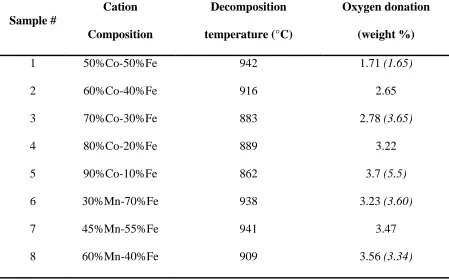
Table 2.1. Decomposition temperatures and total oxygen donations from the unsupported
mixed oxides (Italic numbers in the brackets are weight loss for sol-gel samples, all other
samples are prepared using a solid-state reaction or SSR method)………...…………46
Table 2.2. Decomposition temperatures and total oxygen donations from the supported mixed
oxides………..……….49
Table 2.3. Elemental composition of the cation species recorded from EDX point scan of the
point demonstrated in Figure 2.9……….………..……...53
Table 2.4. Initial reduction temperatures of selected supported and unsupported mixed oxides
in hydrogen and methane………...………...54
Table 3.1. Position and area percentage of the major reduction peaks for pure components and
supported samples...77
Table 3.2. BET surface area of the as-prepared perovskite supported samples………79
Table 3.3. Elemental compositions of the core-shell sample before and after 100 redox cycles
(Italic numbers in the brackets are atomic percentages of the cation species)……….………..81
Table 3.4. Post 100 cycle coke formation on the samples after 1 hour reduction in 10%
methane………..………..………85
Table 3.5. Redox catalyst samples and their nominal compositions……….87
Table 5.1. Methane coversion, CO/H2 selectivity, oxygen donation, and coke formation of the
x Table 5.2. Near surface atomic elemental composition of the redox catalysts in reduced and
oxidized state after 5 methane/oxygen cycles………...………..142
Table 5.3. Methane coversion, CO/H2 selectivity, oxygen donation, and coke formation of the
CaMnO3-based redox catalysts during the reduction half cycle…………...………..149
Table 5.4. Methane coversion, CO/H2 selectivity, oxygen donation, and coke formation of the
LaCeO3.5-based redox catalysts during the reduction half cycle (The selectivites of
unpromoted sample at 800 and 700 °C are not very accurate due to low signal to noise
ratio)………...………150
Table 5.5. Activation energies of the catalysts in both redox and pulse injection
xi LIST OF FIGURES
Figure 1.1. Comparison of price and emission of fossil fuels.3 ...1
Figure 1.2. Summary of conversion and selectivity data for methane to oxygenate conversion
reported in literature. 13 ...5
Figure 1.3. Chemical looping combustion schematic. ...9
Figure 2.1. Phase diagrams of a) Fe-Mn oxide43 and b) Fe-Co oxide in air (reproduced from
FactSage oxides database)………..………..41
Figure 2.2. Schematic of cation diffusion study between two pellets with well-defined
interface...43
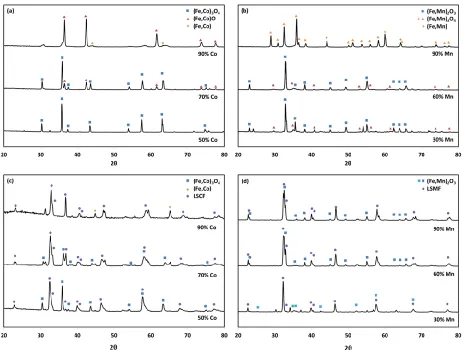
Figure 2.3. XRD spectra of as prepared samples before reoxidation ...44
Figure 2.4. DTG results of decomposition of unsupported samples fitted with Lorentzian
curves ...46
Figure 2.5. DTG results of decomposition of supported samples fitted with Lorentzian curves
...48
Figure 2.6. Comparison of decomposition temperature of mixed-oxide samples before and
after support addition ...49
Figure 2.7. Weight loss of the perovskite supports due to oxygen uncoupling in an inert
environment ...50
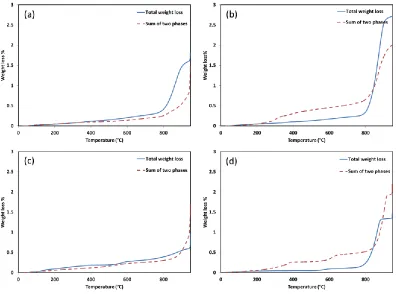
Figure 2.8. Comparison between the absolute weight loss of supported a) 50%Co-50%Fe, b)
70%Co-30%Fe, c) 30%Mn-70%Fe, d) 60%Mn-40%Fe due to oxygen uncoupling in an inert
environment ...51
Figure 2.9. Scanning electron micrograph of the phase interface of the a) Co3O4-LSF and b)
xii Figure 2.10. TPR results of a) unsupported Fe-Co, b) supported Fe-Co in 5% hydrogen with
5 °C/min temperature ramp ...54
Figure 2.11. Weight loss of mixed oxides in cyclic CLOU condition, a) 50% Co, b) 80% Co,
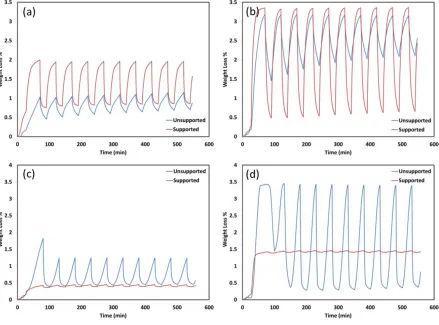
c) 30% Mn, d) 60% Mn ...56
Figure 2.12. Weight loss of mixed oxides in cyclic redox condition with 10% methane/oxygen,
a) 70% Co, b) 60% Mn ...57
Figure 3.1. a) Schematic of the CLR process17, b) Schematic of proposed core-shell structure
redox catalyst………..……….66
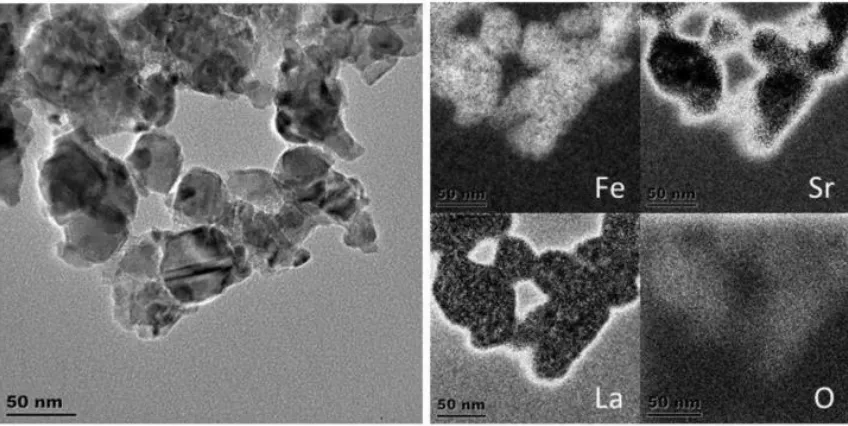
Figure 3.2. TEM image (a) and EFTEM mappings (b) of the Fe2O3@LaxSr1-xFeO3 core-shell
particles. ...70
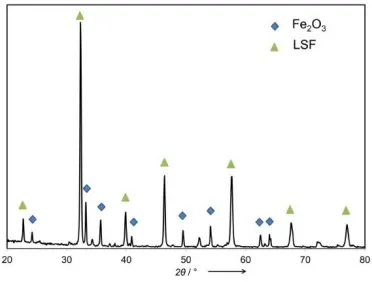
Figure 3.3. XRD pattern of the as-prepared Fe2O3@ LSF core-shell particles. ...71
Figure 3.4. XPS spectra of the as-prepared Fe2O3@LSF core-shell particle. ...72
Figure 3.5. Rates of second cycle reduction for different redox catalyst samples in
methane. ...74
Figure 3.6. TPR results for a) individual components b) perovskite supported redox catalysts,
in hydrogen. ...76
Figure 3.7. Reactivity comparisons of the core-shell and composite perovskite supported redox
catalyst. ...78
Figure 3.8. Reactivity comparisons of the core-shell redox catalyst in different redox
cycles...80
Figure 3.9. XRD pattern of the core-shell Fe2O3@ LSF after 50 redox cycles in
xiii Figure 3.10. SEM image of the oxidized core-shell particle a) after sintering, b) after 5 cycles,
c) after 50 cycles, d) after 100 cycles. ...81
Figure 3.11. Cumulative CO: CO2 molar ratio in the methane partial oxidation products for
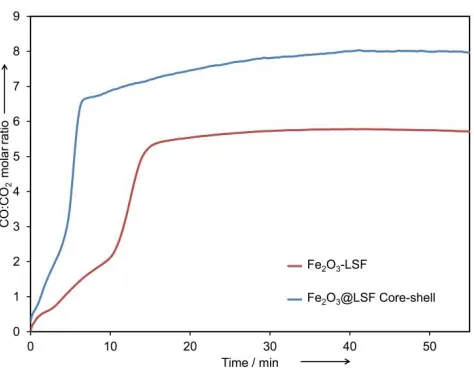
the LSF supported redox catalysts ...83
Figure 4.1. Schematic of the experimental setup used for pulse injection experiments……103
Figure 4.2. (a) Product evolution from the oxidation of methane on FeOx@LSF core-shell
redox catalyst, (b) Average selectivity of CO and CO2 in the first 3 regions for methane
reduction at 900°C in 10 Vol. % methane (balance Ar). ...106
Figure 4.3. (a) XRD pattern and assigned phases after the three pretreatment procedures (PP):
1, oxidation in 10% oxygen for 10 min, 2, reduction in 20% CO + CO2 for 10 min,
PP-3, reduction in 10% H2 for 10 min to obtain samples representing the first three regions,
respectively; (b) average selectivity of CO and CO2 during 5 pulse injections after each
pretreatment at 900 1C (50 vol% methane, balance Ar) ...107
Figure 4.4. Selectivity transition from CO2 to CO within the first 10 pulse injections. ...108
Figure 4.5. Normalized responses of products to injection of 2.6 mL methane (50%) at 900°C
in (a) first pulse injection (CH4, CO, CO2, and H2 are normalized by the sum of all
carbonaceous species and Ar is normalized to show a comparable scale as total carbonaceous
species) and (b) Comparison of the intensity and position of CO and CO2 responses during first
and second pulse injections. ...110
Figure 4.6. Effect of relaxation time on CO selectivity in the first region at 900°C (pulse 1-5
has a relation time of 15 seconds whereas pulses 5-6 has a longer relaxation time of 150
xiv Figure 4.7. Relative distribution of products in methane isotope exchange experiments on the
catalyst surface at (a) 900°C and (b) 800°C. ...113
Figure 4.8. Relative distribution of products in oxygen isotope exchange experiments on the
catalyst surface at (a) 900°C and (b) 800°C (the volume percents are normalized to the total
oxygen in the outlet stream). ...114
Figure 4.9. Response to a broadened pulse of methane combined with a sharp pulse of 18O2 at
900°C in the first region at (a) 50 and (b) 150 mL/min total gas flow rate. ...115
Figure 4.10. Normalized responses of products to injection of 1 mL methane (50%) at 900°C
in (a) second region and (b) third region. ...117
Figure 4.11. Effect of relaxation time on CO selectivity in the third region (pulse 1-5 has a
relation time of 15 seconds whereas pulses 5-6 has a longer relaxation time of 150
seconds)...118
Figure 4.12. Response to a broadened pulse of methane combined with a sharp pulse of 18O2
at 900°C in the third region at (a) 50 and (b) 150 mL/min total flow rate...119
Figure 4.13. Schematics of methane activation and conversion of (a) oxidized and (b) reduced
catalyst surface (M represents metal atoms). ...121
Figure 5.1. DTG resulys of methane TPR experiments on redox catalysts (20 °C/min ramping
rate)………..………...138
Figure 5.2. Comparison of CO selectivity and maximum oxygen donation rate of the redox
catalysts at 900 °C ...139
Figure 5.3. Oxygen extracted from the redox catalysts during the initial stages of the reduction
xv Figure 5.4. Comparison of CO selectivity/yield and methane/oxygen conversion during
methane-oxygen cofeed experiments using (a) unpromoted and (b) promoted LaCeO3.5-based
redox catalyst ...144
Figure 5.5. Comparison of CO selectivity at each methane pulse injection on (a) CaMnO3
-based and (b) LaCeO3.5-based redox catalysts at 900 °C ...145
Figure 5.6. Comparison of oxygen donation at each methane pulse injection on (a) CaMnO3
-based and (b) LaCeO3.5-based redox catalysts at 900 °C ...147
Figure 5.7. Comparison of CO selectivity and maximum oxygen donation rate of the (a)
CaMnO3-based and (b) LaCeO3.5-based redox catalysts at different temperatures ...148
Figure 5.8. Selectivity, converted methane, and O2 extracted during 100 redox cycles at 600
1 CHAPTER 1 Introduction
1.1 Methane as an Energy Source
Natural gas, which is primarily composed of methane, is one of the most important raw
materials for both energy production and chemical industry. According to the Oil and Gas
Journal,1 the world’s proven natural gas reserves have grown by about 40% over the past 20
years, due primarily to advancements in shale gas production technologies.2 With proven
reserves of about 6,950 trillion cubic feet (196.8 Tm3) at the end of 2015,3 methane is among
the most abundant organic compounds on earth. To generate the same amount of thermal
energy, methane emits roughly 48% less CO2 than coal and 27% less than crude oil (Figure
1.1). Relative abundance of natural gas reserves coupled with increasing global warming
concerns have made methane a clean and affordable source of energy.
Figure 1.1. Comparison of price and emission of fossil fuels.3
At present, methane is primarily used as a fuel for residential heating and power generation
2
of compressed natural gas (CNG) and liquefied natural gas (LNG). However, transportation
costs for CNG and LNG can be significant.4 It is, therefore, desirable to explore novel
approaches to convert methane into transportation fuels and value added chemicals. This
significantly renewed interests in methane processing to more valuable products in a global
scale.
1.2 Current Technologies for Methane Conversion
Current technologies in methane conversion can be classified in two major categories: 1.
combustion or complete oxidation to CO2 for energy production, and 2. partial oxidation,
which can be further categorized to direct and indirect routes.
1.2.1 Complete Oxidation/Combustion
As mentioned earlier, power generation through combustion of methane in gas-powered power
plants is currently the main application of methane. Thermal efficiency of gas-fired plants is
typically around 55-60% without implementing carbon capture technologies.5 However, recent
concerns over global climate changes and international agreements such as Kyoto protocol and
Paris agreement mandate carbon mitigation for fossil fuel based power plants. Most carbon
capture and sequestration (CCS) technologies are highly capital intensive and often impose
high parasitic energy penalties that can reduce the energy conversion efficiencies of such plants
by as much as 11-26%.5–8 Table 1.1 reports the average thermal efficiencies of a typical
3 Table 1.1. Comparison of the average thermal efficiencies of the gas-fired power plants. 5–8
Carbon Capture
Technology
Thermal Efficiency (%
LHV)
Overall Efficiency
Drop (%)
No Capture 55-60 ----
Post-Combustion 47-50 11-18
Pre-Combustion 40-46 23-26
Oxy-fuel Combustion 44-48 19-25
1.2.2 Partial Oxidation
Partial oxidation techniques have potential of converting methane to more value added
products such as oxygenates and olefins. Currently, most partial oxidation technologies adopt
indirect routes. In these processes, methane is converted in two or more steps: in the first step,
methane is reformed into syngas, which is a mixture composed primarily of carbon monoxide
and hydrogen; the syngas is then processed into chemicals and liquid fuels in one or more
steps. The complexity of the aforementioned indirect conversion processes and the energy
intensive methane reforming step lead to high energy penalties and capital cost. This prompts
the need to develop efficient and cost-effective reforming strategies.
Alternatively, direct partial oxidation approaches which selectively convert methane into
value-added products have the potential to be efficient and cost effective.4,9–11 Over the past
few decades, extensive studies have been performed to develop effective catalysts and reactor
designs. To date, however, direct approaches are not competitive when compared to indirect
4
to direct oxidation lies in the fact that the C-H bond in methane, which has activation energy
of 435 kJ/mol, is notably more stable than the desired products. It is therefore challenging to
obtain high conversion of methane without further oxidation of the products. From a
thermodynamic standpoint, neither oxygenates nor olefins are favored products.
1.2.2.1 Methane Valorization
Significant amount of work has been devoted to oxidative coupling/dehydrogenation of
methane to ethylene,4,14–19 with most research focused on using oxygen gas as the oxidant. The
yields of ethylene in these processes are generally limited to around 25%.11 The limitation in
product yield results from either the activation of C2 products on the active sites for methane
activation, which leads to deep oxidation of the less stable ethane and ethylene, or desorption
of methyl radicals to the gas phase, which favors non selective products.11,13 The use of lattice
oxygen in metal oxide-based oxygen carriers and oxygen conducting membranes instead of
gaseous oxygen although lead to higher C2 yields,16,17,19–21 conversions and selectivities
obtained in these processes were still insufficient to make the process competitive with indirect
approaches from a process economics standpoint.
Various approaches for partial oxidation of methane to methanol and/or formaldehyde have
also been investigated over the past few decades. Existing methods can be categorized into
four categories based on operating temperature and dominating reaction mechanism: high
temperature (> 300°C) catalysis route, low temperature catalysis route, homogeneous
5
Achieving high methanol/formaldehyde selectivity at high temperatures is generally not
practical foe various reasons such as further oxidation of unstable intermediates/oxygenates to
COx through gas phase reactions,24–26 presence of chemisorbed active O2 which tends to
oxidize oxygenates to COx, and decomposition of oxygenates on the catalyst surface at high
temperature.27 Figure 1.2 summarizes the performances of various approaches for gas phase
partial oxidation of methane.13
Figure 1.2. Summary of conversion and selectivity data for methane to oxygenate conversion
reported in literature. 13
Gaseous oxidants other than oxygen can also be used for methane oxidation. Although higher
selectivity can be achieved using oxidants such as nitrogen oxides,28 they are impractical for
industrial use. A combination of H2 and O2 can be used, though costs associated with H2 use
can be prohibitive. A well-known low temperature methane oxidation route occurs through
monooxygenase at ambient conditions.29 Cu-ZSM-5 zeolite is also found to be active for
6
low temperature approaches are promising, methane conversion and kinetics limitations hinder
their applicability at the moment.
Homogenous solution-based approaches are exemplified by the process developed by Periana
et al.33 A bipyrimidyl platinum (II) complex is used to convert 90% methane in concentrated
sulfuric acid, achieving high selectivity toward methyl bisulfate. However, hydrolysis of
methyl bisulfate and regeneration of sulfuric acid can be challenging. Other approaches such
as plasma and photocatalysis are not well-established and suffer from high energy demands,
low product yields, and poor methane conversions.23,34 To summarize, significant
improvement in oxygenate yields is necessary for direct methane oxidation strategies for them
to be economically feasible.
1.2.2.2 Methane reforming
Methane reforming is one of the most important steps in converting natural gas/methane to
chemicals or fuels. Currently there are three better-studied methods to converts methane to
syngas all of which uses a gaseous reactant: steam reforming (Reaction 1.1) in the presence of
steam, dry reforming (Reaction 1.2) in the presence of CO2, and partial oxidation (Reaction
1.3) in the presence of oxygen. All of these reactions are performed in the presence of a
heterogeneous catalyst. Unless carried out at ultra-high temperatures, the use of heterogeneous
reforming catalyst is necessary as methane is a highly stable molecule.
4 2 2 0 ,1
4 2 2 0 ,1
4 2 2
3 215.7 Reaction 1.1 2 2 255.3 Reaction 1.2 1 2 2
C atm
C atm
CH H O CO H H kJ
CH CO CO H H kJ
CH O CO H
7
At present, steam reforming is a better-established commercial approach for methane
reforming. However, it suffers from high operating cost due to the high endothermicity of the
reactions. In addition, high steam to methane ratio is required in order to minimize coke
formation. The use of large amount of steam causes additional energy penalty. Dry reforming
also suffers from catalyst deactivation caused by carbon formation from methane
decomposition reaction. Partial oxidation, on the other hand, is an exothermic reaction. It is
also the only method that produces syngas with proper hydrogen to carbon monoxide ratio for
further processing in Fischer-Tropsch synthesis which eliminates the need to hydrogen
separation/addition. This makes partial oxidation a highly promising option. Within the last
few decades, many catalysts such as transition metals and some noble metals are tested and
proven active for partial oxidation of methane.35–40 However, these catalysts face challenges
such as low selectivity, deactivation, and coke formation. Additionally, the needs for gaseous
oxygen, which needs to be generated from an air separation unit (ASU), imposes significant
capital and operating costs, making it less competitive from a process economic stand
point.41,42 Developing a methane partial oxidation process with minimal oxygen separation cost
is therefore highly desirable.
1.3 Chemical Looping
By definition, “any reaction scheme in which a reaction is decomposed to multiple
sub-reactions and proceeds through reaction and regeneration of the chemical intermediates, is
referred to as a chemical looping”.43 A chemical looping scheme, when properly designed, can
significantly reduce the irreversibility/exergy loss and increase efficiency of a reaction.
8
fossil fuel conversion for both power generation and chemical production purposes. This is
done through substituting gaseous oxygen with lattice oxygen of a solid oxygen carrier. These
solid oxygen carriers, which are commonly oxides of transition metals,44,45 are used in a cyclic
redox scheme to convert fuels. In the reduction half cycle, the oxygen carriers are reduced and
donate their lattice oxygen to oxidize the fuel in a “fuel reactor”. The reduced particles are then
transferred to a separate reactor, “air reactor”, and exposed to air or other gaseous oxidants and
regenerate back to their oxidized form through an exothermic reaction. With a proper heat
integration scheme and use of proper oxygen carriers, these processes can generate heat/power
and a separate CO2-rich stream (in case of using carbonaceous fuels) which is really easy to
capture.
1.3.1 Chemical Looping Combustion (CLC)
The idea of using chemical looping for oxidation reactions goes back to the pioneering work
of Lewis and Gilliland in the 1950s when they proposed to used copper oxide as an oxidant for
converting syngas to carbon dioxide.46,47 Later thermodynamic studies suggested CLC as a
heat/power generation process through a fuel conversion route with less irreversibility/exergy
loss. 48–50 Figure 1.3 schematically shows the CLC process. As can be seen, carbonaceous fuel
reacts with the oxidized oxygen carrier in the fuel reactor to produce a stream of CO2 and water
through a typically endothermic reaction. This is extremely desirable from a carbon capture
stand point as the CO2 can be easily separated by condensing out the water. The
oxygen-depleted oxygen carriers are then exposed to air in the air reactor and oxidize back to their
original state in an exothermic reaction and produce a hot stream of nitrogen-reached air and/or
9
can be seen, the inherent oxygen separation completely eliminates the need to energy intensive
cryogenic ASU.
Figure 1.3. Chemical looping combustion schematic.
Other than providing lattice oxygen, oxygen carriers also act as heat carriers to circulate heat
between the two reactors. This can significantly increase thermal efficiency of the system.43
The abovementioned advantages combined with the environmental concerns about greenhouse
gas emission has made CLC processes highly desirable and a great deal of research has been
dedicated to reactor design oxygen carrier development within the last three decades.51–54
In a CLC scheme, excellent contact between fuel and oxygen carrier is essential to extract the
oxygen from the oxygen carriers. The nature of the process also mandates circulation of the
redox catalyst between two reactors. Among all reactor set-ups, circulating fluidized bed
(CFB) seemed to be the most promising option and almost exclusively used for CLC in early
studies.43,55,56 CFB reactor set-ups are demonstrated for pilot plants up to 3 MWth43,57–59 and
design and development of larger scale plants (1000 MWth) is also begun.60 More recently
10
pilot scales.43,61,62 Other reactor schemes are also proposed and tested at laboratory scale.63–69
These set-ups, however, are still in the early stages of development. Progress in the oxygen
carrier development is discussed in section 1.4.
1.3.2 Chemical looping with Oxygen Uncoupling (CLOU)
Early CLC studies mainly focused on conversion of gaseous fuels such as methane and
coal-derived syngas. With solid fuels such as coal offering lower cost on the same energy content
basis, it is highly desirable to extend the use of chemical looping for solid fuel processing. The
poor solid-solid reaction kinetics, however, hinders development of such processes. Chemical
looping with oxygen uncoupling (CLOU), originally proposed over 60 years ago,46,47 is the
most promising method suggested for direct solid conversion in chemical looping scheme. The
process basics are similar to that of gas-fired CLC. The only difference is in the oxygen
carriers. The oxygen carriers for CLOU process has to have the ability to release or “uncouple”
their lattice oxygen in environments with low oxygen partial pressures. The difference in
oxygen partial pressure between the lattice of the oxygen carrier and gaseous environment
inside the reactor allows for such oxygen release. The gaseous oxygen can then react with the
solid fuel and combust it at a much higher kinetic rate compared to solid-solid reaction. Other
methods such as chemical looping with in-situ gasification are also proposed to tackle the low
reaction rate problem.70–75 However, such processes are not very desirable as they impose
11 1.3.3 Chemical Looping Reforming (CLR)
Chemical looping reforming (CLR) is another variation of the chemical looping oxidation
processes in which oxygen carriers needs to be engineered to act as both an oxygen donor and
a catalyst. Because of this dual functionality, oxygen carriers are also referred to as “redox
catalysts” in such processes, following a literature convention.76–78 beside the aforementioned
advantages of chemical looping processes, the CLR approach has the potential to minimize
catalyst deactivation and increase the selectivity of partial oxidation reaction through replacing
gaseous oxidants with much more selective lattice oxygen. To date, many oxygen carriers have
been tested for CLR applications.79 However, most of these redox catalysts suffer from low
activity, low product selectivity, or deactivation due to sintering and/or coke formation.43,80–87
Developing highly active, selective, and stable redox catalyst, therefore, is of high importance
and can have groundbreaking effects in reforming technologies.
1.3.4 Challenges for chemical looping processes
Despite all the promising advantages of chemical looping processes, they are still in the early
stages of development and face many challenges that need to be addressed. These challenges
include, but are not limited to: developing oxygen carriers/redox catalysts with higher oxygen
storage/heat capacity, selectivity, stability, mechanical integrity (to prevent attrition and
particulate emission), and more effective reactor design to improve gas-solid interaction and
heat integration. This study mainly focuses on development of next generation of redox
catalysts and understanding the kinetic mechanisms through which these redox catalysts
12 1.4 Oxygen Carriers/Redox Catalysts
As mentioned earlier, oxygen carrier plays a key role in chemical looping processes. This
makes it important to design oxygen carriers/redox catalyst that are specifically engineered
toward the intended application. There are numerous design parameters that can be modified
for different purposes. These parameters include, but are not limited to oxygen storage, oxygen
anion transport capability, mechanical stability and attrition resistance, sintering resistance,
long term recyclability, and low health and environmental impacts.79,80,88
In order to perform well, oxygen carriers should possess multiple oxidation states, be able to
readily donate their lattice oxygen though either surface reactions or uncoupling, and be
regenrable. Oxides of transition metals such as iron, nickel, copper, cobalt, and manganese are
among the most studied materials as oxygen reservoirs.45,80 More recently, it has been shown
that thermodynamic and oxygen donation properties of the oxygen carriers can be tuned by
mixing different ration of metal oxides.89 This opens the possibility to explore though
unlimited number of combinations to synthesize the material with desired thermodynamic
properties. However, most pure single metal oxides are prone to sintering due to lower melting
temperature of metals in reduced form. They also suffer from several other disadvantages such
as low reaction kinetics and poor oxygen anion conduction in reduced states.79,80,88,90
As a result, presence of a secondary “support” phase, which is usually a more stable metal
oxide, is necessary to overcome these issues and improve oxygen carrier’s properties.
Typically, supports consist of inert ceramics such as TiO2 and Al2O3 that do not contribute to
the reaction. Mixed metal oxides with various structures and oxidative properties are also
13
increasing mechanical integrity of the particles. However, more recent studies showed that
even the phases that are chemically inert decrease the energy barrier for oxygen conduction
through the oxygen carriers by providing mediums with higher electronic and ionic
conductivity.91 So far, more than 1000 different oxygen carrier combinations have been
developed and tested in chemical looing processes.43,44,44,45,79,80,88,92–95 Among the metal oxides
tested for CLC/CLR processes, oxides of iron, nickel, copper, manganese, and cobalt attracted
the most attentions.79,80,93
Currently, two main strategies are followed for oxygen carrier design: 1. Design of complex,
highly active, and more stable oxygen carriers with the cost of being pricier and more harmful
to the environment; and 2. Use of cheap, less toxic, and often naturally occurring materials
with the cost of being less active and less recyclable. Our current research focuses on the first
idea and understanding of how these complex structures can help increasing activity and/or
selectivity for different applications.
1.4.1 Nickel-based Oxygen Carriers
Nickel oxide is the most widely studied material as it offers a relatively high oxygen capacity
(~20 wt. %) and high activity for carbonaceous fuel conversion.96 However, its high cost, low
carbon resistance, and environmental and health concerns hinders its application for CLC.
Although close to complete methane conversion is reported on nickel-based catalysts, their
poor selectivity toward partial oxidation products makes them unattractive for CLR as well. 96
Sintering and agglomeration in reduced states is another concern about pure nickel oxide which
causes poor re-oxidation kinetics and makes it less recyclable.97 This concern, however, could
14
Various supports such as Al2O3, TiO2, MgO, ZrO2, yittria stabilized zirconia, SiO2, bentonite,
and sepiolite (Mg4Si6O15(OH)) are tested. All of these supports, however, suffer from either
deactivation due to formation of a stable complex phase under reaction conditions (Al2O3,
TiO2, MgO, SiO2, sephiloite, and bentonite),45,69,85,98–108 or structural instability due to
detrimental mechanical properties (Zr and YSZ).45,85,109 To address the first issue, excess
amount of NiO or metals with higher tendency on forming complex compounds with the
support, can be added to the solid solution to prevent some of the nickel from forming the
secondary phase.69,103–105
Susceptibility to sulfur poisoning is another challenge facing the use of nickel oxide-based
oxygen carriers for fossil fuel processing as H2S is a common impurity in both natural gas and
coal. This can cause nickel oxide to deactivate through formation of nickel sulfide phase at
high operating temperatures.110,111 This deactivation could be problematic even at low
concentrations of H2S (down to 100 ppmv) according to tests conducted on a 500 Wth fluidized
bed reactor.110
1.4.2 Copper-based Oxygen Carriers
Copper oxide is another well-studied oxygen carrier that offers high oxygen capacity and
oxidative activity at slightly lower costs and environmental impact compared to nickel. It also
offers the option to combust solid fuels in CLOU configurations dues to its ability to uncouple
half of its oxygen content (CuO to Cu2O) at elevated temperatures. Being thermodynamically
favorable for complete combustion of fuels to CO2 and water, copper based oxygen carriers
15
however, is much more severe compared to nickel due to significantly lower melting point of
copper. This leads to extreme defluidization in CFB configurations.80
Addition of supports, though, is proved to significantly mitigate the agglomeration problem by
forming complex compounds that are also active for CLC applications. Al2O3, TiO2, ZrO2,
SiO2, and MgAl2O3 are among the most used supports.45,53,69,92,108,112–115 Choice of support
when designing a copper-based oxygen carrier for CLOU applications is highly important as
some supports may negatively alter the oxygen uncoupling properties of copper. SiO2 and
MgAl2O3 are among the supports that improved the sintering resistance and hence the
recyclability of the copper oxide while maintaining its active for oxygen uncoupling.116–118
1.4.3 Iron-based Oxygen Carriers
High oxygen capacity (30 wt.%) of iron oxide along with its low cost and environmental
impacts have made it very desirable for chemical looping applications. However, it showed
poor activity with carbonaceous fuels and poor oxygen anion transport especially in reduced
form. Moreover, only about 2.4 wt. % oxygen can be used for combustion in CFB reactor
configuration. This corresponds to reduction from hematite (Fe2O3) to magnetite (Fe3O4).
Further reduction to wustite (FeO) and metallic iron (Fe) increases the selectivity toward partial
oxidation and increases syngas selectivity.119 Although this issue can be alleviated using
countercurrent moving bed reactor set-ups to achieve better CO2 purity through reduction to
lower oxidation states, low melting points of wustite and metallic iron causes agglomeration
problems that deactivates the particles and imposes new challenges in iron-based oxygen
16
Addition of inert support such as Al2O3, TiO2, SiO2, MgAl2O3 and Zr-based supports has been
shown to address the sintering issue to a great extent by providing a more stable matrix to
support iron oxide particles.45,51,94,112,120–124 Presence of these supports could also partially
solve the selectivity decrease problem mentioned earlier by forming stable phases that prevent
reduction of iron cations further than their Fe2+ state.120,125,126 Additionally, recent research on
use of mixed ionic electronic conductive (MIEC) materials, such as lanthanum cerium ferrite
(LSF), barium cerium ferrite (BCF), and calcium titanium ferrite (CTF), as supports showed
that activity of iron oxide-based oxygen carriers can be enhance by up 70 times when compare
to typical inert supported iron oxide.127 This significant increase in attributed to counter-current
diffusion of electrons and oxygen anions through the lattice of the support phase.
Naturally occurring iron ores such as ilmenite could also be used as oxygen carriers.128,129
However, noticeable changes in activity of such samples has been reported that needs to be
taken into account when designing the reactor set-ups and oxygen carrier recirculation rate.
These activations/deactivations could be due to changes in porosity and surface area of the
samples over cyclic redox reactions. 128,129
1.4.4 Manganese-based Oxygen Carriers
Similar to iron, manganese oxide is also of interest because of its minimal environmental and
health impacts and relatively low cost compared to copper and nickel. Although the highest
oxidation state of manganese is Mn4+, its low melting/decomposition point (535 °C) makes
manganese dioxide impractical to use in CLC applications. Mn2O3 is the second highest
oxidation state that is also impractical to use in CLC applications as it decomposes at about
17
some degree of oxygen uncoupling when converting to Mn3O4 which could be used in CLOU
configurations, but temperature swing in fuel and air reactor or higher partial pressures of
oxygen is needed to regenerate manganese to Mn3+ state. Mn3O4, which is the most stable
manganese oxide phase, is commonly used in CLC applications and can be reduced to MnO
to give off about 5 wt. % oxygen.130
Manganese oxide generally showed poor activity with both solid and gaseous fuels. Addition
of support typical inert supports such as Al2O3, TiO2, MgAl2O4, and SiO2 did not help as they
contribute to irreversible formation of stable and unreactive phases.45,96,108,112,131 Among all
supports tested with manganese, zirconia (ZrO2) showed the most promising results in terms
of activity increase. However, its poor mechanical properties and vulnerability to
agglomeration during redox cycling remains an issue.132 Although addition of MgO, CaO, and
CeO2 are reported to improve zirconia mechanical properties, its significantly lower activity
with methane when compared to other abovementioned carriers makes its uncompetitive for
chemical looping applications.132
1.4.5 Cobalt-based Oxygen Carriers
Oxides of cobalt are less attractive than the other first row transition metal oxides for CLC
application. Although Co3O4 is the most common form of cobalt oxide, its low decomposition
temperature (~900 °C) makes CoO the only practical form for CLC applications. This reduced
form of cobalt does not thermodynamically favor the combustion reaction which makes it
undesirable for CLC applications.80 It also forms unreactive phases when combined with most
18 1.4.6 Mixed Oxide Oxygen Carriers
As mentioned earlier, many combination of mixed metal oxides has been tested as supports
phases. Through these tests, it is found out that some of these mixed oxides possess oxygen
donation or uncoupling properties. This started a new area in oxygen carrier design as
practically endless number of metallic combinations with different crystal structures can be
synthesized for different applications. Numerous combinations of the first row transition
metals have been synthesized and tested.45,80 Due to its low environmental impacts, high
oxygen capacity, and low cost, iron is one the most common metals in mixed oxides. It has
been mixed with copper, manganese and cobalt to make use of their uncoupling properties
while providing higher oxygen content with less cost.134–136 Addition of small percentages of
nickel to pure iron oxides is also proved to improve its activity for methane conversion due to
nickel catalytic properties.137
Perovskite-structured materials are the most studied mixed oxide material yet.138–147 These
materials which share the general formula of ABO3-δ possess several very interesting features
that make them highly desirable for chemical looping applications. A-site typically represents
a large cation, commonly from the alkali earth or rare earth metals, and B-site is usually
occupied with a smaller transition metal. Each of these sites could also been occupied with
multiple cations. Different combinations of cations can lead to perovskites with structures
ranging from perfect cubic to orthorhombic or rhombohedral variations. Different perovskites
have different phase stabilities. A semi-empirical factor named “Goldschmidt tolerance factor”
19
equation, however, is not extended for materials with more than one cation in each site. The
Goldschmidt tolerance factor is defined as
𝑡 = 𝑟𝐴+ 𝑟𝑂 √2(𝑟𝐵+ 𝑟𝑂)
Equation 1.1
with rA, rB, and rO being the ionic radii of the A- and B- site and oxygen ions respectively. Ideal
cubic perovskites have a tolerance factor value of 1.
Perovskites can withstand moderate deviations from their oxidation stoichiometry without
collapsing their structure. This makes them a very stable oxygen carrier with minimal
regeneration issues. Recent studies also showed very fast and consistent regeneration kinetics
even in the cases that go through phase changes during the reduction half cycle. Many different
combinations of perovskites have been tested for chemical looping applications.138–147,150–155
Among all these materials, La1-xSrxFe1-yCoyO3-δ (LSCF) showed superior performance for
CLC,138,140 La1-xSrxFeO3 (LSF) favored partial oxidation reaction,150 and CaMnO3-based (CM)
oxygen carriers possessed the best CLOU properties.142–147,151–155 The most important draw
backs of perovskites are low oxygen storage capacity and high cost. Our recent studies showed
that lower cost perovskites such as calcium titanium ferrite and barium cerium ferrite could
also have reasonable activity when reacting with methane.127
To sum up, a great amount of effort has been devoted to synthesis and test of various oxygen
carriers. However, most of these oxygen carriers have been synthesized based on trial and error
approach or rough speculation. Therefore, development of theoretical relation to predict
thermodynamic and mechanical properties of mixed oxides is very important for a more
20 1.4.7 Redox Catalyst Surface Modification
Design of an effective CLR redox catalyst is usually more challenging. Presence of a
catalytically selective surface a vital for a redox catalyst to be functional. Some materials have
inherently reasonable selectivity toward CO and hydrogen when reducing. However, it is
usually difficult for a redox catalyst to possess both high activity and selectivity. Surface
modification through addition of catalytically active sites to the existing active oxygen carriers
is a possible way to tackle this challenge. However, this area has not been studied extensively
yet and there are many challenges that need to be addressed.
1.5 Summary
Rational design of stable, active, and selective oxygen carriers/redox catalysts is one of the
most, if not the most, important step in designing an effective chemical looping process.
Understanding the mechanisms through which the oxygen carriers interact with the fuels,
therefore, is of utmost importance. This work covers some areas for conversion of methane.
Most of the experiments have been performed in either in TGA or packed bed reactors with
short residence time to mimic the differential bed set-up.
The second chapter focuses on the design of iron oxide based oxygen carriers with tunable
oxygen content and reduction/uncoupling properties. To do so, mixed oxides of Fe-Mn and
Fe-Co with various Fe:Mn/Co ratios have been synthesized. These oxygen carriers have also
been supported on La0.8Sr0.2Fe1-xMnxO3-δ, and La0.8Sr0.2Fe1-yCoyO3-δ respectively as they
showed better phase compatibility. These materials have mixed ionic electronic properties and
21
oxygen uncoupling and methane reforming. Results confirmed that presence of a cobalt and
manganese generally decreases the initial decomposition of the mixed oxide. It is also
confirmed that different compositions of cations can be used to tune the uncoupling properties
of the mixed oxides. Presence of secondary perovskite phase is found to affect the properties
of the base oxides but the changes did not follow the same trends.
Chapters 3 and 4 discuss the effect of engineered structures on the performance of iron oxide
based oxygen carriers. A so called core-shell structure are designed with iron oxide (Fe2O3) as
the main oxygen donor in the core and La0.8Sr0.2FeO3 as the support shell. Chapter 3 focuses
on the improvements in activity, selectivity toward reforming products, and carbon resistance
caused by the proposed structure. Not only the presence of the mixed conductive shell did not
hinder the reducibility of the iron oxide core, but also significantly enhanced the reduction
kinetics, CO selectivity, and sintering resistance of iron oxide based redox catalyst. The redox
catalyst is also remained active for over 50 complete cycles with very minimal changes in its
structure.
Chapter 4 further investigates the mechanisms through which the core-shell catalyst reacts with
methane for both complete and partial oxidation reactions. Because of the dynamic nature of
the redox catalyst, a transient pulse injection scheme is designed to investigate the product
selectivity and surface exchange in different oxidation states throughout the reduction half
cycle. Results confirmed that the studied redox catalyst goes through multiple reduction region
with distinct mechanisms and consequently different product distributions. The nature of the
22
the surface oxygen consumption rate, is the dominant factor in determining the selectivity of
the redox catalyst.
In chapter 5 surface catalytic modification for selectivity enhancement is studied. Rhodium is
chosen as the active catalyst as it reported to have very good gasification and partial oxidation
catalytic activity. Since the LSF used in the previous chapters already showed good selectivity
toward methane formation, effect of surface modification is studied on two other mixed oxides.
CaMnO3 and LaCeO3.5 are chosen as they demonstrated lower selectivity and activity when
compared to LSF respectively. Results confirmed significant improvements on selectivity,
reaction kinetics, and overall oxygen donation of the redox catalysts. These improvements are
23 REFERENCES
1. Oil & Gas Journal - December 07, 2015 - 1.
2. Shale gas production drives world natural gas production growth - Today in Energy - U.S. Energy Information Administration (EIA).
3. International Energy Outlook 2016-Natural gas - Energy Information Administration.
4. III, J. M. F. The Different Catalytic Routes for Methane Valorization: An Assessment of Processes for Liquid Fuels. Catal. Rev.35, 169–212 (1993).
5. Gibbins, J. & Chalmers, H. Carbon capture and storage. Energy Policy36, 4317–4322 (2008).
6. Kanniche, M. et al. Pre-combustion, post-combustion and oxy-combustion in thermal power plant for CO2 capture. Appl. Therm. Eng.30, 53–62 (2010).
7. Leung, D. Y. C., Caramanna, G. & Maroto-Valer, M. M. An overview of current status of carbon dioxide capture and storage technologies. Renew. Sustain. Energy Rev.39, 426–443 (2014).
8. Nord, L. O., Anantharaman, R. & Bolland, O. Design and off-design analyses of a pre-combustion CO2 capture process in a natural gas combined cycle power plant. Int. J. Greenh. Gas Control3, 385–392 (2009).
9. Hickman, D. A. & Schmidt, L. D. Synthesis gas formation by direct oxidation of methane over Pt monoliths. J. Catal.138, 267–282 (1992).
10. Hickman, D. A., Haupfear, E. A. & Schmidt, L. D. Synthesis gas formation by direct oxidation of methane over Rh monoliths. Catal. Lett.17, 223–237
11. Holmen, A. Direct conversion of methane to fuels and chemicals. Catal. Today142, 2– 8 (2009).
12. Herman, R. G. et al. Development of active oxide catalysts for the direct oxidation of methane to formaldehyde. Catal. Today37, 1–14 (1997).
13. Tabata, K. et al. Activation of methane by oxygen and nitrogen oxides. Catal. Rev.44,
1–58 (2002).
24
15. Tang, S., Lin, J. & Tan, K. L. Partial oxidation of methane to syngas over Ni/MgO, Ni/CaO and Ni/CeO2. Catal. Lett.51, 169–175
16. Dong, W.-S., Roh, H.-S., Jun, K.-W., Park, S.-E. & Oh, Y.-S. Methane reforming over Ni/Ce-ZrO2 catalysts: effect of nickel content. Appl. Catal. Gen.226, 63–72 (2002).
17. Lanza, R., Canu, P. & Järås, S. G. Methane partial oxidation over Pt–Ru catalyst: An investigation on the mechanism. Appl. Catal. Gen.375, 92–100 (2010).
18. Corbo, P. & Migliardini, F. Hydrogen production by catalytic partial oxidation of methane and propane on Ni and Pt catalysts. Int. J. Hydrog. Energy32, 55–66 (2007).
19. Yan, Q. G., Gao, L. Z., Yuan, S. Y. & Yu, Z. L. Partial oxidation of methane to syngas over Pt/A(2)O(3) and Pt/CeO2/Al2O3. Chem. J. Chin. Univ.-Chin.19, 1300–1303 (1998).
20. Figueroa, J. D., Fout, T., Plasynski, S., McIlvried, H. & Srivastava, R. D. Advances in CO2 capture technology—The U.S. Department of Energy’s Carbon Sequestration Program. Int. J. Greenh. Gas Control2, 9–20 (2008).
21. Anheden, M., Yan, J. & De Smedt, G. Denitrogenation (or Oxyfuel Concepts). Oil Gas Sci. Technol.60, 485–495 (2005).
22. Keller, G. E. & Bhasin, M. M. Synthesis of ethylene via oxidative coupling of methane. J. Catal.73, 9–19 (1982).
23. Lunsford, J. H. The catalytic conversion of methane to higher hydrocarbons. Catal. Today6, 235–259 (1990).
24. Jones, C. A., Leonard, J. J. & Sofranko, J. A. The oxidative conversion of methane to higher hydrocarbons over alkali-promoted MnSiO2. J. Catal.103, 311–319 (1987).
25. Sofranko, J. A., Leonard, J. J. & Jones, C. A. The oxidative conversion of methane to higher hydrocarbons. J. Catal.103, 302–310 (1987).
26. Olivier, L. et al. High-temperature parallel screening of catalysts for the oxidative coupling of methane. Catal. Today137, 80–89 (2008).
27. Olivier, L., Haag, S., Mirodatos, C. & van Veen, A. C. Oxidative coupling of methane using catalyst modified dense perovskite membrane reactors. Catal. Today142, 34–41 (2009).
28. Gaffney, A. M. Methane conversion process. (1988).
25
30. Otsuka, K. & Wang, Y. Direct conversion of methane into oxygenates. Appl. Catal. Gen.222, 145–161 (2001).
31. Indarto, A. A review of direct methane conversion to methanol by dielectric barrier discharge. IEEE Trans. Dielectr. Electr. Insul.15, 1038–1043 (2008).
32. Burch, R., Squire, G. D. & Tsang, S. C. Direct conversion of methane into methanol. J. Chem. Soc. Faraday Trans. 1 Phys. Chem. Condens. Phases85, 3561–3568 (1989).
33. Thomas, D. J., Willi, R. & Baiker, A. Partial oxidation of methane: the role of surface reactions. Ind. Eng. Chem. Res.31, 2272–2278 (1992).
34. Casey, P. S., McAllister, T. & Foger, K. Selective Oxidation of Methane to Methanol at High Pressures. Ind. Eng. Chem. Res.33, 1120–1125 (1994).
35. Otsuka, K., Wang, Y., Yamanaka, I. & Morikawa, A. Kinetic study of the partial oxidation of methane over Fe2(MoO4)3 catalyst. J. Chem. Soc. Faraday Trans.89, 4225–4230 (1993).
36. Barbero, J. A., Alvarez, M. C., Bañares, M. A., Peña, M. A. & Fierro, J. L. G. Breakthrough in the direct conversion of methane into c1-oxygenates. Chem. Commun. 1184– 1185 (2002). doi:10.1039/B202812N
37. Labinger, J. A. Selective alkane oxidation: hot and cold approaches to a hot problem. J. Mol. Catal. Chem.220, 27–35 (2004).
38. Beznis, N. V., Weckhuysen, B. M. & Bitter, J. H. Cu-ZSM-5 Zeolites for the Formation of Methanol from Methane and Oxygen: Probing the Active Sites and Spectator Species. Catal. Lett.138, 14–22 (2010).
39. Woertink, J. S. et al. A [Cu2O]2+ core in Cu-ZSM-5, the active site in the oxidation of methane to methanol. Proc. Natl. Acad. Sci.106, 18908–18913 (2009).
40. Groothaert, M. H., Smeets, P. J., Sels, B. F., Jacobs, P. A. & Schoonheydt, R. A. Selective Oxidation of Methane by the Bis(μ-oxo)dicopper Core Stabilized on ZSM-5 and Mordenite Zeolites. J. Am. Chem. Soc.127, 1394–1395 (2005).
41. Periana, R. A. et al. Platinum Catalysts for the High-Yield Oxidation of Methane to a Methanol Derivative. Science280, 560–564 (1998).
42. Yuliati, L. & Yoshida, H. Photocatalytic conversion of methane. Chem. Soc. Rev.37,
1592–1602 (2008).
26
44. Kang, K.-S. et al. Oxygen-carrier selection and thermal analysis of the chemical-looping process for hydrogen production. Int. J. Hydrog. Energy35, 12246–12254 (2010).
45. Adánez, J. et al. Selection of Oxygen Carriers for Chemical-Looping Combustion. Energy Fuels18, 371–377 (2004).
46. Lewis, W. K., Gilliland, E. R. & Sweeney, W. P. Gasification of carbon metal oxides in a fluidized power bed. Chem Eng Prog47, 251–256 (1951).
47. R, G. E. & K, L. W. Production of pure carbon dioxide. (1954).
48. Ishida, M. & Jin, H. G. A New Advanced Power-Generation System Using Chemical-Looping Combustion. Energy19, 415–422 (1994).
49. Ishida, M., Zheng, D. & Akehata, T. Evaluation of a chemical-looping-combustion power-generation system by graphic exergy analysis. Energy12, 147–154 (1987).
50. Knoche, K. F. & Ritcher, H. J. Improvement of the Reversibility of Combustion Processes. Brennstoff-Waerme-Kraft20, 205–210 (1968).
51. Hossain, M. M. & de Lasa, H. I. Chemical-looping combustion (CLC) for inherent separations—a review. Chem. Eng. Sci.63, 4433–4451 (2008).
52. Ryu, H.-J. & Jin, G.-T. Criteria for Selection of Metal Component in Oxygen Carrier Particles for Chemical-Looping Combustor. Korean Chem. Eng. Res.42, 588–597 (2004).
53. Chuang, S., Dennis, J., Hayhurst, A. & Scott, S. Development and performance of Cu-based oxygen carriers for chemical-looping combustion. Combust. Flame 154, 109–121 (2008).
54. Mattisson, T. et al. Chemical-looping combustion using syngas as fuel. Int. J. Greenh. Gas Control1, 158–169 (2007).
55. Kronberger, B. et al. A Two-Compartment Fluidized Bed Reactor for CO 2 Capture by
Chemical-Looping Combustion. Chem. Eng. Technol.27, 1318–1326 (2004).
56. Lyngfelt, A., Leckner, B. & Mattisson, T. A fluidized-bed combustion process with inherent CO2 separation; application of chemical-looping combustion. Chem. Eng. Sci. 56,
3101–3113 (2001).
57. Abdully, I. et al. Alstom’s Chemical Looping Prototypes, Program Update. in 37th International Technical Conference on Clean Co al & Fuel Systems (2012).
27
59. Lyngfelt, A. & Thunman, H. Chapter 36 - Construction and 100 h of Operational Experience of A 10-kWth Chemical - Looping Combustor. in In Carbon Dioxide Capture for Storage in Deep Geologic Formations 625–645 (Elsevier Science, 2005).
60. Lyngfelt, A. & Leckner, B. A 1000MWth boiler for chemical-looping combustion of solid fuels – Discussion of design and costs. Appl. Energy157, 475–487 (2015).
61. Li, F. & Fan, L.-S. Clean coal conversion processes – progress and challenges. Energy Environ. Sci.1, 248 (2008).
62. Li, F., Zeng, L., Velazquez-Vargas, L. G., Yoscovits, Z. & Fan, L.-S. Syngas chemical looping gasification process: Bench-scale studies and reactor simulations. AIChE J.56, 2186– 2199 (2010).
63. Shen, L., Wu, J., Xiao, J., Song, Q. & Xiao, R. Chemical-Looping Combustion of Biomass in a 10 kW th Reactor with Iron Oxide As an Oxygen Carrier. Energy Fuels23, 2498–
2505 (2009).
64. Gu, H., Shen, L., Xiao, J., Zhang, S. & Song, T. Chemical Looping Combustion of Biomass/Coal with Natural Iron Ore as Oxygen Carrier in a Continuous Reactor. Energy Fuels
25, 446–455 (2011).
65. Bischi, A. et al. Design study of a 150kWth double loop circulating fluidized bed reactor system for chemical looping combustion with focus on industrial applicability and pressurization. Int. J. Greenh. Gas Control5, 467–474 (2011).
66. Dahl, I. M. et al. On the development of novel reactor concepts for chemical looping combustion. Energy Procedia1, 1513–1519 (2009).
67. Noorman, S., van Sint Annaland, M. & Kuipers, J. A. M. Experimental validation of packed bed chemical-looping combustion. Chem. Eng. Sci. 65, 92–97 (2010).
68. Noorman, S., van Sint Annaland, M. & Kuipers. Packed Bed Reactor Technology for Chemical-Looping Combustion. Ind. Eng. Chem. Res.46, 4212–4220 (2007).
69. Kooiman, R. F., Hamers, H. P., Gallucci, F. & van Sint Annaland, M. Experimental Demonstration of Two-Stage Packed Bed Chemical-Looping Combustion Using Syngas with CuO/Al 2 O 3 and NiO/CaAl 2 O 4 as Oxygen Carriers. Ind. Eng. Chem. Res.54, 2001–2011
(2015).
70. Lyngfelt, A. Chemical-looping combustion of solid fuels – Status of development. Appl. Energy113, 1869–1873 (2014).